Introduction
AI Regulatory Reporting Automation uses artificial intelligence, machine learning, natural language processing, data engineering, and workflow automation to help financial institutions prepare, validate, manage, and submit regulatory reports. Instead of relying entirely on spreadsheets and manual reconciliation, organizations can use automated systems to collect information from multiple sources, identify data-quality problems, map data to reporting requirements, generate reports, and maintain an audit trail.This category is increasingly important as financial institutions manage growing reporting volumes, changing regulatory requirements, fragmented data environments, and tighter expectations around accuracy and governance. AI can assist with interpreting reporting rules, detecting anomalies, classifying information, identifying missing fields, and supporting human reviewers.
What’s Changed in AI Regulatory Reporting Automation
- AI is increasingly being used to classify and transform large volumes of regulatory and financial data.
- Generative AI can assist with interpreting regulatory language and mapping requirements to internal data.
- Agentic workflows can coordinate multiple reporting tasks while keeping humans responsible for high-risk decisions.
- Automated data lineage is becoming more important as regulators expect organizations to explain where reported information originated.
- AI-assisted anomaly detection can identify unusual values before reports are submitted.
- Regulatory change management can use NLP to identify relevant changes across lengthy regulatory documents.
- Human-in-the-loop review remains essential for material reporting decisions.
- Explainability is increasingly important when AI contributes to regulatory reporting.
- Data-quality monitoring can identify missing, inconsistent, duplicated, or stale information.
- Privacy and data residency requirements affect how institutions deploy external AI models.
- Model governance is becoming important when generative AI influences reporting workflows.
- Auditability must extend beyond the final report to include source data, transformations, approvals, and AI-generated recommendations.
- Cost and latency controls matter when large reporting datasets are processed repeatedly.
- Organizations increasingly need abstraction layers that prevent excessive dependence on a single AI model or vendor.
Quick Buyer Checklist
- Data-source connectivity.
- Regulatory data mapping.
- Automated reconciliation.
- Data-quality validation.
- Regulatory change monitoring.
- Data lineage.
- Audit trails.
- Human approval workflows.
- AI explainability.
- Model governance.
- AI evaluation and testing.
- Prompt and workflow versioning.
- Guardrails.
- Data privacy.
- Data retention controls.
- Data residency options.
- Encryption.
- RBAC.
- SSO.
- API access.
- Reporting templates.
- Exception management.
- Workflow orchestration.
- Cost monitoring.
- Vendor lock-in protection.
- Disaster recovery.
- Scalability.
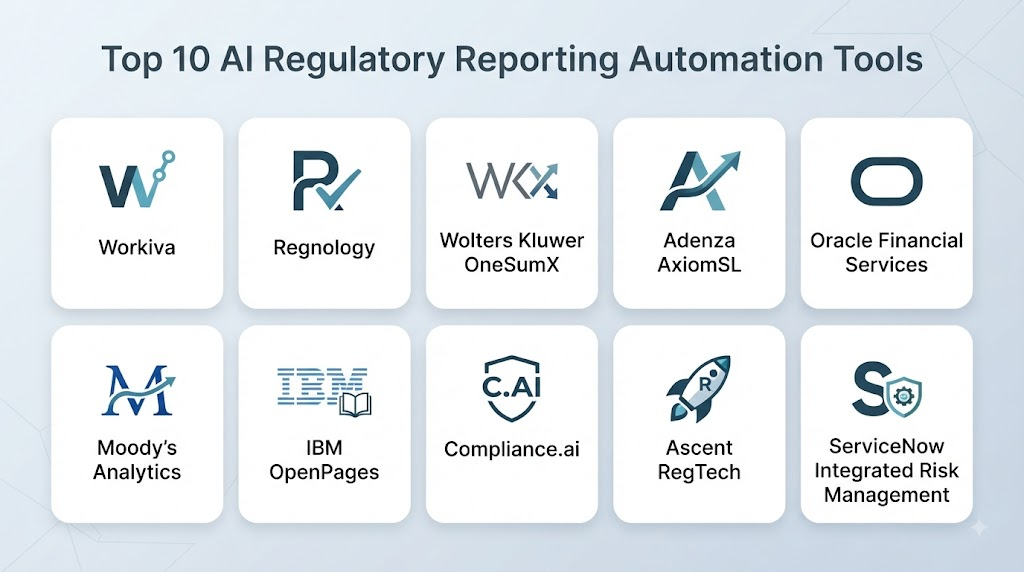
Top 10 AI Regulatory Reporting Automation Tools
1. Wolters Kluwer OneSumX
One-line verdict: Best for financial institutions seeking broad regulatory reporting, risk management, data management, and compliance capabilities.
Short description
Wolters Kluwer OneSumX provides regulatory reporting and risk-management capabilities for financial institutions. It is designed to help organizations manage complex reporting requirements through centralized data, validation, workflow, and regulatory processes.
Standout Capabilities
- Regulatory reporting.
- Risk data management.
- Data aggregation.
- Reporting workflow automation.
- Data validation.
- Regulatory calculations.
- Data lineage.
- Enterprise reporting controls.
AI-Specific Depth
- Model support: AI and analytics capabilities vary by OneSumX solution.
- RAG / knowledge integration: Regulatory knowledge integration varies by implementation.
- Evaluation: Validation and reporting controls are available; generative-AI evaluation capabilities vary.
- Guardrails: Enterprise governance and workflow controls are available.
- Observability: Reporting, validation, and operational monitoring capabilities vary by deployment.
Pros
- Broad financial-regulatory functionality.
- Designed for complex institutional environments.
- Strong focus on data and reporting processes.
Cons
- Implementation can be substantial.
- Requires regulatory and technical expertise.
- Pricing is generally customized.
Security & Compliance
Enterprise security, access control, audit, and governance capabilities are available. Specific certifications and controls should be verified for the selected implementation.
Deployment & Platforms
- Enterprise.
- Cloud and deployment options vary.
- API-based integration.
- Web interfaces.
Integrations & Ecosystem
OneSumX can connect regulatory reporting with broader financial data and risk environments.
- Banking systems.
- Data warehouses.
- Risk systems.
- APIs.
- Reporting platforms.
- Enterprise data sources.
Pricing Model
Enterprise pricing. Exact pricing is not publicly standardized.
Best-Fit Scenarios
- Large banks.
- Complex regulatory reporting environments.
- Institutions managing multiple reporting frameworks.
2. Regnology
One-line verdict: Best for financial institutions needing regulatory reporting, regulatory data management, and compliance-focused automation.
Short description
Regnology provides technology for regulatory reporting and supervisory processes. Its platform portfolio focuses on helping financial institutions manage reporting requirements, data, workflows, and regulatory information.
Standout Capabilities
- Regulatory reporting.
- Regulatory data management.
- Reporting workflows.
- Data validation.
- Regulatory intelligence.
- Supervisory reporting.
- Data transformation.
- Compliance automation.
AI-Specific Depth
- Model support: AI capabilities vary by product.
- RAG / knowledge integration: Regulatory information capabilities are available; exact RAG implementation varies.
- Evaluation: Reporting validation is supported; generative-AI evaluation varies.
- Guardrails: Workflow and governance controls are available.
- Observability: Reporting and operational monitoring capabilities vary.
Pros
- Strong regulatory focus.
- Broad reporting capabilities.
- Suitable for complex financial institutions.
Cons
- Can require specialized implementation.
- Product portfolio may be complex to navigate.
- Pricing is not universally public.
Security & Compliance
Enterprise security and governance controls are available. Specific certifications should be confirmed for the selected products and deployment.
Deployment & Platforms
- Cloud.
- Enterprise.
- Web.
- APIs.
Integrations & Ecosystem
Regnology solutions can integrate with financial and regulatory data environments.
- Core banking systems.
- Data warehouses.
- APIs.
- Reporting systems.
- Compliance platforms.
- Enterprise applications.
Pricing Model
Enterprise/custom pricing.
Best-Fit Scenarios
- Banks with complex regulatory obligations.
- Multi-jurisdiction reporting.
- Financial institutions requiring regulatory-focused technology.
3. AxiomSL
One-line verdict: Best for financial institutions requiring controlled regulatory reporting, data aggregation, validation, and governance.
Short description
AxiomSL provides regulatory reporting and risk-data management technology designed for financial institutions. Its platform focuses on bringing data together, applying regulatory logic, validating outputs, and supporting controlled reporting workflows.
Standout Capabilities
- Regulatory reporting.
- Data aggregation.
- Regulatory calculations.
- Data validation.
- Data lineage.
- Reporting workflows.
- Risk reporting.
- Exception management.
AI-Specific Depth
- Model support: AI functionality varies by platform capability.
- RAG / knowledge integration: Not publicly stated as a universal platform capability.
- Evaluation: Strong reporting validation capabilities; generative-AI evaluation varies.
- Guardrails: Governance and workflow controls are available.
- Observability: Reporting and data-quality monitoring capabilities vary.
Pros
- Strong regulatory reporting orientation.
- Suitable for complex data environments.
- Emphasis on controlled reporting processes.
Cons
- Implementation can be technically demanding.
- Requires specialized regulatory knowledge.
- Pricing varies by deployment.
Security & Compliance
Enterprise access controls, auditability, and governance capabilities are available. Specific certifications should be verified directly.
Deployment & Platforms
- Enterprise.
- Cloud and deployment options vary.
- Web.
- APIs.
Integrations & Ecosystem
AxiomSL can connect to financial institutions’ data and reporting infrastructure.
- Data warehouses.
- Core banking systems.
- Risk systems.
- APIs.
- Enterprise databases.
- Reporting environments.
Pricing Model
Enterprise/custom pricing.
Best-Fit Scenarios
- Large financial institutions.
- Complex regulatory reporting.
- Multi-source financial data environments.
4. Moody’s Regulatory Reporting
One-line verdict: Best for organizations combining regulatory data, risk information, analytics, and reporting processes.
Short description
Moody’s provides financial data, risk, analytics, and regulatory solutions that can support institutions managing reporting and risk obligations. Its broader ecosystem can help organizations combine regulatory workflows with financial intelligence.
Standout Capabilities
- Regulatory data.
- Risk analytics.
- Financial data.
- Reporting support.
- Data integration.
- Regulatory workflows.
- Risk management.
- Analytics.
AI-Specific Depth
- Model support: AI and analytics capabilities vary.
- RAG / knowledge integration: Knowledge and financial-data integration varies.
- Evaluation: Reporting and analytical validation capabilities vary.
- Guardrails: Enterprise governance controls vary by product.
- Observability: Monitoring capabilities depend on the selected solution.
Pros
- Broad financial-data ecosystem.
- Strong risk-management context.
- Useful for organizations already using Moody’s solutions.
Cons
- Product capabilities differ across solutions.
- May require multiple components for end-to-end automation.
- Pricing varies.
Security & Compliance
Enterprise security and governance capabilities are available across relevant services. Specific certifications should be verified for the exact product.
Deployment & Platforms
- Cloud.
- Enterprise.
- Web.
- APIs.
Integrations & Ecosystem
Moody’s solutions can integrate financial, risk, data, and reporting workflows.
- Financial databases.
- Risk systems.
- APIs.
- Data warehouses.
- Analytics platforms.
- Enterprise applications.
Pricing Model
Enterprise/custom pricing.
Best-Fit Scenarios
- Financial institutions using Moody’s ecosystem.
- Risk-intensive reporting environments.
- Large organizations managing complex financial data.
5. SAP Regulatory Reporting
One-line verdict: Best for enterprises seeking regulatory reporting integrated with broader financial, accounting, and enterprise data systems.
Short description
SAP provides regulatory reporting capabilities within its broader enterprise financial ecosystem. Organizations can connect reporting workflows with financial data, accounting processes, and enterprise systems.
Standout Capabilities
- Financial reporting.
- Regulatory reporting.
- Enterprise data integration.
- Accounting integration.
- Data transformation.
- Reporting workflows.
- Financial consolidation.
- Enterprise governance.
AI-Specific Depth
- Model support: SAP AI capabilities vary by product and architecture.
- RAG / knowledge integration: Enterprise data and knowledge integration capabilities vary.
- Evaluation: AI evaluation varies by selected SAP AI services.
- Guardrails: Enterprise security and governance capabilities are available.
- Observability: SAP monitoring capabilities vary by deployment.
Pros
- Strong enterprise ecosystem.
- Useful for SAP-centric organizations.
- Integrates financial data and reporting workflows.
Cons
- Best suited to organizations already using SAP.
- Implementation can be complex.
- Costs depend on the broader SAP environment.
Security & Compliance
SAP provides enterprise security and governance features. Specific certifications should be verified according to the selected products and deployment.
Deployment & Platforms
- Cloud.
- Enterprise.
- Web.
- APIs.
Integrations & Ecosystem
SAP regulatory reporting can work with broader enterprise finance infrastructure.
- ERP.
- Financial systems.
- Data platforms.
- APIs.
- Enterprise analytics.
- Accounting systems.
Pricing Model
Enterprise licensing and subscription structures vary.
Best-Fit Scenarios
- SAP-centric banks.
- Large enterprises.
- Organizations integrating regulatory reporting with finance.
6. IBM Regulatory Compliance Solutions
One-line verdict: Best for enterprises combining AI, data governance, risk management, and regulatory compliance workflows.
Short description
IBM provides a broad portfolio of AI, data, governance, risk, and compliance technologies that can support regulatory reporting architectures. Its strength is often in combining data management and AI capabilities with enterprise governance.
Standout Capabilities
- Data governance.
- AI governance.
- Risk management.
- Compliance workflows.
- Data integration.
- Analytics.
- Automation.
- Enterprise governance.
AI-Specific Depth
- Model support: IBM supports multiple AI and model-management approaches depending on product.
- RAG / knowledge integration: Available through relevant IBM AI and data technologies.
- Evaluation: AI governance and evaluation capabilities are available across relevant offerings.
- Guardrails: Governance and policy controls are supported.
- Observability: Monitoring capabilities vary across products.
Pros
- Strong governance capabilities.
- Broad enterprise ecosystem.
- Suitable for complex AI and compliance architectures.
Cons
- May require combining multiple IBM products.
- Implementation can be complex.
- Pricing varies.
Security & Compliance
IBM provides enterprise security and governance capabilities. Specific certifications should be verified for individual products.
Deployment & Platforms
- Cloud.
- Hybrid.
- Enterprise.
- APIs.
Integrations & Ecosystem
IBM solutions can connect regulatory workflows with enterprise data and AI infrastructure.
- Databases.
- Data platforms.
- APIs.
- AI platforms.
- Governance systems.
- Enterprise applications.
Pricing Model
Enterprise/custom pricing.
Best-Fit Scenarios
- Large banks.
- Hybrid-cloud organizations.
- AI governance-heavy reporting environments.
7. FIS Regulatory Reporting Solutions
One-line verdict: Best for financial institutions seeking regulatory reporting capabilities integrated with broader financial technology infrastructure.
Short description
FIS provides financial technology solutions across banking, payments, capital markets, and related areas. Its regulatory and reporting capabilities can support institutions managing complex financial reporting requirements.
Standout Capabilities
- Financial reporting.
- Regulatory reporting.
- Banking integration.
- Data processing.
- Workflow automation.
- Risk support.
- Enterprise financial technology.
- Reporting controls.
AI-Specific Depth
- Model support: AI capabilities vary by solution.
- RAG / knowledge integration: Varies / N/A.
- Evaluation: Reporting validation capabilities vary.
- Guardrails: Enterprise governance controls vary.
- Observability: Operational reporting and monitoring vary by product.
Pros
- Strong financial-services focus.
- Broad banking ecosystem.
- Useful for institutions already using FIS infrastructure.
Cons
- Product capabilities vary.
- Integration may require specialized expertise.
- Pricing is typically customized.
Security & Compliance
Enterprise security and compliance capabilities are available. Exact certifications should be verified for the relevant solution.
Deployment & Platforms
- Enterprise.
- Cloud.
- Hybrid options vary.
- APIs.
Integrations & Ecosystem
FIS solutions can integrate with financial and banking infrastructure.
- Banking platforms.
- Data systems.
- Risk platforms.
- APIs.
- Reporting systems.
- Enterprise applications.
Pricing Model
Enterprise/custom pricing.
Best-Fit Scenarios
- Banks using FIS infrastructure.
- Large financial institutions.
- Complex financial reporting environments.
8. Oracle Regulatory Reporting
One-line verdict: Best for enterprises that need regulatory reporting connected to Oracle financial, data, and enterprise application environments.
Short description
Oracle provides financial, data, analytics, and regulatory technologies that can support automated reporting processes. Organizations using Oracle enterprise systems can connect reporting workflows with existing financial and operational data.
Standout Capabilities
- Financial data integration.
- Regulatory reporting.
- Enterprise analytics.
- Workflow automation.
- Data management.
- Financial controls.
- Cloud infrastructure.
- Enterprise integration.
AI-Specific Depth
- Model support: Oracle AI capabilities vary by service.
- RAG / knowledge integration: Oracle data and AI services can support knowledge integration.
- Evaluation: AI evaluation capabilities vary.
- Guardrails: Enterprise governance and security controls are available.
- Observability: Oracle monitoring capabilities vary by deployment.
Pros
- Strong enterprise integration.
- Broad financial ecosystem.
- Useful for Oracle-centric organizations.
Cons
- Complex implementations may require specialist teams.
- Capabilities vary across Oracle products.
- Pricing can be complex.
Security & Compliance
Oracle provides enterprise security, access management, and governance capabilities. Specific certifications should be verified for the chosen services.
Deployment & Platforms
- Cloud.
- Enterprise.
- Hybrid.
- APIs.
Integrations & Ecosystem
Oracle can connect reporting workflows with financial and enterprise applications.
- ERP.
- Databases.
- Data warehouses.
- APIs.
- Analytics.
- Financial systems.
Pricing Model
Enterprise licensing and cloud consumption models vary.
Best-Fit Scenarios
- Oracle-centric financial institutions.
- Large enterprises.
- Complex finance-data environments.
9. Adenza
One-line verdict: Best for capital-markets organizations managing regulatory reporting, risk, treasury, and financial data processes.
Short description
Adenza provides technology for capital markets, risk management, regulatory compliance, and financial operations. Its solutions are designed for institutions that require sophisticated regulatory and risk workflows.
Standout Capabilities
- Regulatory reporting.
- Risk management.
- Capital-markets workflows.
- Treasury functionality.
- Data management.
- Regulatory calculations.
- Reporting automation.
- Enterprise integration.
AI-Specific Depth
- Model support: AI capabilities vary by product.
- RAG / knowledge integration: Varies / N/A.
- Evaluation: Strong rule and reporting validation capabilities; generative-AI evaluation varies.
- Guardrails: Workflow and governance controls are available.
- Observability: Monitoring varies by implementation.
Pros
- Strong capital-markets orientation.
- Broad risk and regulatory capabilities.
- Suitable for sophisticated financial institutions.
Cons
- Enterprise implementation can be complex.
- Requires specialized financial expertise.
- Pricing is customized.
Security & Compliance
Enterprise security and governance capabilities are available. Specific certifications should be verified during procurement.
Deployment & Platforms
- Enterprise.
- Cloud.
- Hybrid options vary.
- APIs.
Integrations & Ecosystem
Adenza can connect regulatory processes with financial and risk systems.
- Trading systems.
- Risk systems.
- Treasury systems.
- Data warehouses.
- APIs.
- Enterprise applications.
Pricing Model
Enterprise/custom pricing.
Best-Fit Scenarios
- Investment banks.
- Capital-markets institutions.
- Complex regulatory reporting environments.
10. Workiva
One-line verdict: Best for organizations coordinating regulatory reporting, financial reporting, data, controls, and collaborative review processes.
Short description
Workiva provides connected reporting and compliance workflows designed to help organizations manage financial reporting, regulatory disclosures, controls, and supporting documentation. Its collaborative approach can reduce manual work across reporting processes.
Standout Capabilities
- Financial reporting.
- Regulatory reporting.
- Data connections.
- Document management.
- Workflow automation.
- Collaboration.
- Audit trails.
- Reporting controls.
AI-Specific Depth
- Model support: AI capabilities vary by Workiva functionality.
- RAG / knowledge integration: Data and document connectivity is available; exact RAG capabilities vary.
- Evaluation: Reporting review and control workflows are available; generative-AI evaluation varies.
- Guardrails: Access and workflow controls are available.
- Observability: Reporting and workflow visibility are supported.
Pros
- Strong reporting collaboration.
- Useful for controlled reporting processes.
- Good visibility across reporting workflows.
Cons
- Not solely focused on regulatory reporting.
- Advanced implementations may require configuration.
- Pricing is generally customized.
Security & Compliance
Workiva provides enterprise security and administrative controls. Specific certifications and compliance requirements should be verified for the selected service.
Deployment & Platforms
- Cloud.
- Web.
- APIs.
- Enterprise applications.
Integrations & Ecosystem
Workiva can connect reporting processes with enterprise data sources.
- ERP systems.
- Financial databases.
- Spreadsheets.
- APIs.
- Data warehouses.
- Enterprise applications.
Pricing Model
Enterprise subscription/custom pricing.
Best-Fit Scenarios
- Financial reporting teams.
- Compliance teams.
- Organizations managing collaborative regulatory documentation.
Comparison Table
| Tool Name | Best For | Deployment | Model Flexibility | Strength | Watch-Out | Public Rating |
|---|---|---|---|---|---|---|
| Wolters Kluwer OneSumX | Complex bank reporting | Cloud/Enterprise | Varies | Regulatory depth | Implementation effort | N/A |
| Regnology | Regulatory reporting | Cloud/Enterprise | Varies | Regulatory specialization | Product complexity | N/A |
| AxiomSL | Data-driven reporting | Enterprise/Cloud | Varies | Data aggregation | Technical complexity | N/A |
| Moody’s Regulatory Solutions | Risk and regulatory data | Cloud/Enterprise | Varies | Financial intelligence | Portfolio complexity | N/A |
| SAP Regulatory Reporting | SAP-centric enterprises | Cloud/Enterprise | Varies | Enterprise finance integration | SAP dependency | N/A |
| IBM Solutions | Governance-heavy enterprises | Cloud/Hybrid | Multi-model options vary | AI governance | Multiple products may be needed | N/A |
| FIS | Banking institutions | Enterprise/Cloud | Varies | Financial-services ecosystem | Customized implementation | N/A |
| Oracle | Oracle-centric enterprises | Cloud/Hybrid | Multi-model options vary | Enterprise integration | Complex ecosystem | N/A |
| Adenza | Capital markets | Cloud/Enterprise | Varies | Risk and regulatory depth | Specialist implementation | N/A |
| Workiva | Reporting collaboration | Cloud | Varies | Connected reporting | Broader than regulatory reporting | N/A |
Scoring & Evaluation
The following scoring model is a comparative framework for evaluating regulatory reporting automation platforms. It does not represent official vendor rankings, certifications, or regulatory approval.
The score emphasizes regulatory functionality, AI reliability, governance, integrations, usability, performance, security, and support.
Because AI capabilities and product configurations can change, buyers should validate important capabilities through a proof of concept.
A high score does not automatically mean a platform is appropriate for every financial institution.
The strongest option is the one that fits the organization’s regulatory scope, data architecture, governance requirements, and operating model.
| Tool | Core | Reliability/Eval | Guardrails | Integrations | Ease | Perf/Cost | Security/Admin | Support | Weighted Total |
|---|---|---|---|---|---|---|---|---|---|
| Wolters Kluwer OneSumX | 10 | 9 | 10 | 10 | 7 | 8 | 10 | 10 | 9.25 |
| Regnology | 10 | 9 | 10 | 9 | 7 | 8 | 10 | 10 | 9.10 |
| AxiomSL | 10 | 9 | 10 | 10 | 7 | 8 | 10 | 9 | 9.20 |
| Moody’s | 9 | 9 | 9 | 9 | 8 | 8 | 9 | 10 | 8.90 |
| SAP | 9 | 9 | 10 | 10 | 7 | 8 | 10 | 10 | 9.15 |
| IBM | 9 | 10 | 10 | 10 | 7 | 8 | 10 | 10 | 9.30 |
| FIS | 9 | 8 | 9 | 10 | 7 | 8 | 10 | 10 | 8.95 |
| Oracle | 9 | 9 | 10 | 10 | 7 | 8 | 10 | 10 | 9.15 |
| Adenza | 10 | 9 | 10 | 10 | 7 | 8 | 10 | 9 | 9.20 |
| Workiva | 9 | 8 | 9 | 9 | 9 | 8 | 9 | 10 | 8.90 |
Top 3 for Enterprise
- IBM — Strong combination of AI governance, enterprise data, and compliance capabilities.
- Wolters Kluwer OneSumX — Strong regulatory reporting focus.
- AxiomSL — Strong data aggregation and regulatory reporting capabilities.
Top 3 for SMB
- Workiva — Strong collaborative reporting workflows.
- SAP — Useful where existing SAP infrastructure is already present.
- Oracle — Strong option for organizations already operating within Oracle’s ecosystem.
Top 3 for Developers
- IBM — Strong data, AI, and governance ecosystem.
- Oracle — Broad APIs and enterprise cloud capabilities.
- SAP — Extensive enterprise integration possibilities.
Which AI Regulatory Reporting Automation Tool Is Right for You?
Solo / Freelancer
Most freelancers and very small organizations do not need a full regulatory reporting platform.
A lightweight reporting workflow, controlled spreadsheet process, or specialized compliance application may be sufficient when reporting requirements are limited.
If AI is introduced, use it primarily for document classification, data preparation, anomaly detection, or research assistance rather than unsupervised regulatory filing.
SMB
SMBs should prioritize:
- Ease of implementation.
- Data connectivity.
- Reporting templates.
- Validation.
- Auditability.
- Affordable licensing.
- Workflow automation.
A platform that solves a small number of reporting requirements effectively can be better than an enterprise system with capabilities the organization will never use.
Mid-Market
Mid-market institutions should focus on building a standardized reporting data layer.
Important requirements include:
- Centralized reporting data.
- Automated reconciliation.
- Regulatory mapping.
- Exception management.
- Data lineage.
- Approval workflows.
- Audit trails.
- AI-assisted data analysis.
AI should complement established reporting rules rather than replace them.
Enterprise
Large financial institutions need enterprise-scale governance.
Prioritize:
- Multi-jurisdiction reporting.
- Centralized data models.
- Automated validation.
- Data lineage.
- Regulatory change management.
- Model governance.
- Role-based access.
- Auditability.
- Human approvals.
- High availability.
- API integration.
- Vendor-risk management.
Regulated Industries
Financial services organizations should treat regulatory reporting as a controlled process rather than an ordinary AI automation project.
The organization should know:
- Which data sources were used.
- Which transformations occurred.
- Which rules were applied.
- Which AI models were involved.
- Which employees approved the output.
- Which exceptions occurred.
- Which version of the workflow produced the final report.
Budget vs Premium
Budget solutions may work for limited reporting requirements and smaller organizations.
Premium platforms become more appropriate when an organization has multiple reporting jurisdictions, complex financial products, high reporting volumes, large data environments, or demanding audit requirements.
Build vs Buy
Building internally can make sense when reporting requirements are highly specialized and the institution has strong data engineering, compliance, and software-development capabilities.
Buying is generally more attractive when the organization needs established regulatory content, reporting frameworks, workflow controls, integrations, and vendor support.
A hybrid approach can be effective: use a specialized regulatory platform for core reporting while deploying internal AI services for classification, data-quality analysis, regulatory research, and workflow assistance.
Implementation Playbook: 30 / 60 / 90 Days
30 Days: Pilot + Success Metrics
Start with one regulatory reporting workflow rather than attempting to automate everything.
Focus on:
- Select a high-volume reporting process.
- Map existing data sources.
- Document manual processes.
- Identify repetitive tasks.
- Establish data-quality baselines.
- Define reporting accuracy requirements.
- Create an initial evaluation dataset.
- Identify sensitive information.
- Define approval requirements.
- Establish measurable success criteria.
Useful metrics include:
- Data-quality error rate.
- Reconciliation time.
- Manual effort.
- Exception rate.
- Report preparation time.
- Validation accuracy.
- Review time.
60 Days: Harden Security + Evaluation + Rollout
Next, strengthen the implementation.
- Implement RBAC.
- Configure authentication.
- Establish audit logging.
- Define data-retention policies.
- Test AI-generated recommendations.
- Validate regulatory mappings.
- Test edge cases.
- Test missing data.
- Test conflicting data.
- Establish model and prompt version control.
- Create human-review checkpoints.
- Perform adversarial testing.
- Establish incident procedures.
Every AI-generated reporting recommendation should be traceable to its supporting data or regulatory source where practical.
90 Days: Optimize Cost/Latency + Governance + Scale
Once the workflow is stable:
- Expand reporting coverage.
- Automate additional reconciliations.
- Improve data-quality rules.
- Optimize AI model usage.
- Monitor processing costs.
- Reduce unnecessary AI calls.
- Establish regulatory-change monitoring.
- Create governance dashboards.
- Monitor model performance.
- Conduct recurring red-team tests.
- Review vendor risk.
- Expand reporting automation gradually.
Common Mistakes & How to Avoid Them
- Using AI without reliable source data: Poor data quality will produce poor reporting outcomes regardless of model quality.
- Allowing AI to make unsupervised filing decisions: Maintain human review for material regulatory decisions.
- Skipping data lineage: Every important reporting value should be traceable to an appropriate source.
- Ignoring regulatory changes: Reporting logic must be maintained as requirements evolve.
- Failing to evaluate AI outputs: Use representative datasets and regression testing.
- Ignoring hallucinations: Generative AI should not invent regulatory interpretations or financial values.
- Poor access control: Restrict access to sensitive reporting data.
- Weak audit trails: Record data transformations, approvals, exceptions, and important AI interactions.
- Uncontrolled data retention: Define how long reporting and AI-related information is retained.
- Ignoring prompt injection: Treat external regulatory documents and untrusted content carefully when using AI.
- Overusing expensive models: Use appropriate models for classification, extraction, and simple transformations.
- No human escalation: Establish clear review procedures for ambiguous cases.
- Excessive vendor lock-in: Maintain data and workflow portability where practical.
- Testing only normal cases: Include missing, duplicated, inconsistent, and unusual data.
- Automating the entire reporting process too quickly: Begin with controlled workflows and expand after validation.
FAQs
What is AI regulatory reporting automation?
AI regulatory reporting automation uses AI and workflow technologies to help collect, transform, validate, analyze, and prepare information required for regulatory reports. It can reduce repetitive manual work while keeping humans responsible for important decisions.
Can AI automatically submit regulatory reports?
Some workflows can automate parts of the submission process, but organizations should determine the appropriate level of human approval based on regulatory requirements and reporting risk.
How does AI improve regulatory reporting?
AI can assist with data classification, anomaly detection, document analysis, regulatory-change identification, data mapping, and exception management. These capabilities can reduce manual effort when properly controlled.
Is AI regulatory reporting suitable for banks?
Yes. Banks can benefit from automation because they often manage large datasets and numerous recurring regulatory obligations. However, security, governance, validation, and auditability are essential.
Can AI interpret regulatory requirements?
AI can assist with analyzing regulatory documents and identifying potentially relevant requirements. Human compliance professionals should validate important interpretations before they become reporting rules or decisions.
What is regulatory data lineage?
Data lineage shows where reporting information originated, how it was transformed, and how it reached the final report. It is important for troubleshooting, governance, auditability, and reporting confidence.
Can these platforms integrate with core banking systems?
Many enterprise platforms provide APIs and integration capabilities, but the exact integration method depends on the reporting platform and the institution’s core banking and data architecture.
Does AI regulatory reporting require human review?
Human review remains important, particularly for material reporting decisions, unusual data, regulatory interpretation, exceptions, and high-impact filings.
How should organizations evaluate AI reporting accuracy?
Organizations should create representative test datasets and measure extraction accuracy, data mapping, anomaly detection, regulatory-rule application, consistency, and exception handling.
Can regulatory reporting platforms be self-hosted?
Deployment options vary significantly. Some enterprise solutions support cloud, hybrid, or controlled enterprise deployments, while others are primarily cloud-based.
How much does AI regulatory reporting automation cost?
Pricing varies based on reporting scope, data volume, users, integrations, modules, deployment, and implementation requirements. Enterprise platforms frequently use customized pricing.
Can AI regulatory reporting work across multiple jurisdictions?
Some platforms are designed to support multiple regulatory frameworks and jurisdictions. Organizations should verify the specific jurisdictions and reporting regimes required before selecting a platform.
What are the main risks of AI in regulatory reporting?
Key risks include incorrect data interpretation, hallucinations, data-quality problems, inadequate auditability, unauthorized access, outdated regulatory logic, and excessive automation without human oversight.
What is the difference between traditional regulatory reporting software and AI-enabled reporting?
Traditional platforms generally rely heavily on predefined rules, workflows, and data transformations. AI-enabled systems can add capabilities such as document understanding, anomaly detection, classification, natural-language analysis, and intelligent workflow assistance.
Conclusion
AI regulatory reporting automation can significantly reduce repetitive work while improving data validation, reconciliation, anomaly detection, and reporting workflow management. However, regulatory reporting is a high-accountability process where automation must be carefully controlled.The strongest platforms combine reliable reporting infrastructure with data governance, workflow automation, auditability, integrations, and increasingly sophisticated AI capabilities.Organizations should avoid treating generative AI as a replacement for regulatory controls. Instead, AI should operate within clearly defined boundaries, with trustworthy source data, measurable evaluations, appropriate permissions, and human oversight.