Introduction
AI Hospital Bed Demand Forecasting tools use artificial intelligence, machine learning, statistical forecasting, and healthcare data analysis to predict how many hospital beds may be required over a future period. Instead of relying only on historical averages or manual spreadsheets, these systems can analyze patterns across admissions, discharges, transfers, emergency-department activity, seasonal demand, patient flow, length of stay, and other operational variables.
For hospitals, bed capacity is a complex balancing problem. Too few available beds can create emergency-department congestion, delayed admissions, canceled procedures, ambulance diversions, and pressure on clinical staff. Too many unused beds can increase operating costs and reduce resource efficiency.
Modern forecasting systems are increasingly moving toward real-time and predictive hospital operations. AI can help planners identify upcoming demand, estimate occupancy, anticipate bottlenecks, and test different capacity scenarios before problems occur.
Best for: Hospitals, health systems, hospital networks, healthcare operations teams, bed-management departments, emergency departments, clinical operations leaders, capacity-planning teams, and healthcare analytics departments.
Not ideal for: Very small facilities with limited historical data, organizations without reliable operational data, or hospitals expecting AI to make autonomous capacity decisions without operational oversight.
The best forecasting system should not simply produce a predicted number. It should help hospital leaders understand why demand may change, how confident the prediction is, what capacity constraints exist, and what actions could reduce bottlenecks.
What’s Changing in AI Hospital Bed Demand Forecasting
- Real-time forecasting is becoming more important. Hospitals increasingly want forecasts that incorporate current admission, discharge, transfer, and emergency-department activity rather than relying exclusively on historical averages.
- Forecasting is moving from single-number predictions to ranges. A prediction such as “450 beds” may be less useful than a range showing expected demand and uncertainty.
- AI is combining more operational signals. Admission patterns, emergency activity, scheduled procedures, patient demographics, length of stay, discharge behavior, seasonal trends, and historical occupancy can all contribute to forecasting.
- Short-term forecasting is becoming more granular. Operations teams may need forecasts for the next few hours, days, weeks, and months rather than one long-term annual estimate.
- Scenario modeling is becoming a major capability. Hospitals can ask what might happen if admissions increase, elective procedures change, discharge rates improve, or a ward becomes temporarily unavailable.
- Patient-flow forecasting is becoming connected to bed forecasting. Predicting demand is only part of the problem. Hospitals also need to understand where patients are likely to move and where bottlenecks may occur.
- Emergency-department demand is increasingly connected to capacity planning. Higher emergency admissions can create downstream inpatient bed pressure.
- AI is increasingly being used for staffing decisions. Bed-demand forecasts can support planning for nurses, physicians, housekeeping, transport, and other operational resources.
- Explainability matters. Hospital leaders need to understand which variables are influencing predictions, particularly when forecasts affect clinical operations.
- Data quality is becoming a strategic issue. Incomplete discharge timestamps, inconsistent admission categories, missing occupancy data, and delayed updates can significantly affect forecasting performance.
- Privacy and governance remain important. Hospitals need strong controls around patient information, access, retention, and secondary use of healthcare data.
- Model monitoring is becoming essential. A forecasting model that performs well during normal operations may behave differently during unusual events, outbreaks, disasters, or major changes in hospital policy.
- AI agents may eventually move from forecasting to operational recommendations. Future systems could identify an expected shortage and recommend operational actions such as adjusting elective capacity, accelerating discharge workflows, or reallocating beds.
- Human oversight remains critical. Bed forecasts should support hospital decision-makers rather than automatically overriding clinical or operational judgment.
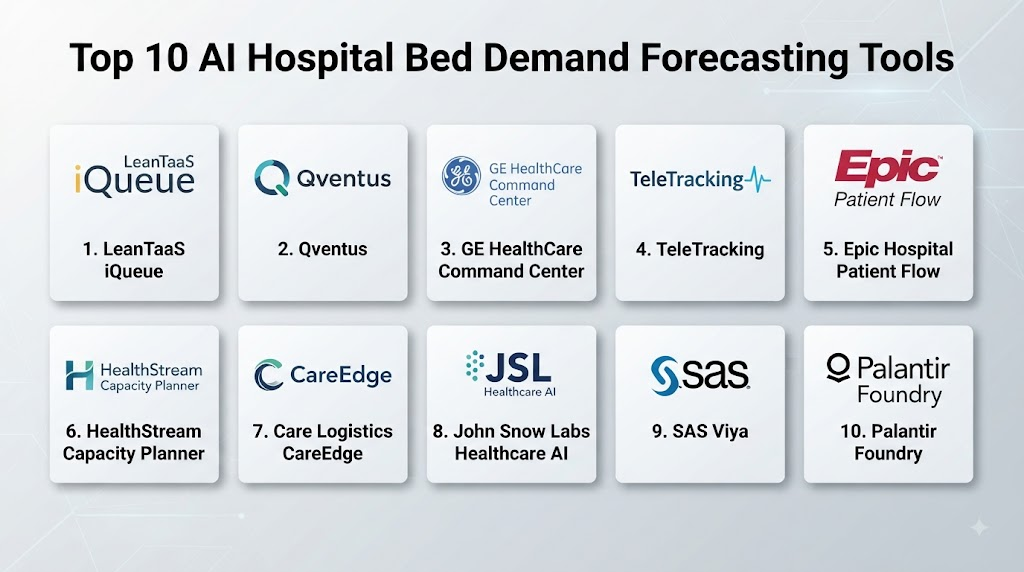
Top 10 AI Hospital Bed Demand Forecasting Tools
1. Qventus
One-line verdict: Best for hospitals seeking AI-powered patient-flow optimization, capacity management, and operational forecasting.
Short description:
Qventus provides healthcare operations technology focused on improving patient flow and hospital efficiency. Its platform can support areas such as perioperative operations, patient flow, discharge management, and capacity optimization.
Its value for bed-demand forecasting comes from connecting predictive analytics with operational workflows rather than treating forecasting as an isolated reporting exercise.
Standout Capabilities
- AI-supported hospital operations.
- Patient-flow optimization.
- Capacity management.
- Discharge optimization.
- Predictive operational insights.
- Perioperative workflow support.
- Hospital-wide operational visibility.
- Workflow automation.
AI-Specific Depth
- Model support: Proprietary healthcare AI and machine-learning capabilities.
- RAG / knowledge integration: Operational and healthcare data integration; conventional RAG or vector-database compatibility is Not publicly stated.
- Evaluation: Operational performance evaluation is part of healthcare deployments; detailed model-level evaluation methodology is Not publicly stated.
- Guardrails: Human operational oversight and workflow controls.
- Observability: Operational dashboards and analytics; detailed model-level token and AI-cost metrics are Not publicly stated.
Pros
- Strong focus on real hospital operations.
- Goes beyond forecasting into patient-flow improvement.
- Useful for organizations seeking operational automation.
Cons
- More appropriate for hospitals than small practices.
- Implementation may require integration with multiple hospital systems.
- Exact pricing is Not publicly stated.
Security & Compliance
Healthcare security and privacy requirements are relevant to enterprise deployments. Specific certifications, encryption configuration, retention controls, residency, SSO, and RBAC should be verified for the intended deployment. Certifications: Not publicly stated.
Deployment & Platforms
- Cloud-based healthcare platform.
- Enterprise hospital environments.
- EHR-connected workflows.
- Operational dashboards.
Self-hosted deployment: Not publicly stated.
Integrations & Ecosystem
Qventus is designed around hospital operational workflows.
- EHR systems.
- Patient-flow data.
- Capacity management.
- Discharge workflows.
- Perioperative systems.
- Operational analytics.
- Hospital management workflows.
Pricing Model
Enterprise pricing is generally customized. Exact pricing is Not publicly stated.
Best-Fit Scenarios
- Large hospitals.
- Multi-site health systems.
- Organizations seeking predictive patient-flow optimization.
2. LeanTaaS
One-line verdict: Best for health systems wanting predictive capacity planning across inpatient, operating-room, infusion, and hospital workflows.
Short description:
LeanTaaS focuses on healthcare operations and capacity optimization using predictive analytics and AI. Its technology is designed to help hospitals better match demand with available resources.
The platform is particularly relevant for organizations that want to connect forecasting with operational decisions.
Standout Capabilities
- Predictive hospital operations.
- Capacity optimization.
- Inpatient workflow support.
- Operating-room optimization.
- Infusion-center planning.
- Demand forecasting.
- Operational analytics.
- Resource optimization.
AI-Specific Depth
- Model support: Proprietary AI and predictive analytics.
- RAG / knowledge integration: Operational healthcare data; RAG is Not publicly stated.
- Evaluation: Forecasting and operational performance measurement are core capabilities; detailed model benchmark methodology is Not publicly stated.
- Guardrails: Operational controls and human decision-making.
- Observability: Analytics and operational reporting; detailed AI model telemetry is Not publicly stated.
Pros
- Strong healthcare operations specialization.
- Useful for multiple capacity-planning problems.
- Connects forecasting with operational decision-making.
Cons
- Enterprise-oriented.
- Implementation may require substantial data integration.
- Exact pricing is Not publicly stated.
Security & Compliance
Specific enterprise security controls, certifications, data residency, and retention policies should be verified for each implementation. Certifications: Not publicly stated.
Deployment & Platforms
- Cloud.
- Enterprise healthcare environments.
- EHR-connected workflows.
- Operational dashboards.
Self-hosted deployment: Not publicly stated.
Integrations & Ecosystem
LeanTaaS connects predictive analytics with healthcare capacity workflows.
- EHR systems.
- Hospital operations.
- Operating rooms.
- Infusion centers.
- Inpatient capacity.
- Analytics platforms.
- Scheduling systems.
Pricing Model
Enterprise quote-based pricing. Exact pricing is Not publicly stated.
Best-Fit Scenarios
- Large health systems.
- Hospitals with complex capacity challenges.
- Organizations managing multiple clinical resources.
3. Hospital IQ
One-line verdict: Best for hospitals seeking predictive analytics and operational intelligence for patient flow, capacity, and workforce planning.
Short description:
Hospital IQ is focused on healthcare operations and predictive analytics. Its platform helps healthcare organizations understand operational demand, identify bottlenecks, and improve the use of hospital resources.
The platform is relevant when bed forecasting needs to be connected with broader hospital capacity management.
Standout Capabilities
- Predictive analytics.
- Hospital capacity planning.
- Patient-flow analysis.
- Workforce planning.
- Operational dashboards.
- Demand forecasting.
- Bottleneck identification.
- Enterprise analytics.
AI-Specific Depth
- Model support: Proprietary predictive analytics and AI.
- RAG / knowledge integration: Hospital operational data; RAG architecture is Not publicly stated.
- Evaluation: Operational analytics are central to the platform; detailed AI evaluation methodology is Not publicly stated.
- Guardrails: Human operational review and configurable workflows.
- Observability: Operational dashboards and analytics.
Pros
- Healthcare-specific operational focus.
- Strong capacity-management orientation.
- Can support multiple operational functions.
Cons
- Designed primarily for healthcare organizations.
- Implementation may require significant data integration.
- Exact pricing is Not publicly stated.
Security & Compliance
Security and compliance requirements should be verified according to deployment, data flows, and organizational policy. Certifications: Not publicly stated.
Deployment & Platforms
- Cloud.
- Hospital enterprise environments.
- Web dashboards.
- Data integrations.
Integrations & Ecosystem
The platform is designed around hospital operational data.
- EHR systems.
- Patient-flow systems.
- Workforce data.
- Capacity management.
- Operational analytics.
- Hospital dashboards.
Pricing Model
Enterprise pricing. Exact pricing is Not publicly stated.
Best-Fit Scenarios
- Large hospitals.
- Health systems.
- Capacity and operations teams.
4. Pieces Technologies
One-line verdict: Best for healthcare organizations exploring AI-supported operational forecasting and patient-flow optimization.
Short description:
Pieces Technologies focuses on healthcare operations and patient-flow management. Its solutions are designed to help hospitals coordinate patient movement, improve discharge processes, and use operational data more effectively.
For bed-demand planning, the key value is connecting operational predictions with actual patient-flow decisions.
Standout Capabilities
- Patient-flow management.
- Predictive analytics.
- Discharge optimization.
- Capacity planning.
- Operational visibility.
- Healthcare workflow automation.
- Patient movement support.
- Data-driven operations.
AI-Specific Depth
- Model support: Proprietary AI and predictive analytics.
- RAG / knowledge integration: Healthcare operational data; detailed RAG capabilities are Not publicly stated.
- Evaluation: Operational outcomes and workflow performance are important evaluation areas; detailed model benchmarks are Not publicly stated.
- Guardrails: Workflow controls and human operational review.
- Observability: Operational dashboards and analytics.
Pros
- Strong patient-flow focus.
- Connects capacity with discharge workflows.
- Useful for operational improvement.
Cons
- More specialized toward healthcare operations.
- Forecasting may be part of a broader platform rather than a standalone forecasting product.
- Pricing is Not publicly stated.
Security & Compliance
Healthcare security controls should be verified during procurement. Certifications: Not publicly stated.
Deployment & Platforms
- Cloud.
- Web.
- Hospital systems.
- Enterprise healthcare environments.
Integrations & Ecosystem
Pieces Technologies is designed to work with hospital operational data.
- EHR.
- Patient-flow systems.
- Discharge workflows.
- Capacity planning.
- Operational analytics.
- Hospital management systems.
Pricing Model
Enterprise pricing is Not publicly stated.
Best-Fit Scenarios
- Hospitals with patient-flow bottlenecks.
- Health systems improving discharge efficiency.
- Capacity-management teams.
5. GE HealthCare Command Center
One-line verdict: Best for large hospitals seeking command-center visibility across patient flow, capacity, staffing, and operational performance.
Short description:
GE HealthCare’s Command Center approach provides healthcare organizations with centralized operational visibility. These environments can combine clinical and operational information to help hospital leaders understand patient flow and capacity.
Its relevance to bed-demand forecasting comes from placing capacity intelligence inside a broader hospital command-center environment.
Standout Capabilities
- Hospital command-center operations.
- Capacity visibility.
- Patient-flow monitoring.
- Operational analytics.
- Resource coordination.
- Hospital-wide dashboards.
- Predictive insights.
- Clinical operations support.
AI-Specific Depth
- Model support: Healthcare analytics and predictive technologies; exact model architecture varies.
- RAG / knowledge integration: Healthcare and operational data integration; RAG is Not publicly stated.
- Evaluation: Operational and clinical workflow performance can be evaluated; detailed model-level methodology varies.
- Guardrails: Operational governance and human decision-making.
- Observability: Command-center dashboards and operational monitoring.
Pros
- Strong enterprise hospital orientation.
- Broad operational visibility.
- Useful for centralized capacity management.
Cons
- More comprehensive than a simple forecasting application.
- Enterprise deployment can be complex.
- Exact pricing is Not publicly stated.
Security & Compliance
Large healthcare deployments require organization-specific security and compliance validation. Certifications and controls should be confirmed for the exact implementation.
Deployment & Platforms
- Enterprise cloud.
- Hospital command centers.
- Web dashboards.
- Integrated hospital systems.
Integrations & Ecosystem
The platform can connect multiple operational data sources.
- EHR systems.
- Hospital operations.
- Patient-flow systems.
- Capacity management.
- Staffing.
- Command-center dashboards.
- Analytics.
Pricing Model
Enterprise quote-based pricing. Exact pricing is Not publicly stated.
Best-Fit Scenarios
- Large hospitals.
- Multi-hospital health systems.
- Organizations establishing command centers.
6. TeleTracking
One-line verdict: Best for hospitals connecting patient-flow automation, bed management, capacity visibility, and operational workflows.
Short description:
TeleTracking focuses heavily on patient flow and hospital logistics. Its technology helps healthcare organizations manage patient movement, bed availability, environmental services, transport, and related operational workflows.
While not simply a forecasting product, its operational data and capacity-management capabilities make it relevant to AI-supported bed-demand planning.
Standout Capabilities
- Bed management.
- Patient flow.
- Capacity visibility.
- Transport coordination.
- Environmental-services workflows.
- Patient placement.
- Operational analytics.
- Hospital logistics.
AI-Specific Depth
- Model support: Predictive and automation technologies; exact model architecture is Not publicly stated.
- RAG / knowledge integration: Operational hospital data; RAG is Not publicly stated.
- Evaluation: Operational performance metrics are relevant; detailed AI evaluation methodology is Not publicly stated.
- Guardrails: Configurable workflow rules and human operational oversight.
- Observability: Operational reporting and dashboards.
Pros
- Strong bed-management heritage.
- Broad patient-flow capabilities.
- Useful for operational coordination.
Cons
- More focused on patient flow than standalone forecasting.
- Implementation can involve multiple hospital departments.
- Pricing is Not publicly stated.
Security & Compliance
Security and compliance controls should be evaluated for the organization’s specific deployment. Certifications: Not publicly stated.
Deployment & Platforms
- Cloud.
- Web.
- Enterprise hospital environments.
- Integrated operational systems.
Integrations & Ecosystem
TeleTracking operates across multiple hospital logistics workflows.
- EHR.
- Bed management.
- Patient placement.
- Transport.
- Environmental services.
- Patient flow.
- Operational dashboards.
Pricing Model
Enterprise pricing. Exact pricing is Not publicly stated.
Best-Fit Scenarios
- Hospitals with bed-management challenges.
- Large patient-flow operations.
- Health systems seeking centralized capacity visibility.
7. LeanTaaS iQueue
One-line verdict: Best for hospitals seeking specialized predictive analytics to optimize capacity across high-demand healthcare resources.
Short description:
iQueue is part of LeanTaaS’s healthcare operations portfolio and is associated with predictive analytics and capacity optimization across healthcare settings.
Its broader platform approach can be valuable when bed forecasting needs to connect with operating-room, infusion, or other resource-demand planning.
Standout Capabilities
- Predictive capacity management.
- Demand forecasting.
- Operational optimization.
- Resource planning.
- Healthcare analytics.
- Patient-flow support.
- Capacity utilization.
- Scenario planning.
AI-Specific Depth
- Model support: Proprietary predictive analytics.
- RAG / knowledge integration: Operational healthcare data; RAG is Not publicly stated.
- Evaluation: Forecasting and operational outcomes can be measured; detailed model evaluation methodology is Not publicly stated.
- Guardrails: Human review and operational workflow controls.
- Observability: Capacity dashboards and analytics.
Pros
- Strong predictive-planning orientation.
- Healthcare-specific optimization.
- Supports multiple capacity problems.
Cons
- Enterprise implementation.
- Product capabilities vary across the iQueue portfolio.
- Pricing is Not publicly stated.
Security & Compliance
Specific security controls and certifications should be verified for the selected product and deployment.
Deployment & Platforms
- Cloud.
- Enterprise healthcare.
- Web dashboards.
- Hospital data integrations.
Integrations & Ecosystem
The platform connects predictive analytics with healthcare operations.
- EHR.
- Scheduling.
- Capacity systems.
- Hospital operations.
- Resource planning.
- Analytics.
Pricing Model
Enterprise pricing. Exact pricing is Not publicly stated.
Best-Fit Scenarios
- Large hospitals.
- Capacity-planning departments.
- Multi-resource healthcare operations.
8. Qventus Patient Flow
One-line verdict: Best for organizations wanting predictive patient-flow intelligence connected directly to hospital capacity and discharge operations.
Short description:
Qventus Patient Flow focuses on improving how patients move through hospitals. By combining operational data, predictive insights, and workflow support, the platform can help organizations identify potential capacity issues and improve throughput.
This makes it useful for organizations where bed demand cannot be separated from discharge and patient-flow performance.
Standout Capabilities
- Patient-flow optimization.
- Predictive capacity insights.
- Discharge planning.
- Bed utilization.
- Operational automation.
- Bottleneck identification.
- Hospital throughput.
- Workflow coordination.
AI-Specific Depth
- Model support: Proprietary healthcare AI.
- RAG / knowledge integration: Operational patient-flow data; RAG is Not publicly stated.
- Evaluation: Operational outcomes and workflow performance are central; detailed model evaluation is Not publicly stated.
- Guardrails: Human review and configurable operational workflows.
- Observability: Operational dashboards and workflow analytics.
Pros
- Strong patient-flow connection.
- Useful for bed utilization.
- Supports operational action rather than forecasting alone.
Cons
- Enterprise-oriented.
- Requires reliable hospital operational data.
- Pricing is Not publicly stated.
Security & Compliance
Security and compliance should be evaluated based on the deployment and organizational requirements. Certifications: Not publicly stated.
Deployment & Platforms
- Cloud.
- Web.
- EHR-connected.
- Hospital operational environments.
Integrations & Ecosystem
The platform connects capacity intelligence with patient-flow operations.
- EHR.
- Bed management.
- Discharge workflows.
- Patient placement.
- Capacity analytics.
- Hospital operations.
Pricing Model
Enterprise quote-based pricing. Exact pricing is Not publicly stated.
Best-Fit Scenarios
- Hospitals experiencing capacity bottlenecks.
- Organizations improving discharge processes.
- Health systems optimizing patient throughput.
9. Palantir Foundry
One-line verdict: Best for technically mature health systems wanting customizable data and AI infrastructure for complex capacity forecasting.
Short description:
Palantir Foundry is a data and AI platform rather than a purpose-built hospital-bed forecasting application. Its strength is the ability to bring together multiple operational datasets and develop customized analytical and predictive workflows.
For hospitals with sophisticated data teams, this approach can support customized bed-demand forecasting, scenario modeling, and operational decision support.
Standout Capabilities
- Data integration.
- Predictive modeling.
- Custom AI applications.
- Scenario analysis.
- Operational dashboards.
- Workflow orchestration.
- Data lineage.
- Enterprise analytics.
AI-Specific Depth
- Model support: Multi-model and configurable AI capabilities.
- RAG / knowledge integration: Data integration and knowledge workflows; specific implementation depends on the organization.
- Evaluation: Custom model evaluation and testing can be implemented.
- Guardrails: Enterprise permissions, governance, workflow controls, and configurable policies.
- Observability: Data lineage, operational monitoring, and application-level visibility.
Pros
- Extremely flexible.
- Strong for complex data environments.
- Can support custom forecasting models and scenarios.
Cons
- Requires sophisticated technical teams.
- Not a ready-made bed-demand forecasting product.
- Implementation can be expensive and complex.
Security & Compliance
Enterprise security and governance capabilities are available, but exact controls and certifications should be evaluated for the specific deployment.
Deployment & Platforms
- Cloud.
- Enterprise.
- Hybrid options may vary.
- Custom applications.
Integrations & Ecosystem
The platform can integrate with many healthcare and enterprise data sources.
- EHR.
- Data warehouses.
- APIs.
- Operational systems.
- AI models.
- Analytics.
- Enterprise applications.
Pricing Model
Enterprise contract and customized pricing. Exact pricing is Not publicly stated.
Best-Fit Scenarios
- Large health systems with advanced data teams.
- Complex multi-hospital forecasting.
- Organizations building custom AI operations platforms.
10. SAS Viya
One-line verdict: Best for healthcare organizations wanting mature statistical forecasting, machine learning, scenario modeling, and enterprise analytics.
Short description:
SAS Viya is a broad analytics and AI platform that can be used to develop forecasting and predictive models for healthcare operations. Unlike dedicated hospital bed-management products, it provides a flexible analytics environment where organizations can build customized demand-forecasting models.
This makes it particularly relevant for health systems with internal data-science teams.
Standout Capabilities
- Time-series forecasting.
- Machine learning.
- Statistical modeling.
- Scenario analysis.
- Data preparation.
- Predictive analytics.
- Model management.
- Enterprise governance.
AI-Specific Depth
- Model support: Multiple statistical and machine-learning approaches.
- RAG / knowledge integration: General data integration capabilities; RAG is Varies / N/A for bed forecasting.
- Evaluation: Model comparison, validation, and monitoring capabilities.
- Guardrails: Enterprise governance and model-management controls.
- Observability: Model monitoring, analytics, and performance tracking.
Pros
- Strong forecasting capabilities.
- Highly customizable.
- Suitable for organizations with experienced data-science teams.
Cons
- Requires technical expertise.
- Not purpose-built solely for hospital bed management.
- Implementation can require substantial data engineering.
Security & Compliance
Enterprise security and governance capabilities are available. Exact certifications and healthcare-specific controls should be verified for the relevant deployment.
Deployment & Platforms
- Cloud.
- Enterprise.
- Hybrid options may vary.
- Data-science environments.
Integrations & Ecosystem
SAS Viya can connect forecasting models with enterprise data infrastructure.
- Data warehouses.
- EHR data.
- APIs.
- Analytics systems.
- Machine-learning workflows.
- BI environments.
- Enterprise applications.
Pricing Model
Enterprise and customized pricing. Exact pricing is Not publicly stated.
Best-Fit Scenarios
- Large healthcare analytics teams.
- Health systems building custom forecasting models.
- Organizations requiring advanced statistical forecasting.
Comparison Table
| Tool Name | Best For | Deployment | Model Flexibility | Strength | Watch-Out | Public Rating |
|---|---|---|---|---|---|---|
| Qventus | Patient-flow optimization | Cloud | Proprietary | Operational AI | Enterprise implementation | N/A |
| LeanTaaS | Healthcare capacity planning | Cloud | Proprietary | Predictive optimization | Enterprise focus | N/A |
| Hospital IQ | Hospital operations analytics | Cloud | Proprietary | Capacity intelligence | Integration effort | N/A |
| Pieces Technologies | Patient-flow optimization | Cloud | Proprietary | Discharge and flow | Broader platform | N/A |
| GE HealthCare Command Center | Hospital command centers | Cloud / Enterprise | Proprietary / Configurable | Centralized visibility | Complex deployment | N/A |
| TeleTracking | Bed and patient management | Cloud | Proprietary | Bed operations | Forecasting is broader workflow | N/A |
| LeanTaaS iQueue | Capacity optimization | Cloud | Proprietary | Predictive planning | Enterprise focus | N/A |
| Qventus Patient Flow | Hospital throughput | Cloud | Proprietary | Flow + capacity | Requires operational data | N/A |
| Palantir Foundry | Custom AI forecasting | Cloud / Hybrid | Multi-model / Configurable | Flexibility | Requires technical expertise | N/A |
| SAS Viya | Custom forecasting | Cloud / Hybrid | Multi-model / Statistical | Advanced analytics | Requires data-science skills | N/A |
Scoring & Evaluation
The scoring below is a comparative editorial rubric rather than an official vendor rating. A hospital should adjust the weighting according to its own operational priorities, data maturity, clinical environment, and implementation requirements.
Purpose-built healthcare platforms generally have an advantage in workflow readiness, while general analytics platforms can provide greater customization.
| Tool | Core | Reliability/Eval | Guardrails | Integrations | Ease | Perf/Cost | Security/Admin | Support | Weighted Total |
|---|---|---|---|---|---|---|---|---|---|
| Qventus | 9.5 | 9.0 | 9.1 | 9.3 | 8.7 | 8.5 | 9.0 | 9.1 | 9.0 |
| LeanTaaS | 9.5 | 9.1 | 9.0 | 9.2 | 8.5 | 8.5 | 9.0 | 9.1 | 9.0 |
| Hospital IQ | 9.2 | 8.9 | 8.9 | 9.0 | 8.5 | 8.5 | 8.8 | 8.8 | 8.8 |
| Pieces Technologies | 9.0 | 8.7 | 8.8 | 8.8 | 8.6 | 8.5 | 8.7 | 8.7 | 8.7 |
| GE HealthCare Command Center | 9.4 | 8.9 | 9.1 | 9.5 | 8.0 | 8.0 | 9.3 | 9.3 | 8.9 |
| TeleTracking | 9.3 | 8.7 | 9.0 | 9.3 | 8.2 | 8.2 | 9.0 | 9.1 | 8.8 |
| LeanTaaS iQueue | 9.4 | 9.0 | 9.0 | 9.1 | 8.4 | 8.5 | 9.0 | 9.1 | 8.9 |
| Qventus Patient Flow | 9.4 | 9.0 | 9.1 | 9.3 | 8.6 | 8.5 | 9.0 | 9.1 | 9.0 |
| Palantir Foundry | 9.4 | 9.2 | 9.3 | 9.7 | 7.5 | 8.0 | 9.5 | 9.2 | 9.0 |
| SAS Viya | 9.3 | 9.3 | 9.2 | 9.2 | 7.7 | 8.0 | 9.4 | 9.3 | 9.0 |
Top 3 for Enterprise
- Qventus — Strong fit for hospitals wanting AI-powered operational optimization and patient-flow intelligence.
- LeanTaaS — Strong choice for organizations managing multiple capacity and resource-planning challenges.
- GE HealthCare Command Center — Well suited to large health systems seeking centralized hospital operations visibility.
Top 3 for SMB
- Qventus — Useful for healthcare organizations with meaningful patient-flow challenges.
- TeleTracking — Strong for organizations where bed management and patient movement are major priorities.
- LeanTaaS — Appropriate when capacity optimization extends beyond inpatient beds.
Top 3 for Developers
- Palantir Foundry — Strongest flexibility for custom AI and forecasting workflows.
- SAS Viya — Strong for statistical forecasting and machine-learning development.
- Microsoft-style enterprise analytics approaches — Useful when healthcare organizations want to build forecasting into broader data platforms, although implementation depends heavily on internal capabilities.
Which AI Hospital Bed Demand Forecasting Tool Is Right for You?
Solo / Freelancer
An individual healthcare professional generally does not need a dedicated hospital bed-demand forecasting platform.
These systems are designed for organizational operations rather than individual clinical use.
If the goal is a small analytical project, a general forecasting environment may be more practical. However, healthcare organizations should avoid building operational forecasts from incomplete or poorly governed data.
SMB
Smaller hospitals should prioritize:
- Simplicity.
- Reliable data integration.
- Occupancy forecasting.
- Bed availability visibility.
- Easy dashboards.
- Clear alerts.
- Predictable costs.
- Implementation support.
A smaller hospital should avoid buying an overly complex AI platform if it lacks the data infrastructure or staff required to maintain it.
Mid-Market
Mid-sized healthcare organizations can benefit from connecting bed forecasting with patient flow.
Look for:
- Admission forecasting.
- Discharge forecasting.
- Emergency-department demand.
- Bed occupancy.
- Patient placement.
- Staffing.
- Scenario planning.
- Operational dashboards.
- EHR integration.
The objective should be to forecast capacity constraints before they become operational emergencies.
Enterprise
Large health systems should consider hospital bed forecasting as part of a broader capacity-intelligence architecture.
Important capabilities include:
- Multi-hospital forecasting.
- Real-time operational data.
- Scenario simulation.
- Predictive patient flow.
- Capacity optimization.
- EHR integration.
- Data governance.
- Model monitoring.
- Auditability.
- Enterprise identity.
- Role-based access.
- Disaster planning.
Enterprise organizations may benefit from combining a dedicated healthcare operations platform with their own data-science infrastructure.
Regulated Industries
Healthcare forecasting systems may process sensitive patient and operational information.
Organizations should assess:
- Data privacy.
- Data residency.
- Access controls.
- Retention.
- Encryption.
- Audit logs.
- Vendor security.
- Data-processing agreements.
- Model governance.
- Appropriate use of patient information.
The forecasting objective does not eliminate healthcare privacy requirements.
Budget vs Premium
The cheapest forecasting tool is not necessarily the most cost-effective.
Hospitals should calculate:
- Software cost.
- Implementation.
- Data integration.
- Training.
- Support.
- Infrastructure.
- Model maintenance.
- Internal data-science resources.
- Operational savings.
- Potential reduction in delayed admissions.
- Potential reduction in canceled procedures.
- Bed-utilization improvements.
A premium platform may make sense if it produces measurable improvements in throughput and capacity utilization.
Build vs Buy
Building a custom forecasting model may be appropriate for a large health system with:
- Strong data engineering.
- Data scientists.
- Clinical informatics teams.
- Reliable historical data.
- Real-time operational feeds.
- Model-governance capabilities.
Buying a specialized platform is generally more practical when the organization needs faster implementation and healthcare-specific operational workflows.
A custom model also creates ongoing responsibilities for monitoring, retraining, documentation, security, and governance.
Implementation Playbook
First 30 Days: Pilot + Success Metrics
Begin with one hospital or one service line.
Collect:
- Historical admissions.
- Discharges.
- Transfers.
- Occupancy.
- Emergency-department activity.
- Elective procedures.
- Average length of stay.
- Bed availability.
- Seasonal information.
- Ward-level capacity.
Establish baseline metrics before deploying the model.
Measure:
- Forecast accuracy.
- Forecast bias.
- Mean absolute error.
- Peak-demand accuracy.
- Bed-shortage prediction.
- False alarms.
- Forecast latency.
- Operational response time.
Test both normal and unusual demand patterns.
Days 31–60: Security + Evaluation + Rollout
Once the model is working, improve governance.
Key activities include:
- Validate data quality.
- Establish data ownership.
- Configure access controls.
- Review patient-data handling.
- Establish model documentation.
- Build a forecasting evaluation harness.
- Test historical periods.
- Test seasonal changes.
- Test unusual admission spikes.
- Test changes in discharge patterns.
- Compare AI forecasts against baseline forecasting.
- Evaluate confidence intervals.
- Establish alert thresholds.
- Create human-review workflows.
The evaluation should determine not only whether the model is accurate on average but whether it performs well when the hospital most needs it.
Days 61–90: Optimize Cost + Governance + Scale
Expand the forecasting program after validation.
Key activities include:
- Add additional wards.
- Add additional hospitals.
- Connect real-time data.
- Introduce scenario planning.
- Optimize model refresh frequency.
- Monitor infrastructure costs.
- Track forecast drift.
- Monitor seasonal changes.
- Establish model-retraining schedules.
- Create operational dashboards.
- Develop escalation procedures.
- Integrate forecasts with staffing.
- Connect forecasts with discharge planning.
- Establish executive reporting.
The long-term goal should be a continuously improving capacity-management system.
Common Mistakes & How to Avoid Them
- Using poor-quality historical data: Forecasting cannot compensate for inconsistent admission, discharge, or occupancy records.
- Forecasting beds without forecasting patient flow: Bed demand is affected by admissions, transfers, length of stay, and discharge performance.
- Ignoring emergency-department demand: Emergency admissions can rapidly change inpatient capacity requirements.
- Ignoring elective procedures: Scheduled procedures can create predictable but substantial demand.
- Using only historical averages: Static averages often fail when operational conditions change.
- Ignoring seasonality: Demand can vary substantially by season, holidays, weather, and other factors.
- Producing only one forecast number: Decision-makers need uncertainty ranges and scenario information.
- Ignoring model drift: Hospital operations change over time.
- Failing to test unusual events: Models should be evaluated during demand spikes and operational disruptions.
- Ignoring data latency: A forecast based on yesterday’s occupancy may be less useful when the hospital changes rapidly.
- Over-automating decisions: AI should support capacity decisions rather than automatically overriding operational leaders.
- Ignoring explainability: Leaders need to understand why a forecast changed.
- Failing to monitor bias: Forecast performance may differ across facilities, wards, or patient populations.
- Ignoring cybersecurity: Operational AI platforms are part of healthcare technology infrastructure and require appropriate security.
- Failing to establish ownership: Someone should be responsible for monitoring forecast quality and acting when performance deteriorates.
- Measuring only forecast accuracy: The ultimate goal is better hospital operations, not simply a lower forecasting error.
FAQs
What is AI Hospital Bed Demand Forecasting?
It is the use of artificial intelligence, machine learning, statistical models, and healthcare operational data to predict future hospital bed requirements.
The forecast can help hospitals plan capacity, staffing, patient flow, and resource allocation.
Why is hospital bed forecasting important?
Hospitals need to balance available capacity against changing patient demand.
Accurate forecasting can help reduce congestion, improve patient flow, support staffing decisions, and identify potential capacity shortages earlier.
What data is needed for hospital bed forecasting?
Common inputs include admissions, discharges, transfers, occupancy, length of stay, emergency-department activity, scheduled procedures, historical demand, and bed availability.
The exact data requirements vary by model.
Can AI predict hospital occupancy?
Yes. AI and machine-learning models can forecast future occupancy using historical and real-time hospital operational data.
Forecast quality depends heavily on data quality, model design, and changing operational conditions.
Can AI predict ICU bed demand?
Specialized forecasting models can be developed for intensive-care demand.
However, ICU forecasting is particularly sensitive to patient acuity, clinical events, admission patterns, and sudden changes in demand.
Can AI forecast emergency admissions?
Yes. Historical emergency-department activity, seasonal patterns, demographics, and other operational variables can be used to forecast demand.
Forecasting emergency admissions can help hospitals anticipate downstream inpatient bed requirements.
Can AI predict discharge volumes?
Predictive models can estimate expected discharge volumes using historical patterns and current patient information.
Discharge forecasting can be particularly valuable because increased discharge capacity can directly affect bed availability.
What is the difference between bed forecasting and bed management?
Bed forecasting predicts future demand.
Bed management focuses on the current allocation and movement of beds.
The strongest hospital operations platforms can connect both capabilities.
Can AI forecasting reduce hospital overcrowding?
Forecasting alone does not eliminate overcrowding.
Its value comes from giving hospital teams earlier visibility so they can take operational actions such as improving discharge coordination, adjusting capacity, or preparing additional resources.
How accurate are AI hospital bed forecasts?
Accuracy varies considerably based on hospital size, data quality, forecasting horizon, patient population, and model design.
Hospitals should evaluate forecasts against their own historical data instead of relying on generic accuracy claims.
How far ahead can hospital bed demand be predicted?
Forecasting can range from hours and days to weeks and months.
Short-term forecasts are typically useful for operational decisions, while longer forecasts can support strategic capacity planning.
Can AI predict bed shortages before they happen?
That is one of the key objectives of predictive capacity management.
A system can identify when predicted demand is likely to exceed available capacity and give operational teams time to respond.
Can hospital bed forecasting support staffing?
Yes. Forecasted occupancy and patient volumes can help hospitals plan nursing, physician, housekeeping, transport, and other operational resources.
However, staffing decisions should consider clinical acuity and workforce requirements in addition to bed counts.
Can these systems integrate with EHRs?
Many enterprise healthcare platforms support integration with EHR and operational systems.
The exact integration method and depth vary by vendor.
Can hospitals build their own forecasting models?
Yes. Hospitals with strong data-science and engineering teams can build custom models.
The organization must also maintain data pipelines, model monitoring, evaluation, governance, retraining, and security.
Should hospitals use generative AI for bed forecasting?
Generative AI can support natural-language interfaces, scenario analysis, and operational explanations.
The actual numerical forecasting engine may still benefit from specialized time-series, statistical, or machine-learning models.
What is model drift in hospital forecasting?
Model drift occurs when the relationship between the data and forecasting outcome changes over time.
Changes in clinical protocols, patient populations, bed configurations, discharge practices, or external events can reduce forecasting performance.
Conclusion
AI Hospital Bed Demand Forecasting is becoming an important part of modern hospital capacity management. The technology can help healthcare organizations move from reactive bed management toward more predictive operations.Instead of waiting until beds are unavailable, hospitals can use forecasting to anticipate demand, identify potential bottlenecks, prepare staffing, improve discharge planning, and coordinate patient movement.The strongest platforms also recognize that bed demand does not exist in isolation. Admissions, emergency-department activity, elective procedures, length of stay, transfers, discharge efficiency, staffing, and available physical capacity all influence the final outcome.Qventus and LeanTaaS are strong options for organizations seeking healthcare-specific operational optimization. Hospital IQ and Pieces Technologies are useful for patient-flow and capacity intelligence. GE HealthCare Command Center can support large hospital command-center environments, while TeleTracking provides extensive patient-flow and bed-management capabilities.