Introduction
AI Clinical Decision Support Systems use artificial intelligence to help healthcare professionals make better-informed clinical decisions. Depending on the system, they can summarize medical evidence, identify possible diagnoses, analyze symptoms, surface relevant clinical information, support medication decisions, assist with differential diagnosis, or provide context from large medical knowledge bases.AI-powered clinical decision support is different from traditional rule-based decision support. Traditional systems often rely on predefined clinical rules, while newer AI systems can use natural-language processing, machine learning, retrieval systems, and generative AI to interpret complex information and present it in a more conversational format.The most important evaluation criteria are clinical accuracy, evidence quality, hallucination risk, transparency, explainability, source traceability, patient-data privacy, regulatory status, workflow integration, usability, latency, cost, interoperability, auditability, and human oversight.
What’s Changed in AI Clinical Decision Support
AI clinical decision support is moving from static databases and rule engines toward conversational, evidence-aware, multimodal, and workflow-integrated systems.
- Conversational clinical search: Clinicians can increasingly ask questions using natural language instead of manually navigating large medical databases.
- Evidence-grounded responses: Modern systems increasingly emphasize retrieving information from identifiable medical literature, guidelines, and curated clinical resources.
- Generative AI: Large language models can summarize complex information, explain clinical concepts, and organize differential diagnoses.
- Retrieval-augmented generation: Retrieval systems can connect AI responses to medical knowledge sources instead of relying entirely on model memory.
- Clinical reasoning support: Some platforms are designed to help structure differential diagnoses and clinical reasoning rather than simply return search results.
- Multimodal inputs: Emerging systems may combine clinical text with images, laboratory values, medications, and other patient information.
- Patient-specific context: Clinical decision support is increasingly moving toward incorporating relevant patient information instead of providing generic medical answers.
- Hallucination controls: Evidence retrieval, citations, confidence indicators, source traceability, and human review are becoming important safeguards.
- Privacy requirements: Clinical AI systems may process highly sensitive patient information, increasing the importance of data retention, access controls, encryption, and appropriate deployment architecture.
- Workflow integration: The value of AI increases when decision support appears inside the clinician’s existing workflow instead of requiring constant application switching.
- Clinical governance: Healthcare organizations increasingly need formal processes for evaluating, approving, monitoring, and retiring AI systems.
- Model evaluation: Organizations need to test systems for factual accuracy, clinical relevance, consistency, bias, unsafe recommendations, and hallucinations.
- Prompt-injection defense: Systems connected to external documents or clinical data need protection against malicious or misleading content entering the AI context.
- Cost and latency management: High-volume AI usage can create meaningful infrastructure and inference costs, particularly when large patient contexts are processed.
- Auditability: Healthcare organizations increasingly need to understand what information the AI received, what it generated, and how the output entered the clinical workflow.
- Human-in-the-loop design: The strongest systems are generally designed to support clinical professionals rather than eliminate their judgment.
- Agentic workflows: Future systems may perform multi-step evidence retrieval, compare guidelines, summarize patient information, identify missing data, and suggest follow-up questions under defined controls.
Quick Buyer Checklist
Use this checklist when evaluating AI Clinical Decision Support Systems:
- Clinical indication
- Intended users
- Intended patient population
- Regulatory status
- Clinical validation
- Independent evaluation
- Evidence quality
- Medical-source coverage
- Source traceability
- Citation quality
- Hallucination controls
- Differential-diagnosis support
- Clinical reasoning capabilities
- Guideline integration
- Medication information
- Drug-interaction support
- Patient-context handling
- RAG architecture
- Model choice
- Hosted-model dependence
- BYO-model support
- Multimodal support
- Evaluation framework
- Human review
- Guardrails
- Prompt-injection defenses
- Audit logs
- Data retention
- Data residency
- Encryption
- SSO
- RBAC
- EHR integration
- API availability
- FHIR support where applicable
- Workflow integration
- Latency
- Cost controls
- Model-version tracking
- Monitoring
- Incident handling
- Vendor lock-in
- Export capabilities
- Business continuity
- Clinical governance
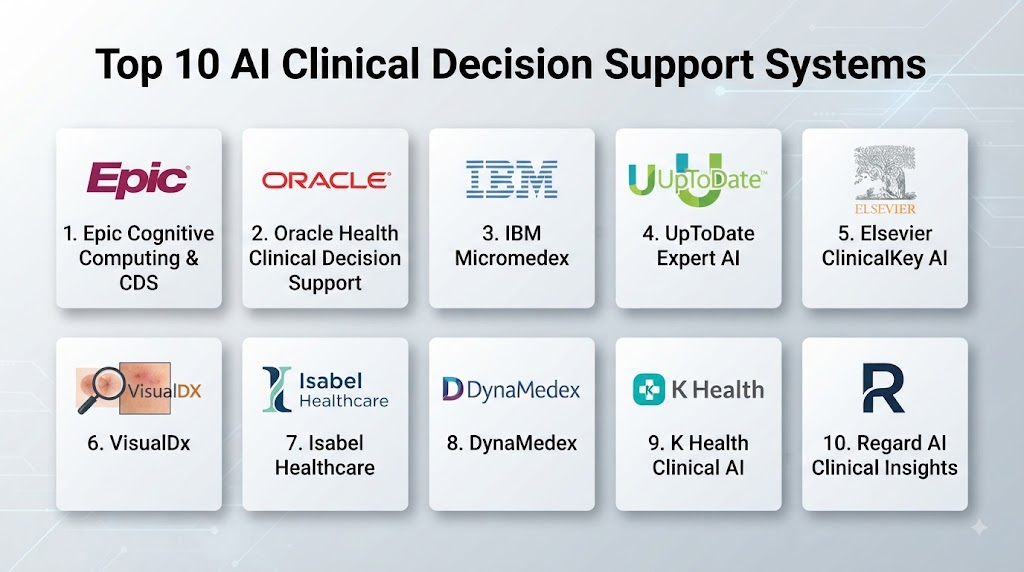
Top 10 AI Clinical Decision Support Systems
1 — UpToDate
One-line verdict: Best for clinicians seeking established evidence-based clinical information within a structured point-of-care decision-support environment.
Short description:
UpToDate is a widely used clinical decision-support resource covering diseases, diagnosis, treatment, medications, and clinical management. Its AI-related capabilities are increasingly relevant to clinicians looking for faster ways to interact with large amounts of clinical knowledge.
Standout Capabilities
- Evidence-based clinical content
- Point-of-care decision support
- Disease management information
- Treatment guidance
- Clinical topic search
- Medication information
- Specialty coverage
- Structured medical knowledge
AI-Specific Depth
- Model support: AI capabilities and underlying model architecture vary by product feature.
- RAG / knowledge integration: Strong integration with curated clinical knowledge; exact AI retrieval architecture varies.
- Evaluation: Clinical content undergoes editorial processes; AI-specific evaluation varies by feature.
- Guardrails: Structured medical content and professional review provide important safeguards.
- Observability: Enterprise AI monitoring details vary by product and deployment.
Pros
- Extensive clinical knowledge base.
- Familiar to many healthcare professionals.
- Strong emphasis on evidence-based clinical information.
Cons
- Primarily a clinical knowledge platform rather than a fully autonomous AI reasoning system.
- AI functionality varies across the product ecosystem.
- Licensing can be significant for large organizations.
Security & Compliance
Healthcare organizations should verify SSO, RBAC, audit logging, encryption, retention, residency, and applicable certifications for the exact enterprise deployment.
Deployment & Platforms
- Web: Yes
- Windows/macOS/Linux: Browser-based access
- iOS/Android: Available through supported clinical applications
- Deployment: Primarily hosted/cloud-based
Integrations & Ecosystem
UpToDate is designed for clinical environments and can be incorporated into broader healthcare workflows.
- EHR environments
- Clinical portals
- Mobile clinical applications
- Medical knowledge workflows
- Institutional authentication
- Clinical reference systems
Pricing Model
Subscription and enterprise licensing. Exact pricing varies by organization and configuration.
Best-Fit Scenarios
- Hospitals
- Physicians
- Academic medical centers
- Evidence-based point-of-care support
2 — OpenEvidence
One-line verdict: Best for clinicians seeking conversational access to medical evidence and research-oriented clinical questions.
Short description:
OpenEvidence is an AI-focused clinical knowledge platform designed to help healthcare professionals search and interact with medical evidence. Its conversational approach is particularly relevant to clinicians who want faster answers to complex medical questions.
Standout Capabilities
- Conversational medical search
- Clinical evidence retrieval
- Medical literature analysis
- Natural-language questions
- Evidence summarization
- Clinical question answering
- Research-oriented workflows
- Point-of-care information access
AI-Specific Depth
- Model support: AI-driven clinical information system; exact underlying model configuration may vary.
- RAG / knowledge integration: Evidence retrieval is central to the platform’s purpose.
- Evaluation: Clinical and evidence-quality evaluation varies by feature.
- Guardrails: Evidence-oriented workflows and source presentation provide important safeguards.
- Observability: Detailed enterprise observability capabilities vary.
Pros
- Natural-language clinical interaction.
- Designed around medical evidence.
- Can reduce time spent manually searching literature.
Cons
- Clinical answers still require professional judgment.
- AI-generated summaries can require verification.
- Exact capabilities may evolve rapidly.
Security & Compliance
Verify enterprise security, access controls, encryption, retention, residency, audit logging, and applicable certifications before using patient-specific information.
Deployment & Platforms
- Web: Yes
- Windows/macOS/Linux: Browser-based
- iOS/Android: Availability varies
- Deployment: Hosted/cloud-oriented
Integrations & Ecosystem
- Clinical workflows
- Medical literature
- Healthcare organizations
- Clinical research
- Professional knowledge systems
Pricing Model
Availability and pricing structures may vary by user type and organization.
Best-Fit Scenarios
- Physicians
- Medical researchers
- Evidence-intensive clinical environments
3 — ClinicalKey AI
One-line verdict: Best for healthcare organizations wanting AI-assisted clinical information discovery connected to a broad medical knowledge environment.
Short description:
ClinicalKey AI provides AI-assisted access to medical information and clinical content. It is particularly relevant to healthcare professionals who want natural-language interaction with a large clinical knowledge environment.
Standout Capabilities
- Clinical information retrieval
- Natural-language search
- Medical literature access
- Evidence discovery
- Clinical topic research
- Medical content summarization
- Point-of-care support
- Healthcare knowledge management
AI-Specific Depth
- Model support: AI capabilities vary by product functionality.
- RAG / knowledge integration: Strong integration with curated medical content.
- Evaluation: Content quality and AI evaluation vary by capability.
- Guardrails: Source-oriented medical content provides a foundation for safer use.
- Observability: Enterprise monitoring varies.
Pros
- Broad clinical knowledge ecosystem.
- Useful for evidence discovery.
- Suitable for institutional healthcare environments.
Cons
- AI capabilities may vary by subscription and product configuration.
- Generated information still requires clinician review.
- Full institutional deployment can require implementation work.
Security & Compliance
Verify enterprise privacy, encryption, SSO, RBAC, retention, auditability, and applicable certifications for the specific deployment.
Deployment & Platforms
- Web: Yes
- Windows/macOS/Linux: Browser-based
- iOS/Android: Supported clinical access varies
- Deployment: Hosted/cloud-oriented
Integrations & Ecosystem
- EHR workflows
- Clinical research
- Medical literature
- Institutional knowledge
- Healthcare organizations
- Clinical education
Pricing Model
Subscription and enterprise licensing. Exact pricing varies.
Best-Fit Scenarios
- Hospitals
- Medical schools
- Academic healthcare systems
4 — VisualDx
One-line verdict: Best for clinicians needing AI-assisted visual differential diagnosis support for dermatology and related conditions.
Short description:
VisualDx is a clinical decision-support resource with a strong emphasis on visual diagnosis. It can help clinicians evaluate dermatologic presentations and explore potential diagnoses using images and clinical information.
Standout Capabilities
- Visual differential diagnosis
- Dermatology support
- Clinical image references
- Differential diagnosis
- Medical condition information
- Point-of-care support
- Image-based clinical reasoning
- Specialty-oriented decision support
AI-Specific Depth
- Model support: AI and image-analysis capabilities vary by product functionality.
- RAG / knowledge integration: Strong visual and clinical knowledge integration.
- Evaluation: Clinical content is structured; AI-specific evaluation varies.
- Guardrails: Clinical reference content and professional review are important safeguards.
- Observability: Enterprise monitoring capabilities vary.
Pros
- Strong visual component.
- Useful for dermatology-oriented workflows.
- Supports differential diagnosis.
Cons
- More specialized than general clinical decision-support systems.
- Not designed for every medical specialty.
- Visual similarity does not guarantee diagnostic equivalence.
Security & Compliance
Verify enterprise security, authentication, access controls, data retention, residency, encryption, and applicable certifications.
Deployment & Platforms
- Web: Yes
- Windows/macOS/Linux: Browser-based
- iOS/Android: Supported
- Deployment: Hosted/cloud-oriented
Integrations & Ecosystem
- Clinical reference systems
- Medical image libraries
- Mobile clinical workflows
- Healthcare organizations
- Clinical education
Pricing Model
Subscription and institutional licensing. Exact pricing varies.
Best-Fit Scenarios
- Dermatology
- Primary care
- Emergency medicine
5 — Isabel Healthcare
One-line verdict: Best for clinicians seeking differential-diagnosis support when symptoms and clinical findings are complex or overlapping.
Short description:
Isabel Healthcare provides clinical decision-support technology focused on differential diagnosis. Its purpose is to help clinicians consider potential diagnoses that may otherwise be overlooked.
Standout Capabilities
- Differential diagnosis
- Symptom-based reasoning
- Clinical decision support
- Diagnosis exploration
- Clinical information organization
- Medical knowledge assistance
- Point-of-care workflows
- Diagnostic-support applications
AI-Specific Depth
- Model support: Proprietary clinical decision-support technology; exact model architecture varies.
- RAG / knowledge integration: Medical knowledge integration is central.
- Evaluation: Clinical evaluation varies by product capability.
- Guardrails: Designed as decision support rather than autonomous diagnosis.
- Observability: Enterprise monitoring details vary.
Pros
- Focused on differential diagnosis.
- Useful for complex or atypical presentations.
- Can encourage broader diagnostic consideration.
Cons
- Output should not be interpreted as a definitive diagnosis.
- Clinical context remains essential.
- Specialized workflows may require integration effort.
Security & Compliance
Verify security, encryption, authentication, data retention, residency, audit logging, and applicable certifications.
Deployment & Platforms
- Web: Yes
- Windows/macOS/Linux: Browser-based
- iOS/Android: Varies
- Deployment: Hosted/cloud-oriented
Integrations & Ecosystem
- Clinical workflows
- Hospital systems
- Physician applications
- Medical knowledge resources
- Diagnostic-support environments
Pricing Model
Subscription and enterprise/custom structures may vary.
Best-Fit Scenarios
- Complex diagnostic cases
- Primary care
- Emergency medicine
6 — Glass Health
One-line verdict: Best for clinicians and healthcare teams exploring AI-assisted clinical reasoning, documentation, and diagnostic decision support.
Short description:
Glass Health provides AI-oriented clinical tools designed to assist healthcare professionals with clinical reasoning and related workflows. It is particularly relevant to users interested in conversational AI applied to clinical decision-making.
Standout Capabilities
- Clinical reasoning assistance
- Differential diagnosis
- Clinical information organization
- Patient-case analysis
- Medical summarization
- Decision-support workflows
- Natural-language interaction
- Clinical documentation support
AI-Specific Depth
- Model support: Generative AI-based; exact underlying models and configurations may vary.
- RAG / knowledge integration: Clinical knowledge integration varies by capability.
- Evaluation: AI performance requires ongoing clinical evaluation.
- Guardrails: Safety controls and professional review are important.
- Observability: Detailed enterprise observability varies.
Pros
- Conversational clinical experience.
- Useful for organizing complex clinical reasoning.
- Flexible natural-language interaction.
Cons
- Generative AI can produce incorrect information.
- Human verification is essential.
- Enterprise governance should be assessed carefully before patient-data use.
Security & Compliance
Organizations should verify data handling, encryption, access controls, retention, residency, auditability, and certifications before deploying it with sensitive clinical information.
Deployment & Platforms
- Web: Yes
- Windows/macOS/Linux: Browser-based
- iOS/Android: Availability varies
- Deployment: Hosted/cloud-oriented
Integrations & Ecosystem
- Clinical workflows
- Medical information
- Documentation environments
- Healthcare applications
- AI-assisted reasoning
Pricing Model
Subscription and enterprise/custom models may vary.
Best-Fit Scenarios
- Physicians
- Clinical innovation teams
- AI-assisted reasoning pilots
7 — Pathway
One-line verdict: Best for clinicians seeking structured clinical pathways and evidence-oriented support for diagnosis and treatment decisions.
Short description:
Pathway is designed to provide clinical decision-support information around diagnosis and treatment. Its approach focuses on helping healthcare professionals navigate clinical pathways and relevant medical knowledge.
Standout Capabilities
- Clinical pathways
- Diagnostic support
- Treatment information
- Medical evidence
- Clinical decision support
- Point-of-care information
- Structured clinical guidance
- Healthcare education
AI-Specific Depth
- Model support: AI capabilities vary by product functionality.
- RAG / knowledge integration: Clinical knowledge integration is central.
- Evaluation: Clinical content and AI-specific evaluation vary.
- Guardrails: Structured clinical pathways can provide useful boundaries.
- Observability: Enterprise monitoring varies.
Pros
- Structured clinical information.
- Useful for point-of-care decision support.
- Supports clinical pathway thinking.
Cons
- Not intended to replace clinical judgment.
- Coverage varies by specialty and condition.
- AI capabilities may differ from conventional decision-support features.
Security & Compliance
Verify security, privacy, authentication, retention, residency, audit logging, and applicable certifications.
Deployment & Platforms
- Web: Yes
- Windows/macOS/Linux: Browser-based
- iOS/Android: Varies
- Deployment: Hosted/cloud-oriented
Integrations & Ecosystem
- Clinical workflows
- Medical education
- Healthcare organizations
- Clinical reference systems
- Point-of-care environments
Pricing Model
Subscription or institutional pricing may vary.
Best-Fit Scenarios
- Clinical education
- Point-of-care support
- Structured decision pathways
8 — Infermedica
One-line verdict: Best for healthcare organizations building AI-assisted symptom assessment and structured clinical triage experiences.
Short description:
Infermedica provides AI-powered healthcare technologies focused on symptom assessment, patient triage, and clinical decision support. Its technology is particularly relevant to digital-health organizations building structured patient-facing or clinician-supported assessment workflows.
Standout Capabilities
- Symptom assessment
- Clinical triage
- Differential diagnosis support
- Conversational health experiences
- Patient intake
- Clinical decision support
- Healthcare APIs
- Digital-health integration
AI-Specific Depth
- Model support: Proprietary healthcare AI.
- RAG / knowledge integration: Structured medical knowledge integration.
- Evaluation: Product-specific clinical validation varies.
- Guardrails: Structured clinical pathways can constrain AI interactions.
- Observability: API and enterprise monitoring capabilities vary.
Pros
- Strong focus on structured symptom assessment.
- Useful for digital-health applications.
- API-oriented architecture can support integration.
Cons
- More focused on assessment and triage than specialist clinical reasoning.
- Patient-facing use requires careful safety design.
- Integration and governance require technical resources.
Security & Compliance
Verify security architecture, encryption, access control, retention, residency, audit logging, and certifications applicable to the intended deployment.
Deployment & Platforms
- Web: Yes
- Windows/macOS/Linux: API and web integration
- iOS/Android: Can support integrated mobile experiences
- Deployment: Cloud/API-oriented
Integrations & Ecosystem
- Healthcare applications
- Patient portals
- Digital-health platforms
- APIs
- Triage workflows
- Clinical systems
Pricing Model
Enterprise/API-based pricing may vary according to usage and deployment.
Best-Fit Scenarios
- Digital-health companies
- Patient triage
- Healthcare intake workflows
9 — Ada Health
One-line verdict: Best for organizations evaluating AI-assisted symptom assessment and patient-facing healthcare navigation.
Short description:
Ada Health develops AI-based health assessment technology designed to help users understand symptoms and navigate potential health concerns. Its strongest use cases are patient-facing assessment and healthcare navigation rather than replacing clinician diagnosis.
Standout Capabilities
- Symptom assessment
- Conversational health interaction
- Patient education
- Health navigation
- Clinical reasoning support
- Digital-health workflows
- Personalized health information
- Patient intake
AI-Specific Depth
- Model support: Proprietary healthcare AI.
- RAG / knowledge integration: Structured medical knowledge integration.
- Evaluation: Product-specific clinical evaluation varies.
- Guardrails: Structured assessment workflows and safety mechanisms are important.
- Observability: Product-specific monitoring varies.
Pros
- Strong patient-facing experience.
- Useful for symptom assessment.
- Can support healthcare navigation.
Cons
- Not a substitute for professional diagnosis.
- Patient-facing AI requires careful safety messaging.
- Clinical utility depends on the intended workflow.
Security & Compliance
Organizations should verify applicable privacy, security, encryption, access, retention, residency, and regulatory requirements.
Deployment & Platforms
- Web: Supported
- Windows/macOS/Linux: Browser-based
- iOS/Android: Supported experiences vary
- Deployment: Hosted/cloud-oriented
Integrations & Ecosystem
- Patient applications
- Digital health
- Symptom assessment
- Healthcare navigation
- Clinical intake
Pricing Model
Consumer and enterprise arrangements may vary.
Best-Fit Scenarios
- Digital health
- Patient navigation
- Symptom assessment
10 — DynaMed
One-line verdict: Best for clinicians seeking structured evidence-based clinical decision support for diagnosis, treatment, and point-of-care questions.
Short description:
DynaMed is a clinical reference and decision-support resource designed for healthcare professionals. Its structured medical content makes it useful for clinicians who need concise, evidence-oriented information during patient care.
Standout Capabilities
- Clinical evidence
- Diagnosis support
- Treatment information
- Point-of-care reference
- Medical literature
- Clinical topic summaries
- Specialty information
- Evidence updates
AI-Specific Depth
- Model support: AI capabilities vary by current product functionality.
- RAG / knowledge integration: Strong integration with curated clinical knowledge.
- Evaluation: Content quality is governed through editorial processes; AI-specific evaluation varies.
- Guardrails: Structured clinical content provides useful boundaries.
- Observability: Enterprise AI monitoring varies.
Pros
- Structured clinical reference.
- Evidence-focused.
- Useful across multiple clinical specialties.
Cons
- More knowledge-resource oriented than fully autonomous generative AI.
- AI functionality varies by product configuration.
- Clinical judgment remains essential.
Security & Compliance
Verify enterprise security, access controls, encryption, retention, residency, auditability, and applicable certifications.
Deployment & Platforms
- Web: Yes
- Windows/macOS/Linux: Browser-based
- iOS/Android: Supported
- Deployment: Hosted/cloud-oriented
Integrations & Ecosystem
- Hospitals
- Medical schools
- Clinical workflows
- Mobile clinical applications
- Medical reference environments
Pricing Model
Subscription and institutional licensing. Exact pricing varies.
Best-Fit Scenarios
- Hospitals
- Physicians
- Academic medical centers
Comparison Table
| Tool | Best For | Deployment | Model Flexibility | Strength | Watch-Out | Public Rating |
|---|---|---|---|---|---|---|
| UpToDate | Evidence-based point-of-care support | Cloud | Hosted | Extensive clinical knowledge | AI capabilities vary by feature | N/A |
| OpenEvidence | Conversational medical evidence | Cloud | Hosted | Natural-language evidence retrieval | Generated answers require review | N/A |
| ClinicalKey AI | Clinical information discovery | Cloud | Hosted | Broad medical content | Feature availability varies | N/A |
| VisualDx | Visual differential diagnosis | Cloud | Hosted | Image-supported clinical reasoning | Specialty-focused | N/A |
| Isabel Healthcare | Differential diagnosis | Cloud | Hosted | Diagnostic support | Not autonomous diagnosis | N/A |
| Glass Health | AI clinical reasoning | Cloud | Hosted | Conversational reasoning | Hallucination risk | N/A |
| Pathway | Clinical pathways | Cloud | Hosted | Structured guidance | Coverage varies | N/A |
| Infermedica | Symptom assessment | Cloud/API | Proprietary | Digital triage | Requires careful safety design | N/A |
| Ada Health | Patient assessment | Cloud/mobile | Proprietary | Patient-facing experience | Not a diagnostic replacement | N/A |
| DynaMed | Evidence-based reference | Cloud | Hosted | Structured clinical knowledge | AI capabilities vary | N/A |
Scoring & Evaluation
The following scores are comparative editorial assessments rather than medical safety, diagnostic accuracy, or regulatory ratings.
The weighting favors clinical capabilities, reliability, safety, integrations, and security. Organizations should still perform their own clinical evaluation before deployment.
| Tool | Core | Reliability/Eval | Guardrails | Integrations | Ease | Perf/Cost | Security/Admin | Support | Weighted Total |
|---|---|---|---|---|---|---|---|---|---|
| UpToDate | 9.4 | 9.3 | 9.3 | 9.1 | 9.0 | 8.2 | 9.2 | 9.2 | 9.1 |
| OpenEvidence | 9.2 | 8.9 | 8.7 | 8.5 | 9.2 | 8.7 | 8.7 | 8.4 | 8.8 |
| ClinicalKey AI | 9.2 | 9.1 | 9.1 | 9.0 | 8.7 | 8.1 | 9.1 | 9.0 | 8.9 |
| VisualDx | 8.8 | 8.8 | 8.8 | 8.5 | 8.8 | 8.2 | 8.8 | 8.7 | 8.7 |
| Isabel Healthcare | 8.8 | 8.7 | 8.7 | 8.4 | 8.5 | 8.2 | 8.7 | 8.5 | 8.6 |
| Glass Health | 8.7 | 8.0 | 7.9 | 8.2 | 9.0 | 8.5 | 8.1 | 8.1 | 8.3 |
| Pathway | 8.6 | 8.7 | 8.6 | 8.3 | 8.7 | 8.2 | 8.6 | 8.5 | 8.5 |
| Infermedica | 8.6 | 8.4 | 8.5 | 9.0 | 8.4 | 8.3 | 8.6 | 8.4 | 8.5 |
| Ada Health | 8.5 | 8.4 | 8.5 | 8.5 | 9.0 | 8.3 | 8.6 | 8.4 | 8.5 |
| DynaMed | 9.0 | 9.1 | 9.1 | 8.7 | 8.7 | 8.1 | 9.0 | 8.9 | 8.8 |
Top 3 for Enterprise
- UpToDate — strong fit for established evidence-based clinical decision support across healthcare organizations.
- ClinicalKey AI — particularly relevant to institutions seeking AI-assisted access to broad clinical content.
- DynaMed — suitable for organizations prioritizing structured, evidence-oriented clinical information.
Top 3 for SMB
- UpToDate — strong general-purpose clinical reference and decision-support option.
- VisualDx — particularly useful for visual differential-diagnosis workflows.
- Isabel Healthcare — relevant for diagnostic-support scenarios involving complex differentials.
Top 3 for Developers
- Infermedica — strong fit for organizations building symptom assessment and triage workflows.
- OpenEvidence — relevant to AI-assisted evidence retrieval experiences.
- Glass Health — useful for teams exploring conversational clinical reasoning workflows.
Which AI Clinical Decision Support System Is Right for You?
Solo / Freelancer
Individual clinicians should prioritize evidence quality and clinical safety over the novelty of an AI model.
A useful system should:
- Provide trustworthy clinical information
- Identify supporting evidence
- Make uncertainty visible
- Avoid presenting guesses as facts
- Preserve clinician control
- Protect patient information
- Fit naturally into clinical practice
For individual physicians, established evidence-based clinical resources may be preferable to general-purpose AI systems because the provenance and editorial processes are easier to understand.
SMB
Smaller practices should begin with one clearly defined problem.
Examples include:
- Differential diagnosis
- Drug information
- Clinical evidence retrieval
- Dermatology decision support
- Patient symptom assessment
Avoid purchasing a broad AI platform without defining the workflow it is supposed to improve.
Measure:
- Time saved
- Clinical usefulness
- Search efficiency
- Clinician acceptance
- Error rate
- Verification burden
- Patient-data handling
Mid-Market
Mid-sized healthcare organizations should establish formal AI governance.
Create:
- AI approval processes
- Clinical owners
- Technical owners
- Evaluation criteria
- Data-protection policies
- Model inventories
- Incident procedures
- Monitoring policies
- Version tracking
- User training
AI should be evaluated using representative clinical scenarios rather than generic chatbot benchmarks alone.
Enterprise
Large healthcare organizations should consider clinical decision support as part of their broader clinical information architecture.
Important requirements include:
- EHR integration
- Clinical workflow integration
- Identity management
- Centralized governance
- Auditability
- Data residency
- Security
- Model monitoring
- Evidence traceability
- Clinical validation
- Change management
- Business continuity
Enterprise organizations should also consider whether AI systems can operate consistently across different hospitals, specialties, patient populations, and workflows.
Regulated Industries
Healthcare organizations should apply strong governance to AI systems that influence clinical decisions.
Evaluate:
- Intended use
- Regulatory status
- Clinical evidence
- Data handling
- Patient privacy
- Retention
- Residency
- Encryption
- Authentication
- Authorization
- Audit trails
- Model updates
- Vendor access
- Incident response
- Human oversight
For high-risk clinical applications, organizations should establish clear policies describing when AI can be used and when clinicians must independently verify information.
Budget vs Premium
The most expensive AI platform is not automatically the most valuable.
Consider:
- Number of users
- Clinical specialties
- Patient volume
- Query volume
- EHR integration
- Implementation effort
- Training
- Security review
- Support
- Data-processing costs
- Verification time
A cheaper system can become expensive if clinicians spend significant time correcting or verifying unreliable outputs.
Build vs Buy
Building a clinical decision-support system internally can be appropriate for organizations with strong AI, clinical informatics, software engineering, and governance capabilities.
A custom system may require:
- Medical knowledge sources
- Retrieval architecture
- LLM infrastructure
- Evaluation datasets
- Prompt management
- Clinical safety testing
- Guardrails
- Authentication
- Audit logging
- EHR integration
- Monitoring
- Incident response
- Model governance
A hybrid approach can be effective:
Established medical knowledge source + controlled AI interface + organization-specific clinical workflows.
Implementation Playbook
First 30 Days: Pilot + Success Metrics
Choose a narrow clinical workflow.
Examples:
- Evidence retrieval
- Differential diagnosis
- Medication information
- Specialty clinical questions
- Patient triage
Create a representative evaluation set.
Include:
- Straightforward cases
- Complex cases
- Rare conditions
- Ambiguous cases
- Cases with incomplete information
- High-risk cases
- Cases involving conflicting evidence
Measure:
- Accuracy
- Evidence relevance
- Hallucination rate
- Clinical usefulness
- Time saved
- Verification time
- User satisfaction
- Unsafe-response rate
Days 31–60: Security + Evaluation + Rollout
Build an AI evaluation harness.
Test:
- Clinical factuality
- Evidence grounding
- Hallucinations
- Contradictory information
- Missing information
- Ambiguous questions
- Unsafe recommendations
- Prompt injection
- Malicious clinical text
- Sensitive-data exposure
Implement appropriate guardrails.
Consider:
- Source restrictions
- Clinical disclaimers
- Human review
- Confidence indicators
- Evidence retrieval
- Prompt filtering
- Output validation
- Access controls
Security testing should include:
- Authentication
- Authorization
- Encryption
- Data retention
- Residency
- Audit logs
- Vendor access
- API security
- Incident response
Days 61–90: Cost, Latency, Governance + Scale
Once the system passes the initial evaluation:
- Expand to more clinicians.
- Monitor AI performance.
- Track user feedback.
- Monitor hallucinations.
- Review unsafe outputs.
- Measure latency.
- Track AI usage.
- Measure cost per interaction.
- Monitor model versions.
- Establish incident procedures.
- Create governance policies.
- Define escalation procedures.
For high-risk applications, maintain a formal review process for model changes.
Common Mistakes & How to Avoid Them
- Treating AI output as medical fact: Always consider the possibility of incorrect or incomplete information.
- Skipping clinical evaluation: Generic AI benchmarks do not prove clinical usefulness.
- No evidence verification: High-quality decision support should make it possible to assess supporting evidence.
- Ignoring hallucinations: Generative models can produce plausible but incorrect medical statements.
- Using AI without patient-data controls: Clinical information requires appropriate privacy and security safeguards.
- No human oversight: High-risk decisions should retain appropriate professional review.
- Ignoring prompt injection: AI connected to external or patient-generated information can encounter malicious instructions.
- Overtrusting confidence language: A confident AI response can still be wrong.
- Ignoring outdated knowledge: Clinical guidelines and medical evidence change.
- No model-version tracking: Changes in models can change clinical outputs.
- No audit trail: Organizations should know how AI was used in important clinical workflows.
- Ignoring bias: Performance can differ between populations and clinical settings.
- Using one benchmark for every specialty: Clinical AI evaluation should reflect the intended use.
- Over-automating treatment decisions: AI should not silently make high-impact decisions without appropriate controls.
- Poor EHR integration: Clinicians may ignore AI if it requires disruptive application switching.
- Ignoring latency: Slow decision support can be unusable during time-sensitive care.
- Ignoring cost: High-volume AI queries can create significant recurring expenses.
- No fallback: Clinical workflows should continue if the AI service is unavailable.
- No incident process: Organizations need a defined process for reporting and investigating AI-related errors.
- Choosing novelty over reliability: A sophisticated generative model is not automatically a better clinical decision-support system.
FAQs
What is an AI Clinical Decision Support System?
It is software that uses AI to provide information, analysis, evidence, predictions, or recommendations intended to assist healthcare professionals with clinical decisions.
Can AI Clinical Decision Support diagnose patients?
Some systems can support differential diagnosis or specific clinical tasks, but their exact capabilities and regulatory status vary. AI should not automatically be treated as an autonomous diagnostic authority.
Can AI replace doctors?
No. Clinical decision support is intended to assist healthcare professionals. Doctors and other qualified clinicians remain responsible for appropriate clinical decisions.
What is the difference between AI CDS and a medical chatbot?
AI CDS is designed around clinical workflows, medical information, and decision-support use cases. A general medical chatbot may not have the same evidence controls, validation, intended use, or governance.
Does AI CDS use medical literature?
Many systems integrate medical literature, clinical guidelines, curated databases, or other medical knowledge sources. The depth and source quality vary by product.
What is RAG in clinical AI?
Retrieval-augmented generation allows an AI model to retrieve relevant information from a controlled knowledge source before generating a response. This can help improve evidence grounding.
Can AI CDS hallucinate?
Yes. Generative AI systems can produce plausible but incorrect information. Clinical implementations should use appropriate evidence retrieval, evaluation, guardrails, and human review.
How should hospitals test clinical AI?
Hospitals should test representative clinical scenarios and evaluate factuality, evidence quality, hallucination rate, safety, bias, usability, workflow impact, and performance across relevant patient populations.
Can clinical AI use patient information?
Some systems can incorporate patient-specific information, but organizations must evaluate privacy, security, retention, residency, access controls, and appropriate contractual requirements.
Is cloud-based clinical AI safe?
Cloud deployment can be appropriate when properly designed and governed. Security depends on the architecture, controls, data handling, vendor practices, and healthcare organization’s configuration.
Can AI CDS integrate with an EHR?
Some systems can integrate with EHR environments or related clinical workflows. Integration capabilities vary considerably between products.
What is the role of FHIR?
FHIR provides standardized structures and interfaces for exchanging healthcare information. It can be useful when connecting AI decision-support systems to clinical data and workflows.
Can AI CDS analyze laboratory results?
Some systems can incorporate laboratory information when the necessary data integration is available. The capability depends on the specific platform.
Can AI CDS analyze medical images?
Some clinical AI platforms can incorporate imaging information, but dedicated medical imaging systems may be more appropriate for image-specific analysis.
What are AI guardrails?
Guardrails are controls designed to reduce unsafe, inappropriate, irrelevant, or unauthorized AI behavior. They can include input filtering, output validation, source restrictions, policy rules, and human review.
What is prompt injection in healthcare AI?
Prompt injection occurs when malicious or misleading instructions are introduced into information processed by an AI system, potentially causing unintended behavior.
How can hospitals reduce hallucinations?
Useful approaches include retrieval from controlled medical sources, evidence grounding, structured prompts, output validation, clinical evaluation, model monitoring, and human review.
Should AI provide treatment recommendations?
It depends on the specific intended use and clinical governance. Treatment-related AI requires particularly careful evaluation because incorrect recommendations can have direct patient-safety implications.
Can AI CDS support emergency medicine?
Yes. It can potentially assist with rapid evidence retrieval, differential diagnosis, triage, and other time-sensitive workflows, provided that latency, accuracy, and safety are appropriately evaluated.
Can AI CDS support oncology?
Yes. Potential applications include evidence retrieval, treatment information, clinical-trial discovery, biomarker interpretation, and case summarization. High-risk oncology decisions require particularly strong clinical oversight.
Can AI CDS support primary care?
Yes. Primary care can benefit from differential-diagnosis support, evidence retrieval, medication information, and patient-assessment workflows.
Is open-source AI suitable for clinical decision support?
Open-source models can be useful for research and controlled deployments, but clinical use requires appropriate validation, security, governance, monitoring, and regulatory consideration.
Should hospitals build their own AI CDS?
Building can make sense for organizations with strong clinical informatics and AI engineering capabilities. For many organizations, buying or integrating an established system is more practical.
How much does AI CDS cost?
Pricing varies considerably. Common models include subscription, per-user, enterprise licensing, usage-based, and custom contracts. Exact pricing should be evaluated against total implementation and verification costs.
What is the biggest risk with AI CDS?
One of the biggest risks is inappropriate trust in an incorrect or incomplete AI output. Clinical systems should therefore emphasize evidence, transparency, human oversight, and appropriate governance.
What should happen when clinicians disagree with AI?
The clinician should retain appropriate authority to reject or override AI output. Organizations should document important disagreements and use them to improve clinical AI evaluation and governance.
What is the future of AI Clinical Decision Support?
The category is likely to move toward multimodal reasoning, evidence-grounded AI, patient-specific context, automated evidence retrieval, clinical workflow agents, continuous evaluation, stronger governance, and deeper EHR integration.
Conclusion
AI Clinical Decision Support Systems are evolving from traditional medical reference databases and rule-based alerts into increasingly conversational and intelligent systems capable of retrieving evidence, organizing clinical information, supporting differential diagnosis, and assisting with complex clinical reasoningThe strongest systems are not necessarily those that generate the most sophisticated answers.They are the systems that can provide useful, evidence-grounded, clinically relevant information while clearly communicating limitations and preserving professional control.UpToDate remains highly relevant for structured evidence-based clinical information. OpenEvidence is particularly interesting for conversational medical evidence retrieval. ClinicalKey AI is relevant to organizations seeking AI-assisted access to broad clinical content. VisualDx is valuable for visual differential diagnosis, while Isabel Healthcare focuses strongly on diagnostic-support workflows. Glass Health represents the conversational clinical-reasoning direction of the market. Pathway emphasizes structured clinical guidance, while Infermedica and Ada Health are particularly relevant to symptom assessment and digital-health workflows. DynaMed remains a strong option for evidence-oriented clinical reference and decision support.