Introduction
AI Threat Intelligence Enrichment uses artificial intelligence to collect, analyze, correlate, and add context to security indicators and threat data. Instead of forcing analysts to manually investigate every IP address, domain, URL, file hash, email artifact, or suspicious user activity, these platforms can automatically connect indicators with threat intelligence, security telemetry, historical activity, and contextual information.The category is becoming increasingly valuable as security teams deal with massive quantities of alerts and threat data from SIEM, EDR, XDR, email security, network monitoring, cloud platforms, and external intelligence feeds. AI can help prioritize relevant intelligence, summarize findings, identify relationships, and support faster investigations.Common use cases include IOC enrichment, phishing analysis, malware investigation, threat-actor profiling, suspicious-domain analysis, incident investigation, vulnerability prioritization, threat hunting, and automated alert triage.
What’s Changed in AI Threat Intelligence Enrichment
- AI is increasingly being used to summarize large volumes of threat intelligence.
- Automated enrichment can combine multiple indicators into a single investigation context.
- Natural-language interfaces make threat-hunting queries easier for less experienced analysts.
- AI can help correlate domains, IP addresses, hashes, malware families, organizations, and threat actors.
- Agentic workflows can perform multiple enrichment steps before presenting findings to an analyst.
- Security teams are combining commercial intelligence with open-source intelligence and internal telemetry.
- AI-generated summaries are increasingly being validated against underlying evidence.
- Prompt-injection protection is important when intelligence sources contain attacker-controlled content.
- Model routing can help organizations balance investigation quality, latency, and AI operating costs.
- Data privacy is increasingly important when internal security telemetry is sent to AI services.
- Human review remains important for attribution and high-impact security decisions.
- Observability is becoming important for tracking enrichment requests, model usage, latency, and failures.
- AI can help identify relationships that may be difficult to discover through isolated indicator lookups.
- Automated enrichment is increasingly connected to SIEM, SOAR, XDR, EDR, case-management, and ticketing workflows.
- Organizations are paying more attention to the provenance and reliability of intelligence sources.
- AI-assisted threat intelligence should complement, rather than replace, analyst judgment.
Quick Buyer Checklist
- Indicator enrichment.
- IP reputation.
- Domain reputation.
- URL analysis.
- File-hash enrichment.
- Malware intelligence.
- Threat-actor intelligence.
- Vulnerability intelligence.
- Threat-feed integration.
- Internal telemetry integration.
- SIEM integration.
- SOAR integration.
- EDR/XDR integration.
- API access.
- Automated enrichment.
- Natural-language investigation.
- AI-generated summaries.
- Evidence traceability.
- Intelligence-source provenance.
- Data privacy.
- Data retention controls.
- Data residency options.
- Model flexibility.
- BYO model support.
- RAG or knowledge integration.
- Evaluation capabilities.
- Prompt-injection protection.
- RBAC and SSO.
- Audit logging.
- Cost and latency controls.
- Vendor lock-in considerations.
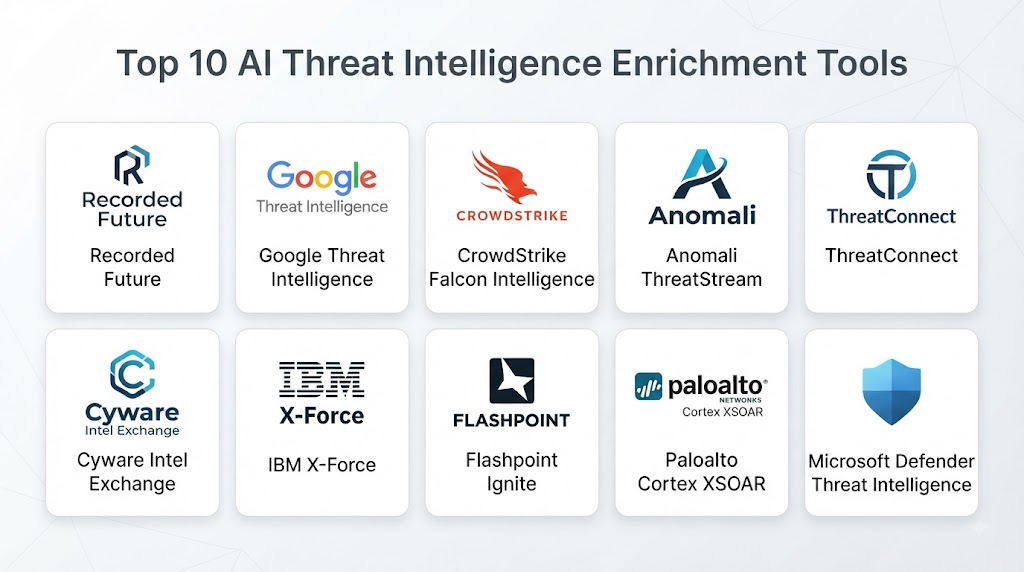
Top 10 AI Threat Intelligence Enrichment Tools
1. Recorded Future
One-line verdict: Best for enterprises needing broad threat intelligence, automated context, and intelligence-driven security investigations.
Short description
Recorded Future provides a broad threat intelligence platform designed to help security teams understand threats, indicators, vulnerabilities, and adversary activity. Its intelligence can support automated enrichment and investigation workflows across security operations.
Standout Capabilities
- Threat intelligence aggregation.
- Indicator enrichment.
- Threat-actor intelligence.
- Vulnerability intelligence.
- Malware intelligence.
- Automated intelligence analysis.
- Risk prioritization.
- Security operations integrations.
AI-Specific Depth
- Model support: AI capabilities are vendor-provided; specific model architecture is not publicly stated.
- RAG / knowledge integration: Large-scale intelligence knowledge and connected security data can provide contextual enrichment.
- Evaluation: Intelligence quality and source validation are important; specific AI evaluation mechanisms vary.
- Guardrails: Access controls and governed workflows can restrict security actions.
- Observability: Platform activity and intelligence workflows can be monitored; AI-specific telemetry varies.
Pros
- Broad intelligence coverage.
- Strong enterprise orientation.
- Useful context for security investigations.
Cons
- Enterprise-focused implementation.
- Pricing can be significant.
- Intelligence volume may require tuning and prioritization.
Security & Compliance
Enterprise security controls, access management, and auditing capabilities are available. Specific certifications and compliance coverage should be verified for the applicable service.
Deployment & Platforms
- Cloud.
- Web.
- APIs.
- Enterprise security environments.
Integrations & Ecosystem
Recorded Future is designed to integrate intelligence into existing security workflows.
- SIEM platforms.
- SOAR platforms.
- EDR/XDR.
- Vulnerability management.
- Security operations tools.
- APIs.
- Threat-intelligence workflows.
Pricing Model
Enterprise/custom pricing.
Best-Fit Scenarios
- Enterprise threat intelligence programs.
- Large SOC environments.
- Organizations requiring broad external intelligence.
2. Google Threat Intelligence
One-line verdict: Best for organizations wanting threat intelligence enriched by large-scale malware, web, and security research capabilities.
Short description
Google Threat Intelligence combines threat intelligence capabilities with extensive security research and intelligence resources. It can help security teams investigate indicators, malware, domains, and adversary activity.
Standout Capabilities
- Indicator investigation.
- Malware intelligence.
- Domain analysis.
- Threat-actor research.
- Threat intelligence feeds.
- Security research.
- Automated enrichment.
- Intelligence-driven investigation.
AI-Specific Depth
- Model support: Vendor-managed AI capabilities vary by service.
- RAG / knowledge integration: Threat intelligence and security knowledge provide contextual investigation capabilities.
- Evaluation: Intelligence validation and research processes support reliability; AI-specific evaluation varies.
- Guardrails: Enterprise access and security controls help govern use.
- Observability: Security activity and intelligence queries can be monitored.
Pros
- Strong threat research ecosystem.
- Broad intelligence context.
- Useful malware and indicator analysis.
Cons
- Advanced capabilities may require specialist expertise.
- Enterprise features can be complex.
- Pricing varies by configuration.
Security & Compliance
Enterprise security and access-management capabilities are available. Specific certifications should be confirmed for the selected service.
Deployment & Platforms
- Cloud.
- Web.
- APIs.
- Enterprise environments.
Integrations & Ecosystem
Google Threat Intelligence can support security operations through intelligence integrations.
- SIEM.
- SOAR.
- EDR/XDR.
- Malware analysis.
- Security analytics.
- APIs.
Pricing Model
Enterprise/custom pricing.
Best-Fit Scenarios
- Threat intelligence teams.
- Malware investigations.
- Enterprise security operations.
3. VirusTotal
One-line verdict: Best for rapid indicator investigation, malware analysis, reputation checks, and collaborative threat intelligence enrichment.
Short description
VirusTotal provides services for analyzing files, URLs, domains, and IP addresses using information from multiple security sources. It is commonly used by security analysts during triage and threat investigations.
Standout Capabilities
- File analysis.
- URL analysis.
- Domain investigation.
- IP investigation.
- Malware intelligence.
- Security-vendor detections.
- Indicator relationships.
- API-based enrichment.
AI-Specific Depth
- Model support: AI-related capabilities vary; specific model support is not publicly stated for all functionality.
- RAG / knowledge integration: Extensive security intelligence and relationships can provide investigation context.
- Evaluation: Multiple detection sources can provide comparative evidence; AI-specific evaluation varies.
- Guardrails: Access and service-level controls apply.
- Observability: API and investigation activity can be monitored depending on account and integration.
Pros
- Fast indicator investigation.
- Large security-community ecosystem.
- Useful API capabilities.
Cons
- Detection results can require analyst interpretation.
- Not every detection means an indicator is malicious.
- Advanced enterprise usage may require paid capabilities.
Security & Compliance
Security controls vary by service and subscription. Specific certifications should be verified where required.
Deployment & Platforms
- Web.
- Cloud.
- APIs.
Integrations & Ecosystem
VirusTotal can be incorporated into automated enrichment pipelines.
- SIEM.
- SOAR.
- Malware-analysis workflows.
- Threat-hunting tools.
- Security scripts.
- APIs.
Pricing Model
Free capabilities are available alongside paid and enterprise offerings.
Best-Fit Scenarios
- SOC investigations.
- Malware analysis.
- Automated IOC enrichment.
4. Microsoft Defender Threat Intelligence
One-line verdict: Best for Microsoft-centric security teams needing threat intelligence integrated into broader security operations.
Short description
Microsoft Defender Threat Intelligence provides threat intelligence capabilities for investigating infrastructure, indicators, domains, and adversary activity. It is particularly relevant to organizations using Microsoft’s broader security ecosystem.
Standout Capabilities
- Domain intelligence.
- IP intelligence.
- Infrastructure analysis.
- Threat-actor research.
- Indicator investigation.
- Security intelligence.
- Microsoft security integration.
- Threat-hunting support.
AI-Specific Depth
- Model support: Microsoft-managed AI capabilities vary across security products.
- RAG / knowledge integration: Security intelligence and connected Microsoft security data can provide contextual information.
- Evaluation: Security investigation workflows can be validated; AI-specific evaluation varies.
- Guardrails: Microsoft identity and access controls support governed use.
- Observability: Security activity can be monitored across the Microsoft security ecosystem.
Pros
- Strong Microsoft integration.
- Useful infrastructure intelligence.
- Enterprise security ecosystem.
Cons
- Strongest value may come from Microsoft-heavy environments.
- Advanced capabilities can require security expertise.
- Pricing varies by service.
Security & Compliance
Microsoft provides enterprise security, identity, access management, auditing, encryption, and governance capabilities. Specific certifications should be verified for the relevant service.
Deployment & Platforms
- Cloud.
- Web.
- APIs.
Integrations & Ecosystem
Microsoft Defender Threat Intelligence works within a broader security ecosystem.
- Microsoft Defender.
- SIEM.
- XDR.
- Threat-hunting workflows.
- Identity security.
- APIs.
Pricing Model
Subscription and enterprise/custom structures vary.
Best-Fit Scenarios
- Microsoft security environments.
- Threat-hunting teams.
- Enterprise SOCs.
5. MISP
One-line verdict: Best for organizations wanting flexible threat-intelligence sharing, structured indicators, and customizable enrichment workflows.
Short description
MISP is an open-source threat intelligence platform designed for collecting, storing, correlating, and sharing threat intelligence. It can act as a central intelligence repository and connect with external enrichment and automation systems.
Standout Capabilities
- Threat-intelligence sharing.
- IOC management.
- Event correlation.
- Structured threat information.
- Community intelligence sharing.
- APIs.
- Custom feeds.
- Automation support.
AI-Specific Depth
- Model support: No universal built-in AI model; AI can be incorporated through integrations.
- RAG / knowledge integration: MISP data can serve as a security knowledge source for external AI systems.
- Evaluation: AI evaluation depends on the external AI implementation.
- Guardrails: Platform permissions and organizational controls can govern data access.
- Observability: Events, feeds, and platform activity can be monitored.
Pros
- Open-source flexibility.
- Strong data ownership potential.
- Extensive customization opportunities.
Cons
- Requires technical administration.
- AI functionality generally requires additional components.
- Quality depends on intelligence sources and configuration.
Security & Compliance
Security depends significantly on deployment architecture and administration. Specific certifications are not applicable to the open-source platform as a universal service.
Deployment & Platforms
- Self-hosted.
- Linux environments.
- Web interface.
- APIs.
Integrations & Ecosystem
MISP supports integrations and feeds for threat intelligence workflows.
- Threat feeds.
- SIEM.
- SOAR.
- Security tools.
- Custom applications.
- APIs.
- Automation scripts.
Pricing Model
Open-source software with optional commercial services and hosting options from ecosystem providers.
Best-Fit Scenarios
- Security teams requiring data ownership.
- Research organizations.
- Custom threat-intelligence programs.
6. Anomali
One-line verdict: Best for enterprises seeking centralized threat intelligence management, indicator enrichment, and intelligence-driven security operations.
Short description
Anomali provides threat intelligence capabilities for collecting, analyzing, and operationalizing intelligence across security environments. Its platform can help organizations connect external intelligence with internal security investigations.
Standout Capabilities
- Threat intelligence management.
- Indicator enrichment.
- Threat-actor intelligence.
- Threat-feed management.
- Automated intelligence workflows.
- Security integrations.
- Intelligence correlation.
- Risk analysis.
AI-Specific Depth
- Model support: AI capabilities vary by product.
- RAG / knowledge integration: Threat intelligence and organizational security data can support contextual analysis.
- Evaluation: Intelligence validation and workflow testing vary by implementation.
- Guardrails: Enterprise permissions and access controls support governance.
- Observability: Intelligence workflows and platform activity can be monitored.
Pros
- Enterprise threat-intelligence focus.
- Strong intelligence operationalization.
- Useful integrations.
Cons
- Enterprise deployment can be complex.
- Pricing is generally custom.
- Requires good intelligence-management practices.
Security & Compliance
Enterprise security and administrative controls are available. Specific certifications should be verified for the applicable offering.
Deployment & Platforms
- Cloud.
- Enterprise.
- Web.
- APIs.
Integrations & Ecosystem
Anomali supports security operations integration.
- SIEM.
- SOAR.
- EDR/XDR.
- Threat feeds.
- Security analytics.
- APIs.
Pricing Model
Enterprise/custom pricing.
Best-Fit Scenarios
- Enterprise CTI teams.
- SOC enrichment.
- Threat-feed management.
7. ThreatConnect
One-line verdict: Best for organizations combining threat intelligence, analysis, orchestration, and structured security investigations.
Short description
ThreatConnect provides threat intelligence and security operations capabilities focused on helping teams operationalize intelligence. It supports the collection, analysis, correlation, and use of threat information in security workflows.
Standout Capabilities
- Threat intelligence management.
- Indicator analysis.
- Threat-actor research.
- Intelligence correlation.
- Security orchestration.
- Workflow automation.
- Case management.
- Security integrations.
AI-Specific Depth
- Model support: AI functionality varies by product and configuration.
- RAG / knowledge integration: Intelligence repositories can provide contextual security knowledge.
- Evaluation: Workflow validation is supported; AI-specific evaluation varies.
- Guardrails: Permissions and workflow controls support governed operations.
- Observability: Investigation and automation activity can be monitored.
Pros
- Combines intelligence and operations.
- Strong workflow capabilities.
- Useful for mature CTI programs.
Cons
- May require specialist knowledge.
- Advanced workflows need maintenance.
- Enterprise pricing can be significant.
Security & Compliance
Enterprise security controls are available. Specific certifications should be verified for the applicable offering.
Deployment & Platforms
- Cloud.
- Web.
- APIs.
- Enterprise environments.
Integrations & Ecosystem
ThreatConnect can connect intelligence with operational security systems.
- SIEM.
- SOAR.
- EDR.
- Threat feeds.
- Case-management systems.
- APIs.
Pricing Model
Enterprise/custom pricing.
Best-Fit Scenarios
- Mature CTI programs.
- Enterprise SOCs.
- Intelligence-driven incident response.
8. OpenCTI
One-line verdict: Best for teams wanting an open-source knowledge graph approach to threat intelligence and relationship-based analysis.
Short description
OpenCTI is an open-source threat intelligence platform built around structured threat information and relationships. Its knowledge-graph approach can help analysts connect threat actors, indicators, malware, infrastructure, vulnerabilities, and campaigns.
Standout Capabilities
- Threat-intelligence knowledge graph.
- Relationship mapping.
- STIX support.
- Threat-actor tracking.
- Indicator management.
- Intelligence visualization.
- API access.
- Extensible architecture.
AI-Specific Depth
- Model support: AI functionality depends on integrations and deployment.
- RAG / knowledge integration: Its structured knowledge graph can provide a useful source for external AI systems.
- Evaluation: AI evaluation depends on the connected implementation.
- Guardrails: Platform access controls can govern intelligence access.
- Observability: Platform and connector activity can be monitored.
Pros
- Open-source architecture.
- Relationship-focused intelligence.
- Strong customization potential.
Cons
- Requires technical administration.
- AI capabilities are not equivalent to dedicated AI-first platforms.
- Data quality depends on configured sources.
Security & Compliance
Security depends on deployment architecture and administration. Specific certifications are not universally applicable to the open-source platform.
Deployment & Platforms
- Self-hosted.
- Cloud deployment through supported hosting approaches.
- Web.
- Linux environments.
- APIs.
Integrations & Ecosystem
OpenCTI is designed for extensibility.
- STIX/TAXII.
- Threat feeds.
- SIEM.
- Security tools.
- Custom connectors.
- APIs.
- Automation.
Pricing Model
Open-source software with hosting and commercial service options varying by provider.
Best-Fit Scenarios
- Threat-intelligence research.
- Custom security environments.
- Organizations requiring knowledge-graph capabilities.
9. EclecticIQ
One-line verdict: Best for intelligence teams requiring structured threat intelligence management and operational integration across security environments.
Short description
EclecticIQ provides threat intelligence capabilities designed to help organizations collect, manage, analyze, and operationalize intelligence. It supports security teams that need to turn intelligence into actionable information.
Standout Capabilities
- Threat intelligence management.
- Intelligence collection.
- Indicator enrichment.
- Threat-actor analysis.
- Intelligence sharing.
- Threat-feed management.
- Security integrations.
- Operational intelligence.
AI-Specific Depth
- Model support: AI capabilities vary by product.
- RAG / knowledge integration: Intelligence repositories can support contextual enrichment.
- Evaluation: Intelligence-source validation and workflow testing vary.
- Guardrails: Enterprise access controls help govern intelligence usage.
- Observability: Platform activity can be monitored.
Pros
- Strong CTI orientation.
- Enterprise intelligence workflows.
- Useful integration capabilities.
Cons
- Primarily suited to mature security teams.
- Implementation can require specialist expertise.
- Pricing is generally custom.
Security & Compliance
Enterprise security and administrative controls are available. Specific certifications should be verified for the selected product and deployment.
Deployment & Platforms
- Cloud.
- Enterprise.
- Web.
- APIs.
Integrations & Ecosystem
EclecticIQ can connect intelligence to security workflows.
- SIEM.
- SOAR.
- Threat feeds.
- Security analytics.
- Case management.
- APIs.
Pricing Model
Enterprise/custom pricing.
Best-Fit Scenarios
- CTI teams.
- Enterprise intelligence programs.
- Intelligence sharing environments.
10. GreyNoise
One-line verdict: Best for distinguishing common internet background noise from potentially meaningful malicious activity during security investigations.
Short description
GreyNoise provides internet intelligence focused on identifying and contextualizing scanning and network activity. It can help security teams determine whether observed IP activity represents common background noise or warrants further investigation.
Standout Capabilities
- IP intelligence.
- Internet scanning context.
- Indicator enrichment.
- Noise reduction.
- Threat investigation.
- API access.
- Security integrations.
- Automated enrichment.
AI-Specific Depth
- Model support: Specific AI model support is not publicly stated for all capabilities.
- RAG / knowledge integration: Intelligence data can provide context for external AI workflows.
- Evaluation: Detection and classification quality should be validated against organizational use cases.
- Guardrails: API and account-level access controls apply.
- Observability: API usage and enrichment activity can be monitored depending on deployment.
Pros
- Useful for reducing investigation noise.
- Focused IP intelligence.
- Straightforward enrichment use cases.
Cons
- Narrower focus than full CTI platforms.
- Primarily useful for network and IP-related investigations.
- Advanced requirements may require additional intelligence sources.
Security & Compliance
Security controls vary by service and subscription. Specific certifications should be verified when required.
Deployment & Platforms
- Cloud.
- Web.
- APIs.
Integrations & Ecosystem
GreyNoise can be incorporated into security enrichment workflows.
- SIEM.
- SOAR.
- Threat-hunting tools.
- Firewalls.
- Security analytics.
- APIs.
Pricing Model
Subscription and enterprise/custom options vary.
Best-Fit Scenarios
- SOC alert enrichment.
- IP investigation.
- Reducing network-security noise.
Comparison Table
| Tool Name | Best For | Deployment | Model Flexibility | Strength | Watch-Out | Public Rating |
|---|---|---|---|---|---|---|
| Recorded Future | Enterprise CTI | Cloud | Hosted/integrations | Broad intelligence | Enterprise cost | N/A |
| Google Threat Intelligence | Malware and threat research | Cloud | Hosted/integrations | Research depth | Complexity | N/A |
| VirusTotal | IOC investigation | Cloud | Hosted/API | Fast enrichment | Requires interpretation | N/A |
| Microsoft Defender Threat Intelligence | Microsoft environments | Cloud | Hosted/integrations | Microsoft ecosystem | Platform dependency | N/A |
| MISP | Custom CTI | Self-hosted | Open/integrations | Flexibility | Administration | N/A |
| Anomali | Enterprise intelligence | Cloud | Hosted/integrations | Intelligence operationalization | Complexity | N/A |
| ThreatConnect | CTI + operations | Cloud | Hosted/integrations | Workflow integration | Cost | N/A |
| OpenCTI | Knowledge-graph CTI | Self-hosted | Open/integrations | Relationship analysis | Technical overhead | N/A |
| EclecticIQ | CTI teams | Cloud/Enterprise | Hosted/integrations | Intelligence management | Specialist skills | N/A |
| GreyNoise | IP intelligence | Cloud | Hosted/API | Noise reduction | Narrower scope | N/A |
Scoring & Evaluation
The scoring below is a comparative framework rather than an official vendor rating.
Scores consider overall capabilities for AI-assisted threat intelligence enrichment, including automation, intelligence integration, AI reliability, governance, and usability.
Actual performance depends heavily on intelligence sources, deployment architecture, integrations, analyst workflows, and the quality of internal telemetry.
Organizations should validate these assumptions with a representative pilot before making a purchasing decision.
| Tool | Core | Reliability/Eval | Guardrails | Integrations | Ease | Perf/Cost | Security/Admin | Support | Weighted Total |
|---|---|---|---|---|---|---|---|---|---|
| Recorded Future | 10 | 9 | 9 | 10 | 9 | 8 | 9 | 10 | 9.15 |
| Google Threat Intelligence | 10 | 10 | 9 | 9 | 8 | 9 | 9 | 10 | 9.25 |
| VirusTotal | 9 | 9 | 8 | 10 | 10 | 9 | 8 | 9 | 8.95 |
| Microsoft Defender Threat Intelligence | 9 | 9 | 9 | 10 | 9 | 9 | 10 | 10 | 9.30 |
| MISP | 9 | 8 | 8 | 10 | 7 | 10 | 8 | 8 | 8.55 |
| Anomali | 9 | 9 | 9 | 10 | 8 | 8 | 9 | 9 | 8.95 |
| ThreatConnect | 9 | 9 | 9 | 10 | 8 | 8 | 9 | 9 | 8.95 |
| OpenCTI | 9 | 8 | 8 | 9 | 7 | 10 | 8 | 8 | 8.40 |
| EclecticIQ | 9 | 9 | 9 | 9 | 8 | 8 | 9 | 9 | 8.85 |
| GreyNoise | 8 | 9 | 8 | 9 | 10 | 9 | 8 | 9 | 8.80 |
Top 3 for Enterprise
- Microsoft Defender Threat Intelligence — Strong choice for Microsoft-heavy enterprise environments.
- Google Threat Intelligence — Excellent for deep threat and malware investigation.
- Recorded Future — Strong broad-spectrum intelligence capabilities.
Top 3 for SMB
- VirusTotal — Practical for straightforward indicator enrichment.
- GreyNoise — Useful for reducing unnecessary investigation of internet scanning activity.
- MISP — Attractive when technical teams want greater control and customization.
Top 3 for Developers
- MISP — Strong API and open-source flexibility.
- OpenCTI — Useful for building relationship-driven intelligence workflows.
- VirusTotal — Practical for API-driven indicator investigation.
Which AI Threat Intelligence Enrichment Tool Is Right for You?
Solo / Freelancer
For individual security researchers and small security teams, a complete enterprise CTI platform may be unnecessary.
Start with tools that provide:
- IP enrichment.
- Domain analysis.
- URL investigation.
- Hash analysis.
- API access.
- Basic automation.
The priority should be fast investigation rather than building a complex intelligence program.
SMB
SMBs should focus on integrations and practical enrichment.
A useful platform should connect with the existing SIEM, EDR, email-security system, and ticketing platform without requiring a dedicated intelligence engineering team.
Mid-Market
Mid-market organizations should consider centralized intelligence management.
Important capabilities include:
- Automated IOC enrichment.
- Threat-feed integration.
- Internal telemetry correlation.
- API support.
- Intelligence scoring.
- Threat-actor context.
- Automated case enrichment.
- AI-assisted investigation.
Enterprise
Enterprise organizations should prioritize intelligence breadth and governance.
Look for:
- Multiple intelligence sources.
- Intelligence provenance.
- RBAC.
- SSO.
- Audit logging.
- Data-retention controls.
- API scalability.
- SIEM/SOAR integration.
- AI governance.
- Model controls.
- Human review.
- Workflow automation.
Regulated Industries
Organizations operating in regulated environments should carefully assess how sensitive security telemetry is handled.
Important questions include:
- Where is data processed?
- Is customer data retained?
- Can AI providers use submitted information for model improvement?
- What access controls are available?
- Can intelligence records be audited?
- Can sensitive data be excluded from external AI services?
Budget vs Premium
Budget-focused teams can start with individual enrichment APIs and open-source intelligence platforms.
Premium platforms become more attractive when organizations need large-scale intelligence coverage, advanced correlation, automated enrichment, threat-actor research, and enterprise support.
Build vs Buy
Building an enrichment pipeline can make sense when the organization has strong engineering resources and specialized intelligence requirements.
Buying a platform is usually more efficient when the organization needs numerous integrations, maintained intelligence feeds, analyst workflows, commercial research, and enterprise governance.
Implementation Playbook: 30 / 60 / 90 Days
30 Days: Pilot + Success Metrics
Start with a small set of high-volume indicators.
- Select IP, domain, URL, and hash enrichment use cases.
- Connect the primary SIEM or security platform.
- Define intelligence sources.
- Establish enrichment priorities.
- Measure analyst investigation time.
- Create an AI evaluation dataset.
- Record false-positive rates.
- Establish evidence requirements for AI-generated summaries.
60 Days: Harden Security + Evaluation + Rollout
Expand enrichment while strengthening controls.
- Implement RBAC.
- Configure SSO where available.
- Review data retention.
- Validate intelligence-source provenance.
- Test prompt-injection scenarios.
- Evaluate AI-generated summaries.
- Establish human-review requirements.
- Version prompts and enrichment workflows.
- Add additional intelligence sources.
- Document failure-handling procedures.
90 Days: Optimize Cost/Latency + Governance + Scale
Move from pilot to operational scale.
- Monitor API usage.
- Measure AI inference costs.
- Optimize enrichment frequency.
- Cache repeat lookups where appropriate.
- Improve model routing.
- Reduce unnecessary AI calls.
- Establish intelligence-quality reviews.
- Monitor enrichment latency.
- Create incident-handling procedures.
- Conduct regular AI red-team exercises.
- Review vendor dependency.
Common Mistakes & How to Avoid Them
- Treating every indicator as malicious: Reputation information should be interpreted within context.
- Ignoring intelligence provenance: Analysts should know where important intelligence originated.
- Overtrusting AI summaries: Preserve access to the underlying evidence.
- Sending sensitive telemetry to AI services without review: Understand data handling before deployment.
- No evaluation dataset: Test AI enrichment using realistic organizational incidents.
- Ignoring prompt injection: Treat external intelligence content as potentially untrusted.
- Using too many feeds: More feeds do not automatically mean better intelligence.
- Failing to normalize indicators: Standardize formats before correlation.
- Ignoring duplicate intelligence: Deduplication can reduce unnecessary processing.
- No cost monitoring: Automated enrichment can generate significant API and AI usage.
- No human review for attribution: Threat-actor attribution can be uncertain and should not be treated as absolute.
- Ignoring false positives: Automated enrichment should improve triage rather than create additional noise.
- Poor integration design: Failed APIs and outdated connectors can disrupt workflows.
- Creating excessive automation: Automate predictable enrichment before automating high-impact security actions.
FAQs
What is AI Threat Intelligence Enrichment?
AI Threat Intelligence Enrichment uses artificial intelligence to add context to security indicators such as IP addresses, domains, URLs, hashes, vulnerabilities, and threat actors.
How does AI improve threat intelligence enrichment?
AI can summarize intelligence, correlate related indicators, identify relationships, prioritize information, and help analysts understand large quantities of security data faster.
What indicators can be enriched?
Common indicators include IP addresses, domains, URLs, file hashes, email addresses, vulnerabilities, malware families, threat actors, and infrastructure identifiers.
Can AI threat intelligence enrichment work with a SIEM?
Yes. Many intelligence platforms provide APIs or integrations that allow enrichment results to be incorporated into SIEM alerts and investigation workflows.
Can organizations use their own AI model?
Model flexibility varies. Some platforms provide vendor-managed AI while others can be connected to external models through APIs or custom integrations.
Is threat intelligence enrichment safe for sensitive security data?
It depends on the platform and configuration. Organizations should review data processing, retention, residency, access controls, and whether submitted information can be used for model improvement.
Can AI automatically determine whether an indicator is malicious?
AI can assist with classification, but it should not automatically be treated as an unquestionable source of truth. Multiple intelligence sources and analyst review can improve confidence.
What is the role of RAG in threat intelligence?
RAG can allow an AI system to retrieve relevant intelligence from approved knowledge sources before generating an answer, helping connect AI responses to organizational threat data.
How should AI threat intelligence accuracy be evaluated?
Use historical and synthetic security cases to measure enrichment accuracy, relevance, false positives, missing context, evidence quality, consistency, and analyst acceptance.
Does threat intelligence enrichment require a dedicated CTI team?
Not always. Smaller organizations can use automated enrichment services, while mature enterprises may benefit from dedicated threat intelligence analysts and engineering teams.
Can MISP be used for AI threat intelligence enrichment?
Yes. MISP can provide structured threat intelligence that can be connected to external AI systems, SIEM platforms, SOAR workflows, and custom enrichment pipelines.
What is the difference between threat intelligence and threat enrichment?
Threat intelligence is the broader collection and analysis of information about threats. Enrichment adds relevant context to a specific indicator, alert, or investigation.
How can organizations reduce AI enrichment costs?
Use deterministic lookups for simple indicators, cache repeated results, route only complex investigations to AI, monitor API usage, and avoid sending unnecessary data to AI models.
Can AI threat intelligence enrichment detect unknown threats?
AI can identify patterns and relationships that may support detection of previously unseen activity, but it cannot guarantee discovery of every unknown threat.
How can organizations avoid vendor lock-in?
Use standard formats and APIs where possible, maintain independent copies of important intelligence, document enrichment workflows, and keep critical intelligence pipelines portable.
Conclusion
AI Threat Intelligence Enrichment can significantly improve the speed and context of modern security investigations. Instead of examining indicators individually, security teams can combine external intelligence, internal telemetry, historical activity, and AI-assisted analysis into a more complete investigation.The strongest solutions are not necessarily those with the most AI features. They are the platforms that provide reliable intelligence, strong integrations, evidence-backed analysis, useful automation, privacy controls, and clear governance.Enterprise teams may benefit from broad commercial intelligence platforms, while smaller teams can often achieve meaningful results with focused enrichment services or open-source platforms.