Introduction
The shift toward automated, code-driven cloud infrastructure has made DevOps expertise essential for modern software delivery. However, with hundreds of tools and cloud platforms available, finding the right starting point can be overwhelming. Best DevOps Certifications Instead of collecting random certificates, choosing a strategic certification path provides a structured roadmap to master core skills like continuous integration, container orchestration, and Infrastructure as Code (IaC). Whether you are a developer learning infrastructure or a systems administrator shifting to automation, the right credential validates your practical ability to solve complex production problems under pressure.
Why DevOps Certifications Matter
- Structured Knowledge Acquisition: Preparing for a well-designed exam forces you to explore features, edge cases, and architectural best practices you might not encounter in your day-to-day work.
- Validation of Technical Skills: While GitHub repositories and project portfolios prove you can write code, an industry-standard certification provides independent validation of your skills, helping you pass initial HR filters.
- Alignment with Market Demand: Major cloud platforms and container runtimes shape how modern enterprises operate. Certifications ensure your skills match current industry trends, such as GitOps workflow deployment, automated compliance, and cloud-native security.
- Architectural Standard Uniformity: Studying official certification paths helps teams adopt shared definitions, design principles, and operational frameworks. This leads to cleaner codebases and more reliable deployment pipelines.
Who Should Read This Guide
- Systems Administrators & Linux Engineers: Professionals looking to move away from manual server configuration and embrace automated, code-driven infrastructure.
- Software Developers: Engineers aiming to understand the deployment lifecycle, bridge the gap between application code and runtime environments, and build reliable software.
- Cloud and Infrastructure Engineers: Practitioners working with cloud resources who want to formalize their skills in multi-tenant architectures and infrastructure automation.
- Technical Managers & Team Leads: Leaders looking to build effective training roadmaps for their engineering teams and align team skills with modern cloud-native standards.
Types of DevOps Certifications
Foundation Certifications
These entry-level credentials focus on core principles, culture, terminology, and high-level workflows. They are ideal for project managers, business analysts, and junior engineers establishing a conceptual baseline before diving into code and configuration.
Tool-Based Certifications
These certifications focus deeply on specific open-source tools or enterprise platforms that handle automation, configuration, and orchestration.
- Containerization & Orchestration: Credentials centered on runtime environments, microservices isolation, and production-grade scheduling using Docker and Kubernetes.
- Infrastructure as Code (IaC): Exams that validate your ability to safely provision, version, and manage multi-cloud infrastructure declaratively using languages like HCL (HashiCorp Configuration Language).
- Version Control & CI/CD: Frameworks assessing competence in distributed version control, branching strategies, and continuous integration engines like Jenkins or GitHub Actions.
Cloud DevOps Certifications
Platform-specific tracks offered by major cloud providers (AWS, Microsoft Azure, Google Cloud). They validate an engineer’s capacity to deploy, monitor, and maintain highly available systems using native cloud services and proprietary scaling tools.
DevSecOps Certifications
Advanced certifications focusing on shifting security left. They cover automated dependency scanning, container runtime security, secret management, and compliance-as-code integration directly within the delivery pipeline.
SRE and Platform Engineering Certifications
Credentials focused on large-scale system reliability, observability, error budgets, incident response, and building internal developer platforms (IDPs) that minimize friction for software engineering teams.
Advanced Certifications
Niche credentials targeting specialized practices such as GitOps, Machine Learning Operations (MLOps), Artificial Intelligence for IT Operations (AIOps), and cloud financial management (FinOps).
Best DevOps Certifications at a Glance
| Certification Name | Best For | Level | Difficulty | Main Skills | Career Scope |
| DevOps Foundation | Beginners, Managers | Foundational | Low | Principles, Terminology, Core Workflows | Cultural baseline, non-technical roles |
| Docker Certified Associate (DCA) | Containerization Basics | Intermediate | Medium | Image Creation, Storage, Networking | Entry-to-mid level infrastructure roles |
| Certified Kubernetes Administrator (CKA) | Cluster Orchestration | Intermediate to Advanced | High | Cluster Architecture, Troubleshooting, Networking | Extremely high demand across enterprise environments |
| Terraform Associate | Multi-Cloud Provisioning | Intermediate | Medium | Infrastructure as Code, State Management | Standard requirement for automation roles |
| AWS DevOps Engineer – Professional | AWS-Centric Infrastructure | Advanced | High | Cloud Automation, High Availability, Logging | Dominant market share, high enterprise visibility |
| Azure DevOps Engineer Expert | Enterprise Azure Environments | Advanced | High | Azure Pipelines, Git, Release Management | Critical for corporate enterprise ecosystems |
| Google Cloud DevOps Engineer | GCP Site Reliability | Advanced | High | SRE Principles, Metrics, Cloud Build | Highly valued in data-intensive scale-ups |
Detailed Certification Analysis
Certified Kubernetes Administrator (CKA)
What It Is
The CKA is a practical, performance-based exam developed by the Cloud Native Computing Foundation (CNCF) in partnership with The Linux Foundation. It tests an engineer’s ability to install, configure, manage, and troubleshoot production-grade Kubernetes clusters.
Who Should Take It
System administrators, cloud engineers, and DevOps professionals responsible for managing containerized workloads in production environments.
Best Career Fit
- Kubernetes Infrastructure Engineer
- Cloud Native Architect
- Site Reliability Engineer (SRE)
Difficulty Level
Advanced (Performance-based, hands-on command-line exam).
Career Scope
Kubernetes is the industry standard for container orchestration. Holding a CKA proves you can handle real-world system failures under pressure, making it highly valuable to employers.
Skills You Will Learn
- Configuring and managing production-ready Kubernetes clusters.
- Setting up cluster networking, persistent storage volume plugins, and ingress controllers.
- Troubleshooting node failures, broken control plane components, and misconfigured core DNS.
- Implementing application lifecycle management strategies, including rolling updates and rollbacks.
- Securing cluster access using role-based access control (RBAC) definitions.
Tools Covered
- Kubernetes (
kubeadm,kubectl) - Container Runtimes (
containerd) - Core System Utilities (
systemd,journalctl,openssl)
Exam Details
- Format: Hands-on performance-based tasks via a command-line interface.
- Duration: 2 Hours.
- Passing Score: 66%.
- Validity: 2 Years.
- Cost: Varies by provider.
Study Roadmap
- Master fundamental Linux administration, including systemd service management and network diagnostics.
- Learn Docker containerization basics, focusing on images, multi-stage builds, and basic networking.
- Complete a structured course, such as “Kubernetes the Hard Way” to understand control plane interactions.
- Practice extensively on interactive terminal environments to build speed and accuracy with
kubectl.
Real-World Use Cases
Production engineers use these skills to diagnose why an enterprise application cluster is failing to pull images, fix broken internal networking paths, configure ingress certificates, and safely drain worker nodes for rolling kernel upgrades without interrupting users.
Pros
- Performance-based structure filters out rote memorization.
- High industry recognition across cloud providers and enterprises.
- Strongly reinforces fundamental Linux networking and operating system skills.
Cons
- High difficulty curve can be discouraging for complete beginners.
- Requires continuous practice to maintain command-line speed.
Best Recommendation
- Choose it if: You actively manage or plan to deploy workloads on cloud-native container platforms.
- Avoid it if: You lack foundational knowledge of Linux command lines and basic networking protocols.
- Best career stage: Mid-level engineer aiming for advanced infrastructure or platform engineering positions.
HashiCorp Certified: Terraform Associate
What It Is
An official knowledge-based certification that validates an engineer’s understanding of open-source Terraform features, multi-cloud provisioning concepts, and declarative infrastructure-as-code paradigms.
Who Should Take It
Cloud engineers, automation specialists, and developers looking to safely build, modify, and version infrastructure across multiple cloud platforms.
Best Career Fit
- Cloud Automation Engineer
- DevOps Engineer
- Platform Engineer
Difficulty Level
Intermediate.
Career Scope
Terraform is a widely adopted vendor-neutral tool for infrastructure provisioning. This certification is a strong addition to any cloud engineer’s profile.
Skills You Will Learn
- Writing, modifying, and refactoring declarative infrastructure layouts using HCL.
- Managing state files safely and implementing state locking to prevent deployment collisions.
- Creating reusable, modular configuration structures for development, staging, and production environments.
- Utilizing variables, outputs, functions, and dynamic blocks to build flexible infrastructure definitions.
- Integrating Terraform cloud workflows within continuous deployment setups.
Tools Covered
- Terraform OSS / Terraform Cloud
- Provider plug-ins (AWS, Azure, GCP APIs)
Exam Details
- Format: Multiple-choice, multiple-select, and text-match questions.
- Duration: 1 Hour.
- Passing Score: Varies by provider.
- Validity: 2 Years.
- Cost: Varies by provider.
Study Roadmap
- Deploy simple resources (like single VM instances or virtual networks) manually on a cloud provider to understand the workflow.
- Recreate those exact resources using standard Terraform configuration blocks (
resource,provider). - Study state file management, focusing on remote backends with tracking dynamic lock tables.
- Review the official HashiCorp documentation regarding built-in functions, lifecycle hooks, and CLI commands (
plan,apply,refresh).
Real-World Use Cases
Engineers use Terraform to spin up identical development, staging, and production networks in minutes. This ensures environments remain consistent and prevents configuration drift between teams.
Pros
- Low cost barrier with high industry adoption.
- Provides vendor-neutral skills that apply to AWS, Azure, and Google Cloud alike.
- Teaches clean architectural design principles based on declarative configurations.
Cons
- The exam format is purely conceptual and lacks a live performance-based lab component.
Best Recommendation
- Choose it if: You want to specialize in infrastructure automation, cloud migrations, and scalable system architectures.
- Avoid it if: You do not have a working knowledge of at least one public cloud ecosystem.
- Best career stage: Early-to-mid level engineers establishing automated environment deployment skills.
AWS Certified DevOps Engineer – Professional
What It Is
An advanced, comprehensive certification that tests your ability to design, manage, and maintain automated distributed applications on the Amazon Web Services platform.
Who Should Take It
Experienced cloud systems engineers and technical architects who manage highly available AWS infrastructure deployments.
Best Career Fit
- Senior Cloud DevOps Engineer
- AWS Infrastructure Architect
- Site Reliability Engineer (SRE)
Difficulty Level
Advanced / High.
Career Scope
As AWS continues to hold a dominant share of the global cloud market, this certification is highly respected by enterprises, system integrators, and consulting partners worldwide.
Skills You Will Learn
- Building continuous delivery systems using native tools like AWS CodePipeline and CodeDeploy.
- Enforcing security guardrails and automated compliance policies using AWS Config and Service Catalog.
- Designing and configuring high-availability architectures with automated auto-scaling and cross-region failovers.
- Setting up centralized logging and real-time monitoring metrics using CloudWatch, X-Ray, and OpenSearch.
- Implementing automated healing workflows to respond to infrastructure degradation.
Tools Covered
- AWS Developer Tools (CodeCommit, CodeBuild, CodeDeploy, CodePipeline)
- AWS Management & Governance Services (CloudFormation, Systems Manager, CloudTrail, Config)
- Core Compute/Networking (EC2, ECS, EKS, Lambda, Route53, ALB)
Exam Details
- Format: Multiple-choice and multiple-response scenario questions.
- Duration: 180 Minutes.
- Passing Score: Varies by provider.
- Validity: 3 Years.
- Cost: Varies by provider.
Study Roadmap
- Complete the AWS Certified SysOps Administrator or Developer Associate path to build a baseline understanding of the platform.
- Build multi-stage deployments using CloudFormation, focusing on custom resources and nested stacks.
- Study advanced branching strategies and deployment techniques, such as blue-green, canary, and rolling deployments on ECS and EC2.
- Analyze complex architectural failure scenarios to practice identifying root causes under pressure.
Real-World Use Cases
Engineers use these skills to build fully automated pipelines that deploy microservices across multiple AWS accounts, monitor performance metrics, and rollback deployments automatically if error rates spike.
Pros
- Deeply covers architectural design patterns for enterprise cloud infrastructure.
- High industry value and visibility with recruiters.
- Validates advanced disaster recovery and automated governance skills.
Cons
- Focuses heavily on proprietary AWS tools rather than vendor-neutral open-source alternatives.
- Long, complex exam scenarios require strong reading stamina.
Best Recommendation
- Choose it if: Your daily work is centered on the AWS cloud ecosystem and you want to master advanced automation patterns.
- Avoid it if: You operate in a multi-cloud environment or prefer vendor-neutral, open-source tool chains.
- Best career stage: Senior system engineers looking to validate their cloud architecture expertise.
DevOps Certification Comparison Table
| Certification | Best For | Level | Main Focus | Difficulty | Recommended Role | Link |
| DevOps Certified Professional (DCP) | Core Lifecycle Automation | Foundational | CI/CD, Git, Jenkins, Core Workflows | Low | Junior DevOps Engineer | View Course |
| DevSecOps Certified Professional (DSOCP) | Pipeline Vulnerability Scanning | Advanced | Shift-Left Security, SAST/DAST, Compliance | High | DevSecOps Engineer | View Course |
| Site Reliability Engineering (SRE) | System Resiliency & Observability | Advanced | SLOs, Error Budgets, Chaos Engineering | High | Site Reliability Engineer | View Course |
| Master in DevOps Engineering (MDE) | End-to-End Enterprise Strategy | Expert | Architecture Design & Production Release | High | Senior DevOps Architect | View Course |
| Master in Azure DevOps | Microsoft Ecosystem Specialists | Advanced | Azure Pipelines, Boards, Repos Setup | Medium | Azure Cloud Engineer | View Course |
| AWS Certified DevOps Professional | Amazon Web Services Architecture | Advanced | AWS Developer Tools, CloudFormation, Auto Scaling | High | AWS Infrastructure Engineer | View Course |
| Master in Python Programming | Infrastructure Automation Scripting | Intermediate | Scripting, Custom CLI Tools, API Automation | Medium | Automation Engineer / Developer | View Course |
| Certified Kubernetes Administrator (CKA) | Production Container Orchestration | Advanced | Cluster Architecture, Networking, Troubleshooting | High | Kubernetes Specialist | View Course |
| Docker Certified Associate (DCA) | Application Containerization | Intermediate | Image Optimization, Container Runtimes, Volumes | Medium | Systems Administrator | View Course |
| Google Cloud DevOps Engineer | Google Cloud Native Platforms | Advanced | GKE Administration, GCP Operations Suite | High | GCP Cloud Engineer | View Course |
| Master in Data Science | Enterprise Data Engineering | Advanced | Statistical Analytics, Scalable Data Pipelines | High | Data Infrastructure Engineer | View Course |
| Hashicorp Certified Terraform Associate | Multi-Cloud Infrastructure as Code | Intermediate | Declarative State Files, Module Management | Medium | Cloud Automation Specialist | View Course |
| Master in Artificial Intelligence | Intelligent System Automation | Advanced | Neural Networks, Automated Model Training | High | AI Operations Specialist | View Course |
| Master in Deep Learning | Advanced Model Topologies | Advanced | Complex Layer Compute, Topology Deployments | High | Deep Learning Engineer | View Course |
| GitOps Certified Professional (GOCP) | Declarative Continuous Delivery | Intermediate | ArgoCD, Flux, Git-Driven Cluster State | Medium | Platform Engineer | View Course |
| Envoy ISTIO Certification Training | Microservices Service Mesh | Advanced | Traffic Splitting, mTLS Encryption, Sidecars | High | Network Infrastructure Architect | View Course |
| Prometheus with Grafana | Cloud-Native Systems Monitoring | Intermediate | Time-Series Metrics, Dashboard Visuals, Alerting | Medium | Monitoring & Operations Engineer | View Course |
| MLOps Certification Training Course | Machine Learning Pipeline Scale | Advanced | Model Lifecycle Automation, Data Versioning | High | MLOps Engineer | View Course |
| Master in Machine Learning | Predictive Operational Algorithms | Advanced | Supervised/Unsupervised Modeling Deployments | High | ML Infrastructure Engineer | View Course |
| Master in AppDynamics | Enterprise Performance Tracking | Intermediate | APM Dashboards, JVM/CLR Code Diagnostics | Medium | Application Support Engineer | View Course |
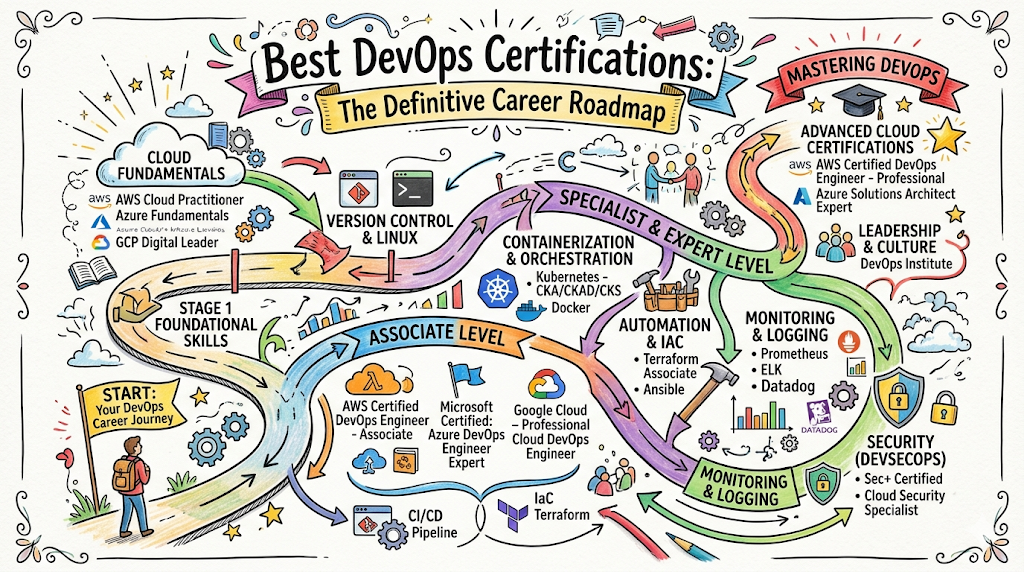
DevOps Certification Roadmap
Phase 1: The Foundational Base (Beginner Path)
- Core Systems: Linux Fundamentals (Systemd, file systems, permissions) and Network Basics (TCP/IP, DNS, HTTP/S).
- Version Control: Git basics (Branching, merging, resolving conflicts, pull requests).
- Basic Virtualization: Learning how isolated runtime environments function on a local workstation.
- Target Badges: Linux Professional Institute Essentials, AWS Cloud Practitioner, or a general DevOps Foundation certificate.
Phase 2: The Core Automation Core (Intermediate Path)
- Containerization: Writing efficient Dockerfiles and managing local storage and network bridges.
- Infrastructure as Code: Moving away from manual click-driven consoles to structured configuration files.
- Basic CI/CD pipelines: Automating code linting, unit testing, and artifact compilation.
- Target Badges: HashiCorp Certified Terraform Associate, Docker Certified Associate (DCA).
Phase 3: Enterprise Cloud Scale (Advanced Path)
- Orchestration at Scale: Managing distributed microservices networks across server pools.
- Advanced Provider Design: Learning multi-region failovers, enterprise identity management, and compliance enforcement.
- Target Badges: Certified Kubernetes Administrator (CKA), AWS DevOps Engineer Professional, or Azure DevOps Engineer Expert.
Phase 4: High Specialization (Advanced/Specialized Path)
- DevSecOps: Shifting security left by running static analysis, dependency vulnerability scans, and automated compliance checks within delivery pipelines.
- Site Reliability & Platform Design: Defining service level objectives (SLOs), error budgets, centralized logging, and internal developer platforms.
- Target Badges: Certified Kubernetes Security Specialist (CKS), GitOps Fundamentals, specialized site reliability architectures.
Recommended Certification Path by Role
The Absolute IT Beginner Path
Linux Essentials ➔ AWS Cloud Practitioner ➔ Terraform Associate ➔ CKA
Focus: Building a strong foundational understanding of systems administration and public cloud services before moving into complex automation frameworks.
The Application Developer Transition Path
Docker Certified Associate ➔ Terraform Associate ➔ CKA ➔ Cloud DevOps Specialist
Focus: Helping developers understand the systems their code runs on, container isolation mechanics, and environment consistency.
The Traditional Systems Administrator Migration Path
Terraform Associate ➔ CKA ➔ AWS Certified DevOps Professional
Focus: Shifting manual server maintenance skills toward code-driven infrastructure provisioning and modern container management.
Real-World Career Scenarios
Scenario A: Moving from Helpdesk/Support to Infrastructure Automation
An engineer spent time handling desktop support and basic user management. They wanted to transition into infrastructure automation.
- The Strategy: Instead of jumping straight into complex Kubernetes clustering, they focused on mastering Linux system administration and basic Git workflows. They earned a cloud associate certification alongside a Terraform Associate badge, then built an automated deployment portfolio. This structural approach helped them secure an Associate DevOps Engineer position.
Scenario B: Software Engineer Optimizing Container Delivery
A backend developer frequently encountered issues where code ran fine locally but failed in production due to environmental differences.
- The Strategy: They focused on containerization, earning a Docker certification, followed by the CKA. This helped them build a deep understanding of multi-tenant scheduling and networking, allowing them to lead their engineering group’s migration to a stable microservices setup.
Common Mistakes to Avoid
- Jumping into Kubernetes Too Early: Many learners try to master Kubernetes without understanding basic Linux process isolation, storage mounts, or DNS routing. This makes troubleshooting real-world cluster errors extremely difficult.
- Collecting Certificates Without Writing Code: Passing multiple-choice exams using practice test braindumps provides a false sense of security. If you cannot configure a multi-stage container build or troubleshoot a broken state file from scratch, a certificate won’t help you pass a practical technical interview.
- Ignoring Fundamental Systems Networking: Modern cloud engineering relies heavily on secure, reliable networking. Skipping concepts like subnet allocation, routing tables, security groups, and reverse proxies will lead to fragile infrastructure setups down the road.
Hands-On Projects
To reinforce what you learn while preparing for certifications, try building these portfolio projects:
1. Multi-Stage Containerized Web App Pipeline
- The Project: Build an automated pipeline that pulls code from GitHub, runs security checks and unit tests, builds an optimized multi-stage Docker container image, and pushes the verified artifact to a secure registry.
- Why It Matters: Validates your practical understanding of continuous integration and container optimization principles.
2. Declarative Multi-Tier Cloud Networks via Infrastructure as Code
- The Project: Write reusable Terraform modules to build a highly available, multi-tier public cloud network. This should include isolated private subnets, NAT gateways, load balancers, and automated auto-scaling compute groups.
- Why It Matters: Replaces error-prone manual console configurations with automated, version-controlled infrastructure definitions.
3. GitOps Continuous Deployment Cluster Sync
- The Project: Deploy a production-ready Kubernetes cluster. Set up automated sync tools to track a Git repository, automatically deploying application updates whenever changes are merged into the main branch.
- Why It Matters: Teaches modern, declarative continuous deployment workflows used by high-performing enterprise infrastructure teams.
Tools and Free Learning Resources
- Linux & Shell Practice: Use free interactive learning environments to practice file manipulation, permission management, and shell scripting.
- Git Mechanics Practice: Explore visual platforms to master advanced workflows like rebasing, cherry-picking, and conflict resolution.
- Interactive Container Testing: Use sandbox container testing interfaces to test multi-node cluster configurations directly in your browser without incurring cloud costs.
- Cloud Testing Sandboxes: Take advantage of the official free-tier allowances on major public cloud platforms to practice provisioning real cloud infrastructure within safe limits.
- Production Architecture Blueprints: Review open-source cloud-native landscape guides and provider architecture centers to learn how large-scale, production-ready systems are designed.
How to Choose the Right DevOps Certification
When choosing your next certification path, keep these factors in mind:
- Assess Your Current Technical Baseline: If you aren’t comfortable with the Linux command line or basic IP routing, prioritize a foundational systems certificate before tackling advanced cloud orchestration.
- Align with Your Current or Target Infrastructure: Look at the technology stack used by your current employer or the companies you want to work for. If your target market relies heavily on Azure, choosing an AWS-specific path is less effective than pursuing an Azure Expert or vendor-neutral credential.
- Prioritize Performance-Based Exams: When possible, choose certifications that require you to solve real problems on a live command line (like the CKA) over purely multiple-choice exams. They carry more weight with technical hiring managers because they test practical skills under pressure.
FAQs
1.Which DevOps certification is best for beginners?
The DevOps Foundation or an associate cloud credential is an ideal starting point. These exams establish a conceptual understanding of cloud infrastructure, automated delivery lifecycles, and core operational terminology before you dive into complex command-line configurations.
2. Is Kubernetes certification worth it?
Yes. The Certified Kubernetes Administrator (CKA) credential is one of the most respected validations in the cloud infrastructure industry. Because it uses a live, performance-based testing terminal rather than multiple-choice questions, it demonstrates true hands-on engineering competence.
3. Which cloud certification is best for DevOps?
The answer depends on your target enterprise ecosystem. The AWS Certified DevOps Engineer – Professional path holds a dominant share of the global cloud market. However, if you are targeting large corporate environments heavily integrated with Microsoft services, the Azure DevOps Engineer Expert credential is equally valuable.
4. Is Terraform certification useful?
Yes. The HashiCorp Terraform Associate certification is a valuable, budget-friendly option that proves you understand declarative infrastructure-as-code principles. It demonstrates you can safely provision and manage infrastructure across multiple cloud providers without being locked into a single vendor’s tools.
5. Do DevOps engineers need coding skills?
Yes. While you don’t need to write complex application logic or algorithms like a core software engineer, you must be comfortable writing automation scripts (Bash, Python), defining configuration layouts (YAML, JSON), and managing declarative infrastructure definitions (HCL).
6. How long does DevOps certification preparation take?
Preparation timelines vary based on your existing experience. A foundational certification can often be completed in 2 to 4 weeks. Intermediate tool-specific credentials like Terraform typically take 1 to 2 months, while advanced performance-based tracks like the CKA or Professional Cloud paths often require 3 to 6 months of dedicated hands-on practice.
7. Is Docker certification worth it?
Earning a containerization credential is helpful, but the practical knowledge gained during preparation is what matters most. Understanding how to build optimized images, manage local volume mounts, and configure isolated network bridges is essential before moving on to advanced orchestration tools.
8. Which certification is best for SRE roles?
The Certified Kubernetes Administrator (CKA) combined with senior cloud engineering credentials provides an excellent foundation for Site Reliability Engineering. SRE roles require a deep understanding of cluster scheduling, distributed systems diagnostics, metrics collection, and real-world system debugging under pressure.
9. Which DevOps certification has highest salary value?
Advanced, professional-tier credentials and performance-based tracks like the CKA tend to command higher market values. However, long-term earning potential is ultimately driven by your ability to solve complex system scaling problems in real-world production environments.
10. Should beginners start with Kubernetes?
No. Attempting to learn Kubernetes without a solid understanding of Linux administration, container isolation, and basic networking can be incredibly frustrating. Beginners should focus on mastering operating system basics and local container environments before moving to complex orchestration platforms.
11. Is DevOps certification enough to get a job?
No. A certification helps you clear automated HR resume filters and demonstrates your commitment to professional growth. To secure an engineering role, you need to combine those credentials with a portfolio of real-world projects that demonstrate your practical troubleshooting and systems design skills.
12. Which DevOps certification roadmap is best?
The most effective roadmap starts with core systems administration (Linux, Git, Networking), moves into infrastructure automation (Docker, Terraform), and finishes with advanced cloud architecture and orchestration (CKA, Professional Cloud Tracks). Tailor this path to match your target industry’s specific needs.
Conclusion
Certifications are valuable milestones, but they should never replace hands-on engineering practice. True expertise is built by configuring systems, breaking environments, and systematically diagnosing root causes on a live terminal.
If you are just starting out, focus on mastering Linux fundamentals, version control via Git, and core cloud infrastructure. Once you have that foundation down, invest your time into earning vendor-neutral, performance-based credentials like the Certified Kubernetes Administrator (CKA) alongside a core Infrastructure as Code discipline like Terraform. This balanced approach ensures you build a strong foundation of practical skills that will serve you well throughout your engineering career.
Well-structured and informative content. The step-by-step certification approach makes it easier for professionals to choose the right learning path.
Excellent roadmap! The article provides a clear and practical path for choosing the right DevOps certifications based on career goals, skill levels, and industry demands
The certification roadmap is laid out in a very logical way, making it easier to choose the right learning path based on career goals.