Table of Contents
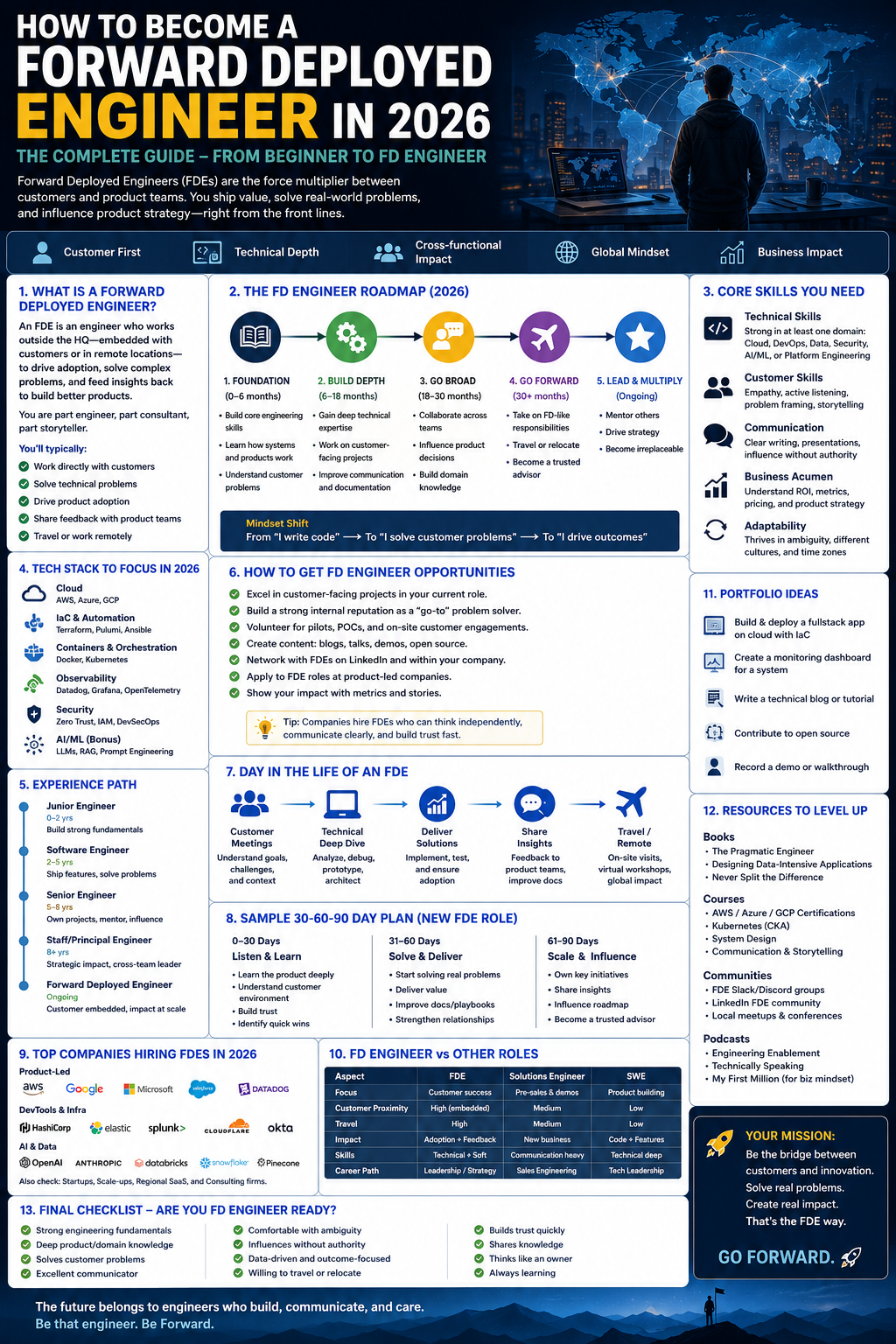
- Quick Answer
- What Is a Forward Deployed Engineer?
- Why FDE Is Becoming Important in 2026
- What an FDE Actually Does
- Types of Forward Deployed Engineering Roles
- FDE vs Related Engineering Roles
- Is Forward Deployed Engineering Right for You?
- The Complete FDE Skill Map
- Software Engineering Skills
- Full-Stack and Integration Skills
- Data Engineering Skills
- Cloud, DevOps and Production Skills
- System Design Skills
- AI, LLM and Agent Engineering Skills
- Security, Privacy and Governance
- Customer Discovery Skills
- Product and Business Skills
- Communication and Leadership Skills
- Do You Need a Degree?
- Are Certifications Useful?
- Career Paths into Forward Deployed Engineering
- The Complete 12-Month Learning Roadmap
- The Best FDE Portfolio Projects
- How to Build a Production-Grade Portfolio Project
- How to Gain Customer Experience Without Being an FDE
- How to Write an FDE Resume
- How to Optimize Your LinkedIn and GitHub Profiles
- How to Find Forward Deployed Engineering Jobs
- How to Prepare for FDE Interviews
- Common Mistakes
- Compensation and Career Growth
- Your First 90 Days as an FDE
- FDE Readiness Assessment
- Frequently Asked Questions
- Final Checklist
1. Quick Answer
To become a Forward Deployed Engineer in 2026, you must become strong in four areas:
- Building software
- Deploying production systems
- Understanding customer problems
- Turning field experience into reusable product improvements
A modern FDE is not simply a programmer assigned to a customer. The engineer may conduct discovery, design a system, write frontend and backend code, integrate enterprise data, deploy infrastructure, evaluate AI behavior, handle security reviews, support adoption and measure business impact.
A practical path is:
flowchart LR
    A[Learn Software Engineering] --> B[Build Full-Stack Systems]
    B --> C[Learn Cloud and Production]
    C --> D[Learn AI and Data]
    D --> E[Practice Customer Discovery]
    E --> F[Build FDE Portfolio Projects]
    F --> G[Gain Customer-Facing Experience]
    G --> H[Prepare for FDE Interviews]
    H --> I[Become an FDE]
For most people, becoming job-ready requires:
- Six to twelve months for an experienced engineer changing direction
- Twelve to twenty-four months for an early-career engineer
- Two to four years for someone beginning without programming experience
These are practical estimates, not formal hiring requirements.
2. What Is a Forward Deployed Engineer?
A Forward Deployed Engineer, or FDE, is a software engineer who works closely with customers to solve important operational or business problems.
The word forward means the engineer operates close to the customer and the real-world problem.
The word deployed means the engineer is not limited to prototypes or recommendations. The engineer helps move the solution into actual use.
The word engineer means this is still a technical role involving code, architecture, debugging, integration and production responsibility.
OpenAI currently describes FDEs as owning complex deployments from discovery and technical scoping through system design, implementation and production rollout. Success is measured through adoption, workflow impact and feedback that improves products and models. (OpenAI)
Palantir explains the distinction as:
- Product engineers often build one capability for many customers.
- Forward-deployed engineers often use many capabilities to solve one customer’s problem. (Palantir)
Simple Definition
A Forward Deployed Engineer finds an important customer problem, builds the technical solution, deploys it safely and remains involved until the solution produces measurable value.
3. Why FDE Is Becoming Important in 2026
Forward-deployed engineering existed before generative AI. Palantir has used the model for years to deploy complex data and operational systems.
However, AI has made the role much more visible.
Modern AI systems are rarely valuable when they exist only as a model or demonstration. Companies need engineers who can connect models to:
- Business workflows
- Enterprise data
- Existing applications
- Authentication systems
- Approval processes
- Cloud infrastructure
- Security controls
- Human operators
- Monitoring and evaluations
As of July 2026, OpenAI lists FDE opportunities across North America, Europe, Asia-Pacific and the Middle East, including Tokyo, Seoul, Singapore, Sydney, Dublin, London, Paris, Madrid, Stockholm and the UAE. (OpenAI)
Scale AI’s FDE role combines daily technical customer interaction, full-stack development, large-scale data infrastructure and rapid experimentation. (Scale AI)
In June 2026, Anthropic announced that DXC planned to train tens of thousands of forward-deployed engineers to bring Claude into regulated systems used by banks, insurers, airlines, manufacturers and government organizations. This shows that the FDE model is expanding beyond a small group of technology companies into large-scale enterprise delivery. (Anthropic)
The 2026 Shift
The role is moving from:
“Help the customer configure our software.”
To:
“Help the customer redesign an important workflow using software, data and AI—and make the new system secure, measurable and production-ready.”
4. What an FDE Actually Does
A typical engagement may follow this lifecycle:
flowchart TD
    A[Understand Customer Goal] --> B[Observe Current Workflow]
    B --> C[Find the Real Bottleneck]
    C --> D[Define Success Metrics]
    D --> E[Design the Solution]
    E --> F[Build a Prototype]
    F --> G[Evaluate Results]
    G --> H[Harden for Production]
    H --> I[Deploy Safely]
    I --> J[Drive User Adoption]
    J --> K[Measure Business Impact]
    K --> L[Convert Lessons into Product Improvements]
Common FDE Responsibilities
An FDE may:
- Interview customer stakeholders.
- Observe how users work.
- Analyze business processes.
- Examine customer data.
- Build frontend applications.
- Develop backend services.
- Create APIs and integrations.
- Design data pipelines.
- Deploy cloud infrastructure.
- Configure authentication and authorization.
- Build AI agents or retrieval systems.
- Create evaluation datasets.
- Debug production incidents.
- Train customer engineering teams.
- Help users adopt the system.
- Convert one-off solutions into reusable components.
Current OpenAI roles explicitly include full-stack building, customer embedding, delivery sequencing, risk management, adoption guidance and converting successful patterns into tools and reusable building blocks. (OpenAI)
5. Types of Forward Deployed Engineering Roles
The title does not mean exactly the same thing at every company.
5.1 Forward Deployed Software Engineer
This is the traditional version of the role.
Main focus:
- Software development
- Data integration
- Customer workflows
- Production deployment
- Custom extensions
Common employers include enterprise software, data and defense-technology companies.
5.2 AI Forward Deployed Engineer
This role combines software engineering with:
- LLM applications
- Retrieval
- AI agents
- Evaluations
- Prompt and model behavior
- Enterprise AI architecture
- AI security
OpenAI’s current FDE roles expect experience deploying systems powered by LLMs or generative models and understanding how model behavior affects the product experience. (OpenAI)
5.3 Forward Deployed Platform Engineer
This engineer works between individual customer deployments and the core platform.
The role may involve:
- Identifying repeated customer needs
- Designing reusable abstractions
- Refactoring customer-specific code
- Building deployment accelerators
- Establishing engineering standards
- Improving reliability and governance
OpenAI’s FDE platform role focuses on turning repeated customer signals into reusable platform capabilities while improving architecture, hardening, tooling and engineering quality. (OpenAI)
5.4 Forward Deployed Infrastructure Engineer
This role is more infrastructure-oriented.
Main areas may include:
- Cloud architecture
- Kubernetes
- Terraform
- Networking
- Identity
- Observability
- Reliability
- Secure customer environments
5.5 Technical Deployment Lead
This role coordinates complex deployments across:
- Engineering
- Product
- Research
- Security
- Legal
- Customer leadership
- Customer engineering teams
It may involve less daily coding than a hands-on FDE, but it still requires strong technical judgment.
5.6 AI Deployment Engineer
Some companies use AI Deployment Engineer for a role close to FDE.
These engineers often help customers:
- Identify valuable AI use cases
- Build prototypes
- Design production architecture
- Establish AI roadmaps
- Improve adoption
- Scale successful applications
OpenAI’s current AI Deployment Engineer roles emphasize business value, technical architecture, customer partnership, prototypes, evaluation, production delivery and reusable guidance. (OpenAI)
5.7 Domain-Specialized FDE
Some roles require expertise in a specific industry or technical domain, such as:
- Cybersecurity
- Government
- Healthcare
- Financial services
- Manufacturing
- Semiconductors
- Defense
- Legal operations
- Insurance
- Developer tools
For example, current OpenAI roles include forward-deployed work in government and semiconductor design verification, while separate deployment roles focus on cybersecurity and coding workflows. (OpenAI)
6. FDE vs Related Engineering Roles
| Role | Primary Focus | Customer Contact | Coding | Production Ownership |
|---|---|---|---|---|
| Forward Deployed Engineer | Solve customer problems through engineering | Very high | High | High |
| Software Engineer | Build core product capabilities | Low to moderate | Very high | High |
| Solutions Engineer | Demonstrate and design product solutions | High | Low to moderate | Low to moderate |
| Sales Engineer | Technical support for sales | Very high | Low | Low |
| Solutions Architect | Design technical architecture | High | Moderate | Moderate |
| DevOps Engineer | Automate infrastructure and delivery | Moderate | Moderate | High |
| SRE | Reliability and operations | Low to moderate | High | Very high |
| ML Engineer | Build and operate ML systems | Moderate | High | High |
| Technical Consultant | Advise and deliver customer projects | High | Varies | Moderate |
| Customer Success Engineer | Adoption and customer health | Very high | Low to moderate | Moderate |
| Product Manager | Product decisions and prioritization | High | Usually low | Indirect |
The Main Difference
The FDE is responsible for connecting all of the following:
flowchart LR
    A[Customer Need] --> B[Product Capability]
    B --> C[Custom Engineering]
    C --> D[Customer Environment]
    D --> E[User Adoption]
    E --> F[Business Outcome]
Many roles own one or two stages. An FDE may participate across the entire path.
7. Is Forward Deployed Engineering Right for You?
FDE work can be exciting, but it is not the best fit for everyone.
You May Enjoy FDE Work If You:
- Like writing code.
- Enjoy learning unfamiliar industries.
- Want direct contact with users.
- Can work with incomplete requirements.
- Like debugging across multiple systems.
- Can explain technical ideas simply.
- Enjoy moving between product and engineering.
- Stay calm when plans change.
- Care about whether users adopt what you build.
- Are willing to challenge a customer respectfully.
- Can make practical trade-offs.
- Enjoy ownership.
You May Dislike FDE Work If You:
- Want long periods of uninterrupted coding.
- Strongly dislike customer meetings.
- Need complete requirements before starting.
- Prefer a narrow and stable technical area.
- Do not enjoy travel or on-site work.
- Avoid production responsibility.
- Become frustrated by organizational politics.
- Prefer success to be measured only through code quality.
Some current customer-tagged FDE roles require travel of up to 50%, while platform-oriented FDE roles may require little or no routine travel. Always read the specific job description instead of assuming all FDE roles operate identically. (OpenAI)
Self-Test
Ask yourself:
Would I rather spend three months building the perfect technical component, or spend three weeks building a useful solution with users and improve it from real evidence?
Neither answer is wrong. But the second mindset is usually closer to forward-deployed engineering.
8. The Complete FDE Skill Map
A strong FDE needs breadth across several areas and depth in at least two or three.
mindmap
  root((Forward Deployed Engineer))
    Software Engineering
      Programming
      APIs
      Testing
      Debugging
      Full Stack
    Production Engineering
      Cloud
      Containers
      CI/CD
      Observability
      Reliability
    Data
      SQL
      Pipelines
      Modeling
      Quality
      Streaming
    AI Engineering
      LLM APIs
      RAG
      Agents
      Evals
      Guardrails
    Security
      IAM
      Secrets
      Privacy
      Audit
      Threat Modeling
    Customer Skills
      Discovery
      Communication
      Stakeholders
      Adoption
      Training
    Product Skills
      Prioritization
      Metrics
      Prototyping
      Trade-offs
      Reusability
The T-Shaped FDE
You do not need to be the world’s best expert in every area.
Aim for:
- Broad working knowledge across the full lifecycle
- Deep expertise in two or three areas
- Strong enough coding ability to build production systems
- Strong enough communication ability to lead customer discussions
Examples of useful depth combinations:
- Backend engineering + distributed systems
- Cloud infrastructure + security
- Data engineering + machine learning
- Full-stack engineering + product design
- AI engineering + evaluations
- DevOps + enterprise integration
9. Software Engineering Skills
Software engineering remains the foundation.
You cannot replace production engineering skill with presentation ability.
9.1 Choose a Primary Language
Recommended primary languages include:
- Python
- TypeScript
- JavaScript
- Java
- Go
- C#
- Rust for specialized systems work
Python and JavaScript or TypeScript are especially useful because current AI-focused FDE roles often involve both backend and frontend development. OpenAI’s FDE listings specifically mention Python, JavaScript or comparable stacks. (OpenAI)
9.2 Learn Core Programming Concepts
You should understand:
- Variables and data types
- Functions
- Classes and objects
- Error handling
- Modules and packages
- Concurrency
- Asynchronous programming
- Memory basics
- File processing
- Network calls
- Testing
- Logging
9.3 Learn Data Structures and Algorithms
You do not need to spend your entire career solving puzzle problems.
However, you should know:
- Arrays and lists
- Hash maps
- Sets
- Queues
- Stacks
- Trees
- Graphs
- Sorting
- Searching
- Recursion
- Time and space complexity
Palantir’s interview guidance emphasizes writing structured, readable code, considering edge cases, testing the solution and understanding scalability rather than memorizing obscure language behavior. (Palantir)
9.4 Learn Production Coding Practices
Practice:
- Clear naming
- Small functions
- Type checking
- Input validation
- Error handling
- Unit tests
- Integration tests
- Configuration management
- Dependency management
- Code review
- Documentation
9.5 Learn Git
You should be comfortable with:
- Cloning repositories
- Branches
- Commits
- Pull requests
- Merge conflicts
- Rebasing
- Reverting
- Tags
- Release branches
- Code reviews
10. Full-Stack and Integration Skills
Many FDEs build whatever is needed to make the customer workflow succeed.
That may include both a user interface and the backend behind it.
10.1 Backend Skills
Learn how to build:
- REST APIs
- Webhooks
- Background workers
- Scheduled jobs
- Authentication
- Authorization
- Database access
- Caching
- Message queues
- File-processing services
- Audit logs
Useful frameworks include:
- FastAPI
- Django
- Flask
- Express
- NestJS
- Spring Boot
- ASP.NET Core
The exact framework matters less than understanding the engineering principles.
10.2 Frontend Skills
Learn enough frontend development to create usable customer workflows.
Recommended topics:
- HTML
- CSS
- JavaScript
- TypeScript
- React or a comparable framework
- Forms
- Tables
- Authentication flows
- State management
- API calls
- Error states
- Loading states
- Accessibility
10.3 Integration Skills
Enterprise systems rarely operate alone.
Learn:
- REST
- GraphQL
- Webhooks
- OAuth 2.0
- OpenID Connect
- SAML concepts
- API keys
- Service accounts
- Pagination
- Rate limiting
- Retries
- Idempotency
- Schema validation
10.4 Resilient Integration Pattern
flowchart LR
    A[Customer System] --> B[Adapter]
    B --> C[Validation]
    C --> D[Queue]
    D --> E[Processing Service]
    E --> F[Target System]
    E --> G[Dead Letter Queue]
    E --> H[Metrics and Logs]
A good integration should expect:
- Timeouts
- Duplicate messages
- Expired credentials
- Invalid records
- Rate limits
- Partial failures
- Schema changes
- Late-arriving data
11. Data Engineering Skills
Many customer problems are actually data problems in disguise.
Essential Data Skills
Learn:
- SQL
- Relational databases
- Data modeling
- Joins
- Indexes
- Transactions
- Data validation
- Batch processing
- Streaming concepts
- Object storage
- ETL and ELT
- Schema evolution
- Data lineage
Technologies Worth Understanding
You do not need expert-level experience with all of them.
- PostgreSQL
- MySQL
- MongoDB
- Redis
- Kafka
- Spark
- Databricks
- Snowflake
- BigQuery
- Amazon S3
- Azure Blob Storage
- Google Cloud Storage
Questions an FDE Must Ask
Before building a data solution:
- Who owns the data?
- Is the data accurate?
- How often is it updated?
- What identifiers connect the systems?
- Which records may the user access?
- How long may the data be retained?
- What happens when the schema changes?
- How can data be deleted?
- How will failed records be repaired?
12. Cloud, DevOps and Production Skills
An FDE who can build but cannot deploy is incomplete.
12.1 Learn One Cloud Deeply
Choose one:
- AWS
- Microsoft Azure
- Google Cloud
Learn the core services:
- Compute
- Networking
- Storage
- Databases
- Identity
- Secrets
- Logging
- Monitoring
- Queues
- Serverless
- Load balancing
Then gain enough familiarity with the other clouds to understand equivalent services.
12.2 Learn Containers
Understand:
- Docker images
- Dockerfiles
- Registries
- Environment variables
- Volumes
- Networking
- Health checks
- Image security
- Multi-stage builds
12.3 Learn Kubernetes Basics
You should understand:
- Pods
- Deployments
- Services
- Ingress
- ConfigMaps
- Secrets
- Resource requests
- Resource limits
- Readiness checks
- Liveness checks
- Horizontal scaling
- Logs
- Rolling deployments
Some OpenAI government FDE roles explicitly mention AWS, Azure, Kubernetes and Terraform among relevant infrastructure skills. (OpenAI)
12.4 Learn Infrastructure as Code
Use:
- Terraform
- Pulumi
- CloudFormation
- Bicep
Know how to:
- Create repeatable environments
- Review changes
- Separate environments
- Manage state
- Protect production resources
- Handle secrets safely
12.5 Learn CI/CD
Build pipelines that:
- Run tests
- Scan code
- Build artifacts
- Build container images
- Deploy to test
- Require production approval
- Support rollback
- Record versions
12.6 Learn Observability
Understand:
- Logs
- Metrics
- Traces
- Dashboards
- Alerts
- SLOs
- Error budgets
- Audit logs
A production system should answer:
- Is it available?
- Is it correct?
- Is it fast?
- Is it secure?
- Is it being used?
- Is it creating value?
13. System Design Skills
System design interviews test whether you can convert a vague problem into a workable architecture.
Learn to Design:
- Web applications
- API platforms
- Data pipelines
- Multi-tenant systems
- Search systems
- Notification systems
- Workflow engines
- Analytics platforms
- File-processing services
- AI assistants
- AI agents
- Retrieval systems
Use the PRISM Framework
P — Problem
What user problem are we solving?
R — Requirements
What are the functional and non-functional requirements?
I — Interfaces
Which systems, users and data sources interact?
S — System
What are the main components and data flows?
M — Measurement
How will we monitor, evaluate, roll out and recover the system?
Example Architecture
flowchart TD
    A[Users] --> B[Web Application]
    B --> C[API Gateway]
    C --> D[Application Service]
    D --> E[Database]
    D --> F[Queue]
    F --> G[Background Workers]
    D --> H[External Systems]
    D --> I[AI Service]
    D --> J[Audit Log]
    D --> K[Monitoring]
Always Discuss:
- Scale
- Latency
- Availability
- Security
- Cost
- Data consistency
- Failure handling
- Observability
- Deployment
- Rollback
- Ownership
- Adoption
14. AI, LLM and Agent Engineering Skills
In 2026, many FDE opportunities involve AI.
You do not necessarily need to train foundation models. You do need to understand how to build reliable systems around them.
14.1 Learn LLM Fundamentals
Understand:
- Tokens
- Context windows
- Prompts
- System instructions
- Temperature
- Structured outputs
- Tool calling
- Embeddings
- Retrieval
- Model latency
- Model cost
- Hallucination
- Refusal
- Model versioning
14.2 Learn Retrieval-Augmented Generation
A basic RAG system works like this:
flowchart LR
    A[Documents] --> B[Parse and Chunk]
    B --> C[Create Index]
    D[User Question] --> E[Search]
    C --> E
    E --> F[Relevant Context]
    F --> G[Language Model]
    D --> G
    G --> H[Answer with Evidence]
Learn:
- Document parsing
- Chunking
- Embeddings
- Vector search
- Keyword search
- Hybrid retrieval
- Metadata filtering
- Reranking
- Permission-aware retrieval
- Citations
- Retrieval evaluation
14.3 Learn AI Agents
An agent can:
- Reason over a task
- Choose tools
- Call APIs
- Read results
- Update its plan
- Continue until it finishes or stops
However, more autonomy also creates more failure and security risk.
Anthropic recommends starting with simple, composable workflows and introducing more complex agent behavior only when it creates clear value. (Anthropic)
14.4 Learn AI Evaluation
A prototype that looks good during a demonstration is not enough.
Learn how to create:
- Evaluation datasets
- Expected outcomes
- Scoring rubrics
- Regression tests
- Model comparisons
- Human evaluations
- Tool-call evaluations
- Retrieval evaluations
- Safety tests
- Production feedback loops
Current FDE and AI deployment roles increasingly treat evaluation as part of normal engineering. OpenAI’s enterprise deployment roles explicitly include evaluation strategies, evaluation systems, error analysis and measurable success criteria. (OpenAI)
14.5 Learn the AI Quality Stack
flowchart TD
    A[Business Outcome] --> B[User Workflow Metrics]
    B --> C[Application Evaluation]
    C --> D[Agent or Model Evaluation]
    D --> E[Retrieval and Tool Evaluation]
    E --> F[Infrastructure Metrics]
A good AI application must work at every layer.
14.6 Learn Human-in-the-Loop Design
Use human approval when:
- Actions are financially important.
- Errors may create legal consequences.
- Confidence is low.
- The model accesses sensitive data.
- The workflow is new.
- The system can change external state.
14.7 Learn Cost and Latency Optimization
Measure:
- Cost per request
- Cost per successful task
- Time to first token
- Total response time
- Retrieval time
- Tool execution time
- Retry rate
- Tokens per workflow
15. Security, Privacy and Governance
Security is not a final checkbox.
It shapes the architecture from the beginning.
15.1 Learn Identity and Access Management
Understand:
- Authentication
- Authorization
- Role-based access control
- Attribute-based access control
- Service identities
- Workload identity
- Single sign-on
- Least privilege
- Short-lived credentials
15.2 Learn Secrets Management
Never place secrets in:
- Source code
- Git repositories
- Container images
- Plaintext configuration
- Screenshots
- Documentation examples
Use managed secret stores and workload identities.
15.3 Learn Threat Modeling
For every system, ask:
- What are we protecting?
- Who may attack it?
- Where does untrusted data enter?
- Which actions can change external state?
- What happens if a credential is stolen?
- How is access audited?
- How can the system be disabled?
15.4 Learn AI-Specific Security
Important risks include:
- Prompt injection
- Sensitive-information disclosure
- Unsafe output handling
- Excessive agent permissions
- Unbounded resource consumption
- Insecure tools
- Data poisoning
- Model denial of service
OWASP’s current guidance highlights prompt injection and excessive agency as important risks in generative AI systems. (OWASP Gen AI Security Project)
15.5 Treat the Model as an Untrusted Decision-Maker
An AI model should not be the only enforcement layer.
Use deterministic controls for:
- Permissions
- Spending limits
- Data access
- Allowed tool arguments
- Approval requirements
- Output validation
- Rate limits
- Kill switches
15.6 Learn AI Governance
Understand how organizations manage:
- Approved use cases
- Data handling
- Evaluation
- Model changes
- Human oversight
- Risk ownership
- Incident response
- Audit evidence
NIST’s AI Risk Management Framework and Generative AI Profile provide structured approaches for incorporating trustworthiness and risk management into the design, deployment and evaluation of AI systems. (NIST)
16. Customer Discovery Skills
This is where many strong software engineers struggle when moving toward FDE work.
Customers usually describe a requested solution before describing the real problem.
A customer may say:
“We need an AI chatbot.”
The real need might be:
- Reduce support response time
- Help employees find internal policies
- Automate order-status requests
- Improve lead qualification
- Reduce manual document review
Use the SCOPE Framework
S — Success
What measurable result must improve?
C — Current Workflow
How is the work performed today?
O — Owners and Users
Who uses, approves, supports and funds the system?
P — Problems and Constraints
What prevents improvement?
E — Evidence
What data will prove that the solution worked?
Discovery Questions
Ask:
- Who experiences the problem?
- How frequently does it occur?
- What happens today?
- Which step takes the most time?
- What is the cost of failure?
- Which systems are involved?
- Which data is available?
- Which actions require approval?
- What cannot change?
- How will success be measured?
- Who makes the final decision?
Observe, Do Not Only Interview
People may describe the official workflow rather than the real workflow.
Whenever possible:
- Watch the user complete the task.
- Examine real examples.
- Review support tickets.
- Inspect existing reports.
- Measure delays.
- Compare different user groups.
- Identify manual workarounds.
17. Product and Business Skills
An FDE is not successful merely because the system runs.
The system must produce value.
17.1 Learn to Define Outcomes
Weak goal:
Build an AI claims assistant.
Strong goal:
Reduce median claim-review time from 35 minutes to 15 minutes without increasing incorrect approvals.
17.2 Learn Prioritization
Use the VALUE framework:
- Value: How important is the outcome?
- Adoption: Will users use the solution?
- Level of effort: How expensive is delivery?
- Uncertainty: Which assumptions remain untested?
- Exposure: What risk is introduced?
17.3 Learn Scope Control
Separate requirements into:
- Must have
- Should have
- Could have
- Not now
A strong FDE reduces the first release to the smallest end-to-end workflow that can prove value.
17.4 Learn Productization
Ask:
- Is this requirement unique?
- Have other customers requested it?
- Can it become configuration?
- Should it become a reusable library?
- Does it belong in the core product?
- Who will maintain it?
- What is the migration path?
17.5 Learn Adoption
Adoption can fail because:
- The tool is outside the normal workflow.
- Authentication is difficult.
- The system is slow.
- Users do not trust the output.
- Users cannot correct mistakes.
- Managers still reward the old process.
- The tool creates extra work.
- Training is missing.
- The system solves the wrong problem.
18. Communication and Leadership Skills
FDEs communicate with several audiences.
| Audience | Main Concern |
|---|---|
| End user | Does this make my work easier? |
| Software engineer | How does the system work? |
| Security team | What are the risks and controls? |
| Product manager | What should become product functionality? |
| Executive | What result will this create? |
| Operations team | How will this be supported? |
| Legal or compliance | How is regulated information handled? |
Learn to Communicate at Three Levels
Executive Level
Explain:
- Business outcome
- Status
- Main risk
- Decision required
- Next milestone
Architecture Level
Explain:
- Components
- Dependencies
- Data flow
- Security boundaries
- Trade-offs
Implementation Level
Explain:
- APIs
- Schemas
- Errors
- Tests
- Deployment
- Operational procedures
Learn Written Communication
Practice writing:
- Technical proposals
- Architecture decisions
- Project updates
- Risk registers
- Incident reports
- Runbooks
- Deployment plans
- Executive summaries
Learn to Disagree Constructively
A strong FDE does not agree with every customer request.
Use this structure:
- Confirm the desired outcome.
- Explain the risk.
- Provide evidence.
- Suggest an alternative.
- Define a path toward the original goal.
19. Do You Need a Degree?
There is no universal FDE degree requirement.
Many FDEs have degrees in:
- Computer science
- Software engineering
- Information technology
- Data science
- Mathematics
- Electrical engineering
- Physics
- Other technical fields
However, demonstrated skill and production experience can matter more than the exact degree.
Palantir states that it values strong thinking and initiative across educational backgrounds, while also maintaining formal student and new-graduate routes for some roles. (Palantir)
Without a Degree, You Need Stronger Evidence
Build evidence through:
- Production-quality projects
- Open-source contributions
- Freelance work
- Customer integrations
- Cloud deployments
- Technical writing
- Demonstrations
- References
- Strong coding interviews
Degree vs Evidence
| Candidate | What Helps Most |
|---|---|
| Computer science graduate | Projects and customer experience |
| Self-taught developer | Production evidence and strong fundamentals |
| Bootcamp graduate | Deeper system design and cloud skills |
| Career changer | Transferable domain expertise plus engineering |
| Experienced engineer | Customer impact and end-to-end ownership |
20. Are Certifications Useful?
Certifications can help organize learning or pass enterprise screening.
They do not replace engineering experience.
Potentially Useful Areas
Cloud
- AWS
- Azure
- Google Cloud
Kubernetes
- Kubernetes administration or application development
Security
- Cloud security
- General security foundations
- Identity and access management
Data
- Databricks
- Snowflake
- Cloud data engineering
AI
- Model-provider training
- Cloud AI engineering
- AI risk and governance training
Anthropic’s 2026 partnership with DXC includes an FDE training and certification program layered with industry-specific training, showing that structured vendor and domain education is becoming part of enterprise FDE development. (Anthropic)
Certification Rule
Use this formula:
Certification + working project + written explanation + demonstration
A certificate without a project is weak evidence.
21. Career Paths into Forward Deployed Engineering
There is no single route.
21.1 Student or New Graduate
Best path:
flowchart LR
    A[Programming Fundamentals] --> B[Internships]
    B --> C[Full-Stack Projects]
    C --> D[Cloud Deployment]
    D --> E[Customer-Facing Project]
    E --> F[FDE Internship or New-Grad Role]
Palantir currently lists FDE internships and new-graduate opportunities, showing that some organizations hire directly into forward-deployed roles. (Palantir)
Focus on:
- Coding
- Algorithms
- Projects
- Teamwork
- Communication
- Learning speed
- Ownership
21.2 Software Engineer
You already have the strongest foundation.
Add:
- Customer discovery
- Cloud and operations
- Business metrics
- Architecture presentations
- Cross-functional leadership
- AI engineering where relevant
Look for opportunities to:
- Join customer calls.
- Support implementation teams.
- Build integrations.
- Lead pilots.
- Handle production rollouts.
- Write customer-facing documentation.
21.3 DevOps Engineer or SRE
Your production experience is valuable.
Add:
- Application development
- Frontend basics
- Product thinking
- Customer discovery
- Data modeling
- AI application development
You may be especially strong for:
- Infrastructure FDE
- Platform FDE
- Government deployments
- Regulated enterprise deployments
- Customer-hosted software
21.4 Data Engineer
You already understand pipelines, databases and data quality.
Add:
- Full-stack development
- User-facing workflows
- APIs
- Product metrics
- AI retrieval
- Customer communication
You may be strong for:
- Analytics platforms
- AI data infrastructure
- Knowledge systems
- Enterprise search
- Model evaluation platforms
21.5 ML Engineer
Add:
- Enterprise integration
- Frontend development
- Cloud security
- Customer discovery
- Workflow design
- Business impact measurement
Do not focus only on model accuracy. Learn how models affect complete workflows.
21.6 Solutions Engineer or Solutions Architect
You likely have customer and architecture skills.
Add:
- Deeper production coding
- Testing
- Debugging
- CI/CD
- Ownership after deployment
- Software-maintenance discipline
21.7 Technical Consultant
Add:
- Stronger coding depth
- Product engineering
- Long-term system ownership
- Production reliability
- Reusable software design
21.8 Domain Expert
A healthcare, finance, manufacturing or security expert can become a powerful FDE by adding engineering skills.
Domain expertise helps you understand:
- Real workflows
- Regulations
- Failure consequences
- User behavior
- Industry data
- Organizational constraints
22. The Complete 12-Month Learning Roadmap
This roadmap assumes that you already know basic programming.
Beginners can extend each phase.
Months 1–2: Strengthen Programming
Learn
- Python or TypeScript
- Data structures
- Algorithms
- Git
- Testing
- APIs
- SQL
Build
Create a backend API that:
- Authenticates users
- Stores data
- Validates input
- Handles errors
- Includes tests
- Produces logs
Evidence
- Public repository
- README
- Architecture diagram
- Automated tests
- Deployed demonstration
Months 3–4: Learn Full-Stack and Integration
Learn
- React or another frontend framework
- API integration
- OAuth
- Webhooks
- Background jobs
- PostgreSQL
- Redis or queues
Build
Create a workflow application that:
- Receives requests
- Calls an external API
- Stores results
- Shows status
- Retries failures
- Supports user correction
Goal
Learn to build the entire user workflow rather than an isolated backend component.
Months 5–6: Learn Cloud and Production Engineering
Learn
- One cloud provider
- Docker
- Kubernetes basics
- Terraform
- CI/CD
- Monitoring
- Secrets
- IAM
Build
Deploy your application with:
- Infrastructure as code
- Separate development and production environments
- Automated tests
- Container images
- Dashboards
- Alerts
- Rollback documentation
Goal
Prove that you can operate what you build.
Months 7–8: Learn AI Application Engineering
Learn
- LLM APIs
- Structured output
- Tool calling
- Embeddings
- RAG
- Agent workflows
- Evals
- Prompt injection
- Human approval
Build
Create an enterprise knowledge assistant with:
- Authenticated users
- Document ingestion
- Permission-aware retrieval
- Citations
- Evaluation dataset
- Feedback capture
- Cost and latency monitoring
Months 9–10: Learn Customer Discovery and Product Thinking
Practice
Choose a real workflow from:
- A small business
- A nonprofit
- An internal company team
- A community organization
- An open-source project
Conduct:
- Stakeholder interviews
- Workflow mapping
- Baseline measurement
- Scope definition
- Pilot delivery
- User feedback
- Outcome measurement
Deliver
Create:
- Problem statement
- Current workflow
- Proposed workflow
- Architecture
- Risk assessment
- Success metrics
- Pilot results
- Lessons learned
Months 11–12: Build Your FDE Portfolio and Prepare for Interviews
Prepare
- Two strong portfolio projects
- One customer case study
- Resume
- LinkedIn profile
- GitHub profile
- System-design practice
- Coding practice
- Behavioral stories
- Architecture presentation
Apply To
- Forward Deployed Engineer
- Forward Deployed Software Engineer
- AI Deployment Engineer
- Applied AI Engineer
- Customer Engineer
- Deployment Engineer
- Solutions Architect
- Technical Consultant
- Professional Services Engineer
- Integration Engineer
23. The Best FDE Portfolio Projects
A strong FDE project should demonstrate more than code.
It should demonstrate:
- Problem discovery
- Architecture
- Implementation
- Security
- Production deployment
- Evaluation
- Adoption
- Outcome measurement
Project 1: Enterprise Knowledge Assistant
Build
- Document ingestion
- Permission-aware retrieval
- Hybrid search
- Answers with citations
- Feedback
- Evaluation
- Audit logs
Demonstrates
- AI
- RAG
- Security
- Full stack
- Data pipelines
- Enterprise integration
Project 2: Customer Support Automation
Build
- Ticket ingestion
- Classification
- Customer-data lookup
- Response drafting
- Human approval
- Escalation
- Quality evaluation
Demonstrates
- Workflow design
- LLMs
- Tool calling
- Integration
- Human-in-the-loop design
- Business metrics
Project 3: Data Reconciliation Platform
Build
- Import from several systems
- Normalize identifiers
- Detect conflicts
- Recommend matches
- Route uncertain records
- Track corrections
- Produce audit reports
Demonstrates
- Data engineering
- Idempotency
- Enterprise integration
- User workflow
- Reliability
Project 4: Cloud Cost Investigation Assistant
Build
- Import cloud billing data
- Detect unusual changes
- Link costs to services
- Explain likely causes
- Create recommended actions
- Require approval before changes
Demonstrates
- Cloud knowledge
- Data analytics
- AI reasoning
- Cost management
- Safe automation
Project 5: Security Incident Triage Assistant
Build
- Import alerts
- Gather context
- Classify severity
- Suggest investigation steps
- Produce incident summaries
- Require analyst approval
- Maintain an audit trail
Demonstrates
- Security
- Agents
- Tool use
- Least privilege
- High-risk workflow design
Project 6: Insurance Claim Review Assistant
Build
- Document extraction
- Policy retrieval
- Missing-information detection
- Review summaries
- Human approval
- Regional rules
- Evaluation
Demonstrates
- Regulated workflows
- Document AI
- Retrieval
- Governance
- Human oversight
24. How to Build a Production-Grade Portfolio Project
Do not create another chatbot that answers questions from a PDF.
Build a complete system.
Step 1: Define the User
Example:
A customer-support agent who handles refund requests.
Step 2: Define the Current Workflow
flowchart LR
    A[Read Request] --> B[Search Customer]
    B --> C[Check Order]
    C --> D[Review Refund Policy]
    D --> E[Write Response]
    E --> F[Issue or Reject Refund]
Step 3: Define the Outcome
Example:
Reduce average handling time from eight minutes to three minutes while keeping incorrect refund recommendations below an agreed threshold.
Step 4: Define the First Release
The first release may:
- Classify the request.
- Retrieve order information.
- Retrieve the refund policy.
- Draft a response.
- Recommend an action.
- Require human approval.
Step 5: Design the Architecture
flowchart TD
    A[User Interface] --> B[Application API]
    B --> C[Customer System Adapter]
    B --> D[Order Service]
    B --> E[Policy Retrieval]
    B --> F[AI Orchestrator]
    F --> G[Model]
    F --> H[Tool Validator]
    B --> I[Audit Log]
    B --> J[Evaluation Store]
    B --> K[Monitoring]
Step 6: Add Security
Include:
- Authentication
- Role-based authorization
- Secret management
- Input validation
- Tool allowlists
- Audit logs
- Rate limits
- Human approval
- Data deletion
Step 7: Add Failure Handling
Test:
- API timeout
- Missing customer
- Duplicate request
- Invalid order
- Model failure
- Malformed output
- Policy not found
- Permission denied
- Partial completion
Step 8: Add Evaluation
Create at least:
- Common cases
- Edge cases
- Historical failures
- Adversarial cases
- Cases requiring escalation
- Cases requiring refusal
Step 9: Deploy It
Use:
- Cloud infrastructure
- Infrastructure as code
- CI/CD
- Monitoring
- Alerts
- Versioned releases
Step 10: Document the Trade-Offs
Explain:
- Why you chose the architecture
- What you deliberately did not build
- What would change at larger scale
- Which risks remain
- How you would roll out safely
25. How to Gain Customer Experience Without Being an FDE
This is one of the hardest career-transition problems.
Employers want customer-facing experience, but you may not have an FDE title yet.
Option 1: Work With an Internal Team
Treat another team as your customer.
Examples:
- Build a deployment dashboard for developers.
- Automate a finance workflow.
- Improve support-ticket triage.
- Create a compliance reporting tool.
- Integrate two internal systems.
Conduct discovery and measure the result.
Option 2: Freelance for a Small Business
Help with:
- Data automation
- Reporting
- CRM integration
- Customer support
- Document processing
- Cloud migration
Be careful with customer data and define the project clearly.
Option 3: Support a Nonprofit
Nonprofits often have valuable workflows but limited engineering resources.
Build something maintainable, not an abandoned experiment.
Option 4: Contribute to Open Source
Contribute:
- Integrations
- Deployment templates
- Documentation
- Bug fixes
- Observability
- Security improvements
Option 5: Join Professional Services
Roles that can lead toward FDE include:
- Cloud consultant
- Technical consultant
- Implementation engineer
- Customer engineer
- Solutions architect
- Integration engineer
- Professional services engineer
Option 6: Lead Technical Discovery in Your Current Role
Volunteer to:
- Join customer calls.
- Write technical proposals.
- Investigate customer escalations.
- Lead proofs of concept.
- Support production launches.
- Conduct architecture workshops.
26. How to Write an FDE Resume
An FDE resume should connect engineering work to user or business outcomes.
Weak Resume Bullet
Created a Python API.
Strong Resume Bullet
Designed and deployed a Python reconciliation API integrating three customer systems, reducing manual exception processing by 62% while preserving a human-review path for uncertain matches.
Recommended Formula
Action + technical system + customer or workflow context + scale + measurable outcome
Strong Examples
- Led discovery with operations and finance teams, mapped a six-step manual approval process and delivered an automated workflow that reduced processing time from two days to four hours.
- Built a multi-tenant ingestion platform processing 15 million daily events with per-tenant authorization, retry-safe delivery and end-to-end observability.
- Designed an evaluation and human-review framework for an LLM support assistant, improving accepted drafts while reducing unsupported responses.
- Diagnosed a cross-region latency problem across an API gateway, Kubernetes services and database dependencies, restoring service and implementing preventive monitoring.
- Converted three customer-specific integrations into a configurable connector framework, reducing delivery time for later implementations.
Resume Sections
- Summary
- Technical skills
- Professional experience
- Selected customer or delivery projects
- Education
- Certifications
- Open-source work
Sample Summary
Software engineer with six years of experience designing, deploying and operating cloud-native systems across customer-facing environments. Experienced in Python, TypeScript, Kubernetes, Terraform, enterprise integrations and AI-assisted workflows. Strong record of translating ambiguous operational problems into secure production systems with measurable user adoption and business impact.
27. How to Optimize LinkedIn and GitHub
LinkedIn Headline
Avoid:
Software Engineer Seeking Opportunities
Use:
Software Engineer | Enterprise AI, Cloud Platforms and Customer-Facing Delivery
Or:
Forward Deployed Engineering | Full-Stack, AI Systems, Kubernetes and Enterprise Integration
LinkedIn About Section
Explain:
- What you build
- Which users or customers you serve
- Your strongest technical areas
- The outcomes you create
- What type of problems interest you
GitHub Profile
Pin repositories that show:
- Production architecture
- Testing
- Deployment
- Security
- AI evaluation
- Good documentation
Every Major Repository Should Include
- Problem statement
- User
- Architecture diagram
- Setup instructions
- Security model
- Evaluation method
- Screenshots
- Deployment guide
- Known limitations
- Future improvements
28. How to Find FDE Jobs
The same work appears under several titles.
Search for:
- Forward Deployed Engineer
- Forward Deployed Software Engineer
- Forward Deployed Infrastructure Engineer
- AI Deployment Engineer
- Applied AI Engineer
- Customer Engineer
- Deployment Engineer
- Implementation Engineer
- Field Engineer
- Solutions Architect
- Professional Services Engineer
- Technical Consultant
- Resident Engineer
- Integration Engineer
- Customer-Facing Software Engineer
Companies to Target
Look at organizations building:
- Enterprise AI
- Data platforms
- Cybersecurity platforms
- Developer tools
- Cloud infrastructure
- Robotics
- Defense technology
- Healthcare technology
- Financial technology
- Industrial software
- Workflow automation
Read the Responsibilities, Not Only the Title
A genuine FDE-style role usually contains several of these phrases:
- Work directly with customers
- Own deployment end to end
- Write production code
- Operate in ambiguity
- Build prototypes
- Move systems to production
- Drive adoption
- Measure outcomes
- Translate customer needs
- Influence the product roadmap
- Create reusable patterns
Entry-Level Reality
Some companies offer direct internships and new-graduate roles, while others expect several years of engineering experience.
Current examples range from Scale AI preferring at least two years of relevant experience to OpenAI customer-tagged FDE roles seeking five or more years. (Scale AI)
Therefore, do not judge your eligibility from the title alone. Read the level and responsibilities.
29. How to Prepare for FDE Interviews
FDE interviews may test more dimensions than a standard software-engineering interview.
Expected Areas
- Coding
- Data structures
- Practical debugging
- System design
- Cloud architecture
- Customer discovery
- Product judgment
- Communication
- Behavioral experience
- AI systems
- Security
- Production delivery
29.1 Coding Preparation
Practice:
- Arrays and strings
- Hash maps
- Trees and graphs
- Data transformation
- API integration
- SQL
- File processing
- Concurrency
- Error handling
- Testing
Explain:
- Assumptions
- Edge cases
- Complexity
- Production limitations
- Testing strategy
29.2 System-Design Preparation
Practice designing:
- Enterprise search
- Workflow engine
- Multi-tenant platform
- Data-ingestion service
- AI support assistant
- Document-processing system
- Real-time alerting system
- Customer-hosted application
29.3 Customer Case Preparation
Example prompt:
A global retailer wants an AI agent to handle customer refunds.
Do not immediately design an agent.
Ask:
- What is the business goal?
- Which refunds are eligible?
- What is the financial risk?
- How is identity verified?
- Which systems contain order data?
- What is the current error rate?
- When is human approval required?
- What result would justify deployment?
29.4 Behavioral Preparation
Prepare stories for:
- End-to-end ownership
- Customer disagreement
- Production incident
- Ambiguous requirements
- Technical failure
- Scope reduction
- Cross-functional conflict
- Rapid learning
- Influencing without authority
- Delivering under pressure
Use:
- Situation
- Task
- Action
- Result
- Learning
29.5 Presentation Preparation
Prepare a 15-minute presentation containing:
- Customer problem
- Current workflow
- Proposed solution
- Architecture
- Security
- Rollout
- Outcome
- Lessons
30. Common Mistakes
Mistake 1: Becoming Too Broad and Not Deep Enough
FDE requires breadth, but you still need strong technical depth.
Choose two or three areas to master.
Mistake 2: Learning Only AI Frameworks
Frameworks change quickly.
Learn durable concepts:
- APIs
- Data
- Evaluation
- Permissions
- Reliability
- Tool calling
- State management
- Failure handling
Mistake 3: Building Demonstrations Instead of Systems
A polished chatbot is not enough.
Add:
- Authentication
- Evaluation
- Monitoring
- Security
- Error handling
- Deployment
- User feedback
Mistake 4: Ignoring Customer Discovery
Do not begin with technology.
Begin with:
- User
- Workflow
- Outcome
- Constraint
- Evidence
Mistake 5: Collecting Too Many Certifications
Five certificates and no working system are weaker than one certificate and one excellent production project.
Mistake 6: Treating Communication as Presentation Skill
Good communication includes:
- Listening
- Asking clear questions
- Writing decisions
- Explaining risks
- Managing disagreement
- Following through
Mistake 7: Avoiding Production Operations
You need experience with:
- Deployments
- Logs
- Alerts
- Incidents
- Rollbacks
- Data repair
- Customer communication
Mistake 8: Applying Only to Jobs With “FDE” in the Title
Use adjacent roles to build the same skills.
Mistake 9: Claiming Business Impact Without Evidence
Do not invent metrics.
When exact numbers are unavailable, explain:
- What was measured
- What changed
- What evidence you observed
- Which limitations remain
Mistake 10: Overengineering
Start with the smallest system that can test the most important assumption.
31. Compensation and Career Growth
FDE compensation varies widely by:
- Country
- Company stage
- Seniority
- Technical specialization
- Customer responsibility
- Travel
- Security clearance
- Equity
- Industry
As current US examples, Scale AI lists a base range of $180,000–$225,000 for one GenAI FDE posting, while an OpenAI San Francisco FDE listing displays a broader range of $162,000–$280,000. These are individual postings, not universal salary benchmarks. (Scale AI)
Common Career Directions
An experienced FDE may move into:
- Senior FDE
- Staff FDE
- FDE manager
- Technical deployment lead
- Platform engineering
- Product engineering
- Solutions architecture
- Applied AI engineering
- Product management
- Engineering management
- Customer engineering leadership
- Founder or technical co-founder
What Senior FDEs Do Differently
A junior FDE may successfully deliver one project.
A senior FDE can:
- Lead several deployments.
- Manage stakeholders.
- Identify risks early.
- Create repeatable delivery methods.
- Mentor other engineers.
- Influence product direction.
- Decide what should become reusable.
- Handle high-stakes incidents.
- Communicate with executives.
32. Your First 90 Days as an FDE
Days 1–30: Learn
Focus on:
- Product architecture
- Customer workflows
- Deployment process
- Security controls
- Incident history
- Internal stakeholders
- Existing playbooks
- Successful deployments
Do not rush to redesign everything.
Days 31–60: Deliver a Small Outcome
Choose work that:
- Matters to a customer
- Has controlled risk
- Can be completed quickly
- Builds product knowledge
- Produces measurable evidence
Days 61–90: Own a Workstream
Begin owning:
- Discovery
- Technical scope
- Architecture
- Delivery plan
- Risk tracking
- Customer communication
- Rollout
- Measurement
Document what should become reusable.
33. FDE Readiness Assessment
Score yourself from zero to three.
- 0: No experience
- 1: Basic knowledge
- 2: Can work independently
- 3: Can lead and teach others
| Skill | Score |
|---|---|
| Production programming | 0–3 |
| API design | 0–3 |
| SQL and data modeling | 0–3 |
| Frontend development | 0–3 |
| Cloud deployment | 0–3 |
| Containers | 0–3 |
| Infrastructure as code | 0–3 |
| CI/CD | 0–3 |
| Observability | 0–3 |
| System design | 0–3 |
| Security and IAM | 0–3 |
| AI application development | 0–3 |
| AI evaluation | 0–3 |
| Customer discovery | 0–3 |
| Product prioritization | 0–3 |
| Executive communication | 0–3 |
| Incident response | 0–3 |
| User adoption | 0–3 |
Interpreting the Score
0–18
Build engineering foundations.
19–32
You may be ready for implementation, consulting or customer-engineering roles that lead toward FDE.
33–44
You may be ready for junior or mid-level FDE opportunities, depending on depth.
45–54
You likely have a competitive senior FDE profile if your experience is supported by strong examples.
The total score matters less than your evidence.
34. Frequently Asked Questions
Can a fresher become a Forward Deployed Engineer?
Yes. Some companies offer internships and new-graduate roles.
However, many FDE roles require previous engineering experience. Students should target internships, new-graduate positions and adjacent implementation roles.
Can a DevOps engineer become an FDE?
Yes.
DevOps engineers already understand deployment, infrastructure and operations. They should strengthen application development, customer discovery and product thinking.
Can a software engineer become an FDE?
Yes.
This is one of the most common transitions. Add customer-facing ownership, cloud delivery, adoption and business-outcome measurement.
Can a solutions architect become an FDE?
Yes.
Strengthen hands-on coding, testing, debugging and long-term production ownership.
Do FDEs code every day?
It depends on the company and project.
Some roles spend most of their time building. Others mix coding with discovery, architecture, stakeholder management and deployment leadership.
One current startup FDE listing describes the role as spending roughly 70% of its time building, but this should not be treated as an industry-wide standard. (Ashby Jobs)
Is FDE mainly an AI role now?
No.
Forward-deployed engineering includes data, enterprise software, infrastructure, defense, security and other areas.
However, AI deployment is one of the fastest-growing applications of the model in 2026.
Do I need machine-learning mathematics?
Not for every FDE role.
For AI application FDE work, you should understand model behavior, evaluation, retrieval, tool use, cost, latency and safety.
Model-training or research-focused roles may require deeper mathematics.
Do I need frontend development?
You do not need to be a visual-design specialist.
But being able to build a useful interface makes you more effective because customer problems often require complete workflows.
Do FDEs travel?
Some do.
Customer-tagged roles may require significant travel. Platform-focused or remote roles may require much less.
What is the best programming language for an FDE?
Python is an excellent primary language, especially for data and AI.
TypeScript is highly useful for full-stack applications.
Java, Go, C# and Rust may be valuable depending on the industry.
Is FDE just consulting with coding?
No.
Consulting skills are useful, but an FDE is normally expected to build and deploy software, accept technical responsibility and improve reusable product capabilities.
What is the hardest part of becoming an FDE?
For software engineers, the hardest part is often customer discovery and business judgment.
For consultants and solutions architects, the hardest part is often production coding depth.
For early-career candidates, the hardest part is proving end-to-end ownership.
35. Final Checklist
You are ready to apply when you can demonstrate most of the following.
Engineering
- Write production-quality code
- Build and consume APIs
- Use SQL
- Build a simple frontend
- Integrate external systems
- Write tests
- Review code
- Debug unfamiliar systems
Production
- Containerize an application
- Deploy to the cloud
- Use infrastructure as code
- Build a CI/CD pipeline
- Manage secrets
- Configure monitoring
- Plan rollback
- Handle partial failure
Architecture
- Clarify requirements
- Draw system diagrams
- Explain trade-offs
- Design for scale
- Design tenant isolation
- Design observability
- Design failure recovery
AI
- Build an LLM application
- Build a retrieval pipeline
- Use structured output
- Implement tool calling
- Create evaluation datasets
- Measure quality
- Control agent permissions
- Handle prompt injection risks
- Add human approval
Customer and Product
- Conduct discovery
- Map workflows
- Define success metrics
- Reduce project scope
- Explain technical ideas simply
- Manage conflicting stakeholders
- Measure user adoption
- Convert customer feedback into product improvements
Career Evidence
- Two strong portfolio projects
- One real user or customer case study
- Clear GitHub documentation
- Outcome-focused resume
- Behavioral interview stories
- System-design practice
- Coding practice
- Architecture presentation
Conclusion
Becoming a Forward Deployed Engineer in 2026 does not require mastering every tool in software engineering.
It requires building a specific combination of abilities:
- Enough technical depth to build reliable systems
- Enough breadth to work across applications, data, infrastructure and AI
- Enough curiosity to understand unfamiliar customer environments
- Enough product judgment to choose the right problem
- Enough communication skill to align engineers, users and executives
- Enough operational discipline to take a system safely into production
The best FDE is not the engineer who uses the most advanced technology.
It is the engineer who can enter a confusing situation, identify the real problem, create a practical technical path and remain accountable until the system produces measurable value.
Start with software engineering.
Learn production delivery.
Work with real users.
Build complete systems.
Measure outcomes.
Then repeat the process until solving ambiguous customer problems becomes one of your strongest engineering skills.
That is how you become a Forward Deployed Engineer.