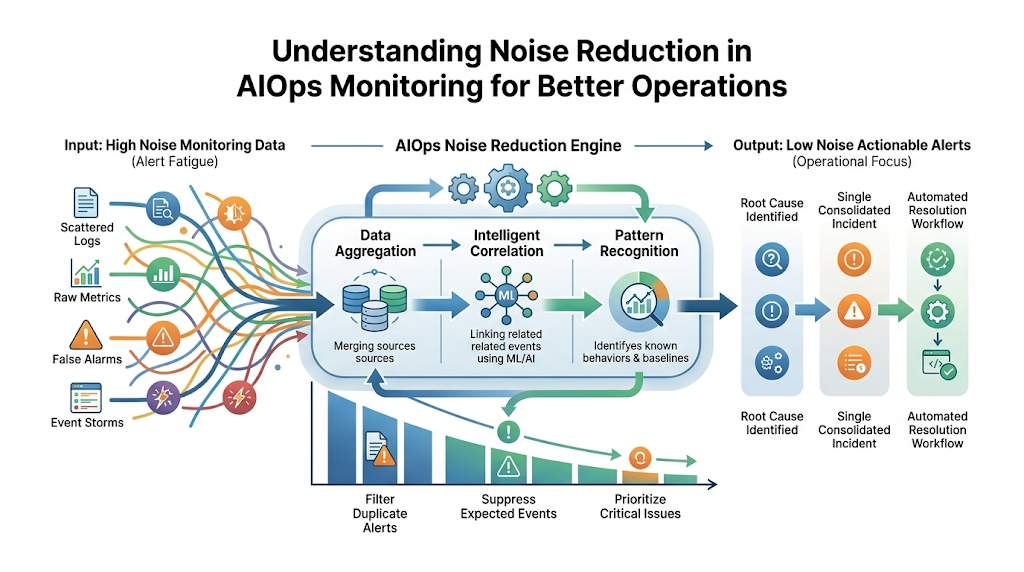
Every day, modern IT infrastructure generates millions of data points. When you log into an enterprise dashboard, you are often greeted by a wall of flashing red lights, ringing alarms, and endless notifications. For DevOps engineers, site reliability engineers (SREs), and system administrators, this daily reality is incredibly overwhelming. When every minor glitch triggers a high-severity alarm, the truly critical issues get lost in the crowd. This is the challenge of alert noise. If an engineering team spends eight hours a day closing duplicate notifications, they cannot focus on building better software or improving system performance. To solve this operational bottleneck, companies are shifting away from rigid, legacy dashboards and moving toward AIOps, which stands for Artificial Intelligence for IT Operations. At the heart of this technological shift is a vital capability called noise reduction. This educational guide breaks down what noise reduction is, how it works, why your business needs it, and how intelligent monitoring transforms chaotic data into actionable insights.
What Is Noise Reduction in AIOps Monitoring?
Definition
Noise reduction in AIOps monitoring is the automated process of filtering, sorting, grouping, and analyzing vast amounts of IT data to eliminate irrelevant or redundant alerts. Instead of passing every single operational blip directly to a human engineer, an AIOps platform acts as an intelligent shield, ensuring that only meaningful, high-priority issues reach your team.
Purpose
The primary goal of noise reduction is to separate the “signal” from the “noise.” The signal represents a genuine problem that requires human intervention, such as a crashing database or a broken payment gateway. The noise consists of harmless, expected, or repetitive background data points, like a brief, normal spike in CPU usage during a scheduled backup.
Why Alert Noise Occurs
In the past, IT environments were simple. You had a physical server sitting in a dedicated server room running a specific application. If that server went down, you fixed it.
Today, businesses use complex hybrid clouds, microservices, and containerized applications across systems like Kubernetes. A single user transaction might pass through dozens of interconnected virtual services. If one underlying service experiences a minor delay, every dependent application down the line might throw an error. Without machine learning, a traditional system views these as hundreds of isolated problems and fires off an alert for each one, creating massive confusion.
Understanding Alert Noise
To fix alert noise, we must first understand the different ways it shows up in daily IT operations.
- False Positives: These occur when a monitoring tool flags an issue that isn’t actually a problem. For example, if an internal test script temporarily stresses a server, a legacy tool might trigger a “Critical System Failure” alarm, even though everything is functioning exactly as intended.
- Duplicate Alerts: If a web server fails, five different monitoring tools might notice it simultaneously. Your infrastructure tool, network monitor, application performance manager, and log aggregator will all send separate notifications for the exact same broken server.
- Low-Priority Alerts: These are informational notifications that do not require immediate action. Receiving an urgent email at 3:00 AM stating that a non-production storage disk is 81% full is an operational distraction, not an emergency.
- Alert Storms: When a core infrastructure piece, like a main network switch or a primary cloud database, goes offline, it triggers a cascading failure. Hundreds of connected applications instantly fail, causing thousands of alarms to fire within a few seconds. This paralyzes IT operations teams.
- Monitoring Overload: This is the collective weight of all the above issues. When engineers are constantly bombarded by non-stop rings, pings, and emails, their brains naturally tune them out. This state of exhaustion is known as alert fatigue, and it often leads to teams accidentally ignoring major, business-critical outages.
Why Noise Reduction Matters
Implementing intelligent noise reduction isn’t just about keeping your inbox clean; it has a massive impact on your business’s bottom line and team health.
Faster Incident Response
When an outage happens, every second counts. If a team has to sift through 5,000 chaotic alarms to find out which database actually broke, the system stays down longer. Noise reduction groups those 5,000 alarms into a single incident ticket, allowing engineers to identify and patch the root cause in minutes instead of hours.
Reduced Alert Fatigue
Engineers who aren’t woken up multiple times a night by false alarms are happier, more focused, and less prone to burnout. Reducing noise improves workplace morale and allows talent to focus on creative engineering work rather than repetitive ticket clearing.
Better Operational Efficiency
Instead of wasting time manually triaging, sorting, and assigning tickets, IT operations teams can use automation. This allows a lean engineering team to easily manage massive cloud environments that would otherwise require dozens of manual operators.
Improved Service Reliability
By catching real infrastructure anomalies early and ignoring the background static, businesses can fix minor bugs before they turn into full-scale system crashes. This creates a much higher level of application uptime.
Better Customer Experience
If your digital storefront or mobile banking app stays online consistently without lag, your customers remain happy. Intelligent monitoring guarantees that digital services remain fast and responsive for end users.
How AIOps Reduces Alert Noise
AIOps platforms do not rely on simple, rigid rules. Instead, they use a multi-step data pipeline powered by artificial intelligence and machine learning to clean up your data stream.
[Raw IT Data Stream]
       │
       ▼
┌──────────────────────────────────────────────┐
│ 1. Data Collection & Aggregation             │
│    Gathers logs, metrics, and traces         │
└──────────────────────┬───────────────────────┘
                       │
                       ▼
┌──────────────────────────────────────────────┐
│ 2. Event Correlation & ML Analysis           │
│    Groups related alerts & recognizes patterns│
└──────────────────────┬───────────────────────┘
                       │
                       ▼
┌──────────────────────────────────────────────┐
│ 3. Intelligent Filtering & Anomaly Detection │
│    Separates normal baselines from real bugs │
└──────────────────────┬───────────────────────┘
                       │
                       ▼
┌──────────────────────────────────────────────┐
│ 4. Root Cause & Actionable Ticket            │
│    Delivers one clear solution to the team   │
└──────────────────────────────────────────────┘
Step 1: Data Collection and Aggregation
The platform continually ingests raw logs, real-time metrics, system events, and traces from every corner of your IT infrastructure, including servers, cloud databases, networks, and applications.
Step 2: Event Correlation
Instead of treating every alert as an isolated incident, the AI looks at context. It checks if multiple alerts are happening at the exact same time, on the same cluster, or along the same application path.
Step 3: Machine Learning Analysis and Pattern Recognition
The system studies historical data to learn what “normal” behavior looks like for your specific business. It recognizes regular patterns, such as an e-commerce site experiencing a natural traffic surge every Friday evening, and adapts its thresholds accordingly.
Step 4: Anomaly Detection
Once the system establishes a normal operational baseline, it can spot true anomalies. If data traffic suddenly drops to zero on a Friday afternoon, the AI recognizes that this deviates from historical patterns and flags it as a genuine issue.
Step 5: Intelligent Alert Filtering
The system automatically silences known low-priority notifications, suppresses expected alerts during pre-scheduled maintenance windows, and filters out false positives before they can reach human dashboards.
Step 6: Root Cause Identification and Action
Finally, the AIOps platform consolidates thousands of scattered data points into one comprehensive incident narrative. It presents the engineer with a single ticket that outlines exactly what went wrong, where it happened, and provides automated recommendations on how to fix it.
Core Technologies Behind Noise Reduction
Several advanced technologies work together under the hood of an AIOps platform to clean up monitoring data:
- Artificial Intelligence & Machine Learning: Algorithmic models that learn over time without needing manual programming. They adapt to changing infrastructure layouts automatically.
- Event Correlation Engines: Software logic that connects independent events based on time proximity, structural topology, and shared resource dependencies.
- Predictive Analytics: Math models that analyze current telemetry trends to forecast system failures before they occur, allowing teams to act proactively.
- Log Analytics: Tools that scan millions of lines of unstructured text generated by software applications to find hidden error codes and system patterns.
- IT Observability Platforms: Deep visibility systems that track the internal states of an application by looking closely at its outputs, namely metrics, logs, and traces.
- Automation Systems: Scripted or algorithmic workflows that automatically execute remediation steps, like restarting a frozen cloud service without human intervention.
Traditional Monitoring vs. AIOps-Based Monitoring
| Feature | Traditional Monitoring | AIOps Monitoring | Business Impact |
| Alert Thresholds | Static and manually set (e.g., alert if CPU > 80%). | Dynamic and calculated automatically by machine learning. | Eliminates manual tuning; stops alerts from normal seasonal traffic spikes. |
| Data Handling | Evaluates alerts in isolation, ignoring broader context. | Correlates logs, metrics, and traces across the entire network. | Drastically reduces duplicate notifications during infrastructure crashes. |
| Root Cause Analysis | Requires manual investigation across multiple dashboards. | Automatically identifies the primary root cause of an event. | Reduces mean time to resolution (MTTR) from hours to minutes. |
| Operational Style | Reactive (notifies you after a system breaks down). | Proactive (predicts anomalies and trends before failures). | Prevents costly, high-severity outages before they impact customers. |
Common Sources of Alert Noise and AIOps Solutions
| Alert Noise Source | Cause | AIOps Solution | Expected Benefit |
| Cascading Infrastructure Failures | A core network router breaks, causing hundreds of connected servers to report connectivity drops. | Event correlation groups all dependent server alarms into one root router ticket. | Prevents alert storms; keeps your engineering team focused on the source problem. |
| Scheduled Maintenance Windows | Engineers update software, causing expected reboots and temporary service offline alerts. | Automated integration silences alerts for systems marked for active maintenance. | Keeps monitoring queues completely clear of expected operational noise. |
| Flapping Alerts | A resource fluctuates rapidly above and below a fixed threshold (e.g., bouncing between 79% and 81%). | Algorithmic smart dampening treats the bouncing metric as a single status change. | Stops continuous, repetitive notification spam on engineer devices. |
| Flaky Testing Scripts | Automated testing routines create brief, harmless spikes in application error rates. | Machine learning baseline analysis recognizes these events as safe, routine patterns. | Eliminates annoying false alarms without lowering security baselines. |
Benefits of Noise Reduction in AIOps
- Fewer Unnecessary Alerts: Teams experience a 90% or higher reduction in overall alert volume, leaving dashboards clean and easy to read.
- Faster Troubleshooting: Because the platform points directly to the root cause, engineers don’t have to guess where a system bug is hiding.
- Better Productivity: Engineers spend less time triaging Jira tickets or looking at Slack notifications and more time writing high-quality software code.
- Improved System Availability: Outages are either caught before they happen or resolved so fast that end-users rarely notice a disruption.
- Lower Operational Costs: Minimizing major down-time saves companies thousands of dollars per minute in lost transactions and operational overhead.
- Better Decision-Making: Clear analytics dashboards provide IT leadership with accurate data regarding the actual health and capacity of their infrastructure.
Common Challenges in Reducing Noise
While AIOps offers incredible value, deploying these systems comes with a few hurdles:
- Poor Initial Configurations: If the foundational monitoring metrics are completely broken, an AIOps system will struggle to find clean patterns.
- Complex Hybrid Environments: Combining old, on-premise legacy servers with cutting-edge, multi-cloud setups makes unified data aggregation difficult.
- Massive Data Volumes: Ingesting terabytes of data every single minute requires significant network bandwidth and modern cloud storage architectures.
- Fear of False Negatives: Teams sometimes worry that aggressive filtering might cause the system to accidentally silence a truly critical alarm.
- Integration Issues: Connecting a new AIOps tool to dozens of older, fragmented monitoring applications can be technically challenging.
- The Skills Gap: Traditional IT teams often require training to trust and properly interact with automated, AI-driven insight platforms.
Best Practices for Effective Noise Reduction
- Define Clear Business Baselines: Before turning on AI filtering, make sure your team clearly understands what systems are genuinely critical to your core business revenue.
- Clean Your Data Input: Ensure your applications output clean, well-structured logs so that machine learning models can parse the information accurately.
- Implement Gradual Automation: Start by letting the AI group and sort alerts for human review. Once you trust its accuracy, enable automated auto-remediation scripts.
- Keep Topology Maps Updated: Maintain accurate structural maps of how your apps and servers connect so the correlation engine understands system dependencies.
- Review System Rules Regularly: Set aside time every quarter to audit your AIOps configurations, ensuring the algorithms match your evolving software architecture.
Real-World Use Cases
1. Cloud Infrastructure Management
- Problem: A global software provider’s cloud system generated 40,000 daily monitoring alerts, causing engineers to miss critical storage failures.
- AIOps Solution: An event correlation tool grouped identical microservice errors based on time and cluster location.
- Outcome: Alert volume dropped by 95%, allowing the SRE team to fix server problems before customers noticed any lag.
2. Banking and Financial Services
- Problem: A retail bank suffered frequent digital banking slowdowns because legacy monitoring tools couldn’t pinpoint bugs across thousands of virtual machines.
- AIOps Solution: An intelligent monitoring platform analyzed cross-system dependencies to track transactional paths in real time.
- Outcome: The bank reduced its mean time to resolution (MTTR) from three hours down to less than ten minutes, preserving consumer trust.
3. Healthcare Networks
- Problem: A hospital group’s patient portals and internal scheduling tools regularly triggered false alarms during nightly database backups.
- AIOps Solution: Machine learning models adjusted the performance threshold baseline automatically during late-night hours.
- Outcome: Night-shift IT staff stopped receiving false emergency pages, allowing them to focus exclusively on hospital network security.
4. Telecommunications Providers
- Problem: A cell network provider suffered from massive alert storms whenever a regional power outage knocked down a primary cell tower.
- AIOps Solution: The system mapped regional hardware topology to suppress thousands of downstream router errors when a main power source failed.
- Outcome: A single, clear repair ticket was sent to field technicians instantly, speeding up local power restoration.
5. E-Commerce Platforms
- Problem: During Black Friday shopping surges, static monitoring tools triggered false alarms due to completely normal spikes in web traffic.
- AIOps Solution: Predictive analytics analyzed historical holiday traffic data to accommodate the massive user influx safely.
- Outcome: The website maintained high availability throughout the holiday rush without distracting engineering teams with false alerts.
6. Enterprise IT Operations
- Problem: A global manufacturing company struggled with separate monitoring teams using isolated tools, resulting in messy, duplicate ticket creation.
- AIOps Solution: A central observability engine consolidated data streams into a single corporate operations dashboard.
- Outcome: Operational siloes were eliminated, saving the company thousands of dollars in redundant software costs.
Future Trends in Intelligent Monitoring
As technology evolves, the capabilities of noise reduction and AIOps continue to mature.
- AI-Driven Observability: Future systems won’t just tell you when a system is broken; they will offer deep, continuous visibility into the health of every line of code running in the cloud.
- Autonomous Incident Management: IT systems will increasingly self-heal. If a service fails, the platform will spin up a replacement container and patch the bug without human intervention.
- Generative AI Integration: Engineers will soon be able to converse with their monitoring tools in natural English, asking questions like, “Why did alert noise spike on server three this morning?” and receiving instant plain-text breakdowns.
FAQs
Q1: What is the difference between an alert and a notification noise?
An alert is a meaningful message indicating a system issue that needs human review, while notification noise refers to duplicate, safe, or low-priority status messages that distract engineers.
Q2: How does machine learning help in reducing monitoring noise?
Machine learning analyzes past IT performance data to understand normal operations, allowing it to automatically ignore safe historical patterns and spot true anomalies.
Q3: Can small businesses benefit from AIOps noise reduction?
Yes, because smaller teams have fewer engineering hours to spare, using automation to filter out false alarms keeps them focused on growth instead of maintenance.
Q4: Will noise reduction cause my team to miss critical system errors?
No, when set up correctly using topology data, intelligent filtering reduces false alarms while ensuring actual, high-severity anomalies stand out clearly.
Q5: What is an alert storm in an IT environment?
An alert storm happens when a core system component fails, causing thousands of connected applications to crash simultaneously and flood dashboards with duplicate messages.
Q6: What does MTTR stand for, and why is it important?
MTTR stands for Mean Time to Resolution, which measures the average time it takes to fix a broken system; lower MTTR means less downtime and happier customers.
Q7: Can traditional monitoring tools handle modern cloud systems?
Traditional tools rely on rigid, manual rules that easily break down when facing the fast-changing scale of modern cloud and container setups.
Q8: How does event correlation work?
It connects separate data points from different systems using shared timestamps, network paths, and hardware locations to identify a single root problem.
Q9: Is noise reduction a manual or an automated process?
It is a highly automated process driven by AI algorithms, though engineers occasionally tweak initial configurations to align with business requirements.
Q10: What is alert fatigue?
Alert fatigue is the state of exhaustion engineers reach when bombarded by endless false notifications, causing them to accidentally ignore actual system emergencies.
Conclusion
Managing a modern IT infrastructure shouldn’t feel like searching for a needle in an endless haystack of alarms. As digital ecosystems grow more complex, relying on old-school, static alerts only leads to burnt-out engineering teams and slow incident response times. Implementing intelligent noise reduction via AIOps changes the game entirely. By utilizing machine learning, event correlation, and dynamic baselines, companies can block out the distracting background hum of their data streams. This ensures that when an alarm finally goes off, your team knows it is a real issue that matters. Investing in modern AIOps tools lets your operations team put down the digital fire extinguishers and focus on what they do best: building stable, scalable, and innovative technology.