Introduction
AI Worker Safety Monitoring combines computer vision, IoT sensors, industrial analytics, edge computing, and artificial intelligence to help organizations identify workplace hazards and improve worker safety. These systems can monitor conditions such as missing personal protective equipment, unsafe proximity to machinery, restricted-area entry, falls, vehicle-pedestrian interactions, environmental hazards, and other safety risks.Unlike conventional safety programs that depend primarily on periodic inspections and manual reporting, AI-powered monitoring can continuously analyze selected workplace conditions and generate alerts when potentially dangerous situations occur.Common applications include PPE detection, fall detection, worker-machine proximity monitoring, forklift and pedestrian safety, restricted-zone monitoring, unsafe behavior detection, fatigue-related risk indicators, environmental monitoring, emergency alerts, and incident investigation.
What Is AI Worker Safety Monitoring?
AI Worker Safety Monitoring uses computer vision, sensors, machine learning, edge computing, and industrial IoT to identify potentially unsafe conditions.
A typical architecture can look like:
Cameras + IoT Sensors + Machine Data → Edge/Cloud Processing → AI Detection → Risk Assessment → Alert → Human Response
A traditional camera system may simply record video.
An AI-enabled system can analyze selected video streams and identify events such as:
- Worker entering a restricted area.
- Worker without required PPE.
- Person approaching moving equipment.
- Forklift approaching a pedestrian.
- Person falling.
- Unsafe distance from machinery.
- Smoke or fire indicators.
- Abnormal environmental conditions.
IoT sensors can add additional context:
- Temperature.
- Gas concentration.
- Noise.
- Vibration.
- Location.
- Machine status.
- Air quality.
- Worker-worn device signals.
The result is a more contextual approach to workplace safety.
Why AI Worker Safety Monitoring Matters
Industrial safety incidents often involve a combination of environmental, equipment, behavioral, and operational factors.
A single camera may show a worker near a machine, but it may not know:
- Whether the machine is operating.
- Whether the worker is authorized to enter the area.
- Whether the worker is wearing required PPE.
- Whether another vehicle is approaching.
- Whether the area is currently restricted.
AI systems can combine multiple signals to provide more useful context.
For example:
Camera: Detects a person.
Machine data: Shows equipment is operating.
Location data: Indicates the person is entering a restricted zone.
AI system: Identifies a potential worker-machine proximity risk.
This type of contextual monitoring can help safety teams prioritize potentially hazardous situations.
AI monitoring should, however, be treated as a safety-support system rather than a replacement for safety procedures, training, supervision, engineering controls, or emergency systems.
Major Use Cases
PPE Detection
Computer vision can identify whether required protective equipment appears to be present.
Examples include:
- Hard hats.
- Safety vests.
- Safety glasses.
- Gloves.
- Protective clothing.
Actual detection capabilities vary according to camera position, lighting, PPE type, and model configuration.
Worker-Machine Proximity
AI can detect when workers move too close to operating equipment.
This can be particularly useful around:
- Robots.
- CNC equipment.
- Presses.
- Conveyors.
- Automated machinery.
Forklift-Pedestrian Safety
Vision and location systems can identify potential interactions between vehicles and pedestrians.
Restricted-Area Monitoring
AI can identify movement into designated zones.
Fall Detection
Computer vision or wearable sensors can detect potential falls or unusual body positions.
Environmental Monitoring
IoT sensors can monitor:
- Temperature.
- Humidity.
- Gas.
- Air quality.
- Noise.
- Other measurable environmental conditions.
Fire and Smoke Detection
Computer vision can potentially identify visible smoke or fire indicators, although dedicated fire-detection systems remain essential for life-safety applications.
Worker Location
IoT and wearable technologies can help determine approximate worker locations in facilities where location monitoring is appropriate.
Fatigue and Ergonomic Risk
Some AI systems can analyze movement or working conditions for indicators associated with ergonomic risk or fatigue.
Such outputs should be treated carefully because they are probabilistic indicators rather than definitive judgments about a worker.
Incident Investigation
AI-assisted search and video analytics can help safety teams investigate events more efficiently.
Safety Compliance Monitoring
Organizations can use analytics to identify recurring safety-pattern issues and determine where additional training or engineering controls may be needed.
How AI Worker Safety Monitoring Works
Video Collection
Cameras capture selected workplace areas.
The system may process video:
- On the camera.
- At an edge device.
- On a local server.
- In the cloud.
- Through a hybrid architecture.
Computer Vision
Computer-vision models can detect:
- People.
- Vehicles.
- PPE.
- Objects.
- Zones.
- Movement.
- Potential hazards.
IoT Data
IoT devices can provide additional information about:
- Machine states.
- Environmental conditions.
- Worker location.
- Equipment status.
- Gas levels.
- Temperature.
- Noise.
Risk Analysis
AI can combine multiple signals.
For example:
Person detected + restricted zone + machine operating = potential safety event
Alerting
Alerts may be delivered through:
- Dashboards.
- Mobile applications.
- Industrial control interfaces.
- Email.
- Messaging systems.
- Audible or visual alarms.
Human Response
A safety professional, supervisor, or authorized operator can assess the alert and take appropriate action.
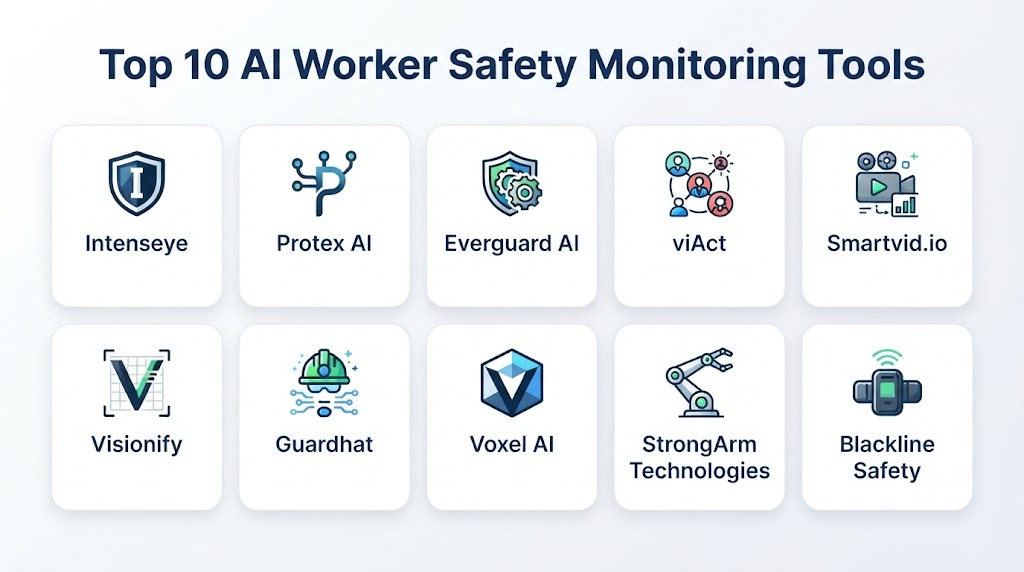
Top 10 AI Worker Safety Monitoring Tools
1 — Protex AI
One-line verdict: Best for organizations seeking AI-powered workplace video analytics focused on proactive safety-risk identification.
Short description:
Protex AI focuses on computer-vision-based workplace safety monitoring. Its technology is designed to analyze workplace video and identify potentially hazardous situations.
It is particularly relevant to industrial environments where organizations want to supplement conventional safety programs with continuous video-based risk analysis.
Standout Capabilities
- Computer vision.
- Workplace safety analytics.
- Hazard detection.
- Video analysis.
- Safety event identification.
- Risk monitoring.
- Proactive safety insights.
- Operational dashboards.
AI-Specific Depth
- Model support: Proprietary computer-vision AI.
- RAG / knowledge integration: Varies / N/A.
- Evaluation: Safety-event detection and model-performance evaluation.
- Guardrails: Configurable safety rules, alert thresholds, access controls, and human review.
- Observability: Detection events, alerts, video analytics, and safety trends.
Pros
- Strong safety-focused computer vision.
- Designed for proactive hazard identification.
- Can complement existing workplace safety programs.
Cons
- Video coverage must be carefully designed.
- Detection accuracy depends on environmental conditions.
- Does not replace physical safety controls.
Security & Compliance
Security and privacy capabilities depend on deployment and configuration. Specific certifications should be independently verified.
Deployment & Platforms
- Edge.
- Cloud.
- Hybrid environments.
Integrations & Ecosystem
Potential integrations can include:
- CCTV cameras.
- Video-management systems.
- Safety platforms.
- Industrial systems.
- Alerting systems.
- APIs.
Pricing Model
Commercial/custom pricing. Exact pricing is Not publicly stated.
Best-Fit Scenarios
- Manufacturing.
- Warehouses.
- Industrial facilities.
2 — Intenseye
One-line verdict: Best for enterprises wanting computer vision for PPE, workplace hazards, safety events, and industrial risk monitoring.
Short description:
Intenseye provides AI-powered computer vision technology for workplace safety and industrial environments.
Its approach focuses on identifying safety risks from visual information and supporting safety teams with automated monitoring.
Standout Capabilities
- PPE detection.
- Computer vision.
- Safety monitoring.
- Risk detection.
- Industrial video analytics.
- Incident analysis.
- Safety dashboards.
- Real-time alerts.
AI-Specific Depth
- Model support: Proprietary computer-vision models.
- RAG / knowledge integration: Varies / N/A.
- Evaluation: Detection performance and safety-event analysis.
- Guardrails: Safety rules, configured policies, alert thresholds, and human review.
- Observability: Alerts, safety events, detection metrics, and trends.
Pros
- Strong industrial safety focus.
- Broad computer-vision applications.
- Useful for continuous workplace monitoring.
Cons
- Camera quality affects performance.
- Site-specific configuration may be necessary.
- Privacy considerations require careful planning.
Security & Compliance
Security and privacy controls vary by deployment. Specific certifications should be independently verified.
Deployment & Platforms
- Cloud.
- Edge.
- Hybrid.
Integrations & Ecosystem
- CCTV.
- Video-management systems.
- Safety software.
- Industrial platforms.
- APIs.
- Alert systems.
Pricing Model
Commercial/custom pricing. Exact pricing is Not publicly stated.
Best-Fit Scenarios
- Large industrial organizations.
- Manufacturing plants.
- Multi-site safety programs.
3 — Protex AI / Computer Vision Safety Platforms
One-line verdict: Best for organizations prioritizing proactive visual hazard identification across industrial workplace environments.
Short description:
AI-based workplace safety platforms can analyze existing camera infrastructure to identify safety-related events and provide actionable information to safety teams.
Capabilities depend on the selected implementation and computer-vision models.
Standout Capabilities
- Worker detection.
- Hazard monitoring.
- PPE analysis.
- Zone monitoring.
- Video analytics.
- Safety-event detection.
- Risk dashboards.
- Historical analysis.
AI-Specific Depth
- Model support: Computer-vision models.
- RAG / knowledge integration: N/A.
- Evaluation: Detection accuracy, false positives, false negatives, and event review.
- Guardrails: Configurable safety rules and human verification.
- Observability: Detection events, alerts, and safety metrics.
Pros
- Uses visual workplace information.
- Can support continuous monitoring.
- Useful for identifying recurring safety patterns.
Cons
- Camera positioning is critical.
- Environmental conditions affect computer vision.
- Requires careful privacy governance.
Security & Compliance
Specific certifications are Not publicly stated unless independently verified.
Deployment & Platforms
- Edge.
- Cloud.
- Hybrid.
Integrations & Ecosystem
- Cameras.
- CCTV.
- VMS.
- Safety systems.
- APIs.
- Alerting tools.
Pricing Model
Commercial/custom pricing. Exact pricing is Not publicly stated.
Best-Fit Scenarios
- Factory safety.
- Warehouse safety.
- Industrial computer vision.
4 — Motorola Solutions Avigilon
One-line verdict: Best for organizations combining video security infrastructure with AI-powered detection and workplace monitoring.
Short description:
Avigilon provides video security and analytics technologies that use computer vision and AI to analyze video environments.
Depending on configuration, these capabilities can support workplace awareness, incident investigation, and selected safety-related monitoring scenarios.
Standout Capabilities
- Video analytics.
- Object detection.
- Video search.
- Event detection.
- Security monitoring.
- Camera management.
- AI-powered analytics.
- Incident investigation.
AI-Specific Depth
- Model support: Proprietary AI/video analytics.
- RAG / knowledge integration: N/A for core video analytics.
- Evaluation: Detection accuracy and event-based evaluation.
- Guardrails: User permissions, zones, event rules, and administrative controls.
- Observability: Video events, analytics alerts, camera health, and system status.
Pros
- Established video-security ecosystem.
- Strong video analytics.
- Useful for organizations combining safety and security.
Cons
- Primarily a video-security ecosystem.
- Dedicated industrial safety capabilities may require additional systems.
- Camera infrastructure is important.
Security & Compliance
Security features vary by solution and deployment. Specific certifications should be independently verified.
Deployment & Platforms
- On-premises.
- Cloud-connected.
- Hybrid.
- Edge.
Integrations & Ecosystem
- IP cameras.
- Video-management systems.
- Access control.
- Security systems.
- APIs.
- Monitoring systems.
Pricing Model
Commercial/custom pricing. Exact pricing is Not publicly stated.
Best-Fit Scenarios
- Industrial campuses.
- Manufacturing facilities.
- Integrated security and safety monitoring.
5 — AWS IoT + Computer Vision Safety Stack
One-line verdict: Best for developers building customized worker-safety systems combining cameras, IoT sensors, machine data, and AI.
Short description:
Cloud and edge technologies can be combined to build custom worker-safety applications.
An organization can connect cameras, machine signals, environmental sensors, and location data to custom AI models and safety workflows.
Standout Capabilities
- Computer vision.
- IoT connectivity.
- Edge processing.
- Machine learning.
- Sensor integration.
- Real-time alerts.
- Custom safety applications.
- Data analytics.
AI-Specific Depth
- Model support: Multiple AI/ML models and custom computer-vision models.
- RAG / knowledge integration: Safety manuals, procedures, incident records, and operational policies can support AI assistants.
- Evaluation: Precision, recall, false-alert rates, scenario testing, and field validation.
- Guardrails: IAM, access policies, safety rules, model thresholds, and human approval.
- Observability: Model metrics, event logs, latency, infrastructure health, and alerts.
Pros
- Highly customizable.
- Supports multimodal data.
- Suitable for complex industrial architectures.
Cons
- Requires engineering expertise.
- Safety workflows must be designed.
- Total cost depends on architecture.
Security & Compliance
Security capabilities depend on selected services and configuration. Specific certifications should be independently verified for the intended architecture.
Deployment & Platforms
- Cloud.
- Edge.
- Hybrid.
Integrations & Ecosystem
- Cameras.
- IoT sensors.
- PLCs.
- Machine data.
- Location systems.
- Databases.
- APIs.
Pricing Model
Usage-based cloud pricing varies by services used. Exact implementation cost is Varies / N/A.
Best-Fit Scenarios
- Custom safety applications.
- Multi-sensor monitoring.
- Developer-led industrial AI.
6 — Microsoft Azure AI + IoT Safety Stack
One-line verdict: Best for enterprises building custom computer-vision and IoT safety monitoring around Microsoft technologies.
Short description:
Microsoft’s AI, IoT, edge, analytics, and data technologies can be combined to build custom worker-safety monitoring applications.
This approach can combine camera feeds, sensor information, machine data, and workplace policies.
Standout Capabilities
- Computer vision.
- IoT.
- Edge AI.
- Machine learning.
- Video analytics.
- Sensor integration.
- Data analytics.
- AI governance.
AI-Specific Depth
- Model support: Multiple AI models and custom machine-learning models.
- RAG / knowledge integration: Safety procedures, manuals, policies, and incident records can support AI applications.
- Evaluation: Offline testing, scenario evaluation, precision, recall, and false-alert analysis.
- Guardrails: Identity, RBAC, policies, model thresholds, and human review.
- Observability: Model performance, latency, system health, event logs, and alerts.
Pros
- Flexible enterprise architecture.
- Strong AI ecosystem.
- Supports multimodal safety applications.
Cons
- Requires development.
- Industrial integration can be complex.
- Safety-specific functionality may need to be built.
Security & Compliance
Security capabilities depend on the services and architecture selected. Specific certifications should be independently verified.
Deployment & Platforms
- Cloud.
- Edge.
- Hybrid.
Integrations & Ecosystem
- Cameras.
- IoT.
- PLCs.
- Data platforms.
- Safety applications.
- APIs.
- Enterprise identity systems.
Pricing Model
Usage-based cloud pricing varies by services used. Exact implementation cost is Varies / N/A.
Best-Fit Scenarios
- Enterprise safety platforms.
- Custom computer vision.
- Multimodal industrial monitoring.
7 — NVIDIA Metropolis
One-line verdict: Best for developers building high-performance edge computer-vision applications for industrial worker and environment monitoring.
Short description:
NVIDIA Metropolis provides technologies for developing and deploying computer-vision applications at the edge and across enterprise environments.
It can serve as a foundation for custom worker-safety applications involving cameras and real-time AI inference.
Standout Capabilities
- Edge AI.
- Computer vision.
- Video analytics.
- Object detection.
- Multi-camera processing.
- AI inference.
- Real-time analytics.
- Developer tooling.
AI-Specific Depth
- Model support: Multiple computer-vision models and custom models.
- RAG / knowledge integration: N/A for core vision infrastructure.
- Evaluation: Model accuracy, latency, false positives, and scenario testing.
- Guardrails: Application-level rules, confidence thresholds, permissions, and human review.
- Observability: Inference performance, latency, GPU utilization, detection events, and application health.
Pros
- Strong edge AI capabilities.
- High-performance computer vision.
- Flexible for custom applications.
Cons
- Development expertise is required.
- Not a complete worker-safety application by itself.
- Hardware and deployment architecture need consideration.
Security & Compliance
Security depends on implementation and deployment. Specific certifications should be independently verified.
Deployment & Platforms
- Edge.
- On-premises.
- Cloud-connected.
- Hybrid.
Integrations & Ecosystem
- IP cameras.
- Edge servers.
- GPUs.
- Computer-vision models.
- IoT systems.
- APIs.
- Industrial applications.
Pricing Model
Technology and infrastructure costs vary by hardware, software, and implementation. Exact cost is Varies / N/A.
Best-Fit Scenarios
- Custom computer vision.
- Low-latency safety monitoring.
- Multi-camera industrial applications.
8 — Landing AI
One-line verdict: Best for organizations developing customized computer-vision applications for industrial inspection and workplace environments.
Short description:
Landing AI provides computer-vision technologies designed to help organizations develop AI vision applications.
Although computer vision can support worker-safety scenarios, specific safety functionality depends on the application created by the organization.
Standout Capabilities
- Computer vision.
- Visual inspection.
- Custom AI models.
- Image analysis.
- Dataset management.
- Model development.
- Vision deployment.
- AI application development.
AI-Specific Depth
- Model support: Computer-vision models and custom models.
- RAG / knowledge integration: N/A for core computer vision.
- Evaluation: Dataset testing, model accuracy, false-positive analysis, and validation.
- Guardrails: Application rules, confidence thresholds, access controls, and human review.
- Observability: Model performance, inference metrics, and application monitoring.
Pros
- Flexible computer-vision development.
- Useful for specialized visual applications.
- Supports customized models.
Cons
- Requires application development for many safety scenarios.
- Not exclusively focused on worker safety.
- Dataset quality is critical.
Security & Compliance
Specific certifications are Not publicly stated unless independently verified.
Deployment & Platforms
- Cloud.
- Edge.
- Hybrid depending on implementation.
Integrations & Ecosystem
- Cameras.
- Vision datasets.
- AI models.
- Industrial applications.
- APIs.
- Edge systems.
Pricing Model
Commercial/custom pricing. Exact pricing is Not publicly stated.
Best-Fit Scenarios
- Custom safety vision.
- Industrial computer vision.
- Specialized visual detection.
9 — Samsara
One-line verdict: Best for organizations combining connected operations, cameras, sensors, vehicle monitoring, and worker-safety workflows.
Short description:
Samsara provides connected-operations technologies covering cameras, telematics, sensors, workflows, and operational monitoring.
Its ecosystem can be relevant to workplace and fleet safety, particularly where worker activity and vehicle operations overlap.
Standout Capabilities
- Connected operations.
- Video safety.
- Fleet monitoring.
- Sensors.
- Driver safety.
- Operational analytics.
- Alerts.
- Safety workflows.
AI-Specific Depth
- Model support: AI-powered video and operational analytics; specific model architecture is not generally exposed.
- RAG / knowledge integration: Varies / N/A.
- Evaluation: Safety events, video review, alerts, and operational metrics.
- Guardrails: Configurable policies, alerts, permissions, and workflow controls.
- Observability: Video events, sensor data, vehicle telemetry, alerts, and operational metrics.
Pros
- Strong connected-operations ecosystem.
- Useful for vehicle and workplace safety.
- Combines cameras and sensor data.
Cons
- Stronger fit for connected operations and fleet environments.
- Factory-specific use cases may require additional systems.
- Monitoring policies require careful privacy governance.
Security & Compliance
Security capabilities vary by product and deployment. Specific certifications should be independently verified.
Deployment & Platforms
- Cloud.
- Mobile.
- Edge-connected devices.
Integrations & Ecosystem
- Cameras.
- Telematics.
- Sensors.
- Fleet systems.
- Mobile devices.
- APIs.
- Operational software.
Pricing Model
Commercial/custom pricing. Exact pricing is Not publicly stated.
Best-Fit Scenarios
- Fleet safety.
- Warehouses.
- Connected industrial operations.
10 — Custom AI Worker Safety Platform
One-line verdict: Best for enterprises needing proprietary multimodal safety monitoring across cameras, IoT, machines, location, and environmental sensors.
Short description:
A custom safety platform can combine computer vision, IoT, machine data, location information, environmental sensors, and AI models.
This provides maximum flexibility for organizations with specialized safety requirements.
Standout Capabilities
- PPE detection.
- Worker-machine proximity.
- Fall detection.
- Restricted-zone monitoring.
- Forklift-pedestrian detection.
- Environmental monitoring.
- Anomaly detection.
- Multimodal risk analysis.
AI-Specific Depth
- Model support: Computer vision, time-series models, multimodal AI, anomaly detection, and custom ML.
- RAG / knowledge integration: Safety manuals, SOPs, risk assessments, incident reports, and site-specific policies.
- Evaluation: Precision, recall, false-alert rate, missed-event rate, latency, and site-specific validation.
- Guardrails: Safety policies, confidence thresholds, escalation rules, human review, and fail-safe behavior.
- Observability: Detection accuracy, model drift, latency, sensor health, alerts, and system performance.
Pros
- Maximum customization.
- Can combine multiple data sources.
- Can be designed around site-specific hazards.
Cons
- High development effort.
- Requires AI, IoT, and safety expertise.
- Long-term maintenance is required.
Security & Compliance
A custom platform can implement:
- SSO.
- RBAC.
- Encryption.
- Audit logs.
- Data-retention controls.
- Privacy controls.
- Model versioning.
- Access restrictions.
Specific certifications are Not publicly stated for a generic implementation.
Deployment & Platforms
- Cloud.
- Self-hosted.
- Edge.
- Hybrid.
Integrations & Ecosystem
Potential integrations include:
- CCTV.
- IoT sensors.
- PLCs.
- SCADA.
- Access control.
- Wearables.
- Location systems.
- Safety-management software.
Pricing Model
Custom development and infrastructure. Exact pricing is N/A.
Best-Fit Scenarios
- Large manufacturing organizations.
- High-risk industrial environments.
- Multi-modal safety monitoring.
Comparison Table
| Tool | Best For | Deployment | Model Flexibility | Strength | Watch-Out | Public Rating |
|---|---|---|---|---|---|---|
| Protex AI | Industrial safety vision | Cloud / Edge / Hybrid | Proprietary AI | Proactive hazard detection | Camera/environment dependency | |
| Intenseye | Enterprise workplace safety | Cloud / Edge / Hybrid | Proprietary AI | Industrial computer vision | Privacy and deployment planning | |
| Protex-style Safety Vision Platforms | Visual safety monitoring | Cloud / Edge | Computer Vision | Hazard detection | Site-specific configuration | |
| Avigilon | Video security + safety | Edge / On-prem / Hybrid | Proprietary AI | Video analytics | Broader security focus | |
| AWS Industrial AI Stack | Custom safety applications | Cloud / Edge | Multi-model | Flexibility | Requires development | |
| Azure Industrial AI Stack | Enterprise custom safety | Cloud / Edge | Multi-model | Enterprise AI ecosystem | Engineering required | |
| NVIDIA Metropolis | Edge computer vision | Edge / Hybrid | Multi-model | Low-latency vision | Developer-focused | |
| Landing AI | Custom vision | Cloud / Edge | Custom models | Vision development | Safety features may require building | |
| Samsara | Fleet + connected safety | Cloud / Edge | AI analytics | Connected operations | Factory use varies | |
| Custom AI Platform | Specialized safety | Cloud / Edge / Hybrid | Multi-model | Maximum flexibility | High engineering effort |
Scoring & Evaluation
These scores are comparative editorial assessments rather than official vendor ratings.
Worker-safety AI should be evaluated primarily on detection reliability, false alarms, missed events, latency, camera and sensor coverage, privacy controls, and how effectively alerts lead to real-world safety interventions.
A system that generates thousands of inaccurate alerts may be less useful than a simpler system with fewer but more actionable alerts.
| Tool | Core Features | AI Reliability | Safety Detection | Integrations | Ease | Performance/Cost | Security/Admin | Support | Weighted Total |
|---|---|---|---|---|---|---|---|---|---|
| Protex AI | 9 | 9 | 10 | 9 | 8 | 8 | 9 | 9 | 9.00 |
| Intenseye | 10 | 9 | 10 | 9 | 8 | 8 | 9 | 9 | 9.10 |
| Protex-style Safety Vision | 9 | 8 | 9 | 8 | 8 | 8 | 9 | 8 | 8.55 |
| Avigilon | 9 | 9 | 8 | 10 | 9 | 8 | 10 | 10 | 9.10 |
| AWS Industrial AI | 10 | 9 | 9 | 10 | 6 | 8 | 10 | 10 | 8.85 |
| Azure Industrial AI | 10 | 9 | 9 | 10 | 7 | 8 | 10 | 10 | 9.00 |
| NVIDIA Metropolis | 9 | 10 | 9 | 9 | 6 | 8 | 9 | 9 | 8.75 |
| Landing AI | 8 | 9 | 8 | 8 | 8 | 8 | 9 | 8 | 8.25 |
| Samsara | 9 | 9 | 8 | 10 | 9 | 8 | 9 | 10 | 9.00 |
| Custom AI Platform | 10 | 10 | 10 | 10 | 5 | 7 | 10 | 10 | 9.40 |
Top 3 for Enterprise
- Intenseye — Strong focus on industrial workplace safety and computer vision.
- Avigilon — Strong choice where video security and safety monitoring overlap.
- Custom AI Worker Safety Platform — Best flexibility for specialized multi-sensor environments.
Top 3 for SMB
- Samsara — Useful for organizations combining connected operations, vehicles, cameras, and safety.
- Protex AI — Focused workplace safety analytics.
- Intenseye — Strong computer-vision approach for industrial safety.
Top 3 for Developers
- NVIDIA Metropolis — Strong foundation for edge computer-vision applications.
- AWS Industrial AI Stack — Flexible cloud and IoT architecture.
- Azure Industrial AI Stack — Strong enterprise AI and IoT development environment.
Which AI Worker Safety Monitoring Tool Is Right for You?
Solo / Small Workplace
Small organizations should first identify their highest-risk scenarios.
For example:
- Forklift movement.
- PPE compliance.
- Restricted areas.
- Machine access.
- Slips and falls.
A simple, focused solution may be more practical than a complex multimodal platform.
SMB
SMBs should prioritize:
- Easy camera deployment.
- Reliable alerts.
- Simple dashboards.
- Mobile notifications.
- Basic sensor integration.
- Clear safety reporting.
Avoid platforms that require excessive engineering if the safety team has limited technical resources.
Mid-Market
Mid-market organizations can consider combining:
- Computer vision.
- Machine data.
- IoT sensors.
- Access control.
- Location information.
This allows the organization to move from isolated alerts toward contextual safety analytics.
Enterprise
Enterprise organizations may need:
- Multi-site monitoring.
- Centralized safety analytics.
- Edge AI.
- Privacy controls.
- Role-based access.
- Auditability.
- Integration with EHS systems.
- Model governance.
Enterprise architectures should also define how AI alerts are reviewed and escalated.
Manufacturing
Manufacturing plants can focus on:
- PPE.
- Machine proximity.
- Restricted zones.
- Robotics.
- Forklifts.
- Conveyors.
- Production-floor hazards.
Warehousing
Warehouses can prioritize:
- Forklift-pedestrian interactions.
- Loading areas.
- Restricted zones.
- Falls.
- Vehicle movement.
- PPE.
Construction
Construction environments can use AI for:
- PPE.
- Site access.
- Fall-risk indicators.
- Restricted areas.
- Equipment proximity.
Environmental conditions and constantly changing site layouts can make deployment challenging.
Mining and Heavy Industry
Important use cases include:
- Vehicle interactions.
- Restricted zones.
- Heavy machinery.
- Environmental conditions.
- Worker location.
These environments may benefit from combining computer vision with IoT and wearable technologies.
Logistics and Fleet Operations
Organizations with large vehicle fleets can combine:
- Vehicle cameras.
- Telematics.
- Driver monitoring.
- Location data.
- Operational alerts.
Budget vs Premium
Budget implementations can focus on one or two high-value safety scenarios.
Premium implementations can combine:
- Computer vision.
- IoT.
- Wearables.
- Machine telemetry.
- Environmental sensors.
- Location.
- AI risk analytics.
Build vs Buy
Buy when:
- Your safety requirements are common.
- You want faster deployment.
- Existing cameras are supported.
- Internal AI expertise is limited.
Build when:
- Your workplace hazards are highly specialized.
- You need multiple sensor types.
- You require custom risk models.
- Existing products cannot represent your safety workflows.
Implementation Playbook
First 30 Days: Define the Safety Problem
Start by identifying the highest-value safety scenarios.
Examples include:
- PPE detection.
- Forklift-pedestrian risk.
- Machine proximity.
- Restricted-area entry.
- Fall detection.
Define what constitutes a safety event before deploying AI.
Also determine:
- Camera locations.
- Sensor locations.
- Privacy requirements.
- Alert recipients.
- Escalation procedures.
Days 31–60: Pilot and Evaluate
Run the system in a controlled environment.
Evaluate:
- Detection accuracy.
- False positives.
- False negatives.
- Alert latency.
- Camera coverage.
- Lighting conditions.
- Occlusion.
- Sensor reliability.
Safety teams should review alerts and determine whether they are operationally useful.
Days 61–90: Harden and Scale
After validating the system:
- Improve camera placement.
- Adjust detection thresholds.
- Connect relevant IoT sensors.
- Integrate safety workflows.
- Establish incident-review procedures.
- Implement access controls.
- Review data-retention practices.
- Monitor model performance.
Automation should be introduced gradually, especially where alerts could trigger operational changes.
Common Mistakes and How to Avoid Them
- Treating AI as a replacement for safety engineering: AI should supplement established safety controls.
- Poor camera placement: Even strong computer-vision models struggle when important areas are blocked or poorly visible.
- Ignoring lighting: Changes in light can affect detection quality.
- Too many false alerts: Excessive alerts can cause workers and supervisors to ignore warnings.
- Ignoring false negatives: Missed hazards are potentially more important than attractive dashboard metrics.
- No site-specific validation: A model that works well in one environment may perform differently in another.
- Monitoring without a response process: An alert is useless if nobody knows what to do next.
- Ignoring privacy: Worker monitoring can create significant privacy and trust concerns.
- Over-monitoring employees: Safety monitoring should focus on legitimate safety purposes rather than unnecessary surveillance.
- Ignoring data retention: Video and sensor data should not be retained indefinitely without a justified purpose.
- No access controls: Safety video and worker information should be accessible only to appropriate users.
- Ignoring cybersecurity: Cameras, sensors, gateways, and AI systems can become part of the industrial attack surface.
- Using AI for punitive decisions: Probabilistic safety detections should not automatically become disciplinary conclusions.
- Ignoring environmental conditions: Dust, smoke, lighting, occlusion, weather, and crowded environments can affect detection.
- No model monitoring: Detection performance can change as cameras, layouts, equipment, and working practices change.
- Ignoring edge latency: Some safety applications require very fast detection and should not depend entirely on distant cloud processing.
- No fallback mechanism: Critical safety functions should have appropriate non-AI controls.
- Confusing detection with prevention: Detecting a hazard does not eliminate the underlying hazard.
- Ignoring worker acceptance: Workers should understand the purpose and limitations of monitoring.
- No human review: Important safety events should be reviewed according to the organization’s safety procedures.
FAQs
What is AI Worker Safety Monitoring?
It uses computer vision, IoT sensors, machine learning, and analytics to identify potentially unsafe workplace conditions and provide safety teams with alerts and insights.
Can AI detect workers without PPE?
Yes, computer-vision systems can be trained or configured to identify selected types of PPE. Accuracy depends on camera placement, lighting, PPE type, occlusion, and model performance.
Can AI detect forklift-pedestrian risks?
Yes. Computer vision, location systems, and vehicle telemetry can be combined to identify potentially dangerous interactions.
Can AI detect falls?
Computer vision and wearable sensors can be used for potential fall detection. These systems can produce false positives and should be evaluated carefully before being relied upon for critical safety response.
Can AI monitor worker proximity to machines?
Yes. Vision, location, machine-state, and sensor information can be combined to identify potentially unsafe proximity situations.
Does AI worker monitoring require cameras?
No. Some applications can use IoT sensors, wearables, location systems, machine telemetry, or environmental sensors without relying exclusively on cameras.
Can IoT improve workplace safety?
Yes. IoT sensors can provide information about environmental conditions, equipment status, worker location, and other measurable safety factors.
Can AI monitor factory environmental conditions?
AI can analyze data from sensors measuring variables such as temperature, humidity, gases, noise, and air quality.
The actual sensors and thresholds depend on the workplace hazard.
Can AI replace safety officers?
No. AI should support safety professionals rather than replace safety management, engineering controls, training, inspections, or human judgment.
Is worker safety monitoring a form of employee surveillance?
It can raise employee-monitoring and privacy concerns, particularly when systems collect identifiable information or track individual behavior.
Organizations should define a legitimate safety purpose, minimize unnecessary collection, establish appropriate access controls, and communicate policies clearly.
Should worker video be stored?
Not necessarily.
Depending on the use case, systems may process video at the edge and retain only relevant events or metadata.
Retention requirements should be based on legitimate operational, legal, and safety requirements.
Can AI worker monitoring work at the edge?
Yes. Edge AI can process video and sensor information locally, which can reduce latency and limit the amount of raw data transmitted elsewhere.
What is edge AI for worker safety?
Edge AI processes computer-vision or sensor data close to where it is generated instead of sending everything to a centralized cloud environment.
This can be useful for low-latency safety applications.
Can AI detect unsafe behavior?
AI can identify predefined visual or sensor patterns that may correspond to safety risks.
However, “unsafe behavior” is often context-dependent, so automated classifications should be treated carefully.
Can AI detect fatigue?
Some systems can analyze movement, behavior, or other signals for indicators associated with fatigue.
Such outputs are probabilistic and should not be treated as definitive medical or psychological conclusions.
Can AI detect smoke or fire?
Computer vision can potentially detect visible smoke or fire indicators, but dedicated fire-detection and life-safety systems should remain part of appropriate fire-protection strategies.
Can AI connect to existing CCTV cameras?
Depending on the platform and camera infrastructure, AI analytics can potentially use existing video streams.
Compatibility should be verified before deployment.
How accurate are AI safety systems?
There is no single accuracy figure that applies to every deployment.
Performance depends on:
- Camera quality.
- Lighting.
- Camera angle.
- Occlusion.
- Environment.
- Detection target.
- Training data.
- Model configuration.
Site-specific testing is important.
What should be measured when evaluating a safety AI system?
Important metrics include:
- Precision.
- Recall.
- False-positive rate.
- False-negative rate.
- Alert latency.
- Detection coverage.
- Sensor reliability.
- Response time.
How much do AI worker safety platforms cost?
Pricing varies according to cameras, sensors, users, sites, software capabilities, edge hardware, integrations, and implementation requirements.
Exact enterprise pricing is often Not publicly stated.
Can AI safety monitoring integrate with EHS systems?
Depending on the platform, alerts and safety events can potentially be connected with environmental, health, and safety workflows through APIs or integrations.
Can AI worker monitoring integrate with industrial equipment?
Yes. A custom or integrated system can combine video with PLC, SCADA, machine-state, access-control, and IoT information.
What is the biggest challenge with AI safety monitoring?
Reliable detection in real-world environments is a major challenge.
Crowded areas, poor lighting, changing layouts, occlusion, dust, weather, and unusual events can affect AI performance.
Should AI automatically stop machinery?
Critical machine-control decisions require careful engineering, safety validation, and appropriate fail-safe architecture.
AI alerts should not automatically be treated as equivalent to certified safety controls.
Conclusion
AI Worker Safety Monitoring can provide manufacturers and industrial organizations with continuous visibility into selected workplace hazards that are difficult to monitor manually at all times.
Computer vision can identify visual conditions such as missing PPE, restricted-area entry, worker-machine proximity, vehicle interactions, and potential falls, while IoT sensors can provide information about environmental conditions, machine status, location, and other safety-related signals.