Introduction
AI Prior Authorization Automation tools use artificial intelligence, natural language processing, machine learning, document processing, rules engines, and workflow automation to reduce the manual work involved in obtaining insurance approval for medications, procedures, imaging, and other healthcare services.Traditional prior authorization can require clinicians and administrative teams to search through medical records, identify payer requirements, complete forms, gather supporting documentation, submit requests, monitor status, and respond to additional information requests. AI automation can help organize these steps by extracting information from clinical records, determining what documentation may be required, preparing authorization requests, checking completeness, and routing work to the appropriate staff.Common use cases include medication prior authorization, specialty drugs, imaging authorization, procedures, surgeries, laboratory services, referrals, and recurring authorization workflows.The category is becoming increasingly important as healthcare organizations look for ways to reduce administrative burden while maintaining accurate documentation and payer compliance. Modern systems increasingly combine AI document understanding with workflow automation, payer connectivity, electronic prior authorization, clinical data integration, and human review.
What Is AI Prior Authorization Automation?
AI Prior Authorization Automation refers to technology that uses artificial intelligence and workflow automation to streamline the process of requesting and managing payer approval for healthcare services.
A typical prior authorization workflow may require staff to:
- Determine whether authorization is required.
- Identify the correct payer policy.
- Review clinical documentation.
- Find supporting evidence.
- Complete payer-specific forms.
- Attach medical records.
- Submit the request.
- Track the authorization.
- Respond to requests for additional information.
- Record the final decision.
- Communicate with clinicians and patients.
AI can assist with several of these tasks.
For example, an AI system may identify relevant information in a patient’s chart, extract diagnoses and previous treatments, recognize documentation gaps, classify the requested service, and prepare information for submission.
The most useful platforms do not simply automate form filling. They connect clinical data, payer requirements, workflow management, electronic submission, status tracking, and human review.
Why AI Prior Authorization Automation Matters
Prior authorization is a significant administrative burden for healthcare organizations.
The process can become especially complicated when different insurers use different requirements, forms, documentation standards, portals, and submission procedures.
AI can help healthcare teams move from a fragmented process toward a more standardized workflow.
Potential benefits include:
- Faster authorization preparation.
- Less repetitive administrative work.
- Fewer incomplete submissions.
- Better documentation gathering.
- Improved workflow visibility.
- Reduced manual data entry.
- Faster responses to payer requests.
- Better prioritization of urgent cases.
- More consistent authorization workflows.
- Improved staff productivity.
However, automation must be carefully governed. A system that submits an incorrect authorization faster is not an improvement. Clinical accuracy, payer-rule accuracy, traceability, and human oversight are therefore critical.
Key Use Cases
Medication Prior Authorization
AI can help gather clinical information needed for specialty drugs, branded therapies, biologics, and other medications requiring payer approval.
Specialty Pharmacy
Specialty medications often involve complex clinical criteria and extensive documentation. Automation can reduce repetitive administrative work.
Imaging Authorization
AI can help identify relevant diagnoses, previous testing, symptoms, and other clinical documentation for imaging requests.
Procedure Authorization
Surgical and interventional procedures may require documentation showing medical necessity, previous treatment, diagnostic findings, or failed conservative management.
Referral Management
AI can help determine whether authorization is required and organize supporting information for referrals.
Denial Prevention
AI can identify potentially missing documentation or mismatches between the requested service and payer requirements before submission.
Status Tracking
Automated workflows can monitor authorization status and alert staff when additional action is required.
Additional Information Requests
AI can identify payer requests and help locate relevant information within the clinical record.
Appeals
AI can help organize documentation and summarize relevant clinical information for human review during appeals.
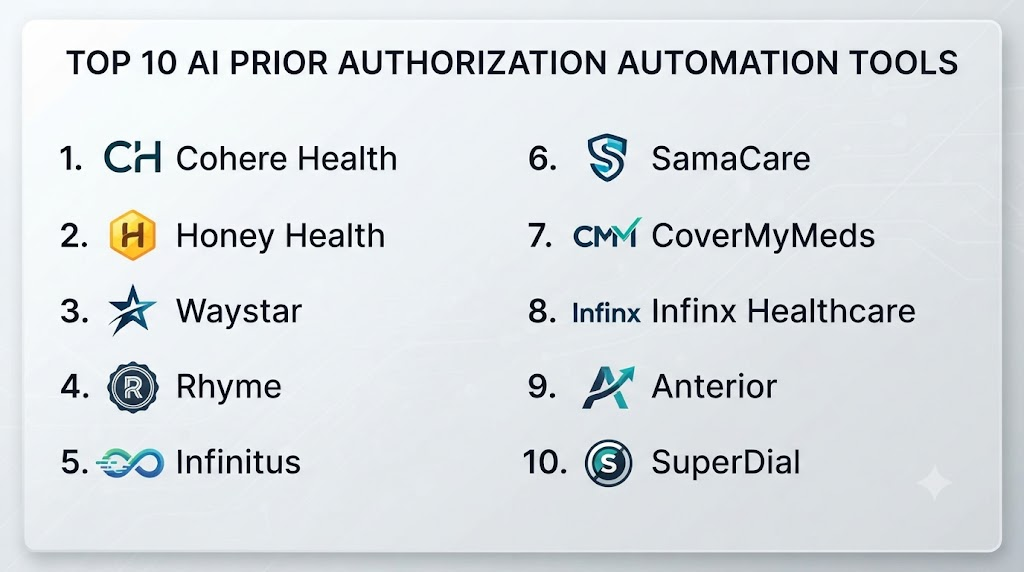
Top 10 AI Prior Authorization Automation Tools
1 — Cohere Health
One-line verdict: Best for health plans and providers seeking comprehensive, clinical-data-driven prior authorization automation.
Short description:
Cohere Health provides technology for automating and improving utilization management and prior authorization. Its platform combines clinical intelligence, workflow automation, electronic authorization, and decision-support capabilities to help payers and providers manage authorization workflows.
Standout Capabilities
- Prior authorization automation.
- Clinical decision support.
- Electronic authorization workflows.
- Medical-necessity review.
- Clinical documentation analysis.
- Provider-payer connectivity.
- Authorization status management.
- Utilization-management workflows.
AI-Specific Depth
- Model support: Proprietary clinical AI and decision-support capabilities.
- RAG / knowledge integration: Clinical and payer-policy information can be incorporated; specific vector-database compatibility is not publicly stated.
- Evaluation: Clinical and operational validation are part of the platform approach; exact customer-specific evaluation methodology varies.
- Guardrails: Human review and clinical governance are important components.
- Observability: Workflow analytics and operational reporting are available; token-level LLM observability is not publicly stated.
Pros
- Strong focus on healthcare authorization workflows.
- Designed for both payer and provider environments.
- Combines clinical intelligence with workflow automation.
Cons
- Primarily enterprise-oriented.
- Implementation may require significant integration.
- Pricing is not publicly stated.
Security & Compliance
Enterprise healthcare security and administrative controls are available. Specific SSO, RBAC, encryption, retention, residency, and certification requirements should be verified for the selected deployment.
Deployment & Platforms
- Web: Yes.
- Cloud: Yes.
- Self-hosted: Not publicly stated.
- Hybrid: Varies / N/A.
- Mobile: Varies.
Integrations & Ecosystem
Cohere Health is designed around payer-provider authorization workflows.
- EHR systems.
- Provider workflows.
- Payer systems.
- Clinical data.
- Authorization workflows.
- Utilization-management processes.
Pricing Model
Enterprise/custom pricing. Exact pricing is Not publicly stated.
Best-Fit Scenarios
- Large health systems.
- Health plans.
- Organizations with high authorization volume.
2 — Waystar
One-line verdict: Best for healthcare organizations wanting prior authorization automation integrated with broader revenue-cycle management.
Short description:
Waystar provides healthcare payment and revenue-cycle technology, including prior authorization capabilities. Its broader platform connects authorization workflows with patient access, claims, payments, and other revenue-cycle processes.
Standout Capabilities
- Prior authorization workflows.
- Electronic authorization.
- Revenue-cycle integration.
- Eligibility verification.
- Claims management.
- Patient access workflows.
- Authorization tracking.
- Payer connectivity.
AI-Specific Depth
- Model support: AI and automation capabilities vary across products.
- RAG / knowledge integration: Healthcare and payer information integration; specific vector-database compatibility is not publicly stated.
- Evaluation: Product-specific evaluation methodology varies.
- Guardrails: Workflow controls and human review.
- Observability: Revenue-cycle and workflow analytics are available; detailed LLM observability is not publicly stated.
Pros
- Broad revenue-cycle ecosystem.
- Useful integration opportunities.
- Suitable for large healthcare organizations.
Cons
- Broader than prior authorization alone.
- Implementation can involve multiple revenue-cycle components.
- Exact AI capabilities vary by product.
Security & Compliance
Enterprise healthcare security capabilities are available. Specific certifications, retention, encryption, data residency, and access-control settings should be verified for the contracted service.
Deployment & Platforms
- Web: Yes.
- Cloud: Yes.
- Self-hosted: Varies / N/A.
- Hybrid: Varies / N/A.
Integrations & Ecosystem
- EHR systems.
- Payer connectivity.
- Claims systems.
- Patient access.
- Revenue-cycle management.
- Authorization workflows.
Pricing Model
Enterprise/custom pricing. Exact pricing is Not publicly stated.
Best-Fit Scenarios
- Large health systems.
- Revenue-cycle departments.
- Organizations seeking integrated authorization and financial workflows.
3 — Rhyme
One-line verdict: Best for automating administrative healthcare workflows where authorization tasks require information gathering and coordination.
Short description:
Rhyme provides healthcare workflow automation designed to reduce repetitive administrative tasks. Its automation approach can support processes involving clinical information, payer requirements, and administrative coordination.
Standout Capabilities
- Healthcare workflow automation.
- Administrative task automation.
- Data extraction.
- Workflow orchestration.
- Document handling.
- Payer-related workflows.
- Task routing.
- Human oversight.
AI-Specific Depth
- Model support: AI automation capabilities; exact model architecture is not publicly stated.
- RAG / knowledge integration: Workflow-specific information retrieval varies.
- Evaluation: Workflow-level evaluation and monitoring are available; detailed AI benchmarks are not publicly stated.
- Guardrails: Human review and workflow controls.
- Observability: Workflow-level monitoring is available; token-level observability is not publicly stated.
Pros
- Flexible automation approach.
- Useful beyond prior authorization.
- Can reduce repetitive administrative work.
Cons
- Not solely focused on prior authorization.
- Exact capabilities depend on implementation.
- Enterprise pricing is not public.
Security & Compliance
Healthcare security controls should be evaluated according to the workflow and deployment. Specific certification and retention details are Not publicly stated universally.
Deployment & Platforms
- Web: Yes.
- Cloud: Yes.
- Self-hosted: Not publicly stated.
- Hybrid: Varies / N/A.
Integrations & Ecosystem
- EHRs.
- Payer systems.
- Healthcare administrative applications.
- Documents.
- Workflow-management tools.
- Internal systems.
Pricing Model
Enterprise/custom pricing. Exact pricing is Not publicly stated.
Best-Fit Scenarios
- Healthcare operations teams.
- Organizations with repetitive authorization tasks.
- Groups seeking broader administrative automation.
4 — Infinitus
One-line verdict: Best for healthcare organizations automating complex payer and administrative interactions through AI-enabled workflows.
Short description:
Infinitus develops AI-powered healthcare administration technology designed to automate interactions and repetitive workflows across healthcare organizations. Its technology is particularly relevant to administrative processes involving insurance, benefits, and authorization-related tasks.
Standout Capabilities
- AI-powered administrative automation.
- Payer interactions.
- Benefits verification.
- Healthcare workflow automation.
- Voice and digital automation.
- Information retrieval.
- Task orchestration.
- Human escalation.
AI-Specific Depth
- Model support: Proprietary AI and automation capabilities.
- RAG / knowledge integration: Retrieval of payer and healthcare information is central; specific vector-database compatibility is not publicly stated.
- Evaluation: Workflow evaluation and quality monitoring are used; exact model-evaluation details are not publicly stated.
- Guardrails: Controlled workflow execution and escalation.
- Observability: Operational workflow monitoring is available; detailed token-level observability is not publicly stated.
Pros
- Strong healthcare administration focus.
- Useful for repetitive payer interactions.
- Can automate complex workflows.
Cons
- Enterprise-focused.
- Implementation depends on workflow complexity.
- Exact pricing is not publicly stated.
Security & Compliance
Healthcare data security and privacy should be verified for the selected implementation. Specific certifications and retention configurations are Not publicly stated universally.
Deployment & Platforms
- Cloud: Yes.
- Web: Yes.
- Self-hosted: Not publicly stated.
- Hybrid: Varies / N/A.
Integrations & Ecosystem
- Payer systems.
- Healthcare workflows.
- Benefits information.
- EHR environments.
- Administrative systems.
- Communication channels.
Pricing Model
Enterprise/custom pricing. Exact pricing is Not publicly stated.
Best-Fit Scenarios
- Specialty-care organizations.
- Healthcare administrative teams.
- High-volume payer interaction workflows.
5 — Olive AI
One-line verdict: Best known for healthcare administrative automation and workflow orchestration across complex operational environments.
Short description:
Olive AI became widely recognized for automating healthcare administrative workflows using artificial intelligence and robotic process automation. Its technology historically addressed tasks across revenue cycle, prior authorization, payer interactions, and other healthcare operations, although current availability and product status should be verified carefully before procurement.
Standout Capabilities
- Healthcare workflow automation.
- Administrative task automation.
- Revenue-cycle workflows.
- Payer interactions.
- Data extraction.
- Process orchestration.
- Automated data entry.
- Healthcare operations automation.
AI-Specific Depth
- Model support: AI and automation capabilities varied by product.
- RAG / knowledge integration: Not publicly stated for current product availability.
- Evaluation: Product-specific methodology varies.
- Guardrails: Workflow controls and human escalation.
- Observability: Operational workflow analytics were available in relevant environments.
Pros
- Strong historical healthcare-automation focus.
- Broad administrative workflow experience.
- Prior authorization was part of its healthcare automation scope.
Cons
- Current product availability should be verified before considering it.
- Historical product information may not represent current capabilities.
- Current pricing and deployment details are not publicly stated.
Security & Compliance
Current certification and security details are Not publicly stated and should be verified before procurement.
Deployment & Platforms
- Cloud: Historically supported.
- Web: Yes / varied.
- Self-hosted: Not publicly stated.
- Current deployment status: Varies / verify before procurement.
Integrations & Ecosystem
Historically included:
- EHR systems.
- Payer systems.
- Revenue-cycle applications.
- Healthcare administrative systems.
- Workflow automation.
Pricing Model
Current pricing is Not publicly stated.
Best-Fit Scenarios
- Organizations researching healthcare automation history.
- Teams evaluating legacy workflow-automation approaches.
- Buyers comparing automation architectures rather than selecting solely on current availability.
6 — AKASA
One-line verdict: Best for health systems seeking AI-powered revenue-cycle automation that can include authorization-related administrative workflows.
Short description:
AKASA provides AI-powered automation for healthcare revenue-cycle operations. Its platform focuses on reducing manual administrative work across healthcare financial and operational processes.
Standout Capabilities
- Revenue-cycle automation.
- Administrative workflow automation.
- AI-based task handling.
- Documentation processing.
- Work queue automation.
- Data extraction.
- Workflow optimization.
- Healthcare operations analytics.
AI-Specific Depth
- Model support: Proprietary AI and automation models.
- RAG / knowledge integration: Healthcare information retrieval varies by workflow.
- Evaluation: Operational performance evaluation is part of deployment.
- Guardrails: Human review and workflow controls.
- Observability: Workflow and operational analytics are available.
Pros
- Strong healthcare revenue-cycle focus.
- Designed to automate repetitive administrative work.
- Useful for enterprise health systems.
Cons
- Broader than prior authorization alone.
- Integration effort can be significant.
- Pricing is not publicly stated.
Security & Compliance
Healthcare security and privacy controls are available. Exact certification, encryption, retention, residency, and identity requirements should be verified.
Deployment & Platforms
- Cloud: Yes.
- Web: Yes.
- Self-hosted: Not publicly stated.
- Hybrid: Varies / N/A.
Integrations & Ecosystem
- EHR systems.
- Revenue-cycle systems.
- Payer workflows.
- Work queues.
- Healthcare administrative applications.
Pricing Model
Enterprise/custom pricing. Exact pricing is Not publicly stated.
Best-Fit Scenarios
- Large health systems.
- Revenue-cycle departments.
- Organizations automating high-volume administrative processes.
7 — Inferscience
One-line verdict: Best for clinical data extraction and automation workflows that help support authorization and medical-necessity processes.
Short description:
Inferscience develops clinical natural-language processing and AI technologies for extracting structured information from clinical documentation. This type of capability can support prior authorization by identifying relevant diagnoses, procedures, medications, and other evidence from medical records.
Standout Capabilities
- Clinical NLP.
- Medical-record data extraction.
- Structured clinical information.
- Clinical decision support.
- Documentation processing.
- Data normalization.
- Healthcare analytics.
- Workflow integration.
AI-Specific Depth
- Model support: Clinical NLP and machine-learning technologies.
- RAG / knowledge integration: Clinical information retrieval is supported; vector-database compatibility is not publicly stated.
- Evaluation: Clinical NLP evaluation varies by use case.
- Guardrails: Healthcare workflow controls.
- Observability: Analytics and data-processing monitoring vary.
Pros
- Strong clinical NLP orientation.
- Useful for extracting evidence from documentation.
- Can support downstream authorization automation.
Cons
- Not a complete prior authorization platform by itself.
- Requires integration into a broader workflow.
- Exact current capabilities vary.
Security & Compliance
Healthcare security and compliance details should be verified for the selected implementation. Certifications are Not publicly stated universally.
Deployment & Platforms
- Cloud: Varies.
- Web: Varies.
- Self-hosted: Varies / N/A.
- Hybrid: Varies / N/A.
Integrations & Ecosystem
- EHR data.
- Clinical notes.
- Healthcare analytics.
- Clinical decision support.
- Authorization workflows.
- Data warehouses.
Pricing Model
Enterprise/custom pricing. Exact pricing is Not publicly stated.
Best-Fit Scenarios
- Health systems with strong data infrastructure.
- Clinical NLP projects.
- Organizations building custom authorization workflows.
8 — Cohere Health Intelligent Prior Authorization
One-line verdict: Best for organizations wanting clinical intelligence and automation specifically designed around authorization decisions.
Short description:
Cohere Health focuses directly on prior authorization and utilization-management workflows. Its technology is designed to connect clinical information, payer policies, authorization processes, and provider workflows.
Standout Capabilities
- Intelligent prior authorization.
- Clinical criteria analysis.
- Automated authorization workflows.
- Clinical documentation review.
- Provider-payer connectivity.
- Utilization management.
- Decision support.
- Authorization status tracking.
AI-Specific Depth
- Model support: Proprietary clinical AI.
- RAG / knowledge integration: Clinical and policy information can be integrated; vector-database support is not publicly stated.
- Evaluation: Clinical and operational validation are used.
- Guardrails: Human clinical review and governance.
- Observability: Workflow analytics and authorization metrics.
Pros
- Strong category specialization.
- Designed around payer-provider collaboration.
- Clinical intelligence is central.
Cons
- Enterprise-oriented.
- Requires workflow integration.
- Exact pricing is not publicly stated.
Security & Compliance
Healthcare security controls should be verified for the deployment. Specific certifications, retention, encryption, residency, and identity settings are not universally stated.
Deployment & Platforms
- Web: Yes.
- Cloud: Yes.
- Self-hosted: Not publicly stated.
- Hybrid: Varies / N/A.
Integrations & Ecosystem
- EHRs.
- Payer systems.
- Clinical documentation.
- Provider workflows.
- Utilization management.
- Authorization systems.
Pricing Model
Enterprise/custom pricing. Exact pricing is Not publicly stated.
Best-Fit Scenarios
- Health plans.
- Large provider organizations.
- High-volume authorization programs.
9 — Availity
One-line verdict: Best for electronic payer-provider transactions where prior authorization needs broad healthcare-network connectivity.
Short description:
Availity provides healthcare information exchange and administrative transaction infrastructure connecting providers and payers. Its prior authorization capabilities are particularly relevant for electronic workflows, eligibility, claims, and payer-provider communication.
Standout Capabilities
- Electronic prior authorization.
- Payer connectivity.
- Provider workflows.
- Eligibility verification.
- Claims-related transactions.
- Authorization status.
- Administrative data exchange.
- Healthcare network connectivity.
AI-Specific Depth
- Model support: AI capabilities vary by product; detailed model architecture is not publicly stated.
- RAG / knowledge integration: Healthcare and payer information integration is central; vector-database compatibility is not publicly stated.
- Evaluation: Product-specific evaluation varies.
- Guardrails: Transaction and workflow controls.
- Observability: Transaction and workflow reporting.
Pros
- Strong payer-provider network.
- Broad administrative transaction capabilities.
- Useful electronic authorization infrastructure.
Cons
- More focused on healthcare transactions than generative AI.
- AI-specific functionality varies.
- Implementation depends on payer and provider participation.
Security & Compliance
Healthcare transaction infrastructure includes enterprise security controls. Exact certification and deployment details should be verified according to the specific service.
Deployment & Platforms
- Web: Yes.
- Cloud: Yes.
- Self-hosted: Not publicly stated.
- Hybrid: Varies / N/A.
Integrations & Ecosystem
- Payer systems.
- Provider systems.
- EHRs.
- Claims.
- Eligibility.
- Electronic authorization transactions.
Pricing Model
Pricing varies by product, organization type, and transaction volume. Exact pricing is Not publicly stated.
Best-Fit Scenarios
- Large provider organizations.
- Health plans.
- Organizations needing broad payer connectivity.
10 — Waystar Authorization Management
One-line verdict: Best for organizations wanting authorization workflows connected to patient access and revenue-cycle operations.
Short description:
Waystar provides authorization-management capabilities within a broader healthcare revenue-cycle platform. The platform can help healthcare organizations manage authorization requirements, submit requests, track status, and connect authorization information with financial workflows.
Standout Capabilities
- Authorization management.
- Electronic submissions.
- Payer connectivity.
- Status tracking.
- Patient access workflows.
- Revenue-cycle integration.
- Eligibility workflows.
- Administrative automation.
AI-Specific Depth
- Model support: AI and automation capabilities vary.
- RAG / knowledge integration: Payer and healthcare information integration varies.
- Evaluation: Product-specific evaluation is not publicly stated.
- Guardrails: Workflow controls and human review.
- Observability: Revenue-cycle analytics and workflow monitoring.
Pros
- Broad healthcare revenue-cycle ecosystem.
- Strong payer connectivity.
- Useful for organizations seeking integrated workflows.
Cons
- Not solely focused on AI.
- Broader implementation may be complex.
- Exact pricing is not publicly stated.
Security & Compliance
Enterprise healthcare security capabilities are available. Exact encryption, retention, residency, identity, and certification details should be confirmed for the specific deployment.
Deployment & Platforms
- Web: Yes.
- Cloud: Yes.
- Self-hosted: Varies / N/A.
- Hybrid: Varies / N/A.
Integrations & Ecosystem
- EHRs.
- Payers.
- Claims.
- Patient access.
- Revenue-cycle systems.
- Authorization workflows.
Pricing Model
Enterprise/custom pricing. Exact pricing is Not publicly stated.
Best-Fit Scenarios
- Hospitals.
- Large medical groups.
- Revenue-cycle organizations.
Comparison Table
| Tool | Best For | Deployment | Model Flexibility | Strength | Watch-Out | Public Rating |
|---|---|---|---|---|---|---|
| Cohere Health | Intelligent prior authorization | Cloud | Proprietary AI | Clinical authorization intelligence | Enterprise implementation | N/A |
| Waystar | Revenue-cycle integrated authorization | Cloud | Proprietary / Varies | Broad healthcare RCM | Broad platform scope | N/A |
| Rhyme | Healthcare workflow automation | Cloud | Proprietary / Varies | Flexible automation | Not authorization-only | N/A |
| Infinitus | Payer interaction automation | Cloud | Proprietary AI | Administrative automation | Enterprise focus | N/A |
| Olive AI | Healthcare automation research | Varies | AI / Automation | Historical workflow automation | Current availability must be verified | N/A |
| AKASA | Revenue-cycle automation | Cloud | Proprietary AI | Administrative automation | Broader RCM focus | N/A |
| Inferscience | Clinical data extraction | Varies | Clinical NLP | Evidence extraction | Requires workflow integration | N/A |
| Cohere Intelligent PA | Authorization-specific workflows | Cloud | Proprietary AI | Clinical decision support | Enterprise focus | N/A |
| Availity | Payer-provider connectivity | Cloud | Varies | Network connectivity | AI depth varies | N/A |
| Waystar Authorization Management | Authorization operations | Cloud | Proprietary / Varies | Workflow integration | Broader platform | N/A |
Scoring & Evaluation
These scores are comparative editorial assessments designed to help buyers structure an initial evaluation. They are not clinical efficacy claims and should not be interpreted as independently validated performance measurements.
Actual performance depends on payer mix, authorization volume, clinical specialty, EHR environment, integration quality, and the complexity of the organization’s workflows.
| Tool | Core Features | AI Reliability | Automation Depth | Integrations | Ease | Performance/Cost | Security/Admin | Workflow Support | Weighted Total |
|---|---|---|---|---|---|---|---|---|---|
| Cohere Health | 10 | 9 | 10 | 9 | 8 | 8 | 9 | 10 | 9.15 |
| Waystar | 10 | 8 | 9 | 10 | 8 | 9 | 10 | 10 | 9.15 |
| Rhyme | 8 | 8 | 9 | 8 | 8 | 8 | 8 | 9 | 8.20 |
| Infinitus | 9 | 9 | 10 | 9 | 8 | 8 | 9 | 10 | 9.05 |
| Olive AI | 8 | 7 | 9 | 9 | 7 | 8 | 8 | 9 | 8.20 |
| AKASA | 9 | 8 | 9 | 9 | 8 | 8 | 9 | 10 | 8.85 |
| Inferscience | 8 | 8 | 7 | 9 | 7 | 8 | 8 | 8 | 7.95 |
| Cohere Intelligent PA | 10 | 9 | 10 | 9 | 8 | 8 | 9 | 10 | 9.15 |
| Availity | 9 | 7 | 8 | 10 | 9 | 9 | 10 | 10 | 8.95 |
| Waystar Authorization Management | 9 | 8 | 9 | 10 | 8 | 9 | 10 | 10 | 9.05 |
Top 3 for Enterprise
- Cohere Health — Strong specialization in intelligent prior authorization.
- Waystar — Broad authorization and revenue-cycle ecosystem.
- Infinitus — Strong potential for automating payer-related administrative interactions.
Top 3 for SMB
- Waystar — Useful when authorization is part of a broader revenue-cycle workflow.
- Availity — Strong payer connectivity for electronic transactions.
- Rhyme — Flexible automation approach for organizations with repetitive administrative workflows.
Top 3 for Developers
- Rhyme — Flexible workflow-automation orientation.
- Inferscience — Useful clinical NLP foundation for custom workflows.
- Infinitus — Interesting for automated payer and administrative interactions.
Which AI Prior Authorization Automation Tool Is Right for You?
Solo / Small Practice
A small practice should first determine whether full AI automation is necessary.
If authorization volume is low, a combination of:
- Electronic payer submission.
- EHR templates.
- Staff checklists.
- Automated status tracking.
- Standardized documentation.
may be enough.
AI becomes more valuable as authorization volume, payer diversity, specialty complexity, and administrative workload increase.
SMB
Small and mid-sized practices should prioritize:
- Simple setup.
- Payer connectivity.
- EHR integration.
- Documentation extraction.
- Authorization status tracking.
- Staff notifications.
- Denial prevention.
- Predictable costs.
The platform should reduce work rather than create another system for staff to maintain.
Mid-Market
Mid-sized organizations should evaluate:
- Multiple payer support.
- Multiple specialties.
- Centralized authorization workflows.
- Automated documentation collection.
- Clinical information extraction.
- Work-queue management.
- Analytics.
- Denial prevention.
- Human-review workflows.
This is often where automation can produce significant operational value.
Enterprise Health System
Large health systems should look for end-to-end authorization orchestration.
Important capabilities include:
- EHR integration.
- Payer connectivity.
- Clinical data extraction.
- Authorization-rule management.
- Automated submissions.
- Status tracking.
- Additional-information handling.
- Appeals support.
- Auditability.
- Enterprise identity.
- Analytics.
- Governance.
Cohere Health, Waystar, Availity, AKASA, and Infinitus are relevant categories to evaluate depending on the organization’s architecture.
Specialty Pharmacy
Specialty pharmacies often handle complex therapies requiring extensive documentation.
Important capabilities include:
- Benefits verification.
- Clinical documentation extraction.
- Payer-policy matching.
- Authorization submission.
- Status tracking.
- Denial management.
- Appeals.
- Patient communication.
Automation should ideally connect the authorization workflow with medication fulfillment and patient-support processes.
Hospitals
Hospitals should evaluate prior authorization in the context of the entire patient-access and revenue-cycle workflow.
Authorization may involve:
- Admission.
- Imaging.
- Procedures.
- Surgery.
- Specialty medications.
- Referrals.
- Post-acute services.
Integration with scheduling, clinical documentation, utilization management, and revenue-cycle systems can be more valuable than a standalone authorization tool.
Health Plans
Health plans have a different perspective.
Instead of simply automating authorization submission, they may need:
- Clinical decision support.
- Medical-necessity workflows.
- Policy interpretation.
- Provider communication.
- Utilization management.
- Case management.
- Audit trails.
- Decision consistency.
Cohere Health is particularly relevant to organizations looking for technology that spans payer and provider workflows.
Build vs Buy
Build a custom solution when:
- The organization has mature data infrastructure.
- Payer rules are highly specialized.
- Strong internal engineering and clinical informatics teams are available.
- Custom integration is essential.
- The organization can support continuous maintenance.
Buy when:
- Authorization volume is high.
- Payer connectivity is complex.
- Rapid deployment is important.
- The organization lacks specialized automation expertise.
- Vendor-maintained payer integrations provide meaningful value.
A hybrid model can work well when commercial authorization infrastructure is combined with internal AI for documentation extraction, prioritization, analytics, and quality control.
Implementation Playbook
First 30 Days: Map and Pilot
Begin with one authorization type and a limited number of payers.
- Map the current workflow.
- Identify manual steps.
- Measure average processing time.
- Measure incomplete submissions.
- Measure additional-information requests.
- Measure denial rates.
- Identify payer-specific requirements.
- Map EHR data sources.
- Identify clinical documentation.
- Define automation boundaries.
- Establish human-review requirements.
- Select representative cases.
Create a baseline before introducing AI so that improvements can be measured objectively.
Days 31–60: Evaluation, Security and Workflow Hardening
During the second phase:
- Test clinical information extraction.
- Validate payer-policy matching.
- Test missing-document detection.
- Evaluate authorization-form completion.
- Check generated summaries.
- Test unusual cases.
- Test ambiguous clinical information.
- Establish human approval workflows.
- Configure access controls.
- Review audit logs.
- Define data-retention policies.
- Establish incident-handling procedures.
- Create regression tests.
- Document model limitations.
The most important test is not whether the AI can complete a form. It is whether it can complete the correct form using accurate and appropriate evidence.
Days 61–90: Scale and Optimize
After the pilot:
- Add more payers.
- Add more authorization types.
- Expand to additional specialties.
- Tune workflow routing.
- Automate status monitoring.
- Analyze denial patterns.
- Measure staff productivity.
- Monitor model performance.
- Monitor payer-policy changes.
- Review exception rates.
- Optimize infrastructure costs.
- Establish governance reviews.
- Create ongoing quality-assurance processes.
Payer policies change frequently, so the system should have a process for updating rules and validating changes.
Common Mistakes and How to Avoid Them
- Automating without understanding the current workflow: Map the process first.
- Using stale payer rules: Authorization requirements can change.
- Submitting incomplete documentation faster: Automation should improve completeness, not just speed.
- Trusting AI-extracted clinical facts without verification: Important information should be validated.
- Ignoring exceptions: Unusual cases often require human review.
- Treating payer policies as simple static rules: Requirements can contain nuanced clinical criteria.
- Failing to maintain audit trails: Every important automated action should be traceable.
- Ignoring denial reasons: Denial data can reveal opportunities for improving documentation.
- Over-automating medical-necessity decisions: Human oversight may be required for high-impact decisions.
- Ignoring data quality: Missing diagnoses, outdated medications, or incomplete clinical notes can create errors.
- Using generic workflows for every payer: Payer-specific requirements can differ significantly.
- Failing to monitor model drift: AI behavior and payer requirements can change.
- Ignoring staff workflow: Automation that creates more queues can increase rather than reduce administrative burden.
- Underestimating integration costs: EHR, payer, scheduling, revenue-cycle, and clinical systems may all need connectivity.
- Failing to test edge cases: Rare authorization scenarios can expose important weaknesses.
- Ignoring patient communication: Authorization delays can affect patient scheduling and treatment.
FAQs
What is AI Prior Authorization Automation?
AI Prior Authorization Automation uses artificial intelligence and workflow technology to reduce manual work involved in requesting, preparing, submitting, tracking, and managing healthcare prior authorizations.
How does AI automate prior authorization?
AI can extract clinical information, identify relevant documentation, classify requests, match information to requirements, prepare forms, organize attachments, route tasks, and help monitor authorization status.
Can AI automatically submit prior authorizations?
Some platforms support electronic submission workflows, while the exact level of automation varies. Organizations should determine which actions require human approval.
Can AI determine whether prior authorization is required?
It can help identify authorization requirements based on payer, service, procedure, medication, and other information. The accuracy of this determination should be validated against current payer rules.
Can AI reduce prior authorization denials?
It can potentially reduce avoidable denials by identifying missing documentation, inconsistencies, or incomplete requests before submission. Results depend on payer rules and implementation quality.
Can AI understand clinical documentation?
Modern clinical AI can extract information from unstructured notes and other documents. However, important information should be validated because AI can misunderstand or omit clinical details.
Can AI summarize a patient’s medical history for authorization?
Yes. AI can organize diagnoses, treatments, previous procedures, medications, and other relevant information into a summary that can help support an authorization request.
Can these tools integrate with EHR systems?
Many are designed to integrate with EHR and healthcare administrative systems, but supported platforms and integration depth vary by vendor.
Can AI handle specialty medications?
Yes. Specialty medication authorization is a common target for automation because these requests can require substantial documentation and coordination.
Can AI help with authorization appeals?
AI can help organize records, summarize clinical evidence, identify relevant documentation, and prepare draft materials for human review. Final appeal decisions and submissions should follow appropriate organizational controls.
Is AI safe for prior authorization?
Safety depends on the system and workflow. Healthcare organizations should implement validation, auditability, access controls, human review, testing, and monitoring.
Can AI make medical-necessity decisions?
Some platforms provide clinical decision-support capabilities, but organizations should carefully define the role of AI and ensure that high-impact decisions receive appropriate clinical and administrative oversight.
What data does an AI authorization system need?
Potential data sources include diagnoses, medications, procedures, laboratory results, imaging reports, clinical notes, prior treatments, payer information, provider information, and scheduling data.
How should AI authorization tools be evaluated?
Evaluate extraction accuracy, payer-rule accuracy, documentation completeness, submission accuracy, processing time, denial rates, exception rates, staff productivity, security, and auditability.
Can AI work across different insurance companies?
Some platforms provide connectivity and workflow support across multiple payers. Coverage varies by vendor, geography, payer, service type, and transaction.
Does AI eliminate authorization staff?
Usually, the goal is to reduce repetitive work rather than eliminate human involvement. Staff can focus more on exceptions, complex cases, payer communication, and appeals.
What are the biggest risks?
Major risks include incorrect clinical information, outdated payer requirements, incomplete documentation, inappropriate automation, privacy problems, and insufficient human oversight.
How can organizations reduce AI errors?
Use structured workflows, validation rules, representative test cases, human approval, source traceability, audit logs, continuous monitoring, and regular updates to payer requirements.
Should small practices use AI prior authorization software?
It depends on authorization volume and complexity. Small practices with only occasional requests may benefit more from simple electronic workflows, while high-volume specialty practices may benefit substantially from automation.
Which AI Prior Authorization Automation tool is best?
There is no universal winner. Cohere Health is particularly focused on intelligent authorization, Waystar is strong for authorization within revenue-cycle workflows, Availity is valuable for payer-provider connectivity, and Infinitus is relevant to automated healthcare administrative interactions.
Should healthcare organizations build their own AI authorization system?
Only when they have strong clinical informatics, engineering, data, compliance, and maintenance capabilities. Buying can be more practical when payer connectivity and ongoing policy updates are important.
Conclusion
AI Prior Authorization Automation is becoming an important part of healthcare administrative modernization.The most valuable systems do more than fill out forms. They connect clinical information, payer requirements, authorization workflows, electronic submission, status monitoring, and human review.Cohere Health stands out for its focus on intelligent prior authorization and utilization management. Waystar and Availity are relevant for organizations seeking broader payer and revenue-cycle connectivity. Infinitus and Rhyme represent a more flexible automation-oriented approach, while AKASA focuses heavily on healthcare revenue-cycle automation.