Introduction
AI Single-Cell Analysis Tools use machine learning, deep learning, statistical modeling, and computational biology techniques to analyze data generated from individual cells. Instead of treating a tissue sample as one averaged population, single-cell analysis can reveal distinct cell types, cellular states, gene-expression patterns, developmental trajectories, immune responses, and interactions between different cell populations.AI is particularly useful because single-cell datasets can contain thousands to millions of cells and thousands of measured features per cell. Modern workflows can use machine learning for dimensionality reduction, clustering, cell-type annotation, batch correction, integration, representation learning, trajectory inference, perturbation analysis, and biological prediction.These capabilities are increasingly relevant across cancer research, immunology, developmental biology, drug discovery, neuroscience, infectious disease research, and precision medicine.
What Are AI Single-Cell Analysis Tools?
AI single-cell analysis tools are software platforms and computational frameworks that help researchers extract biological information from single-cell datasets.
Depending on the technology, input data may come from:
- Single-cell RNA sequencing.
- Single-nucleus RNA sequencing.
- Single-cell ATAC sequencing.
- Single-cell DNA sequencing.
- CITE-seq.
- Spatial transcriptomics.
- Multimodal single-cell assays.
- Perturbation experiments.
A typical workflow can look like:
AI can be applied at multiple stages.
For example, a model can learn a compact representation of thousands of genes across thousands of cells. Researchers can then use that representation to identify cellular populations or compare cell states.
Why AI Single-Cell Analysis Matters
Traditional analysis approaches can struggle with:
- Large datasets.
- High-dimensional measurements.
- Sparse gene-expression matrices.
- Batch effects.
- Complex cell states.
- Multiple experimental modalities.
- Large numbers of samples.
AI and machine learning can help researchers model these complexities.
Potential benefits include:
- More scalable analysis.
- Automated cell-type annotation.
- Better dataset integration.
- Improved representation learning.
- Identification of rare cell populations.
- Analysis of cellular trajectories.
- Multimodal data integration.
- Perturbation-response prediction.
However, AI does not remove the need for biological interpretation.
A model can identify a cluster, but researchers still need to determine whether that cluster represents a genuine biological population, a technical artifact, or an experimental effect.
Key Use Cases
Cell-Type Annotation
Assign likely biological identities to individual cells.
Cell-State Analysis
Identify activated, exhausted, differentiated, proliferative, stressed, or disease-associated cellular states.
Batch Correction
Reduce unwanted technical variation between experiments or datasets.
Dataset Integration
Combine single-cell datasets generated across studies, laboratories, or technologies.
Rare Cell Detection
Identify populations that may represent only a small fraction of a sample.
Trajectory Analysis
Study how cells transition between biological states.
Multimodal Analysis
Combine transcriptomic, epigenomic, protein, and other cellular measurements.
Cancer Research
Analyze tumor heterogeneity, immune populations, and tumor microenvironments.
Drug Discovery
Study cellular responses to compounds and identify candidate mechanisms.
Perturbation Analysis
Analyze how genetic or chemical perturbations alter cellular states.
Spatial Biology
Connect molecular measurements with spatial information.
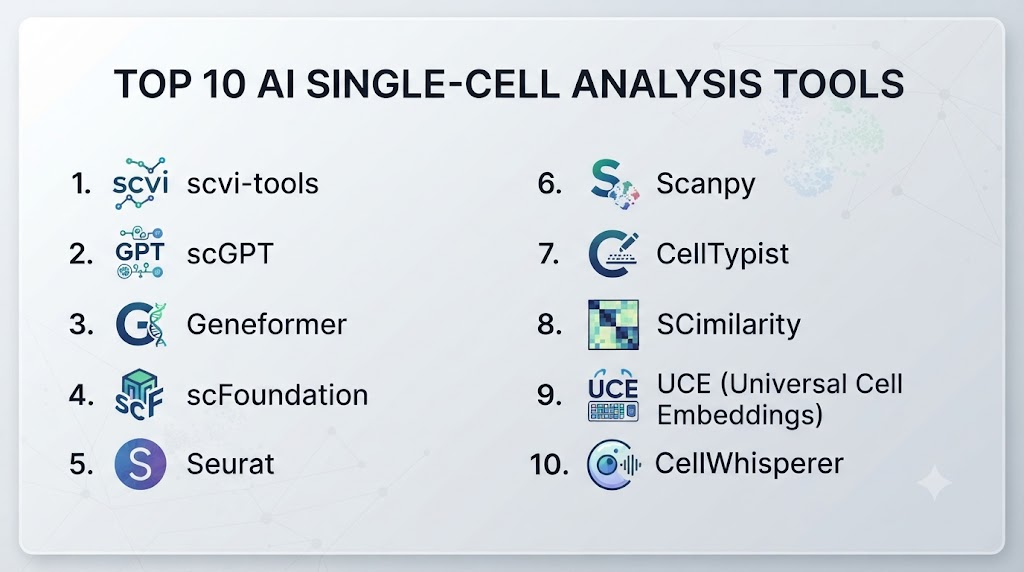
Top 10 AI Single-Cell Analysis Tools
1 — scVI-tools
One-line verdict: Best for researchers building probabilistic and deep-learning workflows for scalable single-cell data integration and analysis.
Short description:
scVI-tools is a Python-based ecosystem for probabilistic modeling of single-cell omics data. It includes models designed for representation learning, integration, annotation, differential analysis, multimodal data, and related tasks.
Standout Capabilities
- Deep generative modeling.
- Single-cell RNA analysis.
- Batch-effect correction.
- Latent representation learning.
- Dataset integration.
- Differential analysis.
- Multimodal modeling.
- Large-scale single-cell analysis.
AI-Specific Depth
- Model support: Deep generative and probabilistic models.
- RAG / knowledge integration: N/A for core modeling; external biological knowledge can be incorporated into downstream workflows.
- Evaluation: Reconstruction metrics, integration benchmarks, biological conservation metrics, and task-specific evaluation.
- Guardrails: Data preprocessing, model diagnostics, and biological validation.
- Observability: Training metrics, latent representations, reconstruction metrics, and computational performance.
Pros
- Powerful modeling ecosystem.
- Strong research adoption.
- Highly customizable.
Cons
- Requires Python and computational-biology expertise.
- Model selection can be complex.
- Results still require biological validation.
Security & Compliance
Self-hosted execution allows organizations to control sensitive genomic data.
Specific certifications are Not publicly stated.
Deployment & Platforms
- Self-hosted: Yes.
- Cloud: Possible.
- Linux: Common.
- HPC: Possible.
- Python: Yes.
Integrations & Ecosystem
- AnnData.
- Scanpy.
- Python.
- Jupyter.
- PyTorch.
- Multimodal single-cell workflows.
Pricing Model
Open-source. Infrastructure costs vary.
Best-Fit Scenarios
- Research bioinformatics.
- Large single-cell datasets.
- Custom AI modeling.
2 — Scanpy
One-line verdict: Best for researchers needing a mature Python ecosystem for scalable single-cell preprocessing, visualization, clustering, and analysis.
Short description:
Scanpy is an open-source Python toolkit for analyzing single-cell gene-expression data. Although not exclusively an AI platform, it provides a core environment where machine-learning and deep-learning methods can be incorporated into single-cell workflows.
Standout Capabilities
- Single-cell preprocessing.
- Quality control.
- Clustering.
- Dimensionality reduction.
- Visualization.
- Differential expression.
- Large dataset handling.
- Integration with AI models.
AI-Specific Depth
- Model support: Supports workflows involving machine learning and integration with specialized AI frameworks.
- RAG / knowledge integration: External biological knowledge can be connected through custom workflows.
- Evaluation: Statistical and biological evaluation methods.
- Guardrails: Quality control and preprocessing validation.
- Observability: Pipeline outputs, metrics, and analysis artifacts.
Pros
- Mature ecosystem.
- Flexible.
- Strong Python integration.
Cons
- Not an AI-first platform.
- Advanced AI functionality requires additional packages.
- Requires computational expertise.
Security & Compliance
Self-hosted execution supports local control of data.
Specific certifications are Not publicly stated.
Deployment & Platforms
- Linux.
- macOS.
- Windows through appropriate Python environments.
- Cloud.
- HPC.
- Self-hosted.
Integrations & Ecosystem
- AnnData.
- scVI-tools.
- PyTorch.
- Jupyter.
- NumPy.
- Pandas.
- Visualization libraries.
Pricing Model
Open-source.
Best-Fit Scenarios
- Academic research.
- General single-cell analysis.
- Custom bioinformatics workflows.
3 — Seurat
One-line verdict: Best for R-based single-cell analysis, clustering, integration, visualization, and multimodal cellular research workflows.
Short description:
Seurat is a widely used R ecosystem for single-cell genomics analysis. It supports preprocessing, clustering, dimensionality reduction, dataset integration, multimodal analysis, and visualization.
Standout Capabilities
- Single-cell RNA analysis.
- Clustering.
- Cell-type identification.
- Dataset integration.
- Multimodal analysis.
- Dimensionality reduction.
- Visualization.
- Spatial analysis capabilities.
AI-Specific Depth
- Model support: Statistical and computational methods with integrations to machine-learning approaches.
- RAG / knowledge integration: External biological knowledge can be incorporated.
- Evaluation: Biological and statistical validation.
- Guardrails: QC and analysis controls.
- Observability: Analysis metrics and workflow outputs.
Pros
- Mature ecosystem.
- Extensive research adoption.
- Strong visualization capabilities.
Cons
- Not primarily an AI platform.
- R expertise may be required.
- Large workflows can require significant computational resources.
Security & Compliance
Self-hosted workflows provide local data control.
Specific certifications are Not publicly stated.
Deployment & Platforms
- R.
- Linux.
- macOS.
- Windows.
- Cloud/HPC through appropriate infrastructure.
Integrations & Ecosystem
- R.
- Bioconductor.
- Python interoperability.
- Spatial datasets.
- Multimodal data.
- Visualization tools.
Pricing Model
Open-source.
Best-Fit Scenarios
- Academic single-cell research.
- Multimodal analysis.
- R-based bioinformatics.
4 — CellTypist
One-line verdict: Best for automated cell-type annotation using pretrained machine-learning models across single-cell transcriptomic datasets.
Short description:
CellTypist is designed to automate cell-type annotation using machine-learning models trained on reference cell populations. It can help researchers assign candidate cell identities to large numbers of cells.
Standout Capabilities
- Automated cell annotation.
- Pretrained models.
- Cell-type classification.
- Reference-based annotation.
- Single-cell RNA analysis.
- Batch annotation.
- Hierarchical classification.
- Custom model possibilities.
AI-Specific Depth
- Model support: Pretrained machine-learning models.
- RAG / knowledge integration: Reference cell-type information rather than conventional RAG.
- Evaluation: Classification metrics and reference-dataset validation.
- Guardrails: Confidence scores and hierarchical annotation.
- Observability: Prediction probabilities and annotation outputs.
Pros
- Fast cell-type annotation.
- Reduces repetitive manual labeling.
- Useful for large datasets.
Cons
- Annotation quality depends on reference models.
- Novel cell states can be difficult.
- Automated labels require biological review.
Security & Compliance
Self-hosted analysis allows local control of data.
Specific certifications are Not publicly stated.
Deployment & Platforms
- Python.
- Self-hosted.
- Cloud.
- HPC.
Integrations & Ecosystem
- Scanpy.
- AnnData.
- Single-cell RNA-seq.
- Reference datasets.
- Python workflows.
Pricing Model
Open-source.
Best-Fit Scenarios
- Automated annotation.
- Large scRNA-seq datasets.
- Reference-based cell classification.
5 — scGPT
One-line verdict: Best for researchers exploring foundation-model approaches to single-cell representation learning and multimodal biological analysis.
Short description:
scGPT applies transformer-based modeling concepts to single-cell genomics. It is designed to learn representations from large-scale cellular data and can support tasks such as cell annotation and integration.
Standout Capabilities
- Transformer-based modeling.
- Single-cell representation learning.
- Cell-type annotation.
- Gene-expression modeling.
- Dataset integration.
- Perturbation-related analysis.
- Foundation-model research.
- Large-scale biological modeling.
AI-Specific Depth
- Model support: Transformer-based biological foundation models.
- RAG / knowledge integration: External biological knowledge can be incorporated through custom workflows; conventional RAG is not the core function.
- Evaluation: Task-specific benchmarks and downstream biological evaluation.
- Guardrails: Input validation and model-confidence analysis.
- Observability: Training metrics, inference performance, and embedding outputs.
Pros
- Modern foundation-model approach.
- Flexible research potential.
- Supports representation learning.
Cons
- Computationally demanding.
- Requires advanced expertise.
- Foundation-model performance can vary across biological contexts.
Security & Compliance
Self-hosted use can keep sensitive datasets within organizational infrastructure.
Specific certifications are Not publicly stated.
Deployment & Platforms
- Self-hosted.
- Cloud.
- GPU infrastructure.
- Linux.
- Python.
Integrations & Ecosystem
- PyTorch.
- AnnData.
- Scanpy.
- Single-cell datasets.
- GPU computing.
- Custom research pipelines.
Pricing Model
Open research software. Infrastructure costs vary.
Best-Fit Scenarios
- Foundation-model research.
- Large single-cell datasets.
- Advanced AI biology teams.
6 — scArches
One-line verdict: Best for transferring trained single-cell models across datasets while reducing the need to retrain models from scratch.
Short description:
scArches provides methods for reference mapping and model adaptation across single-cell datasets. It is useful for integrating new datasets with existing learned representations.
Standout Capabilities
- Reference mapping.
- Transfer learning.
- Dataset integration.
- Model adaptation.
- Single-cell analysis.
- Batch correction.
- Atlas construction.
- Large-scale data integration.
AI-Specific Depth
- Model support: Deep generative and transfer-learning approaches.
- RAG / knowledge integration: Reference atlases serve as biological context.
- Evaluation: Integration metrics and biological conservation measures.
- Guardrails: Mapping confidence and data-quality checks.
- Observability: Model adaptation metrics and integration outputs.
Pros
- Useful for reference mapping.
- Reduces repeated model training.
- Strong fit for atlas-scale projects.
Cons
- Requires technical expertise.
- Performance depends on reference quality.
- Biological interpretation remains necessary.
Security & Compliance
Self-hosted operation allows local data control.
Specific certifications are Not publicly stated.
Deployment & Platforms
- Python.
- Linux.
- Cloud.
- HPC.
- Self-hosted.
Integrations & Ecosystem
- scVI ecosystem.
- AnnData.
- Scanpy.
- Cell atlases.
- PyTorch.
- Single-cell datasets.
Pricing Model
Open-source.
Best-Fit Scenarios
- Cell atlases.
- Dataset integration.
- Transfer learning.
7 — scFoundation
One-line verdict: Best for teams investigating large pretrained models for single-cell representation learning and downstream biological prediction.
Short description:
scFoundation represents a newer class of large-scale single-cell foundation models. Such models aim to learn reusable representations from large single-cell datasets for downstream biological tasks.
Standout Capabilities
- Foundation-model research.
- Gene-expression representation.
- Single-cell embeddings.
- Cell-state modeling.
- Transfer learning.
- Downstream prediction.
- Large-scale biological modeling.
- Research experimentation.
AI-Specific Depth
- Model support: Foundation and deep-learning models.
- RAG / knowledge integration: N/A as a core function.
- Evaluation: Downstream task benchmarks and biological validation.
- Guardrails: Model input validation and confidence assessment.
- Observability: Training/inference metrics and embedding outputs.
Pros
- Advanced foundation-model direction.
- Reusable representations.
- Potentially broad downstream applications.
Cons
- Research-oriented.
- High computational requirements.
- Foundation models can be sensitive to dataset differences.
Security & Compliance
Self-hosted deployment supports local data handling.
Specific certifications are Not publicly stated.
Deployment & Platforms
- Linux.
- GPU.
- Self-hosted.
- Cloud.
- Python.
Integrations & Ecosystem
- Single-cell datasets.
- Python.
- PyTorch.
- GPU infrastructure.
- Bioinformatics pipelines.
Pricing Model
Research software and models vary. Exact pricing is N/A.
Best-Fit Scenarios
- Single-cell foundation-model research.
- Large-scale biological datasets.
- AI-first computational biology.
8 — Cell Ranger
One-line verdict: Best for standardized processing of single-cell sequencing data before advanced machine-learning and biological analysis.
Short description:
Cell Ranger is a widely used software suite for processing single-cell sequencing data. It is not primarily an AI platform, but it is an important upstream component for many AI-enabled single-cell analysis pipelines.
Standout Capabilities
- Single-cell sequencing processing.
- Read alignment.
- Gene-expression quantification.
- Feature-barcode processing.
- Quality control.
- Cell identification.
- Data generation for downstream analysis.
- Standardized preprocessing.
AI-Specific Depth
- Model support: Primarily computational rather than AI-first.
- RAG / knowledge integration: N/A.
- Evaluation: Pipeline QC metrics and sequencing-data validation.
- Guardrails: Input and output quality controls.
- Observability: Run metrics, QC statistics, and processing logs.
Pros
- Established preprocessing ecosystem.
- Useful upstream of AI analysis.
- Standardized workflow.
Cons
- Not an AI analysis platform.
- Vendor-oriented ecosystem.
- Advanced AI requires downstream tools.
Security & Compliance
Deployment-level security depends on the environment.
Specific certifications should not be inferred from the software alone.
Deployment & Platforms
- Linux.
- Self-hosted.
- Cloud/HPC.
- Command-line workflows.
Integrations & Ecosystem
- Single-cell sequencing.
- FASTQ.
- Gene-expression matrices.
- Seurat.
- Scanpy.
- Downstream AI workflows.
Pricing Model
Software availability and licensing vary. Exact pricing is Not publicly stated.
Best-Fit Scenarios
- Single-cell preprocessing.
- Standardized sequencing workflows.
- Upstream AI pipelines.
9 — Cellenics
One-line verdict: Best for researchers seeking an accessible web-based environment for interactive single-cell data analysis and exploration.
Short description:
Cellenics provides a graphical environment for analyzing single-cell data without requiring every user to build a command-line workflow. It can help research teams explore cell populations and biological patterns.
Standout Capabilities
- Interactive single-cell analysis.
- Data visualization.
- Cell clustering.
- Cell-type exploration.
- Quality control.
- Dataset analysis.
- Collaborative research workflows.
- Accessible user interface.
AI-Specific Depth
- Model support: AI and machine-learning capabilities vary by workflow.
- RAG / knowledge integration: Biological annotations and connected datasets may support interpretation.
- Evaluation: Analysis-specific validation.
- Guardrails: Data-quality controls and workflow settings.
- Observability: Analysis outputs and dataset metrics.
Pros
- More accessible to non-programmers.
- Interactive exploration.
- Useful for research teams.
Cons
- Less customizable than code-first frameworks.
- Advanced AI workflows may require external tools.
- Exact capabilities vary by platform configuration.
Security & Compliance
Specific enterprise security controls are Not publicly stated.
Deployment & Platforms
- Web.
- Cloud.
- Deployment details vary.
Integrations & Ecosystem
- Single-cell datasets.
- Visualization.
- Annotation.
- Computational biology.
- Data exports.
- External analysis workflows.
Pricing Model
Pricing varies by offering. Exact pricing is Not publicly stated.
Best-Fit Scenarios
- Interactive analysis.
- Research teams with mixed technical skills.
- Exploratory single-cell biology.
10 — Custom Single-Cell AI Platform
One-line verdict: Best for organizations combining proprietary single-cell datasets with custom foundation models, annotation, and multimodal analysis.
Short description:
A custom single-cell AI platform can integrate single-cell RNA, ATAC, protein, spatial, imaging, and other biological data into a unified analytical environment.
Organizations with large proprietary datasets may use custom models to identify cellular states, predict perturbation responses, or build disease-specific representations.
Standout Capabilities
- Custom cell-type annotation.
- Foundation models.
- Multimodal integration.
- Spatial analysis.
- Perturbation prediction.
- Cell-state modeling.
- Dataset harmonization.
- Custom biological knowledge systems.
AI-Specific Depth
- Model support: Open-source, proprietary, foundation, multimodal, and internally trained models.
- RAG / knowledge integration: Scientific literature, internal experiments, gene databases, cell atlases, pathway resources, and clinical research data.
- Evaluation: Biological benchmarks, external datasets, held-out experiments, perturbation validation, and prospective testing.
- Guardrails: Access controls, model versioning, data governance, uncertainty thresholds, and human biological review.
- Observability: Model performance, embedding distributions, inference latency, compute usage, data drift, and experiment outcomes.
Pros
- Maximum customization.
- Can use proprietary biological datasets.
- Supports organization-specific research questions.
Cons
- High engineering requirements.
- Expensive to maintain.
- Requires computational biology and AI expertise.
Security & Compliance
Organizations control the architecture and can implement encryption, RBAC, audit logs, data residency, retention policies, and research-data governance.
Specific certifications are Not publicly stated for a generic custom implementation.
Deployment & Platforms
- Cloud.
- Self-hosted.
- Hybrid.
- GPU infrastructure.
- HPC.
Integrations & Ecosystem
Potential integrations include:
- ELN.
- LIMS.
- Single-cell sequencing.
- Spatial datasets.
- Clinical research databases.
- Cell atlases.
- Scientific literature.
Pricing Model
Custom development and infrastructure. Exact pricing is N/A.
Best-Fit Scenarios
- Pharmaceutical research.
- Large biotech organizations.
- Proprietary single-cell datasets.
Comparison Table
| Tool | Best For | Deployment | Model Flexibility | Strength | Watch-Out | Public Rating |
|---|---|---|---|---|---|---|
| scVI-tools | Probabilistic single-cell AI | Self-hosted / Cloud / HPC | Multi-model | Deep generative modeling | Technical learning curve | |
| Scanpy | General single-cell analysis | Self-hosted / Cloud / HPC | Extensible | Mature ecosystem | Not AI-first | |
| Seurat | R-based analysis | Self-hosted / Cloud / HPC | Extensible | Multimodal analysis | Requires R expertise | |
| CellTypist | Cell annotation | Self-hosted / Cloud | Pretrained models | Automated classification | Reference dependence | |
| scGPT | Foundation-model research | Self-hosted / Cloud / GPU | Transformer | Representation learning | Computational demand | |
| scArches | Reference mapping | Self-hosted / Cloud / HPC | Deep learning | Transfer learning | Reference quality matters | |
| scFoundation | Large-scale AI research | Self-hosted / Cloud / GPU | Foundation models | AI-first research | Early-stage ecosystem | |
| Cell Ranger | Preprocessing | Self-hosted / Cloud / HPC | Computational | Standardized processing | Not AI-first | |
| Cellenics | Interactive analysis | Cloud / Web | Varies | Accessibility | Less customization | |
| Custom AI Platform | Enterprise research | Cloud / Self-hosted / Hybrid | Multi-model | Maximum flexibility | High engineering burden |
Scoring & Evaluation
These scores are comparative editorial assessments rather than absolute scientific rankings.
Single-cell tools should be evaluated using representative datasets, biological ground truth where available, batch-effect benchmarks, annotation accuracy, computational efficiency, reproducibility, and downstream biological usefulness.
| Tool | Core Features | AI Reliability | Single-Cell Depth | Integrations | Ease | Performance/Cost | Security/Admin | Support | Weighted Total |
|---|---|---|---|---|---|---|---|---|---|
| scVI-tools | 10 | 10 | 10 | 10 | 7 | 8 | 8 | 9 | 9.25 |
| Scanpy | 10 | 8 | 10 | 10 | 8 | 9 | 8 | 10 | 9.00 |
| Seurat | 10 | 8 | 10 | 10 | 8 | 8 | 8 | 10 | 8.90 |
| CellTypist | 8 | 9 | 9 | 9 | 9 | 10 | 8 | 9 | 8.95 |
| scGPT | 9 | 9 | 10 | 9 | 6 | 7 | 8 | 8 | 8.45 |
| scArches | 9 | 9 | 9 | 9 | 7 | 8 | 8 | 8 | 8.45 |
| scFoundation | 9 | 9 | 10 | 8 | 5 | 6 | 8 | 7 | 8.05 |
| Cell Ranger | 10 | 7 | 9 | 10 | 8 | 8 | 8 | 10 | 8.75 |
| Cellenics | 8 | 7 | 8 | 8 | 10 | 8 | 7 | 8 | 8.05 |
| Custom AI Platform | 10 | 10 | 10 | 10 | 5 | 7 | 10 | 10 | 9.40 |
Top 3 for Enterprise
- Custom Single-Cell AI Platform — Best for proprietary datasets and specialized research programs.
- scVI-tools — Strong foundation for advanced single-cell modeling.
- Scanpy — Broad ecosystem and interoperability.
Top 3 for SMB
- Scanpy — Flexible and mature.
- CellTypist — Useful for automated annotation.
- Seurat — Strong general-purpose analysis environment.
Top 3 for Developers
- scVI-tools — Excellent modeling flexibility.
- scGPT — Strong foundation-model experimentation.
- scArches — Useful for transfer learning and reference mapping.
Which AI Single-Cell Analysis Tool Is Right for You?
Solo / Individual Researcher
Researchers working independently should prioritize usability, documentation, community support, and computational requirements.
A practical stack can combine:
- Scanpy or Seurat.
- CellTypist.
- scVI-tools.
- Standard visualization tools.
There is little reason to build a large foundation-model infrastructure for a small dataset.
SMB Biotech
Small biotech teams should prioritize:
- Reproducible workflows.
- Automated annotation.
- Batch correction.
- Dataset integration.
- Cloud compatibility.
- Data export.
A modular ecosystem can be more practical than a large proprietary platform.
Mid-Market Biotech
Mid-sized organizations can benefit from:
- Centralized single-cell data management.
- Reusable reference atlases.
- Automated annotation.
- Standardized pipelines.
- AI model evaluation.
- Integration with drug-discovery systems.
Enterprise Pharmaceutical Company
Large organizations should consider a broader architecture connecting:
Sequencing → preprocessing → single-cell analysis → AI models → biological knowledge → drug discovery
Important requirements include:
- Multi-omics integration.
- Data governance.
- Reproducibility.
- Model versioning.
- Secure research environments.
- Large-scale compute.
- Cross-project search.
Cancer Research
Cancer researchers may need to characterize:
- Tumor cell populations.
- Immune-cell states.
- Tumor microenvironment.
- Treatment response.
- Cellular heterogeneity.
- Rare populations.
AI can help classify cells and identify complex cellular states, but findings should be confirmed using appropriate biological evidence.
Drug Discovery
Single-cell analysis can help pharmaceutical teams investigate how candidate compounds influence cellular populations.
A workflow can include:
Compound → cellular treatment → single-cell sequencing → AI analysis → response signatures → candidate prioritization
Multimodal Single-Cell Research
For CITE-seq, ATAC-seq, spatial, and other multimodal studies, choose tools that can represent multiple biological modalities together rather than treating every dataset independently.
Spatial Biology
Spatial datasets introduce location as another dimension.
The analysis may need to combine:
- Gene expression.
- Cell identity.
- Spatial coordinates.
- Tissue structure.
- Cell-cell relationships.
Large Cell Atlases
Large reference atlases require scalable representation learning and efficient mapping.
Tools such as scVI-tools and scArches can be useful when integrating new datasets into existing reference representations.
Regulated Research
For clinical or translational applications, focus on:
- Dataset provenance.
- Model versioning.
- Reproducibility.
- Quality controls.
- Auditability.
- Human review.
- Validation against appropriate biological reference data.
Budget vs Premium
Open-source tools can significantly reduce licensing costs but still require:
- Compute.
- Storage.
- Bioinformatics expertise.
- Pipeline maintenance.
- Data engineering.
Commercial environments can simplify deployment but should be evaluated carefully for data governance and integration requirements.
Build vs Buy
Build when:
- You have proprietary single-cell datasets.
- Standard models perform poorly for your biological context.
- You need custom multimodal analysis.
- You have an experienced computational biology team.
Buy when:
- You need rapid deployment.
- Your requirements are conventional.
- You lack AI infrastructure.
- You need vendor support.
A hybrid strategy often works well: use established open-source analysis frameworks and develop custom models only where they provide clear scientific value.
Implementation Playbook
First 30 Days: Establish the Data Foundation
Document:
- Sequencing technologies.
- Dataset sizes.
- Modalities.
- Sample metadata.
- Existing analysis workflows.
- Reference datasets.
- Current annotation process.
Define success metrics for:
- Cell-type annotation.
- Batch correction.
- Clustering.
- Dataset integration.
- Runtime.
- Reproducibility.
Days 31–60: Benchmark AI Models
Compare candidate approaches using representative datasets.
Evaluate:
- Cell-type annotation accuracy.
- Batch mixing.
- Biological conservation.
- Rare-cell detection.
- Reconstruction quality.
- Computational cost.
- Stability across datasets.
Avoid evaluating a model only on the dataset used to develop it.
Days 61–90: Productionize the Workflow
Implement:
- Reproducible pipelines.
- Version-controlled reference datasets.
- Model versioning.
- Automated QC.
- Data lineage.
- Secure storage.
- Workflow monitoring.
For AI assistants or foundation models, add:
- Evaluation harnesses.
- Prompt/version control.
- Model drift monitoring.
- Uncertainty estimates.
- Human review.
Common Mistakes and How to Avoid Them
- Treating AI-generated cell labels as ground truth: Validate important annotations biologically.
- Ignoring batch effects: Technical variation can create misleading clusters.
- Over-clustering: Not every computational cluster represents a distinct biological cell type.
- Under-clustering: Distinct cellular states may be hidden.
- Using inappropriate reference datasets: Annotation models depend heavily on reference quality.
- Ignoring rare populations: Automated pipelines can overlook low-frequency cells.
- Overinterpreting embeddings: Visualization does not automatically establish biological relationships.
- Ignoring doublets: Multiple cells captured together can create artificial populations.
- Skipping quality control: Low-quality cells can distort downstream analysis.
- Ignoring sequencing depth: Sparse measurements affect model behavior.
- Using only one annotation model: Comparing approaches can reveal uncertain cell identities.
- Failing to evaluate across datasets: A model may perform well on one tissue and poorly on another.
- Ignoring biological context: Cell labels depend on tissue, disease state, developmental stage, and experimental design.
- Overusing foundation models: Larger models do not automatically produce better biological conclusions.
- Ignoring compute requirements: Large single-cell models can require substantial GPU resources.
- Failing to version models: Model updates can change cell embeddings and annotations.
- Ignoring data privacy: Human-derived genomic and transcriptomic data can be sensitive.
- Treating correlation as causation: Single-cell associations require appropriate experimental validation.
FAQs
What is AI single-cell analysis?
It is the application of machine learning and related computational methods to analyze measurements from individual cells.
What types of single-cell data can AI analyze?
AI can be applied to RNA, chromatin accessibility, protein, DNA, spatial, imaging, and multimodal single-cell datasets.
What is cell-type annotation?
Cell-type annotation assigns likely biological identities to individual cells based on molecular characteristics.
Can AI automatically identify cell types?
Yes. Tools such as CellTypist can use trained models to predict cell identities, but researchers should validate important predictions.
What is scVI?
scVI is a probabilistic deep-learning framework designed for modeling single-cell data and supporting tasks such as integration, representation learning, and analysis.
What is Scanpy?
Scanpy is a Python toolkit for analyzing single-cell gene-expression data. It provides preprocessing, clustering, visualization, and integration capabilities.
What is Seurat?
Seurat is an R-based ecosystem for single-cell and spatial analysis, including clustering, dimensionality reduction, integration, and multimodal workflows.
What is a single-cell foundation model?
It is a large pretrained model designed to learn reusable representations of single-cell biological data that can be applied to multiple downstream tasks.
Can AI integrate multiple single-cell datasets?
Yes. AI and statistical approaches can help align datasets while attempting to preserve meaningful biological variation.
What is batch correction?
Batch correction attempts to reduce technical differences between datasets while preserving genuine biological differences.
Can AI detect rare cell types?
It can help identify rare populations, but performance depends on data quality, cell numbers, biological similarity, and the modeling approach.
Can AI predict cell states?
Yes. Machine-learning models can identify or predict cellular states based on molecular profiles.
Can AI analyze cancer single-cell data?
Yes. Single-cell AI workflows are widely relevant to tumor heterogeneity, immune-cell analysis, tumor microenvironment research, and treatment-response studies.
Can AI analyze spatial transcriptomics?
Yes. AI can combine molecular measurements with spatial coordinates and tissue structure, although specialized spatial-analysis workflows may be required.
Can single-cell AI replace experimental validation?
No. Computational predictions and cellular clusters should be validated using appropriate experimental or orthogonal biological evidence.
What is the biggest challenge in single-cell AI?
One major challenge is distinguishing true biological variation from technical variation, batch effects, sampling differences, and model artifacts.
Are single-cell foundation models always better?
No. Model size alone does not guarantee better biological performance. Dataset compatibility, validation, and task-specific performance matter.
How much computing power is required?
Basic single-cell workflows can run on ordinary research workstations, while large foundation models and very large datasets may require substantial CPU, memory, storage, or GPU resources.
Can single-cell AI run locally?
Yes. Many open-source tools can run on local workstations, servers, or HPC systems.
Can sensitive human genomic data be analyzed using AI?
Yes, but organizations should implement appropriate data-governance, access-control, encryption, retention, and privacy measures.
Which AI single-cell analysis tool is best?
There is no universal winner. scVI-tools is strong for probabilistic deep learning, Scanpy and Seurat provide broad analysis ecosystems, CellTypist is useful for automated annotation, while scGPT and scFoundation are attractive for foundation-model research.
Conclusion
AI Single-Cell Analysis Tools are becoming increasingly important as researchers move from relatively simple gene-expression analysis toward large-scale, multimodal, and highly detailed cellular profiling.Tools such as scVI-tools, Scanpy, Seurat, CellTypist, scGPT, scArches, and emerging single-cell foundation models represent different parts of this ecosystem.A small academic project may benefit from Scanpy or Seurat. A large integration project may benefit from scVI-tools and scArches. An automated annotation workflow may benefit from CellTypist. Teams investigating biological foundation models may explore scGPT or related approaches.