Introduction
AI Virtual Screening platforms use artificial intelligence, machine learning, molecular modeling, structural biology, and chemical data to identify compounds that may interact with a biological target. Instead of experimentally testing an enormous chemical library one compound at a time, virtual screening helps researchers computationally prioritize a smaller set of candidates for laboratory testing.Modern AI-powered screening can combine molecular representations, protein structures, ligand information, docking, molecular-property prediction, protein language models, generative models, and machine-learning scoring functions. This makes virtual screening useful for hit identification, lead discovery, repurposing research, target validation, and structure-based drug discovery.The technology can be particularly valuable when researchers need to evaluate millions or billions of compounds more efficiently than traditional computational methods alone.
What Is AI Virtual Screening?
AI Virtual Screening is the use of machine learning and computational methods to rank molecules according to their predicted likelihood of having useful biological properties or interactions with a target.
A traditional virtual-screening workflow might use:
- Molecular docking.
- Molecular fingerprints.
- Similarity searching.
- Molecular descriptors.
- Physics-based scoring.
AI can add additional layers of prediction.
A modern workflow may look like:
Depending on the platform, AI can analyze:
- Protein structures.
- Binding sites.
- Molecular graphs.
- SMILES.
- Molecular fingerprints.
- Protein sequences.
- Protein-ligand complexes.
- Historical assay data.
- Chemical properties.
- Large compound libraries.
The output is usually a prioritized list of compounds.
The ranking is not proof of biological activity.
Experimental testing remains essential.
Why AI Virtual Screening Matters
The chemical space relevant to drug discovery is enormous. Researchers cannot practically synthesize and experimentally test every possible molecule.
AI can help reduce this search space.
Potential benefits include:
- Screening large chemical libraries.
- Prioritizing compounds for testing.
- Finding chemically diverse candidates.
- Identifying potential hits.
- Predicting molecular properties.
- Reducing computational screening time.
- Supporting structure-based drug discovery.
- Exploring new chemical scaffolds.
The most effective workflows combine several computational methods instead of relying on a single AI score.
Key Use Cases
Hit Identification
Rank compounds that may interact with a biological target.
Structure-Based Screening
Use protein structures to prioritize compounds for potential binding.
Ligand-Based Screening
Identify compounds similar to known active molecules.
Large-Library Screening
Analyze millions or larger numbers of compounds computationally.
Lead Discovery
Identify candidate molecules for medicinal-chemistry programs.
Scaffold Exploration
Search for structurally different molecules with potentially similar biological activity.
Drug Repurposing
Identify existing compounds that may interact with new targets.
Multi-Parameter Filtering
Rank compounds according to activity, selectivity, solubility, permeability, toxicity-related predictions, and other characteristics.
Protein-Ligand Interaction Analysis
Evaluate potential molecular interactions using structural information.
AI-Assisted Hit Expansion
Generate or identify analogues around promising screening hits.
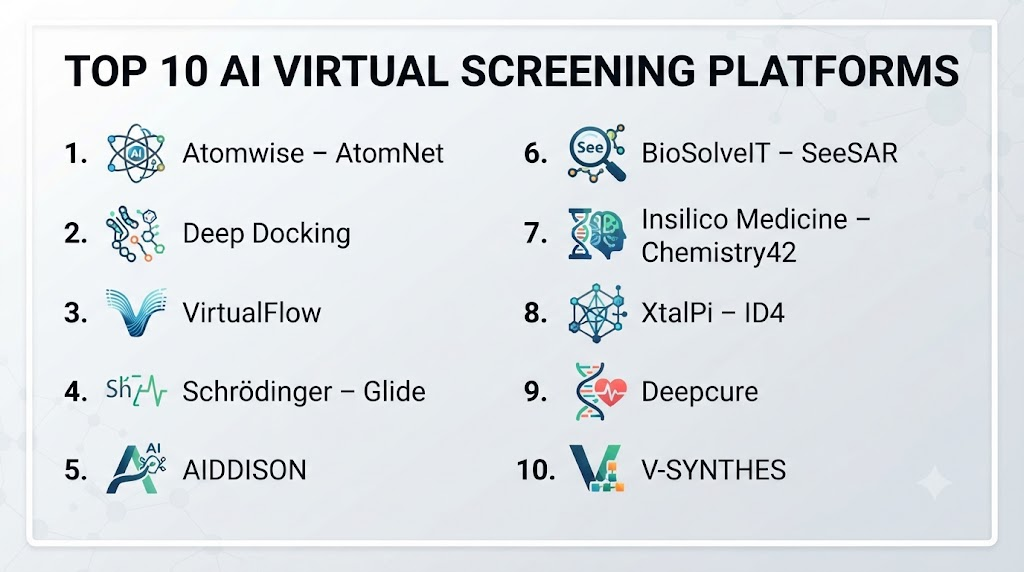
Top 10 AI Virtual Screening Platforms
1 — Schrödinger
One-line verdict: Best for pharmaceutical teams combining AI-assisted screening with physics-based molecular modeling and structure-based drug discovery.
Short description:
Schrödinger provides a broad computational drug-discovery environment combining molecular modeling, physics-based simulations, machine learning, virtual screening, and medicinal-chemistry workflows.
Standout Capabilities
- Structure-based virtual screening.
- Molecular docking.
- Machine-learning models.
- Molecular dynamics.
- Quantum chemistry.
- Lead optimization.
- Molecular property prediction.
- Large-scale computational chemistry.
AI-Specific Depth
- Model support: Proprietary machine-learning and computational models.
- RAG / knowledge integration: Molecular and scientific data can be integrated; specific RAG architecture is not publicly stated.
- Evaluation: Computational benchmarks, physics-based validation, and experimental testing.
- Guardrails: Molecular constraints, property filters, and chemistry-aware validation.
- Observability: Computational workflow metrics, runtime, and screening statistics.
Pros
- Broad computational chemistry ecosystem.
- Combines AI with physics-based approaches.
- Strong fit for structure-based discovery.
Cons
- Can require significant computational chemistry expertise.
- Broad platform may be complex for small teams.
- Pricing is not publicly stated.
Security & Compliance
Enterprise security configurations vary by deployment. Specific certifications and data controls should be verified.
Deployment & Platforms
- Cloud: Available for applicable workflows.
- Self-hosted: Available for applicable software.
- Hybrid: Possible.
- Linux/HPC: Supported for computational workflows.
Integrations & Ecosystem
- Molecular databases.
- Protein structures.
- HPC.
- Docking.
- Molecular dynamics.
- Machine learning.
- Laboratory workflows.
Pricing Model
Commercial licensing and enterprise arrangements. Exact pricing is Not publicly stated.
Best-Fit Scenarios
- Pharmaceutical R&D.
- Structure-based virtual screening.
- Computational chemistry departments.
2 — Atomwise
One-line verdict: Best for AI-driven virtual screening programs focused on discovering compounds against therapeutic protein targets.
Short description:
Atomwise develops AI-based drug-discovery technologies designed to evaluate chemical space and identify compounds that may interact with selected biological targets.
Standout Capabilities
- AI virtual screening.
- Molecular interaction prediction.
- Large chemical-library analysis.
- Target-focused screening.
- Hit identification.
- Small-molecule discovery.
- Computational chemistry.
- Drug-discovery collaboration.
AI-Specific Depth
- Model support: Proprietary AI models.
- RAG / knowledge integration: Chemical and biological data integration; exact RAG architecture is not publicly stated.
- Evaluation: Computational screening followed by experimental validation.
- Guardrails: Molecular property filters and scientific constraints.
- Observability: Screening metrics and research analytics.
Pros
- Strong AI-first screening orientation.
- Suitable for large chemical libraries.
- Focused on drug-discovery applications.
Cons
- Enterprise and partnership-oriented.
- Exact platform capabilities can vary by engagement.
- Pricing is not publicly stated.
Security & Compliance
Specific enterprise security and data-governance controls should be confirmed for each engagement.
Deployment & Platforms
- Cloud: Varies.
- Web: Varies.
- Self-hosted: Not publicly stated.
Integrations & Ecosystem
- Chemical libraries.
- Protein structures.
- Molecular modeling.
- Virtual screening.
- Experimental workflows.
- Pharmaceutical research.
Pricing Model
Enterprise/custom or partnership-based. Exact pricing is Not publicly stated.
Best-Fit Scenarios
- Large-scale virtual screening.
- Hit identification.
- Pharmaceutical discovery.
3 — NVIDIA BioNeMo
One-line verdict: Best for developers building customized AI-powered virtual-screening pipelines with scalable biological and molecular models.
Short description:
NVIDIA BioNeMo provides AI models and infrastructure for drug discovery and biological research. Its ecosystem can support molecular representation, property prediction, generative chemistry, protein modeling, and custom screening workflows.
Standout Capabilities
- Molecular AI models.
- Molecular property prediction.
- Generative chemistry.
- Protein modeling.
- Custom model development.
- GPU acceleration.
- Large-scale inference.
- Drug-discovery pipelines.
AI-Specific Depth
- Model support: Multiple molecular and biological models.
- RAG / knowledge integration: External scientific and chemical data can be incorporated into custom applications.
- Evaluation: Model-specific benchmarks and custom screening evaluation.
- Guardrails: Molecular validity checks, property thresholds, and application-level constraints.
- Observability: GPU, inference, latency, and application-level metrics can be monitored.
Pros
- Strong developer flexibility.
- Scalable GPU infrastructure.
- Broad molecular AI ecosystem.
Cons
- Requires technical expertise.
- Teams must design portions of the screening workflow themselves.
- Compute costs can grow at scale.
Security & Compliance
Deployment and infrastructure configuration determine security controls.
Deployment & Platforms
- Cloud: Yes.
- Self-hosted: Possible.
- Hybrid: Possible.
- Linux: Common.
Integrations & Ecosystem
- GPUs.
- Molecular models.
- Protein models.
- Machine-learning frameworks.
- Cloud platforms.
- Chemical datasets.
Pricing Model
Varies according to software and infrastructure. Exact platform-wide pricing is Not publicly stated.
Best-Fit Scenarios
- AI drug-discovery developers.
- Custom screening systems.
- Large-scale computational research.
4 — DeepMind AlphaFold 3
One-line verdict: Best for structure-aware virtual screening workflows where protein-ligand structural predictions inform compound prioritization.
Short description:
AlphaFold 3 is primarily a biomolecular structure-prediction system rather than a conventional virtual-screening platform. However, its ability to model biomolecular interactions can support structure-aware drug-discovery workflows.
Standout Capabilities
- Biomolecular structure prediction.
- Protein-ligand modeling.
- Complex prediction.
- Binding-site research.
- Structure-guided screening support.
- Structural hypothesis generation.
- Drug-discovery research.
- Molecular interaction analysis.
AI-Specific Depth
- Model support: Deep-learning biomolecular structure models.
- RAG / knowledge integration: N/A as a core prediction system.
- Evaluation: Structural benchmarks and confidence metrics.
- Guardrails: Structural confidence and input constraints.
- Observability: Prediction confidence and computational metrics.
Pros
- Useful for understanding biomolecular interactions.
- Can support structure-based discovery.
- Broader molecular scope than protein-only prediction.
Cons
- Not a complete virtual-screening platform.
- Screening large libraries requires additional infrastructure.
- Predictions require experimental confirmation.
Security & Compliance
Deployment-specific. Security depends on the selected environment.
Deployment & Platforms
- Cloud: Available through applicable implementations.
- Self-hosted: Availability varies.
- Hybrid: Varies.
Integrations & Ecosystem
- Protein structures.
- Molecular databases.
- Docking workflows.
- Computational chemistry.
- Structural biology.
Pricing Model
Availability and pricing vary. Exact pricing is Not publicly stated.
Best-Fit Scenarios
- Structure-guided drug discovery.
- Protein-ligand research.
- Structural screening workflows.
5 — Deep Docking
One-line verdict: Best for researchers seeking scalable computational screening workflows capable of exploring extremely large chemical libraries.
Short description:
Deep Docking is a computational approach designed to accelerate virtual screening across very large chemical libraries by using machine learning within iterative docking workflows.
Standout Capabilities
- Large-scale virtual screening.
- Iterative docking.
- Machine-learning-assisted prioritization.
- Chemical-library exploration.
- Computational filtering.
- Distributed screening.
- Hit identification.
- Research workflows.
AI-Specific Depth
- Model support: Machine-learning models integrated into iterative screening workflows.
- RAG / knowledge integration: N/A as a core screening method.
- Evaluation: Docking benchmarks and experimental validation.
- Guardrails: Chemical filters and screening thresholds.
- Observability: Screening throughput and computational metrics.
Pros
- Designed for very large chemical libraries.
- Can reduce computational screening burden.
- Research-oriented and customizable.
Cons
- Requires computational expertise.
- Screening quality depends on the underlying scoring strategy.
- Requires downstream experimental validation.
Security & Compliance
Self-hosted deployments place security responsibility on the organization.
Deployment & Platforms
- Self-hosted: Yes.
- Cloud: Possible.
- Hybrid: Possible.
- Linux: Common.
Integrations & Ecosystem
- Docking software.
- Chemical libraries.
- HPC.
- Machine-learning frameworks.
- Molecular databases.
Pricing Model
Research software and infrastructure-based. Costs vary by compute requirements.
Best-Fit Scenarios
- Ultra-large library screening.
- Academic research.
- Computational drug discovery.
6 — Gnina
One-line verdict: Best for researchers combining deep-learning scoring with molecular docking for structure-based virtual screening.
Short description:
Gnina is an open-source molecular-docking system that incorporates deep learning into docking and scoring workflows. It can be used as a computational component within AI-enhanced virtual-screening pipelines.
Standout Capabilities
- Molecular docking.
- Deep-learning scoring.
- Protein-ligand modeling.
- Pose prediction.
- Virtual screening.
- Structure-based discovery.
- GPU acceleration.
- Research customization.
AI-Specific Depth
- Model support: Deep-learning scoring models.
- RAG / knowledge integration: N/A.
- Evaluation: Docking benchmarks and experimental validation.
- Guardrails: Docking constraints and molecular filters.
- Observability: Docking scores, runtime, and computational metrics.
Pros
- Open-source.
- Deep learning integrated into docking.
- Suitable for custom workflows.
Cons
- Requires technical expertise.
- Docking scores are not equivalent to experimental affinity.
- Infrastructure management is required.
Security & Compliance
Self-hosted teams control data and infrastructure security.
Deployment & Platforms
- Self-hosted: Yes.
- Cloud: Possible.
- Hybrid: Possible.
- Linux: Common.
Integrations & Ecosystem
- Molecular docking.
- Protein structures.
- Chemical libraries.
- GPUs.
- Computational chemistry pipelines.
Pricing Model
Open-source. Infrastructure costs vary.
Best-Fit Scenarios
- Academic drug discovery.
- AI docking research.
- Custom virtual-screening pipelines.
7 — DiffDock
One-line verdict: Best for researchers investigating diffusion-based protein-ligand docking as part of modern AI screening workflows.
Short description:
DiffDock uses diffusion models to predict protein-ligand binding poses. Although it is more accurately categorized as an AI docking system than a complete screening platform, it can be incorporated into larger virtual-screening pipelines.
Standout Capabilities
- AI docking.
- Binding-pose prediction.
- Diffusion modeling.
- Protein-ligand analysis.
- Structure-based screening.
- Computational chemistry.
- Research workflows.
- Custom deployment.
AI-Specific Depth
- Model support: Diffusion-based docking model.
- RAG / knowledge integration: N/A.
- Evaluation: Docking benchmarks and experimental validation.
- Guardrails: Structural and molecular constraints.
- Observability: Inference and docking metrics.
Pros
- Modern AI docking approach.
- Useful for structure-aware workflows.
- Research flexibility.
Cons
- Not a full end-to-end screening platform.
- Requires technical expertise.
- Docking predictions require experimental validation.
Security & Compliance
Self-hosted deployments allow organizations to control sensitive data.
Deployment & Platforms
- Self-hosted: Yes.
- Cloud: Possible.
- Hybrid: Possible.
- Linux: Common.
Integrations & Ecosystem
- Protein structures.
- Chemical libraries.
- Docking pipelines.
- Molecular visualization.
- Machine-learning frameworks.
Pricing Model
Research software. Infrastructure costs vary.
Best-Fit Scenarios
- AI docking research.
- Structure-based virtual screening.
- Academic computational chemistry.
8 — Schrodinger Virtual Screening Workflows
One-line verdict: Best for teams requiring mature computational chemistry workflows combining docking, filtering, scoring, and molecular-property analysis.
Short description:
Schrödinger’s broader computational platform supports virtual screening using multiple computational methods. Its value is strongest when screening is part of a larger molecular-design and optimization workflow.
Standout Capabilities
- Molecular docking.
- Virtual screening.
- Molecular-property prediction.
- Structure preparation.
- Pharmacophore workflows.
- Molecular dynamics.
- Quantum chemistry.
- Lead optimization.
AI-Specific Depth
- Model support: Machine-learning and physics-based computational models.
- RAG / knowledge integration: Chemical and scientific datasets can be incorporated.
- Evaluation: Computational benchmarking and experimental validation.
- Guardrails: Molecular filters and chemistry-aware constraints.
- Observability: Computational performance and workflow metrics.
Pros
- Broad computational chemistry coverage.
- Suitable for integrated discovery programs.
- Strong structure-based workflows.
Cons
- Requires trained computational chemists.
- Commercial software can involve significant licensing costs.
- Large workflows may require substantial compute.
Security & Compliance
Enterprise security depends on deployment. Specific certifications should be verified.
Deployment & Platforms
- Cloud: Available for applicable workflows.
- Self-hosted: Available.
- Hybrid: Possible.
- HPC: Supported.
Integrations & Ecosystem
- Protein structures.
- Chemical libraries.
- Docking.
- Molecular dynamics.
- Quantum chemistry.
- Machine learning.
- HPC.
Pricing Model
Commercial licensing. Exact pricing is Not publicly stated.
Best-Fit Scenarios
- Pharmaceutical R&D.
- Large-scale virtual screening.
- Integrated computational chemistry.
9 — Custom AI Virtual Screening Platform
One-line verdict: Best for organizations combining proprietary compound libraries, internal assays, target structures, and custom machine-learning models.
Short description:
Large pharmaceutical and biotechnology companies can build custom virtual-screening platforms that combine AI scoring, molecular docking, protein structures, internal assay data, molecular-property prediction, and experimental feedback.
A custom system can be trained around the organization’s therapeutic areas and proprietary chemical data.
Standout Capabilities
- Large-library screening.
- Custom AI scoring.
- Protein-conditioned screening.
- Molecular-property prediction.
- Docking.
- Active learning.
- Multi-objective ranking.
- Experimental feedback.
AI-Specific Depth
- Model support: Open-source, proprietary, hosted, or internally trained models.
- RAG / knowledge integration: Internal assay databases, compound libraries, scientific literature, patents, structural data, and biological datasets.
- Evaluation: Retrospective benchmarks, prospective screening, hit rates, enrichment, false-positive analysis, and experimental validation.
- Guardrails: Chemical validity checks, property constraints, access controls, human review, and model governance.
- Observability: Screening throughput, model performance, compute cost, latency, score distributions, data drift, and experimental outcomes.
Pros
- Maximum customization.
- Can exploit proprietary data.
- Enables organization-specific screening objectives.
Cons
- High development burden.
- Requires computational chemistry expertise.
- Continuous model maintenance is necessary.
Security & Compliance
The organization controls the architecture and is responsible for encryption, access management, retention, auditability, intellectual-property protection, and governance.
Deployment & Platforms
- Cloud: Possible.
- Self-hosted: Possible.
- Hybrid: Possible.
- Linux: Common.
- API: Possible.
Integrations & Ecosystem
Potential integrations include:
- Compound libraries.
- LIMS.
- ELN.
- Protein structures.
- Docking engines.
- Molecular-property models.
- Assay databases.
Pricing Model
Custom development and infrastructure. Exact pricing is N/A.
Best-Fit Scenarios
- Pharmaceutical organizations.
- Large biotech companies.
- Proprietary screening programs.
10 — AI-Enhanced Molecular Docking Pipeline
One-line verdict: Best for teams wanting a modular screening stack combining AI scoring, conventional docking, filtering, and downstream validation.
Short description:
Rather than purchasing a single platform, research teams can build modular screening pipelines using AI scoring models, docking engines, chemical databases, property predictors, and custom ranking logic.
This approach can be particularly useful for computational chemistry groups that want control over individual pipeline components.
Standout Capabilities
- Molecular docking.
- AI scoring.
- Chemical filtering.
- Property prediction.
- Similarity searching.
- Virtual screening.
- Ensemble scoring.
- Custom ranking.
AI-Specific Depth
- Model support: Multi-model and open-source options.
- RAG / knowledge integration: Chemical and scientific databases can be connected.
- Evaluation: Retrospective and prospective screening benchmarks.
- Guardrails: Molecular validity and property filters.
- Observability: Pipeline-level latency, compute cost, failure rates, and scoring metrics.
Pros
- Flexible architecture.
- Reduces dependency on one vendor.
- Components can be replaced independently.
Cons
- Requires engineering expertise.
- Integration can become complicated.
- Support is distributed across multiple components.
Security & Compliance
Security is controlled by the organization operating the pipeline.
Deployment & Platforms
- Cloud: Possible.
- Self-hosted: Possible.
- Hybrid: Possible.
- Linux/HPC: Common.
Integrations & Ecosystem
- Docking engines.
- Chemical databases.
- Protein structures.
- Machine-learning models.
- Molecular-property predictors.
- Workflow orchestration.
- Laboratory systems.
Pricing Model
Open-source, commercial, or infrastructure-based depending on components.
Comparison Table
| Tool | Best For | Deployment | Model Flexibility | Strength | Watch-Out | Public Rating |
|---|---|---|---|---|---|---|
| Schrödinger | Integrated pharmaceutical screening | Cloud / Self-hosted / Hybrid | Multi-method | AI + physics-based chemistry | Complexity | |
| Atomwise | AI-first screening | Cloud / Varies | Proprietary AI | Large-scale target screening | Enterprise focus | |
| NVIDIA BioNeMo | Custom AI screening | Cloud / Self-hosted / Hybrid | Multi-model | Developer flexibility | Infrastructure requirements | |
| AlphaFold 3 | Structure-aware screening | Cloud / Varies | Deep learning | Biomolecular interactions | Not a screening engine | |
| Deep Docking | Ultra-large libraries | Self-hosted / Cloud | ML-assisted | Scale | Technical expertise | |
| Gnina | AI docking | Self-hosted / Cloud | Open research | Deep-learning scoring | Docking limitations | |
| DiffDock | AI docking research | Self-hosted / Cloud | Diffusion model | Modern docking | Not end-to-end | |
| Schrödinger Workflows | Enterprise computational chemistry | Cloud / Self-hosted / Hybrid | Multi-method | Mature workflow | Licensing complexity | |
| Custom AI Platform | Proprietary screening | Cloud / Self-hosted / Hybrid | Multi-model | Maximum customization | High development burden | |
| Modular AI Docking Pipeline | Developer/research teams | Cloud / Self-hosted / Hybrid | Multi-model | Vendor flexibility | Integration overhead |
Scoring & Evaluation
These scores are comparative editorial assessments intended to help create an initial shortlist. They should not be interpreted as laboratory performance benchmarks.
Virtual-screening quality should ultimately be assessed using project-specific retrospective and prospective experiments.
| Tool | Core Features | AI Reliability | Screening Depth | Integrations | Ease | Performance/Cost | Security/Admin | Support | Weighted Total |
|---|---|---|---|---|---|---|---|---|---|
| Schrödinger | 10 | 9 | 10 | 10 | 7 | 8 | 9 | 10 | 9.15 |
| Atomwise | 9 | 9 | 10 | 8 | 8 | 8 | 9 | 9 | 8.85 |
| NVIDIA BioNeMo | 10 | 9 | 10 | 10 | 7 | 8 | 9 | 10 | 9.10 |
| AlphaFold 3 | 9 | 9 | 8 | 9 | 7 | 8 | 8 | 10 | 8.55 |
| Deep Docking | 9 | 8 | 10 | 9 | 6 | 9 | 7 | 8 | 8.35 |
| Gnina | 8 | 8 | 9 | 9 | 6 | 10 | 7 | 8 | 8.15 |
| DiffDock | 8 | 8 | 9 | 8 | 6 | 9 | 7 | 8 | 8.00 |
| Schrödinger Workflows | 10 | 9 | 10 | 10 | 7 | 8 | 9 | 10 | 9.15 |
| Custom AI Platform | 10 | 10 | 10 | 10 | 5 | 7 | 10 | 10 | 9.35 |
| Modular AI Docking Pipeline | 9 | 9 | 9 | 10 | 6 | 9 | 8 | 9 | 8.85 |
Top 3 for Enterprise
- Schrödinger — Strong integrated computational chemistry and screening capabilities.
- NVIDIA BioNeMo — Strong platform foundation for custom AI screening.
- Custom AI Virtual Screening Platform — Best for organizations with proprietary data and specialized requirements.
Top 3 for SMB
- Gnina — Open and customizable AI-enhanced docking.
- DiffDock — Useful for teams exploring modern AI docking.
- NVIDIA BioNeMo — Strong option when the team has technical AI expertise.
Top 3 for Developers
- NVIDIA BioNeMo — Broadest platform for building customized molecular-AI workflows.
- Gnina — Useful open docking foundation.
- DiffDock — Modern research-oriented AI docking approach.
Which AI Virtual Screening Platform Is Right for You?
Solo / Individual Researcher
Individual researchers can often begin with open-source computational tools rather than enterprise platforms.
A practical workflow can combine:
- Public compound libraries.
- Protein structures.
- Gnina.
- DiffDock.
- Molecular-property predictors.
- Molecular visualization.
- Open cheminformatics libraries.
The focus should be on reproducibility and experimental validation.
SMB Biotech
Small biotechnology teams should prioritize:
- Easy compound-library management.
- Accessible docking.
- AI scoring.
- Property prediction.
- Exportable results.
- Batch screening.
- Reasonable compute requirements.
Avoid selecting a platform solely because it claims to screen enormous libraries.
The important question is whether the system improves hit identification for your particular target.
Mid-Market Biotech
Mid-sized teams may benefit from a multi-stage screening pipeline:
AI screening → docking → property filtering → synthesis prioritization → experimental testing
Important capabilities include:
- Batch screening.
- AI scoring.
- Docking.
- ADMET-related prediction.
- Chemical diversity.
- Retrosynthesis.
- Experimental data integration.
Enterprise Pharmaceutical Company
Large pharmaceutical organizations should evaluate:
- Ultra-large library support.
- Proprietary compound integration.
- Multiple scoring methods.
- Structure-based screening.
- Ligand-based screening.
- AI property prediction.
- Docking.
- Active learning.
- Laboratory integration.
- Data governance.
Enterprise teams should also evaluate whether a platform can preserve the complete computational provenance of screening decisions.
Structure-Based Screening
If a reliable protein structure is available, structure-based screening can be highly valuable.
Evaluate:
- Protein preparation.
- Binding-site definition.
- Docking.
- AI scoring.
- Pose prediction.
- Structural confidence.
- Ensemble approaches.
Ligand-Based Screening
When known active compounds are available, ligand-based approaches may be particularly useful.
Consider:
- Similarity searching.
- Molecular fingerprints.
- Pharmacophores.
- Learned molecular representations.
- Activity prediction.
Ultra-Large Chemical Libraries
For extremely large libraries, computational efficiency becomes critical.
Look for:
- Distributed processing.
- GPU acceleration.
- ML pre-filtering.
- Iterative screening.
- Hierarchical ranking.
- Efficient data handling.
Academic Research
Academic teams should prioritize:
- Open-source access.
- Reproducibility.
- Public benchmarks.
- Customization.
- Transparent evaluation.
- Reasonable compute requirements.
Regulated Pharmaceutical Research
Important governance requirements include:
- Compound provenance.
- Model versioning.
- Data access controls.
- Auditability.
- Intellectual-property protection.
- Reproducible computational workflows.
- Experimental confirmation.
Budget vs Premium
Open-source tools can reduce licensing costs but may increase engineering and infrastructure requirements.
Premium platforms may be preferable when teams need:
- Integrated workflows.
- Enterprise support.
- Specialized computational chemistry.
- Large-scale infrastructure.
- Advanced molecular models.
- Collaboration features.
Build vs Buy
Build when:
- You have proprietary compound and assay data.
- Your screening objectives are specialized.
- You have strong computational chemistry expertise.
- You need complete control over scoring models.
Buy or partner when:
- You need rapid deployment.
- Your team lacks specialized infrastructure.
- You need established computational chemistry workflows.
- You want professional scientific support.
A hybrid approach can provide commercial infrastructure while preserving internal models and proprietary data.
Implementation Playbook
First 30 Days: Define the Screening Problem
Start by defining:
- Target protein.
- Binding site.
- Compound library.
- Known active compounds.
- Desired chemical properties.
- Screening objective.
- Experimental assay.
Establish baseline performance using conventional methods where appropriate.
Days 31–60: Build the Screening Benchmark
Create a representative benchmark containing:
- Known actives.
- Known inactives.
- Decoys.
- Structurally diverse compounds.
- Relevant chemical series.
Evaluate:
- Enrichment.
- Recall.
- Precision.
- Ranking quality.
- False-positive rate.
- Computational cost.
Do not rely on a single benchmark.
Days 61–90: Add Experimental Feedback
Create the loop:
Screen → rank → select → synthesize/source → test → analyze → update
During this phase:
- Track experimental hit rates.
- Record false positives.
- Identify chemical-series bias.
- Recalibrate scoring.
- Update models.
- Monitor data drift.
- Optimize compute allocation.
The ultimate objective is not to maximize virtual-screening scores.
It is to maximize useful experimental discoveries per unit of computational and laboratory effort.
Common Mistakes and How to Avoid Them
- Treating docking scores as experimental affinity: Computational scores are estimates.
- Relying on one AI model: Different models have different failure modes.
- Ignoring chemical diversity: Selecting similar molecules can reduce the value of experimental testing.
- Ignoring false positives: A high ranking does not guarantee activity.
- Skipping experimental validation: Virtual screening must eventually connect to biological assays.
- Ignoring protein flexibility: A single rigid protein structure may not capture relevant conformations.
- Using poor protein structures: Structural errors can propagate through screening.
- Ignoring ligand preparation: Incorrect protonation, stereochemistry, or molecular states can affect predictions.
- Ignoring synthetic feasibility: A promising virtual hit may be difficult to make.
- Ignoring ADMET-related properties: Activity alone is insufficient.
- Over-screening without filtering: Large libraries can create unnecessary computational costs.
- Ignoring data leakage: Benchmark contamination can produce misleading performance.
- Using unrealistic benchmarks: Historical retrospective success may not predict prospective performance.
- Failing to version models: Screening results should be reproducible.
- Ignoring data provenance: Track compound sources and preparation steps.
- Assuming AI eliminates docking: AI and physics-based methods can complement one another.
- Ignoring uncertainty: Prediction confidence should influence candidate selection.
- Failing to learn from experimental failures: Negative results can improve future screening.
FAQs
What are AI Virtual Screening platforms?
They are computational systems that use artificial intelligence to prioritize compounds that may interact with a biological target or possess desirable drug-like properties.
How does AI virtual screening work?
AI models analyze molecular and biological information to score or rank compounds before selected candidates undergo experimental testing.
What is the difference between virtual screening and molecular docking?
Virtual screening is the broader process of computationally prioritizing compounds. Docking is one method that estimates how a molecule may interact with a target structure.
Can AI virtual screening replace laboratory screening?
No. AI virtual screening reduces the number of compounds that may need experimental testing, but laboratory validation remains essential.
Can AI screen millions of compounds?
Yes. Appropriate computational systems can screen very large chemical libraries, although infrastructure, model quality, and workflow design determine practical performance.
What is ultra-large virtual screening?
It refers to computational screening against chemical libraries containing extremely large numbers of compounds, often requiring specialized distributed or hierarchical workflows.
What data does AI virtual screening use?
Depending on the platform, inputs can include protein structures, molecular structures, chemical fingerprints, protein sequences, assay data, and molecular-property information.
Can AI virtual screening work without a protein structure?
Yes. Ligand-based and molecular-property approaches can work without an experimentally determined protein structure, although the available information determines which methods are appropriate.
Can AlphaFold 3 be used for virtual screening?
It can support structure-aware drug-discovery workflows, particularly around biomolecular interactions, but it should not be considered a complete high-throughput virtual-screening engine.
What is AI docking?
AI docking uses machine-learning or deep-learning methods to predict protein-ligand poses or improve scoring within molecular docking workflows.
Is DiffDock a virtual-screening platform?
DiffDock is primarily an AI docking approach. It can be incorporated into virtual-screening workflows but is not a complete end-to-end screening platform.
What is Gnina?
Gnina is an open-source molecular-docking system that incorporates deep-learning scoring and is useful for AI-enhanced structure-based screening.
How should AI virtual-screening platforms be evaluated?
Use project-specific retrospective and prospective benchmarks covering enrichment, ranking quality, false positives, chemical diversity, computational cost, and experimental hit rates.
What is enrichment in virtual screening?
Enrichment measures how effectively a screening method places active compounds near the top of a ranked library compared with random selection.
Can AI predict whether a compound will bind?
AI can estimate binding-related properties or interactions, but predictions are uncertain and require experimental confirmation.
Does a high docking score mean a molecule is a good drug?
No. A molecule can have a favorable computational score but poor potency, selectivity, pharmacokinetics, toxicity, or synthetic feasibility.
Can AI virtual screening be used for drug repurposing?
Yes. Existing drugs and compounds can be computationally evaluated against alternative biological targets or disease mechanisms.
Can virtual screening use proprietary compound libraries?
Yes. Private libraries can be screened using controlled infrastructure, subject to the platform’s data-handling and deployment capabilities.
Should pharmaceutical companies self-host AI screening systems?
Self-hosting can be valuable when intellectual property, proprietary compound libraries, or sensitive research data require tighter infrastructure control.
What are the biggest risks of AI virtual screening?
Major risks include false positives, data leakage, poor protein structures, inaccurate molecular representations, model bias, overconfidence, insufficient chemical diversity, and lack of experimental validation.
Which AI Virtual Screening platform is best?
There is no universal winner. Schrödinger is strong for integrated computational chemistry, Atomwise is focused on AI-driven drug discovery, NVIDIA BioNeMo is useful for building customized molecular-AI systems, while open approaches such as Gnina and DiffDock provide flexibility for research teams.
Conclusion
AI Virtual Screening platforms are becoming an important component of modern drug discovery because they can help researchers search chemical space more efficiently.Platforms such as Schrödinger, Atomwise, NVIDIA BioNeMo, and specialized approaches such as Deep Docking, Gnina, and DiffDock demonstrate different ways AI can support computational screening.For enterprise pharmaceutical organizations, integrated platforms can simplify complex discovery workflows. For developers and academic researchers, open models can provide greater flexibility and customization. Organizations with substantial proprietary data may benefit from building specialized screening infrastructure.