Introduction
AI Drug Target Discovery platforms use artificial intelligence, machine learning, biological databases, computational biology, and multi-omics analysis to help researchers identify and prioritize biological targets that could potentially be used to develop new medicines.
Traditional target discovery can require extensive analysis of genomic, transcriptomic, proteomic, structural, clinical, and literature data. AI can help researchers connect these datasets, identify disease-associated mechanisms, predict biological relationships, prioritize candidate targets, and generate hypotheses for experimental validation.
The technology is increasingly relevant across oncology, immunology, neuroscience, rare diseases, metabolic disorders, infectious diseases, and other therapeutic areas. Modern platforms can combine foundation models, knowledge graphs, protein-structure analysis, multimodal data, causal inference, and high-throughput computational workflows.
Typical users include pharmaceutical companies, biotechnology companies, academic research groups, translational medicine teams, computational biologists, and drug-discovery scientists.
Best for: Pharmaceutical companies, biotech organizations, academic drug-discovery groups, translational research teams, and computational biology teams working with large and complex biological datasets.
Not ideal for: Small research teams without appropriate biological datasets or experimental capabilities, organizations seeking fully automated target validation, or projects where conventional literature review and established target databases are sufficient.
What Is AI Drug Target Discovery?
AI Drug Target Discovery refers to the use of computational intelligence to identify, evaluate, and prioritize biological molecules or mechanisms that could potentially become therapeutic targets.
A target may be:
- A protein.
- Gene.
- RNA molecule.
- Signaling pathway.
- Receptor.
- Enzyme.
- Protein-protein interaction.
- Cellular mechanism.
A conventional target-discovery workflow may involve:
- Disease biology research.
- Literature analysis.
- Genetic evidence.
- Expression analysis.
- Functional studies.
- Protein analysis.
- Pathway analysis.
- Experimental validation.
AI can accelerate several stages by processing large datasets and identifying relationships that may be difficult to discover manually.
For example, an AI platform may identify a relationship between:
The output is a research hypothesis, not automatically a validated drug target.
Experimental evidence remains essential.
Why AI Drug Target Discovery Matters
Drug development is expensive and time-consuming, and early target-selection decisions can influence downstream research substantially.
AI can help researchers:
- Analyze large biological datasets.
- Identify disease-associated genes.
- Prioritize potential therapeutic targets.
- Explore gene-disease relationships.
- Integrate multi-omics evidence.
- Analyze scientific literature.
- Study protein structures.
- Identify biological pathways.
- Explore causal relationships.
- Compare target hypotheses.
- Generate experimental hypotheses.
The most useful platforms do not simply produce long lists of candidate targets.
They help researchers understand why a target may be interesting.
A useful target-discovery system should therefore provide evidence such as:
- Genetic support.
- Biological relevance.
- Disease association.
- Tissue expression.
- Pathway involvement.
- Structural information.
- Clinical evidence.
- Safety considerations.
- Existing druggability evidence.
Key Use Cases
Target Identification
AI can identify genes or proteins potentially associated with a disease phenotype.
Target Prioritization
Models can rank candidate targets based on multiple evidence types.
Disease Biology Analysis
AI can help researchers identify biological mechanisms associated with disease.
Multi-Omics Integration
Genomic, transcriptomic, proteomic, metabolomic, and other datasets can be analyzed together.
Genetic Target Validation
Human genetic evidence can be used to strengthen or weaken target hypotheses.
Literature Mining
Natural-language processing can identify relationships across scientific publications.
Protein Analysis
AI can help analyze protein structures, interactions, and functional relationships.
Pathway Discovery
Models can identify potentially relevant signaling pathways and biological networks.
Drug-Target Relationship Analysis
AI can explore existing relationships between drugs, targets, diseases, and biological mechanisms.
Rare Disease Research
AI can help connect genetic abnormalities with disease phenotypes and potential therapeutic hypotheses.
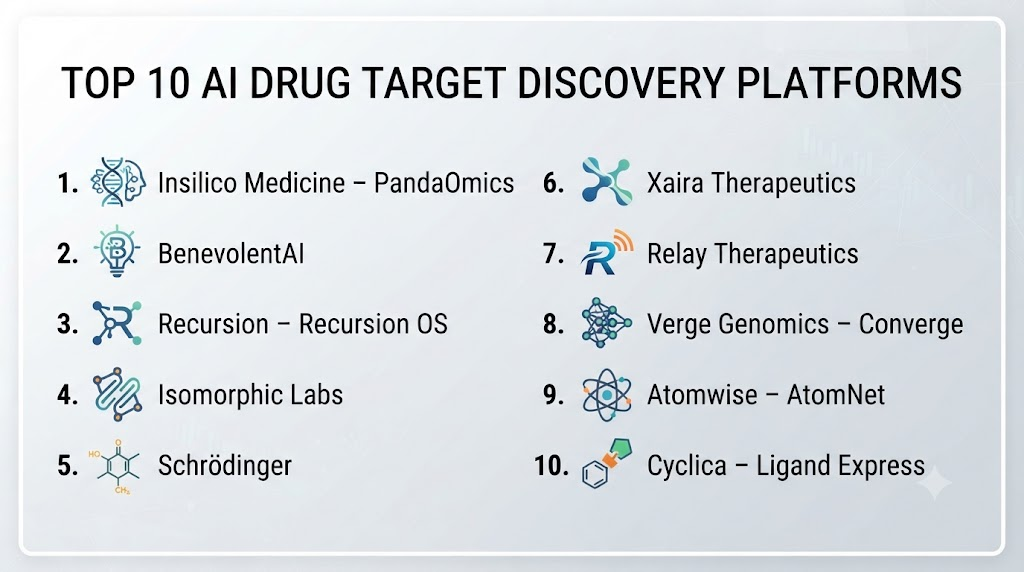
Top 10 AI Drug Target Discovery Platforms
1 — Insilico Medicine
One-line verdict: Best for AI-driven drug discovery programs combining target identification, generative biology, and downstream therapeutic development.
Short description:
Insilico Medicine develops AI-based drug-discovery technologies spanning target identification, molecule generation, and preclinical development. Its platform approach is designed to connect biological research with downstream drug-design workflows.
Standout Capabilities
- AI-powered target identification.
- Disease biology analysis.
- Generative chemistry.
- Drug design.
- Multi-omics analysis.
- Biological data analysis.
- Target prioritization.
- Integrated drug-discovery workflows.
AI-Specific Depth
- Model support: Proprietary AI models and computational biology systems.
- RAG / knowledge integration: Biological and scientific data integration; exact vector-database architecture is not publicly stated.
- Evaluation: Computational validation combined with biological and experimental validation.
- Guardrails: Scientific validation workflows and expert review.
- Observability: Computational and research workflow monitoring; detailed model-level telemetry is not publicly stated.
Pros
- Broad AI drug-discovery platform.
- Connects target discovery with downstream drug design.
- Strong computational biology orientation.
Cons
- Primarily enterprise and research focused.
- Platform access may depend on partnership arrangements.
- Exact pricing is not publicly stated.
Security & Compliance
Specific enterprise security configurations, certifications, data retention, and residency should be verified for the relevant engagement.
Deployment & Platforms
- Cloud: Varies.
- Web: Varies.
- Self-hosted: Not publicly stated.
- Hybrid: Varies / N/A.
Integrations & Ecosystem
- Multi-omics data.
- Scientific literature.
- Biological databases.
- Computational chemistry.
- Drug-discovery workflows.
- Research systems.
Pricing Model
Enterprise or partnership-based arrangements. Exact pricing is Not publicly stated.
Best-Fit Scenarios
- Pharmaceutical companies.
- Biotechnology companies.
- Integrated AI drug-discovery programs.
2 — Recursion
One-line verdict: Best for organizations interested in large-scale, data-driven target discovery using biological experimentation and machine learning.
Short description:
Recursion combines biological experimentation, high-content imaging, automation, and machine learning to study disease biology and identify potential therapeutic opportunities. Its approach emphasizes large-scale experimental datasets and computational analysis.
Standout Capabilities
- Phenotypic screening.
- High-content imaging.
- Machine learning.
- Automated experimentation.
- Biological data generation.
- Target discovery.
- Disease modeling.
- Large-scale data analysis.
AI-Specific Depth
- Model support: Proprietary machine-learning models and computational biology systems.
- RAG / knowledge integration: Scientific and biological data integration; exact vector-database implementation is not publicly stated.
- Evaluation: Experimental validation and computational evaluation.
- Guardrails: Experimental controls and scientific review.
- Observability: Imaging, experimental, and computational analytics.
Pros
- Strong integration of AI and experimentation.
- Large biological datasets.
- Broad drug-discovery capabilities.
Cons
- Primarily enterprise and partnership focused.
- Complex technology stack.
- Exact pricing is not publicly stated.
Security & Compliance
Specific security and data-governance controls depend on the collaboration or deployment.
Deployment & Platforms
- Cloud: Varies.
- Laboratory infrastructure: Yes.
- Self-hosted: Not publicly stated.
- Hybrid: Varies.
Integrations & Ecosystem
- High-content imaging.
- Laboratory automation.
- Biological assays.
- Machine learning.
- Genomics.
- Drug-discovery workflows.
Pricing Model
Partnership and enterprise arrangements. Exact pricing is Not publicly stated.
Best-Fit Scenarios
- Large biotech organizations.
- Pharmaceutical research.
- AI-enabled experimental biology.
3 — BenevolentAI
One-line verdict: Best for researchers using AI and knowledge graphs to investigate disease biology and prioritize potential therapeutic targets.
Short description:
BenevolentAI focuses on AI-driven drug discovery and biomedical knowledge analysis. Its approach uses computational methods to connect scientific evidence, biological relationships, and disease mechanisms.
Standout Capabilities
- Target discovery.
- Biomedical knowledge graphs.
- Disease biology.
- Literature analysis.
- Biological relationship discovery.
- Target prioritization.
- Drug-disease analysis.
- Computational biology.
AI-Specific Depth
- Model support: Proprietary AI and machine-learning systems.
- RAG / knowledge integration: Knowledge-graph and scientific-data approaches are central; exact current vector-database architecture is not publicly stated.
- Evaluation: Computational analysis combined with scientific validation.
- Guardrails: Expert review and evidence-based research workflows.
- Observability: Research analytics and evidence tracking.
Pros
- Strong biomedical knowledge focus.
- Useful for hypothesis generation.
- Emphasizes evidence relationships.
Cons
- Enterprise-oriented.
- Exact product availability can vary.
- Pricing is not publicly stated.
Security & Compliance
Specific enterprise security and data-governance requirements should be verified.
Deployment & Platforms
- Cloud: Varies.
- Web: Varies.
- Self-hosted: Not publicly stated.
- Hybrid: Varies / N/A.
Integrations & Ecosystem
- Scientific literature.
- Biological databases.
- Knowledge graphs.
- Genomics.
- Drug databases.
- Research systems.
Pricing Model
Enterprise/custom or partnership arrangements. Exact pricing is Not publicly stated.
Best-Fit Scenarios
- Pharmaceutical research.
- Target-identification teams.
- Biomedical data science.
4 — Owkin
One-line verdict: Best for AI-driven target discovery combining multimodal biomedical data, clinical evidence, and collaborative research.
Short description:
Owkin develops AI technologies for biomedical research and drug discovery. Its work spans multimodal biomedical data, machine learning, clinical research, and target discovery, with a strong focus on connecting computational analysis with biological and clinical evidence.
Standout Capabilities
- Target discovery.
- Multimodal biomedical AI.
- Clinical data analysis.
- Machine learning.
- Biomarker discovery.
- Disease modeling.
- Federated learning approaches.
- Pharmaceutical research collaboration.
AI-Specific Depth
- Model support: Proprietary machine-learning and AI systems.
- RAG / knowledge integration: Biomedical data and scientific knowledge integration; exact vector architecture is not publicly stated.
- Evaluation: Computational validation and research studies.
- Guardrails: Privacy-preserving approaches and scientific review.
- Observability: Research analytics and model performance monitoring.
Pros
- Strong multimodal-data focus.
- Combines clinical and biological information.
- Relevant to pharmaceutical research.
Cons
- Enterprise and research oriented.
- Complex data requirements.
- Pricing is not publicly stated.
Security & Compliance
Privacy-preserving approaches are part of the platform’s research orientation. Specific contractual security requirements should be verified.
Deployment & Platforms
- Cloud: Varies.
- Hybrid: Possible depending on collaboration.
- Self-hosted: Varies.
- Web: Varies.
Integrations & Ecosystem
- Clinical data.
- Pathology.
- Genomics.
- Biomedical datasets.
- Machine learning.
- Pharmaceutical research systems.
Pricing Model
Enterprise/custom and partnership-based. Exact pricing is Not publicly stated.
Best-Fit Scenarios
- Pharmaceutical companies.
- Academic medical research.
- Multimodal biomedical AI programs.
5 — Generate:Biomedicines
One-line verdict: Best for organizations exploring generative AI and protein engineering as part of target and therapeutic discovery.
Short description:
Generate:Biomedicines develops generative AI approaches for biological and therapeutic discovery. Its technology focuses strongly on biological design and protein engineering, making it relevant to research programs where target biology and therapeutic design intersect.
Standout Capabilities
- Generative biology.
- Protein design.
- Machine learning.
- Therapeutic discovery.
- Biological modeling.
- Protein engineering.
- Computational experimentation.
- Drug-development research.
AI-Specific Depth
- Model support: Proprietary generative models.
- RAG / knowledge integration: Biological data integration; exact RAG architecture is not publicly stated.
- Evaluation: Computational and experimental validation.
- Guardrails: Biological constraints and experimental validation.
- Observability: Computational and experimental research metrics.
Pros
- Strong generative-biology capabilities.
- Deep focus on protein engineering.
- Useful for advanced therapeutic research.
Cons
- More specialized than general target-discovery software.
- Enterprise/research focus.
- Pricing is not publicly stated.
Security & Compliance
Specific security controls depend on research or partnership arrangements.
Deployment & Platforms
- Cloud: Varies.
- Laboratory: Yes.
- Self-hosted: Not publicly stated.
Integrations & Ecosystem
- Protein datasets.
- Biological assays.
- Computational biology.
- Laboratory workflows.
- Drug-discovery programs.
Pricing Model
Partnership and enterprise arrangements. Exact pricing is Not publicly stated.
Best-Fit Scenarios
- Protein-focused drug discovery.
- Biotech research.
- Generative biology programs.
6 — Atomwise
One-line verdict: Best for pharmaceutical teams using AI-based molecular analysis and virtual screening to investigate therapeutic opportunities.
Short description:
Atomwise develops AI technologies for drug discovery, including computational approaches for identifying and evaluating small-molecule opportunities. Its technology is relevant to target-focused discovery programs where molecular interactions and virtual screening are important.
Standout Capabilities
- AI drug discovery.
- Virtual screening.
- Molecular modeling.
- Structure-based analysis.
- Target-focused discovery.
- Small-molecule research.
- Computational chemistry.
- Drug-design workflows.
AI-Specific Depth
- Model support: Proprietary AI models.
- RAG / knowledge integration: Scientific and molecular data integration; exact vector-database compatibility is not publicly stated.
- Evaluation: Computational screening followed by experimental validation.
- Guardrails: Scientific and molecular constraints.
- Observability: Computational screening and research analytics.
Pros
- Strong molecular-AI focus.
- Useful for target-oriented discovery.
- Computational screening can reduce experimental search space.
Cons
- More focused on molecular discovery than target biology alone.
- Enterprise/partnership oriented.
- Pricing is not publicly stated.
Security & Compliance
Specific enterprise security controls should be confirmed for each collaboration.
Deployment & Platforms
- Cloud: Varies.
- Web: Varies.
- Self-hosted: Not publicly stated.
Integrations & Ecosystem
- Protein structures.
- Molecular databases.
- Virtual screening.
- Computational chemistry.
- Experimental workflows.
Pricing Model
Enterprise/custom or partnership-based. Exact pricing is Not publicly stated.
Best-Fit Scenarios
- Pharmaceutical discovery teams.
- Virtual screening programs.
- Structure-based research.
7 — Exscientia
One-line verdict: Best for AI-driven drug-discovery programs connecting target biology, molecular design, and automated research workflows.
Short description:
Exscientia developed an AI-first approach to drug discovery focused on computational design and automated experimentation. Its technology is relevant to organizations seeking to combine machine learning with systematic drug-discovery workflows.
Standout Capabilities
- AI drug discovery.
- Target-related research.
- Molecular design.
- Automated experimentation.
- Machine learning.
- Drug optimization.
- Computational chemistry.
- Experimental validation.
AI-Specific Depth
- Model support: Proprietary AI and machine-learning models.
- RAG / knowledge integration: Scientific and biological data integration; exact architecture is not publicly stated.
- Evaluation: Computational and experimental validation.
- Guardrails: Scientific constraints and experimental validation.
- Observability: Computational and laboratory workflow metrics.
Pros
- Strong AI-first drug-discovery orientation.
- Connects computational and experimental workflows.
- Broad discovery capabilities.
Cons
- Platform availability and corporate product structure can change.
- Enterprise focus.
- Pricing is not publicly stated.
Security & Compliance
Specific enterprise security and data-governance details should be verified for the relevant engagement.
Deployment & Platforms
- Cloud: Varies.
- Laboratory: Yes.
- Self-hosted: Not publicly stated.
Integrations & Ecosystem
- Molecular databases.
- Biological research.
- Computational chemistry.
- Laboratory automation.
- Pharmaceutical workflows.
Pricing Model
Enterprise/custom or partnership-based. Exact pricing is Not publicly stated.
Best-Fit Scenarios
- Pharmaceutical R&D.
- AI drug discovery.
- Automated research programs.
8 — Target Discovery by Recursion
One-line verdict: Best for teams using large-scale biological experimentation and machine learning to uncover disease mechanisms and therapeutic targets.
Short description:
Recursion’s approach combines automated biology, imaging, large datasets, and machine learning to study disease phenotypes and discover potential therapeutic opportunities.
Standout Capabilities
- Phenotypic profiling.
- High-content imaging.
- Machine learning.
- Automated experimentation.
- Target discovery.
- Disease modeling.
- Data-driven biology.
- Drug discovery.
AI-Specific Depth
- Model support: Proprietary machine-learning models.
- RAG / knowledge integration: Biomedical data integration; specific RAG architecture is not publicly stated.
- Evaluation: Experimental validation and computational analysis.
- Guardrails: Laboratory quality controls and expert review.
- Observability: Experimental and computational analytics.
Pros
- Strong experimental-AI integration.
- Large-scale biological data.
- Useful for phenotype-driven discovery.
Cons
- Enterprise and partnership focus.
- Requires complex experimental infrastructure.
- Pricing is not publicly stated.
Security & Compliance
Specific security and data-governance controls depend on the research arrangement.
Deployment & Platforms
- Cloud: Varies.
- Laboratory infrastructure: Yes.
- Self-hosted: Not publicly stated.
Integrations & Ecosystem
- Imaging.
- Laboratory automation.
- Biological assays.
- Genomics.
- Machine learning.
- Drug-discovery workflows.
Pricing Model
Partnership and enterprise arrangements. Exact pricing is Not publicly stated.
Best-Fit Scenarios
- Large biotech companies.
- Pharmaceutical research.
- Phenotypic drug discovery.
9 — Benchling
One-line verdict: Best for biotech teams connecting biological data management, research workflows, and AI-enabled discovery processes.
Short description:
Benchling provides a digital research and development platform for biotechnology organizations. While it is not solely a target-discovery AI platform, its data infrastructure can support AI-enabled biological research by organizing experimental, molecular, and research information.
Standout Capabilities
- Biological data management.
- Research workflows.
- Experimental records.
- Molecular biology data.
- Laboratory collaboration.
- Data organization.
- Workflow automation.
- Integration capabilities.
AI-Specific Depth
- Model support: AI capabilities vary by product and workflow.
- RAG / knowledge integration: Centralized research data can support AI retrieval architectures; exact vector implementation is not publicly stated.
- Evaluation: Experimental and workflow evaluation rather than a single target-prediction benchmark.
- Guardrails: Data permissions, workflow controls, and laboratory governance.
- Observability: Research workflow and data-management analytics.
Pros
- Strong biotechnology data foundation.
- Useful for organizing AI-ready research data.
- Broad laboratory workflow coverage.
Cons
- Not primarily a target-discovery model.
- AI capabilities depend on the specific implementation.
- Pricing is not publicly stated.
Security & Compliance
Enterprise security and access controls are available; exact certifications and configurations should be verified.
Deployment & Platforms
- Cloud: Yes.
- Web: Yes.
- Self-hosted: Not publicly stated.
- Hybrid: Varies.
Integrations & Ecosystem
- Laboratory systems.
- Research databases.
- Molecular biology workflows.
- Data platforms.
- APIs.
- Scientific applications.
Pricing Model
Enterprise/custom pricing. Exact pricing is Not publicly stated.
Best-Fit Scenarios
- Biotechnology companies.
- Research organizations.
- Teams building AI-ready biological data infrastructure.
10 — Custom AI Target Discovery Platform
One-line verdict: Best for organizations requiring proprietary target-ranking models across genomics, proteomics, clinical, and multi-omics datasets.
Short description:
Large pharmaceutical and biotechnology organizations can build custom AI target-discovery systems using internal datasets and external biological knowledge. These platforms can combine machine learning, knowledge graphs, foundation models, causal inference, multi-omics analysis, and experimental evidence.
A mature architecture can rank targets according to biological plausibility, genetic evidence, druggability, safety, tissue specificity, disease relevance, and experimental evidence.
Standout Capabilities
- Target prioritization.
- Multi-omics integration.
- Knowledge graphs.
- Genetic evidence analysis.
- Causal inference.
- Literature mining.
- Protein analysis.
- Target-ranking models.
AI-Specific Depth
- Model support: Hosted, open-source, proprietary, or internally trained models.
- RAG / knowledge integration: Scientific literature, internal research, biological databases, patents, experimental results, and clinical evidence.
- Evaluation: Historical target datasets, prospective validation, expert review, benchmark datasets, and experimental confirmation.
- Guardrails: Evidence thresholds, provenance requirements, human approval, data-access controls, and model governance.
- Observability: Model performance, evidence provenance, confidence scores, data drift, latency, and cost can be monitored.
Pros
- Maximum customization.
- Can combine proprietary research data.
- Full control over target-ranking methodology.
Cons
- Requires substantial AI and computational-biology expertise.
- Data integration is difficult.
- Experimental validation remains necessary.
Security & Compliance
The organization controls the architecture and is responsible for implementing appropriate security, access, encryption, retention, audit, and research-governance controls.
Deployment & Platforms
- Cloud: Possible.
- Self-hosted: Possible.
- Hybrid: Possible.
- Web: Possible.
- APIs: Possible.
Integrations & Ecosystem
Potential integrations include:
- Genomics databases.
- Proteomics platforms.
- Clinical datasets.
- Scientific literature.
- Knowledge graphs.
- Laboratory systems.
- Data warehouses.
Pricing Model
Development and infrastructure costs vary significantly. Exact pricing is N/A.
Best-Fit Scenarios
- Large pharmaceutical companies.
- Advanced biotechnology companies.
- Academic translational-research centers.
Comparison Table
| Tool | Best For | Deployment | Model Flexibility | Strength | Watch-Out | Public Rating |
|---|---|---|---|---|---|---|
| Insilico Medicine | Integrated AI drug discovery | Cloud / Varies | Proprietary AI | Target-to-drug workflow | Enterprise focus | N/A |
| Recursion | Experimental AI discovery | Cloud / Laboratory | Proprietary AI | Large-scale phenotypic data | Complex infrastructure | N/A |
| BenevolentAI | Biomedical knowledge discovery | Cloud / Varies | Proprietary AI | Knowledge graphs | Enterprise focus | N/A |
| Owkin | Multimodal biomedical research | Cloud / Hybrid | Proprietary AI | Clinical + biological AI | Data complexity | N/A |
| Generate:Biomedicines | Generative biology | Cloud / Laboratory | Proprietary generative AI | Protein design | Specialized focus | N/A |
| Atomwise | Molecular discovery | Cloud / Varies | Proprietary AI | Virtual screening | More molecule-focused | N/A |
| Exscientia | AI drug discovery | Cloud / Laboratory | Proprietary AI | AI-driven discovery | Corporate/product scope varies | N/A |
| Recursion Target Discovery | Phenotypic discovery | Cloud / Laboratory | Proprietary AI | Imaging + biology | Enterprise focus | N/A |
| Benchling | Biotech research data | Cloud | Varies / extensible | Research data infrastructure | Not target-discovery-only | N/A |
| Custom AI Platform | Proprietary target discovery | Cloud / Self-hosted / Hybrid | Multi-model / Open-source | Maximum flexibility | High development burden | N/A |
Scoring & Evaluation
These scores are comparative editorial assessments intended to structure an initial platform evaluation rather than provide definitive scientific rankings.
Drug-target discovery cannot be reduced to a single model score because target quality ultimately depends on biological evidence, causal relevance, druggability, safety, translational potential, and experimental validation.
| Tool | Core Features | AI Reliability | Target Depth | Integrations | Ease | Performance/Cost | Security/Admin | Support | Weighted Total |
|---|---|---|---|---|---|---|---|---|---|
| Insilico Medicine | 10 | 9 | 10 | 9 | 8 | 8 | 9 | 10 | 9.05 |
| Recursion | 10 | 9 | 10 | 9 | 7 | 8 | 9 | 10 | 8.95 |
| BenevolentAI | 9 | 9 | 10 | 9 | 8 | 8 | 9 | 10 | 8.95 |
| Owkin | 9 | 9 | 9 | 10 | 7 | 8 | 9 | 10 | 8.90 |
| Generate:Biomedicines | 9 | 9 | 9 | 8 | 7 | 8 | 9 | 9 | 8.60 |
| Atomwise | 9 | 9 | 9 | 8 | 8 | 8 | 9 | 9 | 8.65 |
| Exscientia | 9 | 9 | 9 | 9 | 7 | 8 | 9 | 9 | 8.70 |
| Recursion Target Discovery | 9 | 9 | 10 | 9 | 7 | 8 | 9 | 10 | 8.90 |
| Benchling | 9 | 8 | 7 | 10 | 9 | 8 | 9 | 10 | 8.70 |
| Custom AI Platform | 10 | 10 | 10 | 10 | 5 | 7 | 10 | 10 | 9.35 |
Top 3 for Enterprise
- Insilico Medicine — Strong integrated AI drug-discovery capabilities.
- Recursion — Strong combination of experimental biology and machine learning.
- BenevolentAI — Strong biomedical knowledge and target-discovery orientation.
Top 3 for SMB
- Benchling — Useful research-data foundation for smaller biotechnology organizations.
- Atomwise — Relevant for organizations seeking AI-supported molecular discovery.
- Owkin — Potentially valuable for specialized biomedical AI collaborations.
Top 3 for Developers
- Custom AI Target Discovery Platform — Maximum flexibility.
- Benchling — Strong research-data infrastructure.
- Cloud-based AI and biomedical infrastructure — Useful for teams building specialized computational workflows.
Which AI Drug Target Discovery Platform Is Right for You?
Solo / Individual Researcher
Individual researchers typically do not need a full enterprise AI target-discovery platform.
A practical research stack may combine:
- Public biological databases.
- Scientific literature.
- Protein databases.
- Genomic resources.
- Statistical analysis.
- Open-source machine-learning tools.
- AI research assistants.
The most important consideration is evidence quality.
AI can accelerate hypothesis generation, but researchers still need to verify findings against primary biological evidence.
SMB Biotech
Small biotechnology companies should prioritize platforms that reduce infrastructure requirements.
Look for:
- Easy access to biological data.
- Target-ranking workflows.
- Literature analysis.
- Genetic evidence.
- Multi-omics support.
- Export capabilities.
- API access.
- Reproducibility.
Avoid paying for broad functionality that the research team will not use.
Mid-Market Biotech
Mid-sized biotechnology companies may need deeper computational biology.
Important capabilities include:
- Multi-omics analysis.
- Target prioritization.
- Knowledge graphs.
- Genetic evidence.
- Protein analysis.
- Literature mining.
- Biomarker discovery.
- Experimental integration.
A platform should make it easy to trace why a particular target was prioritized.
Enterprise Pharmaceutical Company
Large pharmaceutical organizations should evaluate platforms across the entire discovery workflow.
Important criteria include:
- Target identification.
- Target validation.
- Human genetic evidence.
- Multi-omics.
- Clinical evidence.
- Structural biology.
- Druggability.
- Safety.
- Biomarker discovery.
- Experimental validation.
- Data governance.
Enterprise teams should avoid systems that produce rankings without transparent evidence.
Oncology Research
Cancer research often involves complex biological networks, genomic variation, tumor heterogeneity, and multi-omics data.
Useful capabilities include:
- Genomic analysis.
- Transcriptomics.
- Proteomics.
- Single-cell data.
- Tumor microenvironment analysis.
- Pathway analysis.
- Target prioritization.
AI can help researchers integrate these data types, but experimental validation remains essential.
Rare Disease Research
Rare-disease target discovery may benefit from:
- Genetic evidence.
- Phenotype matching.
- Literature mining.
- Disease-gene relationships.
- Patient-derived data.
- Functional genomics.
AI can help connect sparse evidence sources and generate hypotheses that may be difficult to identify manually.
Academic Research
Academic teams should prioritize:
- Transparent methodology.
- Reproducibility.
- Exportable data.
- Literature provenance.
- Accessible datasets.
- Open-source compatibility.
- Benchmarking.
Black-box target rankings may be less useful if researchers cannot understand the underlying evidence.
Regulated Pharmaceutical Research
Pharmaceutical organizations should establish strong controls around:
- Research data.
- Intellectual property.
- Access management.
- Data provenance.
- Model versioning.
- Experimental evidence.
- Auditability.
- Human review.
AI-generated hypotheses should remain clearly separated from experimentally validated conclusions.
Budget vs Premium
Budget-conscious teams can combine open-source computational biology tools with public datasets and general-purpose AI infrastructure.
Premium platforms become more attractive when teams need:
- Large-scale multi-omics processing.
- Proprietary datasets.
- Automated experimentation.
- Enterprise collaboration.
- Integrated drug discovery.
- Specialized biological models.
Build vs Buy
Build when:
- You have proprietary datasets.
- Your therapeutic area requires specialized modeling.
- You have computational-biology expertise.
- Existing platforms cannot represent your scientific workflow.
- You need complete control over models and evidence.
Buy or partner when:
- Speed is important.
- Internal AI expertise is limited.
- You need specialized infrastructure.
- You want access to established biological models.
A hybrid approach can be especially powerful: commercial platforms provide infrastructure while internal models address proprietary scientific questions.
Implementation Playbook
First 30 Days: Define the Target-Discovery Problem
Begin with a specific therapeutic question.
Define:
- Disease.
- Biological mechanism.
- Target type.
- Available datasets.
- Existing hypotheses.
- Desired output.
- Experimental validation plan.
Identify the evidence sources that will be used.
These may include:
- Genomics.
- Transcriptomics.
- Proteomics.
- Clinical data.
- Literature.
- Protein structures.
- Functional assays.
- Existing drug-target relationships.
Days 31–60: Build the Evaluation Framework
Create a target-ranking benchmark.
Evaluate:
- Known validated targets.
- Known non-targets.
- Historical discoveries.
- Genetic evidence.
- Biological plausibility.
- Druggability.
- Tissue specificity.
- Safety evidence.
Test whether the system can recover known targets without excessive false positives.
Also evaluate whether the model can explain its ranking.
Days 61–90: Validate Experimentally
AI-generated target hypotheses should move into appropriate experimental workflows.
During this stage:
- Prioritize candidates.
- Review evidence.
- Perform computational validation.
- Design experiments.
- Conduct laboratory validation.
- Compare predictions with experimental outcomes.
- Update models.
- Track failures.
- Document decision criteria.
The goal is to create a feedback loop:
AI hypothesis → biological review → experiment → result → model improvement
Common Mistakes and How to Avoid Them
- Treating AI predictions as validated targets: Prediction is only the beginning.
- Ignoring causal evidence: Association does not necessarily establish therapeutic relevance.
- Using incomplete datasets: Missing biological context can distort rankings.
- Overfitting historical discoveries: A model can perform well retrospectively but fail prospectively.
- Ignoring negative evidence: Failed experiments and safety signals are valuable.
- Relying on one omics layer: Complex diseases often require multimodal evidence.
- Ignoring tissue specificity: A target’s expression pattern can affect therapeutic feasibility.
- Ignoring druggability: Biological relevance does not guarantee therapeutic tractability.
- Ignoring safety: A highly disease-relevant target may have unacceptable biological consequences.
- Using black-box rankings: Researchers should be able to inspect supporting evidence.
- Ignoring literature quality: AI can propagate errors from low-quality or outdated research.
- Failing to track provenance: Every major target hypothesis should have traceable evidence.
- Skipping experimental validation: Computational predictions require biological testing.
- Ignoring model drift: Scientific knowledge and datasets evolve.
- Overusing generative AI: Generative models are useful for hypotheses but should not replace validated computational methods.
- Failing to evaluate negative results: Failed predictions can reveal model weaknesses.
FAQs
What is AI Drug Target Discovery?
AI Drug Target Discovery uses machine learning, computational biology, and biological data analysis to identify and prioritize potential therapeutic targets.
What is a drug target?
A drug target is typically a biological molecule or mechanism that can potentially be modulated to produce a therapeutic effect.
How does AI identify drug targets?
AI can analyze genetic, molecular, clinical, structural, and literature data to identify relationships associated with disease biology.
Can AI discover completely new drug targets?
AI can generate novel target hypotheses, but experimental research is required to determine whether a proposed target is biologically meaningful and therapeutically viable.
What data is used for target discovery?
Common inputs include genomics, transcriptomics, proteomics, single-cell data, clinical information, scientific literature, protein structures, pathway information, and functional assays.
Can AI analyze multi-omics data?
Yes. Multi-omics integration is an important application of machine learning in modern target-discovery research.
Can AI use human genetic evidence?
Yes. Human genetic evidence can be incorporated into target-prioritization models and can provide important support for disease mechanisms.
Does AI replace experimental biology?
No. AI can prioritize hypotheses and reduce the search space, but experimental validation remains essential.
What is target prioritization?
Target prioritization is the process of ranking potential targets according to evidence such as disease relevance, genetics, biological mechanism, druggability, safety, and translational potential.
What is the difference between target discovery and drug discovery?
Target discovery identifies biological mechanisms that may be therapeutically useful. Drug discovery focuses on finding molecules or other therapeutic modalities that act on those targets.
Can AI predict whether a target is druggable?
AI can estimate or prioritize druggability using structural, biological, chemical, and historical evidence, but predictions require further validation.
Can AI analyze scientific literature?
Yes. Natural-language processing and foundation models can help identify relationships across scientific publications and other research documents.
Can AI use knowledge graphs for target discovery?
Yes. Knowledge graphs can represent relationships among genes, proteins, diseases, drugs, pathways, phenotypes, and experimental findings.
What role does generative AI play in target discovery?
Generative AI can summarize research, formulate hypotheses, identify relationships, and help researchers explore biological knowledge. It should be combined with validated computational and experimental methods.
Are AI target-discovery predictions accurate?
Performance varies significantly by disease, dataset, model, and validation methodology. No prediction should automatically be treated as biological proof.
How should AI target-discovery systems be evaluated?
Evaluate known-target recovery, prospective performance, false-positive rates, evidence quality, biological plausibility, reproducibility, and experimental validation.
Can small biotech companies use AI target-discovery platforms?
Yes. Smaller companies can use commercial platforms, cloud infrastructure, or specialized partnerships rather than building everything internally.
Should pharmaceutical companies build their own AI target-discovery platform?
Large organizations with proprietary data and mature computational-biology teams may benefit from custom systems, especially when their research questions are highly specialized.
What are the biggest risks of AI drug target discovery?
Important risks include incorrect biological inference, data bias, hallucinated scientific relationships, overfitting, poor evidence provenance, insufficient experimental validation, and excessive confidence in model outputs.
Can AI discover targets for rare diseases?
Yes. AI can integrate sparse genetic, phenotypic, clinical, and literature evidence to generate hypotheses for rare-disease research.
Can AI target discovery be used in oncology?
Yes. Oncology is a major application area because cancer research generates complex genomic, transcriptomic, proteomic, imaging, and clinical datasets.
Which AI Drug Target Discovery platform is best?
There is no universal winner. Insilico Medicine is notable for integrated AI drug discovery, Recursion for large-scale experimental and machine-learning workflows, BenevolentAI for biomedical knowledge analysis, and Owkin for multimodal biomedical AI. Custom platforms can be strongest when proprietary datasets and specialized research requirements justify the investment.
Conclusion
AI Drug Target Discovery platforms are changing how pharmaceutical and biotechnology organizations investigate disease biology and prioritize therapeutic hypotheses.The most valuable systems do more than generate candidate targets. They connect multiple evidence types and help researchers understand why a target deserves attention.Genetic evidence, multi-omics data, protein biology, disease mechanisms, clinical information, scientific literature, structural data, and experimental results can all contribute to a stronger target hypothesis.