Introduction
AI Industrial Anomaly Detection tools help manufacturers identify unusual behavior in machines, production processes, equipment, sensors, and operational data before those abnormalities become major quality, maintenance, or production problems.Traditional monitoring often depends on fixed thresholds such as temperature exceeding a particular value or vibration passing a predefined limit. AI-based anomaly detection can instead learn patterns of normal operation and identify deviations that may be difficult to describe with simple rules.Typical applications include detecting abnormal machine vibration, unexpected temperature changes, pressure fluctuations, unusual energy consumption, production-process deviations, equipment behavior changes, and emerging quality problems.The technology is especially useful for factories with large volumes of sensor and operational data where manually monitoring every signal is impractical.
What Is AI Industrial Anomaly Detection?
AI Industrial Anomaly Detection uses machine learning, statistical analysis, time-series modeling, deep learning, and pattern-recognition techniques to identify behavior that differs significantly from expected industrial conditions.
A typical workflow looks like:
The AI system may learn normal behavior from historical operating data and then identify deviations.
For example, a pump may normally operate with a particular relationship between:
- Vibration.
- Temperature.
- Pressure.
- Flow.
- Motor current.
- Rotation speed.
A simple threshold system might alert only when one sensor exceeds a limit.
An AI system can potentially identify a more subtle pattern:
Slight vibration increase + small temperature increase + changing motor current + reduced flow
Individually, none of these signals may be alarming. Together, however, they could represent an unusual operating condition.
Why AI Industrial Anomaly Detection Matters
Industrial systems produce enormous quantities of time-series data.
Modern factories may collect information from:
- PLCs.
- Sensors.
- Motors.
- Pumps.
- Compressors.
- Robots.
- CNC machines.
- Production lines.
- HVAC systems.
- Energy meters.
- Process-control systems.
The challenge is not simply collecting data.
The challenge is determining which changes matter.
AI anomaly detection can help organizations move from:
“Something exceeded a threshold.”
to:
“This combination of signals is behaving differently from the normal operating pattern.”
That can support earlier investigation and potentially reduce:
- Unplanned downtime.
- Scrap.
- Production interruptions.
- Quality problems.
- Energy waste.
- Equipment damage.
- Maintenance costs.
However, anomaly detection does not automatically mean failure prediction.
An anomaly means something is unusual.
It does not necessarily mean:
“This machine will fail tomorrow.”
That distinction is important when evaluating vendors and AI models.
Key Use Cases
Machine Behavior Monitoring
Identify unusual patterns in motors, pumps, compressors, conveyors, robots, and other equipment.
Process Monitoring
Detect unexpected changes in temperature, pressure, flow, speed, concentration, or other process variables.
Early Equipment Degradation
Identify behavioral changes that may warrant engineering or maintenance investigation.
Quality Process Monitoring
Detect process patterns associated with emerging quality problems.
Energy Anomaly Detection
Identify unusual electricity, gas, steam, compressed-air, or other energy consumption.
Production-Line Monitoring
Detect unusual production behavior across multiple machines or stations.
Predictive Maintenance Support
Use anomaly scores as one input into maintenance-risk models.
Cyber-Physical Monitoring
Identify unusual operational behavior that may warrant investigation of either equipment or control-system conditions.
Environmental Monitoring
Detect unusual temperature, humidity, pressure, vibration, or other environmental conditions.
Multi-Asset Monitoring
Compare behavior across similar machines or production assets to identify outliers.
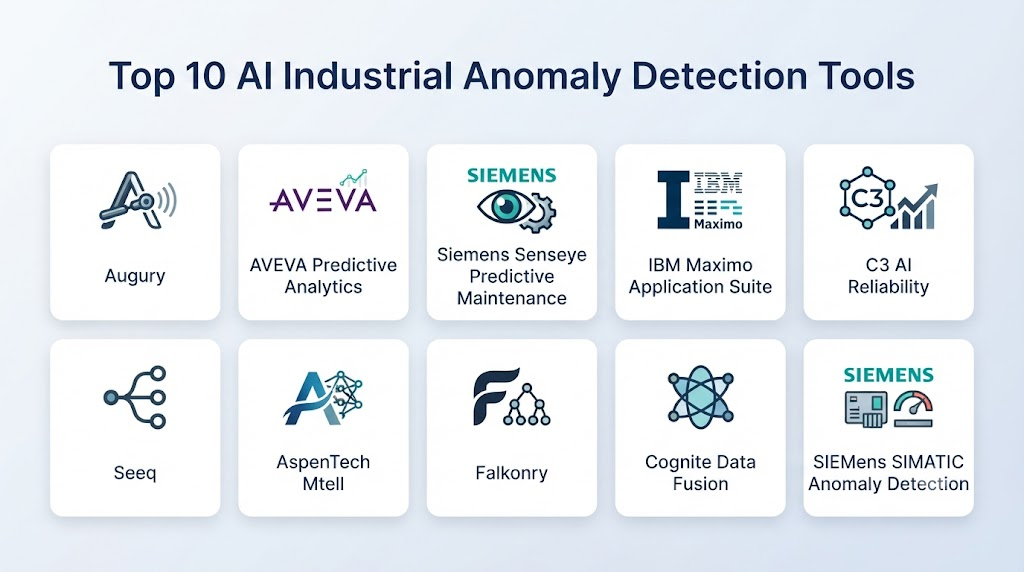
Top 10 AI Industrial Anomaly Detection Tools
1 — Siemens Industrial Edge and Industrial AI
One-line verdict: Best for manufacturers wanting AI anomaly detection integrated closely with industrial automation, edge computing, and factory operations.
Short description:
Siemens provides industrial AI, Industrial Edge, automation, digital-twin, and industrial analytics technologies that can support anomaly detection across manufacturing environments.
Its ecosystem is particularly relevant when anomaly detection needs to connect directly with production equipment, operational data, and industrial workflows.
Standout Capabilities
- Industrial AI.
- Edge analytics.
- Machine monitoring.
- Process monitoring.
- Time-series analysis.
- Digital twins.
- Industrial data processing.
- Production integration.
AI-Specific Depth
- Model support: Machine-learning and AI capabilities vary by solution.
- RAG / knowledge integration: Engineering and operational knowledge can support AI-assisted workflows where configured.
- Evaluation: Historical data, simulation, validation datasets, and production testing.
- Guardrails: Operating limits, engineering rules, permissions, human review, and automation controls.
- Observability: Sensor telemetry, anomaly outputs, process KPIs, edge health, and system diagnostics.
Pros
- Strong industrial ecosystem.
- Excellent fit for edge-based monitoring.
- Can connect anomaly detection with automation systems.
Cons
- Broad product ecosystem can be complex.
- Implementation may require industrial expertise.
- Specific capabilities vary by solution.
Security & Compliance
Security capabilities depend on the products and architecture selected. Specific certifications should be independently verified for the intended deployment.
Deployment & Platforms
- Industrial Edge.
- On-premises.
- Cloud.
- Hybrid.
- Factory environments.
Integrations & Ecosystem
Typical integrations can include:
- PLCs.
- SCADA.
- MES.
- Industrial Edge.
- Sensors.
- Historians.
- Production systems.
Pricing Model
Enterprise/custom pricing. Exact pricing is Not publicly stated.
Best-Fit Scenarios
- Smart factories.
- Multi-machine monitoring.
- Edge anomaly detection.
2 — C3 AI
One-line verdict: Best for large enterprises applying AI across complex industrial assets, processes, and operational data environments.
Short description:
C3 AI provides enterprise AI applications and platform capabilities that can support anomaly detection, predictive maintenance, asset monitoring, and operational analytics.
It is particularly relevant for organizations wanting to combine data from multiple industrial systems rather than monitoring individual sensors in isolation.
Standout Capabilities
- Industrial anomaly detection.
- Predictive analytics.
- Asset monitoring.
- Time-series analysis.
- AI applications.
- Enterprise data integration.
- Predictive maintenance.
- Operational analytics.
AI-Specific Depth
- Model support: Machine-learning and AI models within the platform.
- RAG / knowledge integration: Enterprise operational and maintenance information can support AI workflows.
- Evaluation: Historical-data validation, model testing, and operational performance analysis.
- Guardrails: Enterprise access controls, workflow controls, thresholds, and human review.
- Observability: Model outputs, anomaly scores, asset metrics, application telemetry, and operational KPIs.
Pros
- Designed for enterprise-scale AI.
- Can combine many data sources.
- Strong industrial analytics orientation.
Cons
- Enterprise implementation can be substantial.
- Requires significant data integration.
- May be excessive for small deployments.
Security & Compliance
Security capabilities depend on deployment and configuration. Specific certifications should be independently verified.
Deployment & Platforms
- Cloud.
- Hybrid.
- Enterprise environments.
- Deployment varies by solution.
Integrations & Ecosystem
- IoT platforms.
- Historians.
- MES.
- ERP.
- Data warehouses.
- Maintenance systems.
- APIs.
Pricing Model
Enterprise/custom pricing. Exact pricing is Not publicly stated.
Best-Fit Scenarios
- Large industrial enterprises.
- Multi-site anomaly monitoring.
- Asset-intensive operations.
3 — Augury
One-line verdict: Best for organizations combining machine-health monitoring with AI-based detection of unusual equipment behavior.
Short description:
Augury focuses on machine health and industrial reliability, using machine data and AI to help organizations understand equipment behavior.
Its approach is particularly relevant when anomaly detection is part of a broader machine-health and maintenance strategy.
Standout Capabilities
- Machine health monitoring.
- AI-based anomaly detection.
- Equipment diagnostics.
- Predictive maintenance.
- Machine condition monitoring.
- Asset insights.
- Reliability workflows.
- Industrial monitoring.
AI-Specific Depth
- Model support: Proprietary AI and machine-learning approaches.
- RAG / knowledge integration: Maintenance and machine information can support diagnostic workflows.
- Evaluation: Historical machine data and operational validation.
- Guardrails: Alert thresholds, confidence information, workflow controls, and human review.
- Observability: Machine health indicators, anomaly signals, equipment trends, and alerts.
Pros
- Strong machine-health focus.
- Useful for reliability teams.
- Connects anomaly detection with maintenance workflows.
Cons
- More specialized than general-purpose AI platforms.
- Sensor requirements vary.
- Best suited to equipment-centric applications.
Security & Compliance
Security capabilities depend on deployment and configuration. Specific certifications are Not publicly stated unless independently verified.
Deployment & Platforms
- Industrial environments.
- Cloud-connected.
- Sensor-based deployments.
- Deployment varies.
Integrations & Ecosystem
- Sensors.
- Industrial equipment.
- CMMS.
- Maintenance workflows.
- Production systems.
- APIs.
Pricing Model
Enterprise/custom pricing. Exact pricing is Not publicly stated.
Best-Fit Scenarios
- Machine-health monitoring.
- Reliability programs.
- Predictive maintenance.
4 — Seeq
One-line verdict: Best for process engineers analyzing industrial time-series data to discover unusual operating behavior and process deviations.
Short description:
Seeq provides industrial time-series analytics for process engineers and operations teams.
It can help users investigate historical patterns, compare process behavior, identify unusual events, and develop analytical workflows around industrial data.
Standout Capabilities
- Time-series analytics.
- Process monitoring.
- Pattern recognition.
- Anomaly investigation.
- Trend analysis.
- Industrial data integration.
- Process analytics.
- Collaboration.
AI-Specific Depth
- Model support: Machine learning and advanced analytics capabilities vary.
- RAG / knowledge integration: Process context and engineering information can support analytical workflows.
- Evaluation: Historical time-series analysis and validation against known events.
- Guardrails: User permissions, analytical workflows, operating limits, and human review.
- Observability: Trends, process metrics, analysis outputs, and time-series behavior.
Pros
- Strong process-data analysis.
- Useful for engineering teams.
- Good for investigating complex time-series behavior.
Cons
- Requires process knowledge.
- Not exclusively an AI anomaly-detection product.
- Results depend heavily on data quality.
Security & Compliance
Security capabilities vary by deployment. Specific certifications are Not publicly stated unless independently verified.
Deployment & Platforms
- Cloud.
- On-premises.
- Hybrid.
- Web.
Integrations & Ecosystem
- Historians.
- SCADA.
- DCS.
- MES.
- Databases.
- Data lakes.
- Industrial platforms.
Pricing Model
Enterprise/custom pricing. Exact pricing is Not publicly stated.
Best-Fit Scenarios
- Process anomaly investigation.
- Industrial time-series analytics.
- Process engineering.
5 — Honeywell Forge
One-line verdict: Best for industrial organizations connecting anomaly monitoring with broader operational performance and asset-management workflows.
Short description:
Honeywell Forge provides industrial analytics and performance-management capabilities that can help organizations analyze asset and process data.
Anomaly detection can form part of a larger architecture for monitoring equipment, processes, and operational performance.
Standout Capabilities
- Industrial analytics.
- Asset monitoring.
- Process monitoring.
- Performance management.
- AI-assisted analytics.
- Operational dashboards.
- Predictive insights.
- Industrial data integration.
AI-Specific Depth
- Model support: AI/ML capabilities vary across applications.
- RAG / knowledge integration: Operational and engineering information can support AI workflows.
- Evaluation: Historical analysis, model validation, and production testing.
- Guardrails: Operating constraints, permissions, workflow controls, and human review.
- Observability: Asset KPIs, anomaly outputs, operational metrics, and application telemetry.
Pros
- Strong industrial context.
- Broad operational ecosystem.
- Suitable for large industrial organizations.
Cons
- Broad platform rather than a narrowly focused anomaly product.
- Implementation can be complex.
- Capabilities vary by deployment.
Security & Compliance
Security and compliance capabilities depend on the selected products and deployment. Specific certifications should be independently verified.
Deployment & Platforms
- Cloud.
- Edge.
- Hybrid.
- Enterprise.
Integrations & Ecosystem
- PLCs.
- SCADA.
- Historians.
- MES.
- ERP.
- Sensors.
- Industrial control systems.
Pricing Model
Enterprise/custom pricing. Exact pricing is Not publicly stated.
Best-Fit Scenarios
- Industrial operations.
- Asset monitoring.
- Enterprise anomaly management.
6 — AWS Machine Learning and Industrial IoT Stack
One-line verdict: Best for engineering teams building custom industrial anomaly detection around AWS cloud, IoT, and machine-learning infrastructure.
Short description:
AWS provides cloud, IoT, data, machine-learning, and edge technologies that can be combined to build custom industrial anomaly-detection systems.
This approach is more appropriate for organizations with engineering resources than companies looking for a turnkey industrial anomaly platform.
Standout Capabilities
- Time-series analytics.
- Machine learning.
- IoT data ingestion.
- Edge processing.
- Custom anomaly models.
- Data pipelines.
- Model deployment.
- Monitoring.
AI-Specific Depth
- Model support: Multiple machine-learning approaches and custom models.
- RAG / knowledge integration: Operational documentation and enterprise data can be connected to AI workflows.
- Evaluation: Custom offline evaluation, historical backtesting, and production monitoring.
- Guardrails: Identity controls, permissions, thresholds, application policies, and human approval.
- Observability: Model latency, usage, anomaly results, infrastructure metrics, and application monitoring.
Pros
- Highly customizable.
- Broad cloud and IoT ecosystem.
- Suitable for custom architectures.
Cons
- Requires significant engineering.
- Cloud architecture can become complex.
- Industrial integration must be designed carefully.
Security & Compliance
AWS provides extensive security capabilities, but actual protection depends on the services and architecture selected. Specific certifications should be verified for the intended deployment.
Deployment & Platforms
- Cloud.
- Edge.
- Hybrid.
Integrations & Ecosystem
- IoT devices.
- Data lakes.
- Databases.
- Object storage.
- Edge infrastructure.
- APIs.
- Industrial systems.
Pricing Model
Usage-based cloud pricing can apply depending on selected services. Total cost is Varies / N/A.
Best-Fit Scenarios
- Custom industrial AI.
- AWS-centric organizations.
- Multi-source anomaly detection.
7 — Microsoft Azure Industrial AI Stack
One-line verdict: Best for Microsoft-oriented enterprises building custom anomaly detection across industrial IoT, cloud, edge, and enterprise data.
Short description:
Microsoft’s Azure ecosystem provides cloud AI, IoT, data, analytics, and edge capabilities that can be combined into industrial anomaly-detection applications.
It is particularly useful when anomaly detection must connect with broader enterprise analytics and Microsoft infrastructure.
Standout Capabilities
- Machine learning.
- Time-series analytics.
- IoT connectivity.
- Edge AI.
- Custom anomaly detection.
- Data integration.
- Enterprise analytics.
- AI governance.
AI-Specific Depth
- Model support: Hosted AI services, machine-learning models, and custom models depending on architecture.
- RAG / knowledge integration: Enterprise documentation and operational data can support AI assistants and diagnostic workflows.
- Evaluation: Custom model testing, validation, and production monitoring.
- Guardrails: Identity, access controls, policies, application governance, and human review.
- Observability: Model metrics, latency, application performance, usage, and industrial telemetry.
Pros
- Strong enterprise ecosystem.
- Flexible cloud and edge architecture.
- Useful for custom industrial AI.
Cons
- Requires architecture and development work.
- Not a turnkey anomaly solution by itself.
- Industrial integration can require additional components.
Security & Compliance
Security capabilities depend on the selected Azure services and configuration. Specific certifications should be verified for the intended deployment.
Deployment & Platforms
- Cloud.
- Edge.
- Hybrid.
Integrations & Ecosystem
- IoT.
- Data platforms.
- APIs.
- Enterprise databases.
- MES.
- ERP.
- Industrial devices.
Pricing Model
Usage-based and subscription models vary by service. Exact implementation costs are Not publicly stated.
Best-Fit Scenarios
- Microsoft-centric enterprises.
- Custom industrial analytics.
- Connected factories.
8 — Dataiku
One-line verdict: Best for data-science teams creating customized anomaly-detection models across complex industrial datasets.
Short description:
Dataiku provides a collaborative environment for data preparation, machine learning, model evaluation, governance, and AI application development.
It can be used to create industrial anomaly-detection workflows when organizations have data scientists who need control over modeling and data pipelines.
Standout Capabilities
- Data preparation.
- Machine learning.
- Anomaly detection workflows.
- Time-series modeling.
- Model evaluation.
- Feature engineering.
- AI governance.
- Workflow automation.
AI-Specific Depth
- Model support: Multiple machine-learning methods and custom models.
- RAG / knowledge integration: Enterprise data and knowledge sources can be incorporated into AI workflows.
- Evaluation: Model validation, experimentation, regression testing, and monitoring.
- Guardrails: Governance, permissions, model controls, and workflow policies.
- Observability: Model metrics, data quality, usage, performance, and operational monitoring.
Pros
- Flexible modeling environment.
- Strong governance capabilities.
- Useful for custom industrial analytics.
Cons
- Requires data-science expertise.
- Not a dedicated industrial control system.
- Deployment requires integration with operational infrastructure.
Security & Compliance
Security depends on deployment. Specific certifications should be independently verified for the intended environment.
Deployment & Platforms
- Cloud.
- On-premises.
- Hybrid.
- Enterprise.
Integrations & Ecosystem
- Databases.
- Data warehouses.
- Historians.
- APIs.
- MES.
- ERP.
- IoT platforms.
Pricing Model
Enterprise/custom pricing. Exact pricing is Not publicly stated.
Best-Fit Scenarios
- Custom anomaly models.
- Industrial data-science teams.
- Multi-source analytics.
9 — MATLAB and Simulink
One-line verdict: Best for engineering teams developing customized anomaly-detection algorithms alongside simulations, models, and control systems.
Short description:
MATLAB and Simulink provide engineering environments for mathematical modeling, machine learning, signal processing, simulation, and control development.
They can support industrial anomaly detection when engineers need to combine signal analysis, physical models, machine learning, and simulation.
Standout Capabilities
- Signal processing.
- Machine learning.
- Deep learning.
- Time-series analysis.
- System modeling.
- Simulation.
- Fault detection.
- Control development.
AI-Specific Depth
- Model support: Machine learning, deep learning, statistical methods, signal-processing algorithms, and engineering models.
- RAG / knowledge integration: N/A for core anomaly detection.
- Evaluation: Simulation, cross-validation, historical datasets, and engineering testing.
- Guardrails: Operating constraints, engineering rules, signal validation, and human review.
- Observability: Model outputs, signal characteristics, simulation results, and application metrics.
Pros
- Excellent engineering flexibility.
- Strong signal-processing capabilities.
- Supports physics-plus-AI approaches.
Cons
- Requires technical expertise.
- Industrial deployment may need additional engineering.
- Not a turnkey anomaly-monitoring platform.
Security & Compliance
Specific certifications are Not publicly stated unless independently verified.
Deployment & Platforms
- Windows.
- macOS.
- Linux.
- Cloud and deployment options vary.
Integrations & Ecosystem
- Python.
- C/C++.
- Simulink.
- PLCs.
- Databases.
- Engineering systems.
- Industrial platforms.
Pricing Model
Commercial licensing. Exact pricing is Not publicly stated.
Best-Fit Scenarios
- Engineering-led anomaly detection.
- Signal analysis.
- Custom fault detection.
10 — Custom AI Industrial Anomaly Detection Platform
One-line verdict: Best for enterprises with proprietary assets, unusual operating conditions, or highly specialized anomaly-detection requirements.
Short description:
A custom platform can combine time-series machine learning, deep learning, signal processing, digital twins, statistical process control, physics-based models, and real-time industrial telemetry.
This approach gives organizations control over model design, data architecture, deployment location, alert logic, and integration with existing operational systems.
Standout Capabilities
- Multivariate anomaly detection.
- Time-series modeling.
- Autoencoders.
- Isolation-based methods.
- Forecasting-based anomaly detection.
- Digital twins.
- Physics-informed models.
- Real-time edge inference.
AI-Specific Depth
- Model support: Statistical models, tree-based models, neural networks, autoencoders, transformers, forecasting models, and custom algorithms.
- RAG / knowledge integration: Maintenance manuals, equipment documentation, operating procedures, engineering standards, and incident histories.
- Evaluation: Precision, recall, false-alert rate, detection delay, false negatives, time-to-detection, and event-level evaluation.
- Guardrails: Confidence thresholds, rule-based validation, safety boundaries, human escalation, and model fallback.
- Observability: Anomaly scores, model drift, sensor quality, inference latency, alert volume, false-alert rates, and system health.
Pros
- Maximum customization.
- Can combine multiple modeling approaches.
- Supports proprietary industrial processes.
Cons
- High engineering requirements.
- Requires long-term model maintenance.
- Sensor and data engineering become internal responsibilities.
Security & Compliance
Organizations can implement:
- SSO.
- RBAC.
- Encryption.
- Audit logs.
- Data-retention controls.
- Network isolation.
- Edge-only processing.
- Model version control.
Specific certifications are Not publicly stated for a generic implementation.
Deployment & Platforms
- Cloud.
- Self-hosted.
- Edge.
- Hybrid.
- Industrial PCs.
Integrations & Ecosystem
Potential integrations include:
- PLCs.
- SCADA.
- Historians.
- MES.
- CMMS.
- ERP.
- IoT platforms.
Pricing Model
Custom development and infrastructure. Exact pricing is N/A.
Best-Fit Scenarios
- Proprietary industrial processes.
- Large-scale anomaly monitoring.
- Complex multi-sensor environments.
Comparison Table
| Tool | Best For | Deployment | Model Flexibility | Strength | Watch-Out | Public Rating |
|---|---|---|---|---|---|---|
| Siemens Industrial AI | Smart factories | Edge / Cloud / Hybrid | AI + Analytics | Industrial integration | Complex ecosystem | |
| C3 AI | Enterprise industrial AI | Cloud / Hybrid | AI/ML | Large-scale analytics | Implementation effort | |
| Augury | Machine health | Cloud / Industrial | Proprietary AI | Equipment monitoring | Equipment-focused | |
| Seeq | Process analytics | Cloud / Hybrid | ML / Analytics | Time-series analysis | Requires process expertise | |
| Honeywell Forge | Industrial operations | Cloud / Edge / Hybrid | AI / Analytics | Operational context | Broad platform | |
| AWS Industrial AI Stack | Custom industrial AI | Cloud / Edge | Multi-model | Flexible infrastructure | Requires engineering | |
| Azure Industrial AI Stack | Enterprise AI | Cloud / Edge / Hybrid | Multi-model | Microsoft ecosystem | Development required | |
| Dataiku | Data-science teams | Cloud / Hybrid | Multi-model | Governance + flexibility | Technical expertise | |
| MATLAB/Simulink | Engineering teams | Desktop / Cloud | ML + Models | Signal processing | Complex for non-engineers | |
| Custom AI Platform | Proprietary systems | Cloud / Edge / Hybrid | Multi-model | Maximum flexibility | High engineering burden |
Scoring & Evaluation
These scores are comparative editorial assessments rather than official vendor ratings.
Industrial anomaly detection should be evaluated using actual operating data and known historical events. Accuracy alone is not sufficient.
A useful evaluation should consider whether the system detects meaningful events early while avoiding excessive false alerts.
| Tool | Core Features | AI Reliability | Anomaly Detection | Integrations | Ease | Performance/Cost | Security/Admin | Support | Weighted Total |
|---|---|---|---|---|---|---|---|---|---|
| Siemens Industrial AI | 10 | 9 | 10 | 10 | 7 | 9 | 10 | 10 | 9.35 |
| C3 AI | 10 | 10 | 10 | 10 | 7 | 8 | 10 | 9 | 9.45 |
| Augury | 9 | 10 | 10 | 9 | 8 | 8 | 9 | 9 | 9.15 |
| Seeq | 9 | 9 | 9 | 9 | 8 | 9 | 9 | 9 | 8.95 |
| Honeywell Forge | 9 | 9 | 9 | 10 | 7 | 8 | 10 | 10 | 9.05 |
| AWS Industrial AI Stack | 9 | 9 | 9 | 10 | 7 | 8 | 10 | 10 | 9.00 |
| Azure Industrial AI Stack | 9 | 9 | 9 | 10 | 7 | 8 | 10 | 10 | 9.00 |
| Dataiku | 9 | 10 | 9 | 10 | 7 | 8 | 10 | 9 | 9.05 |
| MATLAB/Simulink | 10 | 10 | 9 | 9 | 6 | 9 | 9 | 10 | 9.10 |
| Custom AI Platform | 10 | 10 | 10 | 10 | 5 | 7 | 10 | 10 | 9.40 |
Top 3 for Enterprise
- C3 AI — Strong for large-scale industrial AI and multi-source anomaly detection.
- Siemens Industrial AI — Excellent where edge processing and automation integration matter.
- Custom AI Platform — Best when anomaly detection is strategically important and highly specialized.
Top 3 for SMB
- Augury — Strong fit for equipment-focused monitoring.
- Seeq — Useful for process engineers working with time-series data.
- Dataiku — Appropriate for SMBs with established data-science capabilities.
Top 3 for Developers
- MATLAB/Simulink — Strong engineering and signal-processing capabilities.
- Custom AI Platform — Maximum technical control.
- AWS Industrial AI Stack — Broad infrastructure for custom implementations.
Which AI Industrial Anomaly Detection Tool Is Right for You?
Solo / Small Manufacturer
Start with a single machine or process.
Good candidates include:
- A critical pump.
- A compressor.
- A CNC machine.
- A production motor.
- A high-value production line.
Do not begin by monitoring hundreds of sensors.
The goal should be to demonstrate that anomaly detection can identify meaningful changes without overwhelming operators with false alerts.
SMB
SMBs should prioritize:
- Fast deployment.
- Existing sensor compatibility.
- Simple dashboards.
- Useful alerts.
- Low maintenance.
- Integration with maintenance workflows.
A specialized machine-health platform may be more practical than building a complete AI platform from scratch.
Mid-Market
Mid-market organizations can monitor multiple assets and production processes.
Important capabilities include:
- Centralized anomaly management.
- Asset comparisons.
- Historical analysis.
- Alert prioritization.
- Maintenance integration.
- Model monitoring.
- Data-quality monitoring.
Enterprise
Enterprise organizations should treat anomaly detection as an operational intelligence layer.
A typical architecture can look like:
Sensors → Edge → Historian → Data platform → AI models → Anomaly scoring → Alert management → CMMS/MES → Engineering investigation
Enterprise requirements should include:
- Model lifecycle management.
- Multi-site monitoring.
- Dataset governance.
- Alert governance.
- Role-based access.
- Audit trails.
- Data lineage.
- Cybersecurity.
- Model drift monitoring.
Asset-Intensive Manufacturing
Focus on:
- Motors.
- Pumps.
- Compressors.
- Fans.
- Gearboxes.
- Conveyors.
- Hydraulic systems.
Machine-health anomaly detection can help prioritize equipment requiring investigation.
Process Manufacturing
Process plants often need multivariate anomaly detection.
A single variable may remain within normal limits while the relationship between multiple variables changes.
Useful signals include:
- Temperature.
- Pressure.
- Flow.
- Level.
- Composition.
- Energy consumption.
Automotive Manufacturing
Anomaly detection can monitor:
- Robots.
- Welding systems.
- Paint systems.
- Conveyors.
- Presses.
- Assembly equipment.
The goal may be early detection of process or equipment behavior that could affect production quality.
Electronics Manufacturing
Electronics factories can use anomaly detection across:
- Assembly equipment.
- Test stations.
- Environmental conditions.
- Production yields.
- Machine states.
Correlating machine behavior with quality outcomes can help identify emerging process problems.
Energy and Utilities
Anomaly detection can support monitoring of:
- Turbines.
- Generators.
- Pumps.
- Transformers.
- Cooling systems.
- Energy consumption.
High-quality sensor data and domain expertise are particularly important.
Budget vs Premium
A lower-cost implementation may use:
- Existing sensors.
- Historical data.
- Statistical methods.
- Simple machine-learning models.
- Edge computing.
Premium implementations may add:
- Multivariate deep learning.
- Digital twins.
- Automated root-cause analysis.
- Multi-site monitoring.
- Real-time model retraining.
- Advanced visualization.
- AI engineering assistants.
Build vs Buy
Buy when:
- Your use case is common.
- You want faster deployment.
- You lack data-science resources.
- Existing integrations are available.
Build when:
- Your assets are highly specialized.
- Existing products cannot represent your operating conditions.
- You require proprietary anomaly algorithms.
- Anomaly detection is strategically important.
A hybrid approach can be effective:
Industrial data platform + specialized anomaly model + existing maintenance system
Implementation Playbook
First 30 Days: Define Normal
The first step is not model training.
It is defining what normal operation actually means.
Collect:
- Sensor data.
- Machine states.
- Production schedules.
- Operating modes.
- Maintenance events.
- Quality outcomes.
- Environmental information.
Separate different operating modes when necessary.
A machine may behave differently during:
- Startup.
- Shutdown.
- Idle.
- Normal production.
- High-load operation.
- Cleaning.
- Maintenance.
A model that treats all of these states as one normal distribution may generate unnecessary alerts.
Days 31–60: Build and Evaluate
Create a baseline anomaly-detection approach.
Test:
- Statistical methods.
- Isolation-based algorithms.
- Autoencoders.
- Forecasting models.
- Time-series models.
- Multivariate models.
Evaluate using known historical events where possible.
Important metrics include:
- Detection rate.
- False-alert rate.
- Detection delay.
- False negatives.
- Alert frequency.
- Time-to-investigation.
- Event-level precision.
Test Edge Cases
Evaluate:
- Sensor failures.
- Missing data.
- Startup conditions.
- Shutdown conditions.
- Maintenance events.
- Product changes.
- Seasonal variation.
- Environmental changes.
Days 61–90: Deploy With Human Review
Start with alerts only.
Do not automatically shut down machines based solely on an early-stage AI model.
Create a workflow:
Anomaly → Alert → Engineer review → Root-cause investigation → Action → Outcome feedback
Then measure whether alerts actually lead to useful interventions.
Over time, reduce false alerts and improve prioritization.
Common Mistakes and How to Avoid Them
- Confusing anomaly detection with failure prediction: An unusual signal does not automatically mean equipment failure is imminent.
- Ignoring operating modes: Startup and shutdown behavior can look anomalous if the model does not understand machine state.
- Poor sensor quality: AI cannot compensate for unreliable measurements.
- Too many false alerts: Operators quickly stop trusting systems that generate excessive alarms.
- No baseline: The system needs a meaningful definition of normal operation.
- Ignoring multivariate relationships: Important anomalies may only become visible when multiple signals are analyzed together.
- Ignoring missing data: Sensor outages can look like process anomalies.
- Training on abnormal data: A contaminated baseline can teach the model that abnormal behavior is normal.
- Ignoring maintenance events: Repairs and replacements can change machine behavior.
- No feedback loop: Engineering investigations should inform future model improvements.
- Automating too early: Human review should generally precede automatic operational actions.
- Ignoring model drift: Equipment and production conditions evolve.
- No alert prioritization: Not every anomaly deserves the same response.
- Ignoring latency: Real-time monitoring requires models and infrastructure capable of responding quickly enough.
- Ignoring cybersecurity: Connected industrial systems create additional attack surfaces.
- No model versioning: Changes to models should be traceable.
- Ignoring business impact: The most statistically unusual event is not necessarily the most important operational problem.
- No root-cause workflow: Detecting anomalies is only useful if teams can investigate and act on them.
- Using one model for everything: Different assets and operating modes may require different models.
- Ignoring uncertainty: Operators should understand how confident the system is in an anomaly signal.
FAQs
What is AI industrial anomaly detection?
It is the use of AI and machine learning to identify unusual patterns in industrial equipment, sensor data, processes, or production operations.
How is anomaly detection different from predictive maintenance?
Anomaly detection identifies behavior that differs from expected normal behavior.
Predictive maintenance attempts to estimate future equipment condition, degradation, or failure risk.
Anomaly detection can be one input into a predictive-maintenance system.
What data does anomaly detection need?
Common inputs include:
- Temperature.
- Vibration.
- Pressure.
- Flow.
- Current.
- Speed.
- Power consumption.
- Machine states.
- Production information.
Does anomaly detection require labeled failures?
Not always.
Many anomaly-detection approaches can learn primarily from normal operating data.
This is useful because confirmed failure events are often relatively rare.
What is multivariate anomaly detection?
Multivariate anomaly detection analyzes multiple variables simultaneously.
This allows the system to identify unusual relationships among signals rather than examining each sensor independently.
What is time-series anomaly detection?
It analyzes data collected over time and identifies unexpected changes in patterns, trends, seasonality, or relationships.
Can AI detect machine failures?
AI can help identify patterns associated with abnormal equipment behavior, but anomaly detection alone should not be interpreted as a guaranteed failure prediction.
Can anomaly detection run at the edge?
Yes.
Edge processing can reduce latency and keep sensitive operational data closer to the production environment.
Does industrial anomaly detection require cloud computing?
No.
Systems can be deployed in cloud, on-premises, edge, or hybrid architectures depending on operational and security requirements.
Can anomaly detection integrate with PLCs?
Yes.
Anomaly results can be connected to industrial automation systems, although automatic control actions should be implemented only after appropriate validation.
Can anomaly detection integrate with CMMS?
Yes.
Alerts can potentially be connected to maintenance workflows so engineers can investigate equipment anomalies and record outcomes.
Can AI detect process anomalies?
Yes.
AI can analyze relationships among temperature, pressure, flow, speed, energy consumption, and other process variables.
What is an anomaly score?
An anomaly score represents how different an observation is from expected behavior.
The interpretation of the score depends on the model and implementation.
How should anomaly detection be evaluated?
Important measures include detection rate, false-alert rate, false negatives, detection delay, alert frequency, and usefulness to maintenance or engineering teams.
What is the biggest problem with industrial anomaly detection?
False alerts are one of the biggest practical challenges.
A technically sensitive model may detect many statistically unusual events that have little operational importance.
Can anomaly detection reduce downtime?
It can help identify unusual equipment behavior earlier, potentially allowing engineers to investigate problems before they cause major interruptions.
The actual benefit depends on detection quality and the organization’s response process.
Can LLMs perform industrial anomaly detection?
LLMs are generally not the primary model for high-frequency industrial sensor analysis.
Specialized time-series, statistical, and machine-learning models are typically better suited to anomaly detection.
LLMs can complement these systems by explaining anomalies and retrieving relevant engineering documentation.
What is RAG in industrial anomaly detection?
RAG can connect an AI assistant to maintenance manuals, equipment documentation, operating procedures, historical incidents, and troubleshooting information.
For example, an AI assistant could summarize an anomaly and retrieve relevant troubleshooting guidance.
How can AI explain an anomaly?
A well-designed system can show:
- Which variables changed.
- When the change began.
- How unusual the behavior is.
- Which assets are affected.
- Relevant historical events.
- Possible contributing factors.
The explanation should be treated as decision support rather than unquestionable root-cause truth.
How much do industrial anomaly-detection platforms cost?
Costs vary based on sensors, data infrastructure, software, number of assets, deployment architecture, integrations, and support.
Exact enterprise pricing is often Not publicly stated.
What is the biggest benefit of AI anomaly detection?
The primary benefit is the ability to continuously analyze large volumes of industrial data and highlight unusual behavior that human teams might otherwise miss.
What is the biggest limitation?
AI needs reliable data and a meaningful definition of normal operation.
Changing production conditions, sensor problems, equipment modifications, and operating-mode differences can all reduce model reliability.
Conclusion
AI Industrial Anomaly Detection can help manufacturers move from reactive monitoring toward continuous, data-driven operational awareness.The technology can analyze large volumes of sensor and process information to identify unusual patterns across equipment and production environments.platforms address different requirements.Custom development provides the greatest flexibility but also creates the greatest responsibility for data engineering, model management, security, monitoring, and long-term maintenance.