Introduction
AI LIMS Optimization Tools use artificial intelligence, machine learning, automation, natural-language processing, and data analytics to improve how laboratory information management systems operate.A LIMS can manage samples, test results, workflows, instruments, users, inventory, quality records, and laboratory data. AI optimization adds another layer by helping laboratories identify bottlenecks, automate repetitive activities, improve data quality, predict workload, detect anomalies, and connect information across laboratory processes.The goal is not simply to add an AI chatbot to a LIMS. A well-designed AI optimization strategy should make laboratory operations more efficient while preserving data integrity, traceability, security, and human oversight.
What Is AI LIMS Optimization?
AI LIMS optimization is the use of AI and advanced analytics to improve laboratory information management processes.
A conventional LIMS primarily records and manages laboratory information.
AI optimization can help analyze that information to identify patterns and make operational recommendations.
Potential applications include:
- Workflow optimization.
- Sample-routing optimization.
- Instrument utilization.
- Workload forecasting.
- Turnaround-time prediction.
- Inventory forecasting.
- Data-quality monitoring.
- Anomaly detection.
- Result review assistance.
- Automated data classification.
- Natural-language laboratory search.
- Predictive maintenance.
- Resource scheduling.
A typical architecture may look like:
The AI layer should remain connected to the authoritative laboratory record rather than creating disconnected copies of critical information.
Why AI LIMS Optimization Matters
Laboratories often operate complicated workflows involving multiple instruments, sample types, analysts, departments, and quality requirements.
Operational inefficiencies can appear as:
- Sample-processing delays.
- Instrument bottlenecks.
- Manual data entry.
- Repeated testing.
- Inventory shortages.
- Poor workload distribution.
- Long turnaround times.
- Inconsistent data.
- Unused instrument capacity.
AI can analyze historical operational information to help identify these problems.
For example, a laboratory could use predictive analytics to estimate expected sample volume and determine whether additional instrument capacity or staffing may be required.
AI can also help identify unusual workflow behavior.
However, AI optimization should not compromise laboratory quality.
Critical decisions involving test results, sample identity, release decisions, quality events, or regulated records should remain governed by appropriate laboratory procedures and qualified personnel.
Key Use Cases
Sample Workflow Optimization
Predict bottlenecks and recommend more efficient sample-routing strategies.
Turnaround-Time Prediction
Estimate how long samples may take to complete based on historical workflow data.
Instrument Utilization
Identify underused or overloaded instruments.
Predictive Maintenance
Use operational information to identify potential equipment-maintenance needs.
Inventory Optimization
Forecast consumption and identify potential stock shortages.
Workforce Planning
Estimate workload and help laboratories plan staffing.
Data Quality Monitoring
Detect missing, inconsistent, duplicated, or unusual laboratory data.
Automated Data Entry
Extract structured information from documents and instrument outputs.
Workflow Automation
Automate repetitive administrative tasks around sample and result management.
Anomaly Detection
Identify unusual laboratory or operational patterns.
Natural-Language Search
Allow users to ask questions about permitted laboratory information using natural language.
Quality Management
Help identify recurring workflow deviations and quality trends.
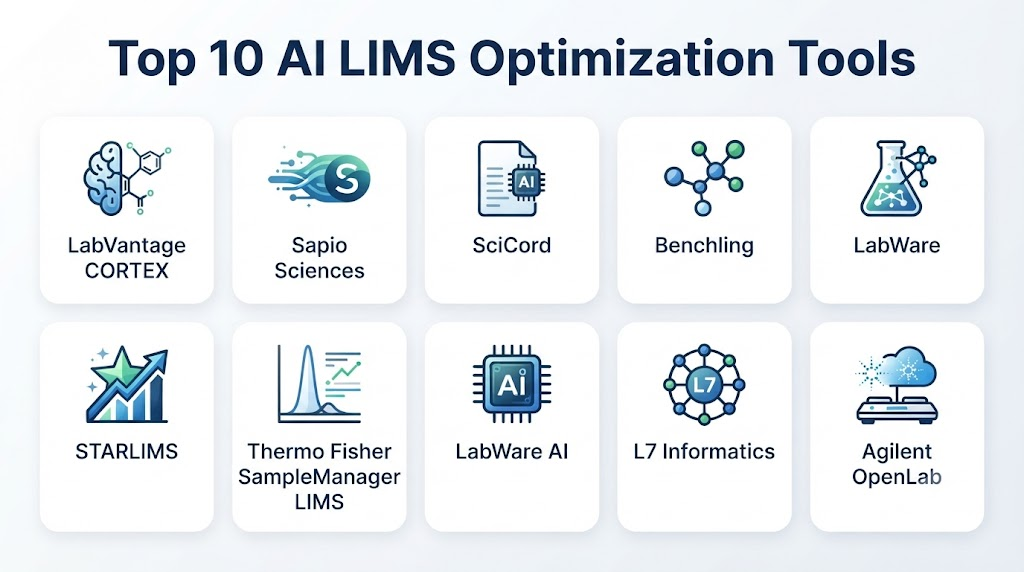
Top 10 AI LIMS Optimization Tools
1 — LabVantage LIMS
One-line verdict: Best for enterprise laboratories seeking a broad LIMS foundation that can support automation, analytics, and AI-assisted optimization.
Short description:
LabVantage provides a comprehensive laboratory information management environment for managing samples, workflows, instruments, results, and laboratory operations.
Its broad platform architecture makes it relevant to organizations looking to combine LIMS functionality with automation and analytical capabilities.
Standout Capabilities
- Sample management.
- Laboratory workflow management.
- Instrument integration.
- Result management.
- Inventory management.
- Workflow automation.
- Reporting and analytics.
- Enterprise laboratory operations.
AI-Specific Depth
- Model support: AI and advanced analytics capabilities vary by product and implementation.
- RAG / knowledge integration: Enterprise laboratory data can provide context for AI workflows where supported.
- Evaluation: AI outputs should be evaluated using laboratory-specific benchmark datasets.
- Guardrails: Role-based access, workflow controls, approvals, and human review.
- Observability: Laboratory KPIs, workflow metrics, turnaround times, and operational analytics.
Pros
- Broad LIMS functionality.
- Suitable for complex laboratories.
- Strong integration potential.
Cons
- Enterprise implementation can be complex.
- AI functionality varies by configuration.
- Requires careful workflow design.
Security & Compliance
Security and compliance controls depend on the applicable deployment and configuration. Specific certifications should be independently verified rather than assumed.
Deployment & Platforms
- Cloud.
- Enterprise.
- Web.
- Deployment options vary.
Integrations & Ecosystem
Potential integrations include:
- Laboratory instruments.
- ELN systems.
- ERP platforms.
- Data warehouses.
- APIs.
- Scientific databases.
- Automation systems.
Pricing Model
Enterprise/custom pricing. Exact pricing is Not publicly stated.
Best-Fit Scenarios
- Enterprise laboratories.
- Pharmaceutical QC.
- Complex laboratory operations.
2 — Thermo Fisher SampleManager LIMS
One-line verdict: Best for large laboratories needing integrated sample management, instrument connectivity, workflow automation, and laboratory data management.
Short description:
Thermo Fisher Scientific’s SampleManager LIMS is designed to manage laboratory workflows, samples, results, instruments, and associated information.
It is particularly relevant to organizations operating complex laboratory environments with extensive instrumentation and data requirements.
Standout Capabilities
- Sample management.
- Laboratory workflow automation.
- Instrument integration.
- Result management.
- Laboratory scheduling.
- Data management.
- Reporting.
- Enterprise laboratory operations.
AI-Specific Depth
- Model support: AI and analytics capabilities vary by implementation and connected solutions.
- RAG / knowledge integration: Laboratory information can support AI workflows where integrated.
- Evaluation: Organization-specific testing is required for AI-generated outputs.
- Guardrails: Workflow approvals, permissions, auditability, and human review.
- Observability: Laboratory performance and workflow analytics.
Pros
- Strong enterprise laboratory foundation.
- Extensive instrument ecosystem.
- Suitable for complex operations.
Cons
- Enterprise implementation may be substantial.
- AI is not the sole focus.
- Costs and capabilities vary by deployment.
Security & Compliance
Security and compliance depend on the specific implementation. Applicable certifications should be verified for the relevant environment.
Deployment & Platforms
- Cloud.
- Enterprise.
- Web.
- Hybrid options vary.
Integrations & Ecosystem
- Laboratory instruments.
- ERP.
- ELN.
- Scientific equipment.
- Data platforms.
- APIs.
- Enterprise systems.
Pricing Model
Enterprise/custom pricing. Exact pricing is Not publicly stated.
Best-Fit Scenarios
- Pharmaceutical laboratories.
- Industrial laboratories.
- Large QC operations.
3 — STARLIMS
One-line verdict: Best for organizations needing configurable laboratory information management across regulated and complex laboratory environments.
Short description:
STARLIMS provides laboratory information management capabilities covering sample workflows, laboratory operations, results, instruments, and data.
Its configurable architecture can support organizations looking to introduce analytics and automation around laboratory processes.
Standout Capabilities
- Sample tracking.
- Laboratory workflows.
- Instrument integration.
- Results management.
- Quality workflows.
- Reporting.
- Data management.
- Enterprise configuration.
AI-Specific Depth
- Model support: AI and analytics vary by product and deployment.
- RAG / knowledge integration: Laboratory records and connected data sources can support AI workflows.
- Evaluation: AI functionality should be validated against laboratory-specific requirements.
- Guardrails: Permissions, approvals, workflow controls, and audit mechanisms.
- Observability: Operational analytics and workflow performance.
Pros
- Configurable laboratory workflows.
- Broad LIMS capabilities.
- Suitable for enterprise use.
Cons
- Configuration can be complex.
- AI capabilities vary.
- Implementation requires careful planning.
Security & Compliance
Security and compliance capabilities vary by deployment. Specific certifications are Not publicly stated unless verified for the applicable service.
Deployment & Platforms
- Cloud.
- Enterprise.
- Web.
- Hybrid capabilities vary.
Integrations & Ecosystem
- Instruments.
- ERP.
- ELN.
- APIs.
- Data warehouses.
- Scientific systems.
Pricing Model
Enterprise/custom pricing. Exact pricing is Not publicly stated.
Best-Fit Scenarios
- Regulated laboratories.
- Enterprise sample management.
- Complex laboratory workflows.
4 — Benchling
One-line verdict: Best for biotechnology R&D teams combining laboratory data, workflows, scientific collaboration, and AI-assisted research operations.
Short description:
Benchling provides a cloud-based R&D environment that brings together scientific data, workflows, inventory, and collaboration.
Although it is broader than a traditional LIMS, its data-centric architecture can support laboratory optimization and AI-enabled research workflows.
Standout Capabilities
- Scientific data management.
- Inventory management.
- Workflow support.
- Molecular biology data.
- Collaboration.
- Structured research data.
- Automation.
- API ecosystem.
AI-Specific Depth
- Model support: AI capabilities vary across the platform and connected applications.
- RAG / knowledge integration: Structured scientific data can support contextual AI workflows.
- Evaluation: AI outputs should be validated against laboratory data and expert-reviewed benchmarks.
- Guardrails: Permissions, structured workflows, and enterprise administration.
- Observability: Workflow and operational analytics vary by implementation.
Pros
- Strong biotech R&D focus.
- Modern cloud architecture.
- Useful scientific-data foundation.
Cons
- Not a traditional LIMS in every workflow.
- AI capabilities vary.
- May require integration with other laboratory systems.
Security & Compliance
Security and compliance capabilities depend on the applicable product and customer configuration. Specific certifications should be independently verified.
Deployment & Platforms
- Cloud.
- Web.
- Enterprise.
Integrations & Ecosystem
- Laboratory instruments.
- Scientific applications.
- APIs.
- Automation.
- Data platforms.
- R&D systems.
Pricing Model
Enterprise/custom pricing. Exact pricing is Not publicly stated.
Best-Fit Scenarios
- Biotechnology R&D.
- Research laboratories.
- Connected scientific-data workflows.
5 — LabWare LIMS
One-line verdict: Best for laboratories requiring mature LIMS capabilities with extensive workflow configuration and integration possibilities.
Short description:
LabWare LIMS supports laboratory information management, sample tracking, workflows, results, quality processes, and integrations.
Its broad configurability makes it suitable for organizations wanting to build advanced optimization workflows around an established laboratory information platform.
Standout Capabilities
- Sample tracking.
- Workflow management.
- Result management.
- Instrument connectivity.
- Quality workflows.
- Reporting.
- Laboratory automation.
- Enterprise data management.
AI-Specific Depth
- Model support: AI capabilities depend on integrations and implementation.
- RAG / knowledge integration: Can be built around laboratory data and connected knowledge sources.
- Evaluation: Custom AI validation required.
- Guardrails: Workflow controls, permissions, review processes, and auditability.
- Observability: Laboratory KPIs and workflow analytics.
Pros
- Highly configurable.
- Broad laboratory functionality.
- Strong integration potential.
Cons
- Configuration can require specialist expertise.
- AI may require external components.
- User experience depends on implementation.
Security & Compliance
Security capabilities vary by deployment. Specific certifications are Not publicly stated unless independently verified.
Deployment & Platforms
- Cloud.
- On-premises.
- Hybrid.
- Enterprise.
Integrations & Ecosystem
- Laboratory instruments.
- ERP systems.
- ELN.
- APIs.
- Data warehouses.
- Automation platforms.
Pricing Model
Enterprise/custom pricing. Exact pricing is Not publicly stated.
Best-Fit Scenarios
- Large laboratories.
- Regulated environments.
- Complex workflows.
6 — Labguru
One-line verdict: Best for research laboratories seeking integrated sample, inventory, experiment, and laboratory-management capabilities.
Short description:
Labguru provides laboratory-management capabilities designed around research workflows, including experiment information, inventory, samples, and collaboration.
It can provide a useful data foundation for laboratories exploring AI-assisted workflow optimization.
Standout Capabilities
- Inventory management.
- Sample management.
- Research documentation.
- Experiment management.
- Collaboration.
- Laboratory workflows.
- Data organization.
- Research operations.
AI-Specific Depth
- Model support: AI capabilities vary by product and connected workflows.
- RAG / knowledge integration: Laboratory records and research information can support AI workflows.
- Evaluation: AI outputs should be evaluated against verified laboratory records.
- Guardrails: User permissions and workflow controls.
- Observability: Operational and research workflow metrics vary.
Pros
- Research-oriented.
- Integrated laboratory information.
- Useful for smaller and growing laboratories.
Cons
- Not designed for every large-scale LIMS environment.
- AI capabilities vary.
- Complex enterprise integrations may require additional work.
Security & Compliance
Specific security certifications are Not publicly stated unless verified for the applicable deployment.
Deployment & Platforms
- Cloud.
- Web.
- Enterprise.
Integrations & Ecosystem
- Research workflows.
- Laboratory instruments.
- APIs.
- Inventory systems.
- Scientific applications.
Pricing Model
Tiered and enterprise pricing may vary. Exact pricing is Not publicly stated.
Best-Fit Scenarios
- Academic laboratories.
- Biotechnology research.
- Growing research teams.
7 — RSpace
One-line verdict: Best for research organizations connecting electronic laboratory documentation with structured scientific information and workflow automation.
Short description:
RSpace is primarily an electronic laboratory notebook and research-data platform rather than a traditional LIMS.
It can nevertheless participate in AI-enabled laboratory optimization by providing structured research information and integrations with laboratory systems.
Standout Capabilities
- Electronic laboratory notebooks.
- Research documentation.
- Structured experimental information.
- Collaboration.
- Data management.
- Integrations.
- Workflow support.
- Research traceability.
AI-Specific Depth
- Model support: AI capabilities vary by implementation and integrations.
- RAG / knowledge integration: Research records can provide context for connected AI workflows.
- Evaluation: AI outputs require researcher verification.
- Guardrails: Access permissions and structured documentation workflows.
- Observability: Workflow and system activity can be monitored.
Pros
- Strong research documentation.
- Useful data foundation.
- Integration-oriented architecture.
Cons
- Not a complete traditional LIMS.
- AI optimization often requires integrations.
- More focused on research documentation.
Security & Compliance
Specific security certifications are Not publicly stated unless verified for the relevant deployment.
Deployment & Platforms
- Cloud.
- Self-hosted options may vary.
- Web.
Integrations & Ecosystem
- LIMS.
- Instruments.
- Research software.
- APIs.
- Data platforms.
- Laboratory automation.
Pricing Model
Commercial/custom pricing. Exact pricing is Not publicly stated.
Best-Fit Scenarios
- Research laboratories.
- ELN-LIMS integration.
- Scientific knowledge management.
8 — Lab Automation + LIMS AI Orchestration Stack
One-line verdict: Best for laboratories integrating robotic instruments, LIMS workflows, scheduling engines, and AI-driven operational optimization.
Short description:
An AI orchestration stack connects LIMS data with laboratory automation systems, robotics, scheduling tools, analytics, and AI models.
Rather than replacing the LIMS, this architecture adds an intelligence layer for optimizing laboratory operations.
Standout Capabilities
- Workflow orchestration.
- Robot scheduling.
- Sample routing.
- Instrument utilization.
- Predictive analytics.
- Automated task assignment.
- Anomaly detection.
- Resource optimization.
AI-Specific Depth
- Model support: Machine learning, optimization models, forecasting models, and LLMs depending on implementation.
- RAG / knowledge integration: LIMS records, SOPs, instrument data, inventory, and laboratory knowledge.
- Evaluation: Historical workflow backtesting and operational KPI comparison.
- Guardrails: Approval gates, permissions, workflow constraints, and human override.
- Observability: Job queues, latency, throughput, failures, resource utilization, and model metrics.
Pros
- Highly flexible.
- Excellent for automated laboratories.
- Can optimize multiple systems simultaneously.
Cons
- Complex architecture.
- Requires integration engineering.
- Maintenance can be significant.
Security & Compliance
Security depends on the implementation. Organizations can apply encryption, RBAC, SSO, audit logging, retention controls, and network isolation.
Specific certifications are Not publicly stated for a generic implementation.
Deployment & Platforms
- Cloud.
- Self-hosted.
- Hybrid.
- Laboratory networks.
Integrations & Ecosystem
- LIMS.
- ELN.
- Laboratory robots.
- Instruments.
- APIs.
- Data warehouses.
- AI platforms.
Pricing Model
Custom infrastructure and software costs. Exact pricing is N/A.
Best-Fit Scenarios
- Automated laboratories.
- High-throughput research.
- Pharmaceutical R&D.
9 — AI LIMS Data Quality & Anomaly Detection Layer
One-line verdict: Best for laboratories seeking AI-driven monitoring of laboratory data quality, anomalies, and operational inconsistencies.
Short description:
An AI data-quality layer can operate alongside an existing LIMS to identify unusual values, missing records, inconsistent metadata, workflow deviations, duplicate entries, and other anomalies.
This approach is especially useful for organizations that do not want to replace an existing LIMS.
Standout Capabilities
- Data-quality monitoring.
- Anomaly detection.
- Duplicate detection.
- Metadata validation.
- Workflow monitoring.
- Data consistency checks.
- Predictive analytics.
- Quality dashboards.
AI-Specific Depth
- Model support: Machine learning, anomaly-detection models, statistical models, and NLP depending on implementation.
- RAG / knowledge integration: LIMS records, SOPs, reference ranges, laboratory metadata, and quality documentation.
- Evaluation: Precision, recall, false-positive rates, and expert-reviewed anomaly datasets.
- Guardrails: Thresholds, human review, access controls, and approval workflows.
- Observability: Data-quality scores, anomaly rates, model performance, and processing metrics.
Pros
- Can work with existing LIMS.
- Focuses on data quality.
- Reduces manual monitoring.
Cons
- Requires integration.
- Generic anomaly detection can generate false positives.
- Requires laboratory-specific tuning.
Security & Compliance
Security depends on deployment and LIMS integration. Specific certifications are Not publicly stated.
Deployment & Platforms
- Cloud.
- Self-hosted.
- Hybrid.
Integrations & Ecosystem
- LIMS.
- Data warehouses.
- ELN.
- Instrument systems.
- APIs.
- Analytics platforms.
Pricing Model
Custom or usage-based depending on implementation. Exact pricing is Not publicly stated.
Best-Fit Scenarios
- LIMS modernization.
- Data-quality programs.
- Enterprise laboratory analytics.
10 — Custom AI LIMS Optimization Platform
One-line verdict: Best for organizations needing proprietary optimization across complex laboratory workflows, instruments, data, and operational constraints.
Short description:
A custom AI LIMS optimization platform can sit above an organization’s existing LIMS and laboratory systems.
Instead of replacing established systems of record, it can analyze operational data and provide predictions, recommendations, automation, and natural-language access.
Standout Capabilities
- Workflow optimization.
- Predictive turnaround time.
- Sample scheduling.
- Instrument optimization.
- Inventory forecasting.
- Anomaly detection.
- Natural-language laboratory search.
- Multimodal laboratory intelligence.
AI-Specific Depth
- Model support: Hosted LLMs, open-source models, classical ML, forecasting models, optimization algorithms, and multimodal models.
- RAG / knowledge integration: LIMS, ELN, SOPs, instrument data, inventory, laboratory protocols, and scientific databases.
- Evaluation: Offline benchmarks, workflow simulations, historical backtesting, human review, regression testing, and production monitoring.
- Guardrails: RBAC, approval workflows, confidence thresholds, prompt-injection defenses, human override, and audit trails.
- Observability: Model traces, latency, token costs, workflow throughput, errors, drift, and resource utilization.
Pros
- Maximum customization.
- Can preserve the existing LIMS.
- Supports advanced operational intelligence.
Cons
- High engineering requirements.
- Integration can be difficult.
- Requires ongoing model governance.
Security & Compliance
Organizations can implement encryption, SSO, RBAC, audit logs, retention policies, network isolation, and data-residency controls.
Specific certifications are Not publicly stated for a generic implementation.
Deployment & Platforms
- Cloud.
- Self-hosted.
- Hybrid.
- Private laboratory infrastructure.
- Enterprise data platforms.
Integrations & Ecosystem
Potential integrations include:
- LIMS.
- ELN.
- Laboratory instruments.
- Robotics.
- ERP.
- Data warehouses.
- AI/ML platforms.
Pricing Model
Custom development, infrastructure, and maintenance. Exact pricing is N/A.
Best-Fit Scenarios
- Large pharmaceutical laboratories.
- Automated laboratory networks.
- Enterprise LIMS modernization.
Comparison Table
| Tool | Best For | Deployment | Model Flexibility | Strength | Watch-Out | Public Rating |
|---|---|---|---|---|---|---|
| LabVantage LIMS | Enterprise laboratory management | Cloud / Hybrid | AI / Analytics | Broad LIMS functionality | Implementation complexity | |
| SampleManager LIMS | Large laboratories | Cloud / Hybrid | AI / Analytics | Instrument integration | Enterprise complexity | |
| STARLIMS | Regulated laboratories | Cloud / Hybrid | AI / Analytics | Configurability | Configuration effort | |
| Benchling | Biotech R&D | Cloud | AI / Integrations | Scientific data | Not traditional LIMS | |
| LabWare LIMS | Complex laboratory workflows | Cloud / Hybrid / On-premises | Integration-based | Customization | Specialist configuration | |
| Labguru | Research laboratories | Cloud | AI / Integrations | Research operations | Enterprise scope varies | |
| RSpace | ELN/LIMS integration | Cloud / Hybrid | Integration-based | Research documentation | Not full LIMS | |
| Automation + LIMS Stack | Automated labs | Cloud / Hybrid | Multi-model | Workflow optimization | Integration complexity | |
| AI Data Quality Layer | LIMS optimization | Cloud / Hybrid | ML / Analytics | Anomaly detection | Requires tuning | |
| Custom AI Platform | Enterprise optimization | Cloud / Hybrid / Self-hosted | Multi-model | Maximum flexibility | High development cost |
Scoring & Evaluation
These scores are comparative editorial assessments rather than absolute measures of LIMS quality or regulatory suitability.
AI LIMS optimization should be evaluated using real laboratory workflows, historical data, representative instruments, actual sample volumes, and measurable operational outcomes.
| Tool | Core Features | AI Reliability | Optimization | Integrations | Ease | Performance/Cost | Security/Admin | Support | Weighted Total |
|---|---|---|---|---|---|---|---|---|---|
| LabVantage LIMS | 10 | 8 | 9 | 10 | 7 | 8 | 9 | 10 | 8.90 |
| SampleManager LIMS | 10 | 8 | 9 | 10 | 7 | 8 | 9 | 10 | 8.90 |
| STARLIMS | 10 | 8 | 9 | 9 | 7 | 8 | 9 | 10 | 8.75 |
| Benchling | 9 | 8 | 9 | 10 | 9 | 8 | 9 | 9 | 8.90 |
| LabWare LIMS | 10 | 8 | 9 | 10 | 7 | 8 | 9 | 10 | 8.90 |
| Labguru | 8 | 8 | 8 | 8 | 9 | 9 | 8 | 9 | 8.40 |
| RSpace | 8 | 8 | 7 | 9 | 9 | 9 | 8 | 9 | 8.35 |
| Automation + LIMS Stack | 9 | 10 | 10 | 10 | 5 | 7 | 10 | 9 | 8.90 |
| AI Data Quality Layer | 8 | 9 | 9 | 10 | 7 | 9 | 10 | 9 | 8.95 |
| Custom AI Platform | 10 | 10 | 10 | 10 | 5 | 7 | 10 | 10 | 9.40 |
Top 3 for Enterprise
- Custom AI LIMS Optimization Platform — Maximum flexibility for complex laboratory environments.
- LabVantage LIMS — Broad laboratory information management capabilities.
- Thermo Fisher SampleManager LIMS — Strong fit for instrument-intensive laboratory operations.
Top 3 for SMB
- Labguru — Accessible research-oriented laboratory management.
- Benchling — Strong biotech R&D data environment.
- STARLIMS — Suitable for organizations needing broader laboratory management.
Top 3 for Developers
- Custom AI LIMS Optimization Platform — Maximum engineering flexibility.
- AI LIMS Data Quality Layer — Useful for building focused analytical services around an existing LIMS.
- LIMS + Automation Orchestration Stack — Best for laboratories integrating AI, robotics, instruments, and scheduling.
Which AI LIMS Optimization Tool Is Right for You?
Solo / Small Laboratory
Small laboratories should first optimize the basics.
Focus on:
- Sample tracking.
- Data quality.
- Inventory.
- Instrument integration.
- Simple reporting.
- Workflow consistency.
AI should be introduced only after the underlying LIMS data is structured and reliable.
SMB Biotechnology Company
Growing biotechnology companies should prioritize:
- Flexible workflows.
- Scientific-data integration.
- Inventory management.
- Instrument connectivity.
- Automation.
- API access.
- Data analytics.
Cloud-first systems can reduce infrastructure overhead when they meet organizational requirements.
Mid-Market Laboratory
Mid-market laboratories should begin measuring:
- Sample throughput.
- Turnaround time.
- Instrument utilization.
- Analyst workload.
- Retesting.
- Workflow failures.
- Inventory consumption.
These metrics create a useful foundation for predictive AI.
Enterprise Pharmaceutical Laboratory
Large pharmaceutical organizations often need an architecture rather than a single AI feature.
A useful model is:
LIMS + ELN + instruments + automation + data platform + AI optimization layer
Prioritize:
- Data lineage.
- Integration.
- Validation.
- Auditability.
- Model governance.
- Security.
- Scalability.
- Cross-site consistency.
Quality-Control Laboratories
QC environments require particularly careful controls.
AI can help with:
- Workflow optimization.
- Instrument scheduling.
- Data-quality monitoring.
- Anomaly detection.
- Resource forecasting.
However, AI should not silently modify authoritative test results or bypass established review procedures.
Research Laboratories
Research laboratories may benefit more from flexible scientific-data platforms than highly rigid enterprise LIMS environments.
Prioritize:
- APIs.
- Experiment integration.
- Data export.
- Custom workflows.
- Automation.
- Research collaboration.
High-Throughput Laboratories
For high-throughput operations, optimize:
- Queue management.
- Sample routing.
- Instrument scheduling.
- Robotics.
- Batch processing.
- Predictive maintenance.
- Turnaround time.
AI can be particularly valuable when small scheduling improvements translate into large throughput gains.
Multi-Site Laboratory Networks
Organizations operating multiple laboratories should focus on:
- Standardized data models.
- Consistent workflows.
- Centralized analytics.
- Cross-site benchmarking.
- Data governance.
- Model consistency.
Budget vs Premium
Open and modular approaches can reduce software costs but may increase engineering requirements.
Enterprise platforms may cost more but provide:
- Vendor support.
- Integrated workflows.
- Enterprise administration.
- Instrument connectivity.
- Professional implementation.
The total cost should include integration and maintenance, not just license fees.
Build vs Buy
Build when:
- Your workflows are highly specialized.
- You have significant historical data.
- You need custom optimization.
- You have strong engineering resources.
Buy when:
- You need rapid deployment.
- Standard LIMS functionality meets most requirements.
- You want vendor-managed infrastructure.
- Internal AI expertise is limited.
A hybrid model is often the most practical: keep the LIMS as the system of record and add AI optimization around it.
Implementation Playbook
First 30 Days: Establish the Baseline
Measure:
- Sample volume.
- Turnaround time.
- Instrument utilization.
- Retest rates.
- Workflow delays.
- Manual data-entry time.
- Inventory shortages.
- Data-quality issues.
Identify one high-value optimization problem.
Days 31–60: Build the AI Pilot
Create a controlled pilot for one workflow.
Examples:
- Turnaround prediction.
- Instrument scheduling.
- Inventory forecasting.
- Data anomaly detection.
- Sample prioritization.
Build a benchmark dataset using historical laboratory records.
Measure:
- Prediction accuracy.
- False positives.
- False negatives.
- Time saved.
- User acceptance.
- Workflow improvement.
Days 61–90: Harden and Scale
Add:
- Role-based access.
- Audit logs.
- Model versioning.
- Evaluation harnesses.
- Human approval.
- Data-quality monitoring.
- Drift detection.
- Cost monitoring.
- Incident-response procedures.
Only expand automation after the pilot demonstrates reliable performance.
Common Mistakes and How to Avoid Them
- Adding AI before fixing poor LIMS data: Garbage data produces unreliable recommendations.
- Replacing the LIMS unnecessarily: AI can often work as an optimization layer around an existing system.
- Ignoring data lineage: Every AI recommendation should be traceable to relevant laboratory data.
- Automating critical decisions: High-impact laboratory decisions should maintain appropriate human oversight.
- Ignoring instrument integration: Instrument data is often central to laboratory optimization.
- Failing to monitor model drift: Workflow patterns change over time.
- Ignoring false positives: Excessive alerts can overwhelm laboratory staff.
- Ignoring false negatives: Missed anomalies may create operational problems.
- Using generic AI models without validation: Laboratory-specific workflows require domain-specific testing.
- Ignoring prompt injection: AI systems connected to laboratory documents should treat retrieved content as data, not instructions.
- Failing to monitor AI costs: Large laboratory datasets can create significant inference and storage expenses.
- Ignoring latency: Real-time laboratory workflows may require faster models or local inference.
- Creating disconnected AI databases: Duplicated records can create data-integrity problems.
- Ignoring access control: Laboratory information may require strict role-based permissions.
- Failing to version workflows: Changes to models or optimization logic can affect results.
- Ignoring human feedback: Laboratory users are important sources of validation information.
- Skipping change management: AI can change operational processes and should be introduced systematically.
- Assuming one optimization model fits every laboratory: Different laboratories have different instruments, sample types, workloads, and constraints.
FAQs
What is AI LIMS optimization?
AI LIMS optimization uses artificial intelligence and analytics to improve laboratory workflows, data quality, scheduling, resource utilization, and operational efficiency.
Is AI replacing LIMS?
Usually, no. AI is often more useful as an intelligence and optimization layer that works with the existing LIMS.
Can AI predict laboratory turnaround time?
Yes. Historical workflow data can be used to develop models that estimate expected turnaround times.
Can AI optimize sample scheduling?
Yes. AI and mathematical optimization can help prioritize samples and allocate them across instruments and laboratory resources.
Can AI detect LIMS data errors?
Yes. Machine-learning and rules-based systems can identify missing values, unusual patterns, duplicates, inconsistent metadata, and other anomalies.
Can AI optimize instrument utilization?
Yes. Historical utilization data can help identify bottlenecks, idle capacity, and scheduling opportunities.
Can AI predict inventory shortages?
Yes. Forecasting models can analyze historical consumption and other operational factors to estimate future inventory requirements.
Can AI connect to an existing LIMS?
Often, yes. APIs, databases, integration platforms, and middleware can connect AI systems with LIMS environments.
Is AI LIMS optimization useful for pharmaceutical companies?
Yes. Pharmaceutical laboratories often have complex workflows, large data volumes, numerous instruments, and strict quality requirements that can benefit from optimization.
Can AI be used in regulated laboratories?
Potentially, but the implementation must account for applicable quality, validation, data-integrity, security, and regulatory requirements.
Can AI change laboratory results automatically?
That should not be assumed. Critical result handling should remain subject to appropriate laboratory controls, validation, and human oversight.
What is the difference between a LIMS and an ELN?
A LIMS generally focuses on laboratory samples, results, workflows, and operational information, while an ELN primarily focuses on experimental documentation and scientific records. The exact boundaries vary by platform.
Does AI LIMS optimization require machine learning?
Not always. Rules, statistical methods, optimization algorithms, traditional analytics, and machine learning can all be useful.
Can LLMs be used with a LIMS?
Yes. LLMs can support natural-language search, documentation assistance, workflow guidance, and data exploration when securely connected to appropriate laboratory information.
What is RAG in an AI LIMS?
Retrieval-augmented generation can allow an AI assistant to retrieve authorized laboratory records, SOPs, or other knowledge before generating an answer.
How should AI LIMS systems be evaluated?
Measure operational outcomes such as turnaround time, throughput, error rates, utilization, prediction accuracy, alert quality, and user acceptance.
Can AI detect laboratory anomalies?
Yes. AI can identify unusual workflow patterns, data values, instrument behavior, and operational events.
Is cloud LIMS better than self-hosted LIMS?
Neither is universally better. The appropriate deployment depends on security, integration, infrastructure, governance, operational requirements, and organizational preferences.
How much does AI LIMS optimization cost?
Costs vary widely depending on the LIMS, integrations, AI infrastructure, users, data volume, deployment, and customization. Exact enterprise pricing is often Not publicly stated.
Should a small laboratory build a custom AI LIMS?
Usually not initially. A small laboratory will often benefit more from an established LIMS and focused automation than from developing an entire custom AI platform.
What is the biggest benefit of AI LIMS optimization?
The biggest potential benefit is improving laboratory efficiency by turning operational data into actionable predictions and recommendations.
What is the biggest risk?
The biggest risk is allowing unreliable AI outputs to influence important laboratory processes without adequate validation, traceability, and human oversight.
Conclusion
Instead, organizations should preserve the LIMS as a trusted system of record while introducing AI where it can demonstrably improve laboratory operations.AI LIMS Optimization Tools can transform a traditional laboratory information system from a passive record-keeping environment into a more intelligent operational platform.Platforms such as LabVantage LIMS, Thermo Fisher SampleManager LIMS, STARLIMS, LabWare LIMS, Benchling, and Labguru provide important laboratory-data foundations. Open and modular approaches can then add specialized AI capabilities for forecasting, anomaly detection, image analysis, scheduling, or natural-language interaction.For highly automated pharmaceutical and biotechnology laboratories, a dedicated AI optimization layer can connect: