Introduction
AI Molecular Generation tools use artificial intelligence to design, modify, and prioritize new molecules for drug discovery and related chemical research. Instead of asking researchers to manually explore enormous chemical spaces, these systems can generate candidate molecular structures according to selected objectives such as potency, selectivity, solubility, permeability, stability, synthetic feasibility, or other properties.Modern molecular-generation workflows increasingly combine generative models with molecular graphs, SMILES representations, 3D structures, protein information, chemical databases, physics-based calculations, and experimental feedback. This makes AI useful not only for generating molecules but also for exploring trade-offs between multiple drug-design objectives.Common applications include de novo drug design, lead optimization, virtual screening, scaffold exploration, property optimization, protein-ligand design, antibody and protein engineering, and early-stage therapeutic research.
What Is AI Molecular Generation?
AI Molecular Generation is the use of machine-learning and generative-model techniques to create new molecular structures or propose modifications to existing compounds.
Traditional medicinal chemistry often begins with known molecules and iteratively changes their structures.
AI can broaden this process by exploring chemical spaces computationally.
A typical workflow can look like:
Depending on the platform, molecular-generation models may work with:
- SMILES strings.
- Molecular graphs.
- 3D molecular structures.
- Protein-ligand complexes.
- Chemical fingerprints.
- Reaction representations.
- Molecular descriptors.
- Experimental assay data.
Generative AI does not automatically produce a viable drug.
A molecule still needs to satisfy multiple requirements involving:
- Biological activity.
- Selectivity.
- Pharmacokinetics.
- Toxicology.
- Solubility.
- Stability.
- Synthetic accessibility.
- Formulation.
- Experimental reproducibility.
The purpose of AI is therefore to improve the search and prioritization process rather than eliminate experimental chemistry.
Why AI Molecular Generation Matters
Chemical space is enormous. The number of theoretically possible drug-like molecules is vastly larger than what researchers can practically synthesize and test.
AI can help narrow this space.
Potential benefits include:
- Generating novel molecular structures.
- Exploring alternative scaffolds.
- Optimizing known leads.
- Searching for compounds with desired properties.
- Balancing multiple objectives.
- Reducing repetitive computational work.
- Prioritizing compounds for synthesis.
- Learning from experimental results.
The biggest advantage is often search efficiency.
Instead of screening every theoretically possible compound, researchers can use AI to generate candidates that are more likely to satisfy predefined objectives.
Key Use Cases
De Novo Molecular Design
Generate molecules without starting from a specific known compound.
Lead Optimization
Modify existing molecules to improve potency, selectivity, solubility, or other characteristics.
Scaffold Hopping
Explore structurally different compounds that may preserve desirable biological activity.
Property Optimization
Generate compounds optimized for multiple chemical and biological properties.
Protein-Conditioned Generation
Generate molecules based on information about a target protein or binding site.
Virtual Screening
Prioritize generated molecules before laboratory testing.
Multi-Parameter Optimization
Balance potency with pharmacokinetics, toxicity, synthetic accessibility, and other requirements.
Chemical Library Expansion
Generate new candidate molecules related to existing chemical series.
Molecular Design for Rare Targets
Explore chemical possibilities where conventional libraries may contain relatively few suitable compounds.
Generative Protein Design
Some related platforms can generate or optimize proteins, peptides, or other biological molecules rather than conventional small molecules.
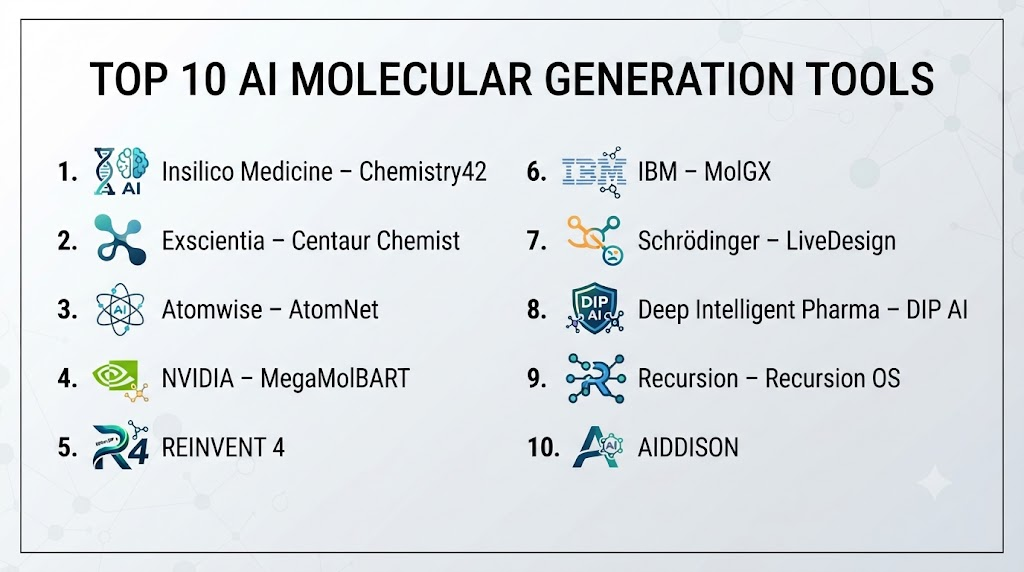
Top 10 AI Molecular Generation Tools
1 — NVIDIA BioNeMo
One-line verdict: Best for developers and research teams building scalable generative AI workflows for molecular and biological discovery.
Short description:
NVIDIA BioNeMo is a platform and collection of models and tools designed for generative AI in drug discovery and biological research. It supports workflows involving molecular generation, protein modeling, molecular property prediction, and other computational biology tasks.
Standout Capabilities
- Generative molecular modeling.
- Protein modeling.
- Molecular property prediction.
- Drug-discovery workflows.
- Model development.
- GPU-accelerated computing.
- Custom model workflows.
- Large-scale inference.
AI-Specific Depth
- Model support: Multiple biological and molecular models, including open and NVIDIA-provided model options depending on the component.
- RAG / knowledge integration: Can be integrated with scientific data and retrieval architectures.
- Evaluation: Model-specific benchmarks and user-defined evaluation workflows.
- Guardrails: Application-level constraints and molecular filtering can be implemented.
- Observability: GPU, inference, application, and model-performance monitoring can be implemented through the broader NVIDIA ecosystem.
Pros
- Strong developer orientation.
- Broad biological AI ecosystem.
- Suitable for scalable computational workflows.
Cons
- Requires significant technical expertise.
- Individual components have different capabilities.
- Infrastructure costs can be substantial at scale.
Security & Compliance
Security depends on the selected deployment and infrastructure. Enterprise identity, access, encryption, and governance should be configured according to organizational requirements.
Deployment & Platforms
- Cloud: Yes.
- Self-hosted: Possible.
- Hybrid: Possible.
- Linux: Common for development and deployment.
- Web: Depends on implementation.
Integrations & Ecosystem
- GPU computing.
- Molecular models.
- Protein models.
- Machine-learning frameworks.
- Data pipelines.
- Cloud infrastructure.
- Research platforms.
Pricing Model
Pricing varies by software component, infrastructure, and deployment model. Exact costs are Not publicly stated for a generalized platform-wide figure.
Best-Fit Scenarios
- Pharmaceutical AI teams.
- Computational chemistry groups.
- Developers building custom molecular-generation systems.
2 — Insilico Medicine
One-line verdict: Best for organizations seeking integrated AI drug discovery spanning molecular generation, target research, and therapeutic development.
Short description:
Insilico Medicine develops AI technologies across multiple stages of drug discovery. Its platform approach combines target identification, generative chemistry, molecular design, and downstream development workflows.
Standout Capabilities
- Generative chemistry.
- Molecular design.
- Target discovery.
- Lead optimization.
- Property prediction.
- AI drug discovery.
- Computational biology.
- Therapeutic development.
AI-Specific Depth
- Model support: Proprietary generative and predictive models.
- RAG / knowledge integration: Scientific and chemical data integration; specific vector-database architecture is not publicly stated.
- Evaluation: Computational and experimental validation.
- Guardrails: Chemical constraints, property filters, and scientific review.
- Observability: Research workflow metrics; detailed model telemetry is not publicly stated.
Pros
- Broad AI drug-discovery scope.
- Strong generative chemistry focus.
- Connects molecular design with target discovery.
Cons
- Enterprise-oriented.
- Platform access may depend on partnerships.
- Exact pricing is not publicly stated.
Security & Compliance
Specific enterprise security, data retention, and certification details should be verified for the relevant engagement.
Deployment & Platforms
- Cloud: Varies.
- Web: Varies.
- Laboratory: Integrated depending on program.
- Self-hosted: Not publicly stated.
Integrations & Ecosystem
- Chemical databases.
- Biological datasets.
- Computational chemistry.
- Target-discovery systems.
- Experimental research.
- Pharmaceutical workflows.
Pricing Model
Enterprise/custom or partnership-based. Exact pricing is Not publicly stated.
Best-Fit Scenarios
- Pharmaceutical R&D.
- Biotech drug discovery.
- Integrated AI chemistry programs.
3 — Generate:Biomedicines
One-line verdict: Best for generative biological design where molecular generation extends beyond conventional small-molecule chemistry.
Short description:
Generate:Biomedicines focuses on generative AI for biological design, particularly proteins and other biological molecules. It is relevant to teams exploring therapeutic design spaces that cannot be addressed solely through conventional small-molecule generation.
Standout Capabilities
- Generative biology.
- Protein design.
- Biological sequence generation.
- Therapeutic discovery.
- Protein engineering.
- Computational biology.
- Generative modeling.
- Experimental validation.
AI-Specific Depth
- Model support: Proprietary generative models.
- RAG / knowledge integration: Biological datasets can inform model development; exact retrieval architecture is not publicly stated.
- Evaluation: Computational and experimental evaluation.
- Guardrails: Biological constraints and experimental validation.
- Observability: Research and experimental metrics.
Pros
- Advanced generative biology focus.
- Useful for protein-based therapeutics.
- Goes beyond conventional small-molecule generation.
Cons
- Specialized use case.
- Enterprise/research orientation.
- Exact pricing is not publicly stated.
Security & Compliance
Specific security controls depend on the collaboration and research environment.
Deployment & Platforms
- Cloud: Varies.
- Laboratory: Yes.
- Self-hosted: Not publicly stated.
Integrations & Ecosystem
- Protein databases.
- Biological assays.
- Computational biology.
- Laboratory workflows.
- Therapeutic discovery.
Pricing Model
Enterprise or partnership arrangements. Exact pricing is Not publicly stated.
Best-Fit Scenarios
- Protein therapeutics.
- Biotech research.
- Generative biology programs.
4 — Schrödinger
One-line verdict: Best for computational chemistry teams combining molecular design, physics-based simulation, machine learning, and drug-discovery workflows.
Short description:
Schrödinger provides computational chemistry and drug-discovery software combining physics-based modeling with machine learning and molecular design workflows. Its platform is widely relevant to structure-based drug discovery and molecular optimization.
Standout Capabilities
- Molecular modeling.
- Structure-based drug design.
- Quantum chemistry.
- Molecular dynamics.
- Machine learning.
- Virtual screening.
- Lead optimization.
- Property prediction.
AI-Specific Depth
- Model support: Proprietary computational and machine-learning models.
- RAG / knowledge integration: Scientific and molecular databases can be integrated; specific RAG architecture is not publicly stated.
- Evaluation: Physics-based calculations, machine-learning evaluation, and experimental validation.
- Guardrails: Molecular constraints and physics-based validation.
- Observability: Computational workflow and simulation metrics.
Pros
- Combines AI with physics-based methods.
- Strong computational chemistry capabilities.
- Broad molecular-design workflow.
Cons
- Can require specialized computational chemistry expertise.
- Broad platform can be complex.
- Pricing is not publicly stated.
Security & Compliance
Enterprise security configuration depends on deployment. Specific certifications and data controls should be verified.
Deployment & Platforms
- Cloud: Available for applicable workflows.
- Self-hosted: Available for applicable software.
- Hybrid: Possible.
- Desktop/HPC: Supported depending on application.
Integrations & Ecosystem
- Molecular databases.
- HPC infrastructure.
- Machine learning.
- Quantum chemistry.
- Molecular dynamics.
- Experimental workflows.
Pricing Model
Commercial licensing and enterprise arrangements. Exact pricing is Not publicly stated.
Best-Fit Scenarios
- Computational chemistry teams.
- Structure-based drug discovery.
- Pharmaceutical R&D.
5 — Atomwise
One-line verdict: Best for AI-driven molecular discovery and virtual screening focused on identifying compounds against therapeutic targets.
Short description:
Atomwise uses AI-based approaches for molecular discovery and virtual screening. Its technology is relevant to teams searching large chemical spaces for molecules with desirable target interactions.
Standout Capabilities
- Virtual screening.
- Molecular generation.
- AI molecular modeling.
- Target-focused discovery.
- Small-molecule research.
- Computational chemistry.
- Lead identification.
- Drug-discovery workflows.
AI-Specific Depth
- Model support: Proprietary AI models.
- RAG / knowledge integration: Molecular and biological data integration; exact RAG architecture is not publicly stated.
- Evaluation: Computational screening followed by experimental validation.
- Guardrails: Molecular property constraints and scientific filtering.
- Observability: Computational screening metrics and research analytics.
Pros
- Strong molecular-AI focus.
- Useful for large-scale screening.
- Relevant to target-focused drug discovery.
Cons
- Enterprise/partnership orientation.
- Not primarily a general-purpose developer tool.
- Pricing is not publicly stated.
Security & Compliance
Specific enterprise security controls should be confirmed for individual engagements.
Deployment & Platforms
- Cloud: Varies.
- Web: Varies.
- Self-hosted: Not publicly stated.
Integrations & Ecosystem
- Protein structures.
- Chemical databases.
- Virtual screening.
- Computational chemistry.
- Experimental testing.
Pricing Model
Enterprise/custom or partnership-based. Exact pricing is Not publicly stated.
Best-Fit Scenarios
- Pharmaceutical discovery.
- Virtual screening.
- AI-assisted molecular research.
6 — DiffDock
One-line verdict: Best for researchers exploring AI-based protein-ligand docking and structure-aware molecular discovery workflows.
Short description:
DiffDock is an AI-based molecular docking approach that uses diffusion models to predict protein-ligand binding poses. It is particularly useful as a computational component within larger molecular-design workflows.
Standout Capabilities
- Protein-ligand docking.
- Diffusion models.
- Structure-based analysis.
- Binding-pose prediction.
- Computational screening.
- Open research.
- Molecular modeling.
- AI-driven docking.
AI-Specific Depth
- Model support: Diffusion-based machine-learning models.
- RAG / knowledge integration: N/A as a core docking system.
- Evaluation: Docking benchmarks and structure-based evaluation.
- Guardrails: Molecular geometry and docking constraints.
- Observability: Model inference and docking metrics depend on implementation.
Pros
- Strong research relevance.
- AI-based docking approach.
- Useful for structure-aware workflows.
Cons
- Docking is not the same as complete molecular generation.
- Requires technical expertise.
- Production support varies by implementation.
Security & Compliance
Deployment-specific. Security and governance are the responsibility of the organization operating the system.
Deployment & Platforms
- Self-hosted: Yes.
- Cloud: Possible.
- Hybrid: Possible.
- Linux: Common.
Integrations & Ecosystem
- Protein structures.
- Molecular datasets.
- Python.
- Machine-learning frameworks.
- Computational chemistry pipelines.
Pricing Model
Open research software. Infrastructure costs depend on computational requirements.
Best-Fit Scenarios
- Academic researchers.
- Computational chemists.
- Developers building AI drug-discovery pipelines.
7 — NVIDIA MegaMolBART
One-line verdict: Best for developers experimenting with transformer-based molecular representation and generation workflows.
Short description:
MegaMolBART is a transformer-based model designed for molecular representation learning and generative chemistry applications. It can serve as a building block for molecular-generation and chemical-property workflows.
Standout Capabilities
- Molecular generation.
- Molecular representation learning.
- Transformer architecture.
- Chemical language modeling.
- Molecular optimization.
- AI chemistry research.
- Custom model development.
- Large-scale inference.
AI-Specific Depth
- Model support: Transformer-based molecular model.
- RAG / knowledge integration: Can be integrated with external chemical knowledge systems.
- Evaluation: Molecular validity, novelty, diversity, and task-specific metrics can be implemented.
- Guardrails: Chemical validity and property constraints can be added.
- Observability: Model inference and infrastructure metrics can be implemented.
Pros
- Strong developer flexibility.
- Useful molecular AI foundation.
- Can support custom workflows.
Cons
- Requires machine-learning expertise.
- Not a complete end-to-end drug-discovery platform.
- Production infrastructure must be designed by the user.
Security & Compliance
Deployment-dependent. Organizations are responsible for securing the model and associated data infrastructure.
Deployment & Platforms
- Cloud: Possible.
- Self-hosted: Possible.
- Hybrid: Possible.
- Linux: Common.
Integrations & Ecosystem
- Python.
- PyTorch.
- Molecular datasets.
- NVIDIA GPU infrastructure.
- Chemical modeling tools.
Pricing Model
Model/software availability and infrastructure costs vary. Exact commercial pricing is Not publicly stated.
Best-Fit Scenarios
- AI researchers.
- Computational chemists.
- Developers building molecular-generation pipelines.
8 — DeepMind AlphaFold
One-line verdict: Best for structure-guided workflows where protein structure information helps constrain or inform molecular design.
Short description:
AlphaFold is primarily a protein-structure prediction system rather than a molecular-generation platform. However, predicted protein structures can be extremely useful inputs to structure-based drug-design workflows.
It therefore belongs in a broader molecular-generation toolkit rather than being treated as a standalone compound generator.
Standout Capabilities
- Protein-structure prediction.
- Structural biology.
- Protein modeling.
- Structure-guided research.
- Binding-site analysis.
- Computational drug discovery.
- Protein research.
- Structural hypothesis generation.
AI-Specific Depth
- Model support: Deep-learning structural models.
- RAG / knowledge integration: N/A as a core structural-prediction workflow.
- Evaluation: Structural prediction benchmarks and experimental comparison.
- Guardrails: Confidence measures and structural validation.
- Observability: Prediction confidence and computational metrics.
Pros
- Major structural-biology capability.
- Useful input to molecular-design workflows.
- Supports structure-guided research.
Cons
- Not a molecular generator.
- Requires downstream chemistry tools.
- Structure prediction does not guarantee binding or drug efficacy.
Security & Compliance
Deployment depends on implementation. Specific enterprise controls are Not publicly stated.
Deployment & Platforms
- Cloud: Possible through applicable services.
- Self-hosted: Available for applicable implementations.
- Hybrid: Possible.
- Linux: Common for research deployments.
Integrations & Ecosystem
- Protein structures.
- Structural databases.
- Molecular docking.
- Computational chemistry.
- Drug-discovery pipelines.
Pricing Model
Software/model availability varies by implementation. Exact pricing is Not publicly stated.
Best-Fit Scenarios
- Structure-based drug discovery.
- Protein research.
- Molecular-design pipelines.
9 — ChemCrow
One-line verdict: Best for researchers experimenting with LLM-powered chemical reasoning and tool-assisted molecular research workflows.
Short description:
ChemCrow is a research-oriented approach that combines language models with chemistry tools. It illustrates how AI agents can call specialized computational chemistry tools rather than relying only on language-model knowledge.
Standout Capabilities
- AI-assisted chemistry.
- Tool calling.
- Chemical reasoning.
- Molecular analysis.
- Literature assistance.
- Computational chemistry integration.
- Agentic workflows.
- Research automation.
AI-Specific Depth
- Model support: LLM-based and tool-assisted architectures.
- RAG / knowledge integration: Can retrieve or query external chemical resources depending on implementation.
- Evaluation: Task-specific evaluation is required.
- Guardrails: Tool permissions and chemistry validation should be implemented.
- Observability: Agent traces, tool calls, latency, and costs can be monitored in a custom deployment.
Pros
- Demonstrates agentic chemistry workflows.
- Flexible research architecture.
- Can connect language models with specialist tools.
Cons
- Research-oriented.
- Not a turnkey enterprise molecular-generation platform.
- Requires technical configuration.
Security & Compliance
Security depends on implementation. Tool access and data permissions should be tightly controlled.
Deployment & Platforms
- Cloud: Possible.
- Self-hosted: Possible.
- Hybrid: Possible.
- Linux: Common.
Integrations & Ecosystem
- LLMs.
- Chemistry tools.
- Python.
- Chemical databases.
- Computational workflows.
- APIs.
Pricing Model
Research/software-based. Infrastructure and model costs vary.
Best-Fit Scenarios
- AI chemistry research.
- Agentic workflow experimentation.
- Computational chemistry development.
10 — Custom AI Molecular Generation Platform
One-line verdict: Best for organizations needing proprietary molecular design models optimized for specific targets, properties, and research objectives.
Short description:
Large pharmaceutical and biotechnology organizations can develop custom molecular-generation platforms that combine generative models with internal chemical datasets, assay results, structural information, computational chemistry, and laboratory feedback.
A custom system can optimize molecules for multiple objectives rather than relying on a single generic generation model.
Standout Capabilities
- De novo molecular generation.
- Lead optimization.
- Multi-objective optimization.
- Protein-conditioned generation.
- Molecular property prediction.
- Synthetic accessibility filtering.
- Virtual screening.
- Active-learning workflows.
AI-Specific Depth
- Model support: Hosted, open-source, proprietary, or internally trained models.
- RAG / knowledge integration: Internal compound libraries, assay results, scientific literature, protein structures, patents, and chemical databases.
- Evaluation: Molecular validity, novelty, diversity, property prediction, retrosynthesis feasibility, docking performance, experimental hit rate, and prospective validation.
- Guardrails: Chemical validity, toxicity filters, synthesis constraints, property thresholds, access controls, and human approval.
- Observability: Model latency, compute cost, generation quality, molecular diversity, property distributions, experiment outcomes, and model drift.
Pros
- Maximum customization.
- Can learn from proprietary experimental data.
- Supports organization-specific optimization objectives.
Cons
- High engineering and computational requirements.
- Requires strong chemistry expertise.
- Experimental validation remains essential.
Security & Compliance
The organization controls the architecture and is responsible for data protection, access control, encryption, retention, auditability, intellectual-property protection, and research governance.
Deployment & Platforms
- Cloud: Possible.
- Self-hosted: Possible.
- Hybrid: Possible.
- Web: Possible.
- API: Possible.
Integrations & Ecosystem
Potential integrations include:
- Compound libraries.
- LIMS.
- ELN systems.
- Protein databases.
- Molecular docking.
- Retrosynthesis software.
- Laboratory automation.
Pricing Model
Development and infrastructure costs vary significantly. Exact pricing is N/A.
Best-Fit Scenarios
- Pharmaceutical R&D.
- Advanced biotech.
- Proprietary molecular-design programs.
Comparison Table
| Tool | Best For | Deployment | Model Flexibility | Strength | Watch-Out | Public Rating |
|---|---|---|---|---|---|---|
| NVIDIA BioNeMo | AI drug-discovery developers | Cloud / Self-hosted / Hybrid | Multi-model | Broad biological AI ecosystem | Technical complexity | |
| Insilico Medicine | Integrated drug discovery | Cloud / Varies | Proprietary AI | Generative chemistry | Enterprise focus | |
| Generate:Biomedicines | Generative biology | Cloud / Laboratory | Proprietary generative AI | Protein design | Specialized scope | |
| Schrödinger | Computational chemistry | Cloud / Self-hosted / Hybrid | Proprietary + computational | Physics + AI | Requires expertise | |
| Atomwise | AI molecular discovery | Cloud / Varies | Proprietary AI | Virtual screening | Enterprise focus | |
| DiffDock | AI docking research | Self-hosted / Cloud | Open research | Structure-based AI | Not complete generation platform | |
| NVIDIA MegaMolBART | Molecular AI development | Self-hosted / Cloud | Model-based | Molecular generation foundation | Requires ML expertise | |
| AlphaFold | Structure-guided design | Cloud / Self-hosted | Deep learning | Protein structures | Not a molecule generator | |
| ChemCrow | Agentic chemistry research | Cloud / Self-hosted | LLM + tools | Tool-using AI | Research-oriented | |
| Custom AI Platform | Proprietary discovery | Cloud / Self-hosted / Hybrid | Multi-model | Maximum customization | High development burden |
Scoring & Evaluation
These scores are comparative editorial assessments rather than laboratory benchmarks. Molecular-generation performance should ultimately be tested using prospective chemistry experiments and project-specific objectives.
A model that generates many valid molecules is not necessarily better than one that generates fewer but more useful candidates.
| Tool | Core Features | AI Reliability | Generation Depth | Integrations | Ease | Performance/Cost | Security/Admin | Support | Weighted Total |
|---|---|---|---|---|---|---|---|---|---|
| NVIDIA BioNeMo | 10 | 9 | 10 | 10 | 7 | 8 | 9 | 10 | 9.05 |
| Insilico Medicine | 10 | 9 | 10 | 9 | 8 | 8 | 9 | 10 | 9.05 |
| Generate:Biomedicines | 9 | 9 | 10 | 8 | 7 | 8 | 9 | 9 | 8.75 |
| Schrödinger | 10 | 9 | 10 | 10 | 7 | 8 | 9 | 10 | 9.00 |
| Atomwise | 9 | 9 | 9 | 8 | 8 | 8 | 9 | 9 | 8.65 |
| DiffDock | 8 | 9 | 8 | 8 | 6 | 10 | 7 | 8 | 8.00 |
| MegaMolBART | 8 | 8 | 9 | 8 | 6 | 9 | 7 | 8 | 7.90 |
| AlphaFold | 9 | 9 | 7 | 9 | 8 | 9 | 8 | 10 | 8.60 |
| ChemCrow | 8 | 7 | 8 | 9 | 6 | 8 | 6 | 7 | 7.30 |
| Custom AI Platform | 10 | 10 | 10 | 10 | 5 | 7 | 10 | 10 | 9.35 |
Top 3 for Enterprise
- Schrödinger — Strong combination of computational chemistry, simulation, and molecular design.
- Insilico Medicine — Strong integrated AI drug-discovery workflow.
- NVIDIA BioNeMo — Strong platform foundation for organizations building customized AI workflows.
Top 3 for SMB
- NVIDIA BioNeMo — Flexible foundation when technical expertise is available.
- Schrödinger — Strong for teams needing established computational chemistry capabilities.
- Atomwise — Relevant for organizations seeking AI-supported molecular discovery through specialized engagement.
Top 3 for Developers
- NVIDIA BioNeMo — Broadest developer-oriented AI ecosystem in this group.
- MegaMolBART — Useful molecular-model foundation for custom workflows.
- DiffDock — Strong research option for structure-based AI workflows.
Which AI Molecular Generation Tool Is Right for You?
Solo / Individual Researcher
Individual researchers usually benefit from open research tools and established computational chemistry software rather than expensive enterprise platforms.
A practical workflow may combine:
- Molecular-generation models.
- Open chemical datasets.
- Molecular-property predictors.
- Docking tools.
- Retrosynthesis analysis.
- Literature research.
- Molecular visualization.
The researcher should prioritize reproducibility and chemical validation.
SMB Biotech
Smaller biotechnology companies should prioritize tools that reduce infrastructure requirements.
Look for:
- Accessible molecular generation.
- Property optimization.
- Virtual screening.
- Exportable molecular structures.
- Chemical filters.
- Synthetic feasibility assessment.
- API access.
- Reasonable compute requirements.
A platform should fit the company’s actual chemistry workflow rather than simply offering the largest model.
Mid-Market Biotech
Mid-sized biotech organizations may benefit from integrated molecular-generation and screening workflows.
Important capabilities include:
- Generative chemistry.
- Lead optimization.
- Protein structure integration.
- Molecular-property prediction.
- Docking.
- Retrosynthesis.
- Experimental data integration.
Enterprise Pharmaceutical Company
Large pharmaceutical organizations should evaluate molecular-generation systems across the complete discovery pipeline.
Key requirements include:
- Multi-objective optimization.
- Target-conditioned generation.
- Proprietary compound data.
- Assay integration.
- ADMET prediction.
- Synthetic feasibility.
- Docking.
- Retrosynthesis.
- Laboratory automation.
- Model governance.
Enterprise systems should make it possible to trace generated compounds back to the model, prompt or conditions, input data, filtering criteria, and subsequent experimental results.
Structure-Based Drug Discovery
If the research program has reliable protein structures, structure-aware molecular generation can be particularly valuable.
Teams should evaluate:
- Binding-site representation.
- Protein-ligand modeling.
- Docking.
- Molecular dynamics.
- Binding-pose prediction.
- Structural confidence.
- Experimental confirmation.
Lead Optimization
For existing chemical series, molecular generation should focus less on novelty alone and more on controlled improvement.
Useful objectives include:
- Potency.
- Selectivity.
- Solubility.
- Stability.
- Permeability.
- Metabolic properties.
- Synthetic accessibility.
Academic Research
Academic teams should prioritize:
- Open models.
- Reproducibility.
- Transparent evaluation.
- Public benchmarks.
- Dataset provenance.
- Exportable results.
- Custom experimentation.
Regulated Pharmaceutical Research
Organizations working toward clinical development should establish strong controls around:
- Compound provenance.
- Data access.
- Model versioning.
- Research records.
- Intellectual property.
- Experimental evidence.
- Auditability.
- Human review.
Generated molecules should remain clearly separated from experimentally confirmed compounds.
Budget vs Premium
Budget-conscious teams can use open-source molecular models and cloud GPUs.
Premium systems become more attractive when teams need:
- Enterprise support.
- Specialized molecular models.
- Integrated chemistry workflows.
- Large-scale screening.
- Proprietary data integration.
- Experimental feedback loops.
Build vs Buy
Build when:
- Your optimization objectives are highly specialized.
- You have proprietary assay data.
- You need custom model architectures.
- You have strong computational chemistry expertise.
- You require full control over the pipeline.
Buy or partner when:
- You need production capability quickly.
- You lack machine-learning expertise.
- You want established chemistry workflows.
- You need specialized scientific support.
A hybrid architecture can combine commercial molecular-design tools with internally developed models and filters.
Implementation Playbook
First 30 Days: Define Molecular Objectives
Before selecting a model, define what “good” means.
Possible objectives include:
- Potency.
- Selectivity.
- Solubility.
- Permeability.
- Stability.
- Toxicity.
- Synthetic accessibility.
- Novelty.
- Binding affinity.
Avoid optimizing for only one property.
A molecule with excellent predicted potency may still be unusable because of poor pharmacokinetics or synthesis difficulty.
Days 31–60: Build the Evaluation Pipeline
Create an evaluation framework covering:
- Molecular validity.
- Novelty.
- Diversity.
- Property accuracy.
- Chemical plausibility.
- Synthetic accessibility.
- Docking performance.
- Multi-objective optimization.
- Computational cost.
Compare generated compounds against appropriate baselines.
Use held-out datasets whenever possible.
Days 61–90: Connect Generation to Experimental Feedback
The strongest workflows create an iterative loop:
Generate → predict → filter → synthesize → test → learn → generate again
During this stage:
- Connect laboratory results.
- Track experimental failures.
- Update predictive models.
- Recalibrate scoring.
- Monitor model drift.
- Version generated libraries.
- Record generation parameters.
- Compare predicted and experimental properties.
The purpose is not simply to generate more molecules.
It is to generate more useful molecules per experimental cycle.
Common Mistakes and How to Avoid Them
- Optimizing novelty alone: Novel molecules are not necessarily useful molecules.
- Ignoring synthetic accessibility: A theoretically attractive molecule may be difficult to manufacture.
- Trusting predicted potency: Predictions require experimental confirmation.
- Optimizing one property: Drug discovery requires multi-parameter optimization.
- Ignoring toxicity: Safety-related properties must be considered early.
- Ignoring chemical validity: Generative models can produce chemically implausible structures.
- Ignoring data leakage: Evaluation datasets must be designed carefully.
- Overfitting to known chemical series: Models may reproduce existing chemistry without genuine innovation.
- Ignoring scaffold diversity: A model can generate many near-duplicates.
- Skipping retrosynthesis: Generated molecules need a realistic synthesis path.
- Ignoring uncertainty: Prediction confidence matters as much as predicted values.
- Failing to version models: Different model versions can generate substantially different results.
- Ignoring provenance: Teams should know how every candidate was generated.
- Using LLMs without chemical validation: Language-model output should pass specialized chemistry checks.
- Ignoring experimental feedback: Laboratory results are critical for improving models.
- Assuming docking equals binding: Computational docking is an approximation and does not establish biological activity.
- Ignoring compute cost: Large generative workflows can become expensive without appropriate filtering.
- Failing to monitor distribution shift: Models may perform differently on chemical spaces unlike their training data.
FAQs
What are AI Molecular Generation tools?
They are AI systems that generate new molecular structures or modify existing compounds according to chemical, biological, or therapeutic objectives.
How does AI generate molecules?
Models can represent molecules as graphs, strings, sequences, or three-dimensional structures and then learn patterns that allow them to generate new candidates.
Can AI design new drugs?
AI can help design drug candidates, but generating a promising molecule is only one stage of drug discovery. Experimental testing and development remain necessary.
What is de novo molecular design?
De novo molecular design generates new chemical structures rather than simply selecting compounds from an existing library.
Can AI optimize existing molecules?
Yes. Molecular-generation models can propose structural modifications designed to improve selected properties.
Can AI generate molecules for a specific protein?
Some systems can condition molecular generation or scoring on target-protein information, binding sites, structures, or other biological constraints.
What is multi-objective molecular generation?
It means optimizing several properties simultaneously, such as potency, selectivity, solubility, toxicity, and synthetic accessibility.
Can AI generate completely novel molecules?
Yes, models can generate structures that are not exact copies of compounds in their training data. However, novelty does not automatically imply useful biological activity.
How are AI-generated molecules evaluated?
Researchers can evaluate molecular validity, novelty, diversity, predicted properties, synthetic feasibility, docking, experimental activity, and other project-specific criteria.
Does AI replace medicinal chemists?
No. AI can accelerate molecular exploration, but medicinal chemists remain essential for interpreting results, designing experiments, assessing synthesis, and making scientific decisions.
Can AI predict molecular properties?
Yes. Machine-learning models can predict various chemical and biological properties, although accuracy varies by property and chemical domain.
Can AI predict toxicity?
AI can estimate toxicity-related endpoints, but predictions should be treated as risk signals rather than definitive safety conclusions.
What is AI protein-conditioned molecular generation?
It is an approach where molecular generation is influenced by information about a protein, target, binding site, or protein-ligand relationship.
Is AlphaFold a molecular-generation tool?
AlphaFold is primarily a protein-structure prediction system. Its outputs can support molecular-design workflows, but it does not function as a conventional small-molecule generator.
Is DiffDock a molecular-generation tool?
DiffDock is primarily an AI docking system for predicting protein-ligand binding poses. It can support molecular-generation workflows but should not be treated as a complete generative chemistry platform.
Can open-source molecular-generation models be self-hosted?
Yes. Several research models can be deployed on private infrastructure, although the technical requirements vary considerably.
Should molecular-generation models use RAG?
RAG can be useful for retrieving chemical literature, internal research records, compound information, and scientific documentation. It is complementary to specialized molecular-generation models.
How should generative chemistry models be evaluated?
Use project-specific benchmarks covering validity, novelty, diversity, property accuracy, synthetic feasibility, computational cost, and prospective experimental performance.
Can AI-generated molecules be synthesized?
Some can, but not all. Synthetic accessibility should be evaluated before prioritizing candidates for laboratory work.
What are the biggest risks of AI molecular generation?
Important risks include chemically invalid structures, inaccurate property predictions, data leakage, poor synthetic feasibility, model bias, overconfidence, insufficient experimental validation, and intellectual-property concerns.
Is a larger AI model always better for molecular generation?
No. Model quality depends on the chemistry task, training data, representation, conditioning information, evaluation method, and experimental objective.
Which AI Molecular Generation tool is best?
There is no universal winner. NVIDIA BioNeMo is strong for developers building broad AI biology workflows, Schrödinger is strong for computational chemistry, Insilico Medicine offers an integrated AI drug-discovery approach, and custom platforms can be strongest when proprietary datasets and specialized objectives justify their development.
Conclusion
AI Molecular Generation tools are becoming an important component of modern drug-discovery workflows.Their greatest value is not simply the ability to produce large numbers of molecules. The real opportunity is to search chemical space more intelligently by combining generation with prediction, structural analysis, synthetic feasibility, biological evidence, and experimental feedback.Platforms such as NVIDIA BioNeMo, Insilico Medicine, Generate:Biomedicines, Schrödinger, and Atomwise demonstrate different approaches to AI-enabled molecular discovery. Research technologies such as DiffDock, MegaMolBART, AlphaFold, and ChemCrow can also become valuable components of specialized computational chemistry workflows.