Introduction
AI Biomedical Literature Mining Tools use artificial intelligence, natural language processing, machine learning, knowledge graphs, semantic search, and large language models to help researchers discover, analyze, summarize, and connect information across biomedical publications.Biomedical research generates an enormous amount of literature across journals, conference papers, preprints, clinical research, patents, and other scientific sources. Finding one useful paper is often easy; understanding thousands of relevant papers and connecting their findings is much harder.AI-powered literature mining can help researchers identify relevant publications, extract entities such as genes, proteins, diseases, drugs, and biomarkers, compare findings, discover relationships, generate research hypotheses, and build evidence maps.
What Is AI Biomedical Literature Mining?
AI biomedical literature mining is the use of AI and computational methods to extract useful knowledge from large collections of biomedical publications.
Traditional literature searching often depends on keywords and manual screening.
AI-based systems can go further by understanding relationships between concepts.
For example, a researcher searching for a particular cancer mechanism might want to identify relationships between:
AI literature-mining systems can help connect these concepts across thousands or millions of documents.
Typical capabilities include:
- Semantic search.
- Natural-language search.
- Paper discovery.
- Citation analysis.
- Entity extraction.
- Relationship extraction.
- Knowledge graphs.
- Literature summarization.
- Evidence comparison.
- Research trend analysis.
- Hypothesis generation.
- Systematic-review support.
Why AI Biomedical Literature Mining Matters
Biomedical research is increasingly difficult to navigate because scientific information is fragmented across disciplines.
A single research question may involve:
- Molecular biology.
- Genetics.
- Pharmacology.
- Clinical research.
- Bioinformatics.
- Immunology.
- Epidemiology.
- Drug discovery.
- Computational biology.
AI can reduce the time required to navigate this information landscape.
However, biomedical literature mining has an important limitation: scientific plausibility is not the same as scientific proof.
An AI system may correctly identify a relationship reported in the literature while still misunderstanding:
- Study design.
- Sample size.
- Statistical significance.
- Experimental limitations.
- Confounding variables.
- Causality.
- Publication bias.
- Conflicting evidence.
For that reason, AI should accelerate scientific investigation rather than eliminate expert review.
Key Use Cases
Literature Discovery
Find relevant research using concepts rather than exact keywords.
Evidence Mapping
Organize publications according to diseases, mechanisms, interventions, outcomes, or research questions.
Gene-Disease Research
Identify relationships between genes, variants, pathways, and diseases.
Drug Discovery
Connect compounds, targets, pathways, mechanisms, and disease indications.
Biomarker Research
Identify publications discussing potential diagnostic, prognostic, or therapeutic biomarkers.
Competitive Intelligence
Monitor scientific developments relevant to a therapeutic area.
Systematic Reviews
Accelerate literature screening and prioritization.
Mechanism-of-Action Research
Connect molecular mechanisms across multiple studies.
Citation Discovery
Identify influential papers and related research.
Research Trend Analysis
Detect emerging topics and rapidly growing areas of scientific interest.
Hypothesis Generation
Surface previously reported relationships that may inspire new research questions.
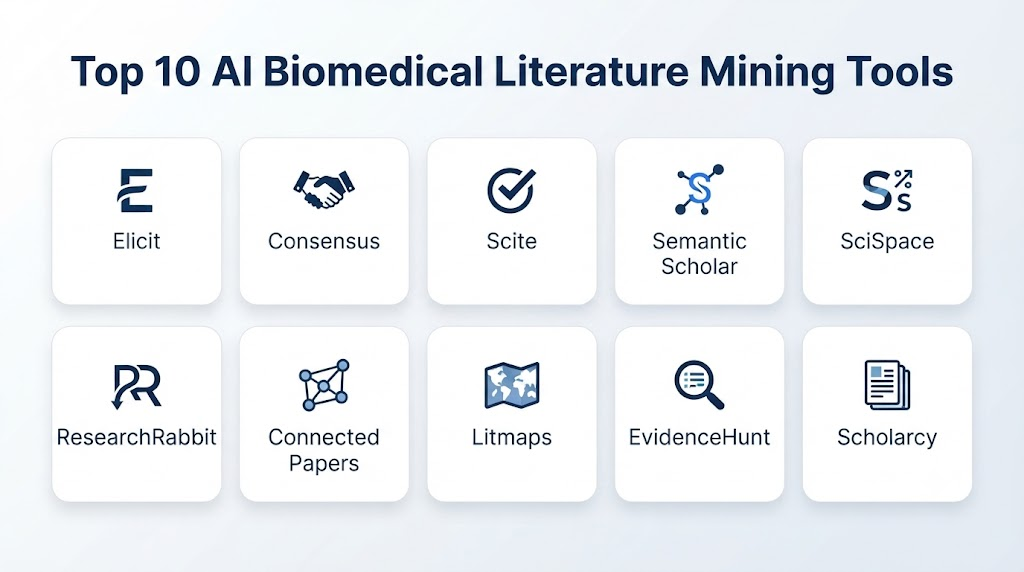
Top 10 AI Biomedical Literature Mining Tools
1 — PubTator 3.0
One-line verdict: Best for researchers who need large-scale biomedical entity recognition and structured literature-mining capabilities.
Short description:
PubTator is a biomedical literature annotation and text-mining resource associated with the National Center for Biotechnology Information ecosystem.
It is particularly useful for extracting biomedical entities and relationships from scientific publications.
Standout Capabilities
- Biomedical entity recognition.
- Literature annotation.
- Gene and protein identification.
- Disease identification.
- Chemical and drug recognition.
- Mutation and variant concepts.
- Large-scale biomedical text mining.
- Programmatic access.
AI-Specific Depth
- Model support: NLP and machine-learning-based biomedical text processing.
- RAG / knowledge integration: Biomedical literature and structured annotation resources.
- Evaluation: Biomedical entity-recognition evaluation and annotation-quality assessment.
- Guardrails: Structured annotation and source traceability help reduce unsupported interpretation.
- Observability: API and annotation outputs can be inspected programmatically.
Pros
- Strong biomedical specialization.
- Useful for large-scale text mining.
- Suitable for computational research.
Cons
- More technical than consumer research assistants.
- Requires computational knowledge for advanced workflows.
- Entity extraction is not equivalent to scientific validation.
Security & Compliance
Public biomedical research resources generally provide access according to their published data policies. Specific enterprise security certifications are Not publicly stated.
Deployment & Platforms
- Web.
- API.
- Programmatic workflows.
- Cloud/server environments depending on implementation.
Integrations & Ecosystem
Potential integrations include:
- PubMed.
- Biomedical databases.
- Python workflows.
- NLP pipelines.
- Research databases.
- Knowledge graphs.
Pricing Model
Core public resources are generally available for research use, subject to applicable usage policies. Enterprise pricing is Not publicly stated.
Best-Fit Scenarios
- Biomedical NLP.
- Large-scale literature mining.
- Entity extraction.
2 — Semantic Scholar
One-line verdict: Best for researchers seeking AI-assisted scientific discovery, semantic paper search, citations, and research-network exploration.
Short description:
Semantic Scholar uses machine learning to improve scientific literature discovery and help researchers navigate papers, citations, authors, and related research.
It covers a broad range of scientific disciplines, including biomedical research.
Standout Capabilities
- Semantic search.
- Paper discovery.
- Citation analysis.
- Research recommendations.
- Author discovery.
- Related-paper exploration.
- Scientific knowledge graphs.
- API access.
AI-Specific Depth
- Model support: Machine learning and semantic-search systems.
- RAG / knowledge integration: Scientific publications and citation relationships provide retrieval context.
- Evaluation: Search relevance and recommendation performance are evaluated through platform methodologies.
- Guardrails: Source-linked results allow researchers to inspect underlying papers.
- Observability: Search and citation information can be examined directly.
Pros
- Excellent research discovery.
- Strong citation navigation.
- Broad scientific coverage.
Cons
- Not exclusively biomedical.
- AI summaries can require verification.
- Coverage may differ from specialized biomedical databases.
Security & Compliance
Specific enterprise security certifications are Not publicly stated.
Deployment & Platforms
- Web.
- API.
- Research applications.
- Cloud infrastructure.
Integrations & Ecosystem
- Scientific publications.
- Citation networks.
- Research APIs.
- Bibliographic workflows.
- Academic discovery tools.
Pricing Model
Public research access and API usage models vary. Exact commercial pricing is Not publicly stated.
Best-Fit Scenarios
- Literature discovery.
- Citation research.
- Scientific intelligence.
3 — Elicit
One-line verdict: Best for researchers using AI-assisted search, paper screening, extraction, and evidence synthesis for biomedical questions.
Short description:
Elicit is an AI research assistant designed to help users discover and analyze academic literature. It can organize papers and extract information from research documents.
It can be particularly useful during early-stage literature reviews and evidence exploration.
Standout Capabilities
- AI literature search.
- Paper discovery.
- Research-question exploration.
- Paper summaries.
- Information extraction.
- Evidence tables.
- Literature review workflows.
- Research comparison.
AI-Specific Depth
- Model support: AI language models and retrieval systems; exact model configuration varies.
- RAG / knowledge integration: Retrieved academic papers provide context for generated outputs.
- Evaluation: Users should validate extracted claims against original papers.
- Guardrails: Source-linked research workflows help support verification.
- Observability: Paper-level evidence and extracted fields can be reviewed.
Pros
- Easy to use.
- Useful for literature reviews.
- Reduces repetitive screening work.
Cons
- AI-generated summaries can contain errors.
- Biomedical interpretation requires expert verification.
- Exact database coverage varies.
Security & Compliance
Specific enterprise security certifications are Not publicly stated.
Deployment & Platforms
- Web.
- Cloud.
- Browser-based research workflow.
Integrations & Ecosystem
- Academic literature.
- Research workflows.
- Paper collections.
- Evidence tables.
- Export functionality.
Pricing Model
Tiered/free and paid offerings may vary. Exact pricing is Not publicly stated.
Best-Fit Scenarios
- Literature reviews.
- Evidence extraction.
- Research discovery.
4 — Consensus
One-line verdict: Best for quickly exploring scientific questions and finding research-backed evidence from academic literature.
Short description:
Consensus is an AI-powered academic search and research platform designed to help users find and synthesize scientific evidence.
It is particularly useful when researchers want a concise starting point before reviewing the underlying publications.
Standout Capabilities
- Natural-language scientific search.
- Evidence discovery.
- Paper retrieval.
- AI-assisted summaries.
- Research comparison.
- Citation-backed answers.
- Scientific question answering.
- Literature exploration.
AI-Specific Depth
- Model support: AI language models combined with scientific retrieval; exact models vary.
- RAG / knowledge integration: Retrieved research papers provide evidence context.
- Evaluation: Outputs should be checked against source papers.
- Guardrails: Citation-backed responses help facilitate verification.
- Observability: Source papers and evidence can be inspected.
Pros
- Fast research discovery.
- User-friendly.
- Good for evidence-oriented questions.
Cons
- Not a full biomedical knowledge-management platform.
- AI summaries require verification.
- Coverage depends on indexed literature.
Security & Compliance
Specific enterprise certifications are Not publicly stated.
Deployment & Platforms
- Web.
- Cloud.
- Browser-based.
Integrations & Ecosystem
- Academic papers.
- Scientific databases.
- Research workflows.
- Evidence summaries.
Pricing Model
Free and paid plans may be available; exact pricing is Not publicly stated.
Best-Fit Scenarios
- Early research.
- Evidence discovery.
- Scientific question exploration.
5 — Scite
One-line verdict: Best for researchers analyzing citation context and determining how scientific claims are supported or challenged by later publications.
Short description:
Scite focuses on citation analysis and helps researchers understand how papers are cited by subsequent research.
This can be valuable in biomedical research where simply counting citations does not reveal whether later studies support, contradict, or merely mention an earlier finding.
Standout Capabilities
- Citation analysis.
- Citation context.
- Supporting citation identification.
- Contrasting citation identification.
- Literature discovery.
- Research monitoring.
- Smart citations.
- Evidence evaluation.
AI-Specific Depth
- Model support: Machine learning and NLP for citation-context analysis.
- RAG / knowledge integration: Scientific papers and citation networks.
- Evaluation: Citation classification can be evaluated against labeled citation contexts.
- Guardrails: Source-level citation context allows human inspection.
- Observability: Citation relationships and supporting/contrasting contexts are visible.
Pros
- Excellent citation context.
- Useful for evidence validation.
- Helps identify conflicting literature.
Cons
- Citation classification can require interpretation.
- Not a complete biomedical research database.
- Some advanced capabilities may require paid access.
Security & Compliance
Specific enterprise certifications are Not publicly stated.
Deployment & Platforms
- Web.
- Cloud.
- Research workflows.
- API capabilities vary.
Integrations & Ecosystem
- Scientific publications.
- Citation networks.
- Research databases.
- Literature monitoring.
- Research workflows.
Pricing Model
Free and paid offerings may vary. Exact pricing is Not publicly stated.
Best-Fit Scenarios
- Evidence checking.
- Citation analysis.
- Scientific controversy research.
6 — Iris.ai
One-line verdict: Best for research teams exploring large scientific literature collections through AI-assisted semantic search and knowledge mapping.
Short description:
Iris.ai is designed to help researchers explore scientific literature using semantic technologies and AI-assisted discovery.
Its approach can help researchers move beyond exact keyword matching when exploring unfamiliar research areas.
Standout Capabilities
- Semantic literature search.
- Knowledge mapping.
- Research discovery.
- Document analysis.
- Concept extraction.
- Literature exploration.
- Research workflows.
- Scientific knowledge organization.
AI-Specific Depth
- Model support: NLP and semantic AI; exact models vary.
- RAG / knowledge integration: Scientific documents and research concepts.
- Evaluation: Search relevance and extraction accuracy should be tested for each research domain.
- Guardrails: Source-linked research supports verification.
- Observability: Search results and extracted concepts can be reviewed.
Pros
- Strong semantic discovery.
- Useful for broad research questions.
- Helps explore unfamiliar domains.
Cons
- Requires careful source verification.
- Biomedical functionality varies by dataset.
- Advanced workflows may require training.
Security & Compliance
Specific certifications are Not publicly stated.
Deployment & Platforms
- Web/cloud.
- Enterprise deployment options vary.
- API capabilities vary.
Integrations & Ecosystem
- Research documents.
- Scientific databases.
- Knowledge maps.
- Research workflows.
- APIs.
Pricing Model
Commercial/custom pricing may vary. Exact pricing is Not publicly stated.
Best-Fit Scenarios
- Scientific discovery.
- Literature mapping.
- Multidisciplinary research.
7 — Litmaps
One-line verdict: Best for researchers who want visual literature discovery, citation mapping, and monitoring around specific biomedical research topics.
Short description:
Litmaps uses citation relationships to help researchers discover papers connected to a starting set of publications.
It can be particularly useful for expanding a literature search and monitoring how a research field evolves.
Standout Capabilities
- Citation mapping.
- Literature discovery.
- Visual research maps.
- Related-paper discovery.
- Literature monitoring.
- Research alerts.
- Bibliographic exploration.
- Research organization.
AI-Specific Depth
- Model support: Automated literature discovery and analytical techniques; exact AI architecture varies.
- RAG / knowledge integration: Citation networks and publication metadata.
- Evaluation: Relevance should be manually assessed.
- Guardrails: Citation relationships provide traceable discovery paths.
- Observability: Citation maps and source papers are visible.
Pros
- Excellent visual exploration.
- Useful for literature reviews.
- Good for finding connected research.
Cons
- Citation-based discovery can miss relevant non-connected research.
- Not a specialized biomedical NLP system.
- Interpretation still requires researchers.
Security & Compliance
Specific certifications are Not publicly stated.
Deployment & Platforms
- Web.
- Cloud.
- Browser-based research environment.
Integrations & Ecosystem
- Academic publications.
- Citation networks.
- Bibliographic workflows.
- Literature alerts.
- Research collections.
Pricing Model
Free and paid offerings may vary. Exact pricing is Not publicly stated.
Best-Fit Scenarios
- Literature mapping.
- Systematic research.
- Citation discovery.
8 — Connected Papers
One-line verdict: Best for visually exploring papers related to a foundational biomedical publication or research topic.
Short description:
Connected Papers creates visual graphs of papers related to a selected research work.
It can help researchers quickly understand clusters of related publications and discover papers they may not have found through keyword searches.
Standout Capabilities
- Visual paper graphs.
- Related-paper discovery.
- Research cluster exploration.
- Literature navigation.
- Citation-based relationships.
- Foundational-paper discovery.
- Research-field mapping.
AI-Specific Depth
- Model support: Automated similarity and literature-network analysis; exact implementation varies.
- RAG / knowledge integration: Publication metadata and paper relationships.
- Evaluation: Researchers should verify relevance against source papers.
- Guardrails: Direct paper access supports manual validation.
- Observability: Visual graph relationships provide discovery context.
Pros
- Extremely easy to explore.
- Strong visual research experience.
- Useful for finding related publications.
Cons
- Not designed as a complete biomedical knowledge-extraction platform.
- Graph relationships do not establish scientific validity.
- Coverage depends on indexed literature.
Security & Compliance
Specific enterprise certifications are Not publicly stated.
Deployment & Platforms
- Web.
- Cloud.
- Browser-based.
Integrations & Ecosystem
- Scientific publications.
- Citation metadata.
- Research discovery.
- Bibliographic workflows.
Pricing Model
Access and pricing vary. Exact pricing is Not publicly stated.
Best-Fit Scenarios
- Starting a new literature review.
- Finding related studies.
- Exploring research clusters.
9 — PubMed + AI/NLP Research Pipelines
One-line verdict: Best for technical research teams building reproducible biomedical literature-mining workflows around a large biomedical publication database.
Short description:
PubMed provides access to a large biomedical literature database. Researchers can combine PubMed with NLP, machine learning, APIs, embeddings, vector search, and custom AI systems to build specialized literature-mining workflows.
This approach is especially useful for teams requiring control over retrieval, extraction, and evaluation.
Standout Capabilities
- Biomedical publication search.
- Structured metadata.
- MeSH terminology.
- API access.
- Large-scale retrieval.
- Custom NLP.
- Embedding-based search.
- Reproducible research pipelines.
AI-Specific Depth
- Model support: Any compatible NLP or AI model selected by the development team.
- RAG / knowledge integration: PubMed literature can serve as a retrieval corpus.
- Evaluation: Custom benchmark datasets, retrieval recall, extraction precision, and human review.
- Guardrails: Source grounding, citation requirements, retrieval restrictions, and output validation can be implemented.
- Observability: Pipeline logs, retrieval metrics, latency, model costs, and extraction quality can be monitored.
Pros
- High technical flexibility.
- Strong biomedical literature foundation.
- Excellent for reproducible pipelines.
Cons
- Requires engineering expertise.
- AI layer must be built and maintained.
- Literature retrieval does not automatically solve evidence interpretation.
Security & Compliance
Security depends on the architecture built around the data and models. Specific enterprise certifications are Not publicly stated for a generic pipeline.
Deployment & Platforms
- Cloud.
- Self-hosted.
- Hybrid.
- Linux.
- Python and other programming environments.
Integrations & Ecosystem
- PubMed.
- APIs.
- Python.
- Vector databases.
- Embedding models.
- LLMs.
- Data warehouses.
Pricing Model
The underlying public literature infrastructure may be accessible without commercial licensing for many research uses. AI infrastructure costs vary.
Best-Fit Scenarios
- Custom biomedical NLP.
- Research organizations.
- Reproducible literature pipelines.
10 — Custom Biomedical Literature Intelligence Platform
One-line verdict: Best for pharmaceutical and biotechnology teams building proprietary literature-mining and scientific-intelligence workflows.
Short description:
A custom biomedical literature intelligence platform can combine scientific publications with patents, clinical-trial information, internal research documents, structured biomedical databases, and proprietary knowledge.
The platform can then use retrieval, NLP, knowledge graphs, and AI models to create a domain-specific scientific intelligence layer.
Standout Capabilities
- Semantic literature search.
- Biomedical entity extraction.
- Relationship extraction.
- Knowledge graphs.
- Evidence summarization.
- Hypothesis generation.
- Competitive intelligence.
- Research monitoring.
AI-Specific Depth
- Model support: Proprietary models, open-source models, hosted LLMs, embeddings, rerankers, and multi-model architectures.
- RAG / knowledge integration: Literature, patents, clinical trials, internal research documents, databases, and structured biomedical knowledge.
- Evaluation: Retrieval recall, citation accuracy, extraction precision, hallucination testing, benchmark datasets, expert review, and regression testing.
- Guardrails: Source grounding, citation enforcement, prompt-injection protection, access controls, data filtering, and human approval.
- Observability: Retrieval traces, model latency, token usage, cost, citation coverage, extraction quality, and model drift.
Pros
- Maximum control.
- Can integrate proprietary research knowledge.
- Highly customizable.
Cons
- Significant engineering investment.
- Requires continuous evaluation.
- Data licensing can become complex.
Security & Compliance
Organizations can implement encryption, RBAC, SSO, audit logging, retention policies, data residency, private model deployment, and granular access controls.
Specific certifications are Not publicly stated for a generic implementation.
Deployment & Platforms
- Cloud.
- Self-hosted.
- Hybrid.
- Enterprise data centers.
- APIs.
Integrations & Ecosystem
Potential integrations include:
- PubMed.
- Scientific databases.
- Patent databases.
- Clinical-trial databases.
- Vector databases.
- LLM providers.
- Internal knowledge systems.
Pricing Model
Custom development and infrastructure. Exact pricing is N/A.
Best-Fit Scenarios
- Pharmaceutical R&D.
- Biotechnology intelligence.
- Proprietary research knowledge systems.
Comparison Table
| Tool | Best For | Deployment | Model Flexibility | Strength | Watch-Out | Public Rating |
|---|---|---|---|---|---|---|
| PubTator 3.0 | Biomedical NLP | Web / API | NLP / ML | Entity extraction | Technical workflow | |
| Semantic Scholar | Scientific discovery | Web / API | ML / Semantic | Research discovery | Not biomedical-only | |
| Elicit | Literature reviews | Cloud / Web | AI / Multi-model | Evidence extraction | Verify AI summaries | |
| Consensus | Scientific Q&A | Cloud / Web | AI / Retrieval | Fast evidence discovery | Coverage varies | |
| Scite | Citation analysis | Web / Cloud | NLP / ML | Citation context | Interpretation required | |
| Iris.ai | Semantic research | Cloud / Web | AI / NLP | Knowledge discovery | Requires validation | |
| Litmaps | Citation mapping | Cloud / Web | Semantic / Automated | Literature maps | Citation bias | |
| Connected Papers | Visual discovery | Web | Similarity / ML | Research graphs | Not full-text mining | |
| PubMed + AI Pipeline | Custom research | Cloud / Self-hosted | Any model | Maximum flexibility | Requires engineering | |
| Custom Platform | Enterprise intelligence | Cloud / Hybrid | Multi-model | Proprietary knowledge | High complexity |
Scoring & Evaluation
These scores are comparative editorial assessments rather than absolute measures of scientific quality.
For biomedical literature mining, retrieval accuracy and source traceability are particularly important. A system that generates attractive summaries but fails to retrieve relevant papers should not be considered reliable.
| Tool | Core Features | AI Reliability | Literature Depth | Integrations | Ease | Performance/Cost | Security/Admin | Support | Weighted Total |
|---|---|---|---|---|---|---|---|---|---|
| PubTator 3.0 | 9 | 9 | 10 | 9 | 7 | 9 | 8 | 9 | 8.85 |
| Semantic Scholar | 9 | 9 | 10 | 9 | 10 | 9 | 8 | 10 | 9.20 |
| Elicit | 9 | 8 | 9 | 8 | 10 | 8 | 8 | 9 | 8.80 |
| Consensus | 8 | 8 | 9 | 8 | 10 | 8 | 8 | 9 | 8.60 |
| Scite | 9 | 9 | 9 | 9 | 9 | 8 | 8 | 9 | 8.85 |
| Iris.ai | 9 | 8 | 9 | 8 | 8 | 8 | 8 | 9 | 8.40 |
| Litmaps | 8 | 8 | 9 | 8 | 10 | 9 | 8 | 9 | 8.65 |
| Connected Papers | 8 | 8 | 8 | 7 | 10 | 9 | 8 | 8 | 8.20 |
| PubMed + AI Pipeline | 10 | 10 | 10 | 10 | 5 | 9 | 10 | 9 | 9.35 |
| Custom Platform | 10 | 10 | 10 | 10 | 5 | 7 | 10 | 10 | 9.40 |
Top 3 for Enterprise
- Custom Biomedical Literature Intelligence Platform — Best for proprietary scientific intelligence.
- PubMed + AI Research Pipeline — Excellent for controlled, reproducible technical workflows.
- Semantic Scholar — Strong general scientific discovery and research-network exploration.
Top 3 for SMB
- Elicit — Strong literature-review workflow.
- Scite — Excellent for evaluating citation context.
- Consensus — Fast scientific evidence discovery.
Top 3 for Developers
- PubMed + AI/NLP Pipeline — Maximum control.
- PubTator 3.0 — Strong biomedical NLP foundation.
- Custom Biomedical Literature Platform — Maximum extensibility.
Which AI Biomedical Literature Mining Tool Is Right for You?
Solo / Independent Researcher
Start with tools that reduce search and screening time without requiring infrastructure.
Prioritize:
- Natural-language search.
- Citation discovery.
- Paper summaries.
- Evidence tables.
- Citation context.
- Export capabilities.
Use AI-generated summaries as starting points rather than final scientific conclusions.
SMB Biotechnology Company
A small biotechnology company should focus on tools that support:
- Target research.
- Competitive intelligence.
- Mechanism-of-action research.
- Biomarker discovery.
- Literature monitoring.
- Patent and publication awareness.
An accessible AI research assistant may provide more value than building a custom system.
Mid-Market Biotechnology Company
A growing biotech organization can benefit from integrating literature intelligence with internal research.
Potential architecture:
External literature → AI retrieval → entity extraction → internal knowledge → evidence synthesis → researcher review
This makes literature analysis more useful than a standalone search tool.
Enterprise Pharmaceutical Company
Large pharmaceutical companies can build a scientific intelligence layer connecting:
- Publications.
- Patents.
- Clinical trials.
- Internal research.
- Experimental results.
- Biomedical databases.
- Competitive intelligence.
Enterprise buyers should prioritize:
- Data licensing.
- Source traceability.
- Model governance.
- Privacy.
- Data residency.
- Role-based access.
- Evaluation.
- Retrieval quality.
Drug Discovery Teams
For drug discovery, literature mining can connect:
Target → pathway → disease → mechanism → compound → clinical evidence
AI can help researchers identify relationships across publications that may not be obvious through keyword searches.
Biomarker Research
AI literature mining can help identify:
- Candidate biomarkers.
- Disease associations.
- Molecular pathways.
- Diagnostic markers.
- Prognostic markers.
- Treatment-response markers.
However, researchers should distinguish between an association reported in literature and a clinically validated biomarker.
Genomics Research
Genomics teams can use literature-mining systems to connect:
- Genes.
- Variants.
- Phenotypes.
- Diseases.
- Pathways.
- Population studies.
- Functional experiments.
Specialized biomedical entity extraction is especially valuable for this workflow.
Clinical Research
Clinical researchers can use AI literature mining to identify:
- Existing evidence.
- Clinical outcomes.
- Treatment comparisons.
- Safety findings.
- Trial methodologies.
- Research gaps.
Always verify clinical conclusions against the original publications.
Systematic Reviews
AI can reduce repetitive work in:
- Search expansion.
- Title screening.
- Abstract prioritization.
- Data extraction.
- Citation discovery.
Human reviewers should remain responsible for inclusion criteria and final evidence interpretation.
Budget vs Premium
Low-cost approaches can include:
- PubMed.
- Semantic search.
- Citation mapping.
- General AI research tools.
Premium enterprise approaches can incorporate:
- Proprietary databases.
- Patents.
- Internal research.
- Knowledge graphs.
- Advanced retrieval.
- Custom models.
- Enterprise governance.
Build vs Buy
Build when:
- Your organization has proprietary scientific data.
- Literature mining is a core research capability.
- You need specialized entity extraction.
- You require private deployment.
- You have data-science and engineering resources.
Buy when:
- You need immediate productivity.
- Your research requirements are broad.
- You do not need proprietary customization.
- You want vendor-maintained search infrastructure.
A hybrid approach is often the most practical.
Implementation Playbook
First 30 Days: Define the Research Questions
Identify the literature-mining problems that matter most.
Examples:
- Find publications related to a target.
- Monitor a therapeutic area.
- Identify biomarker evidence.
- Analyze competitor research.
- Build a systematic-review corpus.
Create benchmark questions and expected papers.
Days 31–60: Build an Evaluation Dataset
Create a test set containing:
- Known relevant papers.
- Known irrelevant papers.
- Important foundational papers.
- Conflicting studies.
- Recent publications.
- Different terminology and synonyms.
Evaluate:
- Retrieval recall.
- Precision.
- Citation accuracy.
- Entity extraction.
- Summary faithfulness.
Days 61–90: Deploy Research Workflows
Integrate:
- Source retrieval.
- Document parsing.
- Semantic search.
- Reranking.
- Citation extraction.
- Evidence summaries.
- Researcher review.
Add:
- Prompt/version control.
- Evaluation harnesses.
- Hallucination testing.
- Citation verification.
- Cost monitoring.
- Access controls.
Common Mistakes and How to Avoid Them
- Trusting AI summaries without reading papers: Always verify important findings against the source.
- Confusing correlation with causation: Literature associations are not automatically causal.
- Ignoring contradictory studies: Search for evidence that challenges the initial conclusion.
- Using only keyword search: Biomedical terminology has extensive synonyms and abbreviations.
- Ignoring publication bias: Published literature may not represent the entire evidence base.
- Relying on one database: Different sources have different coverage.
- Ignoring preprints: They can contain emerging research but may not have undergone peer review.
- Failing to track publication dates: Biomedical knowledge changes quickly.
- Ignoring retractions or corrections: Research status can change after publication.
- Accepting fabricated citations: AI systems can generate plausible-looking but incorrect references.
- Failing to evaluate retrieval: Good summaries are useless if the wrong papers are retrieved.
- Ignoring terminology variation: Gene, disease, drug, and protein names can have many aliases.
- Using black-box extraction: Researchers should be able to inspect source evidence.
- Overusing RAG without source controls: Retrieval quality determines output quality.
- Ignoring prompt injection in documents: Retrieved documents may contain instructions that should never override system policies.
- Failing to monitor costs: Large literature corpora can create significant embedding and inference costs.
- Ignoring model drift: New models can change extraction and summarization behavior.
- Treating AI-generated hypotheses as established science: Hypotheses require experimental or clinical validation.
FAQs
What is biomedical literature mining?
Biomedical literature mining is the computational analysis of scientific publications to extract useful information about diseases, genes, drugs, proteins, pathways, biomarkers, clinical findings, and other biomedical concepts.
How does AI improve biomedical literature mining?
AI can understand semantic relationships, extract biomedical entities, rank relevant papers, summarize evidence, and connect concepts across large collections of publications.
Can AI read scientific papers?
AI can process and summarize scientific documents, but its interpretation may contain errors. Important claims should be checked against the original paper.
Can AI discover new scientific knowledge?
AI can identify previously reported relationships and generate hypotheses, but it does not establish new scientific knowledge without appropriate validation.
Can AI find biomedical research faster than traditional search?
Often yes, particularly for exploratory questions where synonyms, related concepts, and citation relationships make keyword searching difficult.
What databases can be used?
Depending on the workflow, researchers may use biomedical publication databases, scientific indexes, citation databases, patents, clinical-trial databases, and internal research repositories.
Can AI analyze PubMed?
Yes. PubMed data can be searched directly or incorporated into custom NLP, semantic-search, and retrieval-augmented AI workflows.
Can AI identify gene-disease relationships?
Yes. Biomedical NLP systems can extract and organize gene-disease relationships reported in scientific literature.
Can AI help with drug discovery?
Yes. Literature mining can connect targets, mechanisms, pathways, compounds, diseases, and clinical evidence.
Can AI find biomarkers?
It can identify publications discussing potential biomarkers and organize evidence around them. It cannot by itself establish that a biomarker is clinically validated.
Can AI perform systematic reviews?
AI can assist with search, screening, extraction, and organization, but research teams should maintain appropriate human review and methodological controls.
What is semantic search?
Semantic search retrieves documents based on meaning and concepts rather than requiring exact keyword matches.
What is a biomedical knowledge graph?
A biomedical knowledge graph represents entities such as genes, proteins, diseases, drugs, and publications as connected relationships.
Can AI identify conflicting research?
Yes. Citation analysis and evidence-comparison tools can help identify studies that support or challenge particular findings.
What is the biggest benefit of AI literature mining?
The biggest benefit is reducing the time researchers spend discovering and organizing relevant scientific information.
What is the biggest limitation?
AI may misunderstand scientific context, generate inaccurate summaries, or overstate conclusions.
How should literature-mining AI be evaluated?
Measure retrieval recall, precision, citation correctness, entity extraction accuracy, summary faithfulness, and researcher agreement.
Can AI literature tools use private company research?
Some enterprise architectures can integrate private documents, but data governance, access controls, retention, and model-training policies must be carefully reviewed.
Is self-hosting possible?
Yes for custom AI/NLP pipelines, depending on the models and infrastructure. Commercial platforms vary.
Can AI literature mining replace scientists?
No. AI can accelerate information discovery and analysis, but scientists remain responsible for interpreting evidence and designing experiments.
How much do biomedical literature-mining tools cost?
Pricing varies widely. Public research resources may be freely accessible, while commercial AI research platforms and enterprise systems may use subscription, usage-based, or custom pricing.
Should pharmaceutical companies build their own literature-mining platform?
Companies with substantial proprietary research data and repeated scientific-intelligence requirements may benefit from a custom platform. Others may achieve better economics with established tools.
Conclusion
AI Biomedical Literature Mining Tools are becoming an important part of modern scientific research because the challenge is no longer simply finding publications.The larger challenge is understanding relationships across enormous amounts of biomedical information.Tools such as PubTator 3.0 are valuable for biomedical NLP and entity extraction, while Semantic Scholar supports broad scientific discovery. Elicit and Consensus simplify literature exploration and evidence synthesis, while Scite provides valuable citation-context analysis. Litmaps and Connected Papers are useful for exploring research networks visually.For technical organizations, PubMed combined with custom AI/NLP pipelines offers substantially greater control. Pharmaceutical and biotechnology companies with proprietary research data may eventually benefit from a custom scientific-intelligence platform that connects publications with patents, clinical trials, internal documents, and biomedical databases.