Introduction
AI Clinical Documentation Summarization tools use artificial intelligence to turn large amounts of clinical information into concise, structured, and clinically useful summaries. These systems can process information from clinical notes, encounter transcripts, electronic health records, referral documents, discharge summaries, laboratory results, medication histories, and other healthcare documentation.The goal is not simply to shorten a medical record. A useful clinical summarization system should preserve clinically important context while reducing the time physicians, nurses, care coordinators, and other healthcare professionals spend searching through fragmented documentation.
Modern AI systems can summarize patient histories, prepare pre-visit briefs, extract important findings, organize longitudinal records, support handoffs, generate discharge documentation, and help clinicians quickly understand what changed between encounters.Common use cases include pre-visit preparation, longitudinal patient-history review, discharge summaries, referral summaries, specialist consultations, care transitions, clinical handoffs, utilization review, chart review, and administrative documentation.
What Is AI Clinical Documentation Summarization?
AI Clinical Documentation Summarization is the use of artificial intelligence to condense clinical information while preserving details that may be important for patient care.
A traditional medical record can contain years of information spread across:
- Progress notes.
- Consultation notes.
- Nursing documentation.
- Laboratory results.
- Imaging reports.
- Medication histories.
- Procedure notes.
- Discharge summaries.
- Referral letters.
- Patient messages.
- Encounter transcripts.
- Care plans.
- Previous diagnoses.
- Treatment responses.
Finding the most important information can take considerable time.
AI summarization systems can analyze these records and produce a structured overview. Depending on the platform, a summary might include the patient’s relevant history, active problems, recent changes, medications, investigations, previous treatments, pending actions, and other clinically relevant information.
The technology is particularly valuable for longitudinal records because it can help clinicians understand how a patient’s condition has evolved rather than requiring them to read every historical note.
However, summarization is a high-stakes healthcare application. A fluent AI-generated summary can still contain omissions, incorrect interpretations, or unsupported conclusions. The safest systems therefore provide source context, preserve traceability, and keep clinicians responsible for final decisions.
Why AI Clinical Documentation Summarization Matters
Healthcare documentation continues to grow in volume and complexity.
Clinicians may need to review multiple encounters before a consultation, understand historical treatment decisions, identify previous diagnostic workups, and determine what changed since the patient’s last visit.
AI summarization can reduce the cognitive burden associated with this information retrieval process.
A well-designed system can help answer questions such as:
- What are the patient’s major active problems?
- What treatments have already been tried?
- What changed during the most recent encounters?
- Which medications are currently documented?
- What relevant investigations have been completed?
- What abnormal findings require attention?
- What follow-up actions are pending?
- What information came from previous specialists?
- How has the patient’s condition evolved?
The goal is not to replace clinical reasoning. The goal is to give clinicians a better starting point.
Key Use Cases
Pre-Visit Preparation
AI can generate a concise patient brief before an appointment so clinicians can review important history without manually searching through the entire chart.
Longitudinal Record Summarization
For patients with years of documentation, AI can organize historical information into a chronological or problem-oriented summary.
Specialist Referrals
Referral summaries can help specialists understand why the patient was referred and what investigations or treatments have already occurred.
Hospital Discharge
AI can help organize hospitalization events, diagnoses, procedures, medication changes, and follow-up recommendations into a discharge-oriented summary.
Clinical Handoffs
Summarization can help clinicians quickly understand active problems, recent changes, pending tests, and important care considerations during transitions.
Care Coordination
Care managers can use summaries to understand patient histories across multiple encounters and providers.
Utilization Review
Healthcare organizations can use summarization to accelerate review of complex clinical documentation.
Clinical Research
Researchers can use AI-assisted summarization to organize large volumes of clinical documentation for research workflows, subject to appropriate governance and validation.
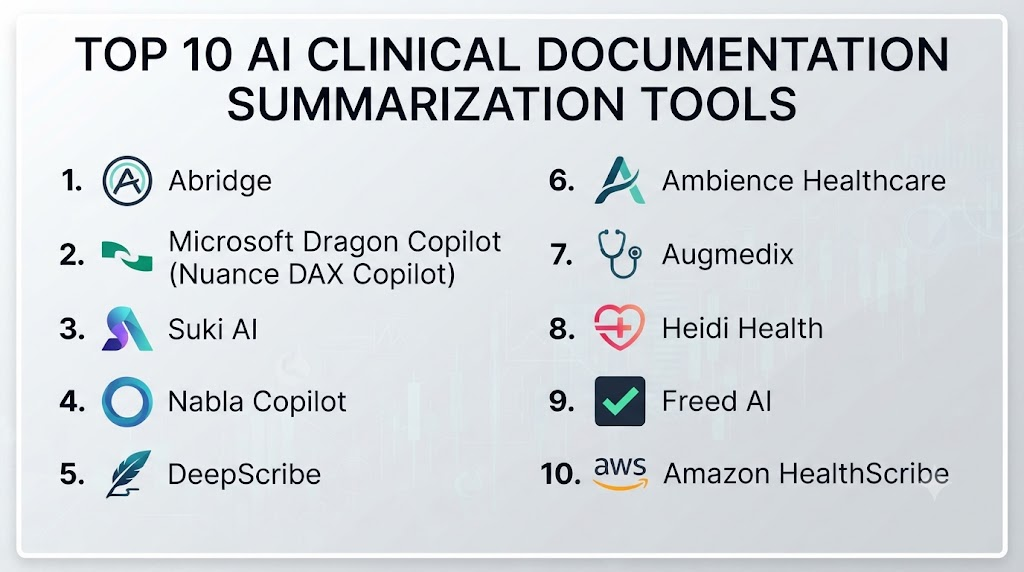
Top 10 AI Clinical Documentation Summarization Tools
1 — Microsoft Dragon Copilot
One-line verdict: Best for healthcare organizations seeking an enterprise clinical AI assistant integrated into clinician documentation workflows.
Short description:
Microsoft Dragon Copilot combines conversational AI, clinical documentation capabilities, and ambient listening technology to support healthcare professionals. It builds on Nuance’s clinical speech and documentation technologies and is designed to reduce administrative burden while integrating with healthcare workflows.
Standout Capabilities
- Ambient clinical documentation.
- Clinical conversation capture.
- AI-assisted note generation.
- Physician workflow support.
- Clinical information summarization.
- Healthcare-focused speech recognition.
- EHR workflow integration.
- Enterprise healthcare deployment.
AI-Specific Depth
- Model support: Microsoft and Nuance AI technologies; exact underlying model routing varies by capability.
- RAG / knowledge integration: Clinical context and EHR integration are central; specific vector-database compatibility is not publicly stated.
- Evaluation: Clinical documentation quality and workflow validation are emphasized; exact customer-specific evaluation methodology varies.
- Guardrails: Healthcare-focused safety controls and clinician review workflows are supported.
- Observability: Enterprise administration and product analytics are available; detailed token-level observability is not publicly stated.
Pros
- Strong healthcare-specific documentation heritage.
- Designed for clinician workflows.
- Broad enterprise ecosystem.
Cons
- Enterprise deployment can be complex.
- Availability of specific features varies by environment.
- Pricing is not publicly stated.
Security & Compliance
Microsoft and Nuance provide enterprise healthcare security capabilities. Specific encryption, retention, data residency, SSO, RBAC, and certification scope should be verified for the selected product and deployment.
Deployment & Platforms
- Web: Yes / applicable.
- Desktop: Supported depending on workflow.
- Mobile: Applicable features vary.
- Cloud: Yes.
- Self-hosted: Varies / N/A.
- Hybrid: Varies.
Integrations & Ecosystem
Microsoft’s healthcare ecosystem provides extensive integration opportunities.
- EHR systems.
- Clinical documentation workflows.
- Microsoft healthcare technologies.
- Speech-recognition workflows.
- Enterprise identity systems.
- Healthcare applications.
Pricing Model
Enterprise/custom pricing. Exact pricing is Not publicly stated.
Best-Fit Scenarios
- Large health systems.
- Hospital networks.
- Organizations already using Microsoft healthcare technologies.
2 — Abridge
One-line verdict: Best for ambient clinical documentation and AI-generated summaries connected closely to real patient conversations.
Short description:
Abridge uses generative AI to transform clinician-patient conversations into clinical documentation. Its platform is designed to summarize conversations, generate documentation, and integrate outputs into healthcare workflows while keeping clinicians involved in reviewing the resulting documentation.
Standout Capabilities
- Ambient clinical documentation.
- Conversation summarization.
- AI-generated clinical notes.
- Patient-visit context.
- EHR integration.
- Clinician review.
- Longitudinal documentation support.
- Enterprise healthcare deployment.
AI-Specific Depth
- Model support: Proprietary healthcare AI architecture; exact model composition varies.
- RAG / knowledge integration: Clinical context and EHR information can be incorporated; specific vector-database support is not publicly stated.
- Evaluation: Extensive clinical AI evaluation is part of the platform’s development approach; exact customer-specific metrics vary.
- Guardrails: Clinical review, structured workflows, and safety-oriented controls.
- Observability: Enterprise analytics are available; detailed token-level metrics are not publicly stated.
Pros
- Strong ambient documentation capabilities.
- Designed around real clinical conversations.
- Useful for reducing documentation workload.
Cons
- Primarily focused on healthcare organizations.
- Requires careful implementation and clinician training.
- Pricing is not publicly stated.
Security & Compliance
Abridge publicly describes healthcare privacy and security capabilities. Specific contractual controls, retention settings, data residency, encryption, and certification scope should be verified for the implementation.
Deployment & Platforms
- Mobile: Yes.
- Web: Yes.
- Cloud: Yes.
- Self-hosted: Not publicly stated.
- Hybrid: Varies / N/A.
Integrations & Ecosystem
Abridge is designed to connect ambient documentation with healthcare technology.
- EHR systems.
- Clinical workflows.
- Mobile applications.
- Provider workflows.
- Patient encounters.
- Enterprise healthcare environments.
Pricing Model
Enterprise/custom pricing. Exact pricing is Not publicly stated.
Best-Fit Scenarios
- Hospitals and health systems.
- Physician practices.
- High-volume outpatient environments.
3 — Ambience Healthcare
One-line verdict: Best for healthcare organizations wanting ambient documentation combined with specialty-aware clinical summarization.
Short description:
Ambience Healthcare provides AI-powered clinical documentation and workflow tools designed to support clinicians across different specialties. Its technology focuses on converting conversations and clinical context into structured documentation while helping clinicians review relevant information.
Standout Capabilities
- Ambient documentation.
- Clinical note generation.
- Specialty-aware workflows.
- Clinical summarization.
- Patient-visit documentation.
- EHR integration.
- Automated coding support.
- Workflow automation.
AI-Specific Depth
- Model support: Proprietary AI architecture and multiple AI capabilities; exact model routing is not publicly stated.
- RAG / knowledge integration: Clinical context integration; specific vector-database compatibility is not publicly stated.
- Evaluation: Healthcare documentation evaluation and clinical validation are emphasized.
- Guardrails: Clinician review and controlled documentation workflows.
- Observability: Product and workflow analytics; detailed token-level observability is not publicly stated.
Pros
- Strong specialty-focused approach.
- Combines documentation with workflow support.
- Designed for enterprise healthcare.
Cons
- Implementation can require workflow customization.
- Primarily designed for healthcare organizations.
- Exact pricing is not public.
Security & Compliance
Security and compliance capabilities are designed for healthcare deployments. Exact certification, retention, encryption, access-control, and residency details should be confirmed during procurement.
Deployment & Platforms
- Web: Yes.
- Mobile: Applicable.
- Cloud: Yes.
- Self-hosted: Not publicly stated.
- Hybrid: Varies / N/A.
Integrations & Ecosystem
- EHR systems.
- Clinical documentation.
- Coding workflows.
- Provider applications.
- Healthcare analytics.
- Enterprise clinical systems.
Pricing Model
Enterprise/custom pricing. Exact pricing is Not publicly stated.
Best-Fit Scenarios
- Specialty clinics.
- Large physician groups.
- Health systems seeking ambient documentation.
4 — Nabla Copilot
One-line verdict: Best for clinicians seeking an AI copilot that combines ambient documentation with concise clinical information support.
Short description:
Nabla Copilot is an AI clinical assistant focused on ambient documentation and clinical workflow support. It can listen to consultations, generate clinical documentation, and help clinicians reduce manual note-taking.
Standout Capabilities
- Ambient listening.
- AI note generation.
- Clinical documentation.
- Patient conversation summarization.
- Multiple clinical specialties.
- EHR connectivity.
- Clinician editing.
- Multilingual capabilities.
AI-Specific Depth
- Model support: Proprietary AI architecture using large language models; exact model configuration varies.
- RAG / knowledge integration: Clinical context integration is available; specific vector-database compatibility is not publicly stated.
- Evaluation: Clinical documentation evaluation is performed; exact customer-specific benchmarks vary.
- Guardrails: Clinician review and healthcare-oriented workflows.
- Observability: Platform analytics are available; detailed LLM tracing is not publicly stated.
Pros
- Easy-to-understand clinical workflow.
- Strong ambient documentation use case.
- Suitable for different practice sizes.
Cons
- Focused more on documentation than broad longitudinal analytics.
- Advanced integration requirements can vary.
- Exact enterprise pricing is not public.
Security & Compliance
Healthcare security and privacy controls are available. Exact encryption, retention, residency, SSO, RBAC, and certification details should be verified for the selected configuration.
Deployment & Platforms
- Mobile: Yes.
- Web: Yes.
- Cloud: Yes.
- Self-hosted: Not publicly stated.
- Hybrid: Varies / N/A.
Integrations & Ecosystem
- EHR systems.
- Provider workflows.
- Mobile applications.
- Clinical notes.
- Patient encounters.
- Healthcare practice environments.
Pricing Model
Tiered and enterprise pricing may vary. Exact current pricing is Not publicly stated.
Best-Fit Scenarios
- Physician practices.
- Outpatient clinics.
- Clinicians wanting ambient documentation assistance.
5 — Suki
One-line verdict: Best for clinicians wanting an AI assistant for ambient documentation, summarization, and voice-driven workflow support.
Short description:
Suki provides an AI-powered clinical assistant designed to reduce documentation burden. It can capture conversations, generate clinical notes, support structured documentation, and provide voice-based assistance in clinical environments.
Standout Capabilities
- Ambient documentation.
- Voice-based clinical assistance.
- Clinical note generation.
- Documentation summarization.
- EHR integration.
- Structured note support.
- Clinician editing.
- Workflow automation.
AI-Specific Depth
- Model support: Proprietary healthcare AI architecture; specific model providers and routing are not publicly stated.
- RAG / knowledge integration: Clinical context can be incorporated; vector-database architecture is not publicly stated.
- Evaluation: Clinical documentation quality and workflow performance are evaluated; exact customer-specific metrics vary.
- Guardrails: Clinician review and controlled documentation workflows.
- Observability: Platform-level analytics are available; detailed token-level observability is not publicly stated.
Pros
- Strong voice interaction.
- Designed specifically for clinical environments.
- Can reduce manual documentation.
Cons
- Primarily documentation-oriented.
- Integration effort varies.
- Pricing is not publicly stated.
Security & Compliance
Healthcare security controls are available. Exact certification and contractual requirements should be verified for each deployment.
Deployment & Platforms
- Mobile: Yes / applicable.
- Web: Yes.
- Cloud: Yes.
- Self-hosted: Not publicly stated.
- Hybrid: Varies / N/A.
Integrations & Ecosystem
- EHR platforms.
- Voice workflows.
- Clinical notes.
- Provider applications.
- Healthcare enterprise systems.
Pricing Model
Enterprise/custom pricing. Exact pricing is Not publicly stated.
Best-Fit Scenarios
- Independent physicians.
- Medical groups.
- Health systems.
6 — Nabla Clinical Copilot
One-line verdict: Best for healthcare teams needing AI-generated documentation with clinician review and structured workflow integration.
Short description:
Nabla’s clinical copilot capabilities focus on assisting clinicians with documentation and information processing. The platform can transform patient conversations into structured notes and help clinicians spend less time manually documenting encounters.
Standout Capabilities
- Clinical conversation transcription.
- Automated note generation.
- Summary creation.
- Structured clinical documentation.
- Multilingual support.
- EHR workflow integration.
- Clinician editing.
- Documentation automation.
AI-Specific Depth
- Model support: Healthcare-focused AI and language models; exact architecture varies.
- RAG / knowledge integration: Clinical context integration; vector-database compatibility is not publicly stated.
- Evaluation: Clinical quality evaluation is part of product development.
- Guardrails: Human review and controlled documentation workflows.
- Observability: Product analytics are available; detailed LLM tracing is not publicly stated.
Pros
- Practical documentation workflow.
- Useful for reducing administrative burden.
- Suitable for multiple specialties.
Cons
- Less focused on advanced longitudinal record analysis.
- AI output still requires clinician review.
- Enterprise pricing is not public.
Security & Compliance
Healthcare privacy and security controls are available. Exact retention, residency, encryption, SSO, and certification details should be verified.
Deployment & Platforms
- Web: Yes.
- Mobile: Yes.
- Cloud: Yes.
- Self-hosted: Not publicly stated.
Integrations & Ecosystem
- EHRs.
- Clinical documentation.
- Provider applications.
- Patient encounters.
- Healthcare workflows.
Pricing Model
Enterprise/custom pricing. Exact pricing is Not publicly stated.
Best-Fit Scenarios
- Outpatient practices.
- Multispecialty groups.
- Healthcare organizations implementing ambient documentation.
7 — Freed AI
One-line verdict: Best for clinicians and smaller practices wanting accessible AI-assisted clinical documentation and summarization.
Short description:
Freed AI is designed to assist clinicians with medical documentation using ambient AI. It can capture patient conversations and generate structured clinical notes, reducing manual documentation work.
Standout Capabilities
- Ambient documentation.
- Medical note generation.
- Conversation summarization.
- Clinical templates.
- Provider workflow support.
- EHR copy/export workflows.
- Patient encounter organization.
- Automated documentation.
AI-Specific Depth
- Model support: AI language models; exact model providers and routing are not publicly stated.
- RAG / knowledge integration: Clinical-context handling varies; vector-database compatibility is not publicly stated.
- Evaluation: Product-level documentation evaluation is used; detailed clinical benchmark methodology is not publicly stated.
- Guardrails: Clinician review is central.
- Observability: Product analytics are available; detailed model observability is not publicly stated.
Pros
- Accessible workflow.
- Strong focus on documentation.
- Suitable for smaller clinical teams.
Cons
- May not provide the same enterprise depth as large health-system platforms.
- Clinician review remains necessary.
- Enterprise integration capabilities vary.
Security & Compliance
Healthcare privacy and security controls are provided for the service. Exact certification, data-retention, residency, and enterprise identity configurations should be verified.
Deployment & Platforms
- Web: Yes.
- Mobile: Yes / applicable.
- Cloud: Yes.
- Self-hosted: Not publicly stated.
Integrations & Ecosystem
- EHR workflows.
- Clinical notes.
- Provider applications.
- Patient encounters.
- Documentation templates.
Pricing Model
Subscription and enterprise pricing may vary. Exact current pricing is Not publicly stated.
Best-Fit Scenarios
- Independent clinicians.
- Small medical practices.
- Outpatient documentation workflows.
8 — Heidi Health
One-line verdict: Best for clinicians seeking AI documentation and clinical workflow assistance across multiple specialties.
Short description:
Heidi Health provides AI-powered clinical documentation tools that can capture patient conversations and turn them into structured medical notes. Its platform is designed to support clinicians across different healthcare settings and reduce documentation workload.
Standout Capabilities
- Ambient documentation.
- Clinical note generation.
- Medical transcription.
- AI-assisted summarization.
- Custom templates.
- Multiple specialties.
- Patient documentation.
- Clinical workflow support.
AI-Specific Depth
- Model support: Proprietary healthcare AI capabilities; exact model routing is not publicly stated.
- RAG / knowledge integration: Clinical context integration varies; vector-database compatibility is not publicly stated.
- Evaluation: Clinical documentation quality is evaluated; detailed customer-specific benchmarks are not publicly stated.
- Guardrails: Human review and controlled clinical documentation workflows.
- Observability: Product analytics are available; detailed token-level metrics are not publicly stated.
Pros
- Broad clinical usability.
- Strong documentation workflow.
- Customization can help different specialties.
Cons
- Advanced enterprise features may vary by plan.
- AI-generated documentation requires clinician review.
- Exact enterprise pricing is not publicly stated.
Security & Compliance
Healthcare privacy and security features are available. Exact certification, encryption, retention, residency, and access-control requirements should be verified for the deployment.
Deployment & Platforms
- Web: Yes.
- Mobile: Yes.
- Cloud: Yes.
- Self-hosted: Not publicly stated.
Integrations & Ecosystem
- EHR systems.
- Clinical templates.
- Provider workflows.
- Mobile applications.
- Documentation systems.
Pricing Model
Tiered and enterprise models may be available. Exact current pricing is Not publicly stated.
Best-Fit Scenarios
- Small and medium practices.
- Multispecialty clinics.
- Clinicians seeking flexible documentation workflows.
9 — Commure Ambient
One-line verdict: Best for health systems seeking ambient clinical documentation connected with broader healthcare workflow infrastructure.
Short description:
Commure provides healthcare technology designed around clinical workflows, infrastructure, and AI-enabled healthcare applications. Its ambient documentation capabilities can help convert patient-provider conversations into structured clinical documentation.
Standout Capabilities
- Ambient clinical documentation.
- Clinical workflow automation.
- AI-assisted note creation.
- Healthcare infrastructure integration.
- EHR connectivity.
- Clinical workflow support.
- Enterprise deployment.
- Healthcare AI capabilities.
AI-Specific Depth
- Model support: AI models and healthcare-specific AI architecture; exact model routing varies.
- RAG / knowledge integration: Healthcare-context integration; detailed vector-database compatibility is not publicly stated.
- Evaluation: Clinical workflow and documentation evaluation are part of implementation.
- Guardrails: Healthcare workflow controls and human review.
- Observability: Enterprise analytics available; detailed LLM observability is not publicly stated.
Pros
- Enterprise healthcare orientation.
- Broader infrastructure capabilities.
- Potential for workflow-level integration.
Cons
- More complex than a standalone documentation application.
- Enterprise implementation may require substantial planning.
- Exact pricing is not publicly stated.
Security & Compliance
Enterprise healthcare security capabilities are available. Specific certifications, encryption, retention, data residency, SSO, and RBAC details should be verified.
Deployment & Platforms
- Web: Yes.
- Cloud: Yes.
- Self-hosted: Varies / N/A.
- Hybrid: Varies / N/A.
- Mobile: Varies.
Integrations & Ecosystem
- EHR systems.
- Healthcare infrastructure.
- Clinical workflows.
- Enterprise applications.
- Provider tools.
- Healthcare data environments.
Pricing Model
Enterprise/custom pricing. Exact pricing is Not publicly stated.
Best-Fit Scenarios
- Large health systems.
- Enterprise healthcare organizations.
- Organizations modernizing clinical workflows.
10 — Nabla AI Clinical Assistant
One-line verdict: Best for organizations seeking lightweight AI-assisted clinical documentation without building a custom summarization system.
Short description:
Nabla’s broader AI clinical-assistant approach supports clinical documentation, patient conversation summarization, and workflow assistance. It can help transform unstructured clinical encounters into structured documentation while leaving final review with the clinician.
Standout Capabilities
- Clinical conversation summarization.
- Automated documentation.
- Structured note generation.
- Patient encounter support.
- Clinical templates.
- Multilingual capabilities.
- EHR connectivity.
- Clinician review.
AI-Specific Depth
- Model support: Proprietary AI and language-model technology.
- RAG / knowledge integration: Clinical context can be incorporated; exact vector-database compatibility is not publicly stated.
- Evaluation: Clinical documentation evaluation is performed; exact methodology is not publicly stated.
- Guardrails: Clinician review and controlled workflow design.
- Observability: Product analytics are available; detailed LLM tracing is not publicly stated.
Pros
- Practical clinical documentation workflow.
- Easy-to-understand use case.
- Can reduce manual note-writing.
Cons
- Still requires clinician verification.
- Advanced enterprise capabilities vary.
- Pricing is not publicly stated.
Security & Compliance
Healthcare privacy and security capabilities are available. Specific deployment-level certifications, retention, encryption, residency, and administrative controls should be verified.
Deployment & Platforms
- Web: Yes.
- Mobile: Yes.
- Cloud: Yes.
- Self-hosted: Not publicly stated.
Integrations & Ecosystem
- EHR systems.
- Clinical documentation.
- Provider workflows.
- Patient encounters.
- Clinical templates.
Pricing Model
Enterprise/custom pricing. Exact pricing is Not publicly stated.
Best-Fit Scenarios
- Physician practices.
- Outpatient clinics.
- Healthcare organizations introducing AI documentation.
Comparison Table
| Tool | Best For | Deployment | Model Flexibility | Strength | Watch-Out | Public Rating |
|---|---|---|---|---|---|---|
| Microsoft Dragon Copilot | Enterprise clinical documentation | Cloud / Enterprise | Proprietary / Varies | Healthcare documentation ecosystem | Enterprise complexity | N/A |
| Abridge | Ambient documentation | Cloud / Mobile | Proprietary AI | Conversation-to-documentation workflow | Enterprise focus | N/A |
| Ambience Healthcare | Specialty-aware documentation | Cloud | Proprietary AI | Specialty workflows | Implementation complexity | N/A |
| Nabla Copilot | Clinical AI assistance | Cloud / Mobile | Proprietary AI | Practical clinician workflow | Requires review | N/A |
| Suki | Voice-driven clinical documentation | Cloud / Mobile | Proprietary AI | Voice and ambient workflows | Enterprise integration | N/A |
| Nabla Clinical Copilot | Structured clinical notes | Cloud | Proprietary AI | Documentation automation | Limited public model detail | N/A |
| Freed AI | Smaller clinical practices | Cloud | AI language models | Accessible documentation | Less enterprise depth | N/A |
| Heidi Health | Multispecialty documentation | Cloud / Mobile | Proprietary AI | Flexible workflows | Feature availability varies | N/A |
| Commure Ambient | Enterprise health systems | Cloud / Enterprise | Proprietary AI | Healthcare infrastructure | Deployment complexity | N/A |
| Nabla AI Clinical Assistant | Clinical documentation | Cloud / Mobile | Proprietary AI | Simple workflow | Requires clinician verification | N/A |
Scoring & Evaluation
The following scores are comparative editorial assessments rather than clinical efficacy claims. They are intended to help buyers structure an initial shortlist.
Actual performance should be tested using real clinical documentation, specialty-specific workflows, representative patient encounters, and the organization’s own security and governance requirements.
| Tool | Core Features | Summary Quality | Clinical Safety | Integrations | Ease | Performance/Cost | Security/Admin | Workflow Support | Weighted Total |
|---|---|---|---|---|---|---|---|---|---|
| Microsoft Dragon Copilot | 10 | 9 | 9 | 10 | 8 | 8 | 10 | 10 | 9.20 |
| Abridge | 9 | 10 | 9 | 10 | 9 | 8 | 9 | 10 | 9.25 |
| Ambience Healthcare | 9 | 9 | 9 | 9 | 8 | 8 | 9 | 10 | 8.95 |
| Nabla Copilot | 9 | 9 | 9 | 9 | 9 | 9 | 9 | 9 | 9.00 |
| Suki | 9 | 9 | 9 | 9 | 9 | 8 | 9 | 9 | 8.95 |
| Freed AI | 8 | 8 | 8 | 7 | 9 | 9 | 8 | 9 | 8.25 |
| Heidi Health | 8 | 9 | 8 | 8 | 9 | 9 | 8 | 9 | 8.55 |
| Commure Ambient | 9 | 9 | 9 | 10 | 7 | 8 | 10 | 10 | 9.00 |
| Nabla Clinical Copilot | 9 | 9 | 9 | 9 | 9 | 9 | 9 | 9 | 9.00 |
| Nabla AI Clinical Assistant | 9 | 9 | 9 | 9 | 9 | 9 | 9 | 9 | 9.00 |
Top 3 for Enterprise
- Microsoft Dragon Copilot — Strong healthcare documentation ecosystem and enterprise infrastructure.
- Abridge — Strong ambient documentation and clinical workflow capabilities.
- Commure Ambient — Attractive for organizations seeking broader healthcare infrastructure integration.
Top 3 for SMB
- Nabla Copilot — Strong balance between clinical usability and documentation functionality.
- Freed AI — Accessible option for smaller practices.
- Heidi Health — Flexible clinical documentation workflow.
Top 3 for Developers
- Abridge — Strong clinical AI workflow orientation.
- Microsoft Dragon Copilot — Extensive enterprise healthcare technology ecosystem.
- Commure Ambient — Broader healthcare infrastructure opportunities.
Which AI Clinical Documentation Summarization Tool Is Right for You?
Solo / Individual Clinician
Individual clinicians should prioritize simplicity.
The most useful capabilities are:
- Fast documentation.
- Reliable transcription.
- Clear summaries.
- Easy editing.
- Simple EHR workflows.
- Minimal configuration.
- Transparent privacy controls.
A complicated enterprise deployment may create more work than it removes.
SMB Practice
Smaller practices should look for:
- Easy onboarding.
- Ambient documentation.
- Custom templates.
- EHR compatibility.
- Mobile support.
- Predictable pricing.
- Strong privacy controls.
- Clinician review.
Nabla, Freed AI, Heidi Health, and Suki can be useful starting points depending on specialty and workflow.
Mid-Market Medical Group
Mid-sized organizations should evaluate:
- Multi-provider deployment.
- Central administration.
- EHR integration.
- Specialty templates.
- Quality monitoring.
- Role-based access.
- Usage analytics.
- AI governance.
At this scale, the tool needs to work consistently across providers rather than simply perform well for a single clinician.
Enterprise Health System
Large health systems should evaluate architecture and governance as carefully as documentation quality.
Important requirements include:
- Enterprise identity.
- EHR integration.
- Data governance.
- Auditability.
- Security.
- Multi-specialty support.
- Model evaluation.
- Quality monitoring.
- Administrative controls.
- Deployment scalability.
- Business continuity.
Microsoft Dragon Copilot, Abridge, Ambience Healthcare, and Commure are logical platforms to evaluate for different enterprise requirements.
Specialty Clinics
Specialty practices should determine whether the summarization system understands specialty-specific workflows.
Examples include:
- Cardiology.
- Oncology.
- Neurology.
- Gastroenterology.
- Orthopedics.
- Emergency medicine.
- Primary care.
- Behavioral health.
A general-purpose summary may not be sufficient if the specialty requires specific documentation structures or terminology.
Hospitals and Inpatient Teams
Hospital environments require careful evaluation of:
- Longitudinal records.
- Admission information.
- Progress notes.
- Procedures.
- Laboratory results.
- Imaging.
- Medication changes.
- Discharge planning.
- Handoffs.
The system should make it easy to verify the original source information.
Regulated Healthcare Environments
Healthcare organizations should pay particular attention to:
- Patient privacy.
- Data residency.
- Retention.
- Access controls.
- Encryption.
- Audit logs.
- Model governance.
- Human review.
- Data-use policies.
- Incident response.
The ability to generate a fluent summary is less important than maintaining trustworthy clinical provenance.
Build vs Buy
Building a custom clinical summarization system may be appropriate for organizations with strong engineering, data-science, clinical informatics, and governance teams.
Buy when:
- You need rapid deployment.
- You want an established healthcare workflow.
- You lack AI engineering resources.
- EHR integration is important.
- You want vendor-supported infrastructure.
Build when:
- You have specialized workflows.
- You have strong clinical AI expertise.
- You require custom data processing.
- You need full control of models and infrastructure.
A hybrid architecture can be effective when an organization uses a commercial documentation platform while maintaining internal evaluation, governance, analytics, and data controls.
Implementation Playbook
First 30 Days: Pilot and Define Success
Start with a small clinical group.
- Select one or two specialties.
- Define documentation workflows.
- Identify representative encounter types.
- Establish baseline documentation time.
- Measure clinician editing time.
- Collect representative recordings or notes where appropriate.
- Define summary-quality criteria.
- Identify unacceptable hallucination patterns.
- Establish privacy requirements.
- Map EHR integration.
- Define human-review requirements.
- Establish success metrics.
Potential metrics include:
- Documentation time saved.
- Clinician editing time.
- Summary completeness.
- Factual accuracy.
- Omission rate.
- Unsupported statement rate.
- User acceptance.
- Workflow completion time.
Days 31–60: Evaluation and Governance
After the pilot:
- Create a clinical evaluation set.
- Test different specialties.
- Evaluate common and unusual encounter types.
- Measure hallucinations.
- Test omission of clinically important information.
- Check medication accuracy.
- Check dates and temporal relationships.
- Evaluate named conditions.
- Review summaries with clinicians.
- Establish model and prompt version control.
- Test access controls.
- Review data-retention settings.
- Establish incident-management procedures.
- Document model limitations.
Special attention should be given to negative findings, medication changes, allergies, diagnoses, test results, and clinical timelines because omissions in these areas can be consequential.
Days 61–90: Optimize and Scale
Once the system is validated:
- Expand to additional specialties.
- Tune templates.
- Improve EHR workflows.
- Monitor documentation quality.
- Track clinician adoption.
- Monitor model changes.
- Establish periodic evaluations.
- Analyze workflow bottlenecks.
- Monitor costs.
- Create governance reviews.
- Establish escalation procedures.
- Expand gradually.
The objective should be measurable improvement in clinical workflow without reducing documentation reliability.
Common Mistakes and How to Avoid Them
- Treating summaries as authoritative: Always preserve access to the underlying clinical record.
- Ignoring hallucinations: Fluent language does not guarantee factual accuracy.
- Failing to test omissions: A summary can be harmful even when every included statement is technically correct if important information is missing.
- Ignoring temporal context: Clinical records contain events occurring over months or years.
- Incorrect medication information: Medication changes and discontinued medications require careful validation.
- Over-automating documentation: Clinicians should review important generated content.
- Using generic templates everywhere: Specialty workflows often require different structures.
- Ignoring source traceability: Clinicians should be able to verify important claims.
- Failing to evaluate rare cases: Models should be tested beyond common encounters.
- Ignoring multilingual workflows: Language and accent differences can affect transcription and summarization.
- Neglecting privacy: Clinical conversations and records contain highly sensitive information.
- Skipping model monitoring: Performance can change as models or clinical workflows evolve.
- Measuring only time saved: Documentation quality and clinical safety must also be evaluated.
- Ignoring clinician feedback: Frontline users often identify failure modes that technical testing misses.
- Failing to establish an AI incident process: Organizations should know how to report, investigate, and remediate problematic outputs.
FAQs
What is AI Clinical Documentation Summarization?
It is the use of AI to condense clinical notes, conversations, records, and other healthcare information into concise summaries or structured documentation.
How does AI summarize clinical records?
AI can process unstructured notes, encounter transcripts, medical histories, laboratory information, and other contextual data and organize relevant information into a predefined summary structure.
Can AI summarize an entire patient history?
Yes, depending on the platform and available data. Longitudinal summarization can help clinicians understand major events, treatments, diagnoses, and changes over time.
Can AI generate a clinical note from a patient conversation?
Yes. Ambient clinical documentation platforms can listen to a clinician-patient conversation and generate a draft clinical note for clinician review.
Does AI replace clinical documentation?
Generally, AI should be viewed as a documentation assistant rather than an autonomous replacement for clinician responsibility. Generated content should be reviewed according to the organization’s workflow and risk requirements.
Can AI hallucinate clinical information?
Yes. Generative AI can produce incorrect or unsupported information. Healthcare organizations should evaluate hallucination risk and maintain mechanisms for clinician verification.
How can hallucinations be reduced?
Useful measures include constrained workflows, source grounding, structured templates, clinical evaluation datasets, human review, output validation, model testing, and ongoing monitoring.
Can AI summaries be used directly for clinical decisions?
They may support clinical decision-making, but organizations should determine appropriate use based on validation, risk, workflow, and applicable healthcare requirements. Clinicians should retain appropriate professional judgment.
Can these tools integrate with EHR systems?
Many commercial platforms are designed to integrate with EHR workflows, but supported systems and integration depth vary by vendor.
What data can an AI clinical summarizer use?
Depending on the platform, data can include clinical notes, encounter conversations, medication records, laboratory results, imaging reports, referral information, patient messages, and other EHR data.
Is patient data used to train AI models?
This depends on the vendor, contract, product configuration, and data-use policy. Healthcare organizations should explicitly verify whether customer data is retained or used for model training.
Are AI clinical documentation tools secure?
Security varies by vendor and deployment. Organizations should evaluate encryption, access control, retention, data residency, audit logging, identity management, and applicable healthcare privacy requirements.
Can clinical summaries be traced back to their sources?
Some systems provide source context or access to underlying documentation, while others provide primarily generated text. Source traceability should be a key procurement requirement.
What is ambient clinical documentation?
Ambient documentation uses AI to capture a clinical conversation in the background and produce a draft note or summary, reducing the amount of manual typing required from the clinician.
Can these systems summarize specialist referrals?
Yes. Referral summarization can organize the reason for referral, previous investigations, treatment history, relevant diagnoses, and other information for the receiving clinician.
Can AI help with discharge summaries?
It can assist with organizing hospitalization events, procedures, diagnoses, medication changes, follow-up instructions, and other discharge information. Clinician review remains important.
Can AI summarize clinical handoffs?
Yes. A properly configured system can organize active problems, recent changes, pending investigations, and other information relevant to care transitions.
How should clinical summarization systems be evaluated?
Evaluation should include factual accuracy, completeness, omission rates, hallucination rates, clinical usefulness, source traceability, workflow impact, and performance across different specialties and patient populations.
What is the biggest risk of AI clinical summarization?
One major risk is omission of clinically important information. A summary can appear accurate while leaving out a medication change, abnormal result, allergy, diagnosis, or other important detail.
Is a shorter summary always better?
No. The purpose is useful compression, not maximum compression. A good clinical summary should remove unnecessary information while preserving details needed for safe and effective care.
Which AI clinical documentation tool is best?
There is no universal winner. Microsoft Dragon Copilot is particularly relevant to large enterprise healthcare environments, Abridge is strong in ambient documentation, Ambience is notable for specialty-oriented workflows, and platforms such as Nabla, Suki, Freed AI, and Heidi Health can fit different practice sizes and workflows.
Conclusion
AI Clinical Documentation Summarization is becoming an important component of modern healthcare technology because clinical records are growing faster than clinicians can efficiently review them manually.The best systems do more than create short text. They help clinicians understand the patient’s story, preserve clinically important context, reduce administrative workload, and make information easier to navigate.Ambient documentation platforms such as Abridge, Microsoft Dragon Copilot, Ambience Healthcare, Nabla, Suki, Freed AI, Heidi Health, and other healthcare-focused solutions are helping move AI documentation from experimental technology toward practical clinical workflows.