Introduction
AI Predictive Maintenance Platforms use artificial intelligence, machine learning, sensor data, industrial analytics, and equipment-health models to identify developing equipment problems before they become costly failures.Traditional maintenance often follows fixed schedules or responds after equipment breaks. Predictive maintenance takes a different approach: continuously analyze equipment behavior, detect abnormal patterns, estimate degradation, and help maintenance teams decide when intervention is actually necessary.
What Are AI Predictive Maintenance Platforms?
AI predictive maintenance platforms collect equipment and operational data and use analytics or machine-learning models to identify potential failures or abnormal conditions.
A typical workflow looks like:
Depending on the platform, AI can support:
- Anomaly detection.
- Failure prediction.
- Remaining useful life estimation.
- Equipment-health scoring.
- Fault classification.
- Root-cause analysis.
- Maintenance prioritization.
- Spare-parts forecasting.
- Work-order recommendations.
- Fleet-level reliability analysis.
The most effective systems do more than generate alerts.
They help answer:
What is changing?
Why does it matter?
How likely is failure?
How soon could it happen?
What should the maintenance team do?
Why AI Predictive Maintenance Matters
Unexpected equipment failures can create multiple costs simultaneously:
- Production downtime.
- Emergency labor.
- Expedited parts.
- Lost output.
- Quality problems.
- Safety risks.
- Secondary equipment damage.
- Missed delivery commitments.
Preventive maintenance can reduce some of these risks, but fixed schedules can also result in unnecessary maintenance.
AI predictive maintenance attempts to find a more efficient middle ground.
Instead of replacing a component simply because it has reached a scheduled interval, organizations can use equipment-health information to determine whether intervention is justified.
Modern industrial AI can also combine sensor information with maintenance records, operating conditions, asset configuration, and contextual information.
This makes predictive maintenance increasingly relevant to large industrial environments where asset fleets generate substantial amounts of operational data.
Key Use Cases
Rotating Equipment Monitoring
Monitor motors, pumps, compressors, fans, gearboxes, and similar machinery.
Vibration Analysis
Detect abnormal vibration patterns associated with mechanical degradation.
Motor Health Monitoring
Identify unusual electrical or operational signatures.
Bearing Failure Prediction
Detect changes associated with bearing wear or damage.
Pump Failure Prediction
Monitor pressure, flow, vibration, temperature, and operating behavior.
Compressor Monitoring
Identify unusual operating patterns and developing mechanical problems.
Turbine Monitoring
Analyze complex operating conditions and equipment-health signals.
Remaining Useful Life Prediction
Estimate how equipment degradation may progress.
Fleet-Level Monitoring
Compare similar assets across multiple factories or locations.
Maintenance Prioritization
Rank maintenance issues according to severity, probability, and operational impact.
Spare-Parts Optimization
Use predicted maintenance requirements to improve parts planning.
Work-Order Automation
Connect equipment-health alerts with maintenance-management workflows.
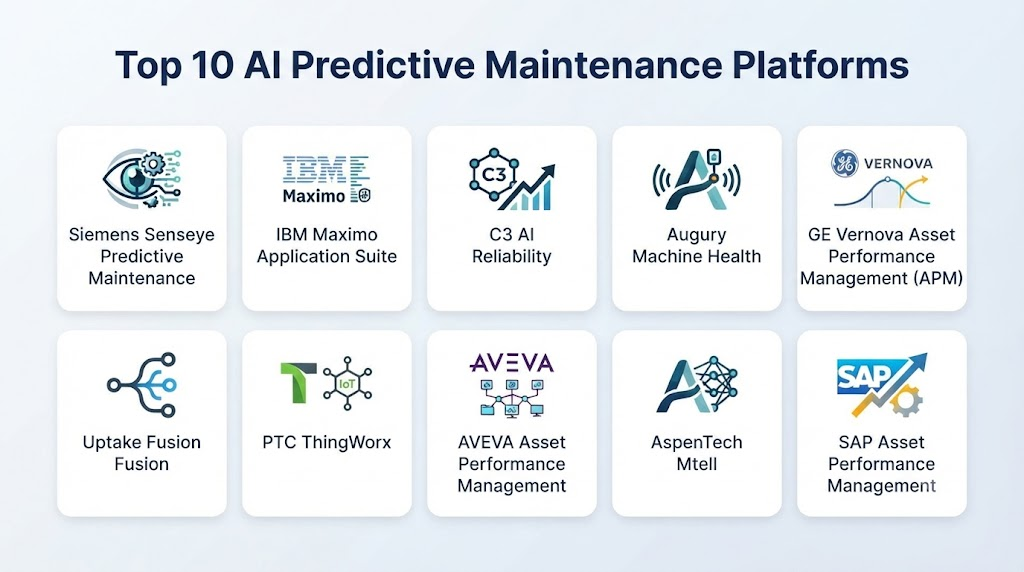
Top 10 AI Predictive Maintenance Platforms
1 — IBM Maximo Application Suite
One-line verdict: Best for enterprises combining asset management, maintenance workflows, IoT data, and AI-driven equipment insights.
Short description:
IBM Maximo Application Suite combines enterprise asset management with monitoring, reliability, maintenance, and AI capabilities.
Its broad architecture makes it suitable for organizations that want predictive maintenance connected directly to asset-management and work-order processes.
Standout Capabilities
- Enterprise asset management.
- Predictive maintenance.
- Asset health monitoring.
- Maintenance planning.
- Work-order management.
- IoT integration.
- Condition monitoring.
- AI-assisted maintenance workflows.
AI-Specific Depth
- Model support: AI and machine-learning capabilities vary by Maximo components and deployment.
- RAG / knowledge integration: Enterprise asset records and maintenance information can support AI-assisted workflows where configured.
- Evaluation: Organizations should evaluate models using historical failure and maintenance data.
- Guardrails: Enterprise permissions, workflows, approvals, and human review.
- Observability: Asset health, equipment condition, maintenance activity, and operational metrics.
Pros
- Strong asset-management foundation.
- Connects predictive insights to maintenance workflows.
- Suitable for large industrial organizations.
Cons
- Enterprise implementation can be complex.
- Full capabilities may require multiple components.
- Costs can increase with customization and integrations.
Security & Compliance
Security capabilities depend on deployment and configuration. Specific certifications should be independently verified for the relevant environment.
Deployment & Platforms
- Cloud.
- Hybrid.
- Enterprise.
- Web.
Integrations & Ecosystem
Potential integrations include:
- IoT platforms.
- ERP systems.
- SCADA.
- MES.
- Sensors.
- Data warehouses.
- Maintenance systems.
Pricing Model
Enterprise/custom pricing. Exact pricing is Not publicly stated.
Best-Fit Scenarios
- Large manufacturing enterprises.
- Utilities.
- Transportation and infrastructure.
- Asset-intensive organizations.
2 — Siemens Senseye Predictive Maintenance
One-line verdict: Best for industrial organizations seeking AI-based equipment monitoring, anomaly detection, and predictive maintenance across asset fleets.
Short description:
Siemens Senseye Predictive Maintenance focuses on applying AI to industrial asset-health monitoring and predictive maintenance.
The platform is designed to identify abnormal equipment behavior and provide maintenance teams with information that can help prioritize interventions.
Standout Capabilities
- AI-based anomaly detection.
- Asset-health monitoring.
- Predictive maintenance.
- Fleet monitoring.
- Failure-risk identification.
- Equipment insights.
- Maintenance prioritization.
- Industrial analytics.
AI-Specific Depth
- Model support: Proprietary AI/ML capabilities.
- RAG / knowledge integration: Maintenance and asset information can be incorporated depending on implementation.
- Evaluation: Historical equipment data and maintenance outcomes can be used to assess predictive performance.
- Guardrails: Alert thresholds, workflow controls, permissions, and human review.
- Observability: Equipment health, anomalies, alerts, trends, and operational metrics.
Pros
- Strong industrial focus.
- Useful across large equipment fleets.
- Focused on predictive maintenance.
Cons
- Best value may require substantial operational data.
- Exact integrations vary by environment.
- Advanced deployments may require industrial expertise.
Security & Compliance
Security capabilities depend on deployment. Specific certifications are Not publicly stated unless verified for the applicable environment.
Deployment & Platforms
- Cloud.
- Industrial environments.
- Enterprise.
- Hybrid integrations.
Integrations & Ecosystem
- Industrial sensors.
- PLCs.
- SCADA.
- Historians.
- MES.
- Asset-management systems.
- Industrial IoT platforms.
Pricing Model
Enterprise/custom pricing. Exact pricing is Not publicly stated.
Best-Fit Scenarios
- Manufacturing fleets.
- Industrial equipment.
- Multi-site predictive maintenance.
3 — C3 AI Reliability
One-line verdict: Best for large enterprises wanting AI-based reliability analytics across complex industrial equipment and maintenance operations.
Short description:
C3 AI provides industrial AI applications for predictive maintenance and reliability management.
Its approach is designed for organizations that want to combine equipment data, maintenance information, operational context, and machine-learning models.
Standout Capabilities
- Predictive maintenance.
- Equipment-health monitoring.
- Failure prediction.
- Asset reliability.
- Fleet analytics.
- Anomaly detection.
- Maintenance prioritization.
- Enterprise AI integration.
AI-Specific Depth
- Model support: Machine-learning and AI models within the C3 AI ecosystem.
- RAG / knowledge integration: Enterprise data and operational information can support AI workflows.
- Evaluation: Model performance can be evaluated using historical maintenance and failure outcomes.
- Guardrails: Enterprise access controls, workflows, and human review.
- Observability: Equipment predictions, anomalies, model performance, and operational KPIs.
Pros
- Enterprise AI orientation.
- Strong industrial analytics.
- Suitable for complex asset environments.
Cons
- Enterprise implementation can be significant.
- Requires substantial data integration.
- May be more than smaller organizations need.
Security & Compliance
Security capabilities depend on deployment and configuration. Specific certifications should be verified for the relevant environment.
Deployment & Platforms
- Cloud.
- Enterprise.
- Hybrid.
- Deployment varies.
Integrations & Ecosystem
- IoT.
- ERP.
- CMMS.
- Historians.
- SCADA.
- Data warehouses.
- Industrial systems.
Pricing Model
Enterprise/custom pricing. Exact pricing is Not publicly stated.
Best-Fit Scenarios
- Large industrial enterprises.
- Energy.
- Manufacturing.
- Asset-intensive operations.
4 — Augury
One-line verdict: Best for organizations focused on machine-health monitoring, diagnostics, and predictive maintenance for critical industrial equipment.
Short description:
Augury focuses on machine health and industrial reliability, combining machine signals with AI-based diagnostics and maintenance insights.
Its approach is particularly relevant for organizations trying to move from reactive maintenance toward continuous machine-health monitoring.
Standout Capabilities
- Machine-health monitoring.
- AI diagnostics.
- Predictive maintenance.
- Machine anomaly detection.
- Equipment insights.
- Failure identification.
- Reliability analytics.
- Maintenance decision support.
AI-Specific Depth
- Model support: Proprietary AI/ML models.
- RAG / knowledge integration: Maintenance and equipment context can support diagnostic workflows.
- Evaluation: Historical machine behavior and maintenance outcomes can be used to evaluate predictions.
- Guardrails: Alert prioritization, workflow controls, permissions, and technician review.
- Observability: Machine health, alerts, anomalies, and condition trends.
Pros
- Strong machine-health focus.
- Useful for reliability teams.
- Designed around equipment signals.
Cons
- Sensor requirements vary.
- Integration requirements depend on the asset environment.
- Exact AI architecture is not fully public.
Security & Compliance
Specific security certifications are Not publicly stated unless independently verified for the applicable deployment.
Deployment & Platforms
- Cloud.
- Industrial edge integrations.
- Enterprise.
- Hybrid architectures.
Integrations & Ecosystem
- Sensors.
- Industrial equipment.
- CMMS.
- ERP.
- Historians.
- IoT platforms.
- Maintenance systems.
Pricing Model
Enterprise/custom pricing. Exact pricing is Not publicly stated.
Best-Fit Scenarios
- Manufacturing.
- Machine-heavy production.
- Critical asset monitoring.
5 — Honeywell Forge
One-line verdict: Best for industrial organizations connecting asset performance, operational data, maintenance, and enterprise industrial analytics.
Short description:
Honeywell Forge provides industrial performance-management capabilities that can bring operational and asset information together for monitoring and optimization.
Predictive maintenance can form part of a broader industrial analytics strategy involving equipment, operations, and performance data.
Standout Capabilities
- Asset performance monitoring.
- Industrial analytics.
- Equipment monitoring.
- Operational intelligence.
- Predictive insights.
- Maintenance support.
- Performance dashboards.
- Industrial data integration.
AI-Specific Depth
- Model support: AI/ML capabilities vary by solution.
- RAG / knowledge integration: Industrial data and asset information can support AI workflows.
- Evaluation: Application-specific model validation is required.
- Guardrails: Industrial permissions, workflow controls, and human review.
- Observability: Asset performance, alarms, trends, and operational KPIs.
Pros
- Strong industrial ecosystem.
- Useful for large operational environments.
- Connects equipment and operational information.
Cons
- Broad industrial platform.
- Exact predictive-maintenance capabilities vary.
- Enterprise implementation can be complex.
Security & Compliance
Security and compliance depend on deployment and product configuration. Specific certifications should be independently verified.
Deployment & Platforms
- Cloud.
- Edge.
- Hybrid.
- Enterprise.
Integrations & Ecosystem
- SCADA.
- PLCs.
- Historians.
- MES.
- Sensors.
- ERP.
- Maintenance systems.
Pricing Model
Enterprise/custom pricing. Exact pricing is Not publicly stated.
Best-Fit Scenarios
- Industrial enterprises.
- Process industries.
- Asset performance management.
6 — PTC ThingWorx
One-line verdict: Best for organizations building customized IoT and AI predictive-maintenance applications around connected industrial assets.
Short description:
PTC ThingWorx provides an industrial IoT application-development environment that can connect assets, machines, sensors, and enterprise data.
It can serve as a foundation for predictive-maintenance solutions that combine IoT connectivity with analytics and machine learning.
Standout Capabilities
- Industrial IoT.
- Asset connectivity.
- Real-time monitoring.
- Application development.
- Analytics.
- Digital-twin capabilities.
- Predictive maintenance.
- Enterprise integration.
AI-Specific Depth
- Model support: AI/ML capabilities vary and can be connected through the platform ecosystem.
- RAG / knowledge integration: Asset and industrial data can be integrated into AI workflows.
- Evaluation: Custom model evaluation is required.
- Guardrails: Application permissions, workflows, user roles, and industrial controls.
- Observability: Asset telemetry, application metrics, equipment health, and alerts.
Pros
- Highly extensible.
- Strong IoT foundation.
- Useful for custom industrial applications.
Cons
- Requires development expertise.
- Predictive models may need additional engineering.
- Architecture can become complex.
Security & Compliance
Security depends on deployment and configuration. Specific certifications are Not publicly stated unless independently verified.
Deployment & Platforms
- Cloud.
- On-premises.
- Edge.
- Hybrid.
Integrations & Ecosystem
- IoT devices.
- Sensors.
- PLCs.
- ERP.
- MES.
- APIs.
- Analytics systems.
Pricing Model
Enterprise/custom pricing. Exact pricing is Not publicly stated.
Best-Fit Scenarios
- Custom predictive-maintenance applications.
- Industrial IoT.
- Connected factories.
7 — AVEVA Predictive Analytics
One-line verdict: Best for industrial organizations using process and equipment data to identify abnormal conditions and predict asset behavior.
Short description:
AVEVA provides industrial software for operations, asset performance, data management, and analytics.
Its predictive-analytics capabilities can be used to analyze industrial equipment and process information for early detection and maintenance decision support.
Standout Capabilities
- Predictive analytics.
- Asset monitoring.
- Process analytics.
- Anomaly detection.
- Industrial data integration.
- Equipment performance.
- Operational dashboards.
- Asset performance management.
AI-Specific Depth
- Model support: Statistical, predictive, and machine-learning capabilities vary by solution.
- RAG / knowledge integration: Industrial process and asset data can support analytical workflows.
- Evaluation: Historical data and known equipment events can be used for model validation.
- Guardrails: User permissions, workflow controls, alarm management, and human review.
- Observability: Asset health, trends, anomalies, and predictive outputs.
Pros
- Strong industrial-data ecosystem.
- Useful for process industries.
- Integrates with broader operations software.
Cons
- Product portfolio is broad.
- Exact AI capabilities depend on the selected solution.
- Enterprise configuration can be complex.
Security & Compliance
Security and compliance capabilities vary by deployment. Specific certifications are Not publicly stated unless verified.
Deployment & Platforms
- Cloud.
- Edge.
- On-premises.
- Hybrid.
Integrations & Ecosystem
- Historians.
- SCADA.
- DCS.
- MES.
- Sensors.
- ERP.
- Industrial IoT.
Pricing Model
Enterprise/custom pricing. Exact pricing is Not publicly stated.
Best-Fit Scenarios
- Process industries.
- Manufacturing.
- Asset performance management.
8 — GE Vernova APM
One-line verdict: Best for energy and industrial organizations managing reliability, asset risk, maintenance strategies, and equipment performance.
Short description:
GE Vernova’s asset-performance-management capabilities are designed for asset-intensive industries, particularly energy.
The platform approach can combine equipment information, reliability analysis, maintenance strategies, and operational data to support predictive and condition-based maintenance.
Standout Capabilities
- Asset performance management.
- Reliability analytics.
- Equipment monitoring.
- Maintenance strategy.
- Risk analysis.
- Asset health.
- Failure analysis.
- Enterprise asset insights.
AI-Specific Depth
- Model support: Analytics and AI/ML capabilities vary by solution.
- RAG / knowledge integration: Asset and maintenance data can support AI-assisted workflows where available.
- Evaluation: Historical equipment events and maintenance outcomes should be used for evaluation.
- Guardrails: Maintenance workflows, risk controls, permissions, and human review.
- Observability: Asset-health metrics, risk indicators, maintenance events, and equipment trends.
Pros
- Strong asset-intensive industry orientation.
- Particularly relevant to energy.
- Supports reliability programs.
Cons
- Primarily enterprise-focused.
- Implementation can be complex.
- Exact AI capabilities vary.
Security & Compliance
Security capabilities depend on deployment and configuration. Specific certifications should be independently verified.
Deployment & Platforms
- Cloud.
- Enterprise.
- Hybrid.
- Industrial environments.
Integrations & Ecosystem
- SCADA.
- Historians.
- ERP.
- CMMS.
- Sensors.
- Industrial control systems.
- Data platforms.
Pricing Model
Enterprise/custom pricing. Exact pricing is Not publicly stated.
Best-Fit Scenarios
- Power generation.
- Utilities.
- Energy infrastructure.
9 — Dataiku Predictive Maintenance Stack
One-line verdict: Best for data-science teams building customized predictive-maintenance models across multiple industrial datasets.
Short description:
Dataiku provides a collaborative data and AI platform that can be used to develop predictive-maintenance workflows.
It is not a dedicated CMMS or industrial control system, but it can provide the analytics and model-development layer around equipment data.
Standout Capabilities
- Data preparation.
- Machine learning.
- Predictive modeling.
- Feature engineering.
- Model evaluation.
- AI governance.
- Workflow automation.
- Enterprise analytics.
AI-Specific Depth
- Model support: Multiple machine-learning approaches and model-development options.
- RAG / knowledge integration: Can support AI workflows using connected enterprise information.
- Evaluation: Model testing, validation, monitoring, and comparison.
- Guardrails: AI governance, permissions, model controls, and workflow governance.
- Observability: Model metrics, data quality, performance, and operational monitoring.
Pros
- Flexible data-science environment.
- Strong model-development capabilities.
- Useful for custom predictive-maintenance projects.
Cons
- Requires data-science expertise.
- Not an out-of-the-box maintenance-management system.
- Industrial integrations may require additional engineering.
Security & Compliance
Security capabilities depend on deployment and configuration. Specific certifications should be verified for the relevant environment.
Deployment & Platforms
- Cloud.
- On-premises.
- Hybrid.
- Enterprise.
Integrations & Ecosystem
- Databases.
- IoT platforms.
- Data lakes.
- ERP.
- CMMS.
- APIs.
- Industrial historians.
Pricing Model
Enterprise/custom pricing. Exact pricing is Not publicly stated.
Best-Fit Scenarios
- Data-science-led maintenance.
- Custom predictive models.
- Multi-source industrial analytics.
10 — Custom AI Predictive Maintenance Platform
One-line verdict: Best for organizations needing proprietary failure prediction, asset-health models, and maintenance optimization across unique equipment.
Short description:
A custom predictive-maintenance platform can combine sensor telemetry, maintenance history, equipment specifications, operating conditions, work orders, environmental information, and machine-learning models.
This approach is especially useful when commercial platforms cannot adequately represent specialized assets or proprietary maintenance processes.
Standout Capabilities
- Failure prediction.
- Remaining useful life estimation.
- Anomaly detection.
- Fault classification.
- Root-cause analysis.
- Maintenance optimization.
- Spare-parts forecasting.
- Natural-language maintenance assistants.
AI-Specific Depth
- Model support: Gradient boosting, neural networks, time-series models, anomaly detection, LLMs, and other models.
- RAG / knowledge integration: Maintenance manuals, work orders, equipment documentation, engineering records, and service histories.
- Evaluation: Historical backtesting, precision/recall, lead-time analysis, false-alarm rates, and technician review.
- Guardrails: Role-based access, confidence thresholds, approval workflows, prompt-injection protection, and human override.
- Observability: Model drift, latency, prediction accuracy, alert volume, inference costs, and equipment-health trends.
Pros
- Maximum customization.
- Can model proprietary equipment.
- Integrates directly with existing enterprise architecture.
Cons
- High engineering requirements.
- Requires substantial historical data.
- Long-term model maintenance is necessary.
Security & Compliance
Organizations can implement:
- SSO.
- RBAC.
- Encryption.
- Audit logs.
- Data retention controls.
- Data residency.
- Network isolation.
- Model versioning.
Specific certifications are Not publicly stated for a generic implementation.
Deployment & Platforms
- Cloud.
- Self-hosted.
- Edge.
- Hybrid.
Integrations & Ecosystem
Potential integrations include:
- IoT.
- SCADA.
- CMMS.
- ERP.
- MES.
- Historians.
- Data lakes.
Pricing Model
Custom development and infrastructure. Exact pricing is N/A.
Best-Fit Scenarios
- Proprietary industrial equipment.
- Large asset fleets.
- Organizations with mature data-science teams.
Comparison Table
| Tool | Best For | Deployment | Model Flexibility | Strength | Watch-Out | Public Rating |
|---|---|---|---|---|---|---|
| IBM Maximo Application Suite | Enterprise asset management | Cloud / Hybrid | AI / Multi-model ecosystem | Maintenance workflow integration | Implementation complexity | |
| Siemens Senseye | Industrial predictive maintenance | Cloud / Hybrid | Proprietary AI/ML | Fleet-level equipment monitoring | Data requirements | |
| C3 AI Reliability | Enterprise reliability | Cloud / Hybrid | AI/ML | Industrial AI | Integration effort | |
| Augury | Machine health | Cloud / Hybrid | Proprietary AI/ML | Equipment diagnostics | Sensor requirements | |
| Honeywell Forge | Industrial asset performance | Cloud / Hybrid | AI/Analytics | Industrial ecosystem | Broad platform | |
| PTC ThingWorx | Custom IoT applications | Cloud / Edge / Hybrid | Multi-model integration | Extensibility | Development effort | |
| AVEVA Predictive Analytics | Process industries | Cloud / Edge / Hybrid | ML / Analytics | Industrial analytics | Configuration complexity | |
| GE Vernova APM | Energy and utilities | Cloud / Hybrid | AI/Analytics | Asset reliability | Enterprise focus | |
| Dataiku | Data-science teams | Cloud / Hybrid | Multi-model | Custom modeling | Requires expertise | |
| Custom AI Platform | Proprietary assets | Cloud / Edge / Hybrid | Multi-model | Maximum flexibility | Engineering burden |
Scoring & Evaluation
These scores are comparative editorial assessments rather than absolute product ratings.
A predictive-maintenance platform should be evaluated using actual equipment data, known failure events, maintenance records, sensor coverage, false-alarm rates, and measurable business outcomes.
The most important question is not simply whether an AI model predicts failures accurately. It is whether the prediction provides enough useful lead time for maintenance teams to act profitably.
| Tool | Core Features | AI Reliability | Predictive Depth | Integrations | Ease | Performance/Cost | Security/Admin | Support | Weighted Total |
|---|---|---|---|---|---|---|---|---|---|
| IBM Maximo | 10 | 9 | 9 | 10 | 7 | 8 | 10 | 10 | 9.15 |
| Siemens Senseye | 9 | 10 | 10 | 9 | 8 | 9 | 9 | 10 | 9.30 |
| C3 AI Reliability | 10 | 10 | 10 | 10 | 7 | 8 | 10 | 9 | 9.40 |
| Augury | 9 | 10 | 10 | 9 | 8 | 8 | 9 | 9 | 9.15 |
| Honeywell Forge | 9 | 9 | 9 | 10 | 7 | 8 | 10 | 10 | 9.10 |
| PTC ThingWorx | 9 | 8 | 9 | 10 | 7 | 8 | 9 | 9 | 8.85 |
| AVEVA | 9 | 9 | 9 | 10 | 7 | 8 | 9 | 10 | 9.00 |
| GE Vernova APM | 10 | 9 | 9 | 10 | 7 | 8 | 10 | 10 | 9.15 |
| Dataiku | 8 | 10 | 10 | 9 | 7 | 8 | 10 | 9 | 8.95 |
| Custom AI Platform | 10 | 10 | 10 | 10 | 5 | 7 | 10 | 10 | 9.40 |
Top 3 for Enterprise
- C3 AI Reliability — Strong enterprise AI and reliability capabilities.
- IBM Maximo Application Suite — Excellent combination of predictive maintenance and asset management.
- Siemens Senseye — Strong industrial predictive-maintenance orientation.
Top 3 for SMB
- Augury — Focused machine-health approach.
- PTC ThingWorx — Flexible foundation for connected-asset applications.
- Dataiku — Strong option for organizations with internal data-science expertise.
Top 3 for Developers
- Custom AI Predictive Maintenance Platform — Maximum flexibility.
- Dataiku — Strong model-development environment.
- PTC ThingWorx — Strong IoT and application-development foundation.
Which AI Predictive Maintenance Platform Is Right for You?
Solo / Small Facility
Start simple.
You may not need a complete enterprise predictive-maintenance platform if you only operate a small number of assets.
Focus on:
- Critical equipment.
- Sensor availability.
- Maintenance history.
- Failure costs.
- Basic anomaly detection.
Select the equipment where downtime has the greatest financial impact.
SMB Manufacturing
SMBs should focus on a few high-value assets rather than trying to monitor everything.
Good starting points include:
- Motors.
- Pumps.
- Compressors.
- CNC equipment.
- Production bottlenecks.
Measure downtime before and after implementation.
Mid-Market Manufacturer
A mid-market organization can expand predictive maintenance across multiple asset categories.
Prioritize:
- Equipment-health scores.
- Failure prediction.
- Work-order integration.
- Spare-parts planning.
- Maintenance prioritization.
- Fleet analytics.
Enterprise
Large organizations should build a connected architecture:
Sensors → Edge → IoT → Data platform → AI → Asset health → CMMS/EAM → Work order → Technician feedback
Enterprise requirements should include:
- Multi-site management.
- Central governance.
- Model lifecycle management.
- Data lineage.
- Role-based access.
- Security monitoring.
- Integration with ERP and EAM.
- Cost controls.
Energy and Utilities
Energy organizations should prioritize reliability and risk.
Important applications include:
- Turbine monitoring.
- Transformer monitoring.
- Generator health.
- Compressor analytics.
- Grid equipment.
- Predictive failure detection.
The cost of failure can be exceptionally high, making predictive maintenance particularly valuable.
Process Manufacturing
For chemical, pharmaceutical, food, and other process industries, combine equipment data with process conditions.
A pump’s health may depend not only on vibration but also on:
- Flow.
- Pressure.
- Temperature.
- Fluid properties.
- Operating mode.
Contextual data can significantly improve model usefulness.
Transportation
Predictive maintenance can support:
- Engines.
- Braking systems.
- Bearings.
- HVAC.
- Rail equipment.
- Aircraft components.
- Fleet assets.
The architecture should support mobile and remote assets where connectivity may be intermittent.
Budget vs Premium
Budget implementations can begin with:
- Existing sensors.
- Historical maintenance records.
- Cloud analytics.
- Basic anomaly detection.
Premium programs may add:
- Edge analytics.
- Advanced digital twins.
- Remaining useful life models.
- Fleet-wide optimization.
- Automated work orders.
- Multimodal AI assistants.
The business case should include total cost of ownership.
Build vs Buy
Buy when:
- You need rapid implementation.
- Your equipment is reasonably standardized.
- You need vendor support.
- Maintenance workflows are conventional.
Build when:
- Equipment is proprietary.
- Failure patterns are unique.
- You have strong data-science capabilities.
- Predictive models are a strategic competitive advantage.
A hybrid approach is often best:
Commercial EAM/CMMS + commercial IoT platform + custom AI models
Implementation Playbook
First 30 Days: Establish the Baseline
Select 5–20 high-value assets.
Collect:
- Sensor data.
- Failure history.
- Maintenance records.
- Operating conditions.
- Equipment specifications.
- Work orders.
- Downtime records.
Calculate:
- Mean time between failures.
- Mean time to repair.
- Downtime cost.
- Maintenance cost.
- False-alarm rate.
Days 31–60: Develop the Predictive Model
Start with anomaly detection or failure prediction.
Create separate datasets for:
- Training.
- Validation.
- Testing.
Avoid random splitting when time-series data is involved if it causes information leakage.
Evaluate:
- Precision.
- Recall.
- False positives.
- False negatives.
- Lead time.
- Prediction stability.
- Model drift.
Build an AI Evaluation Harness
Test:
- Normal operating conditions.
- Startup/shutdown.
- Different production modes.
- Sensor failures.
- Missing data.
- Known equipment faults.
- Maintenance events.
Days 61–90: Connect Predictions to Maintenance
Integrate predictive alerts with the maintenance workflow.
A useful process is:
Prediction → severity → confidence → technician review → inspection → work order → repair → outcome feedback
Track whether predictions actually led to useful interventions.
Optimize:
- Alert frequency.
- Thresholds.
- Model latency.
- Inference costs.
- Sensor sampling.
- Maintenance prioritization.
Common Mistakes and How to Avoid Them
- Predicting failure without useful lead time: Accuracy is less valuable if maintenance cannot act in time.
- Ignoring false alarms: Too many alerts can cause technicians to ignore the system.
- Training on insufficient failures: Rare failures require careful modeling.
- Ignoring sensor quality: Bad telemetry produces bad predictions.
- Ignoring changing operating conditions: Equipment behavior varies by load and operating mode.
- Failing to account for maintenance events: Repairs can change the equipment’s baseline.
- Ignoring data leakage: Future information can accidentally enter the training dataset.
- Using only sensor data: Maintenance history and operating context can be valuable.
- Ignoring class imbalance: Equipment failures may represent a tiny percentage of observations.
- Assuming every asset needs AI: Some equipment is cheaper to maintain preventively.
- Not connecting predictions to work orders: An alert without action has limited business value.
- Ignoring model drift: Equipment, processes, and operating conditions change.
- Automating maintenance blindly: AI recommendations should be reviewed according to risk.
- Ignoring cybersecurity: Connected industrial assets expand the attack surface.
- Failing to monitor inference costs: Large sensor fleets can generate substantial data-processing expenses.
- Ignoring edge latency: Some applications require local inference.
- Ignoring technician feedback: Maintenance teams can provide valuable labels and contextual information.
- Treating RUL as exact: Remaining useful life should be treated as an estimate, not a guaranteed countdown.
- Ignoring business impact: A technically accurate model may still have poor ROI.
FAQs
What is AI predictive maintenance?
AI predictive maintenance uses machine learning and other analytical methods to detect equipment problems, predict potential failures, and support maintenance decisions before breakdowns occur.
How is predictive maintenance different from preventive maintenance?
Preventive maintenance follows a predetermined schedule. Predictive maintenance uses actual equipment condition and data to determine when intervention may be necessary.
What equipment can AI predictive maintenance monitor?
Almost any equipment that generates useful operational data can potentially be monitored, including motors, pumps, compressors, turbines, gearboxes, production machinery, vehicles, and HVAC systems.
Does predictive maintenance require IoT sensors?
Not necessarily. Existing PLC, SCADA, historian, equipment, or maintenance data may already provide useful signals.
However, additional sensors can improve observability.
Can AI predict exactly when a machine will fail?
Usually not. AI provides an estimate based on available evidence.
Remaining useful life should be treated as an uncertain prediction rather than an exact failure date.
What is anomaly detection?
Anomaly detection identifies behavior that differs significantly from expected equipment behavior.
It can be useful when failure examples are rare.
What is remaining useful life?
Remaining useful life is an estimate of how much operating time or usage remains before an asset reaches a defined failure or degradation condition.
Can AI detect bearing failures?
Yes. Vibration, acoustic, temperature, electrical, and other signals can potentially be used to identify bearing-related abnormalities.
Can predictive maintenance reduce downtime?
It can, particularly when predictions provide sufficient lead time for maintenance teams to intervene before failure.
Actual results depend on equipment, data quality, workflow integration, and implementation.
Can predictive maintenance work without historical failures?
Yes, anomaly detection can sometimes be developed without large numbers of known failure examples.
However, failure prediction and remaining useful life models generally benefit from representative historical failure or degradation data.
Can AI integrate with a CMMS?
Yes. A predictive-maintenance platform can potentially send alerts, recommendations, or work-order information to a CMMS or EAM system.
Can AI automatically create work orders?
Technically, yes, depending on the platform and integration.
However, organizations should determine appropriate approval requirements before automating maintenance actions.
What is edge AI in predictive maintenance?
Edge AI runs analytics close to the equipment rather than sending every piece of data to a remote cloud service.
This can reduce latency, bandwidth requirements, and dependence on continuous connectivity.
Is cloud predictive maintenance secure?
Cloud security depends on the provider, architecture, configuration, identity controls, network design, encryption, and organizational policies.
Security should be evaluated as part of the procurement process.
Can predictive maintenance use open-source models?
Yes. Organizations can build predictive-maintenance systems using open-source machine-learning libraries and models.
However, the engineering and maintenance responsibility then falls more heavily on the organization.
Can LLMs be used for predictive maintenance?
Yes, but LLMs are usually more useful for maintenance documentation, technician assistance, knowledge retrieval, work-order summarization, and natural-language interfaces than for directly predicting equipment degradation from raw sensor signals.
Specialized time-series and machine-learning models are often more appropriate for the prediction layer.
What is RAG in predictive maintenance?
RAG can allow a maintenance assistant to retrieve relevant manuals, maintenance histories, troubleshooting procedures, and equipment documentation before generating an answer.
How should AI predictive-maintenance models be evaluated?
Use historical data and realistic testing to measure precision, recall, false alarms, missed failures, lead time, stability, and business impact.
How much do AI predictive-maintenance platforms cost?
Costs vary according to the number of assets, sensors, data volume, software, integrations, deployment, and support requirements. Exact enterprise pricing is often Not publicly stated.
What is the biggest benefit of predictive maintenance?
The major benefit is the ability to identify developing equipment problems early enough to plan maintenance and reduce unexpected downtime.
What is the biggest limitation?
Predictive models are only as useful as the data, equipment context, failure history, and maintenance processes supporting them.
Conclusion
AI Predictive Maintenance Platforms are moving industrial maintenance from scheduled and reactive approaches toward more condition-based and data-driven operations.Platforms such as IBM Maximo, Siemens Senseye, C3 AI Reliability, Augury, Honeywell Forge, PTC ThingWorx, AVEVA, and GE Vernova APM represent different approaches to the problem.Some focus heavily on enterprise asset management. Others specialize in machine health, industrial AI, IoT connectivity, or data science.organizations with specialized equipment, a custom AI layer can provide greater flexibility.