Introduction
AI Public Health Outbreak Detection tools use artificial intelligence, machine learning, natural-language processing, epidemiological models, and real-time data analysis to identify signals that may indicate an emerging infectious-disease outbreak. Instead of relying only on confirmed case reports, these systems can analyze multiple information streams and help public-health teams detect unusual patterns earlier.Potential signals include changes in disease reports, laboratory results, emergency-department activity, syndromic surveillance, wastewater measurements, travel patterns, news reports, and other publicly available information. AI can help connect weak signals that may be difficult to identify manually.Outbreak detection is especially valuable because infectious diseases can spread before traditional surveillance systems have complete information. Early identification can support faster investigation, testing, resource allocation, communication, and intervention.
What Is AI Public Health Outbreak Detection?
AI Public Health Outbreak Detection refers to software systems that analyze large volumes of health and non-health information to identify unusual patterns that may indicate disease transmission.
Traditional surveillance can depend on:
- Confirmed cases.
- Laboratory reporting.
- Physician reports.
- Hospital admissions.
- Public-health notifications.
- Epidemiological investigations.
AI can expand this approach by examining multiple signals simultaneously.
For example, an outbreak intelligence platform may identify:
- A sudden increase in respiratory symptoms.
- Unusual laboratory activity.
- Geographic clustering.
- Increased emergency visits.
- Changes in wastewater measurements.
- Reports of similar symptoms in local communities.
- Emerging disease mentions in public information sources.
The system can then flag the pattern for epidemiologists to investigate.
AI does not prove that an outbreak exists. A signal is an indication that requires validation.
A responsible workflow is therefore:
Why AI Outbreak Detection Matters
Outbreaks can develop faster than traditional reporting systems can respond.
Early detection can help public-health organizations:
- Investigate unusual disease activity.
- Prioritize testing.
- Allocate medical resources.
- Identify affected regions.
- Monitor disease spread.
- Track emerging pathogens.
- Coordinate public-health responses.
- Communicate risks more effectively.
AI can be particularly useful because public-health data is often fragmented.
A single outbreak may appear simultaneously in:
- Hospital data.
- Laboratory systems.
- Syndromic surveillance.
- Wastewater monitoring.
- Pharmacy activity.
- School absenteeism.
- Veterinary surveillance.
- Public reports.
- News coverage.
- Travel data.
The challenge is separating meaningful signals from ordinary variation.
That is where anomaly detection, natural-language processing, forecasting, geospatial analysis, and epidemiological modeling can help.
Key Use Cases
Infectious Disease Surveillance
AI can monitor disease indicators and identify unusual changes.
Syndromic Surveillance
Machine learning can analyze symptoms and healthcare utilization before laboratory confirmation is available.
Wastewater Surveillance
AI can help identify trends in pathogen measurements across geographic areas.
Respiratory Disease Monitoring
Platforms can track signals associated with influenza-like illness, respiratory infections, and other conditions.
Emerging Pathogen Detection
AI can help identify unusual disease signals that may require further investigation.
Global Epidemic Intelligence
Systems can scan information from multiple geographic regions and languages.
Travel-Related Disease Surveillance
Travel and geographic information can help public-health teams assess potential disease movement.
Antimicrobial Resistance
AI can support surveillance for unusual resistance patterns and emerging threats.
Veterinary and Zoonotic Surveillance
Combining human, animal, and environmental data can help identify potential zoonotic risks.
Hospital Outbreak Monitoring
Hospitals can use AI to identify unusual clusters among patients or healthcare workers.
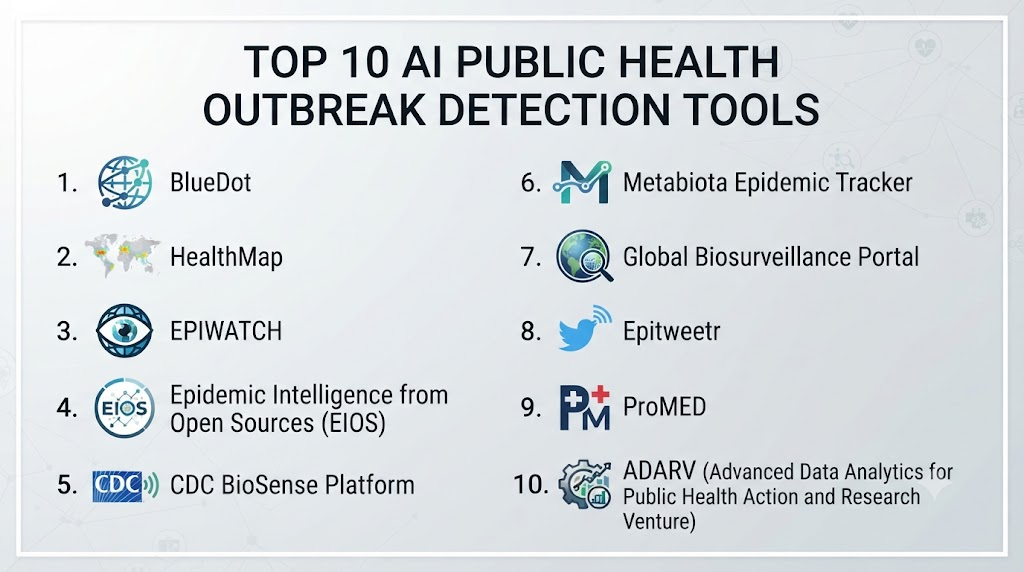
Top 10 AI Public Health Outbreak Detection Tools
1 — BlueDot
One-line verdict: Best for organizations seeking AI-powered infectious-disease intelligence and early warning across global health signals.
Short description:
BlueDot is an infectious-disease intelligence company focused on identifying and assessing emerging disease threats. Its technology combines epidemiology, data science, and automated information analysis to help organizations monitor infectious-disease risks.
Standout Capabilities
- Infectious-disease surveillance.
- Outbreak intelligence.
- Global disease monitoring.
- Risk assessment.
- Automated information processing.
- Epidemiological analysis.
- Geographic monitoring.
- Early-warning workflows.
AI-Specific Depth
- Model support: Proprietary AI, machine learning, and epidemiological models.
- RAG / knowledge integration: Integrates information from multiple data sources; specific vector-database compatibility is not publicly stated.
- Evaluation: Epidemiological validation and surveillance performance are important; exact internal evaluation methodology is not publicly stated.
- Guardrails: Epidemiological review and analytical workflows.
- Observability: Disease intelligence and risk analytics; detailed LLM token-level observability is not publicly stated.
Pros
- Strong infectious-disease specialization.
- Designed for early warning.
- Combines multiple information sources.
Cons
- Enterprise-oriented.
- Intended for professional public-health and risk-management use.
- Exact pricing is not publicly stated.
Security & Compliance
Security and privacy controls vary by deployment and contract. Specific certifications, data residency, retention, encryption, and identity controls should be verified.
Deployment & Platforms
- Cloud: Yes.
- Web: Yes.
- Self-hosted: Not publicly stated.
- Hybrid: Varies / N/A.
Integrations & Ecosystem
Potential ecosystem connections include:
- Public-health data.
- Healthcare data.
- Epidemiological information.
- Geographic information.
- Travel-related information.
- Analytical systems.
- Organizational dashboards.
Pricing Model
Enterprise/custom pricing. Exact pricing is Not publicly stated.
Best-Fit Scenarios
- Government health organizations.
- Global-health teams.
- Large enterprises managing infectious-disease risk.
2 — HealthMap
One-line verdict: Best for researchers and public-health professionals monitoring global disease activity from diverse information sources.
Short description:
HealthMap is a disease-surveillance and epidemic-intelligence platform associated with Boston Children’s Hospital. It aggregates information from multiple sources to provide a global view of infectious-disease activity.
Standout Capabilities
- Global disease surveillance.
- Geographic visualization.
- Automated information aggregation.
- Disease-event monitoring.
- Epidemic intelligence.
- Public-health research.
- Multilingual information processing.
- Historical disease tracking.
AI-Specific Depth
- Model support: Automated processing and computational surveillance; exact current model architecture is not publicly stated.
- RAG / knowledge integration: Multiple information sources are integrated; specific vector-database compatibility is not publicly stated.
- Evaluation: Surveillance quality and epidemiological review.
- Guardrails: Human epidemiological interpretation.
- Observability: Disease-event and geographic monitoring.
Pros
- Broad global disease coverage.
- Useful for research and surveillance.
- Long-standing epidemic-intelligence approach.
Cons
- Not a full enterprise outbreak-response platform.
- Advanced operational automation may require additional systems.
- Exact deployment capabilities vary.
Security & Compliance
Publicly available surveillance information is a major component. Specific enterprise security controls are Not publicly stated.
Deployment & Platforms
- Web: Yes.
- Cloud: Web-based.
- Self-hosted: Not publicly stated.
- Mobile: Varies / N/A.
Integrations & Ecosystem
- Public health information.
- Disease reports.
- Geographic data.
- Research workflows.
- Epidemiological analysis.
- Surveillance systems.
Pricing Model
Public research and surveillance resource. Commercial enterprise pricing is N/A.
Best-Fit Scenarios
- Epidemiologists.
- Researchers.
- Public-health monitoring teams.
3 — BlueDot Signals
One-line verdict: Best for organizations requiring continuous monitoring of infectious-disease signals and emerging health threats.
Short description:
BlueDot’s broader intelligence capabilities are designed to process health-related information and identify potential disease risks. Its approach combines automated analysis with epidemiological expertise.
Standout Capabilities
- Disease signal monitoring.
- Global surveillance.
- Automated information analysis.
- Risk scoring.
- Geographic intelligence.
- Epidemiological insights.
- Threat monitoring.
- Early warning.
AI-Specific Depth
- Model support: Proprietary AI and epidemiological models.
- RAG / knowledge integration: Multi-source information integration; specific vector-database support is not publicly stated.
- Evaluation: Epidemiological validation.
- Guardrails: Analytical review and risk-assessment processes.
- Observability: Risk and disease surveillance analytics.
Pros
- Specialized in infectious diseases.
- Designed for early signals.
- Combines automated analysis with domain expertise.
Cons
- Enterprise-oriented.
- Exact product capabilities depend on deployment.
- Pricing is not publicly stated.
Security & Compliance
Specific security and compliance controls should be verified contractually.
Deployment & Platforms
- Cloud: Yes.
- Web: Yes.
- Self-hosted: Not publicly stated.
- Hybrid: Varies / N/A.
Integrations & Ecosystem
- Health intelligence.
- Public data.
- Epidemiological information.
- Geographic systems.
- Risk dashboards.
- Organizational workflows.
Pricing Model
Enterprise/custom pricing. Exact pricing is Not publicly stated.
Best-Fit Scenarios
- Public-health organizations.
- Global companies.
- Healthcare risk teams.
4 — Epiwatch
One-line verdict: Best for public-health researchers exploring automated epidemic intelligence and emerging infectious-disease signals.
Short description:
Epiwatch is an epidemic-intelligence initiative associated with the Australian National University. It uses automated analysis and human expertise to identify emerging disease signals from publicly available information.
Standout Capabilities
- Epidemic intelligence.
- Disease-event detection.
- Automated monitoring.
- Public information analysis.
- Emerging-threat identification.
- Epidemiological research.
- Human review.
- Global surveillance.
AI-Specific Depth
- Model support: Machine learning and natural-language processing capabilities vary.
- RAG / knowledge integration: Multiple information sources are analyzed; exact vector-database architecture is not publicly stated.
- Evaluation: Human epidemiological review and surveillance evaluation.
- Guardrails: Expert review.
- Observability: Surveillance-event monitoring.
Pros
- Research-oriented.
- Focused on early disease signals.
- Combines automation with human expertise.
Cons
- Not a conventional commercial enterprise platform.
- Operational deployment options are limited.
- Exact pricing is N/A.
Security & Compliance
Public-source intelligence is central. Enterprise certification details are Not publicly stated.
Deployment & Platforms
- Web: Yes.
- Cloud: Varies.
- Self-hosted: Not publicly stated.
- Mobile: N/A.
Integrations & Ecosystem
- Public information.
- Epidemiological research.
- Disease surveillance.
- Natural-language processing.
- Human review.
- Public-health workflows.
Pricing Model
Research-oriented initiative. Commercial pricing is N/A.
Best-Fit Scenarios
- Epidemiology researchers.
- Public-health analysts.
- Academic surveillance programs.
5 — EpiCore
One-line verdict: Best for global-health organizations combining event-based surveillance with human reporting networks.
Short description:
EpiCore is a community-based event-based surveillance initiative designed to support early detection of disease outbreaks. It combines information sharing and expert networks to identify emerging health events.
Standout Capabilities
- Event-based surveillance.
- Global disease monitoring.
- Human intelligence.
- Disease-event verification.
- Early warning.
- Epidemiological collaboration.
- Regional monitoring.
- Outbreak reporting.
AI-Specific Depth
- Model support: Automated capabilities vary; detailed current AI architecture is not publicly stated.
- RAG / knowledge integration: Multi-source event information; vector-database compatibility is N/A.
- Evaluation: Human verification and epidemiological assessment.
- Guardrails: Expert validation.
- Observability: Surveillance event tracking.
Pros
- Strong human intelligence component.
- Useful for early signals.
- International surveillance orientation.
Cons
- Not primarily an AI software platform.
- Human participation is important to the model.
- Advanced AI features are not publicly stated.
Security & Compliance
Specific enterprise security certifications are Not publicly stated.
Deployment & Platforms
- Web: Yes.
- Cloud: Varies.
- Self-hosted: N/A.
Integrations & Ecosystem
- Public-health organizations.
- Epidemiologists.
- Disease surveillance networks.
- Event reporting.
- Research organizations.
Pricing Model
Community/public-health initiative. Commercial pricing is N/A.
Best-Fit Scenarios
- Global-health organizations.
- Epidemiology networks.
- Disease-surveillance programs.
6 — WastewaterSCAN
One-line verdict: Best for wastewater-based pathogen surveillance and population-level monitoring of infectious-disease trends.
Short description:
WastewaterSCAN is a wastewater surveillance initiative that analyzes wastewater samples for biological indicators associated with infectious diseases. Wastewater surveillance can provide community-level signals before or alongside clinical reporting.
Standout Capabilities
- Wastewater surveillance.
- Pathogen monitoring.
- Community-level trend analysis.
- Laboratory data.
- Geographic analysis.
- Disease trend monitoring.
- Research collaboration.
- Public-health intelligence.
AI-Specific Depth
- Model support: Statistical and analytical methods are used; specific generative-AI architecture is not publicly stated.
- RAG / knowledge integration: N/A for the core surveillance workflow.
- Evaluation: Laboratory validation and longitudinal surveillance.
- Guardrails: Laboratory quality controls and analytical protocols.
- Observability: Sample and surveillance analytics.
Pros
- Population-level surveillance.
- Useful before widespread clinical reporting.
- Strong research foundation.
Cons
- Not a general-purpose AI outbreak platform.
- Requires laboratory infrastructure.
- Geographic coverage depends on sampling networks.
Security & Compliance
Data governance depends on the specific program. Specific enterprise certifications are Not publicly stated.
Deployment & Platforms
- Web: Yes.
- Cloud: Varies.
- Self-hosted: N/A.
Integrations & Ecosystem
- Wastewater laboratories.
- Public-health agencies.
- Research organizations.
- Epidemiological analysis.
- Environmental monitoring.
- Pathogen databases.
Pricing Model
Research/public-health initiative. Commercial pricing is N/A.
Best-Fit Scenarios
- Public-health surveillance.
- Academic research.
- Community disease monitoring.
7 — CDC National Syndromic Surveillance Program
One-line verdict: Best for public-health agencies using large-scale syndromic surveillance to identify unusual patterns in healthcare encounters.
Short description:
The National Syndromic Surveillance Program supports public-health surveillance using near-real-time health information. It can help public-health authorities monitor symptoms and healthcare encounters for unusual patterns.
Standout Capabilities
- Syndromic surveillance.
- Near-real-time monitoring.
- Emergency-department data.
- Public-health analytics.
- Geographic surveillance.
- Anomaly detection.
- Health-event monitoring.
- Epidemiological investigation support.
AI-Specific Depth
- Model support: Statistical, computational, and analytical methods; specific current AI models vary by implementation.
- RAG / knowledge integration: Healthcare surveillance data integration; specific vector-database compatibility is N/A.
- Evaluation: Epidemiological and surveillance validation.
- Guardrails: Public-health governance and analytical review.
- Observability: Surveillance dashboards and analytical monitoring.
Pros
- Large-scale public-health surveillance.
- Useful for early signals.
- Strong governmental infrastructure.
Cons
- Primarily a surveillance program rather than a commercial AI product.
- Access and implementation depend on public-health infrastructure.
- Exact AI capabilities vary.
Security & Compliance
Government public-health security and data-governance requirements apply. Specific controls depend on the participating system.
Deployment & Platforms
- Cloud: Varies.
- Web: Yes.
- Self-hosted: Varies.
- Hybrid: Varies.
Integrations & Ecosystem
- Emergency departments.
- Hospitals.
- Public-health agencies.
- Healthcare data systems.
- Epidemiological tools.
- Government surveillance infrastructure.
Pricing Model
Public-health program. Commercial pricing is N/A.
Best-Fit Scenarios
- State and local health departments.
- Epidemiology teams.
- Public-health surveillance programs.
8 — HealthMap Global Health Intelligence
One-line verdict: Best for researchers and analysts needing broad global infectious-disease event monitoring and geographic visualization.
Short description:
HealthMap’s global surveillance approach combines information from diverse sources to identify and visualize disease events. It is useful for understanding how infectious-disease activity is changing across geographic regions.
Standout Capabilities
- Global disease mapping.
- Disease-event monitoring.
- Geographic visualization.
- Automated information collection.
- Multilingual data.
- Epidemiological intelligence.
- Historical trend analysis.
- Research support.
AI-Specific Depth
- Model support: Automated computational surveillance; specific current model architecture is not publicly stated.
- RAG / knowledge integration: Multi-source information integration.
- Evaluation: Epidemiological validation.
- Guardrails: Human expert interpretation.
- Observability: Disease-event and geographic analytics.
Pros
- Global coverage.
- Useful geographic visualization.
- Strong research value.
Cons
- Not a full outbreak-response management system.
- Commercial enterprise features are limited.
- Exact deployment options vary.
Security & Compliance
Specific enterprise security certifications are Not publicly stated.
Deployment & Platforms
- Web: Yes.
- Cloud: Web-based.
- Self-hosted: Not publicly stated.
Integrations & Ecosystem
- Public health data.
- Geographic information.
- Research.
- Disease surveillance.
- Epidemiological workflows.
Pricing Model
Public research resource. Commercial pricing is N/A.
Best-Fit Scenarios
- Researchers.
- Epidemiologists.
- Global-health analysts.
9 — ProMED
One-line verdict: Best for infectious-disease professionals seeking expert-curated outbreak reports and early event intelligence.
Short description:
ProMED is an expert-driven infectious-disease reporting system operated by the International Society for Infectious Diseases. It provides reports and commentary on emerging infectious-disease events worldwide.
Standout Capabilities
- Outbreak reporting.
- Expert review.
- Emerging-disease monitoring.
- Global coverage.
- Human intelligence.
- Infectious-disease analysis.
- Event verification.
- Epidemiological context.
AI-Specific Depth
- Model support: AI capabilities are not the primary publicly stated focus.
- RAG / knowledge integration: N/A.
- Evaluation: Expert review and epidemiological interpretation.
- Guardrails: Human moderation and expert assessment.
- Observability: Reporting and event-monitoring workflows.
Pros
- Strong expert component.
- Valuable early-warning resource.
- Global infectious-disease focus.
Cons
- Not an AI-first platform.
- Human reporting remains central.
- Not a full enterprise analytics environment.
Security & Compliance
Specific enterprise security certifications are Not publicly stated.
Deployment & Platforms
- Web: Yes.
- Cloud: Web-based.
- Self-hosted: N/A.
Integrations & Ecosystem
- Infectious-disease experts.
- Public-health agencies.
- Epidemiologists.
- Research organizations.
- Global-health networks.
Pricing Model
Public information resource. Commercial pricing is N/A.
Best-Fit Scenarios
- Epidemiologists.
- Infectious-disease specialists.
- Public-health researchers.
10 — Custom AI Outbreak Detection Platform
One-line verdict: Best for governments and large health systems requiring customized surveillance across proprietary clinical and public-health datasets.
Short description:
Large public-health agencies and health systems can develop custom AI surveillance platforms that combine clinical data, laboratory results, wastewater measurements, syndromic information, geographic data, and other appropriate signals.
A custom platform can be designed around local disease patterns and specific response workflows.
Standout Capabilities
- Anomaly detection.
- Disease forecasting.
- Syndromic surveillance.
- Geospatial modeling.
- Natural-language processing.
- Wastewater integration.
- Laboratory surveillance.
- Multi-source signal correlation.
AI-Specific Depth
- Model support: Machine learning, time-series models, NLP, anomaly detection, and potentially foundation models.
- RAG / knowledge integration: Can integrate public-health guidelines, epidemiological literature, and internal knowledge bases.
- Evaluation: Backtesting, temporal validation, outbreak simulations, precision, recall, calibration, and expert review can be implemented.
- Guardrails: Epidemiologist approval, confidence thresholds, escalation policies, and source validation.
- Observability: Data quality, model drift, latency, false positives, false negatives, and alert volumes can be monitored.
Pros
- Maximum customization.
- Can integrate proprietary datasets.
- Full control over governance.
Cons
- Expensive to develop.
- Requires epidemiology and AI expertise.
- Continuous maintenance is required.
Security & Compliance
The organization controls the architecture and is responsible for implementing appropriate privacy, security, access, retention, audit, and governance controls.
Deployment & Platforms
- Cloud: Possible.
- Self-hosted: Possible.
- Hybrid: Possible.
- Web: Possible.
- Mobile: Optional.
Integrations & Ecosystem
Potential integrations include:
- EHRs.
- Laboratory systems.
- Public-health surveillance systems.
- Wastewater data.
- Geographic information systems.
- Data warehouses.
- Research databases.
Pricing Model
Development and infrastructure costs vary significantly. Exact pricing is N/A.
Best-Fit Scenarios
- National public-health agencies.
- Large health systems.
- Academic public-health research centers.
Comparison Table
| Tool | Best For | Deployment | Model Flexibility | Strength | Watch-Out | Public Rating |
|---|---|---|---|---|---|---|
| BlueDot | Infectious-disease intelligence | Cloud | Proprietary AI | Global early warning | Enterprise focus | N/A |
| HealthMap | Global disease surveillance | Web | Automated analytics | Broad disease mapping | Limited enterprise workflow automation | N/A |
| BlueDot Signals | Disease-risk monitoring | Cloud | Proprietary AI | Multi-source surveillance | Product scope varies | N/A |
| Epiwatch | Epidemic intelligence research | Web / Varies | AI/ML varies | Automated signal detection | Research-oriented | N/A |
| EpiCore | Event-based surveillance | Web / Varies | Automated + human | Expert network | Not AI-first | N/A |
| WastewaterSCAN | Wastewater surveillance | Web / Varies | Analytical models | Population-level signals | Requires sampling infrastructure | N/A |
| CDC NSSP | Syndromic surveillance | Government infrastructure | Varies | Large-scale health surveillance | Public-health program | N/A |
| HealthMap Global Surveillance | Global monitoring | Web | Automated analytics | Geographic intelligence | Not response management | N/A |
| ProMED | Expert outbreak intelligence | Web | Human-led | Expert reporting | Not AI-first | N/A |
| Custom AI Platform | Customized surveillance | Cloud / Self-hosted / Hybrid | Multi-model | Maximum flexibility | High development burden | N/A |
Scoring & Evaluation
These scores are comparative editorial assessments intended to help structure an initial evaluation. They are not independent measures of outbreak-detection accuracy.
Outbreak detection is particularly difficult to benchmark because datasets, diseases, geographic coverage, reporting delays, and definitions of an outbreak vary considerably.
| Tool | Core Features | AI Reliability | Detection Depth | Integrations | Ease | Performance/Cost | Security/Admin | Workflow Support | Weighted Total |
|---|---|---|---|---|---|---|---|---|---|
| BlueDot | 10 | 9 | 10 | 9 | 8 | 8 | 9 | 10 | 9.10 |
| HealthMap | 9 | 9 | 9 | 8 | 9 | 10 | 7 | 9 | 8.75 |
| BlueDot Signals | 9 | 9 | 10 | 9 | 8 | 8 | 9 | 10 | 9.00 |
| Epiwatch | 8 | 8 | 9 | 8 | 8 | 9 | 7 | 9 | 8.20 |
| EpiCore | 8 | 8 | 8 | 8 | 8 | 9 | 7 | 10 | 8.05 |
| WastewaterSCAN | 8 | 9 | 9 | 8 | 8 | 9 | 7 | 9 | 8.25 |
| CDC NSSP | 10 | 9 | 10 | 10 | 7 | 8 | 10 | 10 | 9.40 |
| HealthMap Global | 9 | 9 | 9 | 8 | 9 | 10 | 7 | 9 | 8.75 |
| ProMED | 8 | 9 | 9 | 7 | 9 | 10 | 8 | 10 | 8.60 |
| Custom AI Platform | 10 | 10 | 10 | 10 | 5 | 7 | 10 | 10 | 9.35 |
Top 3 for Enterprise
- CDC National Syndromic Surveillance Program — Strong large-scale syndromic surveillance infrastructure.
- BlueDot — Strong infectious-disease intelligence and early-warning orientation.
- Custom AI Outbreak Detection Platform — Maximum control for organizations with advanced technical capabilities.
Top 3 for SMB
Outbreak detection is generally not a conventional SMB software category. Smaller healthcare organizations are usually better served by participating in established public-health surveillance systems rather than building dedicated outbreak-detection infrastructure.
- HealthMap — Accessible disease-intelligence resource.
- ProMED — Useful expert-curated outbreak information.
- Public-health surveillance systems — Often more appropriate than standalone enterprise AI.
Top 3 for Developers
- Custom AI Outbreak Detection Platform — Maximum technical flexibility.
- HealthMap — Useful conceptual model for multi-source disease surveillance.
- Wastewater surveillance datasets and platforms — Useful for population-level signal analysis.
Which AI Public Health Outbreak Detection Tool Is Right for You?
Solo / Individual Researcher
Individual researchers usually do not need an enterprise outbreak-detection platform.
A practical surveillance stack may combine:
- Public disease surveillance.
- Expert-curated outbreak reporting.
- Open epidemiological datasets.
- Geographic information.
- Research databases.
- Statistical analysis.
The objective should be understanding disease signals rather than creating automated public-health alerts without expert review.
SMB Healthcare Organization
Small healthcare organizations should generally focus on integrating with existing public-health surveillance infrastructure.
Priorities should include:
- Disease reporting.
- Syndromic surveillance participation.
- Laboratory reporting.
- Infection-control monitoring.
- Internal alerting.
- Clear escalation procedures.
Building a custom AI outbreak-detection system is usually unnecessary.
Mid-Market Health System
A mid-sized health system may benefit from internal anomaly detection.
Potential capabilities include:
- Emergency-department surveillance.
- Infection-control monitoring.
- Laboratory trends.
- Geographic clustering.
- Respiratory-disease monitoring.
- Wastewater data where available.
- Automated alerts.
The system should be designed to support infection-prevention and epidemiology teams rather than replace them.
Enterprise Health System
Large health systems can build comprehensive surveillance architectures.
Important data sources may include:
- EHR data.
- Laboratory results.
- Emergency visits.
- Admission data.
- Infection-control records.
- Pharmacy data.
- Geographic information.
- Wastewater data.
- External public-health information.
AI can correlate these signals and prioritize events for investigation.
Public-Health Department
Government health departments have the strongest use case for outbreak-detection platforms.
They may need:
- Real-time surveillance.
- Syndromic monitoring.
- Laboratory integration.
- Geographic analysis.
- Multilingual information processing.
- Automated alerts.
- Epidemiologist review.
- Cross-jurisdictional coordination.
- Outbreak investigation support.
Research Organization
Researchers should prioritize transparency and reproducibility.
Important capabilities include:
- Accessible datasets.
- Historical records.
- Model documentation.
- Reproducible evaluation.
- Epidemiological validation.
- Geographic analysis.
- Export capabilities.
Black-box predictions can be less useful for scientific research if the underlying data and methodology cannot be evaluated.
Regulated Public-Health Environment
Organizations should establish:
- Data governance.
- Access controls.
- Audit logging.
- Encryption.
- Retention policies.
- Data provenance.
- Model governance.
- Human review.
- Incident management.
Public-health decisions can affect entire communities, making transparency particularly important.
Budget vs Premium
Organizations with limited resources should prioritize reliable surveillance infrastructure rather than expensive generative-AI features.
Premium platforms may become worthwhile when the organization needs:
- Multi-source intelligence.
- Automated anomaly detection.
- Global surveillance.
- Advanced forecasting.
- Geospatial analytics.
- Custom integrations.
- Operational alerts.
Build vs Buy
Build when:
- You have large proprietary datasets.
- Local disease patterns are unusual.
- You have epidemiology and AI expertise.
- You need highly customized surveillance.
- Existing platforms cannot integrate your data.
Buy or adopt established systems when:
- You need rapid deployment.
- You lack specialized epidemiology infrastructure.
- Standard surveillance capabilities are sufficient.
- You want established disease-intelligence workflows.
A hybrid approach is often practical: use established surveillance feeds while developing internal models for local anomaly detection.
Implementation Playbook
First 30 Days: Establish Surveillance Baselines
Start with a limited geographic area or disease category.
Identify:
- Available data sources.
- Data latency.
- Reporting frequency.
- Historical disease patterns.
- Existing alert thresholds.
- Current false-alert rates.
- Epidemiologist workflows.
- Escalation procedures.
Create a baseline for normal activity.
AI cannot reliably detect anomalies unless the organization understands what normal variation looks like.
Days 31–60: Build and Evaluate
During the second phase:
- Create historical evaluation datasets.
- Test anomaly detection.
- Evaluate seasonal patterns.
- Test geographic clustering.
- Compare AI alerts with known outbreaks.
- Measure false positives.
- Measure false negatives.
- Validate data quality.
- Review alerts with epidemiologists.
- Test unusual and incomplete data.
- Establish source provenance.
- Create model versioning.
Historical backtesting should include periods without outbreaks as well as confirmed disease events.
Days 61–90: Operationalize
After validation:
- Integrate surveillance feeds.
- Establish alert thresholds.
- Create escalation workflows.
- Connect dashboards.
- Add epidemiologist review.
- Track alert resolution.
- Monitor model drift.
- Monitor data quality.
- Establish governance meetings.
- Document response procedures.
The final system should clearly distinguish between:
signal → alert → investigation → confirmed event
An AI alert should never automatically be treated as confirmation of an outbreak.
Common Mistakes and How to Avoid Them
- Treating an AI signal as proof: Anomaly detection requires epidemiological investigation.
- Ignoring seasonality: Seasonal disease patterns can look like outbreaks.
- Using only one data source: Multi-source signals are often more informative.
- Ignoring data latency: Delayed data can make an apparently current signal misleading.
- Generating too many alerts: Excessive false positives create alert fatigue.
- Ignoring geographic context: Disease patterns can differ dramatically between regions.
- Ignoring reporting bias: Some areas report diseases more consistently than others.
- Over-relying on social media: Online signals can be noisy and unrepresentative.
- Ignoring data provenance: Analysts need to know where signals originated.
- Using black-box models: Epidemiologists need interpretable evidence.
- Ignoring model drift: Disease patterns and reporting systems change.
- Failing to validate historical outbreaks: Known events provide valuable test cases.
- Ignoring non-human surveillance: Zoonotic and environmental signals can matter.
- Skipping human review: Public-health decisions require expert interpretation.
- Ignoring privacy: Health surveillance can involve highly sensitive information.
- Confusing detection with response: Finding a signal is only the beginning of outbreak management.
FAQs
What is AI Public Health Outbreak Detection?
It is the use of artificial intelligence, machine learning, epidemiological models, and data analysis to identify unusual disease signals that may indicate an emerging outbreak.
How does AI detect outbreaks?
AI can analyze health records, laboratory information, syndromic surveillance, geographic patterns, wastewater data, and other sources to identify unusual changes.
Can AI detect outbreaks before traditional surveillance?
Potentially. Systems that analyze near-real-time or alternative data sources may identify signals before conventional confirmed-case reporting catches up.
Can AI confirm an outbreak?
No. An AI-generated signal should normally be investigated and confirmed by qualified epidemiologists and public-health authorities.
What data is useful for outbreak detection?
Useful sources can include laboratory data, emergency visits, clinical symptoms, wastewater measurements, disease reports, geographic data, and other appropriate surveillance signals.
What is syndromic surveillance?
Syndromic surveillance monitors health-related symptoms and healthcare encounters to identify unusual patterns before definitive diagnoses may be available.
Can AI analyze wastewater data?
Yes. Machine learning and statistical methods can analyze pathogen measurements and identify trends or unusual changes.
Can AI monitor global outbreaks?
Yes. Global epidemic-intelligence systems can process information from multiple countries and languages to identify potential disease events.
What is HealthMap?
HealthMap is a disease-surveillance platform that aggregates information from multiple sources to provide geographic views of infectious-disease activity.
What is BlueDot?
BlueDot is an infectious-disease intelligence organization that uses technology and epidemiological analysis to monitor and assess emerging disease threats.
Can AI predict future outbreaks?
Some systems can forecast disease trends or estimate risk, but forecasting is inherently uncertain and should not be treated as a guaranteed prediction.
Can AI detect new pathogens?
AI can identify unusual disease or genomic patterns that may warrant investigation, but pathogen identification requires appropriate laboratory and scientific validation.
Can AI detect hospital outbreaks?
Yes. Hospitals can use anomaly detection across patient, laboratory, infection-control, and other data to identify unusual clusters.
Can AI detect antimicrobial resistance?
AI can help identify unusual resistance patterns when appropriate laboratory and microbiological data are available.
Is AI outbreak detection reliable?
Reliability depends on data quality, model design, disease characteristics, reporting practices, geographic coverage, and expert validation.
Can AI create false outbreak alerts?
Yes. Seasonal patterns, reporting changes, media activity, data errors, and other factors can generate false positives.
How should outbreak-detection models be evaluated?
Useful metrics include precision, recall, false-positive rate, false-negative rate, detection delay, geographic accuracy, calibration, and performance against historical outbreaks.
Should outbreak-detection systems use generative AI?
Generative AI can be useful for summarizing reports, extracting information, translating surveillance content, and assisting analysts. It should not replace validated epidemiological detection methods.
Can public-health organizations build their own AI surveillance system?
Yes, if they have appropriate data, epidemiological expertise, engineering resources, governance, and long-term maintenance capabilities.
What is the biggest challenge with AI outbreak detection?
Separating meaningful disease signals from normal variation, incomplete reporting, data-quality problems, and unrelated events is one of the central challenges.
Which AI Public Health Outbreak Detection tool is best?
There is no universal winner. BlueDot is particularly relevant to infectious-disease intelligence, HealthMap and ProMED are valuable for global disease monitoring, syndromic surveillance systems are important for public-health agencies, and custom platforms offer the greatest flexibility for organizations with advanced technical capabilities.
Conclusion
AI Public Health Outbreak Detection can strengthen infectious-disease surveillance by bringing together information that would be difficult for human analysts to monitor continuously.The most effective systems combine multiple signals rather than relying on a single data source. Clinical encounters, laboratory results, wastewater measurements, geographic information, public-health reports, and other appropriate inputs can provide complementary views of emerging disease activity.Platforms and initiatives such as BlueDot, HealthMap, Epiwatch, EpiCore, WastewaterSCAN, ProMED, and syndromic surveillance programs demonstrate different approaches to epidemic intelligence. Large health systems and public-health agencies can also develop custom AI surveillance platforms when they have the required data and expertise.