Introduction
AI Energy Optimization for Factories tools help manufacturers monitor, analyze, predict, and optimize energy consumption across machines, production lines, utilities, buildings, and industrial processes. Unlike traditional energy dashboards that mainly report electricity or fuel usage, AI-powered systems can connect energy data with production volume, machine condition, operating schedules, environmental conditions, maintenance events, and process parameters to identify inefficiencies and potential savings opportunities.Factories can use these technologies to analyze electricity consumption, compressed air, steam, gas, heating, cooling, refrigeration, HVAC, motors, pumps, boilers, and other energy-intensive assets. AI can also help forecast energy demand, detect abnormal consumption, identify inefficient equipment, reduce peak demand, and evaluate production schedules from an energy perspective.
What Is AI Energy Optimization for Factories?
AI Energy Optimization for Factories combines machine learning, time-series analytics, industrial IoT, optimization algorithms, forecasting, anomaly detection, and operational data to improve industrial energy efficiency.
A traditional energy-management system may tell a plant manager that electricity consumption increased by 12%.
An AI-powered system can investigate the context behind that increase:
- Did production volume increase?
- Did a specific machine consume more energy?
- Was HVAC demand unusually high?
- Did a compressor operate longer than expected?
- Did equipment operate while idle?
- Did a production schedule create a demand peak?
- Did a machine’s energy consumption change relative to its output?
- Did weather conditions influence consumption?
- Did maintenance activity affect energy performance?
This makes AI energy optimization more useful than simple consumption reporting.
The fundamental objective is:
Reduce unnecessary energy consumption while maintaining production, quality, safety, and equipment reliability.
Why AI Energy Optimization Matters
Energy can represent a significant operating cost for manufacturing organizations. Energy-intensive processes can include heating, cooling, compression, pumping, drying, melting, refrigeration, machining, forming, and automated production.
Factories also rarely operate under identical conditions every day.
Energy demand changes according to:
- Production volume.
- Product mix.
- Machine utilization.
- Shift patterns.
- Weather.
- Equipment condition.
- Maintenance.
- Production schedules.
- Utility pricing.
- Process parameters.
This makes simple year-over-year energy comparisons less useful.
AI can establish more meaningful baselines by considering production and operational conditions.
For example, instead of comparing:
Factory A consumed 10 million kWh last month.
AI can evaluate:
Factory A consumed 10 million kWh while producing 2 million units under specific operating conditions.
This enables analysis of energy intensity, such as:
5 kWh per unit
The system can then compare this value across machines, products, shifts, production lines, and facilities.
Major Use Cases
Machine-Level Energy Monitoring
AI can analyze energy consumption for individual machines and identify equipment that consumes more energy than expected.
Energy Anomaly Detection
Machine-learning models can detect unusual energy patterns that may indicate equipment problems, leaks, inefficient operating conditions, or unexpected production behavior.
Energy Demand Forecasting
AI can forecast future electricity and utility demand using production plans, historical consumption, machine status, and environmental information.
Peak Demand Management
Factories can identify periods where multiple energy-intensive assets operate simultaneously and evaluate alternative operating schedules.
HVAC Optimization
AI can optimize heating, ventilation, and cooling according to factory conditions, occupancy, production requirements, and environmental factors.
Compressed-Air Optimization
Analytics can identify abnormal compressor behavior, demand patterns, and potential inefficiencies.
Production-Aware Energy Optimization
AI can evaluate production schedules while considering energy consumption, delivery requirements, machine availability, and operating constraints.
Boiler and Steam Optimization
AI can analyze fuel consumption, steam demand, process requirements, and equipment performance.
Refrigeration Optimization
Food, beverage, pharmaceutical, and cold-chain facilities can optimize refrigeration systems according to production and environmental conditions.
Renewable-Energy Coordination
Factories with solar generation, batteries, or other energy resources can use forecasting and optimization to coordinate energy demand.
Carbon Optimization
AI can help organizations analyze energy-related emissions and evaluate opportunities for reducing energy intensity and carbon impact.
Predictive Maintenance
Changes in energy consumption can sometimes provide an early indication of equipment degradation.
Process Optimization
AI can identify relationships between process parameters and energy consumption to help engineers evaluate more efficient operating ranges.
How AI Energy Optimization Works
Energy Data Collection
Systems can collect information from:
- Electricity meters.
- Gas meters.
- Steam meters.
- Compressed-air meters.
- Temperature sensors.
- Machine sensors.
- PLCs.
- SCADA systems.
- Building-management systems.
- Production systems.
Production Context
Energy data becomes much more valuable when connected with:
- Production volume.
- Product type.
- Machine state.
- Work orders.
- Production schedule.
- Shift.
- Quality.
- Maintenance.
- Environmental conditions.
Baseline Modeling
AI can establish expected energy consumption based on operating conditions.
For example:
Expected consumption = f(production volume, product, machine state, temperature, operating time)
The system can then compare actual consumption against expected consumption.
Anomaly Detection
If actual energy use differs significantly from the expected pattern, the system can generate an alert.
Forecasting
AI models can forecast:
- Electricity demand.
- Gas consumption.
- Steam demand.
- Peak load.
- Energy intensity.
Optimization
Optimization algorithms can evaluate alternative decisions.
For example:
- Run selected equipment earlier.
- Delay a non-critical energy-intensive operation.
- Change production sequence.
- Adjust HVAC operation.
- Optimize compressor loading.
- Coordinate production with renewable-energy availability.
Human Review
Energy optimization should generally include appropriate engineering and operational review, particularly before changing critical industrial controls automatically.
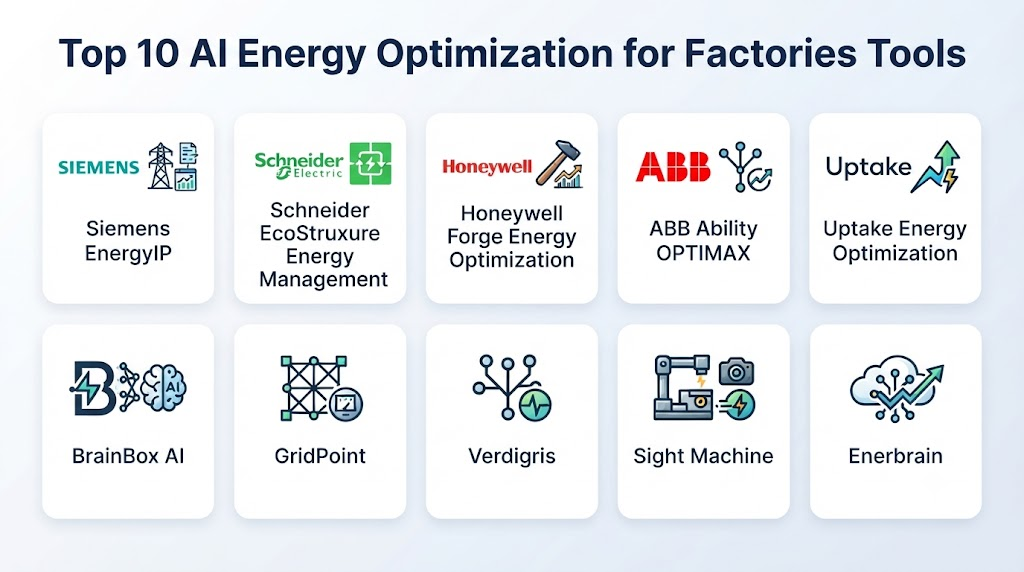
Top 10 AI Energy Optimization for Factories Tools
1 — Siemens Industrial Energy and AI Ecosystem
One-line verdict: Best for manufacturers connecting energy optimization with industrial automation, production systems, machine data, and factory operations.
Short description:
Siemens provides a broad industrial technology ecosystem covering automation, energy management, industrial analytics, digital twins, manufacturing operations, and AI.
Its technologies can support energy optimization when energy information is connected with production equipment and operational systems.
Standout Capabilities
- Industrial energy monitoring.
- Machine analytics.
- Production optimization.
- Industrial AI.
- Digital-twin capabilities.
- Edge analytics.
- Automation integration.
- Manufacturing data connectivity.
AI-Specific Depth
- Model support: AI, machine learning, optimization, analytics, and simulation capabilities vary by product.
- RAG / knowledge integration: Engineering and operational information can support AI-assisted workflows where configured.
- Evaluation: Historical analysis, simulation, scenario comparison, and operational validation.
- Guardrails: Engineering constraints, permissions, operating limits, and human approval.
- Observability: Energy KPIs, equipment telemetry, model outputs, production performance, and operational events.
Pros
- Strong industrial ecosystem.
- Can connect energy and production information.
- Suitable for complex manufacturing environments.
Cons
- Broad portfolio can be difficult to navigate.
- Implementation may require specialist expertise.
- Exact capabilities vary by solution.
Security & Compliance
Security capabilities depend on the selected products and architecture. Specific certifications should be independently verified for the intended deployment.
Deployment & Platforms
- Cloud.
- Edge.
- On-premises.
- Hybrid.
Integrations & Ecosystem
The ecosystem can connect energy systems with industrial automation and manufacturing applications.
- PLCs.
- SCADA.
- MES.
- Energy meters.
- Industrial Edge.
- Automation systems.
- Enterprise data platforms.
Pricing Model
Enterprise/custom pricing. Exact pricing is Not publicly stated.
Best-Fit Scenarios
- Smart factories.
- Energy-intensive manufacturing.
- Integrated energy and production optimization.
2 — Schneider Electric EcoStruxure
One-line verdict: Best for factories seeking integrated energy management, electrical infrastructure, automation, and industrial optimization.
Short description:
Schneider Electric’s EcoStruxure ecosystem combines energy management, industrial automation, electrical systems, monitoring, and analytics.
It can be particularly valuable when a factory wants to understand energy consumption alongside electrical infrastructure and operational equipment.
Standout Capabilities
- Energy monitoring.
- Power management.
- Industrial automation.
- Energy analytics.
- Equipment monitoring.
- Sustainability management.
- Edge connectivity.
- Industrial control.
AI-Specific Depth
- Model support: AI and analytics capabilities vary by EcoStruxure product.
- RAG / knowledge integration: Enterprise energy and operational information can support AI workflows.
- Evaluation: Historical energy analysis, scenario analysis, and operational validation.
- Guardrails: Power constraints, operating rules, access controls, and human oversight.
- Observability: Energy consumption, equipment state, power metrics, and operational KPIs.
Pros
- Strong energy-management orientation.
- Broad electrical and automation ecosystem.
- Suitable for factory-wide energy programs.
Cons
- Large portfolio.
- Integration requirements vary.
- Advanced capabilities may require additional configuration.
Security & Compliance
Security capabilities depend on product and deployment. Specific certifications should be independently verified.
Deployment & Platforms
- Cloud.
- Edge.
- On-premises.
- Hybrid.
Integrations & Ecosystem
EcoStruxure can connect energy infrastructure with industrial and enterprise systems.
- Power meters.
- PLCs.
- SCADA.
- Building-management systems.
- Industrial equipment.
- Energy systems.
- Enterprise applications.
Pricing Model
Enterprise/custom pricing. Exact pricing is Not publicly stated.
Best-Fit Scenarios
- Factory energy management.
- Electrical optimization.
- Sustainability programs.
3 — Honeywell Forge
One-line verdict: Best for industrial organizations combining energy analytics with asset performance and operational intelligence.
Short description:
Honeywell Forge provides industrial performance-management and analytics technologies that can combine equipment, process, operational, and energy information.
This makes it useful for organizations looking to connect energy efficiency with broader industrial performance.
Standout Capabilities
- Energy analytics.
- Asset monitoring.
- Industrial performance management.
- Process analytics.
- AI-assisted insights.
- Operational dashboards.
- Predictive analytics.
- Industrial data integration.
AI-Specific Depth
- Model support: AI and machine-learning capabilities vary by application.
- RAG / knowledge integration: Engineering and operational information can support AI-assisted analysis.
- Evaluation: Historical analysis, scenario evaluation, and operational validation.
- Guardrails: Operating limits, permissions, workflows, and human review.
- Observability: Energy KPIs, asset performance, model outputs, and system telemetry.
Pros
- Strong industrial context.
- Broad operational analytics.
- Suitable for large industrial organizations.
Cons
- Broader than energy optimization alone.
- Implementation can be substantial.
- Capabilities differ across applications.
Security & Compliance
Security capabilities depend on product configuration and deployment. Specific certifications should be independently verified.
Deployment & Platforms
- Cloud.
- Edge.
- Hybrid.
Integrations & Ecosystem
- PLCs.
- SCADA.
- Historians.
- MES.
- ERP.
- Sensors.
- Energy systems.
Pricing Model
Enterprise/custom pricing. Exact pricing is Not publicly stated.
Best-Fit Scenarios
- Industrial energy analytics.
- Asset-intensive factories.
- Enterprise sustainability programs.
4 — AVEVA
One-line verdict: Best for process manufacturers connecting energy consumption with process data, industrial operations, and asset performance.
Short description:
AVEVA provides industrial software covering manufacturing operations, process management, asset performance, engineering information, industrial data, and analytics.
Its technologies can support energy optimization when energy data is combined with process and production information.
Standout Capabilities
- Energy analytics.
- Process monitoring.
- Industrial data management.
- Asset performance.
- Manufacturing operations.
- Visualization.
- Digital twins.
- Industrial analytics.
AI-Specific Depth
- Model support: AI, machine learning, analytics, and optimization capabilities vary.
- RAG / knowledge integration: Engineering and operational information can support AI workflows.
- Evaluation: Historical energy analysis, scenario testing, and process validation.
- Guardrails: Process constraints, engineering rules, permissions, and human approval.
- Observability: Energy consumption, process metrics, asset performance, and analytics outputs.
Pros
- Strong industrial ecosystem.
- Useful for process industries.
- Can connect energy with production and asset data.
Cons
- Portfolio can be complex.
- Requires industrial expertise.
- Energy capabilities vary by implementation.
Security & Compliance
Security capabilities depend on the selected solution. Specific certifications should be independently verified.
Deployment & Platforms
- Cloud.
- Edge.
- On-premises.
- Hybrid.
Integrations & Ecosystem
- Historians.
- SCADA.
- MES.
- ERP.
- Energy meters.
- PLCs.
- Industrial databases.
Pricing Model
Enterprise/custom pricing. Exact pricing is Not publicly stated.
Best-Fit Scenarios
- Process manufacturing.
- Energy-intensive factories.
- Industrial analytics.
5 — IBM Maximo Application Suite
One-line verdict: Best for asset-intensive factories connecting equipment maintenance, asset performance, and energy-related analytics.
Short description:
IBM Maximo provides asset-management and maintenance capabilities that can be combined with IoT and analytics.
Although it is not solely an energy-optimization platform, equipment condition and maintenance information can be highly valuable when investigating energy inefficiency.
Standout Capabilities
- Asset management.
- Predictive maintenance.
- IoT integration.
- Equipment monitoring.
- Operational analytics.
- Work management.
- Asset performance.
- AI-assisted workflows.
AI-Specific Depth
- Model support: AI and machine-learning capabilities vary by application.
- RAG / knowledge integration: Maintenance and asset information can support AI knowledge workflows.
- Evaluation: Historical asset data, maintenance outcomes, and model-performance analysis.
- Guardrails: Maintenance workflows, permissions, approvals, and operational rules.
- Observability: Asset condition, maintenance events, energy-related metrics, and application telemetry.
Pros
- Strong asset-management foundation.
- Useful for connecting equipment health with energy performance.
- Enterprise workflow capabilities.
Cons
- Not primarily an energy-optimization platform.
- Energy data integration may be required.
- Enterprise deployment can be substantial.
Security & Compliance
Security capabilities vary by deployment and configuration. Specific certifications should be independently verified.
Deployment & Platforms
- Cloud.
- On-premises.
- Hybrid.
Integrations & Ecosystem
- IoT.
- CMMS.
- ERP.
- Sensors.
- Energy systems.
- Maintenance platforms.
- APIs.
Pricing Model
Enterprise/custom pricing. Exact pricing is Not publicly stated.
Best-Fit Scenarios
- Asset-intensive manufacturing.
- Energy-maintenance analysis.
- Predictive maintenance programs.
6 — BrainBox AI
One-line verdict: Best for optimizing factory HVAC and building energy where heating, cooling, and ventilation represent major energy loads.
Short description:
BrainBox AI focuses on artificial intelligence for HVAC and building-energy optimization.
For factories with substantial HVAC, heating, cooling, or ventilation requirements, it can complement production-focused energy-management initiatives.
Standout Capabilities
- HVAC optimization.
- Energy forecasting.
- Building analytics.
- Thermal optimization.
- Automated control.
- Building-management integration.
- Energy monitoring.
- Operational optimization.
AI-Specific Depth
- Model support: Proprietary AI and predictive analytics.
- RAG / knowledge integration: N/A for core HVAC optimization.
- Evaluation: Energy-performance comparisons, forecasting, and operational outcomes.
- Guardrails: HVAC operating limits, control constraints, and automation rules.
- Observability: HVAC performance, energy consumption, system behavior, and control metrics.
Pros
- Strong HVAC specialization.
- Useful for factory facility systems.
- Can complement industrial energy platforms.
Cons
- Primarily HVAC-focused.
- Requires compatible building-management infrastructure.
- Does not cover all production-energy use cases.
Security & Compliance
Specific certifications are Not publicly stated unless independently verified.
Deployment & Platforms
- Cloud.
- Building-management environments.
Integrations & Ecosystem
- HVAC.
- Building-management systems.
- Sensors.
- Energy meters.
- Facility systems.
- APIs.
Pricing Model
Commercial/custom pricing. Exact pricing is Not publicly stated.
Best-Fit Scenarios
- Factory HVAC optimization.
- Large industrial facilities.
- Facility-energy management.
7 — C3 AI
One-line verdict: Best for large manufacturers using enterprise AI to optimize energy, assets, production, and operational performance.
Short description:
C3 AI provides enterprise AI technologies and applications for areas including energy management, asset performance, predictive maintenance, and industrial operations.
Its broad platform approach makes it suitable for manufacturers that want to combine energy optimization with other AI initiatives.
Standout Capabilities
- Energy analytics.
- AI applications.
- Asset optimization.
- Predictive maintenance.
- Anomaly detection.
- Forecasting.
- Industrial data integration.
- Enterprise analytics.
AI-Specific Depth
- Model support: Machine learning and AI models across enterprise applications.
- RAG / knowledge integration: Enterprise operational information can support AI workflows.
- Evaluation: Historical backtesting, model validation, scenario analysis, and production monitoring.
- Guardrails: Enterprise permissions, workflow controls, operating constraints, and human review.
- Observability: Energy metrics, anomaly scores, asset performance, and AI application telemetry.
Pros
- Enterprise-scale AI capabilities.
- Broad industrial applications.
- Can combine energy and asset information.
Cons
- Enterprise implementation can be complex.
- Significant data integration may be required.
- May be excessive for smaller factories.
Security & Compliance
Security capabilities depend on the selected solution and architecture. Specific certifications should be independently verified.
Deployment & Platforms
- Cloud.
- Hybrid.
- Enterprise environments.
Integrations & Ecosystem
- IoT.
- ERP.
- MES.
- Energy systems.
- Data platforms.
- Maintenance systems.
- APIs.
Pricing Model
Enterprise/custom pricing. Exact pricing is Not publicly stated.
Best-Fit Scenarios
- Large manufacturing organizations.
- Multi-site energy optimization.
- Enterprise industrial AI.
8 — Microsoft Azure Industrial AI Stack
One-line verdict: Best for organizations building customized factory-energy solutions using cloud AI, IoT, analytics, and enterprise data.
Short description:
Microsoft provides cloud, machine-learning, IoT, analytics, edge, and data technologies that can be combined to create custom factory-energy optimization architectures.
It is especially suitable for organizations with internal engineering teams capable of integrating industrial data with AI services.
Standout Capabilities
- Machine learning.
- Energy forecasting.
- IoT integration.
- Time-series analytics.
- Edge processing.
- Custom optimization.
- Data engineering.
- AI governance.
AI-Specific Depth
- Model support: Multiple machine-learning approaches and custom models.
- RAG / knowledge integration: Equipment manuals, energy policies, operating procedures, and enterprise information can support AI applications.
- Evaluation: Offline testing, backtesting, scenario analysis, and production monitoring.
- Guardrails: Identity, access controls, policies, operational constraints, and human approval.
- Observability: Model performance, latency, usage, energy metrics, and infrastructure telemetry.
Pros
- Highly customizable.
- Broad enterprise ecosystem.
- Suitable for sophisticated energy models.
Cons
- Requires engineering expertise.
- Multiple services may need to be integrated.
- Total cost depends heavily on architecture.
Security & Compliance
Security capabilities depend on the selected services and configuration. Specific certifications should be verified for the intended architecture.
Deployment & Platforms
- Cloud.
- Edge.
- Hybrid.
Integrations & Ecosystem
- IoT.
- Energy meters.
- Data warehouses.
- Machine learning.
- ERP.
- MES.
- APIs.
Pricing Model
Usage-based cloud pricing varies by services used. Exact implementation cost is Varies / N/A.
Best-Fit Scenarios
- Custom factory-energy platforms.
- Microsoft-oriented enterprises.
- Advanced forecasting and optimization.
9 — AWS Industrial AI Stack
One-line verdict: Best for technical teams developing custom energy forecasting, anomaly detection, and optimization systems for factories.
Short description:
AWS provides cloud, IoT, analytics, machine-learning, and edge technologies that can be assembled into customized industrial energy-management architectures.
It is particularly useful for organizations with software and data-engineering capabilities.
Standout Capabilities
- Energy forecasting.
- IoT data ingestion.
- Machine learning.
- Time-series analytics.
- Edge processing.
- Custom optimization.
- Data lakes.
- Real-time analytics.
AI-Specific Depth
- Model support: Multiple machine-learning approaches and custom models.
- RAG / knowledge integration: Maintenance records, energy documentation, and operational knowledge can support AI applications.
- Evaluation: Backtesting, offline evaluation, scenario analysis, and production monitoring.
- Guardrails: Identity management, permissions, application constraints, and human review.
- Observability: Energy metrics, model performance, infrastructure telemetry, and application monitoring.
Pros
- Highly flexible.
- Strong cloud ecosystem.
- Supports customized architectures.
Cons
- Requires cloud and data-engineering skills.
- Architecture can become complicated.
- Industrial integration must be designed.
Security & Compliance
Security capabilities depend on the selected services and architecture. Specific certifications should be independently verified.
Deployment & Platforms
- Cloud.
- Edge.
- Hybrid.
Integrations & Ecosystem
- IoT.
- Energy meters.
- Data lakes.
- Machine learning.
- MES.
- ERP.
- APIs.
Pricing Model
Usage-based cloud pricing varies by services used. Exact implementation cost is Varies / N/A.
Best-Fit Scenarios
- Custom industrial AI.
- AWS-oriented organizations.
- Multi-site energy analytics.
10 — Custom AI Factory Energy Optimization Platform
One-line verdict: Best for energy-intensive manufacturers requiring proprietary optimization across production, utilities, equipment, and energy resources.
Short description:
A custom platform can combine machine learning, energy forecasting, anomaly detection, optimization algorithms, digital twins, production scheduling, and real-time industrial data.
This approach can provide maximum flexibility but requires significant engineering and ongoing maintenance.
Standout Capabilities
- Real-time energy analytics.
- Demand forecasting.
- Energy-aware production scheduling.
- Peak-demand optimization.
- Machine-level optimization.
- Renewable-energy coordination.
- Anomaly detection.
- Carbon optimization.
AI-Specific Depth
- Model support: Time-series models, machine learning, optimization, forecasting, reinforcement learning, and multimodal AI.
- RAG / knowledge integration: Equipment manuals, energy policies, maintenance documentation, operating procedures, and historical events.
- Evaluation: Forecast accuracy, energy intensity, peak-demand reduction, production impact, model drift, and operational outcomes.
- Guardrails: Production constraints, safety limits, equipment operating ranges, human approval, and fallback controls.
- Observability: Energy consumption, model latency, forecast accuracy, optimization results, equipment health, and system status.
Pros
- Maximum customization.
- Can optimize production and energy together.
- Can incorporate proprietary operational knowledge.
Cons
- High development effort.
- Requires multidisciplinary expertise.
- Long-term maintenance is required.
Security & Compliance
A custom platform can implement:
- SSO.
- RBAC.
- Encryption.
- Audit logs.
- Data-retention controls.
- Network segmentation.
- Model versioning.
- Human approval workflows.
Specific certifications are Not publicly stated for a generic implementation.
Deployment & Platforms
- Cloud.
- Self-hosted.
- Edge.
- Hybrid.
Integrations & Ecosystem
Potential integrations include:
- Energy meters.
- PLCs.
- SCADA.
- MES.
- ERP.
- BMS.
- CMMS.
- Renewable-energy systems.
Pricing Model
Custom development and infrastructure. Exact pricing is N/A.
Best-Fit Scenarios
- Energy-intensive factories.
- Multi-site manufacturing.
- Production-energy co-optimization.
Comparison Table
| Tool | Best For | Deployment | Model Flexibility | Strength | Watch-Out | Public Rating |
|---|---|---|---|---|---|---|
| Siemens Industrial Energy Ecosystem | Smart factories | Cloud / Edge / Hybrid | AI + Optimization | Industrial integration | Complex ecosystem | |
| Schneider EcoStruxure | Energy management | Cloud / Edge / Hybrid | AI + Analytics | Energy and automation | Portfolio complexity | |
| Honeywell Forge | Industrial analytics | Cloud / Edge / Hybrid | AI + Analytics | Asset and operations context | Broad platform | |
| AVEVA | Process industries | Cloud / Edge / Hybrid | AI + Analytics | Industrial data | Implementation effort | |
| IBM Maximo | Asset-intensive factories | Cloud / Hybrid | AI + Analytics | Maintenance integration | Not energy-specific | |
| BrainBox AI | HVAC optimization | Cloud | Proprietary AI | Building energy | HVAC-focused | |
| C3 AI | Enterprise AI | Cloud / Hybrid | Multi-model | Industrial AI | Enterprise complexity | |
| Microsoft Azure Industrial AI | Custom solutions | Cloud / Edge | Multi-model | Microsoft ecosystem | Requires development | |
| AWS Industrial AI | Developers | Cloud / Edge | Multi-model | Flexible architecture | Engineering required | |
| Custom AI Platform | Proprietary optimization | Cloud / Edge / Hybrid | Multi-model | Maximum flexibility | High development effort |
Scoring & Evaluation
These scores are comparative editorial assessments rather than official vendor ratings.
Factory energy-optimization platforms should be evaluated on more than energy-saving claims. Buyers should examine whether results are normalized for production volume, product mix, weather, machine utilization, operating conditions, and equipment state.
The strongest systems combine accurate energy measurement with reliable production context, practical optimization capabilities, good industrial integrations, and transparent AI evaluation.
| Tool | Core Features | AI Reliability | Energy Optimization | Integrations | Ease | Performance/Cost | Security/Admin | Support | Weighted Total |
|---|---|---|---|---|---|---|---|---|---|
| Siemens Industrial Energy Ecosystem | 10 | 9 | 10 | 10 | 7 | 9 | 10 | 10 | 9.35 |
| Schneider EcoStruxure | 10 | 9 | 10 | 10 | 8 | 9 | 10 | 10 | 9.45 |
| Honeywell Forge | 9 | 9 | 9 | 10 | 7 | 8 | 10 | 10 | 9.10 |
| AVEVA | 10 | 9 | 9 | 10 | 7 | 8 | 10 | 10 | 9.20 |
| IBM Maximo | 9 | 9 | 8 | 10 | 7 | 8 | 10 | 10 | 8.95 |
| BrainBox AI | 8 | 9 | 10 | 8 | 9 | 9 | 9 | 9 | 9.00 |
| C3 AI | 10 | 10 | 9 | 10 | 7 | 8 | 10 | 9 | 9.25 |
| Microsoft Azure Industrial AI | 9 | 9 | 9 | 10 | 7 | 8 | 10 | 10 | 9.00 |
| AWS Industrial AI | 9 | 9 | 9 | 10 | 7 | 8 | 10 | 10 | 9.00 |
| Custom AI Platform | 10 | 10 | 10 | 10 | 5 | 7 | 10 | 10 | 9.40 |
Top 3 for Enterprise
- Schneider Electric EcoStruxure — Strong combination of energy management, electrical infrastructure, and industrial operations.
- Siemens Industrial Energy Ecosystem — Strong fit for factories connecting energy optimization with automation and production.
- C3 AI — Suitable for large-scale enterprise AI and industrial optimization programs.
Top 3 for SMB
- BrainBox AI — Particularly relevant where HVAC represents a substantial energy load.
- Schneider Electric EcoStruxure — Useful for energy and electrical management.
- IBM Maximo — Strong where asset performance and maintenance are closely connected to energy efficiency.
Top 3 for Developers
- AWS Industrial AI Stack — Flexible foundation for custom energy applications.
- Microsoft Azure Industrial AI Stack — Strong for custom enterprise architectures.
- Custom AI Platform — Maximum control over energy and production optimization.
Which AI Energy Optimization Tool Is Right for You?
Solo / Small Factory
Small factories should begin with reliable measurement rather than immediately implementing sophisticated AI.
Priority areas can include:
- Main electricity consumption.
- Major production machines.
- HVAC.
- Compressors.
- Boilers.
- Chillers.
- Refrigeration.
The first objective should be identifying obvious waste such as equipment operating while idle, unnecessary heating or cooling, compressed-air losses, or simultaneous high-demand operation.
SMB
SMBs should prioritize:
- Easy meter integration.
- Energy dashboards.
- Automated anomaly detection.
- Energy-per-unit metrics.
- Demand forecasting.
- Practical recommendations.
A straightforward platform that production and energy teams can actually use may deliver more value than a highly sophisticated system that requires extensive technical support.
Mid-Market
Mid-market manufacturers can connect energy consumption with production performance.
Useful measurements include:
- Energy per unit.
- Energy per batch.
- Energy per machine-hour.
- Energy per production line.
- Energy by shift.
- Energy by product.
This provides much better operational context than total electricity consumption.
Enterprise
Large organizations should consider a factory-wide energy architecture connecting:
Meters → Industrial IoT → Data Platform → Production Context → AI Models → Optimization → Operations
Enterprise programs can also include:
- Multi-site benchmarking.
- Energy forecasting.
- Carbon analysis.
- Renewable-energy optimization.
- Demand management.
- Production-energy scheduling.
- Predictive maintenance.
Automotive Manufacturing
Automotive facilities can analyze energy consumption across:
- Welding.
- Stamping.
- Painting.
- Assembly.
- Robotics.
- HVAC.
- Compressed air.
- Material handling.
Energy optimization can become more valuable when production schedules and machine conditions are included in the analysis.
Food and Beverage Manufacturing
Important energy-intensive areas often include:
- Refrigeration.
- Steam.
- Boilers.
- Cooling.
- Packaging.
- Compressed air.
- HVAC.
Energy models should account for production volume, product type, cleaning cycles, and operating schedules.
Pharmaceutical Manufacturing
Energy optimization can involve:
- HVAC.
- Clean environments.
- Chillers.
- Boilers.
- Production equipment.
Energy recommendations must remain within applicable process, quality, safety, and operational requirements.
Electronics Manufacturing
Electronics factories can evaluate:
- Production equipment.
- HVAC.
- Cooling.
- Clean environments.
- Compressed air.
- Testing systems.
Energy intensity per unit can help identify changes in production efficiency.
Process Manufacturing
Process industries can analyze:
- Steam.
- Fuel.
- Pumps.
- Compressors.
- Cooling.
- Heating.
- Process parameters.
AI can help identify relationships between process conditions and energy consumption.
Energy-Intensive Manufacturing
Industries such as steel, chemicals, cement, glass, and paper can benefit from advanced optimization because relatively small changes in energy intensity can have significant economic effects.
Potential applications include:
- Process optimization.
- Energy forecasting.
- Digital twins.
- Anomaly detection.
- Production-energy optimization.
- Equipment efficiency analysis.
Budget vs Premium
A budget implementation can begin with:
- Metering.
- Energy dashboards.
- Baseline calculations.
- Basic anomaly alerts.
- Machine-level monitoring.
Premium implementations may include:
- AI forecasting.
- Automated optimization.
- Digital twins.
- Predictive maintenance.
- Renewable-energy coordination.
- Production scheduling.
- Carbon optimization.
Build vs Buy
Buying a commercial solution is usually more practical when requirements are relatively standard and rapid implementation is important.
Building a custom solution can make sense when energy optimization is strategically important, production processes are highly specialized, or existing products cannot represent the organization’s operational constraints.
A hybrid architecture can combine:
Commercial energy-management software + industrial data platform + custom AI models
Implementation Playbook
First 30 Days: Establish the Energy Baseline
Start by collecting reliable information about:
- Electricity.
- Gas.
- Steam.
- Compressed air.
- Water where relevant.
- HVAC.
- Production volume.
Then calculate energy intensity:
Energy Intensity = Energy Consumed ÷ Production Output
Break this measurement down by:
- Product.
- Machine.
- Production line.
- Shift.
- Factory.
- Time period.
This creates a useful baseline for future AI analysis.
Days 31–60: Develop AI Analytics
Once the data foundation is reliable, introduce AI models for:
- Energy forecasting.
- Energy anomaly detection.
- Equipment-efficiency analysis.
- Production-energy correlations.
- Peak-demand prediction.
Model performance should be tested against historical production conditions.
Important evaluation metrics can include:
- Forecast error.
- False-alert rate.
- Energy intensity.
- Peak demand.
- Production impact.
- Quality impact.
Days 61–90: Connect Energy With Operations
The next phase is connecting energy intelligence with operational decisions.
Potential use cases include:
- Energy-aware production scheduling.
- Maintenance-energy optimization.
- HVAC optimization.
- Peak-demand management.
- Renewable-energy coordination.
- Equipment optimization.
Before automated control is introduced, recommendations should be tested against operational constraints and reviewed by appropriate engineering teams.
Common Mistakes and How to Avoid Them
- Optimizing total energy instead of energy intensity: Production output should be considered when evaluating efficiency.
- Ignoring production schedules: Energy consumption needs to be interpreted alongside production activity.
- Poor meter coverage: Factory-level measurements can hide inefficient individual machines.
- Ignoring idle consumption: Equipment can consume substantial energy without producing output.
- Ignoring compressed-air losses: Leakage and unnecessary pressure can create significant waste.
- Ignoring HVAC: Factory environmental systems can represent a major energy load.
- No reliable baseline: Savings cannot be evaluated properly without a baseline.
- Ignoring weather: Heating and cooling requirements can change substantially with environmental conditions.
- Ignoring product mix: Different products may require different amounts of energy.
- Over-automating controls: Critical industrial settings should not be changed automatically without appropriate validation.
- Ignoring equipment health: Energy inefficiency can sometimes be an indicator of equipment degradation.
- No production constraints: Energy savings should not compromise output, quality, or delivery.
- Ignoring peak demand: Total energy consumption and peak demand require different optimization strategies.
- No AI evaluation: Forecasting and anomaly-detection systems should be tested using real historical conditions.
- Ignoring model drift: Equipment, products, processes, and operating patterns change over time.
- No human oversight: Engineers and energy managers should be able to review significant recommendations.
- Ignoring cybersecurity: Connected energy systems require appropriate industrial security controls.
- No maintenance integration: Equipment deterioration can affect energy consumption.
- Ignoring carbon intensity: Energy savings and carbon reductions are related but not always identical.
- Optimizing one machine in isolation: Factory-wide optimization can produce different results from individual equipment optimization.
FAQs
What is AI Energy Optimization for Factories?
AI Energy Optimization for Factories uses artificial intelligence, machine learning, forecasting, anomaly detection, and optimization techniques to improve industrial energy efficiency while considering production and operational requirements.
What types of energy can AI optimize?
Depending on the system, AI can analyze electricity, gas, steam, compressed air, heating, cooling, refrigeration, fuel, and other measurable energy resources.
Can AI reduce factory electricity consumption?
AI can identify inefficient operating patterns and recommend optimization opportunities. Actual savings depend on the equipment, factory process, data quality, and actions taken.
What is energy intensity?
Energy intensity measures energy consumption relative to production output.
For example:
kWh per unit produced
can provide more useful insight into production efficiency than total energy consumption alone.
Can AI optimize production and energy together?
Yes. AI and optimization algorithms can evaluate production schedules and operating conditions while considering energy consumption, delivery requirements, equipment availability, and other constraints.
Can AI reduce peak electricity demand?
AI can forecast energy demand and identify opportunities to avoid unnecessary simultaneous operation of energy-intensive equipment.
Can AI optimize factory HVAC?
Yes. AI can analyze environmental conditions, production requirements, building conditions, and HVAC performance to identify opportunities for more efficient heating and cooling.
Can AI detect energy waste?
Yes. Anomaly-detection models can identify consumption patterns that differ from expected behavior and help teams investigate potential causes.
Can AI identify inefficient machines?
AI can compare energy consumption with production output and operating conditions to identify equipment that consumes more energy than expected.
Does factory energy optimization require IoT?
Not necessarily. Energy optimization can use data from meters, PLCs, SCADA systems, historians, building-management systems, ERP systems, MES platforms, and other data sources.
Can AI optimize compressed air?
AI can analyze compressor loading, demand patterns, pressure, operating schedules, and energy consumption. The ability to identify specific causes depends on available sensor and system data.
Can AI optimize boilers and steam?
Yes. AI can analyze fuel consumption, steam demand, process requirements, operating conditions, and equipment behavior to identify potential efficiency opportunities.
Can AI optimize refrigeration?
Yes. AI can analyze cooling demand, environmental conditions, equipment performance, and production schedules to help optimize refrigeration systems.
Can AI support renewable-energy integration?
Yes. AI can forecast factory energy demand and renewable generation and help evaluate operating strategies involving solar generation, storage, or other energy resources.
Can AI predict factory energy consumption?
Yes. Time-series forecasting models can estimate future energy demand using historical consumption, production, weather, machine states, and other variables.
Can LLMs optimize factory energy?
LLMs can assist with natural-language analysis, reporting, documentation, knowledge retrieval, and explanation of energy trends. Specialized forecasting and optimization models are generally more appropriate for precise energy prediction and operational optimization.
What is RAG in industrial energy optimization?
RAG can connect an AI assistant with equipment manuals, energy policies, maintenance records, operating procedures, and historical incidents so that users can ask context-specific questions about energy performance.
Can energy optimization run at the edge?
Yes. Edge processing can analyze machine and energy information locally, which can be useful when low latency, connectivity, or data-locality requirements are important.
How should an AI energy-optimization system be evaluated?
Important measurements include energy intensity, forecast accuracy, peak demand, energy cost, production impact, quality impact, false alerts, equipment performance, and measurable operational improvement.
How much do AI factory energy tools cost?
Costs vary according to factory size, energy meters, sensors, software capabilities, integrations, AI models, deployment architecture, and implementation requirements. Exact enterprise pricing is often Not publicly stated.
What is the biggest challenge with AI energy optimization?
Reliable and contextualized data is often the biggest challenge. Energy consumption becomes much more useful when connected with production volume, equipment status, product type, operating conditions, and maintenance information.
Can AI energy optimization reduce carbon emissions?
It can potentially reduce emissions by reducing energy consumption or shifting operations toward lower-carbon energy sources. The actual carbon impact depends on the factory’s energy mix and operating strategy.
Is AI better than traditional energy-management systems?
AI is not automatically better for every factory. Traditional monitoring may be sufficient for basic visibility, while AI becomes more valuable when the factory has complex equipment, large datasets, variable production, or difficult optimization problems.
Can AI automatically control factory equipment?
Technically, AI-based systems can be connected to industrial control environments, but automatic control should be introduced carefully. Critical operations require appropriate engineering validation, safety controls, fallback mechanisms, and human oversight.
What is energy-aware production scheduling?
Energy-aware production scheduling considers energy consumption, production requirements, equipment availability, demand constraints, and potentially energy prices or renewable generation when evaluating production sequences.
Conclusion
AI Energy Optimization for Factories can transform industrial energy management from simple consumption reporting into a more intelligent, contextual, and predictive process.
Instead of only showing how much energy a factory consumes, AI can help explain where energy is being used, why consumption changes, and which operational conditions may be inefficient.
The technology can support energy forecasting, anomaly detection, machine-level optimization, HVAC management, compressed-air analysis, peak-demand reduction, production-energy coordination, and renewable-energy planning.
Siemens and Schneider Electric are particularly relevant for factories seeking deep integration between energy management, automation, and industrial operations.