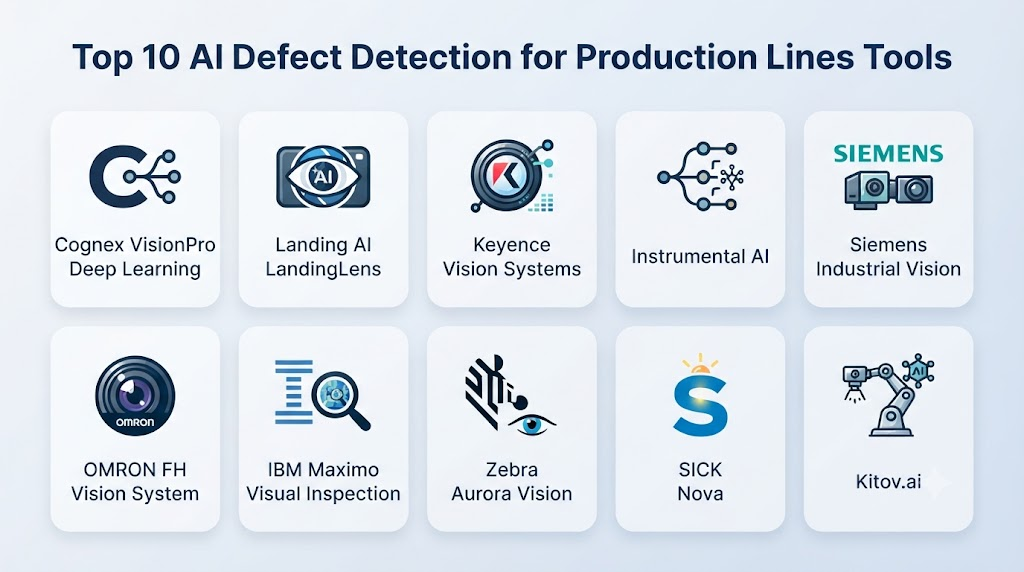
Introduction
AI Defect Detection for Production Lines uses computer vision, machine learning, deep learning, cameras, sensors, and industrial automation to identify defective products or process abnormalities while manufacturing is taking place. Instead of relying entirely on manual inspection or rigid image-processing rules, AI systems can learn patterns associated with acceptable and defective products and make inspection decisions at production speed.
These systems can detect scratches, cracks, dents, contamination, missing components, incorrect assembly, surface irregularities, dimensional deviations, packaging problems, label errors, and other quality issues. Modern industrial vision systems increasingly combine conventional machine vision with AI rather than treating AI as a complete replacement for deterministic inspection.
The technology is especially valuable when production lines operate continuously, products have significant visual variation, defects are difficult to describe with fixed rules, or manual inspection creates inconsistent results.
What Is AI Defect Detection for Production Lines?
AI defect detection is an automated visual-inspection approach in which cameras capture products or production processes and AI models analyze the resulting images.
A typical workflow looks like:
Different AI approaches are appropriate for different inspection problems.
Classification
Determines whether a product or image belongs to a particular quality category.
Object Detection
Identifies and locates defects within an image.
Segmentation
Precisely identifies the pixels associated with a defect or region of interest.
Anomaly Detection
Learns normal appearance and flags unusual patterns, which can be useful when defective examples are rare.
OCR and Text Verification
Checks serial numbers, labels, dates, codes, and other markings.
AI-Assisted Measurement
Combines visual analysis with measurement or geometric inspection.
Assembly Verification
Determines whether components are present, correctly positioned, and assembled appropriately.
The strongest production systems often combine AI with traditional machine-vision algorithms, measurements, lighting controls, deterministic rules, and industrial automation.
Why AI Defect Detection Matters
Manufacturing defects can become more expensive as they move further through the production process.
A defective component detected immediately after production can often be:
- Rejected.
- Reworked.
- Repaired.
- Investigated.
- Used to identify an upstream process problem.
The same defect discovered after additional processing, packaging, shipping, or customer delivery can be substantially more expensive.
Inline AI inspection therefore provides an opportunity to identify problems closer to where they originate.
AI is also useful where traditional rule-based inspection becomes difficult to maintain. Products may vary naturally because of:
- Material differences.
- Surface finishes.
- Lighting.
- Positioning.
- Manufacturing tolerances.
- Product variants.
- Environmental conditions.
AI-based inspection can learn acceptable variation and distinguish it from meaningful defects when sufficient representative training data is available.
However, AI is not a substitute for good optical engineering.
A poor camera position, inadequate lighting, insufficient resolution, motion blur, or an unsuitable lens can limit performance regardless of how sophisticated the model is.
Key Use Cases
Surface Defect Detection
Identify scratches, dents, pits, cracks, stains, discoloration, corrosion, and other surface abnormalities.
Assembly Verification
Confirm that components are present and positioned correctly.
Automotive Inspection
Inspect body panels, welds, paint, components, trim, and assemblies.
Electronics Inspection
Detect missing components, incorrect placement, solder-related visual issues, damaged parts, and assembly defects.
Semiconductor Inspection
Identify particles, scratches, edge defects, alignment problems, and other highly detailed visual abnormalities.
Battery Manufacturing
Inspect electrodes, cells, welds, surfaces, and other manufacturing stages.
Pharmaceutical Packaging
Check containers, labels, seals, codes, and packaging characteristics where appropriate.
Food Manufacturing
Identify appearance abnormalities, packaging problems, missing items, and product inconsistencies.
Textile Inspection
Detect holes, stains, weaving abnormalities, color variation, and surface defects.
Plastic Manufacturing
Identify molding defects, deformation, scratches, contamination, and surface irregularities.
Metal Inspection
Detect cracks, inclusions, scratches, pits, dents, and other surface problems.
Packaging Inspection
Verify labels, seals, product placement, package integrity, and printing.
Top 10 AI Defect Detection for Production Lines Tools
1 — Cognex AI Vision
One-line verdict: Best for manufacturers combining established industrial machine vision with AI-powered defect detection and high-speed production inspection.
Short description:
Cognex provides industrial vision systems, software, cameras, and AI-based inspection technologies. Its AI capabilities can be used for defect detection, classification, assembly inspection, OCR, and other manufacturing applications.
Cognex combines AI approaches with conventional machine-vision tools, making it suitable for production environments where deterministic inspection and learned visual interpretation may need to work together.
Standout Capabilities
- Automated defect detection.
- Deep-learning inspection.
- AI-assisted machine vision.
- Assembly verification.
- Surface inspection.
- OCR and code reading.
- Measurement.
- High-speed inline inspection.
AI-Specific Depth
- Model support: Proprietary AI, edge-learning, and deep-learning vision capabilities.
- RAG / knowledge integration: N/A for the core visual inference workflow.
- Evaluation: Image-based training, validation, and production testing.
- Guardrails: Confidence thresholds, deterministic inspection tools, operator review, and production rules.
- Observability: Inspection outputs, images, confidence information, production results, and application-level diagnostics.
Pros
- Strong industrial machine-vision ecosystem.
- Suitable for demanding production environments.
- Combines AI with established vision techniques.
Cons
- Product portfolio can be complex.
- Advanced applications may require machine-vision expertise.
- Total implementation cost depends heavily on hardware and integration requirements.
Security & Compliance
Security capabilities vary by product and deployment architecture. Specific certifications should be verified for the applicable configuration.
Deployment & Platforms
- Edge.
- Industrial controllers.
- Vision systems.
- Production-line environments.
- Cloud-connected architectures where applicable.
Integrations & Ecosystem
Cognex systems can be incorporated into broader factory automation environments through:
- PLCs.
- Industrial cameras.
- Robots.
- MES.
- Production equipment.
- Industrial networks.
- APIs and software interfaces.
Pricing Model
Commercial/custom pricing. Exact pricing is Not publicly stated.
Best-Fit Scenarios
- High-speed manufacturing.
- Automated defect inspection.
- Automotive and electronics production.
2 — Keyence AI Vision
One-line verdict: Best for production environments requiring AI inspection alongside measurement, sensors, cameras, and conventional machine-vision capabilities.
Short description:
Keyence provides industrial vision systems, vision sensors, cameras, measurement equipment, and AI-assisted inspection technologies.
Its approach combines AI-based visual interpretation with traditional machine-vision capabilities, making it suitable for production lines where simplicity, repeatability, and integration with factory equipment are important.
Standout Capabilities
- AI-based inspection.
- AI identification.
- AI counting.
- AI differentiation.
- AI OCR.
- Visual inspection.
- Measurement.
- Industrial sensing.
AI-Specific Depth
- Model support: Proprietary AI vision capabilities.
- RAG / knowledge integration: N/A for core defect-detection workflows.
- Evaluation: Application-specific image testing and inspection validation.
- Guardrails: Inspection thresholds, deterministic rules, confidence settings, and operator review.
- Observability: Inspection outputs, images, measurements, and system status.
Pros
- Broad industrial automation ecosystem.
- AI can complement traditional inspection.
- Strong hardware and sensor integration.
Cons
- Product selection can be complicated.
- AI functionality varies across systems.
- Complex inspection projects may require specialist setup.
Security & Compliance
Specific security certifications are Not publicly stated unless independently verified for the relevant product and deployment.
Deployment & Platforms
- Industrial edge.
- Vision sensors.
- Controllers.
- Production lines.
Integrations & Ecosystem
- PLCs.
- Sensors.
- Cameras.
- Robotics.
- Controllers.
- Production equipment.
- Factory automation systems.
Pricing Model
Commercial/custom pricing. Exact pricing is Not publicly stated.
Best-Fit Scenarios
- Automated production inspection.
- Assembly verification.
- Measurement and defect detection.
3 — LandingLens
One-line verdict: Best for manufacturers wanting an AI-first platform for developing and deploying customized visual defect-detection models.
Short description:
LandingLens is focused on industrial computer vision and AI-based visual inspection.
It provides tools for creating models around specific inspection problems, making it relevant when conventional rule-based machine vision struggles with product or defect variability.
Standout Capabilities
- Defect detection.
- Image classification.
- Object detection.
- Segmentation.
- Dataset management.
- Model training.
- Production deployment.
- Industrial inspection.
AI-Specific Depth
- Model support: AI-based computer-vision models.
- RAG / knowledge integration: N/A for core image inference.
- Evaluation: Dataset-based validation and production testing.
- Guardrails: Confidence thresholds, inspection rules, human review, and deployment controls.
- Observability: Model performance, predictions, image datasets, and inspection results.
Pros
- AI-first inspection workflow.
- Focused on manufacturing applications.
- Useful for specialized defect categories.
Cons
- Requires representative images.
- Camera and lighting remain critical.
- Factory integration may require additional engineering.
Security & Compliance
Security and compliance capabilities depend on the deployment. Specific certifications are Not publicly stated unless verified for the applicable configuration.
Deployment & Platforms
- Cloud.
- Edge.
- Industrial environments.
- Deployment options vary.
Integrations & Ecosystem
- Industrial cameras.
- PLCs.
- MES.
- Edge computers.
- Quality systems.
- APIs.
- Production equipment.
Pricing Model
Commercial/custom pricing. Exact pricing is Not publicly stated.
Best-Fit Scenarios
- Surface-defect detection.
- Manufacturing inspection.
- AI vision pilots.
4 — Siemens Industrial AI Visual Inspection
One-line verdict: Best for manufacturers integrating AI visual inspection directly with industrial edge systems and production-line automation.
Short description:
Siemens provides industrial AI and visual-inspection technologies designed for production environments.
Its visual inspection tooling can support use cases such as defect detection, classification, counting, localization, metrology, and text or label verification while connecting inspection decisions with industrial control systems.
Standout Capabilities
- AI visual inspection.
- Defect detection.
- Semantic segmentation.
- Production-line inspection.
- Industrial Edge deployment.
- Camera integration.
- PLC integration.
- Quality classification.
AI-Specific Depth
- Model support: Deep-learning segmentation and other AI-based vision approaches depending on the solution.
- RAG / knowledge integration: N/A for the core inspection model.
- Evaluation: User image datasets and application-specific validation.
- Guardrails: Confidence thresholds, inspection logic, PLC controls, and operator review.
- Observability: Inspection outputs, defect images, production signals, and system status.
Pros
- Strong industrial automation integration.
- Suitable for edge deployment.
- Can connect AI inspection directly with production controls.
Cons
- Industrial implementation can require engineering knowledge.
- Product architecture can be complex.
- Capabilities vary across Siemens offerings.
Security & Compliance
Security depends on the Industrial Edge and overall deployment architecture. Specific certifications should be independently verified for the intended environment.
Deployment & Platforms
- Industrial Edge.
- Linux-based edge environments.
- Production lines.
- Hybrid industrial architectures.
Integrations & Ecosystem
- PLCs.
- Industrial cameras.
- Industrial Edge.
- Automation systems.
- MES.
- Production equipment.
- Factory networks.
Pricing Model
Enterprise/custom pricing. Exact pricing is Not publicly stated.
Best-Fit Scenarios
- Industrial production lines.
- Factory automation.
- Edge-based AI inspection.
5 — MVTec HALCON
One-line verdict: Best for machine-vision engineers developing highly customized defect-detection systems with control over algorithms and deployment.
Short description:
MVTec HALCON is a machine-vision software platform that combines traditional image-processing methods with machine learning and deep learning.
It is particularly suitable for organizations with developers, system integrators, or vision engineers who need extensive control over inspection algorithms.
Standout Capabilities
- Deep learning.
- Image processing.
- Defect detection.
- Anomaly detection.
- Segmentation.
- OCR.
- 3D vision.
- Industrial measurement.
AI-Specific Depth
- Model support: Machine-learning and deep-learning vision technologies.
- RAG / knowledge integration: N/A for core image analysis.
- Evaluation: Dataset validation, model testing, and application-level benchmarks.
- Guardrails: Confidence thresholds, deterministic rules, image-quality checks, and human review.
- Observability: Application diagnostics, model outputs, image-processing results, and inspection metrics.
Pros
- Highly customizable.
- Broad machine-vision functionality.
- Suitable for sophisticated industrial applications.
Cons
- Requires technical expertise.
- More developer-oriented than turnkey inspection platforms.
- Deployment architecture is largely the user’s responsibility.
Security & Compliance
Specific certifications are Not publicly stated unless independently verified for the applicable deployment.
Deployment & Platforms
- Windows.
- Linux.
- Industrial edge.
- Embedded architectures depending on implementation.
Integrations & Ecosystem
- Industrial cameras.
- PLCs.
- Robots.
- C++.
- .NET.
- Python.
- Industrial automation systems.
Pricing Model
Commercial licensing. Exact pricing is Not publicly stated.
Best-Fit Scenarios
- Custom defect detection.
- Industrial system integration.
- Advanced computer-vision development.
6 — Robovision AI
One-line verdict: Best for manufacturers requiring scalable computer-vision AI across multiple production environments, products, and inspection applications.
Short description:
Robovision provides an AI computer-vision platform for manufacturing and industrial automation.
Its platform supports automated inspection, defect detection, real-time monitoring, and deployment architectures spanning cloud, on-premises, and hybrid environments.
Standout Capabilities
- Automated inspection.
- Defect detection.
- Deep-learning vision.
- Real-time monitoring.
- Industrial automation.
- Data annotation.
- Model lifecycle management.
- Edge deployment.
AI-Specific Depth
- Model support: Deep-learning computer-vision models.
- RAG / knowledge integration: N/A for core visual inspection.
- Evaluation: Dataset annotation, model training, testing, and production monitoring.
- Guardrails: Model governance, confidence thresholds, inspection rules, and human review.
- Observability: Model performance, production outputs, monitoring, and lifecycle metrics.
Pros
- Strong manufacturing orientation.
- Flexible deployment.
- Suitable for scaling vision applications across production environments.
Cons
- Advanced implementations require AI and industrial expertise.
- Dataset management remains important.
- Enterprise deployments may require significant integration.
Security & Compliance
Security and governance capabilities vary by deployment. Specific certifications are Not publicly stated unless independently verified.
Deployment & Platforms
- Cloud.
- On-premises.
- Edge.
- Hybrid.
Integrations & Ecosystem
- Industrial cameras.
- Machinery.
- PLCs.
- Production systems.
- Edge computing.
- APIs.
- Manufacturing applications.
Pricing Model
Enterprise/custom pricing. Exact pricing is Not publicly stated.
Best-Fit Scenarios
- Multi-line manufacturing.
- Automated quality inspection.
- Industrial AI scaling.
7 — Instrumental
One-line verdict: Best for electronics manufacturers combining automated visual inspection with broader manufacturing-quality and production intelligence.
Short description:
Instrumental provides manufacturing intelligence and AI-based visual inspection capabilities, with particular relevance to electronics manufacturing.
The platform can help organizations inspect products, identify quality problems, and connect visual information with manufacturing processes.
Standout Capabilities
- Automated inspection.
- Defect detection.
- Manufacturing analytics.
- Image analysis.
- Production monitoring.
- Quality investigation.
- Traceability.
- Manufacturing intelligence.
AI-Specific Depth
- Model support: AI/ML computer-vision models.
- RAG / knowledge integration: Manufacturing information can support analytical workflows.
- Evaluation: Production image validation and inspection-performance measurement.
- Guardrails: Review workflows, inspection thresholds, and production controls.
- Observability: Defect trends, inspection outcomes, images, and production metrics.
Pros
- Strong electronics focus.
- Combines visual inspection with manufacturing context.
- Useful for production-quality analysis.
Cons
- Less general-purpose than some machine-vision platforms.
- Best suited to particular manufacturing environments.
- Integrations vary by production architecture.
Security & Compliance
Security capabilities depend on deployment and configuration. Specific certifications are Not publicly stated unless independently verified.
Deployment & Platforms
- Cloud.
- Production-line integrations.
- Enterprise.
Integrations & Ecosystem
- Manufacturing equipment.
- Cameras.
- MES.
- Quality systems.
- Production databases.
- APIs.
Pricing Model
Enterprise/custom pricing. Exact pricing is Not publicly stated.
Best-Fit Scenarios
- Electronics manufacturing.
- Contract manufacturing.
- Production-quality monitoring.
8 — Landing AI
One-line verdict: Best for teams developing specialized visual inspection models where labeled production data is limited but valuable.
Short description:
Landing AI provides computer-vision development capabilities for industrial and enterprise applications.
Its data-centric approach is relevant to inspection projects where teams need to build models around specific products, defects, and production conditions.
Standout Capabilities
- Image classification.
- Object detection.
- Defect detection.
- Dataset management.
- Model development.
- Computer vision.
- Edge deployment.
- Visual inspection.
AI-Specific Depth
- Model support: AI-based computer-vision models.
- RAG / knowledge integration: N/A for core vision inference.
- Evaluation: Dataset-level model testing and application-specific validation.
- Guardrails: Confidence thresholds, inspection rules, review workflows, and deployment controls.
- Observability: Model metrics, prediction outputs, image datasets, and inspection results.
Pros
- Focused on practical AI vision.
- Useful for specialized inspection.
- Suitable for organizations building custom vision applications.
Cons
- Requires representative production data.
- Factory integration may require engineering.
- Model performance depends heavily on dataset quality.
Security & Compliance
Specific certifications are Not publicly stated unless independently verified.
Deployment & Platforms
- Cloud.
- Edge.
- Enterprise.
Integrations & Ecosystem
- Cameras.
- Production equipment.
- APIs.
- Edge hardware.
- MES.
- Quality systems.
Pricing Model
Commercial/custom pricing. Exact pricing is Not publicly stated.
Best-Fit Scenarios
- Specialized defect detection.
- AI inspection development.
- Manufacturing AI pilots.
9 — AWS Computer Vision Stack
One-line verdict: Best for organizations building custom cloud-connected defect detection around existing AWS data and AI infrastructure.
Short description:
AWS provides cloud AI, computer-vision, storage, edge, IoT, and data services that can be assembled into a custom production-line defect-detection architecture.
This approach is more appropriate for engineering teams than organizations seeking a turnkey industrial inspection appliance.
Standout Capabilities
- Custom computer vision.
- Image storage.
- Machine-learning workflows.
- Edge integration.
- IoT connectivity.
- API-driven inference.
- Data pipelines.
- Model monitoring.
AI-Specific Depth
- Model support: Managed AI services and custom machine-learning models depending on architecture.
- RAG / knowledge integration: Can connect inspection results with enterprise documentation and knowledge systems.
- Evaluation: Custom model validation and production monitoring.
- Guardrails: Identity management, access controls, application policies, and model governance.
- Observability: Application metrics, inference latency, usage, and model-performance monitoring.
Pros
- Flexible cloud infrastructure.
- Strong data and IoT ecosystem.
- Suitable for custom architectures.
Cons
- Requires substantial engineering.
- Not a turnkey production-line inspection solution.
- Cloud and edge architecture must be carefully designed.
Security & Compliance
AWS provides extensive cloud security capabilities, but actual controls depend on the architecture and services selected. Specific certifications should be verified for the intended deployment.
Deployment & Platforms
- Cloud.
- Edge.
- Hybrid.
Integrations & Ecosystem
- Object storage.
- IoT.
- Databases.
- Data lakes.
- APIs.
- Edge devices.
- Manufacturing systems.
Pricing Model
Usage-based cloud pricing can apply depending on selected services. Exact implementation cost is Varies / N/A.
Best-Fit Scenarios
- AWS-centric manufacturers.
- Custom computer-vision applications.
- Enterprise AI infrastructure.
10 — Custom AI Defect Detection Platform
One-line verdict: Best for manufacturers with proprietary products, unusual defects, or inspection requirements that standard platforms cannot fully support.
Short description:
A custom defect-detection platform can combine industrial cameras, specialized lighting, machine-learning models, edge computing, production systems, and quality-management workflows.
Organizations can choose the model architecture, hardware, data pipeline, deployment location, and inspection logic according to their specific production requirements.
Standout Capabilities
- Custom defect detection.
- Classification.
- Object detection.
- Segmentation.
- Anomaly detection.
- OCR.
- Multimodal analysis.
- Real-time edge inference.
AI-Specific Depth
- Model support: CNNs, vision transformers, anomaly-detection models, OCR models, multimodal models, and custom architectures.
- RAG / knowledge integration: Product specifications, inspection procedures, defect catalogs, quality documentation, and maintenance information.
- Evaluation: Precision, recall, F1, false-positive rate, false-negative rate, localization accuracy, throughput, and latency.
- Guardrails: Confidence thresholds, deterministic rules, human review, model fallback, image-quality checks, and production interlocks.
- Observability: Model drift, latency, GPU utilization, inspection throughput, confidence, error rates, and data-quality monitoring.
Pros
- Maximum flexibility.
- Can support proprietary inspection requirements.
- Enables edge-first deployment.
Cons
- High engineering requirements.
- Requires continuous dataset management.
- Organization becomes responsible for model lifecycle management.
Security & Compliance
Organizations can implement:
- SSO.
- RBAC.
- Encryption.
- Audit logs.
- Data-retention controls.
- Network isolation.
- Edge-only processing.
- Model version control.
Specific certifications are Not publicly stated for a generic implementation.
Deployment & Platforms
- Cloud.
- Self-hosted.
- Edge.
- Hybrid.
- Industrial PCs.
Integrations & Ecosystem
Potential integrations include:
- Industrial cameras.
- PLCs.
- MES.
- QMS.
- SCADA.
- Robots.
- Data platforms.
Pricing Model
Custom development and infrastructure. Exact pricing is N/A.
Best-Fit Scenarios
- Proprietary manufacturing processes.
- Complex visual defects.
- High-volume production lines.
Comparison Table
| Tool | Best For | Deployment | Model Flexibility | Strength | Watch-Out | Public Rating |
|---|---|---|---|---|---|---|
| Cognex AI Vision | Industrial inspection | Edge / Industrial | AI + Rules | Production maturity | Configuration complexity | |
| Keyence AI Vision | Factory inspection | Edge | AI + Vision | Hardware ecosystem | Product complexity | |
| LandingLens | AI defect detection | Cloud / Edge | AI Vision | Manufacturing focus | Dataset requirements | |
| Siemens Visual Inspection | Industrial Edge | Edge / Hybrid | AI + Deep Learning | PLC integration | Industrial expertise | |
| MVTec HALCON | Vision developers | Windows / Linux / Edge | ML / Deep Learning | Developer control | Requires expertise | |
| Robovision AI | Scalable industrial AI | Cloud / Edge / Hybrid | Deep Learning | Lifecycle management | Integration effort | |
| Instrumental | Electronics manufacturing | Cloud / Production | AI/ML | Manufacturing intelligence | Specialized focus | |
| Landing AI | Custom AI inspection | Cloud / Edge | AI Vision | Data-centric workflow | Engineering requirements | |
| AWS Vision Stack | Custom cloud AI | Cloud / Edge | Hosted / Custom | Cloud ecosystem | Requires development | |
| Custom AI Platform | Proprietary inspection | Cloud / Edge / Hybrid | Multi-model | Maximum flexibility | High engineering burden |
Scoring & Evaluation
These scores are comparative editorial assessments rather than official vendor ratings.
For production-line defect detection, model accuracy should never be evaluated in isolation. Buyers should test real production images, different product variants, environmental variation, defect rarity, line speed, and false-rejection economics.
A model that performs well on a laboratory dataset may behave differently when deployed on an active production line.
| Tool | Core Features | AI Reliability | Defect Detection | Integrations | Ease | Performance/Cost | Security/Admin | Support | Weighted Total |
|---|---|---|---|---|---|---|---|---|---|
| Cognex AI Vision | 10 | 9 | 10 | 10 | 8 | 9 | 9 | 10 | 9.40 |
| Keyence AI Vision | 10 | 9 | 10 | 10 | 8 | 9 | 9 | 10 | 9.40 |
| LandingLens | 9 | 10 | 10 | 9 | 8 | 9 | 9 | 9 | 9.25 |
| Siemens Visual Inspection | 9 | 9 | 10 | 10 | 7 | 9 | 10 | 10 | 9.25 |
| MVTec HALCON | 10 | 10 | 10 | 10 | 6 | 9 | 9 | 10 | 9.25 |
| Robovision AI | 9 | 10 | 10 | 9 | 7 | 8 | 9 | 9 | 9.05 |
| Instrumental | 9 | 10 | 9 | 9 | 8 | 8 | 9 | 9 | 9.05 |
| Landing AI | 9 | 10 | 10 | 9 | 8 | 9 | 9 | 9 | 9.25 |
| AWS Vision Stack | 8 | 9 | 8 | 10 | 7 | 8 | 10 | 10 | 8.85 |
| Custom AI Platform | 10 | 10 | 10 | 10 | 5 | 7 | 10 | 10 | 9.40 |
Top 3 for Enterprise
- Cognex AI Vision — Strong combination of industrial vision, AI inspection, hardware, and factory integration.
- Keyence AI Vision — Strong choice for integrated vision, sensing, measurement, and production inspection.
- Siemens Industrial AI Visual Inspection — Particularly attractive where industrial edge and PLC integration are priorities.
Top 3 for SMB
- LandingLens — Focused AI inspection approach.
- Landing AI — Suitable for specialized computer-vision projects.
- Keyence AI Vision — Useful where an integrated industrial vision solution is preferred.
Top 3 for Developers
- MVTec HALCON — Extensive control over computer-vision development.
- Custom AI Defect Detection Platform — Maximum flexibility.
- AWS Computer Vision Stack — Strong cloud and AI infrastructure for custom solutions.
Which AI Defect Detection Tool Is Right for You?
Solo / Small Manufacturer
Small manufacturers should avoid trying to automate the entire factory at once.
Start with one high-value inspection.
Good candidates include:
- Surface scratches.
- Missing components.
- Incorrect assembly.
- Label verification.
- Packaging defects.
The first objective should be proving that automated inspection can reliably outperform or complement the existing process.
SMB
An SMB should prioritize ease of implementation.
Important requirements include:
- Simple image collection.
- Practical model training.
- Industrial camera support.
- Edge inference.
- Clear defect visualization.
- Operator review.
- Straightforward production integration.
A platform that requires a large AI team may not be the best fit even if it provides more technical flexibility.
Mid-Market
Mid-market manufacturers should start thinking about inspection as a platform rather than a standalone camera.
Important capabilities include:
- Multiple inspection stations.
- Centralized model management.
- Dataset management.
- Quality analytics.
- MES integration.
- Model monitoring.
- Production dashboards.
This allows successful inspection models to be replicated across product lines.
Enterprise
Enterprise manufacturers should establish a standardized computer-vision architecture.
A typical architecture can look like:
Camera → Edge computer → AI model → Quality decision → PLC → MES/QMS → Data platform → Model monitoring
Enterprise requirements should include:
- Centralized governance.
- Model versioning.
- Dataset lineage.
- Multi-site deployment.
- Role-based access.
- Auditability.
- Edge management.
- Cybersecurity.
- Model-performance monitoring.
Automotive Manufacturing
Automotive applications often involve:
- Paint defects.
- Weld inspection.
- Surface damage.
- Component verification.
- Gap and alignment inspection.
- Assembly verification.
The system must handle production speed while minimizing false rejects.
Electronics Manufacturing
Electronics inspection can involve:
- Component presence.
- Placement.
- Orientation.
- Solder-related visual inspection.
- Connectors.
- PCB surfaces.
- Labeling.
High-resolution imaging and controlled lighting are often critical.
Semiconductor Manufacturing
Semiconductor inspection has unusually demanding requirements.
Consider:
- Resolution.
- Defect size.
- Imaging consistency.
- False-positive economics.
- Process variation.
- Traceability.
- High-throughput inference.
AI is often used alongside specialized optical and deterministic techniques.
Pharmaceutical Manufacturing
Potential applications include:
- Label verification.
- Packaging inspection.
- Container inspection.
- Seal inspection.
- Printing verification.
Regulated production environments require appropriate validation, change management, and quality-system controls.
Food and Beverage
Food production presents additional visual variation because of:
- Natural product differences.
- Moisture.
- Color variation.
- Surface texture.
- Product orientation.
AI can be useful where traditional fixed rules struggle with normal product variability.
Budget vs Premium
Budget projects can start with:
- Existing cameras.
- Controlled lighting.
- Edge computers.
- Focused defect models.
- Manual review.
Premium systems can incorporate:
- Multiple cameras.
- 3D imaging.
- High-speed imaging.
- GPU acceleration.
- Automated rejection.
- Centralized model management.
- Multimodal AI.
- Fleet-wide monitoring.
Build vs Buy
Buy when:
- Your inspection task is relatively standard.
- You need rapid implementation.
- Vendor hardware integration matters.
- Internal AI expertise is limited.
Build when:
- Defects are unique.
- Products are proprietary.
- The inspection process provides competitive differentiation.
- You require specialized model architectures.
A hybrid architecture is often practical:
Commercial camera + industrial lighting + commercial vision platform + custom AI model
Implementation Playbook
First 30 Days: Define the Inspection Problem
Start with one production line and one defect category.
Define:
- What constitutes a defect.
- What constitutes acceptable variation.
- Required inspection speed.
- Acceptable false-positive rate.
- Acceptable false-negative rate.
- Required image resolution.
- Required response time.
Collect representative images.
Include:
- Good products.
- Defective products.
- Different product variants.
- Different shifts.
- Different materials.
- Different environmental conditions.
- Rare edge cases.
Days 31–60: Train and Validate
Create separate:
- Training dataset.
- Validation dataset.
- Independent test dataset.
Avoid putting images of the same physical product in both training and testing.
Measure:
- Precision.
- Recall.
- F1.
- False-positive rate.
- False-negative rate.
- Defect localization.
- Inference latency.
- Throughput.
Test Production Variation
The model should be challenged with:
- Lighting changes.
- Product-position variation.
- Camera movement.
- Material variation.
- Surface variation.
- Minor production changes.
- New product variants.
Days 61–90: Deploy Carefully
Begin with shadow-mode operation.
The AI generates predictions, but humans continue making production decisions.
Compare:
AI prediction → Human decision → Actual quality outcome
Then gradually introduce automated actions.
Integrate with:
- PLC.
- MES.
- QMS.
- Reject mechanism.
- Production dashboard.
Implement:
- Model version control.
- Rollback.
- Dataset versioning.
- Performance monitoring.
- Alert thresholds.
- Human escalation.
Common Mistakes and How to Avoid Them
- Poor lighting: Consistent illumination is foundational to reliable visual inspection.
- Incorrect camera placement: The model cannot compensate for a poorly designed imaging setup.
- Insufficient defect examples: Rare defects require deliberate data collection and evaluation.
- Training on unrealistic images: Production images should represent actual operating conditions.
- Data leakage: Images from the same physical item can create misleadingly high test performance.
- Overfitting: Models may learn backgrounds, fixtures, or camera artifacts rather than defects.
- Ignoring false negatives: Missed defects can be more costly than false alarms.
- Ignoring false positives: Excessive rejection can create unnecessary scrap and rework.
- No shadow-mode deployment: Automated rejection should not be the first production step.
- Ignoring model drift: New products, materials, tooling, and lighting can change visual patterns.
- No feedback mechanism: Technician and quality-engineer feedback can improve future models.
- Ignoring inference latency: A model that is accurate but too slow can disrupt production.
- Using cloud-only inference blindly: Some production lines need local edge processing.
- Ignoring cybersecurity: Connected cameras and edge systems introduce additional attack surfaces.
- Treating AI as the entire inspection system: Optics, lighting, mechanics, image acquisition, software, and automation all matter.
- Automating before validation: AI should be validated against real production outcomes before controlling reject mechanisms.
- Ignoring product variation: A model trained on one product version may not generalize to another.
- No model rollback plan: Every production deployment should have a tested recovery mechanism.
- Ignoring economics: Inspection quality should be measured against scrap, rework, downtime, labor, and customer-quality costs.
FAQs
What is AI defect detection for production lines?
It is the use of computer vision and AI models to automatically identify defective products, components, assemblies, or manufacturing conditions while production is taking place.
How does AI defect detection work?
Industrial cameras capture images, AI models analyze those images, and the system determines whether the product is acceptable or contains a potential defect.
What defects can AI detect?
Depending on the imaging system and training data, AI can detect scratches, cracks, dents, contamination indicators, missing components, assembly errors, discoloration, surface irregularities, packaging defects, and many other visual problems.
Can AI inspect products in real time?
Yes. Edge AI and industrial vision hardware can process images fast enough for many production applications.
The required processing speed depends on the production line, image resolution, model complexity, and hardware.
Does AI replace human quality inspectors?
Not necessarily.
AI can automate repetitive inspection and allow human inspectors to focus on exceptions, ambiguous cases, process investigations, and quality decisions requiring judgment.
What is the difference between AI inspection and traditional machine vision?
Traditional machine vision often relies heavily on manually configured rules, thresholds, measurements, and image-processing algorithms.
AI inspection can learn visual patterns from examples and may handle certain types of variation more effectively.
Many modern systems combine both approaches.
Does AI defect detection require labeled defect images?
Not always.
Supervised models generally benefit from labeled defective and non-defective examples.
Anomaly-detection approaches can learn primarily from normal products and identify unusual patterns.
What is anomaly detection?
Anomaly detection attempts to identify visual patterns that differ from the expected normal appearance of a product.
It can be particularly useful when defective examples are rare or constantly changing.
How important is lighting?
Extremely important.
Lighting determines whether the camera can clearly capture the visual characteristics that distinguish good products from defective ones.
Can AI detect very small defects?
Potentially, but the imaging system must have enough resolution and contrast to capture the defect.
For very small defects, specialized optics, lighting, cameras, and imaging techniques may be necessary.
Can AI defect detection work on moving products?
Yes.
The system must account for motion, exposure time, camera frame rate, image-processing speed, and synchronization with production equipment.
Can AI connect to PLC systems?
Yes.
Industrial inspection systems can send inspection decisions or signals to PLCs and other automation equipment.
Can defect detection integrate with MES?
Yes.
Inspection results can be connected to manufacturing-execution systems for traceability, production analytics, and process monitoring.
Can AI inspection run without cloud connectivity?
Yes.
Many industrial architectures support edge or on-premises inference.
This can reduce latency and keep sensitive production images inside the factory environment.
Can LLMs perform production defect detection?
LLMs are generally not the primary technology for high-speed visual defect detection.
Specialized computer-vision models are usually more appropriate for the actual inspection decision.
Multimodal AI can still assist with inspection explanations, troubleshooting, quality documentation, and natural-language interfaces.
What is RAG in a manufacturing vision system?
RAG can connect an AI assistant to product specifications, inspection procedures, defect catalogs, maintenance manuals, and quality documentation.
It complements rather than replaces the visual inspection model.
How should an AI defect-detection model be evaluated?
Use real production data and measure precision, recall, false-positive rate, false-negative rate, defect localization, inference latency, throughput, and stability across production variation.
What is the most important metric?
There is no universal single metric.
In many manufacturing applications, false negatives, false positives, detection lead time, throughput, and total quality cost should all be considered.
How much does AI defect detection cost?
Costs vary based on cameras, lighting, edge hardware, software, integrations, number of inspection stations, data requirements, and deployment architecture.
Exact pricing is Not publicly stated for many enterprise systems.
Is AI defect detection suitable for small manufacturers?
Yes, especially when a small number of high-value inspection tasks can generate measurable savings.
Starting with one critical inspection is usually more practical than attempting factory-wide automation immediately.
What is the biggest limitation of AI defect detection?
The biggest limitation is often not the AI model itself but the quality and consistency of the overall inspection system.
Poor imaging, inadequate training data, changing production conditions, and unclear defect definitions can all reduce performance.
Conclusion
AI Defect Detection for Production Lines is becoming an important component of modern quality-control strategies.Instead of inspecting products only after production, manufacturers can increasingly analyze products while they are still moving through the manufacturing process.Platforms such as Cognex, Keyence, LandingLens, Siemens, MVTec HALCON, Robovision, Instrumental, Landing AI, and cloud AI stacks provide different approaches to the problem.The most important purchasing decision is not simply choosing the platform with the most advanced AI model.A highly accurate AI model can still produce poor business results if it generates too many false positives, misses important defects, operates too slowly, or cannot adapt to production variation.