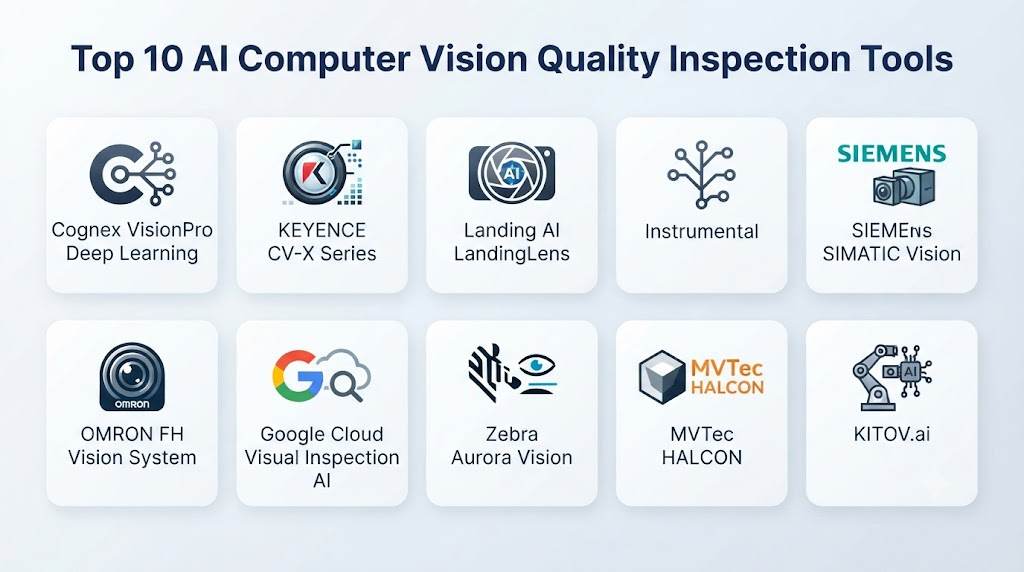
Introduction
AI Computer Vision Quality Inspection tools use cameras, image-processing algorithms, machine learning, and deep-learning models to inspect products, components, packaging, materials, and production processes automatically.Traditional visual inspection often depends on human operators or fixed rule-based machine-vision systems. AI-based inspection can learn visual patterns from representative examples and identify defects that may be difficult to describe using conventional rules.Common applications include detecting scratches, cracks, dents, missing components, incorrect assembly, contamination, surface defects, dimensional problems, packaging errors, label issues, and other visual abnormalities.These systems are increasingly useful because modern manufacturing environments generate large volumes of images and video while requiring consistent inspection at production speed.
What Is AI Computer Vision Quality Inspection?
AI computer vision quality inspection combines industrial cameras and AI models to automatically identify visual defects or verify that products meet predefined quality requirements.
A typical system works like this:
Camera → Image acquisition → Preprocessing → AI model → Detection/classification/segmentation → Quality decision → Operator or production system
AI inspection can perform several different tasks.
Image Classification
Determine whether an image represents an acceptable or defective product.
Object Detection
Locate specific defects or components within an image.
Image Segmentation
Precisely identify the pixels belonging to a defect or object.
Anomaly Detection
Identify unusual visual patterns without requiring examples of every possible defect.
OCR and Text Verification
Check labels, serial numbers, dates, characters, and other printed information.
Assembly Verification
Confirm that required components are present and positioned correctly.
Measurement
Estimate dimensions or compare visual geometry against acceptable tolerances.
The strongest systems usually combine AI with conventional machine vision, lighting, optics, measurement techniques, and deterministic production rules.
Why AI Computer Vision Quality Inspection Matters
Manufacturers often face several visual-inspection challenges:
- Human fatigue.
- Inconsistent inspection decisions.
- High production speeds.
- Tiny defects.
- Increasing product complexity.
- Multiple product variants.
- Labor shortages.
- Difficult-to-define defects.
- Large inspection volumes.
AI vision systems can provide consistent automated inspection and create structured quality data.
However, AI should not automatically be treated as a perfect replacement for human inspection.
The camera system must be designed correctly.
Lighting, camera position, lens selection, focus, resolution, image quality, production speed, product variability, and defect definitions can have as much impact on performance as the AI model itself.
A sophisticated model cannot reliably identify a defect that the camera cannot capture.
Key Use Cases
Surface Defect Detection
Identify scratches, dents, cracks, stains, corrosion, discoloration, and surface irregularities.
Assembly Verification
Check whether required parts are present and correctly positioned.
Packaging Inspection
Detect damaged packaging, incorrect seals, missing components, or visual inconsistencies.
Label Inspection
Verify label placement, readability, and visual correctness.
OCR Verification
Read and validate printed characters, codes, dates, and serial numbers.
Electronics Inspection
Identify component-placement problems, soldering issues, missing parts, and other manufacturing defects.
Automotive Inspection
Inspect body panels, components, welds, surfaces, and assemblies.
Pharmaceutical Inspection
Inspect packaging, containers, labels, and visible product characteristics where appropriate.
Food Inspection
Identify appearance defects, contamination indicators, packaging problems, and product inconsistencies.
Semiconductor Inspection
Analyze highly detailed surfaces and components where extremely high image quality is required.
Dimensional Inspection
Use computer vision to verify shape, alignment, and measurements.
Process Monitoring
Monitor production processes continuously for unusual visual behavior.
Top 10 AI Computer Vision Quality Inspection Tools
1 — LandingLens
One-line verdict: Best for manufacturing teams wanting an AI-first visual-inspection platform designed around industrial defect detection.
Short description:
LandingLens is a computer-vision platform focused on industrial inspection and defect detection.
It provides tools for creating and deploying vision models intended to identify manufacturing defects and automate visual quality-control processes.
Standout Capabilities
- Industrial defect detection.
- Image classification.
- Object detection.
- Segmentation.
- Visual anomaly detection.
- Model training.
- Production deployment.
- Quality-inspection workflows.
AI-Specific Depth
- Model support: Proprietary computer-vision models and AI workflows.
- RAG / knowledge integration: Not a primary capability; vision data is the main model input.
- Evaluation: Model evaluation using labeled inspection data and production validation.
- Guardrails: Confidence thresholds, inspection rules, human review, and controlled deployment.
- Observability: Model performance, inspection outcomes, image data, and production metrics.
Pros
- Strong industrial focus.
- Designed for manufacturing inspection.
- Useful for teams wanting AI-based defect detection.
Cons
- Requires representative image datasets.
- Camera and lighting engineering remain important.
- Exact capabilities depend on implementation.
Security & Compliance
Security features depend on deployment and configuration. Specific certifications should be independently verified.
Deployment & Platforms
- Cloud.
- Edge.
- Industrial environments.
- Deployment options vary.
Integrations & Ecosystem
Potential integrations include:
- Industrial cameras.
- PLCs.
- Production lines.
- MES.
- Quality systems.
- APIs.
- Edge devices.
Pricing Model
Enterprise/custom pricing. Exact pricing is Not publicly stated.
Best-Fit Scenarios
- Manufacturing defect detection.
- Automated visual inspection.
- Industrial quality control.
2 — Cognex Vision AI
One-line verdict: Best for manufacturers combining established machine vision with AI-based inspection and industrial automation.
Short description:
Cognex provides machine-vision technologies for industrial inspection, identification, measurement, and guidance.
Its AI-oriented vision capabilities can complement traditional rule-based machine vision for applications where defects are difficult to define using fixed rules.
Standout Capabilities
- AI-based inspection.
- Defect detection.
- Machine vision.
- OCR.
- Barcode reading.
- Measurement.
- Pattern recognition.
- Industrial vision hardware.
AI-Specific Depth
- Model support: Proprietary vision models and AI-assisted inspection capabilities.
- RAG / knowledge integration: N/A for core vision inspection.
- Evaluation: Training and validation against representative inspection images.
- Guardrails: Confidence thresholds, inspection rules, deterministic checks, and operator review.
- Observability: Inspection results, image records, model outputs, and production metrics.
Pros
- Extensive industrial vision experience.
- Strong hardware/software ecosystem.
- Useful for production environments.
Cons
- AI functionality is only one part of a broad product portfolio.
- Hardware and deployment design can be complex.
- Advanced applications may require vision expertise.
Security & Compliance
Security capabilities vary by product and deployment. Specific certifications are Not publicly stated unless verified for the applicable configuration.
Deployment & Platforms
- Edge.
- Industrial cameras.
- Vision systems.
- Production-line environments.
Integrations & Ecosystem
- PLCs.
- Robots.
- Industrial cameras.
- MES.
- Factory automation.
- Barcode systems.
- APIs.
Pricing Model
Commercial/custom pricing. Exact pricing is Not publicly stated.
Best-Fit Scenarios
- Automated production inspection.
- Industrial machine vision.
- High-speed manufacturing.
3 — Keyence Vision Systems
One-line verdict: Best for manufacturers needing high-performance industrial vision, measurement, inspection, and AI-assisted visual quality control.
Short description:
Keyence provides industrial vision systems, cameras, sensors, measurement systems, and inspection technologies.
AI can complement its broader vision ecosystem in applications where conventional image-processing methods alone are difficult to configure.
Standout Capabilities
- Visual inspection.
- Measurement.
- Pattern recognition.
- Image processing.
- OCR.
- Defect detection.
- Industrial cameras.
- Automation integration.
AI-Specific Depth
- Model support: AI capabilities vary across products.
- RAG / knowledge integration: N/A for core inspection functionality.
- Evaluation: Application-specific inspection validation.
- Guardrails: Inspection thresholds, rules, operator verification, and production controls.
- Observability: Inspection results, images, measurements, and equipment status.
Pros
- Strong industrial hardware ecosystem.
- Broad inspection capabilities.
- Suitable for demanding production environments.
Cons
- Product portfolio can be complex.
- AI capabilities vary.
- Specialized implementation expertise may be required.
Security & Compliance
Specific security certifications are Not publicly stated unless independently verified.
Deployment & Platforms
- Edge.
- Industrial hardware.
- Production lines.
- Machine-vision environments.
Integrations & Ecosystem
- PLCs.
- Robots.
- Industrial controllers.
- Cameras.
- Sensors.
- MES.
- Production equipment.
Pricing Model
Commercial/custom pricing. Exact pricing is Not publicly stated.
Best-Fit Scenarios
- Factory inspection.
- Precision manufacturing.
- Automated measurement.
4 — Instrumental
One-line verdict: Best for electronics manufacturers needing AI-driven automated inspection and manufacturing-quality analysis.
Short description:
Instrumental provides manufacturing intelligence and AI-based visual inspection focused particularly on electronics production.
The platform can analyze images and manufacturing information to identify quality issues and provide insight into production problems.
Standout Capabilities
- Automated visual inspection.
- Defect detection.
- Manufacturing intelligence.
- Image analysis.
- Production monitoring.
- Failure analysis.
- Quality analytics.
- Manufacturing traceability.
AI-Specific Depth
- Model support: AI/ML computer-vision models.
- RAG / knowledge integration: Manufacturing information can be incorporated into analytical workflows.
- Evaluation: Image-based validation and production performance monitoring.
- Guardrails: Inspection thresholds, review workflows, and production controls.
- Observability: Defect trends, image analytics, inspection outcomes, and manufacturing metrics.
Pros
- Strong electronics-manufacturing orientation.
- Combines visual inspection with manufacturing data.
- Useful for production-quality analytics.
Cons
- Best suited to specific manufacturing environments.
- Less general-purpose than broad computer-vision platforms.
- Exact integrations vary.
Security & Compliance
Security capabilities depend on deployment. Specific certifications are Not publicly stated unless independently verified.
Deployment & Platforms
- Cloud.
- Edge/production integration.
- Enterprise.
Integrations & Ecosystem
- Manufacturing equipment.
- Cameras.
- MES.
- Production databases.
- Quality systems.
- APIs.
Pricing Model
Enterprise/custom pricing. Exact pricing is Not publicly stated.
Best-Fit Scenarios
- Electronics manufacturing.
- Contract manufacturing.
- Automated quality inspection.
5 — Robovision
One-line verdict: Best for organizations developing customized computer-vision inspection applications across industrial and specialized manufacturing environments.
Short description:
Robovision provides computer-vision and AI technologies for industrial applications.
Its platform approach is suited to organizations that need customized vision models rather than only predefined inspection functionality.
Standout Capabilities
- Computer vision.
- Image classification.
- Object detection.
- Segmentation.
- Automated inspection.
- AI model development.
- Industrial deployment.
- Custom vision applications.
AI-Specific Depth
- Model support: Deep-learning computer-vision models.
- RAG / knowledge integration: N/A for core image analysis.
- Evaluation: Dataset validation, model performance testing, and production testing.
- Guardrails: Confidence thresholds, business rules, operator review, and deployment controls.
- Observability: Model metrics, inspection outputs, and production monitoring.
Pros
- Flexible computer-vision architecture.
- Suitable for specialized applications.
- Supports industrial AI development.
Cons
- Requires technical expertise.
- Model development depends on image quality and labeling.
- Implementation can vary substantially.
Security & Compliance
Specific certifications are Not publicly stated unless independently verified.
Deployment & Platforms
- Cloud.
- Edge.
- On-premises.
- Hybrid.
Integrations & Ecosystem
- Industrial cameras.
- Robots.
- PLCs.
- Manufacturing systems.
- APIs.
- Edge infrastructure.
Pricing Model
Enterprise/custom pricing. Exact pricing is Not publicly stated.
Best-Fit Scenarios
- Custom inspection.
- Industrial robotics.
- Specialized computer vision.
6 — MVTec HALCON
One-line verdict: Best for developers and machine-vision engineers building highly customized industrial inspection applications.
Short description:
MVTec HALCON is a machine-vision software library and development environment for industrial image processing and computer vision.
It provides a broad set of vision algorithms that can be combined with machine learning and deep-learning approaches.
Standout Capabilities
- Image processing.
- Deep learning.
- Object detection.
- Classification.
- OCR.
- Measurement.
- 3D vision.
- Industrial inspection.
AI-Specific Depth
- Model support: Deep-learning and machine-learning capabilities supported within the platform.
- RAG / knowledge integration: N/A.
- Evaluation: Dataset-based model evaluation and application-specific validation.
- Guardrails: Application rules, confidence thresholds, deterministic vision checks, and human review.
- Observability: Model results, image-processing outputs, and application-level diagnostics.
Pros
- Highly flexible.
- Strong developer control.
- Broad machine-vision functionality.
Cons
- Requires technical vision expertise.
- Not a turnkey inspection solution for every use case.
- Deployment architecture must be designed by the user.
Security & Compliance
Specific certifications are Not publicly stated unless independently verified.
Deployment & Platforms
- Windows.
- Linux.
- Industrial edge.
- Embedded environments depending on application.
Integrations & Ecosystem
- Industrial cameras.
- PLCs.
- Robots.
- C++.
- .NET.
- Python integrations.
- Industrial automation.
Pricing Model
Commercial licensing. Exact pricing is Not publicly stated.
Best-Fit Scenarios
- Custom machine vision.
- Industrial inspection development.
- High-control engineering environments.
7 — Landing AI
One-line verdict: Best for manufacturers wanting AI computer vision that can be developed around relatively small and specialized image datasets.
Short description:
Landing AI provides computer-vision development capabilities aimed at industrial and enterprise inspection applications.
Its approach emphasizes building practical vision systems from task-specific datasets rather than requiring massive generic image collections.
Standout Capabilities
- Visual inspection.
- Object detection.
- Image classification.
- Defect detection.
- Dataset management.
- Model development.
- Edge deployment.
- Industrial computer vision.
AI-Specific Depth
- Model support: AI-based computer-vision models.
- RAG / knowledge integration: N/A for core vision tasks.
- Evaluation: Dataset evaluation and model-performance testing.
- Guardrails: Confidence thresholds, inspection rules, and human review.
- Observability: Model metrics, predictions, image data, and production monitoring.
Pros
- AI-first approach.
- Useful for specialized inspection.
- Designed for practical industrial deployment.
Cons
- Still requires quality image data.
- Industrial integration can require engineering.
- Exact deployment capabilities vary.
Security & Compliance
Security and compliance capabilities depend on deployment. Specific certifications are Not publicly stated unless independently verified.
Deployment & Platforms
- Cloud.
- Edge.
- Enterprise.
Integrations & Ecosystem
- Cameras.
- Production equipment.
- APIs.
- Edge devices.
- MES.
- Quality systems.
Pricing Model
Commercial/custom pricing. Exact pricing is Not publicly stated.
Best-Fit Scenarios
- Specialized defect detection.
- Industrial inspection.
- Rapid AI vision development.
8 — AWS Lookout for Vision
One-line verdict: Best for teams building cloud-connected visual anomaly detection workflows using managed computer-vision infrastructure.
Short description:
AWS Lookout for Vision was designed to detect visual anomalies in industrial products and processes.
Because cloud product availability and service portfolios can change, organizations should verify current availability and lifecycle status before selecting it for a new production deployment.
Standout Capabilities
- Visual anomaly detection.
- Image-based inspection.
- Industrial quality applications.
- Model training.
- Managed AI infrastructure.
- Cloud integration.
- API-driven workflows.
- Automated predictions.
AI-Specific Depth
- Model support: Managed computer-vision models.
- RAG / knowledge integration: N/A for core visual inspection.
- Evaluation: Training and test datasets with application-specific evaluation.
- Guardrails: Confidence thresholds, application logic, access controls, and human review.
- Observability: Prediction outputs and cloud service monitoring.
Pros
- Managed cloud architecture.
- API-friendly.
- Useful for organizations already using AWS infrastructure.
Cons
- Product availability should be verified before adoption.
- Cloud connectivity may not suit every low-latency application.
- Requires appropriate image datasets.
Security & Compliance
AWS provides broad cloud security capabilities, but the relevant controls depend on the service configuration and architecture. Specific certifications should be verified for the actual deployment.
Deployment & Platforms
- Cloud.
- Edge integration can be designed around connected industrial architectures.
Integrations & Ecosystem
- Object storage.
- APIs.
- IoT services.
- Edge computing.
- Data pipelines.
- Manufacturing applications.
Pricing Model
Cloud usage-based pricing where applicable. Exact current pricing is Not publicly stated here.
Best-Fit Scenarios
- Cloud-first inspection.
- AWS-based manufacturing environments.
- Rapid anomaly-detection pilots.
9 — Microsoft Azure AI Vision
One-line verdict: Best for organizations building customized computer-vision inspection applications within broader Microsoft cloud and AI environments.
Short description:
Azure provides computer-vision services and AI infrastructure that can be combined with custom industrial inspection applications.
It is more of a development foundation than a complete factory quality-inspection system.
Standout Capabilities
- Computer vision.
- Image analysis.
- OCR.
- Custom AI development.
- Cloud AI.
- Model deployment.
- Data integration.
- Enterprise AI infrastructure.
AI-Specific Depth
- Model support: Hosted AI services and custom models depending on architecture.
- RAG / knowledge integration: Can connect visual analysis with enterprise knowledge systems.
- Evaluation: Custom model evaluation and application-specific testing.
- Guardrails: Identity, permissions, application controls, and AI governance.
- Observability: AI application monitoring, model metrics, latency, and usage.
Pros
- Broad cloud ecosystem.
- Strong enterprise integration.
- Flexible for custom applications.
Cons
- Requires development work.
- Not a complete turnkey manufacturing inspection platform.
- Industrial edge architecture may require additional components.
Security & Compliance
Security capabilities depend on the selected Azure services and configuration. Specific certifications should be independently verified for the intended environment.
Deployment & Platforms
- Cloud.
- Edge.
- Hybrid.
Integrations & Ecosystem
- IoT.
- Data lakes.
- APIs.
- Power Platform.
- Manufacturing systems.
- Edge devices.
- Enterprise databases.
Pricing Model
Usage-based and subscription models vary by service. Exact pricing is Not publicly stated.
Best-Fit Scenarios
- Custom inspection applications.
- Microsoft-centric enterprises.
- Cloud-connected manufacturing.
10 — Custom AI Vision Inspection Platform
One-line verdict: Best for manufacturers with unique defects, proprietary products, or inspection requirements that commercial systems cannot easily accommodate.
Short description:
A custom AI vision platform can combine cameras, industrial lighting, computer vision, deep learning, anomaly detection, OCR, 3D vision, and production-system integration.
This approach provides maximum control over the inspection pipeline.
Standout Capabilities
- Custom defect detection.
- Classification.
- Segmentation.
- Anomaly detection.
- OCR.
- 3D inspection.
- Multimodal analysis.
- Real-time edge inference.
AI-Specific Depth
- Model support: CNNs, vision transformers, anomaly-detection models, multimodal models, OCR models, and other computer-vision architectures.
- RAG / knowledge integration: Maintenance records, product specifications, quality procedures, defect catalogs, and inspection documentation.
- Evaluation: Precision, recall, F1, false-positive rate, false-negative rate, localization accuracy, and production validation.
- Guardrails: Confidence thresholds, deterministic rules, human review, image-quality checks, model fallback, and production interlocks.
- Observability: Model drift, inference latency, GPU utilization, inspection throughput, error rates, image quality, and prediction confidence.
Pros
- Maximum customization.
- Can operate at the edge.
- Supports proprietary inspection workflows.
Cons
- High development requirements.
- Requires strong image-data management.
- Model maintenance becomes an internal responsibility.
Security & Compliance
Organizations can implement:
- SSO.
- RBAC.
- Encryption.
- Audit logs.
- Data-retention controls.
- Network isolation.
- Edge-only processing.
- Model version control.
Specific certifications are Not publicly stated for a generic implementation.
Deployment & Platforms
- Cloud.
- Self-hosted.
- Edge.
- Hybrid.
- Industrial PCs.
Integrations & Ecosystem
Potential integrations include:
- Industrial cameras.
- PLCs.
- Robots.
- MES.
- QMS.
- SCADA.
- Data platforms.
Pricing Model
Custom development and infrastructure. Exact pricing is N/A.
Best-Fit Scenarios
- Proprietary products.
- High-speed production lines.
- Complex visual defects.
Comparison Table
| Tool | Best For | Deployment | Model Flexibility | Strength | Watch-Out | Public Rating |
|---|---|---|---|---|---|---|
| LandingLens | Industrial defect detection | Cloud / Edge | AI vision | Manufacturing focus | Requires good image data | |
| Cognex Vision AI | Industrial machine vision | Edge | AI + Rules | Industrial ecosystem | Implementation complexity | |
| Keyence Vision | Precision inspection | Edge | AI + Vision | Hardware ecosystem | Product complexity | |
| Instrumental | Electronics manufacturing | Cloud / Edge | AI/ML | Manufacturing intelligence | Specialized use case | |
| Robovision | Custom industrial vision | Cloud / Edge / Hybrid | Deep learning | Customization | Technical expertise | |
| MVTec HALCON | Vision developers | Windows / Linux / Edge | ML / Deep learning | Developer control | Requires expertise | |
| Landing AI | Specialized AI inspection | Cloud / Edge | AI vision | AI-first workflows | Integration effort | |
| AWS Lookout for Vision | Cloud anomaly detection | Cloud | Managed AI | AWS integration | Availability should be verified | |
| Azure AI Vision | Custom enterprise vision | Cloud / Edge | Hosted / Custom | Enterprise ecosystem | Requires development | |
| Custom AI Platform | Proprietary inspection | Cloud / Edge / Hybrid | Multi-model | Maximum flexibility | Engineering burden |
Scoring & Evaluation
These scores are comparative editorial assessments rather than objective product ratings.
Computer-vision inspection should be evaluated using actual production images rather than generic benchmark datasets.
A model that performs well in a laboratory environment may fail when lighting, camera position, product orientation, surface appearance, or production speed changes.
| Tool | Core Features | AI Reliability | Inspection Depth | Integrations | Ease | Performance/Cost | Security/Admin | Support | Weighted Total |
|---|---|---|---|---|---|---|---|---|---|
| LandingLens | 9 | 10 | 10 | 9 | 8 | 9 | 9 | 9 | 9.25 |
| Cognex Vision AI | 10 | 9 | 10 | 10 | 7 | 9 | 9 | 10 | 9.40 |
| Keyence Vision | 10 | 9 | 10 | 10 | 7 | 9 | 9 | 10 | 9.40 |
| Instrumental | 9 | 10 | 9 | 9 | 8 | 8 | 9 | 9 | 9.05 |
| Robovision | 9 | 10 | 10 | 9 | 7 | 8 | 9 | 9 | 9.05 |
| MVTec HALCON | 10 | 10 | 10 | 10 | 6 | 9 | 9 | 10 | 9.25 |
| Landing AI | 9 | 10 | 10 | 9 | 8 | 9 | 9 | 9 | 9.25 |
| AWS Vision Stack | 8 | 9 | 8 | 10 | 8 | 8 | 10 | 10 | 8.90 |
| Azure Vision Stack | 8 | 9 | 8 | 10 | 8 | 8 | 10 | 10 | 8.90 |
| Custom AI Platform | 10 | 10 | 10 | 10 | 5 | 7 | 10 | 10 | 9.40 |
Top 3 for Enterprise
- Cognex Vision AI — Strong industrial inspection and automation ecosystem.
- Keyence Vision Systems — Excellent for integrated industrial vision and measurement.
- MVTec HALCON — Strong foundation for sophisticated custom inspection applications.
Top 3 for SMB
- LandingLens — AI-focused industrial inspection approach.
- Instrumental — Strong for electronics manufacturing.
- Landing AI — Useful for specialized inspection projects.
Top 3 for Developers
- MVTec HALCON — Strong development flexibility.
- Custom AI Vision Platform — Maximum architectural control.
- Azure AI Vision — Broad enterprise AI development ecosystem.
Which AI Computer Vision Quality Inspection Tool Is Right for You?
Solo / Small Manufacturer
Start with one inspection problem.
Do not attempt to automate every quality check immediately.
Choose:
- One product.
- One defect category.
- One camera position.
- One production line.
Measure the AI system against experienced inspectors.
SMB
SMBs should prioritize:
- Easy deployment.
- Camera integration.
- Simple model training.
- Clear dashboards.
- Production-line integration.
- Human review.
Avoid platforms that require a large computer-vision engineering team unless your organization already has one.
Mid-Market Manufacturer
Focus on:
- Multiple inspection stations.
- Centralized model management.
- Quality analytics.
- MES integration.
- Automated rejection.
- Model monitoring.
Start developing standardized image-acquisition practices across production lines.
Enterprise
Enterprise manufacturers need a broader vision architecture.
Consider:
Cameras → edge processing → AI models → inspection decision → PLC/MES/QMS → analytics → model feedback
Enterprise requirements should include:
- Model lifecycle management.
- Dataset governance.
- Edge deployment.
- Security.
- Auditability.
- Multi-site management.
- Centralized monitoring.
- Model versioning.
Electronics Manufacturing
Electronics inspection can benefit from:
- Component verification.
- Assembly inspection.
- Soldering inspection.
- Surface analysis.
- Label verification.
- Connector inspection.
Tiny defects often require high-resolution imaging and carefully controlled lighting.
Automotive Manufacturing
Applications include:
- Paint inspection.
- Weld inspection.
- Surface defects.
- Assembly verification.
- Component identification.
- Gap and alignment analysis.
Production speed makes inference latency particularly important.
Pharmaceutical Manufacturing
Potential applications include:
- Packaging inspection.
- Label verification.
- Container inspection.
- Foreign-particle detection where validated.
- Fill-level inspection.
- Visual defect detection.
Regulated applications require appropriate validation and quality-system controls.
Food Manufacturing
AI vision can help identify:
- Product appearance defects.
- Packaging errors.
- Incorrect labels.
- Missing items.
- Product positioning problems.
Environmental variation should be carefully tested because food production can involve changing lighting, moisture, and product appearance.
Semiconductor Manufacturing
Semiconductor inspection demands:
- Very high image resolution.
- Precise positioning.
- Controlled illumination.
- Extremely low defect tolerance.
- Specialized imaging.
AI may complement traditional inspection algorithms rather than replace them entirely.
Budget vs Premium
Budget implementations may use:
- Standard cameras.
- Edge computers.
- Existing lighting.
- Lightweight models.
- Focused inspection tasks.
Premium systems can incorporate:
- Multiple cameras.
- 3D imaging.
- High-speed cameras.
- GPU inference.
- Advanced segmentation.
- Multimodal models.
- Automated production feedback.
Build vs Buy
Buy when:
- Your inspection requirements are common.
- You need rapid deployment.
- You lack computer-vision expertise.
- Vendor hardware integration is valuable.
Build when:
- Defects are highly specialized.
- Products are proprietary.
- You require unique models.
- Inspection performance is a competitive advantage.
A hybrid approach is often ideal:
Commercial camera + industrial lighting + commercial vision platform + custom AI model
Implementation Playbook
First 30 Days: Build the Inspection Dataset
Select one inspection problem.
Collect images representing:
- Good products.
- Known defects.
- Different product orientations.
- Different lighting conditions.
- Different production speeds.
- Different materials.
- Edge cases.
Label defects consistently.
Do not train the model until the defect definition is clear.
Days 31–60: Train and Evaluate
Split data carefully.
Use:
- Training data.
- Validation data.
- Independent test data.
Avoid data leakage, especially when multiple images come from the same physical product.
Evaluate:
- Precision.
- Recall.
- F1 score.
- False-positive rate.
- False-negative rate.
- Defect localization.
- Inference latency.
For quality inspection, false negatives can be particularly important because they represent defective products that the system failed to identify.
Days 61–90: Deploy to Production
Start in shadow mode.
The AI makes predictions, but humans continue making the final quality decision.
Compare:
AI decision vs human decision vs actual quality outcome
After sufficient validation, introduce controlled automation.
Connect the system to:
- PLC.
- MES.
- QMS.
- Reject mechanism.
- Production dashboard.
Implement model versioning and rollback procedures.
Common Mistakes and How to Avoid Them
- Poor lighting: AI cannot recover information that the camera fails to capture.
- Insufficient defect examples: Rare defects need special dataset strategies.
- Data leakage: Images from the same product can accidentally appear in both training and testing.
- Overfitting: Models can memorize specific backgrounds or fixtures.
- Ignoring production variation: Models should encounter realistic changes in materials and operating conditions.
- Too many false positives: Excessive rejection can become expensive.
- Too many false negatives: Missed defects can damage quality.
- Ignoring camera calibration: Image consistency matters.
- Ignoring lens selection: Resolution and field of view directly affect inspection.
- Ignoring inference latency: A slow model can become a production bottleneck.
- Training only on perfect images: Real-world production images include noise and variation.
- Automating too early: Start with shadow-mode testing.
- Ignoring model drift: Product appearance can change over time.
- Ignoring new defect types: The model needs a mechanism for continuous improvement.
- Using generic AI models blindly: Industrial inspection often requires specialized training.
- Ignoring edge cases: Rare and unusual defects can be disproportionately important.
- Failing to monitor confidence: Low-confidence predictions should have an appropriate workflow.
- Ignoring cybersecurity: Connected cameras and industrial systems create additional attack surfaces.
- Treating AI as the entire vision system: Optics, lighting, cameras, mechanics, and software all matter.
FAQs
What is AI computer vision quality inspection?
It is the use of AI and computer vision to automatically inspect products, components, materials, or production processes for defects or quality problems.
How does AI vision inspection work?
A camera captures an image, the AI model analyzes it, and the system generates a classification, defect location, measurement, or quality decision.
Can AI detect manufacturing defects?
Yes. AI can detect many visual defect categories when trained and validated using representative production data.
What defects can computer vision detect?
Depending on the system, AI can detect scratches, cracks, dents, missing components, contamination indicators, discoloration, assembly errors, packaging problems, and many other visual abnormalities.
Does AI inspection replace human inspectors?
Not always. AI can automate repetitive inspection while humans handle exceptions, difficult cases, validation, and quality decisions requiring judgment.
Does AI vision require special cameras?
Not necessarily. Standard industrial cameras can be sufficient for many applications.
More difficult inspections may require high-resolution, multispectral, infrared, 3D, or other specialized imaging.
Is lighting important for AI inspection?
Extremely important.
Consistent lighting can make the difference between a reliable inspection system and an unstable one.
Can AI detect defects it has never seen?
Some anomaly-detection approaches can identify unusual visual patterns without requiring examples of every specific defect.
However, unseen defects should still be validated before production decisions are automated.
What is anomaly detection?
Anomaly detection identifies images or regions that differ from expected normal production patterns.
It can be useful when defective examples are scarce.
What is segmentation?
Segmentation identifies the exact pixels belonging to an object or defect rather than simply identifying whether a defect exists.
Can AI perform OCR inspection?
Yes. Computer vision can read and verify text, serial numbers, dates, labels, and other characters.
Can AI inspect products in real time?
Yes, if the camera, model, hardware, and software pipeline can meet the required production speed.
Can AI connect to PLCs?
Yes. Industrial computer-vision systems can often communicate inspection decisions to PLCs and other factory-control systems.
Can AI inspection integrate with MES or QMS?
Yes. Inspection results can potentially be connected to manufacturing execution and quality-management workflows.
Can AI vision run at the edge?
Yes. Edge deployment can reduce latency and limit the amount of image data that must be sent to a remote cloud environment.
Is cloud AI suitable for quality inspection?
It can be appropriate for model development, analytics, centralized monitoring, and some inspection workflows.
Low-latency production applications may benefit from edge processing.
Can LLMs perform quality inspection?
LLMs are generally not the primary choice for high-speed industrial image inspection.
Specialized computer-vision models are usually better suited for detecting precise visual defects.
Multimodal models can still be useful for inspection explanations, documentation, troubleshooting, or human-facing quality assistants.
What is RAG in computer-vision inspection?
RAG can connect an AI assistant to inspection manuals, product specifications, quality procedures, defect catalogs, and troubleshooting documentation.
It is separate from the core image-detection model.
How should an AI inspection model be evaluated?
Use representative production images and measure precision, recall, false-positive rate, false-negative rate, localization accuracy, inference latency, and stability across production conditions.
How much do AI vision inspection systems cost?
Costs vary significantly based on cameras, lighting, computing hardware, software, integration, model development, production volume, and support. Exact enterprise pricing is often Not publicly stated.
What is the biggest benefit of AI visual inspection?
The biggest potential benefit is consistent, scalable inspection that can operate continuously at production speed while generating structured quality data.
What is the biggest limitation?
AI vision cannot reliably inspect information that is poorly captured. Camera placement, optics, lighting, product variation, and dataset quality remain fundamental.
Conclusion
AI Computer Vision Quality Inspection is becoming an important part of modern manufacturing because it combines automated imaging with machine learning to detect defects, verify assemblies, monitor production, and improve quality consistency.Platforms such as Cognex, Keyence, LandingLens, Instrumental, Robovision, MVTec HALCON, Landing AI, AWS, and Microsoft Azure represent different approaches.Industrial manufacturers should distinguish between three broad categories:For highly specialized production environments, custom AI can provide maximum flexibility, but it also creates responsibility for dataset management, model validation, cybersecurity, monitoring, and lifecycle maintenance.