Introduction
AI Biomarker Discovery Platforms use artificial intelligence, machine learning, statistics, and multi-omics analysis to identify biological features that may help distinguish diseases, predict treatment response, classify patient populations, or support drug-development research. Instead of examining biomarkers one at a time, AI systems can analyze thousands of genes, proteins, metabolites, imaging features, clinical variables, and other measurements simultaneously.These platforms are becoming increasingly useful in oncology, immunology, neurology, rare diseases, drug discovery, diagnostics research, and precision medicine. Modern workflows can combine genomics, transcriptomics, proteomics, metabolomics, imaging, electronic health data, and longitudinal clinical information.AI can help identify candidate biomarkers, rank features, detect molecular signatures, predict outcomes, and uncover relationships that may be difficult to find through conventional analysis alone. However, a computationally discovered biomarker is still a candidate until it has been appropriately validated.
What Are AI Biomarker Discovery Platforms?
AI biomarker discovery platforms are computational systems that help researchers identify measurable biological characteristics associated with a disease, phenotype, treatment response, or other outcome.
A biomarker might be:
- A gene.
- A protein.
- A metabolite.
- A genetic variant.
- A molecular signature.
- A combination of several biomarkers.
- An imaging feature.
- A clinical variable.
- A multi-omics signature.
A typical workflow looks like:
AI can be used for:
- Feature selection.
- Classification.
- Regression.
- Survival prediction.
- Clustering.
- Multi-omics integration.
- Image analysis.
- Patient stratification.
- Treatment-response prediction.
- Biomarker ranking.
The most useful platforms also provide mechanisms for understanding why a biomarker was selected and whether its performance remains stable across independent datasets.
Why AI Biomarker Discovery Matters
Biological datasets are often extremely high-dimensional.
A research study may include:
- Thousands of genes.
- Thousands of proteins.
- Millions of genetic variants.
- Imaging features.
- Clinical measurements.
- Treatment information.
- Longitudinal outcomes.
The number of potential combinations can quickly become overwhelming.
AI can help researchers search this feature space more efficiently.
For example, a model might identify a combination of proteins that distinguishes treatment responders from non-responders. Another model could combine genomic and clinical features to predict disease progression.
The important distinction is that prediction is not automatically biological proof.
A high-performing model can identify a useful statistical signature, but researchers still need to determine:
- Whether the association is biologically plausible.
- Whether it generalizes to other populations.
- Whether the signal is caused by a confounder.
- Whether the biomarker is measurable reliably.
- Whether it provides value beyond existing biomarkers.
- Whether it can be experimentally validated.
Key Use Cases
Disease Biomarker Discovery
Identify molecular signatures associated with disease presence or progression.
Diagnostic Biomarkers
Discover candidate biomarkers that could potentially distinguish disease from non-disease states.
Prognostic Biomarkers
Identify features associated with disease progression, survival, or recurrence.
Predictive Biomarkers
Find biomarkers associated with response or resistance to a particular treatment.
Companion Diagnostic Research
Support the discovery of molecular characteristics that may help identify patients most likely to benefit from a therapy.
Oncology
Analyze tumor genomics, proteomics, transcriptomics, immune-cell states, and clinical outcomes.
Drug Discovery
Identify biomarkers that reveal mechanisms of action or pharmacodynamic response.
Patient Stratification
Group patients according to molecular or clinical characteristics.
Multi-Omics Discovery
Combine genomic, transcriptomic, proteomic, metabolomic, imaging, and clinical information.
Clinical Trial Enrichment
Explore candidate features that may help identify suitable trial populations.
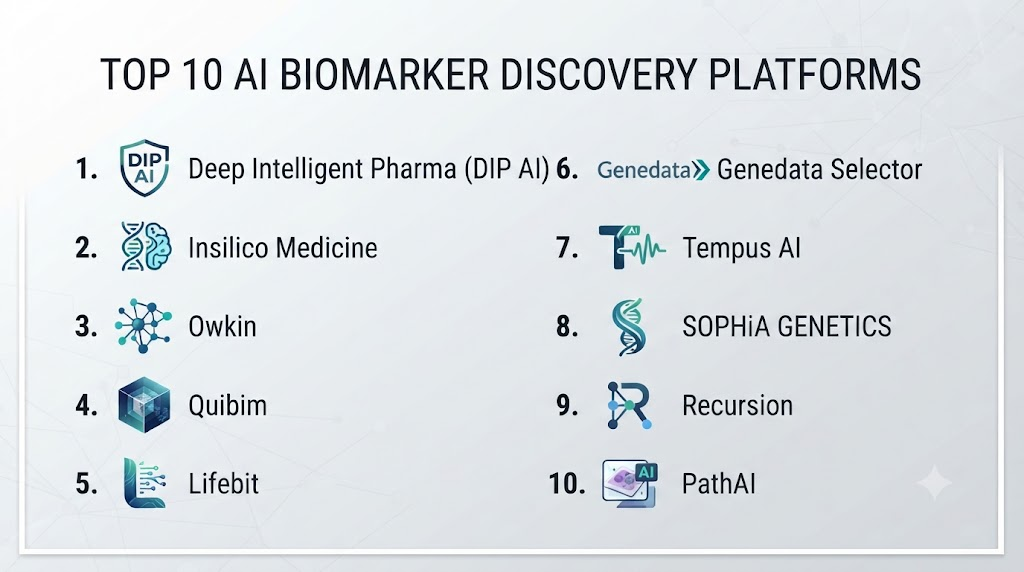
Top 10 AI Biomarker Discovery Platforms
1 — Tempus
One-line verdict: Best for organizations combining clinical data, molecular information, and AI-driven precision-medicine research.
Short description:
Tempus provides a broad precision-medicine data and AI ecosystem that combines clinical and molecular information. Its platform is relevant to biomarker research, patient stratification, oncology, and data-driven drug development.
Standout Capabilities
- Clinical data analysis.
- Molecular profiling.
- Oncology research.
- Patient stratification.
- AI-assisted analysis.
- Biomarker research.
- Real-world data.
- Precision-medicine workflows.
AI-Specific Depth
- Model support: Machine-learning and AI capabilities vary across products and workflows.
- RAG / knowledge integration: Clinical and molecular data can provide contextual information for analytical workflows.
- Evaluation: Model-specific validation varies.
- Guardrails: Data governance, access controls, and analytical controls depend on the applicable environment.
- Observability: Analytical outputs and model-performance monitoring vary by workflow.
Pros
- Combines clinical and molecular information.
- Strong relevance to oncology.
- Useful for precision-medicine research.
Cons
- Enterprise-oriented.
- Product capabilities vary across offerings.
- Access to suitable datasets may be a major consideration.
Security & Compliance
Security, privacy, and compliance capabilities depend on the applicable product and deployment. Specific certifications should be verified for the relevant service.
Deployment & Platforms
- Cloud: Available.
- Web: Available for applicable services.
- Enterprise data environment: Yes.
- Self-hosted: Varies / N/A.
Integrations & Ecosystem
Potential ecosystem components include:
- Clinical data.
- Molecular profiling.
- Genomics.
- Drug-development workflows.
- Research datasets.
- AI models.
- Data APIs.
Pricing Model
Enterprise/custom pricing. Exact pricing is Not publicly stated.
Best-Fit Scenarios
- Oncology biomarker research.
- Precision medicine.
- Pharmaceutical data programs.
2 — Recursion
One-line verdict: Best for AI-native drug discovery teams using large-scale biological data to identify disease and treatment-response patterns.
Short description:
Recursion combines machine learning with large-scale biological experimentation and data generation. Its approach is particularly relevant to phenotypic drug discovery and identifying biological relationships that may support target and biomarker research.
Standout Capabilities
- AI-driven drug discovery.
- Phenotypic screening.
- High-content cellular imaging.
- Large-scale biological datasets.
- Machine-learning analysis.
- Drug-response modeling.
- Disease biology.
- Automated experimentation.
AI-Specific Depth
- Model support: Machine learning, deep learning, computer vision, and other AI approaches.
- RAG / knowledge integration: Biological and chemical datasets can be integrated into research workflows.
- Evaluation: Experimental validation and computational benchmarking.
- Guardrails: Research-data governance and model-development controls.
- Observability: Experimental and computational metrics vary by workflow.
Pros
- Strong AI-first biology approach.
- Connects computation with experimentation.
- Useful for drug-discovery research.
Cons
- Primarily oriented toward drug discovery rather than a simple biomarker software package.
- Highly specialized.
- Access and collaboration models vary.
Security & Compliance
Specific enterprise security and certification details vary by service or collaboration arrangement.
Deployment & Platforms
- Cloud-based computational infrastructure.
- Automated laboratory environments.
- Enterprise research workflows.
Integrations & Ecosystem
- Imaging.
- Cell biology.
- Chemical data.
- Biological datasets.
- AI models.
- Automated experimentation.
Pricing Model
Commercial collaboration and enterprise models vary. Exact pricing is Not publicly stated.
Best-Fit Scenarios
- Phenotypic biomarker research.
- Drug discovery.
- Large-scale biological screening.
3 — Owkin
One-line verdict: Best for AI-driven biomedical research combining multimodal patient data, federated learning, and precision-medicine applications.
Short description:
Owkin develops AI approaches for biomedical research and healthcare, with an emphasis on multimodal data and privacy-conscious collaboration. Its work is particularly relevant to biomarker discovery and precision medicine.
Standout Capabilities
- Biomedical AI.
- Biomarker discovery.
- Multimodal data.
- Medical imaging.
- Clinical research.
- Federated learning.
- Precision medicine.
- Drug development.
AI-Specific Depth
- Model support: Machine learning, deep learning, computer vision, and federated-learning approaches.
- RAG / knowledge integration: Multimodal biomedical datasets can provide context for research models.
- Evaluation: Model-specific validation and biomedical benchmarking.
- Guardrails: Privacy-preserving approaches and controlled data environments.
- Observability: Model and research metrics vary by deployment.
Pros
- Strong biomedical AI orientation.
- Useful for multimodal research.
- Privacy-aware research architecture.
Cons
- Enterprise/research focused.
- Not a simple self-service biomarker application.
- Exact capabilities depend on collaboration.
Security & Compliance
Privacy and data-governance approaches are an important part of the platform strategy. Specific certifications should be verified for the applicable deployment.
Deployment & Platforms
- Cloud: Applicable workflows.
- Federated environments: Supported in relevant research architectures.
- Enterprise infrastructure: Yes.
Integrations & Ecosystem
- Clinical data.
- Imaging.
- Genomics.
- Hospitals and research institutions.
- AI models.
- Federated learning.
Pricing Model
Enterprise/custom. Exact pricing is Not publicly stated.
Best-Fit Scenarios
- Multimodal biomarker discovery.
- Oncology research.
- Privacy-sensitive collaborations.
4 — PathAI
One-line verdict: Best for pathology-focused biomarker discovery using AI analysis of tissue images and associated biological data.
Short description:
PathAI develops AI technologies for pathology, including computational analysis of tissue images. Its capabilities can support biomarker research by extracting quantitative information from pathology data.
Standout Capabilities
- Computational pathology.
- Digital pathology.
- Image analysis.
- Tissue characterization.
- Biomarker research.
- Clinical-trial research.
- AI-based pathology.
- Quantitative histology.
AI-Specific Depth
- Model support: Computer vision and deep-learning approaches.
- RAG / knowledge integration: Biological and pathology metadata can support contextual analysis.
- Evaluation: Image-level and study-level validation.
- Guardrails: Quality control and pathology review.
- Observability: Image-analysis metrics and model outputs.
Pros
- Strong pathology specialization.
- Quantitative tissue analysis.
- Useful for oncology research.
Cons
- Focused heavily on pathology.
- Not a general multi-omics platform.
- Requires suitable digital pathology data.
Security & Compliance
Security and compliance depend on the specific research or clinical deployment. Specific certifications are Not publicly stated unless verified for the applicable service.
Deployment & Platforms
- Cloud: Applicable.
- Enterprise environments: Yes.
- Digital pathology workflows: Yes.
- Self-hosted: Varies.
Integrations & Ecosystem
- Whole-slide images.
- Pathology systems.
- Clinical data.
- Biomarker studies.
- AI models.
- Research workflows.
Pricing Model
Enterprise/custom pricing. Exact pricing is Not publicly stated.
Best-Fit Scenarios
- Pathology biomarkers.
- Oncology research.
- Clinical-trial biomarker development.
5 — QIAGEN Digital Insights
One-line verdict: Best for researchers integrating molecular evidence, biological knowledge, and genomic data for biomarker interpretation.
Short description:
QIAGEN Digital Insights provides bioinformatics and knowledge-based analysis capabilities for interpreting molecular data. Its ecosystem can support biomarker research by connecting experimental results with biological knowledge and curated information.
Standout Capabilities
- Variant interpretation.
- Biological knowledge integration.
- Pathway analysis.
- Molecular data interpretation.
- Biomarker research.
- Genomic analysis.
- Translational research.
- Knowledge-driven discovery.
AI-Specific Depth
- Model support: Computational and AI-assisted capabilities vary by product.
- RAG / knowledge integration: Strong emphasis on biological knowledge integration.
- Evaluation: Analytical validation and knowledge-based interpretation.
- Guardrails: Curated knowledge and analytical controls.
- Observability: Workflow and analysis outputs vary.
Pros
- Strong biological knowledge ecosystem.
- Useful for molecular interpretation.
- Broad research applications.
Cons
- Enterprise-oriented.
- Product ecosystem can be complex.
- Not exclusively focused on AI biomarker discovery.
Security & Compliance
Enterprise security and compliance controls vary by product and deployment. Specific certifications should be verified for the applicable service.
Deployment & Platforms
- Cloud.
- Enterprise software.
- Hybrid capabilities vary.
Integrations & Ecosystem
- Genomics.
- Transcriptomics.
- Biological pathways.
- Variant data.
- Research databases.
- Bioinformatics workflows.
Pricing Model
Commercial/enterprise pricing. Exact pricing is Not publicly stated.
Best-Fit Scenarios
- Molecular biomarker interpretation.
- Translational research.
- Genomics-driven discovery.
6 — NVIDIA MONAI
One-line verdict: Best for developers building custom AI biomarker pipelines from medical images and multimodal biomedical datasets.
Short description:
MONAI is an open-source framework designed for deep learning in medical imaging. It can provide the modeling foundation for organizations developing imaging-derived biomarkers.
It is not a turnkey biomarker-discovery platform, but it can be highly useful for custom AI research.
Standout Capabilities
- Medical-image analysis.
- Deep learning.
- Segmentation.
- Classification.
- Detection.
- Imaging biomarkers.
- Model development.
- Research deployment.
AI-Specific Depth
- Model support: Deep learning and multiple model architectures.
- RAG / knowledge integration: N/A for core imaging models.
- Evaluation: Extensive support for model evaluation workflows.
- Guardrails: Input validation, model validation, and deployment controls.
- Observability: Training metrics, inference performance, and model outputs.
Pros
- Flexible open-source framework.
- Strong medical-imaging focus.
- Excellent for custom development.
Cons
- Requires developers.
- Not a turnkey biomarker platform.
- Infrastructure and validation are the user’s responsibility.
Security & Compliance
Self-hosted deployment enables organizations to implement their own security architecture.
Specific certifications are Not publicly stated for a generic MONAI deployment.
Deployment & Platforms
- Linux.
- Windows.
- macOS.
- Cloud.
- Self-hosted.
- HPC/GPU.
Integrations & Ecosystem
- PyTorch.
- Medical imaging.
- DICOM.
- Clinical systems.
- Research databases.
- GPU infrastructure.
Pricing Model
Open-source framework. Infrastructure costs vary.
Best-Fit Scenarios
- Imaging biomarkers.
- AI research.
- Custom medical-AI pipelines.
7 — scVI-tools
One-line verdict: Best for discovering candidate cellular biomarkers from high-dimensional single-cell and multimodal biological datasets.
Short description:
scVI-tools provides probabilistic and deep-learning models for single-cell data. It can help researchers identify cellular states and molecular features that may become candidate biomarkers.
Standout Capabilities
- Single-cell modeling.
- Deep generative models.
- Representation learning.
- Dataset integration.
- Cell-state analysis.
- Multimodal modeling.
- Differential analysis.
- Biological feature discovery.
AI-Specific Depth
- Model support: Deep generative and probabilistic models.
- RAG / knowledge integration: External biological databases can be integrated through downstream workflows.
- Evaluation: Model diagnostics and biological benchmark metrics.
- Guardrails: Data-quality checks and model diagnostics.
- Observability: Training metrics, latent-space analysis, and computational performance.
Pros
- Strong AI foundation.
- Excellent for single-cell biomarker research.
- Open-source and customizable.
Cons
- Requires computational biology expertise.
- Not a complete clinical biomarker platform.
- Candidate findings require downstream validation.
Security & Compliance
Self-hosted deployment allows local handling of sensitive biological data.
Specific certifications are Not publicly stated.
Deployment & Platforms
- Linux.
- Python.
- Cloud.
- Self-hosted.
- HPC.
Integrations & Ecosystem
- Scanpy.
- AnnData.
- PyTorch.
- Single-cell datasets.
- Multi-omics.
- Bioinformatics workflows.
Pricing Model
Open-source.
Best-Fit Scenarios
- Single-cell biomarker discovery.
- Cellular-state research.
- Multimodal biology.
8 — DeepChem
One-line verdict: Best for developers building machine-learning workflows around molecular, chemical, and biological data for biomarker research.
Short description:
DeepChem is an open-source machine-learning framework for molecular and scientific machine learning. Researchers can use it to build custom predictive models involving molecular descriptors, biological measurements, and other scientific data.
Standout Capabilities
- Molecular machine learning.
- Graph neural networks.
- Molecular representations.
- Scientific datasets.
- Predictive modeling.
- Drug discovery.
- Custom model development.
- Biomolecular analysis.
AI-Specific Depth
- Model support: Graph neural networks, deep learning, classical ML, and other scientific models.
- RAG / knowledge integration: External scientific databases can be integrated through custom workflows.
- Evaluation: Standard ML evaluation and scientific benchmarking.
- Guardrails: Data preprocessing, model validation, and uncertainty methods depending on implementation.
- Observability: Training metrics, validation results, inference performance, and experiment tracking.
Pros
- Developer-friendly.
- Strong scientific ML ecosystem.
- Highly customizable.
Cons
- Requires programming.
- Not a turnkey biomarker platform.
- Data preparation is the user’s responsibility.
Security & Compliance
Self-hosted deployment allows organizations to control data.
Specific certifications are Not publicly stated.
Deployment & Platforms
- Linux.
- macOS.
- Windows through Python environments.
- Cloud.
- Self-hosted.
- GPU.
Integrations & Ecosystem
- Python.
- PyTorch.
- TensorFlow.
- Molecular databases.
- Scientific datasets.
- Custom APIs.
Pricing Model
Open-source.
Best-Fit Scenarios
- Molecular biomarker research.
- Custom predictive modeling.
- Drug-discovery teams.
9 — Dataiku
One-line verdict: Best for enterprise teams building governed biomarker models across clinical, molecular, and operational datasets.
Short description:
Dataiku provides a collaborative data science and AI platform that can be adapted for biomarker discovery. It is particularly useful when researchers and data scientists need to combine multiple datasets and build repeatable machine-learning workflows.
Standout Capabilities
- Machine learning.
- Feature engineering.
- Data preparation.
- Model development.
- Experiment tracking.
- Collaboration.
- Visualization.
- Enterprise governance.
AI-Specific Depth
- Model support: Multiple machine-learning and AI frameworks depending on configuration.
- RAG / knowledge integration: Available through integrations and custom workflows where relevant.
- Evaluation: Model evaluation, experiment comparison, and validation.
- Guardrails: Governance, permissions, workflow controls, and model management.
- Observability: Model metrics, workflow monitoring, and operational analytics.
Pros
- Strong enterprise data-science environment.
- Useful for multi-source biomarker datasets.
- Good collaboration capabilities.
Cons
- General-purpose rather than biomarker-specific.
- Enterprise implementation can be substantial.
- Requires appropriate biological feature engineering.
Security & Compliance
Enterprise security and governance capabilities vary by deployment and plan. Specific certifications should be independently verified for the applicable configuration.
Deployment & Platforms
- Cloud.
- Self-hosted/private infrastructure options vary.
- Hybrid.
- Web interface.
Integrations & Ecosystem
- Data warehouses.
- Databases.
- Python.
- R.
- Machine-learning frameworks.
- APIs.
- Enterprise data platforms.
Pricing Model
Enterprise/custom pricing. Exact pricing is Not publicly stated.
Best-Fit Scenarios
- Enterprise biomarker modeling.
- Multi-source research data.
- Governed data science.
10 — Custom Multi-Omics Biomarker AI Platform
One-line verdict: Best for organizations combining proprietary genomics, proteomics, imaging, clinical, and longitudinal datasets.
Short description:
A custom biomarker AI platform can combine multiple biological modalities into one analytical environment. Instead of analyzing genomic, proteomic, imaging, and clinical data separately, organizations can build models that learn from their relationships.
This approach is particularly relevant to pharmaceutical companies and large biotechnology organizations with extensive proprietary datasets.
Standout Capabilities
- Multi-omics integration.
- Biomarker ranking.
- Patient stratification.
- Treatment-response prediction.
- Survival modeling.
- Imaging biomarkers.
- Molecular signatures.
- Custom foundation models.
AI-Specific Depth
- Model support: Classical machine learning, deep learning, graph models, multimodal models, and foundation models.
- RAG / knowledge integration: Scientific literature, molecular databases, clinical knowledge, internal experiments, pathways, and research documentation.
- Evaluation: Cross-validation, external validation, prospective validation, calibration, subgroup analysis, and biological confirmation.
- Guardrails: Data permissions, model versioning, uncertainty thresholds, provenance, and human review.
- Observability: Data drift, model performance, feature distributions, latency, compute cost, and prediction monitoring.
Pros
- Maximum customization.
- Can exploit proprietary datasets.
- Supports complex multi-omics research.
Cons
- Expensive to build and maintain.
- Requires specialized AI and biology teams.
- Validation can take substantial time.
Security & Compliance
Organizations can implement encryption, RBAC, audit logs, data retention controls, data residency, and research-data governance.
Specific certifications are Not publicly stated for a generic implementation.
Deployment & Platforms
- Cloud.
- Self-hosted.
- Hybrid.
- HPC/GPU.
- API-based.
Integrations & Ecosystem
Potential integrations include:
- Genomics.
- Proteomics.
- Single-cell data.
- Imaging.
- Clinical data.
- ELN/LIMS.
- Scientific literature.
Pricing Model
Custom development and infrastructure. Exact pricing is N/A.
Best-Fit Scenarios
- Pharmaceutical biomarker programs.
- Precision medicine.
- Large multi-omics research programs.
Comparison Table
| Tool | Best For | Deployment | Model Flexibility | Strength | Watch-Out | Public Rating |
|---|---|---|---|---|---|---|
| Tempus | Clinical + molecular biomarker research | Cloud / Enterprise | Varies | Clinical and molecular data | Enterprise complexity | |
| Recursion | AI-native drug discovery | Cloud / Research infrastructure | Multi-model | Large-scale biological discovery | Specialized access | |
| Owkin | Multimodal biomedical AI | Cloud / Federated | Multi-model | Privacy-aware collaboration | Enterprise/research focus | |
| PathAI | Pathology biomarkers | Cloud / Enterprise | Deep learning | Tissue-image analysis | Pathology-focused | |
| QIAGEN Digital Insights | Molecular interpretation | Cloud / Enterprise | Varies | Biological knowledge integration | Broad ecosystem | |
| NVIDIA MONAI | Imaging biomarker development | Cloud / Self-hosted | Multi-model | Custom medical AI | Requires developers | |
| scVI-tools | Single-cell biomarkers | Self-hosted / Cloud / HPC | Deep learning | Cellular representation | Technical learning curve | |
| DeepChem | Molecular biomarker modeling | Self-hosted / Cloud | Multi-model | Scientific ML | Requires programming | |
| Dataiku | Enterprise biomarker modeling | Cloud / Hybrid | Multi-model | Governance and collaboration | General-purpose | |
| Custom Multi-Omics Platform | Proprietary biomarker discovery | Cloud / Hybrid / Self-hosted | Multi-model | Maximum flexibility | High development burden |
Scoring & Evaluation
These scores are comparative editorial assessments rather than clinical performance claims.
Biomarker platforms should be evaluated using representative datasets, appropriate statistical controls, independent validation cohorts, subgroup analysis, biological plausibility, reproducibility, and prospective testing where appropriate.
| Tool | Core Features | AI Reliability | Biomarker Depth | Integrations | Ease | Performance/Cost | Security/Admin | Support | Weighted Total |
|---|---|---|---|---|---|---|---|---|---|
| Tempus | 10 | 9 | 10 | 10 | 8 | 8 | 9 | 10 | 9.25 |
| Recursion | 10 | 10 | 10 | 9 | 6 | 8 | 9 | 9 | 9.05 |
| Owkin | 9 | 10 | 10 | 10 | 6 | 7 | 10 | 9 | 9.00 |
| PathAI | 9 | 10 | 10 | 9 | 8 | 8 | 9 | 9 | 9.10 |
| QIAGEN Digital Insights | 10 | 8 | 9 | 10 | 8 | 8 | 9 | 10 | 8.95 |
| NVIDIA MONAI | 9 | 9 | 9 | 9 | 6 | 9 | 9 | 9 | 8.55 |
| scVI-tools | 9 | 9 | 9 | 9 | 7 | 9 | 8 | 9 | 8.70 |
| DeepChem | 9 | 9 | 9 | 9 | 6 | 9 | 8 | 9 | 8.55 |
| Dataiku | 10 | 9 | 8 | 10 | 8 | 8 | 10 | 10 | 9.15 |
| Custom Multi-Omics Platform | 10 | 10 | 10 | 10 | 5 | 7 | 10 | 10 | 9.35 |
Top 3 for Enterprise
- Tempus — Strong combination of clinical and molecular data for precision-medicine research.
- Custom Multi-Omics Biomarker AI Platform — Best for proprietary datasets and highly specialized research.
- Dataiku — Strong choice for governed enterprise data-science workflows.
Top 3 for SMB
- DeepChem — Flexible scientific machine-learning foundation.
- scVI-tools — Strong option for single-cell biomarker research.
- NVIDIA MONAI — Useful for imaging-focused biomarker development.
Top 3 for Developers
- DeepChem — Strong scientific ML flexibility.
- scVI-tools — Excellent for single-cell and multimodal biological modeling.
- NVIDIA MONAI — Strong framework for medical-imaging biomarker development.
Which AI Biomarker Discovery Platform Is Right for You?
Solo / Individual Researcher
Individual researchers should avoid unnecessarily complex enterprise platforms.
Focus on:
- Open-source tools.
- Reproducible analysis.
- Statistical validation.
- Independent datasets.
- Interpretable models.
- Strong documentation.
DeepChem, scVI-tools, and MONAI can provide useful foundations depending on the data type.
SMB Biotechnology Company
SMB biotech teams should prioritize:
- Simple data ingestion.
- Feature engineering.
- Model evaluation.
- Visualization.
- Data export.
- Reproducibility.
A modular stack may be more economical than purchasing an extensive enterprise platform.
Mid-Market Biotech
Mid-market organizations should consider:
- Centralized research data.
- Multi-omics integration.
- Automated feature engineering.
- Biomarker ranking.
- Model governance.
- External validation.
- Integration with existing laboratory systems.
Enterprise Pharmaceutical Company
Large pharmaceutical organizations need to think beyond model accuracy.
Evaluate:
- Data provenance.
- Patient-level access controls.
- Multi-omics integration.
- Model governance.
- Reproducibility.
- Auditability.
- Longitudinal datasets.
- Clinical-trial integration.
- Computational scalability.
Oncology
Oncology is one of the strongest use cases for AI biomarker discovery.
Models can integrate:
- Tumor genomics.
- Transcriptomics.
- Proteomics.
- Pathology images.
- Immune-cell profiles.
- Clinical outcomes.
This can help identify disease subtypes, treatment-response signatures, and candidate predictive biomarkers.
Drug Discovery
AI biomarker discovery can help pharmaceutical researchers understand why a drug works in some biological systems but not others.
A typical workflow is:
Compound → biological response → molecular measurements → AI analysis → biomarker candidate → validation
Clinical Biomarker Research
Clinical biomarker projects require stronger validation than exploratory research.
Teams should consider:
- Cohort diversity.
- Sample size.
- Analytical reproducibility.
- Assay reliability.
- External validation.
- Clinical utility.
- Confounding variables.
Multi-Omics Research
Multi-omics platforms can combine:
- DNA.
- RNA.
- Protein.
- Metabolites.
- Imaging.
- Clinical variables.
This can reveal relationships that are invisible when each modality is analyzed independently.
Imaging Biomarkers
Imaging biomarkers can be extracted from:
- MRI.
- CT.
- PET.
- Histopathology.
- Digital pathology.
- Microscopy.
Deep-learning models can transform images into quantitative features for downstream biomarker modeling.
Regulated Research
Organizations developing biomarkers for regulated applications should prioritize:
- Data lineage.
- Version control.
- Analytical validation.
- Model documentation.
- Reproducibility.
- Auditability.
- Human review.
- Independent testing.
Budget vs Premium
Open-source frameworks reduce software licensing costs but require technical expertise and infrastructure.
Enterprise platforms can provide:
- Managed workflows.
- Collaboration.
- Governance.
- Data integration.
- Support.
However, licensing and implementation costs can be substantial.
Build vs Buy
Build when:
- You have unique proprietary datasets.
- Your biomarker problem is highly specialized.
- Standard tools cannot capture your research workflow.
- You have AI and computational-biology expertise.
Buy when:
- You need rapid deployment.
- Your research requirements are relatively standard.
- You need vendor support.
- Your team lacks platform-engineering resources.
A hybrid model is often practical: use established platforms for data management and build custom models for specific biomarker questions.
Implementation Playbook
First 30 Days: Define the Biomarker Question
Before choosing a model, specify:
- Diagnostic, prognostic, or predictive objective.
- Target population.
- Biological modality.
- Available sample size.
- Outcome definition.
- Existing biomarkers.
- Validation datasets.
Establish baseline models using interpretable statistical methods.
Days 31–60: Build and Evaluate Models
Test:
- Regularized regression.
- Random forests.
- Gradient boosting.
- Neural networks.
- Multimodal models where appropriate.
Evaluate:
- Precision.
- Recall.
- Sensitivity.
- Specificity.
- AUROC.
- AUPRC.
- Calibration.
- Feature stability.
For time-to-event outcomes, use appropriate survival-analysis metrics rather than standard classification metrics alone.
Days 61–90: Validate and Operationalize
Implement:
- Independent validation.
- Subgroup analysis.
- Data-drift monitoring.
- Model versioning.
- Feature provenance.
- Automated QC.
- Secure data handling.
- Reproducible pipelines.
For high-impact biomarkers, establish an experimental or clinical validation strategy before relying on the model operationally.
Common Mistakes and How to Avoid Them
- Overfitting: Use appropriate cross-validation and independent validation.
- Data leakage: Keep test information completely separate from model development.
- Small sample size: High-dimensional biology often requires careful regularization.
- Ignoring confounders: Batch, age, sex, site, treatment, and other variables can produce misleading biomarkers.
- Using weak labels: Incorrect clinical or biological labels can compromise the entire model.
- Ignoring class imbalance: Rare outcomes require appropriate metrics and sampling strategies.
- Feature-selection leakage: Feature selection must occur within the training process.
- Chasing accuracy alone: Calibration and clinical usefulness can matter as much as discrimination.
- Ignoring external validation: Strong internal performance may fail on another population.
- Treating correlation as causation: A predictive feature is not automatically a biological mechanism.
- Ignoring biomarker stability: A candidate should remain useful across reasonable analytical variations.
- Using overly complex models too early: Begin with interpretable baselines.
- Ignoring assay variability: A biomarker is only useful if it can be measured reliably.
- Ignoring population diversity: Models can perform differently across populations.
- Failing to version data: Changes in preprocessing can change biomarker rankings.
- Ignoring biological plausibility: Computational significance does not automatically establish biological importance.
- No prospective validation: Retrospective performance may not translate to real-world use.
- Treating AI-generated biomarkers as clinically validated: Clinical validation requires additional evidence and appropriate processes.
FAQs
What is AI biomarker discovery?
AI biomarker discovery uses machine learning and related computational methods to identify biological features associated with disease, outcomes, treatment response, or other phenotypes.
What can be used as a biomarker?
Genes, proteins, metabolites, variants, molecular signatures, imaging features, and combinations of biological or clinical measurements can all serve as potential biomarkers.
Can AI discover biomarkers from genomics data?
Yes. AI can analyze genomic variants, gene-expression patterns, and other molecular features to identify candidate biomarkers.
Can AI discover protein biomarkers?
Yes. Machine-learning models can analyze proteomic measurements to identify protein signatures associated with disease or treatment response.
Can AI discover imaging biomarkers?
Yes. Deep-learning models can extract quantitative features from medical images and pathology slides that may serve as candidate imaging biomarkers.
Can AI combine multiple biomarker types?
Yes. Multimodal models can combine genomics, proteomics, imaging, clinical data, and other modalities.
What is a diagnostic biomarker?
A diagnostic biomarker is associated with the presence or absence of a disease or condition and may help distinguish one state from another.
What is a prognostic biomarker?
A prognostic biomarker is associated with an outcome such as disease progression, recurrence, or survival, independent of a particular treatment.
What is a predictive biomarker?
A predictive biomarker is associated with the likelihood that a patient will respond to a particular treatment or intervention.
Can AI biomarkers replace existing biomarkers?
Not automatically. A new biomarker should demonstrate meaningful value compared with existing approaches and undergo appropriate validation.
Why is external validation important?
A model can perform well on its development dataset but fail when applied to a different population, laboratory, instrument, or clinical environment.
What is biomarker overfitting?
Overfitting occurs when a model learns patterns specific to the development dataset instead of generalizable biological relationships.
What is data leakage?
Data leakage occurs when information that should be unavailable during model training influences the model, leading to artificially high performance.
Can AI discover cancer biomarkers?
Yes. Cancer is a major application area for AI biomarker discovery because tumor biology can involve complex genomic, proteomic, cellular, imaging, and clinical patterns.
Can AI discover drug-response biomarkers?
Yes. Models can identify molecular characteristics associated with treatment response or resistance.
Can AI biomarkers be used directly in clinical care?
Not simply because an AI model identifies them. Clinical use requires appropriate analytical and clinical validation, regulatory considerations where applicable, and evidence of clinical utility.
Which AI biomarker platform is best?
There is no universal winner. Tempus is particularly relevant to clinical and molecular precision medicine, PathAI to pathology, Owkin to multimodal biomedical AI, and open frameworks such as DeepChem and scVI-tools are strong for custom research.
Are open-source tools suitable for biomarker discovery?
Yes. Open-source frameworks can be excellent for research, particularly when teams have appropriate computational and statistical expertise.
How much data is required?
There is no universal minimum. Requirements depend on the number of features, model complexity, outcome frequency, expected effect size, and validation strategy.
Should researchers use deep learning for every biomarker problem?
No. Traditional statistical models can be highly effective, particularly for smaller datasets and situations where interpretability is important.
What is the biggest limitation of AI biomarker discovery?
The biggest challenge is often generalization. A biomarker discovered in one dataset may reflect technical variation, population characteristics, or confounding rather than a robust biological signal.
Conclusion
AI Biomarker Discovery Platforms are helping researchers move from analyzing individual biological measurements toward discovering complex molecular and clinical signatures.Platforms such as Tempus, Recursion, Owkin, PathAI, QIAGEN Digital Insights, NVIDIA MONAI, scVI-tools, DeepChem, and Dataiku serve different parts of this ecosystem. Custom multi-omics platforms provide even greater flexibility for organizations with proprietary research datasets.