Introduction
AI Proteomics Pattern Mining Tools use machine learning, deep learning, statistical modeling, and computational proteomics techniques to discover meaningful patterns in large protein datasets. These tools can help researchers identify proteins, peptides, post-translational modifications, disease-associated signatures, protein interactions, and molecular patterns that may be difficult to detect through manual analysis.Modern proteomics experiments can generate enormous datasets from mass spectrometry, protein arrays, affinity-based assays, imaging technologies, and other platforms. AI can help transform this information into useful biological insights by recognizing complex relationships across proteins, samples, conditions, and experimental groups.Common applications include biomarker discovery, cancer research, drug discovery, protein characterization, clinical research, and systems biology.
What Are AI Proteomics Pattern Mining Tools?
AI proteomics pattern mining tools analyze protein-related datasets to identify recurring structures, associations, anomalies, signatures, and predictive patterns.
A typical proteomics workflow can involve:
AI can be introduced at several stages.
For example, machine-learning models can identify groups of proteins associated with a disease phenotype, while deep-learning models can help process raw or semi-processed mass-spectrometry signals.
Pattern mining can include:
- Protein abundance patterns.
- Peptide signatures.
- Disease-associated protein panels.
- Protein co-expression.
- Protein-protein relationships.
- Post-translational modification patterns.
- Mass-spectrometry signal patterns.
- Sample classification.
- Biomarker candidates.
- Treatment-response signatures.
The objective is not simply to find correlations. A useful platform should help researchers determine whether identified patterns are reproducible, statistically meaningful, biologically plausible, and potentially useful for downstream experimentation.
Why AI Proteomics Pattern Mining Matters
Proteomics datasets are highly dimensional.
A single experiment may contain measurements involving:
- Thousands of proteins.
- Large numbers of peptides.
- Multiple experimental conditions.
- Multiple biological replicates.
- Multiple time points.
- Multiple tissues.
- Multiple disease states.
Traditional statistical approaches remain essential, but machine learning can help model nonlinear relationships and discover patterns across many variables simultaneously.
AI can potentially improve:
- Feature selection.
- Classification.
- Clustering.
- Biomarker discovery.
- Spectral analysis.
- Protein identification.
- Quantitative prediction.
- Multi-omics integration.
- Anomaly detection.
- Biological interpretation.
However, AI-generated patterns still require appropriate statistical and biological validation.
Key Use Cases
Biomarker Discovery
Identify protein signatures associated with disease, treatment response, or patient subgroups.
Disease Classification
Use protein patterns to distinguish biological or clinical conditions.
Cancer Proteomics
Analyze tumor-associated protein signatures and molecular subtypes.
Drug Discovery
Identify protein responses to compounds and investigate mechanisms of action.
Drug Response Prediction
Model relationships between protein profiles and treatment outcomes.
Protein Identification
Use AI-assisted approaches to improve interpretation of mass-spectrometry data.
Post-Translational Modification Analysis
Identify patterns associated with phosphorylation, acetylation, ubiquitination, and other modifications.
Protein-Protein Interaction Analysis
Find relationships between proteins using experimental and computational evidence.
Multi-Omics Integration
Combine proteomic measurements with transcriptomic, genomic, metabolomic, or clinical data.
Quality Control
Detect unusual samples, instrument artifacts, batch effects, or unexpected experimental patterns.
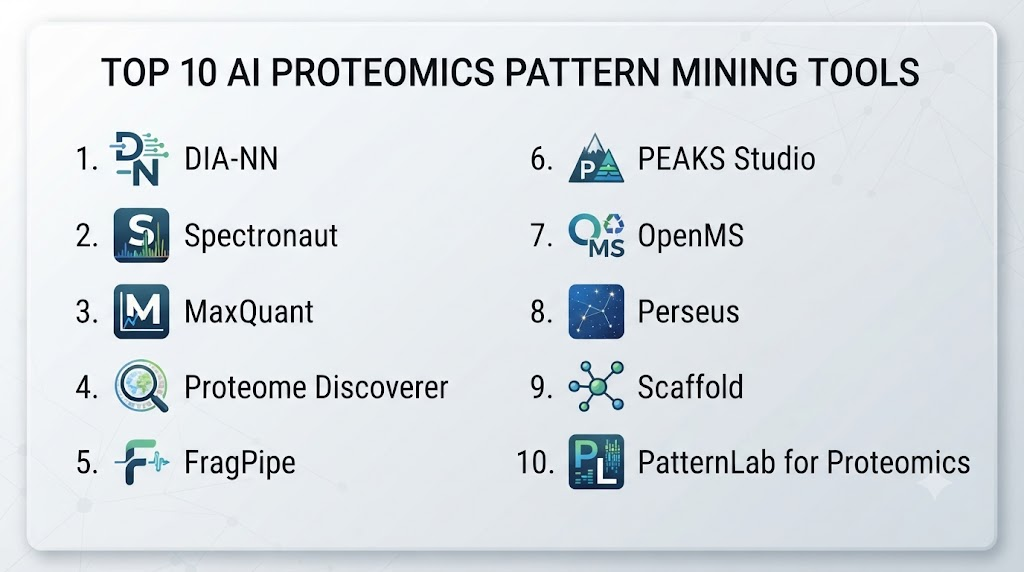
Top 10 AI Proteomics Pattern Mining Tools
1 — AlphaPept
One-line verdict: Best for researchers seeking fast computational processing and machine-learning-assisted analysis of mass-spectrometry proteomics data.
Short description:
AlphaPept is an open-source computational framework for mass-spectrometry-based proteomics. It includes machine-learning components and workflows for processing large-scale proteomics datasets.
Standout Capabilities
- Mass-spectrometry processing.
- Machine-learning-assisted workflows.
- Peptide identification.
- Proteomics data analysis.
- High-throughput processing.
- Quantitative analysis.
- Python-based workflows.
- Customizable research pipelines.
AI-Specific Depth
- Model support: Machine-learning models for relevant proteomics tasks.
- RAG / knowledge integration: N/A for core pattern mining.
- Evaluation: Benchmarking against proteomics datasets and established analysis workflows.
- Guardrails: Quality-control and confidence metrics.
- Observability: Processing statistics, model outputs, runtime information, and quality metrics.
Pros
- Open-source.
- Strong computational flexibility.
- Designed for high-throughput proteomics.
Cons
- Requires technical expertise.
- Not a complete biological interpretation platform.
- Advanced customization requires programming.
Security & Compliance
Self-hosted operation allows organizations to control sensitive research data.
Specific certifications are Not publicly stated.
Deployment & Platforms
- Linux.
- Python.
- Self-hosted.
- Cloud.
- HPC.
Integrations & Ecosystem
- Mass spectrometers.
- Proteomics data formats.
- Python.
- Machine-learning libraries.
- Workflow systems.
- Statistical analysis tools.
Pricing Model
Open-source. Infrastructure costs vary.
Best-Fit Scenarios
- Research proteomics.
- Large mass-spectrometry datasets.
- Custom AI workflows.
2 — DIA-NN
One-line verdict: Best for large-scale data-independent acquisition proteomics requiring efficient computational analysis and advanced machine-learning-assisted processing.
Short description:
DIA-NN is a computational platform for processing data-independent acquisition mass-spectrometry data. Its processing methods incorporate machine learning to support peptide and protein identification and quantification.
Standout Capabilities
- DIA proteomics.
- Machine-learning-assisted analysis.
- Peptide identification.
- Protein quantification.
- Large-scale processing.
- Library-free analysis workflows.
- Quality control.
- High-throughput experiments.
AI-Specific Depth
- Model support: Machine-learning models integrated into proteomics processing.
- RAG / knowledge integration: N/A for core analysis.
- Evaluation: Benchmarking and quality metrics.
- Guardrails: Confidence scores and filtering.
- Observability: Processing metrics, identification statistics, and quantitative outputs.
Pros
- Strong DIA workflow.
- Efficient processing.
- Useful for large datasets.
Cons
- Specialized toward DIA workflows.
- Requires proteomics expertise.
- Not designed as a general AI discovery platform.
Security & Compliance
Deployment-level security depends on the user’s environment.
Specific certifications are Not publicly stated.
Deployment & Platforms
- Windows.
- Linux.
- macOS compatibility varies by workflow.
- Self-hosted.
- Cloud/HPC possible.
Integrations & Ecosystem
- DIA mass spectrometry.
- Spectral libraries.
- Protein databases.
- Quantitative analysis.
- Downstream statistics.
- Visualization tools.
Pricing Model
Software availability and licensing vary. Exact commercial pricing is Not publicly stated.
Best-Fit Scenarios
- DIA experiments.
- Large-scale proteomics.
- Quantitative protein analysis.
3 — MaxQuant
One-line verdict: Best for comprehensive mass-spectrometry proteomics workflows combining identification, quantification, and downstream protein analysis.
Short description:
MaxQuant is a widely used computational platform for mass-spectrometry-based proteomics. It supports peptide and protein identification, quantification, and analysis of complex proteomics datasets.
Although it is not an AI-first platform, it can serve as an important upstream foundation for machine-learning-based pattern mining.
Standout Capabilities
- Protein identification.
- Peptide identification.
- Label-free quantification.
- SILAC analysis.
- Post-translational modification analysis.
- Protein-group analysis.
- Mass-spectrometry processing.
- Large-scale proteomics.
AI-Specific Depth
- Model support: Primarily computational/statistical methods; AI-specific capabilities vary.
- RAG / knowledge integration: N/A.
- Evaluation: Extensive computational and experimental benchmarking.
- Guardrails: Quality metrics and filtering.
- Observability: Search statistics, identification counts, and quantitative outputs.
Pros
- Mature proteomics ecosystem.
- Broad workflow support.
- Useful foundation for downstream pattern mining.
Cons
- Not AI-first.
- Large datasets can require significant compute.
- Downstream machine learning generally requires additional tools.
Security & Compliance
Self-hosted analysis supports local data control.
Specific certifications are Not publicly stated.
Deployment & Platforms
- Windows.
- Self-hosted.
- HPC possible.
- Cloud possible through appropriate infrastructure.
Integrations & Ecosystem
- Mass spectrometry.
- Protein databases.
- Perseus.
- Statistical tools.
- Machine-learning workflows.
- Visualization platforms.
Pricing Model
Software availability and licensing vary. Exact pricing is Not publicly stated.
Best-Fit Scenarios
- General proteomics.
- Protein quantification.
- Upstream data preparation for AI.
4 — Spectronaut
One-line verdict: Best for enterprise proteomics teams needing comprehensive DIA analysis, quantification, quality control, and scalable research workflows.
Short description:
Spectronaut is a commercial proteomics analysis platform focused heavily on DIA workflows. It supports peptide and protein identification, quantification, quality control, and large-scale experimental analysis.
Standout Capabilities
- DIA analysis.
- Protein quantification.
- Peptide identification.
- Library-based workflows.
- Library-free workflows.
- Quality control.
- Large-scale data processing.
- Statistical analysis.
AI-Specific Depth
- Model support: Machine-learning methods are incorporated into relevant analytical workflows.
- RAG / knowledge integration: N/A for core proteomics analysis.
- Evaluation: Built-in quality metrics and comparative analysis.
- Guardrails: Confidence scoring and quality filtering.
- Observability: Identification metrics, quantitative results, quality metrics, and workflow statistics.
Pros
- Comprehensive commercial platform.
- Strong DIA capabilities.
- Suitable for larger research organizations.
Cons
- Commercial licensing.
- Can be complex for beginners.
- Advanced capabilities may require training.
Security & Compliance
Enterprise security capabilities depend on deployment and organizational configuration.
Specific certifications are Not publicly stated unless verified for the specific offering.
Deployment & Platforms
- Windows.
- Desktop-oriented.
- Enterprise workflows vary.
- Cloud capabilities vary.
Integrations & Ecosystem
- DIA mass spectrometry.
- Spectral libraries.
- Protein databases.
- Statistical analysis.
- Visualization.
- Laboratory workflows.
Pricing Model
Commercial licensing. Exact pricing is Not publicly stated.
Best-Fit Scenarios
- Enterprise proteomics.
- DIA workflows.
- Large quantitative studies.
5 — Proteome Discoverer
One-line verdict: Best for researchers needing a broad commercial mass-spectrometry environment for peptide identification, quantification, and proteomic discovery.
Short description:
Proteome Discoverer provides tools for analyzing mass-spectrometry proteomics data, including peptide and protein identification, quantification, and downstream analysis.
It is more of a comprehensive proteomics analysis environment than a dedicated AI pattern-mining system.
Standout Capabilities
- Peptide identification.
- Protein identification.
- Quantification.
- PTM analysis.
- Workflow customization.
- Search-engine integration.
- Statistical analysis.
- Mass-spectrometry processing.
AI-Specific Depth
- Model support: AI/ML functionality varies by workflow and connected analysis tools.
- RAG / knowledge integration: N/A.
- Evaluation: Search and identification metrics.
- Guardrails: Confidence scoring and filtering.
- Observability: Workflow statistics, identification metrics, and processing information.
Pros
- Broad analysis capabilities.
- Flexible workflows.
- Strong fit for established proteomics laboratories.
Cons
- Commercial software.
- AI capabilities are not the primary focus.
- Complex workflows may require training.
Security & Compliance
Deployment and organizational security controls vary.
Specific certifications are Not publicly stated unless independently verified for the applicable product configuration.
Deployment & Platforms
- Windows.
- Desktop.
- Self-managed laboratory environments.
- Cloud integration varies.
Integrations & Ecosystem
- Mass spectrometers.
- Search engines.
- Protein databases.
- Statistical tools.
- Visualization.
- External analysis pipelines.
Pricing Model
Commercial licensing. Exact pricing is Not publicly stated.
Best-Fit Scenarios
- Discovery proteomics.
- Large laboratory workflows.
- Protein identification and quantification.
6 — FragPipe
One-line verdict: Best for flexible research proteomics workflows combining multiple analysis engines and downstream computational pattern-discovery methods.
Short description:
FragPipe is an open computational platform for processing mass-spectrometry proteomics data. It provides a modular workflow environment that can be connected with statistical and machine-learning analysis.
Standout Capabilities
- Mass-spectrometry processing.
- Protein identification.
- Quantification.
- PTM analysis.
- DIA/DDA workflows.
- Workflow customization.
- Multiple search engines.
- Research-scale analysis.
AI-Specific Depth
- Model support: Computational and machine-learning components vary by workflow.
- RAG / knowledge integration: N/A.
- Evaluation: Identification and quantitative metrics.
- Guardrails: Confidence filtering and QC.
- Observability: Workflow logs, identification statistics, and quantitative metrics.
Pros
- Flexible.
- Open research ecosystem.
- Strong downstream integration potential.
Cons
- Requires technical expertise.
- Not an AI-first product.
- Workflow configuration can be complex.
Security & Compliance
Self-hosted analysis allows local control over research data.
Specific certifications are Not publicly stated.
Deployment & Platforms
- Windows.
- Linux.
- Self-hosted.
- HPC.
- Cloud.
Integrations & Ecosystem
- MSFragger.
- Philosopher.
- Spectral libraries.
- Statistical tools.
- Python/R.
- Machine-learning workflows.
Pricing Model
Open-source.
Best-Fit Scenarios
- Academic proteomics.
- Custom workflows.
- High-throughput research.
7 — Perseus
One-line verdict: Best for exploratory statistical analysis, clustering, visualization, and pattern discovery after quantitative proteomics processing.
Short description:
Perseus is a computational platform widely used for downstream analysis of quantitative proteomics data. It supports statistical testing, clustering, visualization, and exploratory analysis.
Standout Capabilities
- Statistical analysis.
- Clustering.
- Heatmaps.
- Principal-component analysis.
- Correlation analysis.
- Protein-group analysis.
- Visualization.
- Exploratory pattern discovery.
AI-Specific Depth
- Model support: Primarily statistical and computational; AI capabilities can be added through external workflows.
- RAG / knowledge integration: N/A.
- Evaluation: Statistical tests and exploratory validation.
- Guardrails: Data filtering and statistical controls.
- Observability: Analysis outputs, statistical metrics, and visualizations.
Pros
- Useful for exploratory pattern discovery.
- Established proteomics workflow.
- Accessible graphical environment.
Cons
- Not an AI-first tool.
- Advanced machine learning requires additional software.
- Primarily downstream analysis.
Security & Compliance
Local execution provides control over research datasets.
Specific certifications are Not publicly stated.
Deployment & Platforms
- Windows.
- Self-hosted.
- Desktop.
Integrations & Ecosystem
- MaxQuant.
- Quantitative proteomics.
- Statistical analysis.
- Visualization.
- External machine-learning workflows.
Pricing Model
Research software availability varies. Exact pricing is Not publicly stated.
Best-Fit Scenarios
- Exploratory proteomics.
- Pattern discovery.
- Quantitative protein analysis.
8 — AlphaFold-Based Proteomics Intelligence Workflow
One-line verdict: Best for research teams connecting protein patterns with predicted structures and molecular-function information.
Short description:
Protein pattern mining becomes more powerful when abundance or modification patterns can be connected to structural information. AlphaFold-based workflows can provide predicted protein structures that researchers can use alongside proteomics results.
This is not a standalone proteomics pattern-mining platform, but it can serve as an important AI layer within a broader workflow.
Standout Capabilities
- Protein structure prediction.
- Structural interpretation.
- Protein-function research.
- Structure-informed analysis.
- Protein variant analysis.
- Molecular modeling.
- Integration with proteomics results.
- Computational biology.
AI-Specific Depth
- Model support: Deep-learning structural prediction.
- RAG / knowledge integration: Protein databases and structural repositories can provide additional context.
- Evaluation: Structural confidence metrics and experimental comparison where available.
- Guardrails: Confidence scores and structural uncertainty.
- Observability: Prediction confidence, computational resources, and model outputs.
Pros
- Connects proteomic patterns with structural biology.
- Useful for mechanistic research.
- Powerful AI modeling foundation.
Cons
- Not a dedicated proteomics platform.
- Structural predictions require careful interpretation.
- Additional proteomics software is required.
Security & Compliance
Security depends on deployment and the databases used.
Specific certifications are Not publicly stated.
Deployment & Platforms
- Cloud.
- Self-hosted implementations vary.
- GPU infrastructure may be required for some workflows.
Integrations & Ecosystem
- Protein sequences.
- Structural databases.
- Proteomics data.
- Molecular modeling.
- Bioinformatics pipelines.
- Protein annotation systems.
Pricing Model
Availability and infrastructure costs vary.
Best-Fit Scenarios
- Structure-informed proteomics.
- Protein-function research.
- Mechanistic drug discovery.
9 — MSFragger
One-line verdict: Best for high-speed peptide-spectrum matching and flexible mass-spectrometry workflows feeding downstream AI pattern discovery.
Short description:
MSFragger is a fast search engine for mass-spectrometry proteomics. It is frequently used as a computational component in larger proteomics pipelines and can generate the peptide-level evidence required for downstream machine learning.
Standout Capabilities
- Fast database searching.
- Peptide identification.
- Open-search workflows.
- PTM analysis.
- Mass-spectrometry processing.
- Large-scale datasets.
- Flexible search parameters.
- Proteomics pipeline integration.
AI-Specific Depth
- Model support: Primarily computational rather than AI-first.
- RAG / knowledge integration: N/A.
- Evaluation: Peptide identification metrics and benchmarking.
- Guardrails: Confidence filtering and quality thresholds.
- Observability: Search statistics and identification outputs.
Pros
- Fast.
- Flexible.
- Strong integration potential.
Cons
- Not a pattern-mining platform by itself.
- Requires downstream analysis.
- Technical workflow knowledge is necessary.
Security & Compliance
Self-hosted execution allows local data management.
Specific certifications are Not publicly stated.
Deployment & Platforms
- Windows.
- Linux.
- Self-hosted.
- HPC.
- Cloud.
Integrations & Ecosystem
- FragPipe.
- Philosopher.
- Protein databases.
- Mass spectrometry.
- Statistical analysis.
- Machine-learning pipelines.
Pricing Model
Research software availability varies. Exact pricing is Not publicly stated.
Best-Fit Scenarios
- Large proteomics datasets.
- Peptide identification.
- AI-ready data generation.
10 — Custom AI Proteomics Pattern Mining Platform
One-line verdict: Best for enterprises combining proprietary proteomics datasets, clinical metadata, and custom machine-learning models.
Short description:
A custom AI proteomics platform can combine mass-spectrometry data, protein abundance matrices, clinical metadata, experimental conditions, protein structures, genomic data, and external scientific knowledge.
This architecture is particularly attractive for pharmaceutical and biotechnology organizations with large proprietary datasets.
Standout Capabilities
- Biomarker discovery.
- Protein signature detection.
- Disease classification.
- Drug-response prediction.
- Multi-omics integration.
- Anomaly detection.
- Protein-network analysis.
- Custom machine-learning models.
AI-Specific Depth
- Model support: Classical machine learning, deep learning, foundation models, ensembles, and custom models.
- RAG / knowledge integration: Scientific literature, protein databases, pathway resources, internal experiments, clinical metadata, and structural databases.
- Evaluation: Cross-validation, external validation, held-out datasets, prospective testing, calibration, and biological validation.
- Guardrails: Data-access policies, model versioning, uncertainty thresholds, provenance, and human review.
- Observability: Model performance, feature distributions, data drift, latency, compute costs, and prediction monitoring.
Pros
- Maximum flexibility.
- Can leverage proprietary datasets.
- Supports highly specialized research questions.
Cons
- High development cost.
- Requires specialist expertise.
- Long-term model maintenance is necessary.
Security & Compliance
Organizations can implement encryption, RBAC, audit logging, data-retention controls, data residency, and research-data governance.
Specific certifications are Not publicly stated for a generic implementation.
Deployment & Platforms
- Cloud.
- Self-hosted.
- Hybrid.
- GPU/HPC.
- API-based architectures.
Integrations & Ecosystem
Potential integrations include:
- Mass spectrometers.
- LIMS.
- ELNs.
- Protein databases.
- Genomics platforms.
- Clinical research systems.
- Data lakes.
Pricing Model
Custom development, infrastructure, and AI usage costs. Exact pricing is N/A.
Best-Fit Scenarios
- Enterprise pharmaceutical research.
- Proprietary biomarker discovery.
- Multi-omics research.
Comparison Table
| Tool | Best For | Deployment | Model Flexibility | Strength | Watch-Out | Public Rating |
|---|---|---|---|---|---|---|
| AlphaPept | ML-assisted proteomics | Self-hosted / Cloud / HPC | ML / Custom | Flexible processing | Technical expertise | |
| DIA-NN | DIA proteomics | Self-hosted / Cloud / HPC | ML-assisted | Efficient DIA analysis | DIA-focused | |
| MaxQuant | General proteomics | Self-hosted / HPC | Computational | Mature ecosystem | Not AI-first | |
| Spectronaut | Enterprise DIA | Desktop / Enterprise | ML-assisted | Comprehensive workflows | Commercial licensing | |
| Proteome Discoverer | Discovery proteomics | Desktop | Extensible | Broad analysis | Complex workflows | |
| FragPipe | Flexible research pipelines | Self-hosted / HPC | Extensible | Modular ecosystem | Technical setup | |
| Perseus | Pattern exploration | Desktop | Statistical / Extensible | Exploratory analysis | Limited native AI | |
| AlphaFold Workflow | Structure-informed research | Cloud / Self-hosted | Deep learning | Structural context | Not proteomics-first | |
| MSFragger | Peptide identification | Self-hosted / HPC | Computational | Fast search | Needs downstream analysis | |
| Custom AI Platform | Enterprise pattern mining | Cloud / Hybrid / Self-hosted | Multi-model | Maximum customization | High development burden |
Scoring & Evaluation
These scores are comparative editorial assessments rather than absolute scientific rankings.
Proteomics pattern-mining systems should be evaluated using representative mass-spectrometry datasets, independent validation cohorts, appropriate biological controls, reproducibility tests, and downstream biological confirmation.
| Tool | Core Features | AI Reliability | Pattern Depth | Integrations | Ease | Performance/Cost | Security/Admin | Support | Weighted Total |
|---|---|---|---|---|---|---|---|---|---|
| AlphaPept | 9 | 9 | 9 | 9 | 7 | 9 | 8 | 8 | 8.65 |
| DIA-NN | 10 | 9 | 9 | 10 | 8 | 10 | 8 | 9 | 9.20 |
| MaxQuant | 10 | 8 | 9 | 10 | 8 | 8 | 8 | 10 | 8.90 |
| Spectronaut | 10 | 9 | 10 | 10 | 8 | 9 | 9 | 10 | 9.35 |
| Proteome Discoverer | 10 | 8 | 9 | 10 | 8 | 8 | 9 | 10 | 8.95 |
| FragPipe | 10 | 8 | 9 | 10 | 7 | 9 | 8 | 9 | 8.75 |
| Perseus | 9 | 7 | 9 | 9 | 9 | 9 | 8 | 9 | 8.55 |
| AlphaFold Workflow | 8 | 10 | 10 | 9 | 6 | 7 | 8 | 9 | 8.50 |
| MSFragger | 9 | 7 | 8 | 10 | 7 | 10 | 8 | 9 | 8.55 |
| Custom AI Platform | 10 | 10 | 10 | 10 | 5 | 7 | 10 | 10 | 9.40 |
Top 3 for Enterprise
- Spectronaut — Strong fit for large-scale quantitative proteomics and DIA workflows.
- Proteome Discoverer — Broad commercial proteomics environment.
- Custom AI Proteomics Platform — Best for proprietary enterprise research programs.
Top 3 for SMB
- DIA-NN — Efficient for DIA workflows.
- FragPipe — Flexible and open.
- AlphaPept — Useful for machine-learning-oriented research workflows.
Top 3 for Developers
- AlphaPept — Strong Python-based customization.
- FragPipe — Flexible modular architecture.
- Custom AI Platform — Maximum control over modeling and integration.
Which AI Proteomics Pattern Mining Tool Is Right for You?
Solo / Individual Researcher
Individual researchers should focus on tools that provide a manageable workflow without unnecessary infrastructure.
A practical environment may combine:
- DIA-NN or another processing engine.
- Python or R.
- Perseus or equivalent statistical analysis.
- Machine-learning libraries.
- Protein databases.
Start with reproducible analysis before adding sophisticated AI.
SMB Biotechnology Company
Small biotech organizations should prioritize:
- Easy data import.
- Reproducible workflows.
- Protein identification.
- Quantification.
- Statistical analysis.
- Machine-learning compatibility.
- Data export.
Open-source tools can provide significant flexibility without requiring a large software budget.
Mid-Market Biotech
Mid-sized organizations should consider:
- Centralized proteomics data.
- Automated processing.
- Standardized pipelines.
- Batch-effect monitoring.
- Biomarker discovery.
- Machine-learning infrastructure.
- Integration with LIMS and ELN systems.
Enterprise Pharmaceutical Company
Enterprise organizations often need a broader architecture:
Mass spectrometry → proteomics processing → data warehouse → AI pattern mining → biological knowledge → biomarker/drug discovery
Important requirements include:
- Multi-project data management.
- Access controls.
- Reproducibility.
- Model governance.
- Data provenance.
- Multi-omics integration.
- Large-scale computing.
Clinical Proteomics
Clinical proteomics requires particularly careful validation.
Prioritize:
- Analytical reproducibility.
- Sample tracking.
- Quality controls.
- Reference standards.
- Model validation.
- Data provenance.
- Appropriate clinical validation.
AI-derived protein signatures should not automatically be considered diagnostic biomarkers without appropriate evidence.
Cancer Proteomics
Cancer researchers may use AI to identify:
- Tumor-specific protein signatures.
- Disease subtypes.
- Treatment-response patterns.
- Protein-network changes.
- Signaling pathway alterations.
- Potential therapeutic targets.
Large, well-controlled cohorts are particularly important because tumor heterogeneity can produce substantial variation.
Drug Discovery
AI proteomics can help researchers compare protein profiles before and after treatment.
A workflow could look like:
Compound → treatment → proteomic measurement → pattern mining → pathway analysis → mechanism hypothesis
This can help prioritize hypotheses for experimental testing.
Biomarker Discovery
Biomarker projects should avoid relying solely on training-set performance.
Evaluate:
- Independent cohorts.
- Batch robustness.
- Biological plausibility.
- Feature stability.
- Cross-platform performance.
- Prospective performance where appropriate.
Multi-Omics Research
Proteomics can become much more informative when connected with:
- Genomics.
- Transcriptomics.
- Metabolomics.
- Clinical metadata.
- Imaging.
- Protein structures.
AI can help discover relationships across these modalities.
Budget vs Premium
Open-source tools can reduce software licensing costs but still require:
- Compute.
- Storage.
- Bioinformatics expertise.
- Pipeline management.
Commercial platforms can provide integrated workflows and vendor support but may have higher licensing costs.
Build vs Buy
Build when:
- You have proprietary proteomics datasets.
- You need custom biomarker models.
- Standard software cannot represent your workflow.
- You have AI and bioinformatics expertise.
Buy when:
- You need fast implementation.
- Standard workflows meet your requirements.
- Your team has limited computational resources.
- Vendor support is important.
A hybrid approach is often practical: use established proteomics processing software and build custom AI models for downstream pattern mining.
Implementation Playbook
First 30 Days: Establish the Proteomics Baseline
Document:
- Instrument type.
- Acquisition method.
- DDA or DIA.
- Sample types.
- Number of samples.
- Protein coverage.
- Peptide coverage.
- Existing processing pipeline.
Define baseline metrics such as:
- Identification rate.
- Quantification completeness.
- Missingness.
- Reproducibility.
- Coefficient of variation.
- Processing time.
Days 31–60: Build the Pattern-Mining Layer
Start with relatively interpretable approaches:
- PCA.
- Clustering.
- Feature selection.
- Random forests.
- Regularized regression.
- Dimensionality reduction.
Then evaluate more advanced models where justified.
Measure:
- Cross-validation performance.
- External validation.
- Feature stability.
- Biological consistency.
- Batch robustness.
Days 61–90: Productionize and Govern
Implement:
- Version-controlled datasets.
- Reproducible pipelines.
- Model versioning.
- Data lineage.
- Automated QC.
- Monitoring.
- Secure storage.
- Experiment tracking.
For AI systems, add:
- Model-drift monitoring.
- Prediction confidence.
- Explainability.
- Feature-importance analysis.
- Human review.
- Independent validation.
Common Mistakes and How to Avoid Them
- Treating every discovered pattern as biologically meaningful: Validate important findings independently.
- Overfitting small proteomics datasets: Use proper cross-validation and independent validation.
- Ignoring batch effects: Technical variation can dominate biological patterns.
- Using too many features: Feature selection can improve generalization.
- Ignoring missing values: Missingness can introduce substantial bias.
- Ignoring protein-identification confidence: Pattern mining is only as reliable as the underlying data.
- Mixing technical and biological replicates: They serve different purposes in statistical analysis.
- Training and testing on related samples: This can cause data leakage.
- Using clinical labels without checking quality: Incorrect labels undermine model performance.
- Ignoring confounding variables: Age, sex, tissue type, treatment, and batch can produce misleading associations.
- Treating correlation as causation: AI patterns generate hypotheses rather than automatically proving mechanisms.
- Ignoring class imbalance: Rare disease or response groups may require specialized evaluation.
- Failing to version preprocessing: Changes in normalization or filtering can change model results.
- Ignoring instrument drift: Long-running experiments can experience systematic changes.
- Overusing black-box models: Interpretable methods can be valuable in scientific research.
- Ignoring external validation: Training-set performance rarely tells the entire story.
- Assuming protein abundance explains function: Protein interactions, localization, PTMs, and structure also matter.
- Skipping biological validation: Computational patterns should lead to experiments rather than replace them.
- Ignoring data privacy: Human proteomics datasets can contain sensitive information.
FAQs
What is AI proteomics pattern mining?
It is the use of machine learning and related computational methods to discover meaningful patterns in protein and peptide datasets.
What data can these tools analyze?
They can work with mass-spectrometry data, peptide measurements, protein abundance matrices, PTM datasets, protein-interaction data, and related biological information.
Is proteomics pattern mining the same as protein identification?
No. Protein identification determines which proteins or peptides are present. Pattern mining analyzes the resulting measurements to identify relationships and signatures.
Can AI find biomarkers?
AI can identify candidate biomarker signatures, but candidates require independent validation and biological or clinical testing.
What is DIA proteomics?
Data-independent acquisition is a mass-spectrometry acquisition strategy that systematically fragments ions within selected windows, producing data suitable for large-scale quantitative analysis.
Is DIA-NN an AI tool?
DIA-NN uses machine-learning approaches as part of its computational analysis and is particularly focused on DIA mass-spectrometry workflows.
Is MaxQuant an AI platform?
MaxQuant is primarily a comprehensive computational proteomics platform rather than an AI-first pattern-mining product.
Is Perseus an AI tool?
Perseus is primarily a statistical and exploratory analysis environment. Machine learning can be incorporated through additional tools and workflows.
Can AI analyze raw mass-spectrometry data?
Yes. AI and machine-learning methods can be applied to different stages of mass-spectrometry processing, although many workflows still combine AI with established computational and statistical methods.
Can AI detect post-translational modifications?
AI can assist with peptide-spectrum interpretation and PTM-related pattern discovery, depending on the workflow.
Can AI integrate proteomics with genomics?
Yes. Multi-omics models can combine protein, gene-expression, genomic, clinical, and other measurements.
Can AI identify disease-specific protein patterns?
Yes. Classification and feature-selection models can identify protein signatures associated with disease states.
Can AI predict treatment response from proteomics?
It can be used to build predictive models, but sufficient sample size, appropriate validation, and independent testing are essential.
How should a proteomics AI model be evaluated?
Use independent datasets, cross-validation, appropriate statistical metrics, feature stability, batch robustness, and biological validation.
Why is overfitting a major problem?
Proteomics datasets can contain many more features than samples. A flexible model can memorize training data instead of learning patterns that generalize.
What is data leakage in proteomics AI?
Data leakage occurs when information from the test set or related samples unintentionally influences model training, producing overly optimistic performance.
Can AI replace proteomics researchers?
No. AI can automate computational tasks and identify patterns, but experimental design, biological interpretation, validation, and scientific judgment remain essential.
What is the biggest benefit of AI proteomics?
The major benefit is the ability to analyze complex, high-dimensional protein datasets and identify patterns that can be difficult to discover manually.
What is the biggest limitation?
A model can find statistically strong patterns that are not biologically meaningful. Independent validation and experimental follow-up are therefore critical.
Which tool is best for large-scale DIA analysis?
DIA-NN and Spectronaut are prominent choices for DIA workflows, while the best option depends on experimental requirements, infrastructure, and organizational needs.
Which tool is best for custom AI research?
AlphaPept, FragPipe, and a custom machine-learning environment can provide strong flexibility for developers and computational biologists.
Conclusion
AI Proteomics Pattern Mining Tools are becoming increasingly valuable as proteomics datasets grow larger, more multidimensional, and more closely connected to other biological measurements.The most important opportunity is not simply automating protein identification.AlphaPept is attractive for machine-learning-oriented proteomics workflows. DIA-NN is particularly useful for DIA analysis. MaxQuant, FragPipe, and MSFragger provide important computational foundations for proteomics processing. Spectronaut and Proteome Discoverer offer broader commercial environments. Perseus is useful for downstream statistical pattern exploration, while structure-prediction workflows can add another layer of biological context.