Introduction
AI genomics variant calling pipelines use machine learning, deep learning, statistical models, and bioinformatics workflows to identify genetic variants from sequencing data. A variant caller analyzes sequencing reads and attempts to determine whether differences from a reference genome represent real biological variants or technical artifacts.Modern pipelines can identify single-nucleotide variants, small insertions and deletions, and, depending on the technology and workflow, larger or more complex genomic alterations. AI can improve parts of this process by learning sequencing-error patterns, distinguishing true variants from noise, and improving genotype or variant-quality predictions.These pipelines are important in clinical genomics, rare-disease research, cancer genomics, population genetics, pharmacogenomics, and pharmaceutical research.
What Is an AI Genomics Variant Calling Pipeline?
A variant calling pipeline converts raw sequencing information into a list of candidate genetic variants.
A simplified workflow is:
AI can be introduced into several stages, particularly variant detection and classification.
Traditional variant callers often use probabilistic or statistical models. Modern AI-enabled callers can use:
- Deep neural networks.
- Convolutional neural networks.
- Recurrent or sequence-aware models.
- Graph-based models.
- Transformer-inspired architectures.
- Ensemble methods.
- Learned error models.
Depending on the technology, pipelines may support:
- Short-read sequencing.
- Long-read sequencing.
- Whole-genome sequencing.
- Whole-exome sequencing.
- Targeted sequencing.
- Germline variant calling.
- Somatic variant calling.
- Single-nucleotide variants.
- Small insertions and deletions.
- Structural variants.
The key point is that AI does not eliminate sequencing uncertainty. It provides another modeling layer for interpreting evidence in sequencing data.
Why AI Variant Calling Matters
Sequencing data contains errors.
Errors can arise from:
- Sequencing chemistry.
- Read quality.
- Alignment ambiguity.
- Repetitive genomic regions.
- Low coverage.
- PCR artifacts.
- Platform-specific error profiles.
- Sample contamination.
- Tumor heterogeneity.
A variant caller must distinguish true biological variation from technical noise.
AI models can learn complex relationships between read-level evidence and known variants.
This is particularly valuable for difficult genomic regions and sequencing technologies with distinctive error profiles.
AI-assisted variant calling can potentially improve:
- Sensitivity.
- Precision.
- Variant-quality scoring.
- Small-variant detection.
- Low-frequency variant detection.
- Long-read variant calling.
- Complex-region performance.
- Automated filtering.
Key Use Cases
Germline Variant Calling
Identify inherited genetic variants from blood, saliva, or other samples.
Rare-Disease Research
Help identify candidate variants associated with inherited disorders.
Cancer Genomics
Detect somatic mutations and characterize tumor genomes.
Whole-Genome Sequencing
Process large sequencing datasets for genome-wide variant discovery.
Whole-Exome Sequencing
Identify coding-region variants for research and clinical analysis.
Long-Read Variant Calling
Use long-read sequencing to investigate difficult regions and structural variation.
Pharmacogenomics
Identify variants that may influence drug response or metabolism.
Population Genomics
Process large numbers of genomes for population-level variant analysis.
Precision Medicine
Generate candidate variants for downstream clinical interpretation.
Research Variant Discovery
Support large-scale genomic studies and disease-association research.
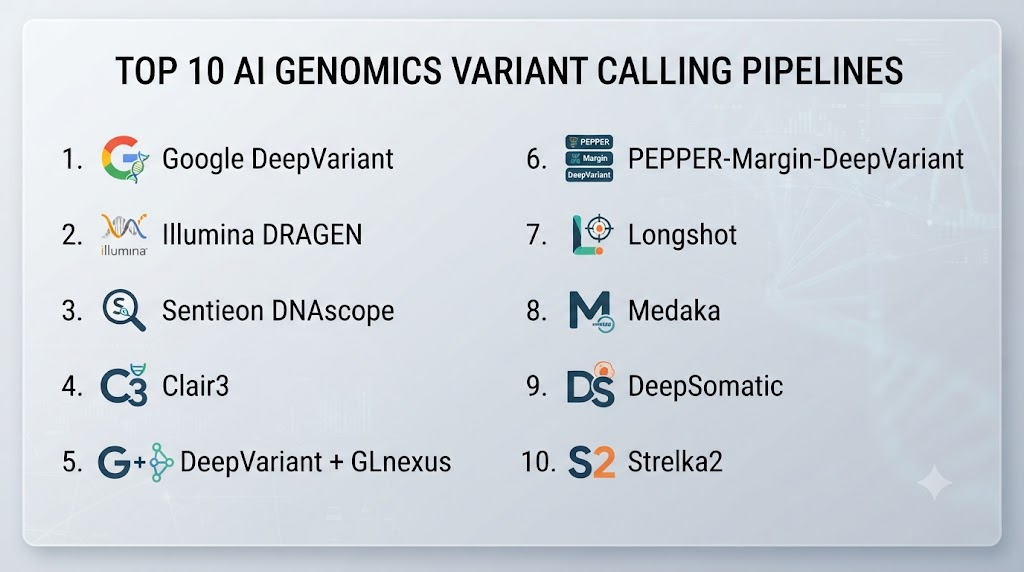
Top 10 AI Genomics Variant Calling Pipelines
1 — Google DeepVariant
One-line verdict: Best for high-accuracy germline variant calling using deep learning across widely used sequencing workflows.
Short description:
DeepVariant is a deep-learning-based variant caller developed for identifying small genetic variants from sequencing data. It uses neural-network models to evaluate sequencing evidence and generate variant calls.
Standout Capabilities
- Deep-learning variant calling.
- Germline variant detection.
- Single-nucleotide variant calling.
- Small insertion/deletion calling.
- High-accuracy analysis.
- Multiple sequencing technologies.
- Genome sequencing workflows.
- Production-oriented pipelines.
AI-Specific Depth
- Model support: Deep-learning models optimized for sequencing data.
- RAG / knowledge integration: N/A for the core variant-calling model.
- Evaluation: Benchmark datasets and sequencing-platform-specific evaluations.
- Guardrails: Variant-quality filtering and model confidence information.
- Observability: Pipeline logs, runtime metrics, variant-quality information, and workflow outputs.
Pros
- Strong deep-learning approach.
- Widely used in genomics research.
- Supports reproducible computational workflows.
Cons
- Primarily focused on variant calling rather than complete interpretation.
- Requires bioinformatics infrastructure.
- Performance depends on sequencing technology and workflow configuration.
Security & Compliance
DeepVariant itself is software rather than a complete clinical compliance platform. Security depends on the infrastructure where it is deployed.
Specific certifications are Not publicly stated for the generic software.
Deployment & Platforms
- Linux: Common.
- Cloud: Possible.
- Self-hosted: Yes.
- HPC: Supported through appropriate workflow configuration.
- Containers: Available in relevant distributions.
Integrations & Ecosystem
- BAM/CRAM sequencing data.
- VCF.
- Reference genomes.
- Workflow engines.
- Cloud genomics.
- HPC.
- Variant annotation systems.
Pricing Model
Open-source software. Infrastructure costs vary.
Best-Fit Scenarios
- Germline WGS.
- Germline WES.
- Research genomics pipelines.
2 — NVIDIA Parabricks
One-line verdict: Best for organizations needing accelerated genomics pipelines combining GPU computing with variant-calling and analysis workflows.
Short description:
NVIDIA Parabricks provides accelerated genomic analysis tools designed to reduce computational time for sequencing workflows. Its capabilities include variant calling and other stages of genomic data processing.
Standout Capabilities
- GPU-accelerated genomics.
- Germline variant calling.
- Somatic workflows.
- Sequencing-data processing.
- Alignment acceleration.
- Variant analysis.
- High-throughput processing.
- Enterprise-scale genomics.
AI-Specific Depth
- Model support: Includes AI/deep-learning approaches for applicable workflows.
- RAG / knowledge integration: N/A for core variant calling.
- Evaluation: Benchmarking and workflow validation.
- Guardrails: Quality filtering and pipeline controls.
- Observability: GPU utilization, runtime, workflow logs, and variant outputs.
Pros
- Significant computational acceleration potential.
- Suitable for large sequencing workloads.
- Supports broader genomics pipelines.
Cons
- GPU infrastructure may be required.
- Infrastructure costs can be significant.
- Not all pipeline stages are AI-based.
Security & Compliance
Security depends on deployment infrastructure. Specific certifications should be verified for the applicable commercial configuration.
Deployment & Platforms
- Linux: Yes.
- Self-hosted: Yes.
- Cloud: Available.
- Hybrid: Possible.
- GPU: Important for accelerated workflows.
Integrations & Ecosystem
- NVIDIA GPUs.
- BAM/CRAM.
- VCF.
- Variant callers.
- Alignment tools.
- Workflow engines.
- Cloud/HPC infrastructure.
Pricing Model
Commercial licensing and infrastructure costs vary. Exact pricing is Not publicly stated.
Best-Fit Scenarios
- High-volume sequencing.
- Enterprise genomics.
- GPU-enabled pipelines.
3 — Clair3
One-line verdict: Best for long-read sequencing workflows requiring deep-learning-based small-variant calling across modern sequencing platforms.
Short description:
Clair3 is a deep-learning-based variant caller designed particularly for long-read sequencing. It combines pileup-style and full-alignment approaches to improve small-variant detection.
Standout Capabilities
- Long-read variant calling.
- Deep-learning models.
- Single-nucleotide variant detection.
- Small indel calling.
- PacBio workflows.
- Oxford Nanopore workflows.
- High-throughput processing.
- Automated variant generation.
AI-Specific Depth
- Model support: Deep-learning models.
- RAG / knowledge integration: N/A.
- Evaluation: Benchmark datasets and platform-specific evaluations.
- Guardrails: Quality scores and variant filtering.
- Observability: Pipeline logs, processing statistics, and variant-quality outputs.
Pros
- Designed for long reads.
- Strong small-variant workflow.
- Open-source availability.
Cons
- Requires command-line bioinformatics expertise.
- Focused on specific variant types.
- Results depend on read quality and sequencing platform.
Security & Compliance
Self-hosted deployment allows organizations to control genomic data.
Specific clinical certifications are Not publicly stated.
Deployment & Platforms
- Linux: Yes.
- Self-hosted: Yes.
- Cloud: Possible.
- HPC: Possible.
Integrations & Ecosystem
- Oxford Nanopore.
- PacBio.
- BAM/CRAM.
- VCF.
- Reference genomes.
- Workflow engines.
- HPC.
Pricing Model
Open-source. Infrastructure costs vary.
Best-Fit Scenarios
- Long-read sequencing.
- Population genomics.
- Research variant calling.
4 — Sentieon
One-line verdict: Best for production genomics teams prioritizing fast, scalable, reproducible variant-calling and analysis pipelines.
Short description:
Sentieon provides optimized genomic analysis software covering alignment, variant calling, and other sequencing workflows. Its focus is computational performance and production-scale genomics.
Standout Capabilities
- Germline variant calling.
- Somatic variant analysis.
- High-performance genomics.
- Sequencing pipelines.
- Workflow optimization.
- Reproducibility.
- Large-scale processing.
- Enterprise deployment.
AI-Specific Depth
- Model support: AI/deep-learning support varies by specific tool and workflow.
- RAG / knowledge integration: N/A for core variant calling.
- Evaluation: Benchmarking and validation against established workflows.
- Guardrails: Variant-quality controls and workflow parameters.
- Observability: Runtime, logs, resource usage, and variant outputs.
Pros
- Performance-oriented.
- Suitable for production workloads.
- Broad genomic-analysis capabilities.
Cons
- Commercial licensing.
- Not every component is AI-based.
- Requires bioinformatics expertise.
Security & Compliance
Deployment-level security controls depend on organizational infrastructure and configuration.
Certifications are Not publicly stated for the generic platform.
Deployment & Platforms
- Linux: Yes.
- Cloud: Yes.
- Self-hosted: Yes.
- HPC: Yes.
- Hybrid: Possible.
Integrations & Ecosystem
- BAM/CRAM.
- VCF.
- Workflow engines.
- Cloud.
- HPC.
- Sequencing pipelines.
- Genomics databases.
Pricing Model
Commercial licensing. Exact pricing is Not publicly stated.
Best-Fit Scenarios
- Enterprise genomics.
- Clinical sequencing research.
- High-throughput pipelines.
5 — DeepVariant + GLnexus
One-line verdict: Best for large-scale germline studies requiring scalable joint genotyping alongside deep-learning variant detection.
Short description:
DeepVariant can be combined with GLnexus for large-scale joint genotyping workflows. This combination is particularly relevant to population-scale sequencing projects where many samples must be analyzed consistently.
Standout Capabilities
- Deep-learning variant detection.
- Joint genotyping.
- Multi-sample analysis.
- Population genomics.
- Large-scale WGS.
- Variant-quality control.
- Distributed workflows.
- Cohort analysis.
AI-Specific Depth
- Model support: Deep-learning variant calling through DeepVariant.
- RAG / knowledge integration: N/A.
- Evaluation: Benchmark datasets and cohort-level validation.
- Guardrails: Variant-quality thresholds and genotype filtering.
- Observability: Workflow logs, processing statistics, and variant outputs.
Pros
- Strong for cohort-scale research.
- Combines AI calling with joint genotyping.
- Open research ecosystem.
Cons
- More complex than single-sample calling.
- Requires substantial compute for large cohorts.
- Primarily germline-focused.
Security & Compliance
Self-hosted deployment allows control of genomic data.
Specific certifications are Not publicly stated.
Deployment & Platforms
- Linux.
- Cloud.
- HPC.
- Self-hosted.
- Workflow-based deployment.
Integrations & Ecosystem
- DeepVariant.
- GLnexus.
- VCF.
- gVCF.
- Reference genomes.
- Cloud/HPC.
- Genomic databases.
Pricing Model
Open-source software. Infrastructure costs vary.
Best-Fit Scenarios
- Population genomics.
- Large WGS cohorts.
- Research biobanks.
6 — GATK
One-line verdict: Best for comprehensive germline and somatic variant-analysis workflows with extensive genomics ecosystem support.
Short description:
The Genome Analysis Toolkit provides a broad collection of tools for analyzing sequencing data and identifying genomic variants. While not every GATK component is AI-based, it remains an important reference ecosystem for modern variant-calling pipelines.
Standout Capabilities
- Germline variant calling.
- Somatic variant calling.
- Variant filtering.
- Genomic data processing.
- Quality control.
- Joint calling.
- Variant recalibration.
- Research workflows.
AI-Specific Depth
- Model support: Primarily statistical/computational methods, with some machine-learning-related functionality in the broader ecosystem.
- RAG / knowledge integration: N/A.
- Evaluation: Extensive benchmark and validation ecosystem.
- Guardrails: Quality filtering, variant recalibration, and workflow controls.
- Observability: Pipeline logs, metrics, quality scores, and variant statistics.
Pros
- Mature genomics ecosystem.
- Broad workflow coverage.
- Strong research adoption.
Cons
- Not exclusively AI-based.
- Pipelines can be computationally intensive.
- Requires substantial bioinformatics knowledge.
Security & Compliance
Security depends on the deployment environment.
Clinical certifications should not be assumed solely from the use of GATK.
Deployment & Platforms
- Linux.
- Cloud.
- Self-hosted.
- HPC.
- Workflow engines.
Integrations & Ecosystem
- BAM/CRAM.
- VCF.
- gVCF.
- Reference genomes.
- Workflow systems.
- Cloud genomics.
- Annotation tools.
Pricing Model
Many components are available as research software; broader commercial services and infrastructure may have separate costs.
Best-Fit Scenarios
- Germline analysis.
- Somatic analysis.
- Research genomics.
7 — Longshot
One-line verdict: Best for haplotype-aware long-read SNP and small-indel calling in research-focused sequencing workflows.
Short description:
Longshot is a variant caller designed for long-read sequencing. It uses statistical and haplotype-aware methods to identify variants from long-read data.
Standout Capabilities
- Long-read variant calling.
- SNP detection.
- Small indel analysis.
- Haplotype-aware processing.
- PacBio-focused workflows.
- High-quality read analysis.
- Research genomics.
- Phasing-related workflows.
AI-Specific Depth
- Model support: Primarily computational/statistical rather than AI-first.
- RAG / knowledge integration: N/A.
- Evaluation: Benchmarking against sequencing datasets.
- Guardrails: Quality thresholds and variant filters.
- Observability: Logs and variant-quality metrics.
Pros
- Strong long-read focus.
- Haplotype-aware analysis.
- Useful for research.
Cons
- Not a broad AI platform.
- Focused variant scope.
- Requires command-line expertise.
Security & Compliance
Self-hosted workflows allow local genomic-data processing.
Specific certifications are Not publicly stated.
Deployment & Platforms
- Linux.
- Self-hosted.
- HPC.
- Cloud possible through infrastructure configuration.
Integrations & Ecosystem
- Long-read sequencing.
- BAM.
- VCF.
- PacBio workflows.
- Reference genomes.
- Phasing tools.
Pricing Model
Open-source. Infrastructure costs vary.
Best-Fit Scenarios
- Long-read research.
- Haplotype analysis.
- Small-variant discovery.
8 — Octopus
One-line verdict: Best for research teams exploring flexible haplotype-aware variant calling across challenging genomic datasets.
Short description:
Octopus is a haplotype-aware variant-calling framework designed to model complex genomic variation. It is useful for research workflows where standard variant-calling approaches may struggle with complex evidence.
Standout Capabilities
- Haplotype-aware calling.
- Small variants.
- Complex variant representation.
- Germline analysis.
- Flexible variant models.
- Research workflows.
- Genomic-region analysis.
- Variant filtering.
AI-Specific Depth
- Model support: Primarily probabilistic/computational; AI usage varies.
- RAG / knowledge integration: N/A.
- Evaluation: Benchmarking and comparative analysis.
- Guardrails: Quality metrics and filtering.
- Observability: Workflow logs and variant statistics.
Pros
- Flexible variant representation.
- Research-oriented.
- Useful for challenging variant contexts.
Cons
- Less turnkey than commercial platforms.
- Requires computational expertise.
- Not an AI-first product.
Security & Compliance
Self-hosted operation provides local control of genomic data.
Specific certifications are Not publicly stated.
Deployment & Platforms
- Linux.
- Self-hosted.
- HPC.
- Cloud possible.
Integrations & Ecosystem
- BAM/CRAM.
- VCF.
- Reference genomes.
- Workflow engines.
- Variant annotation.
- Genomic research tools.
Pricing Model
Open-source. Infrastructure costs vary.
Best-Fit Scenarios
- Research genomics.
- Complex variant analysis.
- Method-development projects.
9 — DeepSomatic
One-line verdict: Best for AI-driven somatic variant detection workflows targeting tumor-normal and tumor-only sequencing applications.
Short description:
DeepSomatic is a deep-learning-based approach for somatic variant calling, designed to identify mutations from sequencing evidence. It is relevant to cancer genomics workflows where distinguishing somatic alterations from technical artifacts is particularly challenging.
Standout Capabilities
- Deep-learning somatic calling.
- Tumor-normal analysis.
- Tumor-only workflows.
- Small-variant detection.
- Cancer genomics.
- Sequencing-data analysis.
- Variant-quality assessment.
- High-throughput workflows.
AI-Specific Depth
- Model support: Deep-learning models.
- RAG / knowledge integration: N/A for core calling.
- Evaluation: Benchmarking on cancer sequencing datasets.
- Guardrails: Variant-quality filtering and model confidence.
- Observability: Pipeline logs, model outputs, runtime, and variant metrics.
Pros
- Designed specifically for somatic calling.
- AI-based approach.
- Useful for cancer research.
Cons
- Focused on somatic analysis.
- Requires computational infrastructure.
- Clinical use requires appropriate validation.
Security & Compliance
Security depends on the environment in which the pipeline is deployed.
Specific certifications are Not publicly stated.
Deployment & Platforms
- Linux.
- Self-hosted.
- Cloud.
- HPC.
- Containerized workflows.
Integrations & Ecosystem
- BAM/CRAM.
- VCF.
- Tumor-normal data.
- Cancer genomics workflows.
- Workflow engines.
- Annotation systems.
Pricing Model
Research software availability and infrastructure costs vary. Exact commercial pricing is Not publicly stated.
Best-Fit Scenarios
- Cancer genomics research.
- Somatic mutation analysis.
- Tumor sequencing.
10 — Custom AI Variant Calling Pipeline
One-line verdict: Best for organizations developing specialized variant callers around proprietary sequencing data and unique genomic applications.
Short description:
A custom AI variant-calling pipeline can combine neural networks, genomic representations, sequencing-platform-specific models, probabilistic methods, and internal datasets.
This approach is useful when an organization has unique sequencing data or needs performance optimized for a specialized application.
Standout Capabilities
- Custom variant calling.
- Proprietary training data.
- Platform-specific modeling.
- Somatic or germline analysis.
- Uncertainty estimation.
- Custom filtering.
- Active learning.
- Workflow integration.
AI-Specific Depth
- Model support: Deep learning, graph models, transformers, ensembles, or custom architectures.
- RAG / knowledge integration: Variant databases and genomic annotations can be integrated downstream.
- Evaluation: External validation, stratified benchmarking, calibration, difficult-region testing, and prospective validation.
- Guardrails: Quality thresholds, uncertainty limits, sample QC, model versioning, and human review.
- Observability: Runtime, resource use, model drift, quality metrics, variant distributions, and pipeline failures.
Pros
- Can be optimized for specific sequencing platforms.
- Can use proprietary datasets.
- Maximum flexibility.
Cons
- Significant engineering burden.
- Requires high-quality labeled data.
- Validation and maintenance are ongoing.
Security & Compliance
Organizations control their own infrastructure and can implement encryption, RBAC, audit logs, retention controls, data residency, and genomic-data governance.
Specific certifications are Not publicly stated for a generic custom implementation.
Deployment & Platforms
- Cloud.
- Self-hosted.
- Hybrid.
- HPC.
- GPU infrastructure where required.
Integrations & Ecosystem
Potential integrations include:
- Sequencers.
- FASTQ/BAM/CRAM.
- VCF.
- LIMS.
- Variant databases.
- Annotation systems.
- Clinical or research data platforms.
Pricing Model
Custom development and infrastructure. Exact pricing is N/A.
Best-Fit Scenarios
- Large genomic organizations.
- Specialized sequencing applications.
- Proprietary clinical or research datasets.
Comparison Table
| Tool | Best For | Deployment | Model Flexibility | Strength | Watch-Out | Public Rating |
|---|---|---|---|---|---|---|
| DeepVariant | Germline variant calling | Self-hosted / Cloud / HPC | Deep learning | Accuracy-focused calling | Requires bioinformatics infrastructure | |
| NVIDIA Parabricks | Accelerated genomics | Cloud / Self-hosted / Hybrid | AI + computational | GPU acceleration | GPU costs | |
| Clair3 | Long-read variants | Self-hosted / Cloud / HPC | Deep learning | Long-read calling | Platform-specific considerations | |
| Sentieon | Production pipelines | Cloud / Self-hosted / Hybrid | Computational + AI components | Performance | Commercial licensing | |
| DeepVariant + GLnexus | Cohort genomics | Cloud / HPC / Self-hosted | Deep learning | Joint genotyping | Large compute requirements | |
| GATK | Broad variant analysis | Cloud / Self-hosted / HPC | Statistical + computational | Mature ecosystem | Not AI-first | |
| Longshot | Long-read SNPs | Self-hosted / HPC | Statistical | Haplotype-aware calling | Narrower scope | |
| Octopus | Complex variant research | Self-hosted / Cloud / HPC | Computational | Flexible haplotypes | Technical complexity | |
| DeepSomatic | Cancer genomics | Self-hosted / Cloud / HPC | Deep learning | Somatic calling | Clinical validation required | |
| Custom AI Pipeline | Specialized applications | Cloud / Self-hosted / Hybrid | Multi-model | Maximum customization | High development burden |
Scoring & Evaluation
These scores are comparative editorial assessments, not clinical performance claims.
Variant-calling tools should be evaluated using representative sequencing data, appropriate truth sets, platform-specific benchmarks, difficult genomic regions, coverage levels, allele frequencies, and realistic production workloads.
| Tool | Core Features | AI Reliability | Variant Depth | Integrations | Ease | Performance/Cost | Security/Admin | Support | Weighted Total |
|---|---|---|---|---|---|---|---|---|---|
| DeepVariant | 10 | 10 | 10 | 9 | 8 | 8 | 8 | 9 | 9.15 |
| NVIDIA Parabricks | 10 | 9 | 10 | 10 | 7 | 10 | 9 | 10 | 9.25 |
| Clair3 | 9 | 9 | 9 | 9 | 7 | 9 | 8 | 8 | 8.65 |
| Sentieon | 10 | 9 | 10 | 10 | 8 | 10 | 9 | 10 | 9.50 |
| DeepVariant + GLnexus | 10 | 10 | 10 | 10 | 7 | 8 | 8 | 9 | 9.05 |
| GATK | 10 | 8 | 10 | 10 | 7 | 7 | 9 | 10 | 8.80 |
| Longshot | 8 | 8 | 8 | 8 | 7 | 9 | 8 | 8 | 8.00 |
| Octopus | 9 | 8 | 9 | 8 | 6 | 8 | 8 | 8 | 8.05 |
| DeepSomatic | 9 | 10 | 10 | 9 | 7 | 8 | 8 | 8 | 8.85 |
| Custom AI Pipeline | 10 | 10 | 10 | 10 | 5 | 7 | 10 | 10 | 9.35 |
Top 3 for Enterprise
- Sentieon — Strong fit for performance-oriented production genomics.
- NVIDIA Parabricks — Attractive for organizations with GPU infrastructure and large sequencing workloads.
- DeepVariant — Strong deep-learning foundation for germline workflows.
Top 3 for SMB
- DeepVariant — Strong open-source foundation.
- Clair3 — Practical for long-read workflows.
- GATK — Broad ecosystem and extensive genomics tooling.
Top 3 for Developers
- DeepVariant — Strong deep-learning variant-calling foundation.
- Clair3 — Excellent for long-read development.
- Custom AI Pipeline — Maximum customization for specialized applications.
Which AI Genomics Variant Calling Pipeline Is Right for You?
Solo / Individual Researcher
Individual researchers should prioritize:
- Open-source availability.
- Documentation.
- Reproducibility.
- Compatibility with existing sequencing data.
- Modest hardware requirements.
DeepVariant, Clair3, and GATK can provide strong foundations depending on sequencing technology and variant type.
SMB Genomics Organization
Small and mid-sized teams should prioritize:
- Pipeline reproducibility.
- Container support.
- Workflow automation.
- Clear input/output formats.
- Reference-genome management.
- Variant-quality controls.
Avoid selecting a tool purely because it uses AI. A reliable end-to-end workflow is more important than the marketing label.
Mid-Market Genomics Organization
Mid-market teams should evaluate:
- Multi-sample processing.
- Cloud/HPC compatibility.
- Pipeline orchestration.
- Automated QC.
- Variant annotation.
- Data provenance.
- Cost per genome.
- Reproducibility.
Enterprise Pharmaceutical Company
Large organizations should prioritize:
- Large-scale compute.
- Workflow orchestration.
- Multiple sequencing platforms.
- Data governance.
- Auditability.
- Model versioning.
- Reproducible pipelines.
- Integration with genomic databases.
Clinical Genomics
Clinical workflows require additional scrutiny.
Prioritize:
- Analytical validation.
- Appropriate reference materials.
- Quality controls.
- Reproducibility.
- Traceability.
- Variant-quality metrics.
- Appropriate laboratory validation.
A research-grade variant caller should not automatically be treated as clinically validated.
Cancer Genomics
Cancer workflows should evaluate:
- Tumor purity.
- Variant allele frequency.
- Tumor-normal availability.
- Sequencing depth.
- Somatic mutation types.
- Copy-number and structural variation requirements.
A caller optimized for germline variants may not be appropriate for somatic analysis.
Long-Read Sequencing
Long-read users should consider:
- Sequencing platform.
- Read accuracy.
- Coverage.
- Small variants.
- Structural variants.
- Phasing.
- Haplotype-aware analysis.
Clair3 and Longshot are examples of tools designed around long-read workflows.
Population Genomics
Large cohorts require more than accurate single-sample calling.
Evaluate:
- Joint genotyping.
- Cohort scaling.
- Storage.
- Compute costs.
- Variant normalization.
- Sample QC.
- Population-level filtering.
Regulated Genomics
Organizations working toward clinical or regulated use should prioritize:
- Validated pipelines.
- Version-controlled software.
- Reference-data versioning.
- Audit trails.
- Reproducible execution.
- Quality management.
- Documented performance.
Budget vs Premium
Open-source pipelines can reduce software licensing costs but still require:
- Compute.
- Storage.
- Bioinformatics expertise.
- Workflow management.
- Maintenance.
Commercial platforms can reduce operational complexity but may introduce licensing costs and vendor dependence.
Build vs Buy
Build when:
- Your sequencing technology is specialized.
- You have proprietary training data.
- Existing callers have known limitations for your application.
- You need full control over the model.
Buy or adopt established tools when:
- You need rapid deployment.
- The sequencing platform is well supported.
- You need mature documentation.
- You lack a machine-learning development team.
Implementation Playbook
First 30 Days: Establish the Baseline
Start by documenting:
- Sequencing platform.
- Read type.
- Coverage.
- Variant types.
- Sample types.
- Existing alignment workflow.
- Current variant caller.
- Ground-truth datasets.
Establish baseline metrics such as:
- Precision.
- Recall.
- F1 score.
- False-positive rate.
- False-negative rate.
- Runtime.
- Compute cost.
Days 31–60: Benchmark AI Callers
Evaluate candidate pipelines using representative data.
Include:
- High-quality regions.
- Difficult genomic regions.
- Different coverage levels.
- Different sequencing batches.
- Different samples.
- Rare variants.
- Platform-specific error patterns.
Avoid relying on one benchmark dataset.
Days 61–90: Productionize the Pipeline
Implement:
- Containerization.
- Workflow orchestration.
- Reference-data versioning.
- Model versioning.
- Automated QC.
- Logging.
- Failure recovery.
- Output validation.
- Variant provenance.
If the pipeline is intended for clinical use, validation requirements should be defined with the appropriate laboratory, quality, and regulatory teams.
Common Mistakes and How to Avoid Them
- Assuming AI automatically means better accuracy: Benchmark against appropriate alternatives.
- Using the wrong caller for the sequencing technology: Platform characteristics strongly influence performance.
- Ignoring coverage: Low coverage can reduce variant-calling reliability.
- Ignoring difficult genomic regions: Performance can vary substantially across the genome.
- Using inappropriate truth sets: Evaluation datasets must match the intended application.
- Ignoring sample contamination: Contamination can create misleading variant evidence.
- Skipping quality control: Poor input data can undermine even sophisticated models.
- Treating variant quality as clinical interpretation: Calling and interpretation are separate tasks.
- Ignoring somatic allele frequencies: Cancer samples can contain low-frequency variants.
- Using random benchmarks only: Include realistic and independent validation data.
- Failing to version references: Reference genomes and annotations can affect results.
- Ignoring software versioning: Small pipeline changes can alter calls.
- No reproducibility: Record parameters, model versions, references, and inputs.
- Ignoring compute costs: AI and GPU workflows can become expensive at scale.
- Skipping security: Genomic data is highly sensitive and requires appropriate protection.
- Ignoring downstream annotation: Variant calling alone does not explain biological or clinical significance.
- Overlooking structural variants: Small-variant callers do not necessarily identify larger genomic changes.
- Assuming one caller works for every use case: Germline, somatic, long-read, and population workflows have different requirements.
FAQs
What is AI variant calling?
AI variant calling uses machine-learning or deep-learning models to analyze sequencing evidence and identify likely genetic variants.
What is a variant caller?
A variant caller is software that compares sequencing evidence against a reference genome and identifies potential genetic differences.
What variants can AI callers detect?
Depending on the pipeline, they can detect SNVs, small indels, and sometimes other forms of genomic variation.
Can AI detect structural variants?
Some AI and machine-learning approaches can support structural-variant detection, but specialized structural-variant callers are often required for comprehensive analysis.
Is DeepVariant an AI variant caller?
Yes. DeepVariant uses deep learning to identify variants from sequencing data.
Is GATK an AI platform?
GATK is primarily a broad genomics analysis toolkit rather than an AI-first platform. Its ecosystem includes statistical and computational approaches and should not be characterized as entirely AI-based.
Which AI caller is best for long-read sequencing?
Clair3 is a prominent deep-learning-based option for long-read small-variant calling. Longshot is another research-oriented long-read option using a different computational approach.
Which variant caller is best for cancer genomics?
The appropriate caller depends on tumor type, sequencing platform, sample design, tumor purity, allele frequency, and required variant types. Deep-learning somatic approaches can be evaluated alongside established somatic pipelines.
Can AI variant callers replace laboratory confirmation?
No. Computational variant calling does not eliminate the need for appropriate analytical and experimental validation.
What is joint genotyping?
Joint genotyping evaluates multiple samples together to produce a more consistent cohort-level genotype representation.
Why is sequencing coverage important?
Higher and more consistent coverage generally provides more evidence for distinguishing true variants from sequencing errors, although the appropriate depth depends on the application.
What is a false positive?
A false positive occurs when a pipeline reports a variant that is not actually present in the sample.
What is a false negative?
A false negative occurs when a real variant is present but the pipeline fails to detect it.
What is model calibration?
Calibration assesses whether predicted confidence values correspond appropriately to observed correctness.
Can AI variant callers work with both short and long reads?
Some systems support multiple technologies, while others are optimized for a particular sequencing platform. The exact compatibility should always be verified.
Can variant calling be performed in the cloud?
Yes. Many pipelines can run on cloud infrastructure, provided sufficient compute, storage, security, and workflow orchestration are available.
Can variant calling be performed on-premises?
Yes. Open-source and commercial pipelines can be deployed on local servers or HPC systems.
What is the role of GPUs?
GPUs can accelerate certain AI-based genomic workflows, particularly deep-learning inference. They are not necessarily required for every variant caller.
How should an AI variant caller be evaluated?
Use appropriate truth sets and measure precision, recall, F1 score, false-positive rates, false-negative rates, and performance across different genomic regions and variant types.
Can AI identify pathogenic variants?
Variant calling identifies genomic differences. Determining whether a variant is pathogenic requires downstream annotation, evidence evaluation, clinical interpretation, and appropriate domain-specific processes.
What is the biggest limitation of AI variant calling?
Performance can vary with sequencing technology, genomic region, coverage, sample quality, variant type, training data, and distribution differences between training and production data.
Which AI genomics variant calling pipeline is best?
There is no single best pipeline. DeepVariant is a strong choice for deep-learning germline calling, Clair3 is valuable for long-read workflows, NVIDIA Parabricks and Sentieon are attractive for high-throughput environments, and custom pipelines make sense for specialized applications.
Conclusion
AI Genomics Variant Calling Pipelines are changing how sequencing data can be converted into candidate genetic variants.The most important development is not simply replacing traditional algorithms with neural networks. It is combining machine learning with high-quality sequencing evidence, genomic representations, robust quality control, reproducible workflows, and appropriate validation.The strongest pipeline is the one that matches the sequencing platform, sample type, variant class, computational environment, and intended use.AI should therefore be treated as one component of a broader genomics workflow: