Introduction
AI Electronic Lab Notebook Assistants combine electronic laboratory notebook software with artificial intelligence to help researchers capture, organize, search, summarize, and interpret scientific work. Instead of treating the ELN as a digital replacement for a paper notebook, AI-enabled systems can make experimental records more searchable, structured, connected, and useful.These assistants can help with tasks such as drafting experimental records, summarizing experiments, extracting information from uploaded documents, finding related experiments, organizing protocols, connecting samples and inventory, and turning unstructured research notes into structured scientific data.AI-enabled ELNs are becoming increasingly relevant as laboratories generate large amounts of experimental information across documents, instruments, spreadsheets, images, assay results, and research databases. The challenge is no longer simply storing information. It is making that information discoverable and useful without compromising scientific traceability.
What Are AI Electronic Lab Notebook Assistants?
An AI Electronic Lab Notebook Assistant is an AI-enabled layer that helps researchers create, search, organize, summarize, and work with information stored in an electronic laboratory notebook.
A conventional ELN primarily helps researchers:
- Record experiments.
- Store protocols.
- Attach files.
- Track samples.
- Document observations.
- Organize research projects.
An AI-enabled ELN can additionally help researchers:
- Summarize experiments.
- Search scientific records using natural language.
- Extract structured information.
- Identify related experiments.
- Draft experimental documentation.
- Compare results.
- Retrieve relevant protocols.
- Generate research summaries.
- Connect information across projects.
- Assist with scientific data interpretation.
A typical workflow might look like:
The AI should support documentation and discovery while preserving the original scientific record.
Why AI ELN Assistants Matter
Scientific organizations often accumulate years of experimental information that becomes difficult to search.
A researcher may know that a particular experiment was performed previously but struggle to find:
- The exact protocol.
- The researcher who performed it.
- The sample used.
- The reagent lot.
- The instrument settings.
- The experimental conditions.
- The observed result.
- The follow-up experiment.
AI can make these records more accessible through natural-language search and contextual retrieval.
For example, instead of searching for an exact experiment name, a researcher could ask:
“Show experiments where this protein was tested under similar temperature and buffer conditions.”
The assistant could retrieve relevant records when the underlying data is properly structured and accessible.
Key Use Cases
AI-Assisted Experiment Documentation
Convert researcher notes into structured experimental records.
Natural-Language Search
Find experiments, protocols, samples, observations, and related records using conversational queries.
Experiment Summarization
Create concise summaries of lengthy experimental histories.
Protocol Assistance
Help researchers locate, interpret, or draft protocols.
Research Knowledge Retrieval
Connect historical experiments with current research questions.
Sample and Reagent Context
Surface information about samples, reagents, batches, and experimental relationships.
Cross-Project Discovery
Identify related experiments across research programs where permissions allow.
Automated Metadata Extraction
Extract structured fields from laboratory notes, documents, or imported datasets.
Research Handoffs
Summarize project history when work moves between researchers or teams.
Scientific Reporting
Help prepare experiment summaries, project updates, and internal research reports.
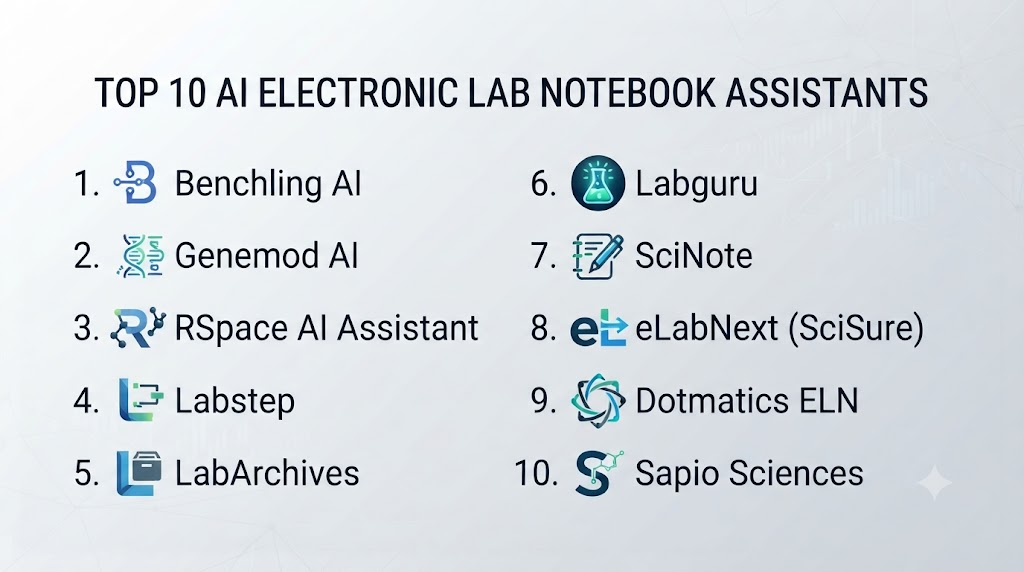
Top 10 AI Electronic Lab Notebook Assistants
1 — Benchling
One-line verdict: Best for biotechnology organizations combining electronic lab notebooks with molecular biology, research data, and collaborative workflows.
Short description:
Benchling provides a broad digital research platform that includes electronic laboratory notebook capabilities alongside molecular biology workflows, inventory, data management, and collaboration. Its AI capabilities can extend the usefulness of research information depending on the specific product configuration.
Standout Capabilities
- Electronic laboratory notebooks.
- Research data management.
- Molecular biology workflows.
- Inventory management.
- Collaboration.
- Structured experiment records.
- Research search.
- Laboratory integrations.
AI-Specific Depth
- Model support: AI capabilities vary by product and deployment.
- RAG / knowledge integration: Research records and connected data can support contextual retrieval.
- Evaluation: AI functionality should be evaluated using organization-specific research questions and datasets.
- Guardrails: Permissions, access controls, workflow restrictions, and data governance.
- Observability: Research activity, workflow history, and system-level data are available depending on configuration.
Pros
- Broad biotech research ecosystem.
- Strong structured research-data foundation.
- Useful for collaborative scientific teams.
Cons
- AI capabilities vary by offering.
- Can require significant implementation effort.
- Not primarily an AI assistant product.
Security & Compliance
Enterprise security and administrative controls vary by configuration. Specific certifications and retention capabilities should be verified for the relevant service.
Deployment & Platforms
- Cloud: Yes.
- Web: Yes.
- Laboratory integrations: Yes.
- Self-hosted: Not publicly stated.
Integrations & Ecosystem
- LIMS.
- Inventory.
- Molecular biology.
- Laboratory instruments.
- Research data.
- APIs.
- Workflow systems.
Pricing Model
Enterprise/custom pricing. Exact pricing is Not publicly stated.
Best-Fit Scenarios
- Biotech organizations.
- Collaborative research.
- Molecular biology laboratories.
2 — LabArchives
One-line verdict: Best for academic and research laboratories seeking a digital notebook with structured documentation and collaboration capabilities.
Short description:
LabArchives is an electronic laboratory notebook platform designed to help researchers document experiments, organize research materials, collaborate, and maintain electronic records.
Its suitability for AI-assisted workflows depends on the specific capabilities and integrations available to the organization.
Standout Capabilities
- Electronic lab notebooks.
- Experiment documentation.
- Collaboration.
- Research organization.
- File attachments.
- Templates.
- Notebook management.
- Educational and research use.
AI-Specific Depth
- Model support: AI functionality varies by product and integration.
- RAG / knowledge integration: Connected research content can support search and retrieval.
- Evaluation: AI-specific evaluation capabilities are Not publicly stated.
- Guardrails: User access and notebook permissions.
- Observability: Notebook activity and record history.
Pros
- Familiar ELN-oriented workflow.
- Suitable for academic environments.
- Supports structured research documentation.
Cons
- Advanced AI capabilities may vary.
- Not primarily designed as an autonomous research assistant.
- Enterprise AI architecture should be verified.
Security & Compliance
Specific security controls and certifications should be verified for the selected configuration.
Deployment & Platforms
- Cloud: Yes.
- Web: Yes.
- Self-hosted: Availability varies.
- Mobile access: Availability varies.
Integrations & Ecosystem
- Research records.
- File storage.
- Laboratory workflows.
- Collaboration.
- Data export.
- Institutional systems.
Pricing Model
Subscription and institutional pricing may vary. Exact pricing is Not publicly stated.
Best-Fit Scenarios
- Academic laboratories.
- Research groups.
- Teaching laboratories.
3 — eLabJournal
One-line verdict: Best for laboratories wanting an ELN-centered research environment with structured experiment management and laboratory data organization.
Short description:
eLabJournal provides electronic laboratory notebook and laboratory-management capabilities for documenting experiments, organizing data, and supporting collaborative research.
AI capabilities should be evaluated based on the current product configuration and integrations.
Standout Capabilities
- Electronic laboratory notebook.
- Experiment management.
- Sample management.
- Research data organization.
- Protocol management.
- Collaboration.
- Project organization.
- Laboratory workflows.
AI-Specific Depth
- Model support: Varies / N/A depending on specific AI functionality.
- RAG / knowledge integration: Research content can be searched and connected according to available functionality.
- Evaluation: Not publicly stated for AI-specific features.
- Guardrails: User permissions and data controls.
- Observability: Experiment and record activity.
Pros
- ELN-focused.
- Useful for structured experiment documentation.
- Suitable for research teams.
Cons
- AI depth may be less extensive than dedicated AI research platforms.
- Exact integrations vary.
- Advanced automation may require additional systems.
Security & Compliance
Security and compliance capabilities depend on the deployment and subscription configuration.
Deployment & Platforms
- Cloud: Available.
- Web: Yes.
- Self-hosted: Availability varies.
- Hybrid: Varies.
Integrations & Ecosystem
- Laboratory data.
- Protocols.
- Samples.
- Research files.
- APIs/integrations.
- Laboratory workflows.
Pricing Model
Subscription/custom pricing. Exact pricing is Not publicly stated.
Best-Fit Scenarios
- Research laboratories.
- Academic teams.
- Small and mid-sized biotech organizations.
4 — RSpace
One-line verdict: Best for research teams prioritizing flexible electronic documentation, collaboration, and structured scientific record management.
Short description:
RSpace is an electronic research notebook platform designed to support scientific documentation, collaboration, and research-data management. It can serve as a structured foundation for AI-assisted research retrieval and analysis.
Standout Capabilities
- Electronic laboratory notebooks.
- Structured experiment records.
- Collaboration.
- Research data management.
- Templates.
- Search.
- File management.
- Research workflows.
AI-Specific Depth
- Model support: AI capabilities and integrations vary.
- RAG / knowledge integration: Research records can potentially support retrieval workflows.
- Evaluation: AI-specific evaluation capabilities are Not publicly stated.
- Guardrails: Permissions, user controls, and data management.
- Observability: Record history and activity tracking.
Pros
- Flexible research documentation.
- Strong focus on scientific records.
- Suitable for collaborative research.
Cons
- AI capabilities depend on implementation.
- Advanced AI workflows may require integration.
- Large-scale enterprise deployments require planning.
Security & Compliance
Security controls vary by deployment. Specific certifications should be independently verified.
Deployment & Platforms
- Cloud: Available.
- Self-hosted: Available for applicable configurations.
- Hybrid: Possible.
- Web: Yes.
Integrations & Ecosystem
- Research systems.
- Institutional infrastructure.
- Data repositories.
- Laboratory workflows.
- APIs.
- External applications.
Pricing Model
Subscription or institutional pricing. Exact pricing is Not publicly stated.
Best-Fit Scenarios
- Academic research.
- Collaborative laboratories.
- Research institutions.
5 — SciNote
One-line verdict: Best for research organizations seeking structured experiment management, documentation, and project-level laboratory organization.
Short description:
SciNote is an electronic laboratory notebook and research-management platform focused on organizing experiments, protocols, projects, and laboratory information.
It can provide the structured research foundation needed for AI-assisted documentation and retrieval.
Standout Capabilities
- Electronic laboratory notebooks.
- Experiment management.
- Protocol management.
- Project organization.
- Inventory capabilities.
- Collaboration.
- Research documentation.
- Data organization.
AI-Specific Depth
- Model support: Varies / N/A for specific AI functionality.
- RAG / knowledge integration: Structured research records can support connected search and retrieval.
- Evaluation: AI-specific evaluation capabilities are Not publicly stated.
- Guardrails: User permissions and workflow controls.
- Observability: Experiment records and project activity.
Pros
- Strong experiment-management orientation.
- Useful for structured laboratory records.
- Suitable for small and mid-sized research teams.
Cons
- AI capabilities may be limited compared with AI-first platforms.
- Advanced integrations may require configuration.
- Exact enterprise features vary.
Security & Compliance
Security and compliance details depend on the selected deployment and plan.
Deployment & Platforms
- Cloud: Yes.
- Web: Yes.
- Self-hosted: Availability varies.
- Hybrid: Varies.
Integrations & Ecosystem
- Laboratory data.
- Protocols.
- Inventory.
- Research projects.
- APIs.
- Data-management workflows.
Pricing Model
Subscription/custom pricing. Exact pricing is Not publicly stated.
Best-Fit Scenarios
- Academic research.
- Small biotech.
- Structured laboratory documentation.
6 — Labguru
One-line verdict: Best for laboratories combining electronic records, inventory, sample management, and broader laboratory operations.
Short description:
Labguru provides laboratory-management capabilities that can connect electronic documentation with inventory, samples, protocols, and other research information.
This broader operational context can make an ELN more useful as a knowledge source for AI-assisted research.
Standout Capabilities
- Electronic laboratory notebook.
- Inventory management.
- Sample management.
- Protocols.
- Research documentation.
- Laboratory operations.
- Collaboration.
- Data organization.
AI-Specific Depth
- Model support: AI functionality varies.
- RAG / knowledge integration: Laboratory records and operational data can provide context for search and analysis.
- Evaluation: AI-specific evaluation is Not publicly stated.
- Guardrails: Access controls, permissions, and data-management policies.
- Observability: Laboratory activity and record history.
Pros
- Broad laboratory-management scope.
- Connects records with operational context.
- Useful for research teams managing samples and inventory.
Cons
- AI depth varies by implementation.
- Broader functionality can increase configuration complexity.
- Exact AI features should be verified.
Security & Compliance
Specific security and certification details should be verified for the applicable deployment.
Deployment & Platforms
- Cloud: Yes.
- Web: Yes.
- Self-hosted: Availability varies.
- Hybrid: Varies.
Integrations & Ecosystem
- Inventory.
- Samples.
- Protocols.
- Laboratory equipment.
- Research records.
- APIs.
Pricing Model
Subscription/custom pricing. Exact pricing is Not publicly stated.
Best-Fit Scenarios
- Operational laboratories.
- Biotech organizations.
- Sample-intensive research.
7 — Benchling AI-Assisted Research Workflows
One-line verdict: Best for biotech teams that want AI assistance layered onto structured molecular biology and experimental research data.
Short description:
Benchling’s broader research environment can provide structured experimental context for AI-assisted workflows. The combination of electronic records, molecular entities, samples, and research data can help organizations create more useful scientific search and knowledge workflows.
Standout Capabilities
- AI-assisted research workflows.
- Experimental documentation.
- Molecular biology.
- Research data.
- Sample tracking.
- Inventory.
- Collaboration.
- Structured scientific records.
AI-Specific Depth
- Model support: Product-dependent AI capabilities.
- RAG / knowledge integration: Structured research data can support contextual retrieval.
- Evaluation: Organization-specific evaluation is recommended.
- Guardrails: Role-based permissions, data controls, and workflow restrictions.
- Observability: Research activity and system records.
Pros
- Strong context around experiments.
- Useful for molecular biology.
- Can connect AI assistance with structured research information.
Cons
- Exact AI functionality varies.
- Enterprise configuration may be complex.
- Not all research organizations need the broader platform.
Security & Compliance
Security and compliance capabilities depend on the specific product configuration.
Deployment & Platforms
- Cloud: Yes.
- Web: Yes.
- Laboratory integrations: Yes.
Integrations & Ecosystem
- Molecular biology.
- Inventory.
- LIMS.
- Laboratory instruments.
- Research data.
- APIs.
- Workflow systems.
Pricing Model
Enterprise/custom pricing. Exact pricing is Not publicly stated.
Best-Fit Scenarios
- Biopharmaceutical research.
- Molecular biology.
- Enterprise laboratory knowledge management.
8 — AI-Enhanced Open ELN Workflow
One-line verdict: Best for technical research teams wanting to combine open ELN software with their own AI models and scientific knowledge systems.
Short description:
Organizations can combine an open or self-hosted ELN with AI models, vector databases, scientific search, structured metadata extraction, and laboratory data systems.
This approach offers substantial control over proprietary scientific information.
Standout Capabilities
- AI-assisted search.
- Experiment summarization.
- Protocol retrieval.
- Metadata extraction.
- Local model deployment.
- Custom RAG.
- Scientific knowledge management.
- Data integration.
AI-Specific Depth
- Model support: Hosted, open-source, BYO, or multi-model.
- RAG / knowledge integration: Strong potential using experiment records, protocols, scientific literature, and internal databases.
- Evaluation: Custom retrieval and answer-quality evaluation.
- Guardrails: Access control, source citations, data boundaries, prompt-injection protection, and human review.
- Observability: Retrieval traces, model latency, token usage, costs, and answer-quality metrics.
Pros
- Maximum flexibility.
- Strong privacy potential.
- Can use proprietary models and data.
Cons
- Requires engineering.
- AI evaluation becomes the organization’s responsibility.
- Maintenance burden can be significant.
Security & Compliance
Self-hosting provides greater control over data residency, retention, encryption, access, and audit architecture, but the organization must implement and maintain those controls.
Deployment & Platforms
- Self-hosted: Yes.
- Cloud: Possible.
- Hybrid: Possible.
- Linux: Common.
Integrations & Ecosystem
Potential integrations include:
- ELN.
- LIMS.
- Vector databases.
- Scientific literature.
- Laboratory instruments.
- Internal databases.
- APIs.
Pricing Model
Open-source or custom infrastructure plus AI usage costs. Exact total cost varies.
Best-Fit Scenarios
- Research organizations with strong engineering teams.
- Sensitive proprietary research.
- Custom scientific AI assistants.
9 — Custom Scientific Knowledge Assistant
One-line verdict: Best for enterprises wanting an AI assistant that can reason over internal experiments, protocols, datasets, and scientific documentation.
Short description:
A custom scientific knowledge assistant can sit above an ELN and connected research systems. Rather than replacing the ELN, it provides an intelligent interface for finding and summarizing scientific information.
The assistant can be designed around an organization’s specific terminology and research processes.
Standout Capabilities
- Natural-language research search.
- Experiment summarization.
- Protocol retrieval.
- Cross-project knowledge discovery.
- Document extraction.
- Scientific Q&A.
- Research-history analysis.
- Custom workflow automation.
AI-Specific Depth
- Model support: Hosted, open-source, proprietary, BYO, or multi-model.
- RAG / knowledge integration: ELN records, LIMS data, protocols, publications, experiment results, inventory, and internal research databases.
- Evaluation: Retrieval accuracy, groundedness, citation correctness, answer completeness, and task-specific evaluations.
- Guardrails: RBAC, source-level permissions, prompt-injection defenses, sensitive-data filtering, human review, and answer grounding.
- Observability: Retrieval traces, token usage, cost, latency, failed queries, hallucination checks, and user feedback.
Pros
- Highly customizable.
- Can connect multiple research systems.
- Can preserve the existing ELN while adding AI.
Cons
- Requires significant engineering.
- Data integration can be difficult.
- Scientific hallucinations must be carefully controlled.
Security & Compliance
Enterprise architecture can include SSO, RBAC, audit logs, encryption, data retention controls, and data-residency policies. Specific certifications are Not publicly stated for a generic custom implementation.
Deployment & Platforms
- Cloud: Possible.
- Self-hosted: Possible.
- Hybrid: Possible.
- API: Yes.
Integrations & Ecosystem
- ELN.
- LIMS.
- Scientific databases.
- Document repositories.
- Vector databases.
- Laboratory instruments.
- Internal APIs.
Pricing Model
Custom development, infrastructure, and AI usage. Exact pricing is N/A.
Best-Fit Scenarios
- Enterprise research organizations.
- Large scientific knowledge bases.
- Cross-system research assistants.
10 — AI Laboratory Documentation Copilot
One-line verdict: Best for teams primarily seeking AI help with experiment notes, protocol summaries, metadata extraction, and scientific documentation.
Short description:
A documentation-focused AI copilot can sit alongside an existing ELN rather than replacing it. Its primary role is reducing repetitive documentation work while maintaining the original researcher record as the source of truth.
Standout Capabilities
- Note summarization.
- Protocol drafting.
- Metadata extraction.
- Experiment summaries.
- Natural-language search.
- Document classification.
- Research handoffs.
- Structured data extraction.
AI-Specific Depth
- Model support: Hosted or BYO models depending on implementation.
- RAG / knowledge integration: ELN records, protocols, documents, and internal research repositories.
- Evaluation: Extraction accuracy, summary quality, retrieval accuracy, and groundedness.
- Guardrails: Human review, access controls, source grounding, and data filtering.
- Observability: Token usage, latency, retrieval traces, and user feedback.
Pros
- Focused on reducing documentation burden.
- Can complement existing ELN software.
- Easier to deploy than replacing the entire research system.
Cons
- Less comprehensive than a full ELN.
- Requires integration with existing records.
- AI-generated content must be reviewed.
Security & Compliance
Controls depend on the implementation. Organizations should verify data retention, access controls, encryption, residency, and audit capabilities.
Deployment & Platforms
- Cloud: Possible.
- Self-hosted: Possible.
- Hybrid: Possible.
- Web: Possible.
Integrations & Ecosystem
- ELNs.
- LIMS.
- Document repositories.
- Scientific databases.
- APIs.
- Research-management platforms.
Pricing Model
Subscription, usage-based, or custom depending on implementation. Exact pricing is Not publicly stated.
Best-Fit Scenarios
- Documentation-heavy laboratories.
- Research teams with an existing ELN.
- Organizations wanting an AI layer without replacing core systems.
Comparison Table
| Tool | Best For | Deployment | Model Flexibility | Strength | Watch-Out | Public Rating |
|---|---|---|---|---|---|---|
| Benchling | Enterprise biotech research | Cloud | Varies | Integrated research platform | Implementation complexity | |
| LabArchives | Academic laboratories | Cloud / Varies | Varies | ELN documentation | AI depth varies | |
| eLabJournal | Structured research records | Cloud / Varies | Varies | ELN-focused workflow | AI capabilities vary | |
| RSpace | Flexible scientific documentation | Cloud / Self-hosted / Hybrid | Varies | Research records | AI requires integration | |
| SciNote | Experiment management | Cloud / Varies | Varies | Structured experiments | Limited AI depth | |
| Labguru | Lab operations + ELN | Cloud / Varies | Varies | Samples and inventory | Broad configuration | |
| Benchling AI Workflows | AI-assisted biotech research | Cloud | Varies | Molecular research context | Product-dependent | |
| Open ELN + AI Workflow | Custom AI research | Self-hosted / Cloud / Hybrid | Multi-model | Privacy and flexibility | Engineering burden | |
| Custom Scientific Assistant | Enterprise research knowledge | Cloud / Self-hosted / Hybrid | Multi-model | Cross-system intelligence | High development effort | |
| AI Documentation Copilot | Documentation automation | Cloud / Self-hosted / Hybrid | Hosted / BYO | Focused productivity | Needs existing ELN |
Scoring & Evaluation
These scores are comparative editorial assessments intended for initial shortlisting rather than absolute scientific or enterprise rankings.
AI ELN assistants should be evaluated not only on convenience but also on scientific traceability, retrieval accuracy, data provenance, permissions, hallucination resistance, and preservation of the original experimental record.
| Tool | Core Features | AI Reliability | AI Research Depth | Integrations | Ease | Performance/Cost | Security/Admin | Support | Weighted Total |
|---|---|---|---|---|---|---|---|---|---|
| Benchling | 10 | 9 | 9 | 10 | 8 | 8 | 9 | 10 | 9.05 |
| LabArchives | 9 | 7 | 6 | 8 | 9 | 9 | 8 | 9 | 7.90 |
| eLabJournal | 9 | 7 | 6 | 8 | 9 | 9 | 8 | 8 | 7.80 |
| RSpace | 9 | 7 | 7 | 9 | 8 | 8 | 9 | 9 | 8.00 |
| SciNote | 9 | 7 | 6 | 8 | 9 | 9 | 8 | 8 | 7.80 |
| Labguru | 9 | 7 | 7 | 9 | 8 | 8 | 8 | 9 | 7.95 |
| Benchling AI Workflows | 10 | 9 | 9 | 10 | 8 | 8 | 9 | 10 | 9.05 |
| Open ELN + AI Workflow | 9 | 9 | 10 | 10 | 5 | 9 | 9 | 7 | 8.65 |
| Custom Scientific Assistant | 10 | 10 | 10 | 10 | 5 | 7 | 10 | 9 | 9.10 |
| AI Documentation Copilot | 8 | 9 | 8 | 9 | 9 | 8 | 8 | 8 | 8.45 |
Top 3 for Enterprise
- Benchling — Strong combination of structured research data and biotech workflows.
- Custom Scientific Knowledge Assistant — Best for connecting multiple proprietary research systems.
- Open ELN + AI Workflow — Strong option where data control and customization are priorities.
Top 3 for SMB
- SciNote — Practical experiment-management foundation.
- eLabJournal — Strong ELN-centered approach.
- Labguru — Useful when inventory and sample management are important.
Top 3 for Developers
- Open ELN + AI Workflow — Maximum model and infrastructure flexibility.
- Custom Scientific Knowledge Assistant — Best for advanced RAG and cross-system research intelligence.
- AI Documentation Copilot — Focused integration opportunity.
Which AI Electronic Lab Notebook Assistant Is Right for You?
Solo / Individual Researcher
Individual researchers generally do not need a complex AI architecture.
Focus on:
- Reliable experiment recording.
- Search.
- Protocol organization.
- Data attachments.
- Simple AI summarization.
- Exportability.
The most important feature is preserving a trustworthy scientific record.
SMB Biotech
Small biotech teams should prioritize an ELN that combines:
- Experiment management.
- Protocols.
- Samples.
- Inventory.
- Search.
- Collaboration.
- Basic AI assistance.
Avoid buying an elaborate AI platform before the organization’s underlying experimental data is structured.
Mid-Market Biotech
Mid-sized organizations should focus on interoperability.
An effective environment can connect:
ELN → LIMS → inventory → instruments → data platform → AI assistant
This makes the AI assistant more useful because it can retrieve information from multiple systems.
Enterprise Pharmaceutical Company
Large organizations should evaluate:
- Multi-project research search.
- Fine-grained permissions.
- Scientific data lineage.
- Experiment versioning.
- Auditability.
- Data retention.
- Model governance.
- AI evaluation.
- Cross-system integration.
- Enterprise identity management.
The AI assistant should respect existing research permissions rather than creating a separate access model that exposes sensitive projects.
Academic Research
Academic groups should prioritize:
- Ease of use.
- Data portability.
- Collaboration.
- Long-term access.
- Institutional integration.
- Low administrative overhead.
AI is particularly useful for summarizing project history and finding related experiments.
Documentation-Heavy Laboratories
If researchers spend substantial time writing repetitive notes, an AI documentation copilot may provide more immediate value than replacing the entire ELN.
Useful capabilities include:
- Note summarization.
- Metadata extraction.
- Protocol formatting.
- Experiment summaries.
- Structured record generation.
Data-Rich Laboratories
Laboratories generating large amounts of instrument and assay data should prioritize systems capable of connecting:
- ELN.
- LIMS.
- Instruments.
- Data lakes.
- Analytical pipelines.
- Sample systems.
The more context available, the more useful a research assistant can become.
Regulated Research
In regulated or highly controlled environments, AI-generated content should be treated carefully.
Prioritize:
- Audit trails.
- Original-record preservation.
- Access controls.
- Version history.
- Data provenance.
- Human review.
- Model governance.
- Reproducibility.
Budget vs Premium
Basic ELNs may be sufficient for small laboratories.
Premium platforms become more attractive when organizations need:
- Enterprise collaboration.
- Complex workflows.
- Multiple research systems.
- Advanced permissions.
- Extensive integrations.
- Large-scale scientific data management.
Build vs Buy
Build when:
- Your organization has proprietary research data.
- Existing ELNs do not provide adequate AI functionality.
- You need custom retrieval.
- You require local or private models.
- You have strong engineering resources.
Buy when:
- You need fast deployment.
- Standard ELN functionality is sufficient.
- You need vendor support.
- Your team lacks AI infrastructure expertise.
A hybrid model is often effective: retain the ELN as the authoritative record while deploying a separate AI assistant for search and productivity.
Implementation Playbook
First 30 Days: Establish the Research Record
Before adding AI, determine:
- What information belongs in the ELN.
- Which fields are structured.
- Which documents are searchable.
- Which projects users can access.
- Which records are authoritative.
- Which data sources need integration.
Define success metrics such as:
- Search time.
- Documentation time.
- Retrieval accuracy.
- User adoption.
- Record completeness.
Days 31–60: Introduce AI Retrieval and Documentation
Start with relatively low-risk use cases:
- Experiment summaries.
- Protocol retrieval.
- Natural-language search.
- Metadata extraction.
- Project-history summaries.
Implement:
- Source grounding.
- Permission-aware retrieval.
- Model versioning.
- Prompt/version control.
- Human review.
- Evaluation datasets.
Test the system against difficult scientific questions rather than only simple searches.
Days 61–90: Expand Scientific Intelligence
Once basic retrieval is reliable, add:
- Cross-experiment comparison.
- Research trend analysis.
- Similar-experiment discovery.
- Automated data classification.
- Experiment planning support.
- Integration with laboratory instruments and LIMS.
Build an evaluation harness covering:
- Retrieval precision.
- Retrieval recall.
- Groundedness.
- Citation/source accuracy.
- Hallucination rate.
- Answer completeness.
- Latency.
- Cost.
Common Mistakes and How to Avoid Them
- Treating AI output as the official experiment record: Preserve the original researcher-generated record.
- Allowing hallucinated experimental details: Require source grounding and human review.
- Ignoring access permissions: AI retrieval must respect project and record-level permissions.
- Using unrestricted RAG: Scientific data should be indexed according to access policies.
- Failing to preserve provenance: Users should be able to identify where AI-generated information came from.
- No AI evaluation: Test retrieval and answer quality systematically.
- Ignoring prompt injection: Uploaded documents can contain malicious or misleading instructions.
- Overusing summarization: Important experimental details can disappear in overly aggressive summaries.
- Ignoring version control: Track model, prompt, retrieval configuration, and source versions.
- Mixing draft and authoritative content: Clearly distinguish AI-generated suggestions from validated records.
- Ignoring data retention: Understand how prompts, documents, embeddings, and outputs are retained.
- Sending sensitive research data to unsuitable external models: Review privacy and data-use controls.
- Ignoring vendor lock-in: Preserve the ability to export original research records.
- Failing to structure experimental metadata: AI cannot reliably retrieve information that was never captured.
- Ignoring scientific terminology: Evaluate the system using domain-specific language and abbreviations.
- Assuming a general-purpose chatbot understands the laboratory: Scientific context must come from reliable internal data.
- No feedback mechanism: Researchers should be able to flag incorrect AI results.
- Automating high-impact decisions too early: Begin with assistance and retrieval before autonomous research decisions.
FAQs
What is an AI Electronic Lab Notebook Assistant?
It is an AI layer that helps researchers document, search, summarize, organize, and retrieve information stored in electronic laboratory systems.
How is an AI ELN different from a traditional ELN?
A traditional ELN primarily stores and organizes experimental records. An AI-enabled ELN can additionally provide natural-language search, summarization, extraction, and contextual assistance.
Can AI write laboratory notes?
AI can help draft or structure notes, but researchers should review generated content and ensure the authoritative experimental record accurately reflects what actually happened.
Can an AI ELN search old experiments?
Yes, provided the relevant historical records are digitized, indexed, accessible, and appropriately structured.
Can AI compare multiple experiments?
Yes. An AI assistant can compare records and identify similarities or differences when the underlying information is available and sufficiently structured.
Can AI summarize an experiment?
Yes. Experiment summarization is one of the lower-risk and potentially useful applications of AI in ELNs, provided the summary is grounded in the original record.
Can AI generate protocols?
AI can assist with protocol drafting or transformation into structured formats, but protocols should be reviewed and validated before experimental execution.
Can an AI ELN connect to a LIMS?
Yes. ELNs and AI assistants can be integrated with LIMS platforms when appropriate APIs or integration mechanisms are available.
Can an AI ELN connect to laboratory instruments?
Some platforms can integrate with instruments directly or through other laboratory systems. The exact capabilities depend on the platform and instrument interfaces.
What is RAG in an AI ELN?
RAG, or retrieval-augmented generation, allows an AI model to retrieve relevant laboratory records or scientific documents before generating an answer.
Why is RAG important for scientific assistants?
It can reduce reliance on the model’s general knowledge by grounding answers in the organization’s actual experimental records and approved scientific information.
Can an AI ELN use proprietary research data?
Yes, but organizations should carefully review data handling, retention, access controls, encryption, model-training policies, and intellectual-property implications.
Can AI ELN assistants hallucinate?
Yes. They can generate incorrect experimental details or misunderstand scientific context. Grounding, evaluation, source attribution, and human review are important safeguards.
Should an AI assistant be allowed to modify the official ELN record?
Usually, AI-generated changes should be treated as drafts or suggestions until reviewed and approved according to the laboratory’s documentation policies.
Can an AI ELN work with open-source models?
Yes. Depending on the architecture, organizations can use open-source models, hosted models, proprietary models, or multiple models.
Is self-hosting an AI ELN better?
Self-hosting can provide greater control over research data, model deployment, retention, and infrastructure, but it also creates additional operational and security responsibilities.
How should an AI ELN assistant be evaluated?
Evaluate retrieval accuracy, groundedness, hallucination rate, source attribution, answer completeness, latency, cost, permission handling, and scientific usefulness.
Can AI help researchers find related experiments?
Yes. Semantic search and retrieval systems can identify records based on meaning rather than requiring exact keyword matches.
Can AI summarize an entire research project?
It can help summarize project records, provided the underlying ELN data is sufficiently complete and the assistant can retrieve the relevant records.
What are the biggest privacy risks?
Important risks include unauthorized retrieval, inappropriate data retention, external model processing, exposure of confidential research, and leakage of intellectual property.
What are the biggest benefits of AI ELN assistants?
The biggest potential benefits include faster information retrieval, reduced documentation work, improved research handoffs, better knowledge discovery, and easier access to historical experiments.
Which AI Electronic Lab Notebook Assistant is best?
There is no universal winner. Benchling is strong for enterprise biotech research, LabArchives and similar ELNs are useful for academic environments, while custom AI assistants and open ELN architectures are attractive when organizations need greater model and data control.
Conclusion
AI Electronic Lab Notebook Assistants are evolving the ELN from a passive documentation system into a more intelligent scientific knowledge environment.The most valuable capability is not simply generating text.It is making experimental knowledge searchable, contextual, traceable, and reusable.A strong AI-enabled laboratory environment can connect:Platforms such as Benchling, LabArchives, eLabJournal, RSpace, SciNote, and Labguru provide different foundations for digital laboratory documentation and research management. Custom AI assistants can add a powerful intelligence layer across these systems.The most successful implementation is usually not one where AI replaces the ELN.