Introduction
AI ADMET prediction tools use artificial intelligence, machine learning, cheminformatics, and molecular modeling to estimate how a drug candidate may behave in the body. ADMET stands for Absorption, Distribution, Metabolism, Excretion, and Toxicity. These properties strongly influence whether a promising molecule can progress through drug discovery and development.Instead of waiting until late-stage experiments to identify problematic compounds, computational ADMET models can help researchers prioritize molecules earlier. A screening workflow may evaluate properties such as solubility, permeability, metabolic stability, plasma protein binding, transporter interactions, clearance, half-life-related characteristics, and toxicity endpoints.Modern AI approaches can process molecular structures, chemical descriptors, assay data, biological information, and sometimes protein or pathway information. However, predicted ADMET values are estimates rather than clinical or experimental measurements.
What Is AI ADMET Prediction?
AI ADMET prediction is the use of computational models to estimate pharmacokinetic and toxicity-related properties of drug candidates.
A simplified workflow looks like:
Depending on the platform, models may accept:
- SMILES strings.
- Molecular structures.
- Molecular graphs.
- Molecular fingerprints.
- Chemical descriptors.
- Protein information.
- Experimental assay data.
- Biological annotations.
Potential predictions include:
- Aqueous solubility.
- Membrane permeability.
- Metabolic stability.
- Cytochrome P450 interactions.
- Transporter interactions.
- Plasma protein binding.
- Clearance.
- Toxicity.
- Cardiac safety-related endpoints.
- Hepatotoxicity-related endpoints.
- Genotoxicity-related endpoints.
The objective is to identify undesirable properties early enough that researchers can modify or deprioritize a molecule.
Why AI ADMET Prediction Matters
A molecule can demonstrate strong target activity and still fail because of poor pharmacokinetics, toxicity, solubility, metabolism, or exposure.
For example, a candidate may have:
- Excellent potency but poor solubility.
- Strong binding but rapid metabolism.
- Good activity but undesirable toxicity predictions.
- Promising biochemical activity but insufficient exposure.
- Good target engagement but poor permeability.
AI-based ADMET screening can help researchers identify these problems earlier.
It can also support medicinal chemistry by allowing teams to compare candidate molecules before committing significant experimental resources.
Key Use Cases
Early Compound Prioritization
Rank molecules according to predicted ADMET characteristics before laboratory testing.
Lead Optimization
Compare analogues and identify structural modifications that may improve pharmacokinetic properties.
Toxicity Screening
Prioritize compounds for additional toxicology studies.
Solubility Prediction
Estimate whether molecules may have formulation or exposure challenges.
Metabolic Stability
Predict whether compounds may be rapidly metabolized.
CYP Interaction Prediction
Evaluate potential interactions involving cytochrome P450 enzymes.
Permeability Analysis
Estimate whether compounds may cross relevant biological barriers.
Drug Repurposing
Assess existing compounds for ADMET characteristics in new therapeutic contexts.
Virtual Screening
Add ADMET filters after molecular docking or AI virtual screening.
Multi-Parameter Optimization
Balance potency, selectivity, ADMET, physicochemical properties, and synthetic considerations.
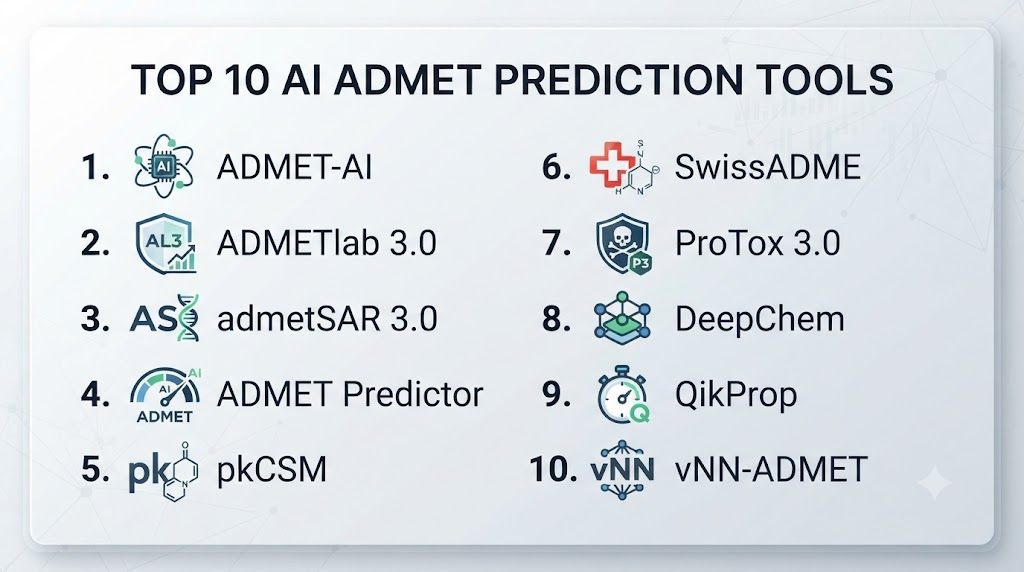
Top 10 AI ADMET Prediction Tools
1 — Schrödinger
One-line verdict: Best for pharmaceutical teams integrating ADMET prediction with molecular modeling, docking, simulation, and lead-optimization workflows.
Short description:
Schrödinger provides a broad computational drug-discovery environment that includes machine-learning and computational approaches for molecular-property and ADMET-related analysis. Its strength is integration with broader computational chemistry workflows.
Standout Capabilities
- Molecular-property prediction.
- ADMET-related modeling.
- Structure-based drug discovery.
- Molecular docking.
- Molecular dynamics.
- Quantum chemistry.
- Lead optimization.
- Computational chemistry.
AI-Specific Depth
- Model support: Machine-learning and computational models.
- RAG / knowledge integration: Chemical and scientific datasets can be integrated into broader workflows; specific RAG architecture is not publicly stated.
- Evaluation: Computational benchmarks and experimental validation.
- Guardrails: Property thresholds and chemistry-aware filtering.
- Observability: Workflow runtime, model outputs, computational metrics, and screening statistics.
Pros
- Broad drug-discovery ecosystem.
- Strong integration with computational chemistry.
- Useful for multi-parameter lead optimization.
Cons
- Can require specialist expertise.
- Full platform workflows may be complex.
- Exact pricing is not publicly stated.
Security & Compliance
Security controls vary according to deployment and organizational configuration. Specific certifications should be verified directly for the relevant offering.
Deployment & Platforms
- Cloud: Available for applicable workflows.
- Self-hosted: Available for applicable software.
- Hybrid: Possible.
- HPC/Linux: Common for computational workflows.
Integrations & Ecosystem
- Molecular databases.
- Docking.
- Molecular dynamics.
- Chemical-property models.
- Protein structures.
- HPC.
- Drug-discovery workflows.
Pricing Model
Commercial licensing and enterprise arrangements. Exact pricing is Not publicly stated.
Best-Fit Scenarios
- Pharmaceutical lead optimization.
- Integrated ADMET modeling.
- Computational drug discovery.
2 — ADMETlab
One-line verdict: Best for researchers seeking broad computational ADMET prediction across many drug-development-related endpoints.
Short description:
ADMETlab is a web-oriented computational platform designed to predict ADMET and related molecular properties. It is useful for researchers who want to evaluate compound profiles across multiple endpoints.
Standout Capabilities
- ADMET prediction.
- Physicochemical-property analysis.
- Toxicity prediction.
- Pharmacokinetic-related prediction.
- Molecular-property profiling.
- Compound prioritization.
- Drug-discovery research.
- Multi-endpoint assessment.
AI-Specific Depth
- Model support: Machine-learning models.
- RAG / knowledge integration: N/A as a core ADMET prediction function.
- Evaluation: Model-specific validation and benchmark datasets.
- Guardrails: Chemical input validation and prediction interpretation.
- Observability: Prediction outputs and computational metrics.
Pros
- Broad endpoint coverage.
- Accessible for research workflows.
- Useful for rapid compound profiling.
Cons
- Web-based workflows may not fit every enterprise environment.
- Predictions should be experimentally validated.
- Exact enterprise deployment capabilities vary.
Security & Compliance
Specific enterprise security controls are Not publicly stated.
Deployment & Platforms
- Web: Yes.
- Self-hosted: Availability varies.
- Cloud: Web-based access.
- API: Availability varies by implementation.
Integrations & Ecosystem
- Molecular structures.
- Chemical datasets.
- Drug-discovery workflows.
- Virtual screening.
- Molecular-property analysis.
Pricing Model
Availability and pricing vary. Exact pricing is Not publicly stated.
Best-Fit Scenarios
- Academic research.
- Early-stage compound screening.
- Multi-endpoint ADMET analysis.
3 — SwissADME
One-line verdict: Best for researchers needing accessible drug-likeness, physicochemical, pharmacokinetic, and ADME-related compound profiling.
Short description:
SwissADME is a widely used computational resource for evaluating small molecules and estimating physicochemical and pharmacokinetic-related properties. It is particularly useful during early compound assessment and medicinal-chemistry research.
Standout Capabilities
- Physicochemical property estimation.
- Pharmacokinetic-related analysis.
- Drug-likeness assessment.
- Lipophilicity estimation.
- Solubility-related prediction.
- Medicinal-chemistry filters.
- Molecular profiling.
- Compound comparison.
AI-Specific Depth
- Model support: Multiple computational prediction methods; not all are AI-based.
- RAG / knowledge integration: N/A.
- Evaluation: Established computational models and published methodology.
- Guardrails: Molecular-input validation and property ranges.
- Observability: Prediction outputs rather than production-style AI telemetry.
Pros
- Accessible.
- Useful for early-stage compound profiling.
- Broad medicinal-chemistry utility.
Cons
- Not a dedicated enterprise AI platform.
- Not every prediction is based on modern generative AI.
- Experimental validation remains necessary.
Security & Compliance
Specific enterprise security controls are Not publicly stated.
Deployment & Platforms
- Web: Yes.
- Self-hosted: Not publicly stated.
- Cloud: Web-based.
Integrations & Ecosystem
- SMILES.
- Molecular structures.
- Medicinal chemistry.
- Drug-discovery workflows.
- Chemical analysis.
Pricing Model
Research-oriented access. Exact commercial pricing is N/A.
Best-Fit Scenarios
- Academic medicinal chemistry.
- Early compound screening.
- Rapid ADME profiling.
4 — DeepChem
One-line verdict: Best for developers and researchers building customizable machine-learning models for ADMET and molecular-property prediction.
Short description:
DeepChem is an open-source machine-learning framework for computational chemistry and molecular machine learning. It provides tools and datasets that can be used to construct customized ADMET prediction workflows.
Standout Capabilities
- Molecular machine learning.
- ADMET modeling.
- Molecular property prediction.
- Graph neural networks.
- Dataset handling.
- Model experimentation.
- Custom training.
- Research workflows.
AI-Specific Depth
- Model support: Multiple machine-learning architectures.
- RAG / knowledge integration: Can be integrated into broader data and retrieval pipelines.
- Evaluation: Train/test splits, cross-validation, benchmark datasets, and custom evaluation.
- Guardrails: Data validation and application-level constraints.
- Observability: Model metrics, training performance, and inference statistics.
Pros
- Highly customizable.
- Open-source.
- Strong developer flexibility.
Cons
- Requires machine-learning expertise.
- Users must build much of the production workflow.
- Model performance depends heavily on training data.
Security & Compliance
Self-hosted deployment allows organizations to control data and infrastructure security.
Deployment & Platforms
- Self-hosted: Yes.
- Cloud: Possible.
- Hybrid: Possible.
- Linux: Common.
- API: Can be built into custom services.
Integrations & Ecosystem
- Python.
- PyTorch.
- TensorFlow.
- Molecular datasets.
- Cheminformatics tools.
- Jupyter.
- Cloud/HPC infrastructure.
Pricing Model
Open-source. Infrastructure and development costs vary.
Best-Fit Scenarios
- Custom ADMET models.
- Academic research.
- Pharmaceutical AI development teams.
5 — NVIDIA BioNeMo
One-line verdict: Best for organizations developing scalable molecular-AI workflows combining ADMET prediction with broader drug-discovery models.
Short description:
NVIDIA BioNeMo provides AI models and infrastructure for drug discovery and biological research. It can support molecular representation learning, property prediction, generative chemistry, protein modeling, and custom machine-learning workflows relevant to ADMET analysis.
Standout Capabilities
- Molecular property prediction.
- Molecular representation learning.
- Generative chemistry.
- Protein modeling.
- Custom model development.
- GPU acceleration.
- Large-scale inference.
- Drug-discovery workflows.
AI-Specific Depth
- Model support: Multiple biological and molecular models.
- RAG / knowledge integration: External datasets can be incorporated into custom applications.
- Evaluation: Model-specific benchmarks and custom evaluation pipelines.
- Guardrails: Molecular validity checks and property constraints.
- Observability: GPU utilization, latency, inference, and application metrics.
Pros
- Strong developer ecosystem.
- GPU acceleration.
- Broad molecular AI capabilities.
Cons
- Requires technical expertise.
- Infrastructure can be expensive at scale.
- Not a simple point-and-click ADMET solution.
Security & Compliance
Security depends on infrastructure and deployment configuration.
Deployment & Platforms
- Cloud: Yes.
- Self-hosted: Possible.
- Hybrid: Possible.
- Linux: Common.
Integrations & Ecosystem
- GPUs.
- Molecular models.
- Protein models.
- Machine-learning frameworks.
- Cloud infrastructure.
- Chemical datasets.
Pricing Model
Varies by software and infrastructure. Exact pricing is Not publicly stated.
Best-Fit Scenarios
- Enterprise drug discovery.
- Custom ADMET systems.
- AI development teams.
6 — pkCSM
One-line verdict: Best for researchers needing accessible computational prediction of pharmacokinetic and toxicity-related molecular properties.
Short description:
pkCSM is a computational approach for predicting pharmacokinetic and toxicity-related properties using molecular representations and graph-based information. It is widely relevant to early-stage drug-discovery research.
Standout Capabilities
- Pharmacokinetic prediction.
- Toxicity prediction.
- Molecular-property analysis.
- ADME-related assessment.
- Compound profiling.
- Early drug-discovery screening.
- Molecular descriptors.
- Computational prioritization.
AI-Specific Depth
- Model support: Machine-learning models.
- RAG / knowledge integration: N/A.
- Evaluation: Published model validation and computational benchmarking.
- Guardrails: Input validation and prediction interpretation.
- Observability: Prediction results and computational metrics.
Pros
- Broad pharmacokinetic relevance.
- Accessible research approach.
- Useful for early compound filtering.
Cons
- Prediction quality depends on applicability domain.
- Not an enterprise orchestration platform.
- Experimental validation remains necessary.
Security & Compliance
Specific enterprise security controls are Not publicly stated.
Deployment & Platforms
- Web: Available through relevant interfaces.
- Self-hosted: Availability varies.
- Cloud: Varies.
Integrations & Ecosystem
- Molecular structures.
- Chemical datasets.
- Drug-discovery workflows.
- ADMET screening.
- Molecular-property analysis.
Pricing Model
Research-oriented availability. Exact pricing is Not publicly stated.
Best-Fit Scenarios
- Academic research.
- Early ADMET screening.
- Pharmacokinetic assessment.
7 — ADMET-AI
One-line verdict: Best for researchers looking for a modern open machine-learning approach to large-scale ADMET property prediction.
Short description:
ADMET-AI is a machine-learning framework designed for predicting multiple ADMET-related properties. It is particularly relevant to computational researchers who want to evaluate many molecules programmatically.
Standout Capabilities
- Multi-endpoint ADMET prediction.
- High-throughput molecular screening.
- Machine-learning inference.
- Molecular-property analysis.
- Batch prediction.
- Computational drug discovery.
- Research customization.
- Programmatic workflows.
AI-Specific Depth
- Model support: Machine-learning ADMET models.
- RAG / knowledge integration: N/A for the core prediction workflow.
- Evaluation: Benchmark datasets and model-performance analysis.
- Guardrails: Molecular input validation and applicability considerations.
- Observability: Inference speed, prediction outputs, and computational metrics.
Pros
- Suitable for programmatic workflows.
- Useful for high-throughput screening.
- Open research orientation.
Cons
- Requires technical expertise.
- Predictions are dependent on training-data quality.
- Not a complete drug-discovery platform.
Security & Compliance
Self-hosted use allows organizational control over sensitive compound data.
Deployment & Platforms
- Self-hosted: Yes.
- Cloud: Possible.
- Hybrid: Possible.
- Linux: Common.
Integrations & Ecosystem
- Python.
- Molecular databases.
- Virtual screening.
- Machine-learning workflows.
- Cheminformatics pipelines.
Pricing Model
Open research software. Infrastructure costs vary.
Best-Fit Scenarios
- High-throughput ADMET screening.
- Computational drug discovery.
- Machine-learning research.
8 — Chemprop
One-line verdict: Best for developers building molecular-property prediction models using graph neural networks and custom chemical datasets.
Short description:
Chemprop is a machine-learning framework focused on molecular property prediction using graph-based neural networks. It can be adapted to ADMET prediction when appropriate datasets and endpoints are available.
Standout Capabilities
- Molecular property prediction.
- Graph neural networks.
- ADMET modeling.
- Custom dataset training.
- Transfer learning.
- Molecular representation learning.
- Batch inference.
- Research experimentation.
AI-Specific Depth
- Model support: Graph neural networks.
- RAG / knowledge integration: N/A for the core model.
- Evaluation: Custom validation, cross-validation, and benchmark datasets.
- Guardrails: Data validation and applicability-domain analysis.
- Observability: Training and inference metrics.
Pros
- Strong customization.
- Developer-friendly research framework.
- Useful for proprietary datasets.
Cons
- Requires ML expertise.
- Users need appropriate labeled data.
- Not a turnkey enterprise ADMET platform.
Security & Compliance
Self-hosted deployments allow organizations to control proprietary molecular data.
Deployment & Platforms
- Self-hosted: Yes.
- Cloud: Possible.
- Hybrid: Possible.
- Linux: Common.
Integrations & Ecosystem
- Python.
- PyTorch.
- Molecular datasets.
- Cheminformatics tools.
- Drug-discovery pipelines.
Pricing Model
Open-source. Infrastructure costs vary.
Best-Fit Scenarios
- Custom ADMET models.
- Academic research.
- Proprietary molecular datasets.
9 — ADMETlab Workflow
One-line verdict: Best for rapid multi-property compound profiling during early-stage medicinal-chemistry and drug-discovery research.
Short description:
ADMETlab-style workflows allow researchers to evaluate compounds across multiple ADMET and physicochemical endpoints. They can be useful for quickly identifying molecules with potentially problematic profiles before additional laboratory investment.
Standout Capabilities
- Multi-endpoint profiling.
- ADME prediction.
- Toxicity assessment.
- Physicochemical properties.
- Compound comparison.
- Candidate prioritization.
- Batch analysis.
- Drug-discovery support.
AI-Specific Depth
- Model support: Machine-learning and computational prediction methods.
- RAG / knowledge integration: N/A.
- Evaluation: Model validation and benchmark datasets.
- Guardrails: Chemical-input validation and applicability considerations.
- Observability: Prediction outputs and computational metrics.
Pros
- Broad endpoint coverage.
- Useful for rapid candidate profiling.
- Easy to incorporate into early screening.
Cons
- Predictions require laboratory confirmation.
- Enterprise deployment options vary.
- Exact model architecture varies by endpoint.
Security & Compliance
Specific enterprise controls are Not publicly stated.
Deployment & Platforms
- Web: Available.
- Cloud: Web-based.
- Self-hosted: Availability varies.
Integrations & Ecosystem
- Chemical structures.
- Drug-discovery workflows.
- Virtual screening.
- Molecular property analysis.
- Compound libraries.
Pricing Model
Exact pricing is Not publicly stated.
Best-Fit Scenarios
- Early lead screening.
- Medicinal chemistry.
- Academic drug discovery.
10 — Custom AI ADMET Prediction Platform
One-line verdict: Best for organizations using proprietary assay data to build specialized ADMET models around internal drug-discovery programs.
Short description:
Large pharmaceutical and biotechnology organizations can build custom ADMET prediction platforms using proprietary experimental datasets, molecular descriptors, graph neural networks, foundation models, ensemble models, and active-learning workflows.
A custom system can be optimized for the company’s specific chemical space and experimental endpoints.
Standout Capabilities
- Custom ADMET prediction.
- Proprietary-data training.
- Multi-endpoint modeling.
- Active learning.
- Candidate ranking.
- Uncertainty estimation.
- Model ensembles.
- Experimental feedback.
AI-Specific Depth
- Model support: Open-source, proprietary, hosted, or internally trained models.
- RAG / knowledge integration: Internal assay databases, chemical libraries, scientific literature, biological databases, and experimental records.
- Evaluation: External validation, temporal splits, scaffold splits, prospective testing, calibration, and experimental validation.
- Guardrails: Applicability-domain checks, uncertainty thresholds, data-quality rules, access controls, and human review.
- Observability: Model drift, prediction distributions, latency, compute cost, uncertainty, data drift, and experimental outcomes.
Pros
- Can leverage proprietary assay data.
- Highly customizable.
- Can optimize for specific therapeutic areas.
Cons
- Significant development requirements.
- Requires strong data-science and chemistry expertise.
- Model maintenance is ongoing.
Security & Compliance
The organization controls infrastructure and is responsible for encryption, access control, retention, auditability, intellectual-property protection, and governance.
Deployment & Platforms
- Cloud: Possible.
- Self-hosted: Possible.
- Hybrid: Possible.
- Linux: Common.
- API: Possible.
Integrations & Ecosystem
Potential integrations include:
- LIMS.
- ELN.
- Compound-management systems.
- Assay databases.
- Molecular databases.
- Virtual screening.
- Laboratory automation.
Pricing Model
Custom development and infrastructure. Exact pricing is N/A.
Best-Fit Scenarios
- Pharmaceutical companies.
- Proprietary drug-discovery programs.
- Large biotech organizations.
Comparison Table
| Tool | Best For | Deployment | Model Flexibility | Strength | Watch-Out | Public Rating |
|---|---|---|---|---|---|---|
| Schrödinger | Integrated drug discovery | Cloud / Self-hosted / Hybrid | Multi-model | Broad computational chemistry | Complexity | |
| ADMETlab | Multi-endpoint ADMET | Web / Varies | ML/computational | Broad profiling | Validation required | |
| SwissADME | Early compound profiling | Web | Multiple methods | Accessibility | Not an enterprise AI platform | |
| DeepChem | Custom ADMET modeling | Self-hosted / Cloud | Multi-model | Developer flexibility | Requires ML expertise | |
| NVIDIA BioNeMo | Enterprise molecular AI | Cloud / Self-hosted / Hybrid | Multi-model | Scalable AI infrastructure | Technical complexity | |
| pkCSM | PK and toxicity prediction | Web / Varies | ML | Pharmacokinetic modeling | Applicability limits | |
| ADMET-AI | High-throughput ADMET | Self-hosted / Cloud | ML | Batch prediction | Requires technical setup | |
| Chemprop | Custom molecular prediction | Self-hosted / Cloud | GNN | Custom modeling | Requires training data | |
| ADMETlab Workflow | Early lead screening | Web / Varies | ML/computational | Multi-property profiling | Model-specific limitations | |
| Custom AI Platform | Proprietary ADMET | Cloud / Self-hosted / Hybrid | Multi-model | Maximum customization | High development burden |
Scoring & Evaluation
These scores are comparative editorial assessments intended for initial tool selection rather than claims of universal scientific performance.
ADMET models should ultimately be evaluated using endpoint-specific external validation, realistic chemical splits, applicability-domain analysis, uncertainty estimation, and prospective experimental testing.
| Tool | Core Features | AI Reliability | ADMET Depth | Integrations | Ease | Performance/Cost | Security/Admin | Support | Weighted Total |
|---|---|---|---|---|---|---|---|---|---|
| Schrödinger | 10 | 9 | 10 | 10 | 7 | 8 | 9 | 10 | 9.15 |
| ADMETlab | 9 | 9 | 10 | 8 | 9 | 9 | 7 | 8 | 8.70 |
| SwissADME | 9 | 8 | 9 | 8 | 10 | 10 | 7 | 9 | 8.80 |
| DeepChem | 9 | 9 | 9 | 10 | 6 | 9 | 8 | 9 | 8.65 |
| NVIDIA BioNeMo | 10 | 9 | 10 | 10 | 7 | 8 | 9 | 10 | 9.10 |
| pkCSM | 8 | 8 | 9 | 7 | 9 | 9 | 7 | 8 | 8.15 |
| ADMET-AI | 9 | 9 | 10 | 9 | 7 | 10 | 7 | 8 | 8.70 |
| Chemprop | 9 | 9 | 9 | 9 | 6 | 10 | 8 | 9 | 8.60 |
| ADMETlab Workflow | 9 | 9 | 10 | 8 | 9 | 9 | 7 | 8 | 8.70 |
| Custom AI Platform | 10 | 10 | 10 | 10 | 5 | 7 | 10 | 10 | 9.35 |
Top 3 for Enterprise
- Schrödinger — Strong choice for integrated computational drug discovery and ADMET workflows.
- NVIDIA BioNeMo — Strong foundation for scalable custom molecular-AI systems.
- Custom AI ADMET Platform — Best for proprietary assay data and specialized endpoints.
Top 3 for SMB
- ADMETlab — Broad multi-endpoint profiling.
- SwissADME — Accessible early compound assessment.
- ADMET-AI — Useful for technical teams needing programmatic prediction.
Top 3 for Developers
- DeepChem — Strong customization.
- Chemprop — Excellent for graph-based molecular-property models.
- ADMET-AI — Useful for high-throughput computational workflows.
Which AI ADMET Prediction Tool Is Right for You?
Solo / Individual Researcher
Individual researchers should prioritize accessibility and broad property coverage.
A practical starting workflow may combine:
- SwissADME.
- ADMETlab.
- pkCSM.
- Open molecular datasets.
- Basic cheminformatics tools.
The goal should be to identify potential liabilities rather than produce definitive ADMET conclusions.
SMB Biotech
Small biotech teams should prioritize:
- Multiple ADMET endpoints.
- Batch processing.
- Easy molecular input.
- Exportable results.
- Reasonable computational requirements.
- Integration with virtual screening.
A simple multi-property workflow can often be more useful than an extremely complex platform.
Mid-Market Biotech
Mid-sized organizations may require:
- Automated compound profiling.
- Custom prediction models.
- Internal assay integration.
- Model benchmarking.
- Applicability-domain analysis.
- Uncertainty estimates.
- Integration with medicinal-chemistry workflows.
Enterprise Pharmaceutical Company
Large organizations should evaluate whether the platform can integrate with:
- Compound management.
- LIMS.
- ELN.
- Virtual screening.
- Molecular design.
- Assay systems.
- Data lakes.
- Laboratory automation.
Enterprise teams should also establish model governance and version control.
Early Drug Discovery
During hit and lead discovery, ADMET prediction can help remove obviously problematic compounds before more expensive testing.
Prioritize:
- Solubility.
- Permeability.
- Metabolic stability.
- CYP-related properties.
- Toxicity-related endpoints.
- Drug-likeness.
Lead Optimization
Lead optimization requires a multi-objective approach.
Teams should balance:
- Potency.
- Selectivity.
- Solubility.
- Stability.
- Permeability.
- Clearance.
- Toxicity.
- Synthetic accessibility.
Optimizing one property independently can create undesirable trade-offs elsewhere.
Toxicology Research
Toxicity prediction should be treated as an early-warning system rather than a replacement for toxicology experiments.
Use models to prioritize:
- Compounds requiring additional testing.
- Structural alerts.
- Potential toxicity mechanisms.
- Comparative analogue profiles.
Virtual Screening
ADMET models can be used after target-based virtual screening.
A typical workflow is:
Virtual screening → activity ranking → ADMET filtering → chemical diversity → experimental testing
This can reduce the number of compounds selected for laboratory evaluation.
Regulated Pharmaceutical Research
Organizations should prioritize:
- Model provenance.
- Dataset provenance.
- Validation records.
- Prediction versioning.
- Auditability.
- Data governance.
- Experimental confirmation.
Budget vs Premium
Open tools can be attractive for research teams because they reduce software licensing costs.
However, organizations should account for:
- Infrastructure.
- Data preparation.
- Model development.
- Maintenance.
- Scientific expertise.
- Validation.
Premium platforms can justify their cost when they provide integrated workflows and enterprise support.
Build vs Buy
Build when:
- You have large proprietary ADMET datasets.
- Your chemical space differs substantially from public datasets.
- You need specialized endpoints.
- You have strong machine-learning expertise.
Buy when:
- You need rapid deployment.
- You lack internal ML infrastructure.
- You need integrated drug-discovery workflows.
- You require vendor support.
A hybrid approach can combine external general-purpose models with proprietary internal models.
Implementation Playbook
First 30 Days: Establish Your ADMET Baseline
Define:
- Target endpoints.
- Available experimental data.
- Chemical domains.
- Existing assays.
- Success criteria.
- Intended use.
Create a representative test set.
Avoid randomly splitting highly similar compounds across training and testing because this can make model performance appear stronger than it will be on genuinely novel chemistry.
Days 31–60: Benchmark the Models
Evaluate:
- ROC-AUC where appropriate.
- PR-AUC where appropriate.
- Regression error.
- Calibration.
- Applicability domain.
- Scaffold-split performance.
- Temporal performance.
- External validation.
Different endpoints require different metrics.
Do not compare all ADMET predictions using one universal score.
Days 61–90: Connect Prediction With Experiments
Build a closed loop:
Predict → rank → select → test → compare → recalibrate → redesign
Track:
- False positives.
- False negatives.
- Uncertainty.
- Chemical-series effects.
- Model drift.
- Experimental outcomes.
Use experimental results to improve future prediction models.
Common Mistakes and How to Avoid Them
- Treating predicted ADMET values as experimental measurements: They are computational estimates.
- Ignoring applicability domains: Models may perform poorly on unfamiliar chemical structures.
- Using random train/test splits without considering chemical similarity: This can inflate apparent performance.
- Ignoring scaffold diversity: Similar compounds can create misleading validation results.
- Using only one ADMET model: Ensemble approaches can provide additional perspective.
- Ignoring uncertainty: A prediction without confidence information is difficult to interpret.
- Optimizing one property independently: ADMET optimization involves trade-offs.
- Ignoring experimental assay differences: Prediction labels may not match real-world assay conditions.
- Using outdated datasets without checking relevance: Biological and chemical data quality matters.
- Ignoring data leakage: Shared compounds or analogue series can contaminate evaluation.
- Treating toxicity prediction as definitive: Toxicity requires appropriate experimental investigation.
- Ignoring formulation factors: Some apparent ADMET liabilities may depend on formulation and context.
- Failing to track model versions: Prediction results need reproducibility.
- Ignoring model drift: Internal chemical libraries may evolve over time.
- Over-filtering candidates: Aggressive ADMET thresholds can remove potentially useful compounds.
- Ignoring biological context: ADMET properties can depend on species, assay, tissue, dose, and experimental conditions.
- Failing to integrate experimental results: Laboratory outcomes should inform future model development.
FAQs
What does ADMET stand for?
ADMET stands for Absorption, Distribution, Metabolism, Excretion, and Toxicity.
What are AI ADMET prediction tools?
They are computational systems that use machine learning or related modeling approaches to estimate ADMET and molecular properties before experimental testing.
Why is ADMET prediction important?
It helps researchers identify potential pharmacokinetic and toxicity liabilities earlier in drug discovery.
Can AI predict drug absorption?
Yes. Certain models estimate properties related to absorption, such as permeability and solubility, although predictions require experimental validation.
Can AI predict drug metabolism?
Yes. Models can estimate properties related to metabolic stability and interactions with metabolic enzymes, but experimental testing remains important.
Can AI predict toxicity?
AI models can estimate various toxicity-related endpoints. They should be treated as screening and prioritization tools rather than definitive toxicology assessments.
What is the difference between ADME and ADMET?
ADME covers absorption, distribution, metabolism, and excretion. ADMET adds toxicity.
Is SwissADME an AI platform?
SwissADME is a computational ADME and drug-likeness resource that uses multiple prediction methods. Not all of its methods should be characterized as modern AI.
Is ADMETlab an AI tool?
ADMETlab provides computational prediction across multiple ADMET-related endpoints using machine-learning and related approaches.
What is DeepChem?
DeepChem is an open-source machine-learning framework for computational chemistry and molecular-property prediction. It can be used to build custom ADMET models.
Can ADMET models be used for virtual screening?
Yes. ADMET prediction can be used as a filtering stage after activity-based or structure-based virtual screening.
Can ADMET prediction replace laboratory assays?
No. Computational predictions are useful for prioritization but cannot replace appropriate experimental ADMET testing.
What data do ADMET models need?
Depending on the model, inputs can include molecular structures, SMILES strings, fingerprints, descriptors, biological information, and experimental assay data.
Can companies train ADMET models using proprietary data?
Yes. Custom models can be trained using internal experimental datasets when sufficient high-quality data is available.
What is an applicability domain?
An applicability domain describes the types of chemical structures for which a model is expected to provide more reliable predictions.
Why can two ADMET models disagree?
Models may use different datasets, algorithms, endpoints, definitions, molecular representations, and training distributions.
Should ADMET models provide uncertainty estimates?
Yes. Uncertainty information can help researchers distinguish confident predictions from molecules that are outside the model’s familiar chemical space.
Can ADMET prediction reduce drug-development costs?
It can potentially reduce wasted experimental effort by helping researchers prioritize compounds earlier, but the actual benefit depends on model quality and workflow integration.
Can AI predict human ADMET from animal data?
AI can incorporate different datasets and species information, but translating ADMET behavior across species remains scientifically challenging.
What are the biggest limitations of AI ADMET prediction?
Important limitations include dataset bias, applicability-domain limitations, assay variability, chemical-space differences, data leakage, uncertainty, and imperfect biological representation.
Which AI ADMET prediction tool is best?
There is no universal winner. Schrödinger is strong for integrated pharmaceutical workflows, ADMETlab and SwissADME are useful for accessible compound profiling, DeepChem and Chemprop provide developer flexibility, and NVIDIA BioNeMo is suited to scalable molecular-AI development.
Conclusion
AI ADMET Prediction tools are becoming an important part of modern drug discovery because they allow researchers to identify potential pharmacokinetic and toxicity liabilities earlier in the development process.Tools such as Schrödinger, ADMETlab, SwissADME, DeepChem, NVIDIA BioNeMo, pkCSM, ADMET-AI, and Chemprop provide different approaches to computational ADMET analysis.organizations may benefit from integrated platforms, while developers and academic researchers may prefer customizable open-source frameworks. Organizations with substantial proprietary assay data may eventually benefit from custom models.