Introduction
AI Protein Design platforms use artificial intelligence, protein language models, generative models, structural prediction, and computational optimization to help researchers create, modify, and prioritize protein sequences with desired characteristics. Instead of relying entirely on trial-and-error protein engineering, these platforms can explore large sequence spaces and identify candidates that may have improved stability, binding, activity, expression, or other properties.Modern protein-design workflows increasingly combine sequence generation with structure prediction, protein-function modeling, molecular interaction analysis, and laboratory experimentation. Some systems focus on therapeutic proteins, while others support enzymes, antibodies, binding proteins, and general protein engineering.Common applications include therapeutic protein design, antibody engineering, enzyme optimization, protein stability improvement, novel binder generation, functional protein design, and synthetic biology.
What Is AI Protein Design?
AI Protein Design is the use of machine learning and generative computational methods to propose new protein sequences or modify existing sequences according to specific design objectives.
Traditional protein engineering may involve:
- Selecting a known protein.
- Introducing mutations.
- Expressing variants.
- Testing activity.
- Repeating the process.
AI can expand this process by exploring many more possible sequences computationally.
A modern workflow can look like:
AI systems may work with:
- Amino-acid sequences.
- Protein structures.
- Multiple-sequence alignments.
- Protein language-model embeddings.
- Binding-site information.
- Functional annotations.
- Experimental assay data.
- Protein-protein interaction data.
The ultimate goal is not simply to produce unusual sequences.
The objective is to produce experimentally useful proteins.
Why AI Protein Design Matters
Proteins are highly complex biological systems. Even small sequence changes can affect:
- Folding.
- Stability.
- Solubility.
- Binding.
- Catalytic activity.
- Expression.
- Specificity.
- Immunogenicity.
The number of possible protein sequences grows exponentially with sequence length, making exhaustive experimental exploration impossible.
AI can help researchers prioritize a smaller set of candidates.
Potential benefits include:
- Exploring sequence space.
- Designing novel proteins.
- Optimizing existing proteins.
- Predicting protein properties.
- Generating candidate binders.
- Improving enzyme performance.
- Designing therapeutic proteins.
- Reducing experimental search space.
The strongest workflows combine AI generation with biological validation.
Key Use Cases
De Novo Protein Design
Generate proteins without relying entirely on an existing natural protein sequence.
Protein Engineering
Modify an existing protein to improve desired characteristics.
Enzyme Design
Explore sequence variants that may improve catalytic performance, stability, or substrate specificity.
Antibody Engineering
Optimize antibody sequences and investigate binding-related characteristics.
Protein Binder Design
Generate proteins intended to bind particular molecular targets.
Therapeutic Protein Development
Support research involving antibodies, cytokines, enzymes, receptors, and other biologics.
Stability Optimization
Identify mutations that may improve folding or thermal stability.
Solubility Optimization
Prioritize sequences with potentially improved expression or solubility characteristics.
Synthetic Biology
Design proteins for engineered biological systems.
Protein Function Exploration
Generate and evaluate sequences associated with desired biological functions.
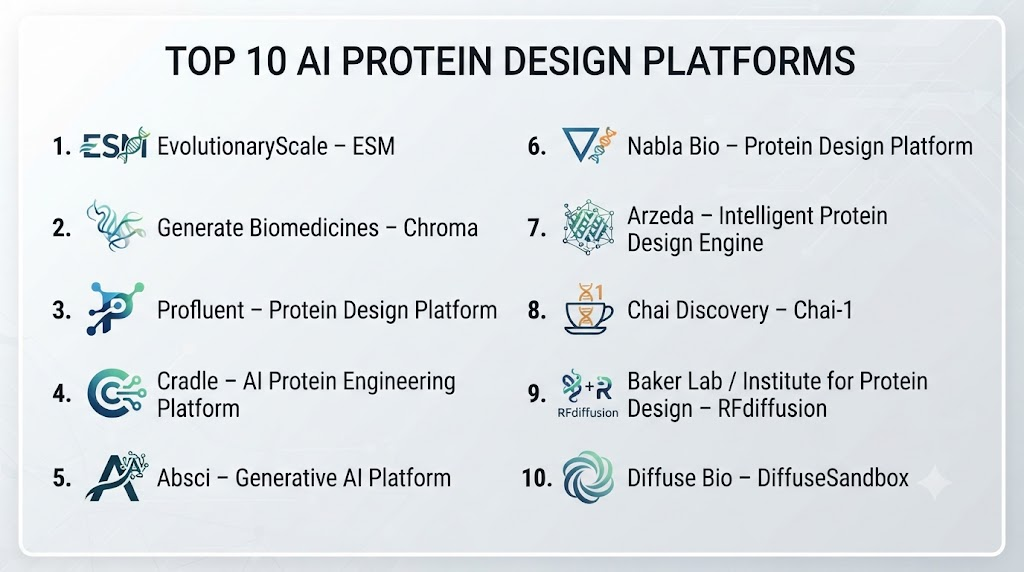
Top 10 AI Protein Design Platforms
1 — Generate:Biomedicines
One-line verdict: Best for organizations using generative AI to design novel proteins and explore therapeutic biological molecules.
Short description:
Generate:Biomedicines develops generative AI technologies for biological design, with a strong emphasis on creating and engineering proteins for therapeutic applications. Its approach combines machine learning with biological experimentation.
Standout Capabilities
- Generative protein design.
- Protein sequence generation.
- Therapeutic protein research.
- Protein engineering.
- Structure-aware design.
- Computational biology.
- Biological optimization.
- Experimental validation.
AI-Specific Depth
- Model support: Proprietary generative AI models.
- RAG / knowledge integration: Biological data can inform design workflows; exact retrieval architecture is not publicly stated.
- Evaluation: Computational and experimental validation.
- Guardrails: Biological constraints, design filters, and experimental review.
- Observability: Research and experimental metrics; detailed model-level telemetry is not publicly stated.
Pros
- Strong generative-biology focus.
- Designed around protein creation rather than simple sequence prediction.
- Relevant to therapeutic protein research.
Cons
- Primarily enterprise and research focused.
- Access may depend on partnerships or programs.
- Exact pricing is not publicly stated.
Security & Compliance
Specific security, data-retention, and enterprise governance controls should be verified for the relevant engagement.
Deployment & Platforms
- Cloud: Varies.
- Laboratory: Integrated with research workflows.
- Self-hosted: Not publicly stated.
- Hybrid: Varies.
Integrations & Ecosystem
- Protein databases.
- Biological assays.
- Computational biology.
- Laboratory systems.
- Therapeutic discovery workflows.
- Structural analysis.
Pricing Model
Enterprise/custom or partnership arrangements. Exact pricing is Not publicly stated.
Best-Fit Scenarios
- Therapeutic protein discovery.
- Novel protein generation.
- Advanced biotechnology research.
2 — EvolutionaryScale
One-line verdict: Best for researchers and developers using large protein language models to understand, generate, and engineer biological sequences.
Short description:
EvolutionaryScale develops large-scale biological foundation models designed to learn patterns within protein sequences and biological systems. Its technology is particularly relevant to teams exploring protein generation, sequence design, and biological representation learning.
Standout Capabilities
- Protein language models.
- Protein sequence generation.
- Protein representation learning.
- Protein engineering.
- Biological sequence analysis.
- Generative protein workflows.
- Functional prediction.
- Research model development.
AI-Specific Depth
- Model support: Large protein foundation models.
- RAG / knowledge integration: External biological knowledge can be incorporated into surrounding workflows.
- Evaluation: Sequence, structural, and functional benchmarks depending on the model and task.
- Guardrails: Sequence constraints and downstream biological validation.
- Observability: Model inference and computational metrics can be monitored.
Pros
- Strong foundation-model approach.
- Broad protein sequence capabilities.
- Useful for custom research workflows.
Cons
- Requires expertise for advanced use.
- Generated sequences require validation.
- Commercial availability varies by offering.
Security & Compliance
Security controls depend on deployment and service configuration.
Deployment & Platforms
- Cloud: Available for applicable services.
- Self-hosted: Availability varies by model.
- Hybrid: Possible.
- Linux: Common for research workflows.
Integrations & Ecosystem
- Protein sequence databases.
- Structural prediction.
- Protein engineering tools.
- Machine-learning frameworks.
- Bioinformatics pipelines.
Pricing Model
Varies by offering and deployment. Exact pricing is Not publicly stated.
Best-Fit Scenarios
- Protein AI research.
- Sequence generation.
- Computational protein engineering.
3 — NVIDIA BioNeMo
One-line verdict: Best for developers building scalable protein-design workflows using biological foundation models and GPU-accelerated infrastructure.
Short description:
NVIDIA BioNeMo provides models, software, and infrastructure for generative AI in drug discovery and biological research. It supports protein-related modeling alongside molecular and chemical AI workflows.
Standout Capabilities
- Protein foundation models.
- Protein generation.
- Protein representation learning.
- Structure prediction.
- Molecular generation.
- Model customization.
- GPU acceleration.
- Large-scale inference.
AI-Specific Depth
- Model support: Multiple biological models and model-development options.
- RAG / knowledge integration: Can integrate external biological data into application workflows.
- Evaluation: Model-specific benchmarks and custom evaluation pipelines.
- Guardrails: Biological constraints and application-level filtering can be implemented.
- Observability: Infrastructure and model metrics can be monitored through the broader NVIDIA ecosystem.
Pros
- Strong developer ecosystem.
- GPU-optimized.
- Broad biological AI capabilities.
Cons
- Technical complexity.
- Requires suitable computing infrastructure.
- Different components have different deployment requirements.
Security & Compliance
Enterprise security depends on deployment and infrastructure configuration.
Deployment & Platforms
- Cloud: Yes.
- Self-hosted: Possible.
- Hybrid: Possible.
- Linux: Common.
Integrations & Ecosystem
- GPUs.
- Protein models.
- Molecular models.
- Machine-learning frameworks.
- Cloud infrastructure.
- Bioinformatics pipelines.
Pricing Model
Software and infrastructure costs vary by product and deployment. Exact platform-wide pricing is Not publicly stated.
Best-Fit Scenarios
- Pharmaceutical AI teams.
- Computational biology developers.
- Large-scale protein design.
4 — RFdiffusion
One-line verdict: Best for researchers exploring diffusion-based de novo protein structure and binder design workflows.
Short description:
RFdiffusion is a generative protein-design approach based on diffusion modeling. It has become an important research technology for generating protein structures and designing candidate proteins around structural constraints.
Standout Capabilities
- De novo protein design.
- Diffusion-based generation.
- Protein binder design.
- Structural conditioning.
- Protein backbone generation.
- Computational protein engineering.
- Structure-guided design.
- Research customization.
AI-Specific Depth
- Model support: Diffusion-based generative models.
- RAG / knowledge integration: N/A as a core generation method.
- Evaluation: Structural quality, sequence design, computational filtering, and experimental testing.
- Guardrails: Structural constraints and design filters.
- Observability: Generation metrics, compute usage, and downstream validation.
Pros
- Powerful structural-generation approach.
- Strong research impact.
- Flexible for custom design tasks.
Cons
- Requires substantial technical expertise.
- Generated structures still require sequence design and validation.
- Experimental testing remains necessary.
Security & Compliance
Self-hosted deployments require organizational controls for data and infrastructure.
Deployment & Platforms
- Self-hosted: Yes.
- Cloud: Possible.
- Hybrid: Possible.
- Linux: Common.
Integrations & Ecosystem
- Protein structure prediction.
- Protein sequence design.
- Molecular visualization.
- Machine-learning frameworks.
- Structural databases.
Pricing Model
Research software/model availability varies. Infrastructure costs depend on compute requirements.
Best-Fit Scenarios
- De novo protein design.
- Binder design research.
- Structural protein engineering.
5 — ProteinMPNN
One-line verdict: Best for designing protein sequences compatible with desired backbone structures in computational protein-engineering workflows.
Short description:
ProteinMPNN is a deep-learning approach for protein sequence design conditioned on protein backbone structures. It is widely useful as a sequence-design component following structure generation or selection.
Standout Capabilities
- Protein sequence design.
- Structure-conditioned generation.
- Backbone-to-sequence modeling.
- Protein engineering.
- Computational sequence optimization.
- Design-library generation.
- Structure-guided workflows.
- Research customization.
AI-Specific Depth
- Model support: Neural-network sequence-design model.
- RAG / knowledge integration: N/A as a core model.
- Evaluation: Sequence-design metrics and experimental validation.
- Guardrails: Structural constraints and sequence filters.
- Observability: Inference and sequence-design metrics.
Pros
- Strong structure-conditioned sequence design.
- Useful as part of larger design pipelines.
- Computationally efficient compared with exhaustive sequence search.
Cons
- Not a complete end-to-end protein-design platform.
- Requires a suitable protein backbone.
- Experimental validation is essential.
Security & Compliance
Self-hosted use places security responsibility on the organization.
Deployment & Platforms
- Self-hosted: Yes.
- Cloud: Possible.
- Hybrid: Possible.
- Linux: Common.
Integrations & Ecosystem
- RFdiffusion.
- Protein structure prediction.
- Molecular visualization.
- Structural datasets.
- Python-based research workflows.
Pricing Model
Open research software. Infrastructure costs vary.
Best-Fit Scenarios
- Structure-conditioned sequence design.
- Protein engineering.
- Academic research.
6 — Chroma
One-line verdict: Best for researchers exploring generative protein design with programmable structural and biological constraints.
Short description:
Chroma is a generative protein-design system focused on computational generation and engineering of proteins. It is designed to provide control over structural characteristics and biological design objectives.
Standout Capabilities
- Generative protein design.
- Protein sequence generation.
- Structural conditioning.
- Protein engineering.
- Constraint-based generation.
- Computational design.
- De novo design.
- Research workflows.
AI-Specific Depth
- Model support: Generative protein models.
- RAG / knowledge integration: External biological information can be integrated into application workflows; exact RAG architecture is not publicly stated.
- Evaluation: Structural and sequence metrics plus experimental validation.
- Guardrails: Design constraints and biological filtering.
- Observability: Computational generation metrics and workflow monitoring.
Pros
- Strong generative-protein focus.
- Programmable design objectives.
- Useful for advanced protein engineering.
Cons
- Requires computational biology expertise.
- Not all design goals can be reliably predicted computationally.
- Pricing and commercial availability vary.
Security & Compliance
Deployment-specific. Enterprise controls should be verified for the selected service.
Deployment & Platforms
- Cloud: Varies.
- Self-hosted: Availability varies.
- Hybrid: Possible.
Integrations & Ecosystem
- Protein structure tools.
- Sequence-design systems.
- Biological databases.
- Computational workflows.
- Experimental pipelines.
Pricing Model
Varies by offering. Exact pricing is Not publicly stated.
Best-Fit Scenarios
- De novo protein design.
- Computational protein engineering.
- Advanced biotech research.
7 — RFdiffusion + ProteinMPNN Workflow
One-line verdict: Best for researchers building flexible open workflows that combine protein backbone generation with structure-conditioned sequence design.
Short description:
RFdiffusion and ProteinMPNN can be combined into a powerful computational protein-design workflow. RFdiffusion can generate structural candidates, while ProteinMPNN can design sequences compatible with selected backbones.
A downstream structure-prediction and experimental validation stage can then filter candidates.
Standout Capabilities
- Backbone generation.
- Sequence design.
- Structure-conditioned design.
- Binder design.
- Candidate filtering.
- Protein engineering.
- Custom pipelines.
- High-throughput design.
AI-Specific Depth
- Model support: Diffusion and neural sequence-design models.
- RAG / knowledge integration: N/A for the core models.
- Evaluation: Structural confidence, sequence metrics, computational filtering, and laboratory validation.
- Guardrails: Structural and sequence constraints.
- Observability: Pipeline runtime, generation statistics, and candidate-quality metrics.
Pros
- Highly customizable.
- Combines complementary AI methods.
- Suitable for research experimentation.
Cons
- Requires several computational components.
- Pipeline management can be complex.
- Experimental validation is essential.
Security & Compliance
Self-hosted deployments provide control but require appropriate security governance.
Deployment & Platforms
- Self-hosted: Yes.
- Cloud: Possible.
- Hybrid: Possible.
- Linux: Common.
Integrations & Ecosystem
- RFdiffusion.
- ProteinMPNN.
- AlphaFold-style prediction.
- Molecular visualization.
- Protein databases.
- Laboratory workflows.
Pricing Model
Open research software and infrastructure-based. Exact total cost depends on compute requirements.
Best-Fit Scenarios
- Research protein design.
- Binder development.
- High-throughput computational design.
8 — AlphaFold-Based Protein Design Workflow
One-line verdict: Best for researchers using structure prediction as a validation layer within broader AI protein-design pipelines.
Short description:
Protein design frequently requires a structure-prediction stage to assess whether generated sequences are likely to fold into the intended structure. AlphaFold-based workflows can therefore complement generative design systems.
AlphaFold is not itself a complete protein-design platform, but it can be an important component of one.
Standout Capabilities
- Structure prediction.
- Design validation.
- Fold assessment.
- Structural confidence.
- Mutation analysis.
- Protein engineering.
- Structural filtering.
- Computational validation.
AI-Specific Depth
- Model support: Deep-learning protein-structure models.
- RAG / knowledge integration: N/A as a core structure-prediction workflow.
- Evaluation: Structural confidence and comparison with known structures.
- Guardrails: Confidence thresholds and structural filters.
- Observability: Prediction confidence and compute metrics.
Pros
- Valuable design-validation layer.
- Strong structural ecosystem.
- Useful for filtering generated sequences.
Cons
- Not a sequence-generation system by itself.
- Structural prediction does not guarantee function.
- Requires integration with other design tools.
Security & Compliance
Deployment-specific.
Deployment & Platforms
- Cloud: Possible.
- Self-hosted: Possible for applicable implementations.
- Hybrid: Possible.
Integrations & Ecosystem
- Protein design models.
- Molecular visualization.
- Structural databases.
- Docking.
- Protein engineering pipelines.
Pricing Model
Varies by implementation. Exact pricing is Not publicly stated.
Best-Fit Scenarios
- Protein-design validation.
- Sequence screening.
- Structure-guided engineering.
9 — EvolutionaryScale ESM Design Workflows
One-line verdict: Best for researchers using protein foundation models to generate and optimize sequences across diverse protein-design tasks.
Short description:
Protein language models can learn evolutionary patterns from very large sequence datasets. EvolutionaryScale’s technology provides a foundation for sequence generation and protein engineering workflows where researchers want to explore biological sequence space computationally.
Standout Capabilities
- Protein sequence generation.
- Protein language models.
- Sequence optimization.
- Protein representation.
- Functional prediction.
- Protein engineering.
- Generative workflows.
- Large-scale inference.
AI-Specific Depth
- Model support: Protein foundation models.
- RAG / knowledge integration: External biological data can be integrated into surrounding applications.
- Evaluation: Sequence, structure, and functional benchmarks.
- Guardrails: Sequence constraints and downstream biological validation.
- Observability: Inference performance and model metrics.
Pros
- Strong foundation-model architecture.
- Broad protein sequence applicability.
- Useful for custom design workflows.
Cons
- Requires domain expertise.
- Generated sequences require laboratory testing.
- Commercial access and model options vary.
Security & Compliance
Deployment-specific.
Deployment & Platforms
- Cloud: Available for applicable offerings.
- Self-hosted: Varies.
- Hybrid: Possible.
- Linux: Common for research.
Integrations & Ecosystem
- Protein sequence databases.
- Structure-prediction systems.
- Protein engineering.
- Machine-learning frameworks.
- Bioinformatics pipelines.
Pricing Model
Varies by model and deployment. Exact pricing is Not publicly stated.
Best-Fit Scenarios
- Protein foundation-model research.
- Sequence engineering.
- Generative protein workflows.
10 — Custom AI Protein Design Platform
One-line verdict: Best for organizations requiring proprietary protein-generation models tied directly to internal experiments and therapeutic objectives.
Short description:
Large biotechnology and pharmaceutical organizations can develop custom protein-design platforms combining protein language models, diffusion models, structure prediction, property prediction, laboratory data, and active-learning systems.
A custom platform can be trained or adapted around proprietary assay results and organization-specific design objectives.
Standout Capabilities
- De novo protein generation.
- Sequence optimization.
- Structure-conditioned design.
- Binder design.
- Protein property prediction.
- Active learning.
- Experimental feedback.
- Multi-objective optimization.
AI-Specific Depth
- Model support: Open-source, proprietary, hosted, or internally trained models.
- RAG / knowledge integration: Internal experiments, protein databases, scientific literature, structural data, assay results, and proprietary research records.
- Evaluation: Sequence validity, structural confidence, functional prediction, experimental activity, stability, specificity, and prospective validation.
- Guardrails: Sequence constraints, safety filters, structural thresholds, human approval, access controls, and model governance.
- Observability: Model performance, sequence diversity, prediction confidence, GPU usage, cost, latency, experimental outcomes, and model drift.
Pros
- Maximum control.
- Can incorporate proprietary experimental data.
- Can optimize organization-specific protein objectives.
Cons
- High development cost.
- Requires AI and protein-engineering expertise.
- Laboratory validation remains essential.
Security & Compliance
The organization controls the architecture and is responsible for access controls, encryption, data retention, auditing, intellectual-property protection, and research governance.
Deployment & Platforms
- Cloud: Possible.
- Self-hosted: Possible.
- Hybrid: Possible.
- Linux: Common.
- API: Possible.
Integrations & Ecosystem
Potential integrations include:
- Protein databases.
- LIMS.
- ELN systems.
- Structural prediction.
- Laboratory automation.
- Assay databases.
- Scientific literature.
Pricing Model
Development and infrastructure costs vary significantly. Exact pricing is N/A.
Best-Fit Scenarios
- Pharmaceutical protein engineering.
- Therapeutic protein development.
- Advanced biotechnology research.
Comparison Table
| Tool | Best For | Deployment | Model Flexibility | Strength | Watch-Out | Public Rating |
|---|---|---|---|---|---|---|
| Generate:Biomedicines | Therapeutic protein design | Cloud / Laboratory | Proprietary generative AI | Generative protein discovery | Enterprise focus | |
| EvolutionaryScale | Protein foundation models | Cloud / Varies | Foundation models | Sequence generation | Requires expertise | |
| NVIDIA BioNeMo | Developer protein AI | Cloud / Self-hosted / Hybrid | Multi-model | Broad AI ecosystem | Technical complexity | |
| RFdiffusion | De novo protein design | Self-hosted / Cloud | Open research | Structural generation | Experimental validation needed | |
| ProteinMPNN | Structure-conditioned sequence design | Self-hosted / Cloud | Open research | Sequence optimization | Needs backbone | |
| Chroma | Generative protein design | Cloud / Varies | Generative AI | Constraint-based design | Specialized | |
| RFdiffusion + ProteinMPNN | Integrated design workflows | Self-hosted / Cloud | Open research | Backbone + sequence design | Pipeline complexity | |
| AlphaFold Workflow | Design validation | Cloud / Self-hosted | Deep learning | Structural validation | Not a generator | |
| ESM Design Workflows | Sequence engineering | Cloud / Varies | Protein foundation models | Broad sequence capabilities | Requires validation | |
| Custom Platform | Proprietary protein engineering | Cloud / Self-hosted / Hybrid | Multi-model | Maximum customization | High development burden |
Scoring & Evaluation
These scores are comparative editorial assessments designed to help structure an initial shortlist rather than replace scientific benchmarking.
Protein-design performance depends heavily on the objective. A model that performs well for binder generation may not be the best choice for enzyme engineering or therapeutic-protein optimization.
| Tool | Core Features | AI Reliability | Design Depth | Integrations | Ease | Performance/Cost | Security/Admin | Support | Weighted Total |
|---|---|---|---|---|---|---|---|---|---|
| Generate:Biomedicines | 10 | 9 | 10 | 9 | 7 | 8 | 9 | 10 | 9.00 |
| EvolutionaryScale | 9 | 9 | 10 | 9 | 7 | 9 | 8 | 9 | 8.85 |
| NVIDIA BioNeMo | 10 | 9 | 10 | 10 | 7 | 8 | 9 | 10 | 9.10 |
| RFdiffusion | 9 | 9 | 10 | 9 | 6 | 9 | 7 | 9 | 8.60 |
| ProteinMPNN | 9 | 9 | 9 | 9 | 7 | 10 | 7 | 9 | 8.65 |
| Chroma | 9 | 9 | 10 | 8 | 7 | 8 | 7 | 8 | 8.45 |
| RFdiffusion + ProteinMPNN | 10 | 9 | 10 | 10 | 6 | 9 | 7 | 9 | 8.80 |
| AlphaFold Workflow | 9 | 10 | 8 | 10 | 8 | 9 | 8 | 10 | 9.00 |
| ESM Design Workflows | 9 | 9 | 9 | 9 | 7 | 9 | 8 | 9 | 8.75 |
| Custom Platform | 10 | 10 | 10 | 10 | 5 | 7 | 10 | 10 | 9.35 |
Top 3 for Enterprise
- NVIDIA BioNeMo — Strong platform foundation for enterprise-scale biological AI.
- Generate:Biomedicines — Strong focus on generative therapeutic protein design.
- Custom AI Protein Design Platform — Best for proprietary data and specialized objectives.
Top 3 for SMB
- ProteinMPNN — Practical structure-conditioned sequence-design component.
- Colaborative open research workflows using RFdiffusion — Useful for teams with technical expertise.
- NVIDIA BioNeMo — Suitable for teams wanting scalable biological AI infrastructure.
Top 3 for Developers
- NVIDIA BioNeMo — Strongest broad developer ecosystem.
- RFdiffusion — Powerful open research foundation.
- ProteinMPNN — Useful for building sequence-design pipelines.
Which AI Protein Design Platform Is Right for You?
Solo / Individual Researcher
Individual researchers should usually begin with open research tools.
A practical workflow can combine:
- Protein language models.
- RFdiffusion.
- ProteinMPNN.
- Structure prediction.
- Molecular visualization.
- Public protein databases.
The main challenge is not generating sequences.
It is identifying which generated sequences are worth testing.
SMB Biotech
Smaller biotechnology companies should prioritize platforms that minimize infrastructure complexity.
Look for:
- Sequence generation.
- Structure prediction.
- Property prediction.
- Candidate ranking.
- API access.
- Exportable sequences.
- Experimental integration.
Mid-Market Biotech
Mid-market companies may benefit from integrated workflows covering:
- Protein generation.
- Structure prediction.
- Stability prediction.
- Binding prediction.
- Sequence optimization.
- Experimental data.
- Active learning.
Enterprise Pharmaceutical Company
Large organizations should evaluate platforms based on their complete protein-development lifecycle.
Important capabilities include:
- De novo design.
- Protein engineering.
- Antibody design.
- Binder generation.
- Stability optimization.
- Expression prediction.
- Immunogenicity assessment.
- Experimental feedback.
- Data governance.
- Model versioning.
Therapeutic Protein Development
For therapeutic proteins, teams should consider more than structural quality.
Important properties may include:
- Binding.
- Specificity.
- Stability.
- Expression.
- Solubility.
- Aggregation risk.
- Immunogenicity.
- Developability.
AI predictions should be integrated into a broader experimental-development strategy.
Enzyme Engineering
Enzyme projects may require:
- Catalytic activity.
- Substrate specificity.
- Thermal stability.
- Solubility.
- Expression.
- Structural integrity.
A model optimized for binding may not be appropriate for enzyme design.
Antibody and Binder Design
Binder-design programs should evaluate:
- Binding affinity.
- Specificity.
- Structural compatibility.
- Expression.
- Stability.
- Off-target risk.
Experimental binding assays remain critical.
Academic Research
Academic teams should prioritize:
- Open models.
- Reproducibility.
- Public benchmarks.
- Model transparency.
- Customization.
- Affordable compute.
Regulated Pharmaceutical Research
Enterprise research teams should establish:
- Data provenance.
- Model versioning.
- Sequence provenance.
- Access controls.
- Intellectual-property controls.
- Experimental records.
- Validation procedures.
Budget vs Premium
Open-source models can significantly reduce software costs, but computational infrastructure and scientific expertise still represent substantial expenses.
Premium platforms can be attractive when teams need:
- Specialized models.
- Enterprise support.
- Integrated workflows.
- Proprietary-data handling.
- Laboratory partnerships.
- Production-scale infrastructure.
Build vs Buy
Build when:
- You have proprietary protein datasets.
- Your design objectives are specialized.
- You have protein-engineering expertise.
- Existing platforms do not support your workflow.
- You need complete model control.
Buy or partner when:
- You need results quickly.
- Internal AI expertise is limited.
- You need integrated experimental capabilities.
- Your organization wants to reduce infrastructure complexity.
A hybrid approach can often provide the best balance between commercial infrastructure and proprietary model development.
Implementation Playbook
First 30 Days: Define the Design Objective
Start with one protein-engineering problem.
Define:
- Protein family.
- Desired function.
- Target structure.
- Binding objective.
- Stability requirements.
- Expression requirements.
- Experimental assay.
- Success threshold.
Do not begin by generating millions of sequences.
Start with a measurable scientific objective.
Days 31–60: Build the Computational Filter
Develop a candidate-ranking pipeline.
Possible filters include:
- Sequence validity.
- Structural confidence.
- Predicted stability.
- Binding prediction.
- Solubility.
- Aggregation.
- Sequence diversity.
- Evolutionary plausibility.
The goal is to reduce a large generated library to a manageable experimental set.
Days 61–90: Add Experimental Feedback
A mature protein-design workflow should operate as a closed loop:
Generate → predict → filter → synthesize → test → learn → redesign
During this stage:
- Record experimental results.
- Track failed designs.
- Compare predictions with observations.
- Retrain or recalibrate models.
- Prioritize informative experiments.
- Monitor model drift.
- Version all design models.
Active learning can help select experiments that provide the most useful information for future design rounds.
Common Mistakes and How to Avoid Them
- Optimizing only sequence novelty: Novelty does not guarantee useful function.
- Generating sequences without structural validation: Many candidates may not fold as intended.
- Ignoring experimental validation: Computational confidence cannot replace biological testing.
- Using one prediction model: Independent computational evidence can reduce model-specific bias.
- Ignoring stability: Strong predicted binding can coexist with poor protein stability.
- Ignoring expression: A well-designed sequence may still express poorly.
- Ignoring aggregation: Aggregation can undermine otherwise promising proteins.
- Optimizing one property: Real protein development usually requires multiple objectives.
- Ignoring evolutionary information: Natural sequence patterns can provide useful constraints.
- Overtrusting protein language models: Language-model likelihood does not directly prove function.
- Ignoring model uncertainty: Confidence should influence candidate prioritization.
- Skipping sequence diversity: Selecting many nearly identical candidates reduces experimental information.
- Ignoring negative experimental results: Failed designs can improve future models.
- Failing to track provenance: Store model versions, inputs, parameters, and candidate histories.
- Ignoring computational cost: Large sequence-generation campaigns can consume substantial resources.
- Assuming predicted structure equals biological function: Structure provides evidence but does not establish function.
- Skipping human expert review: Protein engineers remain important for interpreting biological constraints.
FAQs
What are AI Protein Design platforms?
They are AI systems that generate, modify, or optimize protein sequences and structures for desired biological properties.
How does AI design proteins?
AI models learn patterns from protein sequences, structures, and experimental data and use those patterns to propose new sequences or structural designs.
Can AI create completely new proteins?
Yes. Generative models can propose protein sequences and structures that may not correspond directly to naturally occurring proteins.
Can AI design therapeutic proteins?
AI can support therapeutic-protein research by generating and optimizing candidates, but experimental testing and development remain necessary.
What is de novo protein design?
De novo protein design creates new protein structures or sequences rather than simply modifying an existing natural protein.
What is RFdiffusion?
RFdiffusion is a diffusion-based computational approach for generating protein structures under various design constraints.
What is ProteinMPNN?
ProteinMPNN is a neural-network approach for designing protein sequences compatible with specified backbone structures.
Can RFdiffusion and ProteinMPNN be used together?
Yes. A common computational strategy is to generate protein backbones with a structure-generation model and then design compatible sequences using a sequence-design model.
Are AI-designed proteins guaranteed to work?
No. A computationally promising protein still needs laboratory testing to determine whether it folds, expresses, binds, or performs the intended function.
Can AI optimize protein stability?
Yes. Models can help identify sequence variants predicted to have improved stability, but experimental measurements are required to confirm the improvement.
Can AI design antibodies?
AI can support antibody and binder design, including sequence optimization and structure-aware candidate generation, although successful development requires extensive experimental validation.
Can AI design enzymes?
Yes. AI can generate and optimize enzyme sequences, potentially targeting activity, stability, specificity, or other properties.
What data do protein-design models use?
Depending on the system, training and input data may include protein sequences, structures, evolutionary information, functional annotations, interaction data, and experimental measurements.
What is a protein language model?
A protein language model learns statistical patterns in amino-acid sequences, similar in concept to language models learning patterns in natural-language text.
How are AI-designed proteins evaluated?
Evaluation can include structural confidence, predicted stability, binding performance, sequence quality, expression, biochemical activity, and experimental measurements.
Can AI protein-design platforms run locally?
Many open research models can be self-hosted, although GPU requirements and deployment complexity vary.
Should proprietary protein sequences be sent to external AI services?
Organizations should evaluate data-retention policies, confidentiality, intellectual-property implications, access controls, and contractual terms before using external services with proprietary sequences.
Does a high protein language-model score mean the protein will work?
No. A high model score may indicate sequence plausibility but does not establish biological activity, stability, binding, or therapeutic usefulness.
What is active learning in protein design?
Active learning uses experimental results to improve the model and select future candidates, creating a feedback loop between computational prediction and laboratory testing.
What are the biggest risks of AI protein design?
Important risks include incorrect functional predictions, unstable sequences, poor expression, aggregation, model bias, overconfidence, insufficient experimental validation, and intellectual-property concerns.
Which AI Protein Design platform is best?
There is no universal winner. Generate:Biomedicines is highly focused on generative therapeutic protein design, EvolutionaryScale provides powerful protein foundation-model approaches, NVIDIA BioNeMo offers a broad developer ecosystem, while RFdiffusion and ProteinMPNN are valuable components for customizable research workflows.
Conclusion
AI Protein Design platforms are changing how researchers explore biological sequence and structural space.Instead of relying exclusively on iterative mutation and experimental screening, researchers can now use generative AI to propose large numbers of proteins and computationally prioritize those most likely to satisfy specific design objectives.Generate:Biomedicines, EvolutionaryScale, NVIDIA BioNeMo, RFdiffusion, ProteinMPNN, Chroma, and related workflows represent different approaches to this rapidly developing field.