Introduction
AI Protein Structure Prediction pipelines use machine learning, deep learning, structural bioinformatics, and computational modeling to predict the three-dimensional structure of proteins from amino-acid sequences and related biological information. These predictions can help researchers investigate protein function, molecular interactions, disease mechanisms, antibody binding, enzyme activity, and structure-guided drug discovery.Modern systems can go beyond predicting a single static structure. Depending on the workflow, researchers may analyze protein complexes, alternative conformations, protein-ligand interactions, protein-protein interactions, structural confidence, and large-scale protein datasets.These pipelines are particularly useful in pharmaceutical research, biotechnology, structural biology, genomics, proteomics, academic research, and computational drug discovery.
What Is AI Protein Structure Prediction?
AI Protein Structure Prediction is the use of machine-learning models to estimate the three-dimensional structure of a protein from its amino-acid sequence and other available biological information.
A simplified workflow looks like:
Depending on the model, inputs may include:
- Amino-acid sequence.
- Multiple-sequence alignments.
- Evolutionary information.
- Structural templates.
- Protein complexes.
- Ligand information.
- Protein-protein interaction information.
- Experimental constraints.
Outputs can include:
- Predicted atomic coordinates.
- Confidence scores.
- Alignment information.
- Structural models.
- Interface predictions.
- Multiple possible conformations.
AI structure prediction has become extremely useful because experimental structure determination can require significant time, specialized equipment, and expertise.
However, a predicted structure is not automatically equivalent to an experimentally determined structure.
Why AI Protein Structure Prediction Matters
Protein structure provides important information about biological function.
Structural models can help researchers investigate:
- Binding sites.
- Enzyme active sites.
- Protein-protein interactions.
- Antibody binding.
- Protein stability.
- Disease-associated mutations.
- Structural domains.
- Molecular interfaces.
- Potential drug-binding pockets.
AI can also help scale structural analysis across thousands or millions of proteins.
This is particularly valuable for:
- Genomics.
- Proteomics.
- Rare-disease research.
- Drug discovery.
- Protein engineering.
- Structural annotation.
The major advantage is speed and scale.
Researchers can generate structural hypotheses for proteins that may previously have lacked experimentally determined structures.
Key Use Cases
Protein Structure Prediction
Generate three-dimensional models from amino-acid sequences.
Protein Complex Prediction
Predict structures involving multiple interacting proteins.
Protein-Ligand Research
Use predicted structures as inputs for docking and structure-guided discovery.
Mutation Analysis
Investigate how mutations may affect protein structure or interactions.
Drug Discovery
Identify potential binding pockets and structural relationships.
Protein Engineering
Use structural predictions to guide protein modifications.
Antibody Research
Analyze antibody-antigen interactions and potential binding interfaces.
Rare Disease Research
Study proteins associated with genetic variants and poorly characterized diseases.
Enzyme Engineering
Analyze active sites and structural regions that may influence catalytic activity.
Structural Annotation
Generate hypotheses about the function of previously uncharacterized proteins.
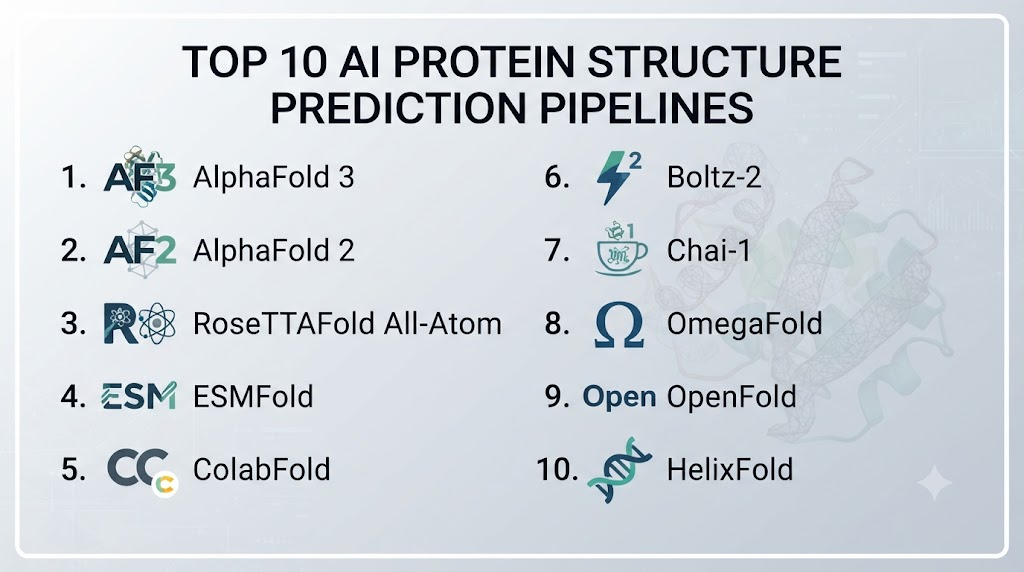
Top 10 AI Protein Structure Prediction Pipelines
1 — AlphaFold
One-line verdict: Best for researchers needing a highly influential AI approach to protein structure prediction and large-scale structural biology.
Short description:
AlphaFold is an AI system developed by Google DeepMind for predicting protein structures. It has become one of the most influential technologies in computational structural biology and has enabled researchers to obtain structural predictions for a very large number of proteins.
Standout Capabilities
- Protein structure prediction.
- Deep-learning-based modeling.
- Large-scale structural analysis.
- Structural confidence estimation.
- Protein-function research.
- Mutation analysis.
- Drug-discovery support.
- Structural biology workflows.
AI-Specific Depth
- Model support: Deep-learning structure-prediction models.
- RAG / knowledge integration: Not a core RAG workflow; biological databases can be incorporated into surrounding pipelines.
- Evaluation: Structural benchmarks and confidence estimation.
- Guardrails: Confidence metrics and structural validation.
- Observability: Prediction confidence and computational metrics can be monitored.
Pros
- Highly influential structural prediction technology.
- Strong research ecosystem.
- Useful for large-scale protein analysis.
Cons
- Prediction confidence can vary significantly by protein region.
- A predicted structure does not automatically prove biological function.
- Complex workflows can require substantial computational expertise.
Security & Compliance
Security depends on deployment and infrastructure. Specific enterprise security controls vary.
Deployment & Platforms
- Cloud: Available through relevant services.
- Self-hosted: Available for applicable implementations.
- Hybrid: Possible.
- Linux: Common for research workflows.
Integrations & Ecosystem
- Protein databases.
- Structural biology tools.
- Molecular visualization.
- Docking workflows.
- Bioinformatics pipelines.
- Drug-discovery platforms.
Pricing Model
Model availability varies by implementation. Exact commercial pricing is Not publicly stated.
Best-Fit Scenarios
- Structural biology research.
- Pharmaceutical discovery.
- Large-scale protein annotation.
2 — AlphaFold 3
One-line verdict: Best for researchers investigating biomolecular complexes involving proteins, nucleic acids, ligands, ions, and other molecular components.
Short description:
AlphaFold 3 extends AI-based structural prediction beyond individual proteins toward broader biomolecular interactions and complexes. This makes it particularly relevant to researchers studying molecular interactions rather than isolated protein structures.
Standout Capabilities
- Biomolecular complex prediction.
- Protein modeling.
- Protein-ligand interaction research.
- Nucleic-acid modeling.
- Molecular interaction analysis.
- Structural hypothesis generation.
- Complex modeling.
- Drug-discovery research.
AI-Specific Depth
- Model support: Deep-learning-based multimolecular structure prediction.
- RAG / knowledge integration: Not a core RAG system.
- Evaluation: Structural benchmarks and model confidence measures.
- Guardrails: Input constraints and confidence assessment.
- Observability: Prediction confidence and computational metrics.
Pros
- Broader molecular scope than protein-only prediction.
- Useful for interaction-focused research.
- Relevant to structure-guided drug discovery.
Cons
- Predictions still require biological validation.
- Access and deployment options vary.
- Complex molecular systems can remain difficult to model reliably.
Security & Compliance
Deployment-specific. Enterprise security requirements should be assessed for the chosen workflow.
Deployment & Platforms
- Cloud: Available through applicable implementations.
- Self-hosted: Availability varies.
- Hybrid: Varies.
Integrations & Ecosystem
- Structural biology.
- Molecular visualization.
- Ligand research.
- Protein databases.
- Drug-discovery workflows.
- Bioinformatics tools.
Pricing Model
Availability and pricing vary by implementation. Exact pricing is Not publicly stated.
Best-Fit Scenarios
- Protein-ligand research.
- Complex structure prediction.
- Drug discovery.
3 — ESMFold
One-line verdict: Best for researchers seeking fast protein structure prediction using protein language-model representations.
Short description:
ESMFold uses protein language modeling to predict protein structures directly from amino-acid sequences. Its architecture provides an alternative to workflows that depend heavily on traditional sequence-alignment pipelines.
Standout Capabilities
- Protein structure prediction.
- Protein language modeling.
- Sequence-based inference.
- Large-scale prediction.
- Computational biology.
- Protein annotation.
- Structural screening.
- Research workflows.
AI-Specific Depth
- Model support: Protein language model-based architecture.
- RAG / knowledge integration: N/A as a core prediction method.
- Evaluation: Structural benchmarks and confidence metrics.
- Guardrails: Model confidence and structural validation.
- Observability: Inference time and confidence metrics.
Pros
- Fast sequence-to-structure workflow.
- Useful for large-scale screening.
- Strong research value.
Cons
- Accuracy varies across proteins.
- Some complex structural problems remain challenging.
- Production deployment requires technical expertise.
Security & Compliance
Deployment-specific. Self-hosted implementations require appropriate organizational security controls.
Deployment & Platforms
- Self-hosted: Yes.
- Cloud: Possible.
- Hybrid: Possible.
- Linux: Common.
Integrations & Ecosystem
- Protein sequences.
- Bioinformatics pipelines.
- Structural visualization.
- Machine-learning frameworks.
- Protein databases.
Pricing Model
Research software/model availability varies. Infrastructure costs depend on deployment.
Best-Fit Scenarios
- Academic research.
- Large-scale protein analysis.
- Developers building structural pipelines.
4 — RoseTTAFold
One-line verdict: Best for researchers using an open research-oriented framework for protein and biomolecular structure prediction.
Short description:
RoseTTAFold is a computational framework for predicting protein structures and studying biomolecular interactions. It has become an important research tool for structural biology and protein-design workflows.
Standout Capabilities
- Protein structure prediction.
- Protein complex modeling.
- Structural biology.
- Protein design research.
- Computational modeling.
- Research customization.
- Molecular analysis.
- Structure-guided discovery.
AI-Specific Depth
- Model support: Deep-learning structural models.
- RAG / knowledge integration: N/A for the core model.
- Evaluation: Structural benchmarking and research validation.
- Guardrails: Structural confidence and scientific review.
- Observability: Model inference and structural metrics.
Pros
- Strong research ecosystem.
- Customizable.
- Useful for protein-design workflows.
Cons
- Requires technical setup.
- Research-oriented.
- Computational requirements vary by workflow.
Security & Compliance
Self-hosted deployment places security responsibilities on the organization.
Deployment & Platforms
- Self-hosted: Yes.
- Cloud: Possible.
- Hybrid: Possible.
- Linux: Common.
Integrations & Ecosystem
- Protein sequences.
- Structural databases.
- Protein-design tools.
- Molecular visualization.
- Machine-learning frameworks.
Pricing Model
Open research software. Infrastructure costs vary.
Best-Fit Scenarios
- Structural biology research.
- Protein engineering.
- Academic computational biology.
5 — ColabFold
One-line verdict: Best for researchers wanting an accessible workflow for running AlphaFold-style structure prediction with simplified computational setup.
Short description:
ColabFold provides a practical interface and workflow around protein structure prediction, making advanced prediction methods easier to use for researchers who may not want to construct an entire computational pipeline from scratch.
Standout Capabilities
- Simplified structure prediction.
- Protein modeling.
- Multiple-sequence alignment workflows.
- Batch prediction.
- Research accessibility.
- Structural visualization.
- Protein-complex workflows.
- Computational biology.
AI-Specific Depth
- Model support: Uses established protein-structure prediction models depending on workflow.
- RAG / knowledge integration: N/A for core structure prediction.
- Evaluation: Confidence scores and structural validation.
- Guardrails: Input checks and confidence assessment.
- Observability: Prediction confidence and runtime metrics.
Pros
- Easier to use than many research pipelines.
- Useful for rapid experimentation.
- Strong academic accessibility.
Cons
- Cloud notebook environments may have resource limitations.
- Not necessarily ideal for enterprise-scale production.
- Advanced customization requires technical expertise.
Security & Compliance
Notebook-based deployments require appropriate handling of sensitive research data.
Deployment & Platforms
- Cloud/notebook: Yes.
- Self-hosted: Possible.
- Hybrid: Possible.
- Web: Notebook-based workflows.
Integrations & Ecosystem
- AlphaFold workflows.
- Protein databases.
- Visualization tools.
- Bioinformatics software.
- Research notebooks.
Pricing Model
Software is generally accessible through research-oriented workflows. Infrastructure costs vary.
Best-Fit Scenarios
- Academic researchers.
- Students and educators.
- Rapid protein-structure experiments.
6 — OpenFold
One-line verdict: Best for developers and researchers building customizable, open implementations of AlphaFold-style protein-structure prediction.
Short description:
OpenFold is an open implementation of protein structure-prediction technology designed for research and computational development. It provides a foundation for teams that want more control over the structure-prediction pipeline.
Standout Capabilities
- Protein structure prediction.
- Open-source development.
- Model training.
- Model inference.
- Research customization.
- Distributed computing.
- Structural benchmarking.
- Computational biology.
AI-Specific Depth
- Model support: Open implementations of protein-structure models.
- RAG / knowledge integration: N/A for the core model.
- Evaluation: Structural benchmarks and confidence measures.
- Guardrails: Model and input validation.
- Observability: Infrastructure and model inference metrics.
Pros
- Strong developer flexibility.
- Suitable for research customization.
- Self-hosting capability.
Cons
- Requires substantial technical expertise.
- GPU resources may be necessary.
- Production operations are the user’s responsibility.
Security & Compliance
Self-hosted organizations control security, access, encryption, retention, and auditing.
Deployment & Platforms
- Self-hosted: Yes.
- Cloud: Yes, through infrastructure.
- Hybrid: Yes.
- Linux: Common.
Integrations & Ecosystem
- PyTorch.
- Protein databases.
- HPC.
- GPU infrastructure.
- Bioinformatics pipelines.
- Structural analysis tools.
Pricing Model
Open-source. Infrastructure costs vary.
Best-Fit Scenarios
- Computational biology developers.
- Research institutions.
- Organizations needing private model execution.
7 — Chai-1
One-line verdict: Best for researchers exploring multimolecular structure prediction across proteins, nucleic acids, and small molecules.
Short description:
Chai-1 is an AI-based biomolecular structure-prediction model designed to model interactions among multiple molecular components. It is relevant to modern structural-biology workflows where understanding complexes is more important than predicting isolated protein structures.
Standout Capabilities
- Multimolecular prediction.
- Protein structure prediction.
- Protein-ligand modeling.
- Nucleic-acid modeling.
- Complex prediction.
- Structure-based research.
- Computational biology.
- Drug-discovery support.
AI-Specific Depth
- Model support: AI-based biomolecular structure models.
- RAG / knowledge integration: N/A as a core structural model.
- Evaluation: Structural benchmarking and confidence metrics.
- Guardrails: Input constraints and structural quality assessment.
- Observability: Inference and confidence metrics.
Pros
- Designed for complex biomolecular systems.
- Relevant to drug-discovery research.
- Modern multimolecular modeling approach.
Cons
- Complex predictions remain difficult.
- Requires computational expertise.
- Research and deployment options vary.
Security & Compliance
Specific enterprise controls depend on deployment.
Deployment & Platforms
- Cloud: Possible.
- Self-hosted: Availability varies.
- Hybrid: Possible.
- Linux: Common for research workflows.
Integrations & Ecosystem
- Protein structures.
- Ligand databases.
- Molecular visualization.
- Computational chemistry.
- Bioinformatics.
Pricing Model
Availability and pricing vary. Exact pricing is Not publicly stated.
Best-Fit Scenarios
- Biomolecular complex research.
- Structure-guided drug discovery.
- Computational structural biology.
8 — Boltz
One-line verdict: Best for open research workflows requiring modern biomolecular structure prediction with broad molecular-component support.
Short description:
Boltz is a family of AI-based biomolecular structure-prediction models designed for research involving proteins and other molecular components. It is relevant to teams looking for modern open approaches to complex structure prediction.
Standout Capabilities
- Biomolecular structure prediction.
- Protein modeling.
- Complex modeling.
- Protein-ligand workflows.
- Open research.
- Structural analysis.
- Computational biology.
- Drug-discovery research.
AI-Specific Depth
- Model support: Modern deep-learning structural models.
- RAG / knowledge integration: N/A for core prediction.
- Evaluation: Structural benchmarks and confidence measures.
- Guardrails: Structural quality checks and scientific validation.
- Observability: Model inference and computational metrics.
Pros
- Modern research-oriented architecture.
- Broad biomolecular scope.
- Suitable for customizable workflows.
Cons
- Requires technical deployment.
- Research performance can vary by molecular system.
- Production support depends on implementation.
Security & Compliance
Self-hosted deployments require organizational security controls.
Deployment & Platforms
- Self-hosted: Yes.
- Cloud: Possible.
- Hybrid: Possible.
- Linux: Common.
Integrations & Ecosystem
- Protein databases.
- Ligand data.
- Molecular visualization.
- GPU infrastructure.
- Computational biology tools.
Pricing Model
Open research software/model availability varies. Infrastructure costs apply to deployment.
Best-Fit Scenarios
- Computational biology research.
- Biomolecular complex prediction.
- AI structural research.
9 — RoseTTAFold All-Atom
One-line verdict: Best for researchers exploring all-atom biomolecular modeling involving proteins, ligands, nucleic acids, and other components.
Short description:
RoseTTAFold All-Atom extends structural prediction toward broader molecular systems. It is relevant to research workflows that require more than isolated protein structure prediction.
Standout Capabilities
- All-atom modeling.
- Protein structures.
- Protein-ligand interactions.
- Nucleic-acid modeling.
- Complex prediction.
- Structure-guided research.
- Computational biology.
- Protein design.
AI-Specific Depth
- Model support: Deep-learning all-atom structural modeling.
- RAG / knowledge integration: N/A for core modeling.
- Evaluation: Structural benchmarks and research validation.
- Guardrails: Molecular constraints and structural quality checks.
- Observability: Inference and confidence metrics.
Pros
- Broad molecular modeling scope.
- Strong research value.
- Useful for complex biological systems.
Cons
- Computationally demanding.
- Requires specialized expertise.
- Prediction quality varies by system.
Security & Compliance
Self-hosted organizations are responsible for security and data governance.
Deployment & Platforms
- Self-hosted: Yes.
- Cloud: Possible.
- Hybrid: Possible.
- Linux: Common.
Integrations & Ecosystem
- Protein structures.
- Chemical databases.
- Nucleic-acid data.
- Molecular visualization.
- GPU infrastructure.
Pricing Model
Open research software. Infrastructure costs vary.
Best-Fit Scenarios
- Structural biology.
- Protein-ligand research.
- Protein engineering.
10 — Custom AI Protein Structure Prediction Pipeline
One-line verdict: Best for organizations requiring proprietary structural prediction workflows across specialized proteins, complexes, and research datasets.
Short description:
Large pharmaceutical, biotechnology, and research organizations can build custom structure-prediction pipelines around open models, proprietary data, experimental structures, specialized protein families, and downstream structural-analysis tools.
A custom pipeline can combine sequence analysis, structure prediction, confidence scoring, ensemble generation, docking, molecular dynamics, and experimental feedback.
Standout Capabilities
- High-throughput prediction.
- Protein-complex modeling.
- Specialized model fine-tuning.
- Structure validation.
- Confidence analysis.
- Mutation analysis.
- Docking integration.
- Automated structural workflows.
AI-Specific Depth
- Model support: Open-source, hosted, proprietary, or internally trained models.
- RAG / knowledge integration: Protein databases, structural databases, internal experiments, scientific literature, and organization-specific annotations.
- Evaluation: Structural benchmarks, experimental structures, confidence calibration, mutation datasets, and prospective validation.
- Guardrails: Input validation, confidence thresholds, structural quality checks, and human review.
- Observability: GPU usage, prediction latency, confidence distributions, model drift, failed predictions, and pipeline cost.
Pros
- Maximum customization.
- Can integrate proprietary structural data.
- Suitable for high-throughput research.
Cons
- High engineering requirements.
- GPU infrastructure can be expensive.
- Requires structural-biology expertise.
Security & Compliance
The organization controls the architecture and is responsible for access control, encryption, retention, auditability, intellectual-property protection, and research governance.
Deployment & Platforms
- Cloud: Possible.
- Self-hosted: Possible.
- Hybrid: Possible.
- Linux: Common.
- API: Possible.
Integrations & Ecosystem
Potential integrations include:
- Protein sequence databases.
- Structural databases.
- LIMS.
- ELN systems.
- Molecular visualization.
- Docking tools.
- Molecular-dynamics platforms.
Pricing Model
Development and infrastructure costs vary significantly. Exact pricing is N/A.
Best-Fit Scenarios
- Pharmaceutical structural-biology teams.
- Advanced biotechnology organizations.
- Large-scale protein research.
Comparison Table
| Tool | Best For | Deployment | Model Flexibility | Strength | Watch-Out | Public Rating |
|---|---|---|---|---|---|---|
| AlphaFold | Protein structure prediction | Cloud / Self-hosted / Hybrid | Deep learning | Highly established structure prediction | Confidence varies by region | |
| AlphaFold 3 | Biomolecular complexes | Cloud / Varies | Deep learning | Multicomponent modeling | Complex access/deployment | |
| ESMFold | Fast sequence-based prediction | Self-hosted / Cloud | Protein language model | Speed and scale | Complex cases remain difficult | |
| RoseTTAFold | Structural research | Self-hosted / Cloud | Open research | Flexible research framework | Technical setup | |
| ColabFold | Accessible structure prediction | Cloud / Self-hosted | Model-based | Ease of use | Resource limitations | |
| OpenFold | Developers and researchers | Self-hosted / Cloud | Open-source | Customization | GPU expertise required | |
| Chai-1 | Multimolecular structures | Cloud / Self-hosted varies | Deep learning | Broad molecular scope | Research-oriented | |
| Boltz | Open biomolecular modeling | Self-hosted / Cloud | Open research | Modern complex modeling | Deployment complexity | |
| RoseTTAFold All-Atom | All-atom research | Self-hosted / Cloud | Open research | Broad molecular modeling | Computational demand | |
| Custom Pipeline | Specialized enterprise research | Cloud / Self-hosted / Hybrid | Multi-model | Maximum control | High development burden |
Scoring & Evaluation
These scores are comparative editorial assessments rather than independent structural-biology benchmarks.
Protein-structure prediction quality varies according to protein family, flexibility, disorder, complex composition, ligand context, and the quality of available biological information.
| Tool | Core Features | AI Reliability | Structure Depth | Integrations | Ease | Performance/Cost | Security/Admin | Support | Weighted Total |
|---|---|---|---|---|---|---|---|---|---|
| AlphaFold | 10 | 10 | 10 | 10 | 8 | 9 | 8 | 10 | 9.45 |
| AlphaFold 3 | 10 | 10 | 10 | 10 | 7 | 8 | 8 | 10 | 9.25 |
| ESMFold | 9 | 9 | 9 | 9 | 8 | 10 | 7 | 9 | 8.95 |
| RoseTTAFold | 9 | 9 | 9 | 9 | 7 | 9 | 7 | 9 | 8.70 |
| ColabFold | 9 | 9 | 9 | 9 | 10 | 9 | 7 | 9 | 9.00 |
| OpenFold | 9 | 9 | 9 | 9 | 6 | 9 | 8 | 9 | 8.55 |
| Chai-1 | 9 | 9 | 10 | 9 | 7 | 8 | 7 | 8 | 8.55 |
| Boltz | 9 | 9 | 10 | 9 | 7 | 9 | 7 | 8 | 8.70 |
| RoseTTAFold All-Atom | 9 | 9 | 10 | 9 | 6 | 8 | 7 | 9 | 8.50 |
| Custom Pipeline | 10 | 10 | 10 | 10 | 5 | 7 | 10 | 10 | 9.35 |
Top 3 for Enterprise
- AlphaFold — Strong foundation for large-scale structural biology.
- AlphaFold 3 — Particularly relevant for broader biomolecular interaction modeling.
- Custom AI Pipeline — Best when proprietary structural datasets and specialized workflows justify custom development.
Top 3 for SMB
- ColabFold — Accessible for smaller research teams.
- ESMFold — Useful for fast sequence-based prediction workflows.
- OpenFold — Suitable for technically capable teams seeking greater control.
Top 3 for Developers
- OpenFold — Strong customization and development potential.
- ESMFold — Useful for building sequence-to-structure pipelines.
- Boltz — Relevant for modern open biomolecular modeling workflows.
Which AI Protein Structure Prediction Pipeline Is Right for You?
Solo / Individual Researcher
Individual researchers generally benefit from accessible research workflows.
A practical toolkit may include:
- ColabFold.
- ESMFold.
- Open structural databases.
- Molecular visualization software.
- Basic structural-analysis tools.
The priority should be understanding confidence metrics and structural limitations.
SMB Biotech
Small biotech teams should prioritize ease of deployment.
Look for:
- Simple sequence input.
- Batch prediction.
- Confidence reporting.
- Exportable structures.
- API access.
- Integration with downstream analysis.
- Reasonable computational requirements.
Mid-Market Biotech
Mid-sized biotech companies may need:
- High-throughput prediction.
- Complex modeling.
- Mutation analysis.
- Protein-ligand workflows.
- Structural visualization.
- Automated quality control.
- Integration with drug-discovery pipelines.
Enterprise Pharmaceutical Company
Large pharmaceutical companies should evaluate structure prediction as part of a broader computational discovery platform.
Important capabilities include:
- High-throughput prediction.
- Protein complexes.
- Protein-ligand modeling.
- Structural confidence.
- Mutation analysis.
- Docking.
- Molecular dynamics.
- Experimental structure integration.
- Data governance.
Structural Biology Research
Research teams should prioritize:
- Prediction accuracy.
- Confidence calibration.
- Flexible/disordered region handling.
- Complex modeling.
- Experimental comparison.
- Structural visualization.
- Reproducibility.
Drug Discovery
Drug-discovery teams should look beyond isolated protein structures.
Important capabilities include:
- Binding-site identification.
- Protein-ligand modeling.
- Complex prediction.
- Docking.
- Molecular dynamics.
- Structural uncertainty.
- Experimental validation.
Protein Engineering
Protein-engineering teams should evaluate:
- Mutation analysis.
- Structural stability.
- Sequence-structure relationships.
- Protein design integration.
- Experimental feedback.
Academic Research
Academic teams often benefit from open research implementations.
Priorities include:
- Reproducibility.
- Open models.
- Customization.
- Accessible datasets.
- Benchmarking.
- Transparent methodology.
Regulated Pharmaceutical Research
Organizations should establish:
- Data governance.
- Access controls.
- Model versioning.
- Structural provenance.
- Auditability.
- Intellectual-property protection.
- Validation procedures.
Implementation Playbook
First 30 Days: Establish the Structural Workflow
Define:
- Protein families.
- Sequence sources.
- Expected structures.
- Complex types.
- Desired output.
- Confidence requirements.
- Downstream applications.
Create a representative benchmark containing proteins with known experimental structures.
Days 31–60: Benchmark Models
Compare models using:
- Structural accuracy.
- Confidence calibration.
- Runtime.
- GPU requirements.
- Complex prediction quality.
- Disordered-region behavior.
- Mutation sensitivity.
- Reproducibility.
Avoid evaluating models using only easy proteins.
Include difficult and representative examples.
Days 61–90: Integrate Downstream Workflows
Connect predictions to:
- Molecular visualization.
- Docking.
- Molecular dynamics.
- Protein design.
- Mutation analysis.
- Drug-discovery workflows.
Add automated quality controls.
A mature workflow should look like:
Sequence → prediction → confidence analysis → structural validation → downstream analysis → experimental validation
Common Mistakes and How to Avoid Them
- Treating a prediction as experimental truth: Predictions remain models.
- Ignoring confidence scores: Low-confidence regions require additional caution.
- Assuming every residue is equally reliable: Flexible and disordered regions can be difficult.
- Ignoring protein dynamics: A single predicted structure may not represent all relevant conformations.
- Assuming accurate structure means accurate function: Structure alone does not establish biological function.
- Using predictions without validation: Important findings should be compared with experimental evidence where appropriate.
- Ignoring complex stoichiometry: Protein complexes require correct biological context.
- Assuming docking proves binding: Docking is computational evidence, not experimental confirmation.
- Ignoring ligand context: Protein structures may change in the presence of ligands.
- Skipping benchmark design: Use representative proteins rather than cherry-picked examples.
- Ignoring compute requirements: Large-scale predictions can require substantial GPU resources.
- Failing to version models: Different model versions can produce different predictions.
- Ignoring data provenance: Track sequence versions, model versions, and prediction settings.
- Overinterpreting low-confidence regions: Use appropriate caution in flexible or poorly supported areas.
- Ignoring experimental structures: Available experimental data can provide valuable validation.
- Failing to monitor pipeline failures: Large-scale workflows need automated quality checks.
FAQs
What is AI Protein Structure Prediction?
It is the use of artificial intelligence and machine learning to predict the three-dimensional structure of proteins from sequence and related biological information.
What is AlphaFold?
AlphaFold is an AI-based protein-structure prediction system developed by Google DeepMind and is one of the most influential tools in modern structural biology.
What is AlphaFold 3?
AlphaFold 3 extends AI-based structural prediction toward broader biomolecular complexes, including proteins and other molecular components.
Is AlphaFold always accurate?
No. Accuracy varies by protein and region. Confidence metrics are important when interpreting predicted structures.
What is ESMFold?
ESMFold is a protein-structure prediction approach based on protein language modeling that can predict structures directly from amino-acid sequences.
What is ColabFold?
ColabFold is a practical workflow that makes advanced protein-structure prediction more accessible through simplified computational interfaces.
Is RoseTTAFold open source?
RoseTTAFold has open research implementations and is widely used in computational structural-biology research.
Can AI predict protein complexes?
Yes. Modern systems can model protein complexes and, in some cases, broader biomolecular assemblies.
Can AI predict protein-ligand structures?
Some modern structure-prediction systems can model protein-ligand interactions, while other tools specialize in docking or related computational tasks.
Can predicted structures be used for drug discovery?
Yes. Predicted structures can support binding-site analysis, docking, virtual screening, and structure-guided drug design, provided uncertainty is considered.
Can AI predict protein function?
Structure can provide clues about function, but structure prediction itself does not establish biological function.
Can AI predict mutation effects?
Some computational systems can analyze how mutations may influence protein structure or stability, but predictions require appropriate validation.
Can protein structure prediction replace experimental structural biology?
No. Experimental methods remain important for validating structures and studying biological states that computational models may not capture.
What is a confidence score in protein prediction?
Confidence scores estimate how reliable a predicted structure or region is. They should be considered when deciding whether a structural interpretation is appropriate.
Why are some protein regions difficult to predict?
Flexible, intrinsically disordered, poorly conserved, or context-dependent regions can be more difficult for structure-prediction models.
Can AI predict protein dynamics?
Some approaches can generate multiple structural states or provide information related to conformational variation, but predicting full biological dynamics remains challenging.
Can these tools run locally?
Several open research implementations can be self-hosted, although GPU requirements and installation complexity vary.
Can protein structure prediction be used with proprietary sequences?
Yes, self-hosted workflows can be particularly useful when organizations need to keep proprietary sequences within controlled infrastructure.
Should pharmaceutical companies use cloud or self-hosted prediction?
The choice depends on data sensitivity, computational requirements, infrastructure expertise, cost, and governance requirements.
How should structure-prediction pipelines be evaluated?
Use representative proteins with known structures and evaluate structural accuracy, confidence calibration, runtime, complex performance, reproducibility, and downstream usefulness.
What are the biggest risks of AI structure prediction?
Major risks include overconfidence, misinterpreting low-confidence regions, assuming static structures represent biological reality, incorrect complex modeling, and treating computational predictions as experimental evidence.
Which AI Protein Structure Prediction pipeline is best?
There is no universal winner. AlphaFold remains highly influential for protein structure prediction, AlphaFold 3 is particularly relevant to broader biomolecular complexes, ESMFold offers fast sequence-based prediction, ColabFold improves accessibility, and open systems such as OpenFold, RoseTTAFold, and Boltz provide flexibility for research and custom development.
Conclusion
AI Protein Structure Prediction pipelines have transformed structural biology by making large-scale structural hypotheses accessible from protein sequences and related biological information.The technology is particularly valuable because it allows researchers to explore proteins that may lack experimentally determined structures. Modern systems are also moving beyond isolated proteins toward complexes involving multiple molecular components.AlphaFold, AlphaFold 3, ESMFold, RoseTTAFold, ColabFold, OpenFold, Chai-1, Boltz, and RoseTTAFold All-Atom represent different approaches to this rapidly developing field. Custom pipelines can provide additional flexibility for pharmaceutical and biotechnology organizations with proprietary datasets and specialized requirements.