Introduction
AI Medication Adherence Prediction tools use artificial intelligence, machine learning, behavioral analytics, patient-generated data, medication records, refill information, and digital engagement signals to identify patients or clinical-trial participants who may be at risk of missing medications. Instead of waiting until a patient has repeatedly missed doses, predictive systems aim to identify risk earlier so healthcare teams, researchers, pharmacists, or life-science organizations can provide timely support.
Medication non-adherence is a complex problem. Patients may miss medicines because of cost, side effects, forgetfulness, complicated treatment schedules, limited health literacy, transportation problems, behavioral factors, or difficulties accessing care. Machine-learning research increasingly explores how demographic, clinical, behavioral, refill, and social factors can be combined to estimate adherence risk. A recent scoping review found that machine-learning approaches for medication non-adherence prediction are increasingly being studied, while emphasizing the importance of actionable predictors and appropriate model evaluation. Real-world applications include identifying patients likely to miss chronic medications, supporting pharmacy outreach, improving clinical-trial adherence, predicting treatment disengagement, triggering personalized reminders, supporting remote monitoring, and prioritizing patients for intervention.The most important evaluation criteria include predictive performance, clinical validation, explainability, data quality, interoperability, privacy, workflow integration, intervention capabilities, patient engagement, bias monitoring, security, scalability, and total cost.
What Is AI Medication Adherence Prediction?
AI medication adherence prediction refers to using computational models to estimate the likelihood that a patient or study participant will follow a prescribed medication regimen.
Traditional adherence monitoring often looks backward. For example, a pharmacy may examine refill gaps after they occur. A predictive system attempts to look forward by identifying signals associated with future non-adherence.
Depending on the platform, inputs can include:
- Prescription and medication history.
- Refill behavior.
- Missed-dose records.
- Medication schedules.
- Patient-reported information.
- Digital engagement.
- Symptoms and treatment experiences.
- Demographic information.
- Clinical information.
- Appointment history.
- Device-generated adherence information.
- Smartphone interactions.
- Behavioral patterns.
- Clinical-trial participation data.
The prediction itself should generally be treated as a decision-support signal rather than a diagnosis. A patient classified as high risk may have perfectly valid reasons for changing or delaying treatment, and healthcare professionals should consider the patient’s circumstances before taking action.
Why AI Medication Adherence Prediction Matters
Medication adherence is particularly difficult in chronic disease because treatment often continues for months or years. Even when patients understand their treatment, practical barriers can make consistent medication use difficult.
Predictive analytics can help organizations shift from reactive monitoring to proactive intervention.
For example, instead of contacting every patient with the same reminder, a healthcare organization could prioritize patients whose recent behavior suggests elevated adherence risk. An intervention could then be personalized according to the reason for the risk.
Research is also moving toward interpretable models. A recent study using hypertension data developed an XGBoost model and used SHAP analysis to identify factors contributing to adherence predictions, illustrating how explainability can make predictive outputs more useful for decision support.
In clinical trials, the problem is especially important because missed doses can affect treatment exposure, study data quality, participant retention, and operational planning. AiCure, for example, combines computer vision, dosing verification, behavioral data, and predictive analytics to monitor adherence in clinical research.
Key Use Cases
Chronic Disease Management
Predict patients who may struggle to maintain medication routines for conditions such as hypertension, diabetes, cardiovascular disease, respiratory disease, or other chronic conditions.
Pharmacy Outreach
Pharmacists can use adherence-risk signals to prioritize medication counseling and outreach.
Clinical Trials
Sponsors and research organizations can identify participants who may be at increased risk of non-adherence or study dropout.
Specialty Medications
Complex treatment regimens may require additional education, reminders, financial support, or patient engagement.
Remote Patient Monitoring
Adherence signals can be combined with remote monitoring data to provide a broader picture of patient engagement.
Population Health
Healthcare organizations can use predictive analytics to segment populations and allocate limited intervention resources.
Patient Support Programs
Pharmaceutical companies can use adherence-risk insights to determine when patients may benefit from reminders, education, coaching, or other support.
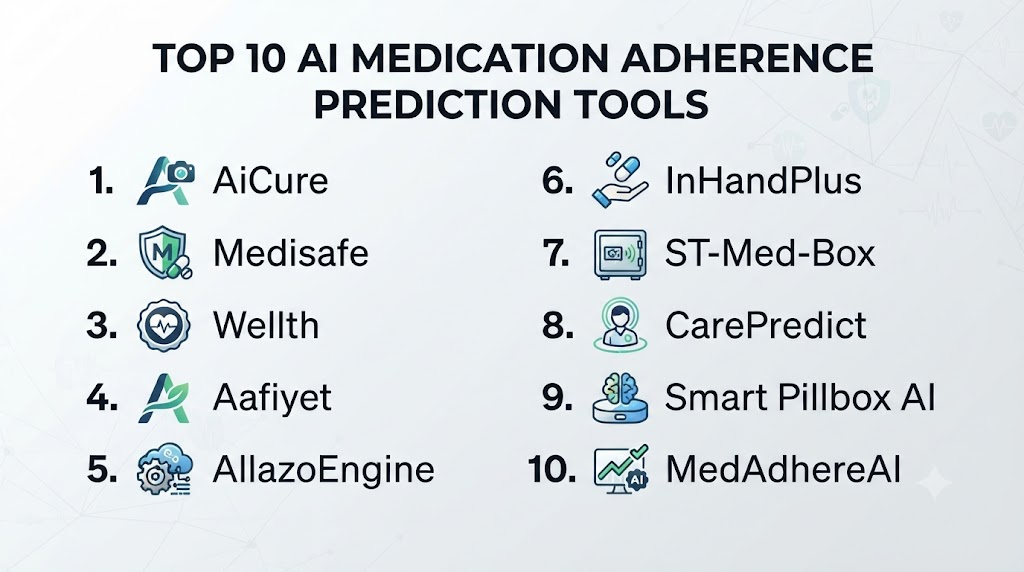
Top 10 AI Medication Adherence Prediction Tools
1 — Medisafe
One-line verdict: Best for pharmaceutical patient-support programs combining predictive adherence analytics with personalized digital engagement.
Short description:
Medisafe provides a medication-management and patient-engagement platform that combines behavioral science, predictive AI, personalized digital experiences, reminders, education, and intervention workflows. Its JITI predictive engine is designed to identify non-adherence risk from behavioral signals and trigger timely interventions.
Standout Capabilities
- Predictive non-adherence risk scoring.
- Just-in-time intervention workflows.
- Personalized medication reminders.
- Therapy-specific patient experiences.
- Patient education.
- Caregiver coordination.
- Progress tracking.
- Multichannel engagement.
AI-Specific Depth
- Model support: Proprietary predictive AI and machine-learning capabilities.
- RAG / knowledge integration: Therapy and patient-engagement information can be integrated; specific vector-database compatibility is not publicly stated.
- Evaluation: Predictive and behavioral analytics are supported; exact model-evaluation methodology is not publicly stated.
- Guardrails: Configurable intervention rules and enterprise controls are available; detailed generative-AI guardrail architecture is not publicly stated.
- Observability: Real-time analytics and cohort tracking are available; detailed model-level observability is not publicly stated.
Pros
- Strong combination of prediction and intervention.
- Designed around medication adherence and patient engagement.
- Suitable for pharmaceutical and enterprise programs.
Cons
- Primarily enterprise and healthcare oriented.
- Exact pricing is not publicly stated.
- Some capabilities are designed for broader patient-engagement programs rather than prediction alone.
Security & Compliance
Enterprise SSO, audit logging, and compliance tools are described for the platform. Exact encryption, retention, residency, and certification requirements should be verified for the specific deployment.
Deployment & Platforms
- Web: Yes.
- Mobile: Yes.
- Cloud: Yes.
- Self-hosted: Not publicly stated.
- Hybrid: Varies / N/A.
Integrations & Ecosystem
Medisafe is designed to integrate medication management with patient-engagement workflows.
- Medication schedules.
- Patient engagement.
- Digital therapeutics workflows.
- Caregiver interactions.
- Web and mobile experiences.
- Analytics dashboards.
- Enterprise patient-support programs.
Pricing Model
Enterprise/custom pricing. Exact pricing is Not publicly stated.
Best-Fit Scenarios
- Pharmaceutical patient-support programs.
- Chronic medication adherence initiatives.
- Personalized patient-engagement programs.
2 — AiCure H.Code
One-line verdict: Best for clinical trials requiring AI-powered medication-dosing verification and adherence-risk prediction.
Short description:
AiCure’s H.Code platform is designed for clinical trials and patient engagement. It combines smartphone-based computer vision, dosing verification, behavioral analytics, predictive analytics, and patient communication to help clinical teams understand adherence and identify participants who may require support. (AiCure)
Standout Capabilities
- AI-powered dosing verification.
- Smartphone computer vision.
- Predictive adherence analytics.
- Participant engagement.
- Digital biomarkers.
- Real-time dosing support.
- Clinical-site dashboards.
- Trial-retention insights.
AI-Specific Depth
- Model support: Proprietary computer vision and machine-learning capabilities.
- RAG / knowledge integration: Clinical-trial and patient information integration; vector-database support is not publicly stated.
- Evaluation: Predictive analytics and clinical-trial model development tools are available.
- Guardrails: Clinical workflows and controlled patient interactions are supported; detailed generative-AI guardrails are not publicly stated.
- Observability: Adherence dashboards and behavioral analytics are available.
Pros
- Strong focus on objective adherence verification.
- Particularly suitable for clinical trials.
- Combines adherence measurement with predictive analytics.
Cons
- More specialized toward life sciences and clinical research.
- Smartphone-based workflows may not suit every patient population.
- Enterprise pricing is not publicly stated.
Security & Compliance
AiCure states that its platform supports protected health information security and describes HIPAA, GDPR, and 21 CFR Part 11-related compliance capabilities for relevant H.Code environments. Specific contractual scope and deployment configuration should still be verified. (AiCure)
Deployment & Platforms
- Mobile: Yes.
- Web dashboards: Yes.
- Cloud: Available.
- Self-hosted: Not publicly stated.
- Hybrid: Varies / N/A.
Integrations & Ecosystem
AiCure is designed around clinical-trial and patient-engagement workflows.
- Smartphone applications.
- Clinical-site dashboards.
- ePRO.
- Secure communications.
- Clinical workflows.
- Patient data.
- Digital biomarker analytics.
Pricing Model
Enterprise/custom pricing. Exact pricing is Not publicly stated.
Best-Fit Scenarios
- Phase I–IV clinical trials.
- Decentralized clinical trials.
- Studies where objective medication ingestion verification is important.
3 — Adherium
One-line verdict: Best for connected medication monitoring where device-generated adherence data can support predictive intervention programs.
Short description:
Adherium focuses on connected medication-management technologies, particularly respiratory medication adherence. Its digital-health approach can generate objective medication-use information that can be used alongside analytics and clinical workflows.
Standout Capabilities
- Connected medication monitoring.
- Inhaler-use tracking.
- Digital adherence information.
- Patient engagement.
- Medication-use analytics.
- Remote monitoring.
- Healthcare workflow integration.
- Respiratory-care focus.
AI-Specific Depth
- Model support: Analytics and digital-health capabilities; specific predictive AI architecture is Not publicly stated.
- RAG / knowledge integration: Healthcare integration capabilities vary.
- Evaluation: Product-specific clinical validation should be verified for each use case.
- Guardrails: Not publicly stated for generative AI.
- Observability: Device and adherence analytics are available; detailed AI observability is Not publicly stated.
Pros
- Objective medication-use data.
- Strong respiratory-health specialization.
- Useful foundation for remote adherence programs.
Cons
- More device-focused than general-purpose medication prediction.
- Primarily relevant to specific medication-delivery environments.
- AI prediction capabilities should be verified for the specific product.
Security & Compliance
Security and regulatory details vary by product and deployment. Specific certifications and data-retention policies should be verified directly.
Deployment & Platforms
- Connected devices: Yes.
- Mobile: Applicable.
- Web/cloud: Varies.
- Self-hosted: Not publicly stated.
Integrations & Ecosystem
Potential ecosystem components include:
- Connected medication devices.
- Mobile applications.
- Patient monitoring.
- Clinical systems.
- Adherence analytics.
- Remote-care workflows.
Pricing Model
Enterprise/custom pricing. Exact pricing is Not publicly stated.
Best-Fit Scenarios
- Respiratory medication programs.
- Connected inhaler initiatives.
- Remote medication monitoring.
4 — Wellth
One-line verdict: Best for payer and population-health programs combining behavioral engagement with adherence-focused interventions.
Short description:
Wellth focuses on digital health engagement and behavioral interventions designed to help patients follow care plans and treatment recommendations. Its approach is particularly relevant to organizations interested in combining patient engagement, behavioral signals, and intervention workflows.
Standout Capabilities
- Digital patient engagement.
- Behavioral interventions.
- Medication adherence support.
- Personalized outreach.
- Patient reminders.
- Population-health workflows.
- Engagement analytics.
- Health-plan applications.
AI-Specific Depth
- Model support: Predictive and behavioral analytics; exact model architecture is not publicly stated.
- RAG / knowledge integration: Healthcare workflow integration varies.
- Evaluation: Program-level outcome measurement is emphasized; detailed AI evaluation methodology is not publicly stated.
- Guardrails: Patient-engagement controls are used; detailed generative-AI guardrails are not publicly stated.
- Observability: Engagement and adherence metrics are available; model-level observability is not publicly stated.
Pros
- Strong behavioral-health orientation.
- Suitable for population-health programs.
- Focuses on intervention rather than prediction alone.
Cons
- Not a pure medication-adherence prediction platform.
- Exact AI architecture is not publicly stated.
- Availability depends on healthcare-program deployment.
Security & Compliance
Security, privacy, identity, and certification details should be verified for the specific deployment.
Deployment & Platforms
- Mobile: Yes.
- Web: Varies.
- Cloud: Yes / varies.
- Self-hosted: Not publicly stated.
Integrations & Ecosystem
Typical ecosystem components include:
- Health-plan systems.
- Patient engagement.
- Medication information.
- Behavioral data.
- Outreach workflows.
- Population-health analytics.
Pricing Model
Enterprise/custom pricing. Exact pricing is Not publicly stated.
Best-Fit Scenarios
- Health plans.
- Population-health programs.
- Chronic-care engagement initiatives.
5 — S3 Connected Health
One-line verdict: Best for healthcare organizations developing connected-care programs that incorporate adherence and patient-behavior analytics.
Short description:
S3 Connected Health develops digital-health and remote-care solutions designed to support chronic disease management, patient engagement, and connected care. Its relevance to medication adherence comes from integrating patient behavior and remote monitoring into broader care-management workflows.
Standout Capabilities
- Digital health platforms.
- Remote patient monitoring.
- Patient engagement.
- Chronic-care support.
- Connected devices.
- Behavioral data.
- Clinical workflows.
- Personalized care programs.
AI-Specific Depth
- Model support: AI and analytics capabilities vary by solution.
- RAG / knowledge integration: Integration depends on the deployed digital-health program.
- Evaluation: Program-specific evaluation varies.
- Guardrails: Healthcare workflow controls; generative-AI guardrails are Not publicly stated.
- Observability: Program analytics are available; detailed model observability varies.
Pros
- Broad connected-health expertise.
- Suitable for complex healthcare workflows.
- Can combine multiple sources of patient information.
Cons
- Not exclusively focused on medication adherence.
- Solutions are often customized.
- Exact AI functionality varies by project.
Security & Compliance
Security and compliance should be assessed for the specific implementation and geographic market.
Deployment & Platforms
- Web: Yes / varies.
- Mobile: Yes / varies.
- Cloud: Available.
- Self-hosted: Varies / N/A.
Integrations & Ecosystem
Potential integrations include:
- Electronic health records.
- Connected devices.
- Patient applications.
- Remote monitoring.
- Clinical workflows.
- Healthcare analytics.
Pricing Model
Custom enterprise pricing. Exact pricing is Not publicly stated.
Best-Fit Scenarios
- Chronic-care programs.
- Remote patient monitoring.
- Large-scale connected-health initiatives.
6 — MedAdvisor
One-line verdict: Best for pharmacy-centered medication management, adherence support, and patient communication.
Short description:
MedAdvisor provides medication-management technology designed to help patients understand, organize, and manage their medicines while supporting pharmacies and healthcare organizations. Its relevance to predictive adherence comes from combining medication information, patient engagement, and adherence-related workflows.
Standout Capabilities
- Medication management.
- Patient medication information.
- Pharmacy engagement.
- Medication reminders.
- Digital communication.
- Prescription information.
- Adherence support.
- Medication reconciliation.
AI-Specific Depth
- Model support: Specific predictive AI architecture is Not publicly stated.
- RAG / knowledge integration: Medication and pharmacy information integration is central.
- Evaluation: Exact predictive-model evaluation is Not publicly stated.
- Guardrails: Medication and healthcare workflows require controlled information handling; generative-AI guardrails are not publicly stated.
- Observability: Medication-management analytics vary by implementation.
Pros
- Strong pharmacy orientation.
- Useful medication-management workflows.
- Patient communication is an important component.
Cons
- Not exclusively an AI prediction platform.
- Advanced predictive capabilities vary.
- Deployment depends on market and healthcare ecosystem.
Security & Compliance
Specific security and compliance controls should be verified for the selected product and geography.
Deployment & Platforms
- Mobile: Yes / applicable.
- Web: Yes / applicable.
- Cloud: Available / varies.
- Self-hosted: Not publicly stated.
Integrations & Ecosystem
Potential ecosystem components include:
- Pharmacy systems.
- Medication records.
- Prescription information.
- Patient applications.
- Healthcare communication.
- Medication-management workflows.
Pricing Model
Pricing varies by deployment and customer type. Exact pricing is Not publicly stated.
Best-Fit Scenarios
- Pharmacy networks.
- Medication-management programs.
- Patient medication-support initiatives.
7 — RxAnte
One-line verdict: Best for healthcare organizations using predictive analytics to identify medication-related risk across populations.
Short description:
RxAnte focuses on medication-management analytics and healthcare interventions. Its platform approach is relevant to organizations seeking to identify medication-related risks and improve adherence through targeted programs.
Standout Capabilities
- Medication-risk analytics.
- Population-level analysis.
- Patient segmentation.
- Medication adherence programs.
- Risk identification.
- Targeted interventions.
- Healthcare analytics.
- Outcome measurement.
AI-Specific Depth
- Model support: Proprietary predictive analytics; exact model architecture is not publicly stated.
- RAG / knowledge integration: Healthcare and medication data integration varies.
- Evaluation: Program and outcome evaluation capabilities are relevant; exact AI evaluation methodology is not publicly stated.
- Guardrails: Healthcare workflow controls; generative-AI guardrails are not publicly stated.
- Observability: Population-level analytics are available; model-level monitoring varies.
Pros
- Strong medication-management orientation.
- Useful for population-level risk stratification.
- Focuses on measurable healthcare outcomes.
Cons
- Primarily enterprise healthcare.
- Exact predictive model details are not publicly stated.
- Implementation can require substantial healthcare-data integration.
Security & Compliance
Healthcare data security requirements should be assessed according to the implementation. Specific certifications and retention controls should be verified during procurement.
Deployment & Platforms
- Cloud: Yes / varies.
- Web: Yes.
- Self-hosted: Not publicly stated.
- Hybrid: Varies / N/A.
Integrations & Ecosystem
Potential integration areas include:
- Pharmacy claims.
- Medical claims.
- Medication data.
- Population-health platforms.
- Patient engagement.
- Healthcare analytics.
Pricing Model
Enterprise/custom pricing. Exact pricing is Not publicly stated.
Best-Fit Scenarios
- Health plans.
- Population-health organizations.
- Medication-risk management programs.
8 — AiCure Patient Connect
One-line verdict: Best for organizations needing smartphone-based medication adherence verification and intervention support.
Short description:
AiCure Patient Connect provides a smartphone application for medication-dosing support and adherence monitoring. It uses computer vision to help verify medication administration and provides clinical teams with information that can support timely intervention. (AiCure)
Standout Capabilities
- Smartphone dosing support.
- Computer-vision verification.
- Real-time adherence information.
- Medication reminders.
- Multi-medication support.
- Secure patient communications.
- ePRO capabilities.
- Predictive adherence analytics.
AI-Specific Depth
- Model support: Computer vision and machine-learning capabilities.
- RAG / knowledge integration: Patient and clinical-trial data integration; vector-database support is not publicly stated.
- Evaluation: Adherence and predictive analytics can be evaluated through clinical-trial workflows.
- Guardrails: Controlled dosing workflows and human oversight.
- Observability: Adherence dashboards and dose-level monitoring.
Pros
- Objective dosing information.
- Real-time adherence monitoring.
- Strong clinical-trial use case.
Cons
- Smartphone participation is required for many workflows.
- More specialized than general medication-management software.
- Enterprise pricing is not public.
Security & Compliance
AiCure describes PHI security and compliance capabilities for its platform. Exact requirements should be confirmed for each implementation. (AiCure)
Deployment & Platforms
- Mobile: Yes.
- Web dashboard: Yes.
- Cloud: Available.
- Self-hosted: Not publicly stated.
Integrations & Ecosystem
- Clinical-trial systems.
- ePRO.
- Secure communication.
- Patient engagement.
- Clinical-site workflows.
- Medication data.
Pricing Model
Enterprise/custom pricing. Exact pricing is Not publicly stated.
Best-Fit Scenarios
- Clinical research.
- Decentralized trials.
- Medication-adherence programs requiring objective dose verification.
9 — Medisafe Digital Drug Companion
One-line verdict: Best for therapy-specific adherence programs requiring personalized patient experiences and predictive intervention.
Short description:
Medisafe’s Digital Drug Companion provides therapy-specific digital experiences designed around medication reminders, education, symptom management, caregiver support, and engagement. Its broader platform can connect these experiences to predictive risk scoring and just-in-time intervention. (Medisafe)
Standout Capabilities
- Therapy-specific patient experiences.
- Medication reminders.
- Side-effect education.
- Patient progress tracking.
- Caregiver coordination.
- Personalized engagement.
- Multichannel communication.
- Predictive intervention.
AI-Specific Depth
- Model support: Proprietary predictive AI.
- RAG / knowledge integration: Therapy-specific information and patient context; specific vector-database support is not publicly stated.
- Evaluation: Engagement and predictive analytics available; exact model-validation methodology is not publicly stated.
- Guardrails: Configurable intervention rules and enterprise administration.
- Observability: Analytics dashboards and cohort tracking.
Pros
- Highly patient-centered.
- Strong personalization.
- Combines adherence prediction with intervention.
Cons
- Best suited to enterprise patient-support programs.
- Not designed as a standalone clinical prediction model.
- Pricing is not publicly stated.
Security & Compliance
Enterprise SSO, audit logging, and compliance tools are described at the platform level. Exact security configuration should be validated for the selected deployment.
Deployment & Platforms
- Mobile: Yes.
- Web: Yes.
- Cloud: Yes.
- Self-hosted: Not publicly stated.
Integrations & Ecosystem
- Medication schedules.
- Patient applications.
- Caregiver support.
- Engagement analytics.
- Digital education.
- Patient-support programs.
Pricing Model
Enterprise/custom pricing. Exact pricing is Not publicly stated.
Best-Fit Scenarios
- Branded pharmaceutical patient programs.
- Specialty medications.
- Long-term chronic therapies.
10 — Predictive Medication Adherence Models Built on EHR and Claims Data
One-line verdict: Best for health systems and analytics teams that need customized adherence-risk prediction inside existing data infrastructure.
Short description:
Not every adherence-prediction capability is packaged as a commercial product. Healthcare organizations can build predictive models using EHR, pharmacy claims, refill history, appointment data, clinical information, and patient-level behavioral signals.
Recent research demonstrates that machine-learning approaches can generate interpretable medication-adherence risk scores. One 2026 study used hypertension data, several machine-learning algorithms, and SHAP-based explanations to produce personalized risk assessments. (Springer)
Standout Capabilities
- Custom risk models.
- EHR integration.
- Pharmacy-claims integration.
- Refill-gap analysis.
- Patient segmentation.
- Explainable predictions.
- Custom intervention triggers.
- Organization-specific model governance.
AI-Specific Depth
- Model support: Logistic regression, random forest, gradient boosting, neural networks, or other approaches can be selected.
- RAG / knowledge integration: Optional depending on architecture.
- Evaluation: Internal validation, external validation, calibration, discrimination, and prospective evaluation can be implemented.
- Guardrails: Designed by the healthcare organization.
- Observability: Can include model drift, calibration, performance, fairness, latency, and data-quality monitoring.
Pros
- Maximum customization.
- Can fit existing healthcare infrastructure.
- Full control over model design and governance.
Cons
- Requires specialized data-science expertise.
- External validation is essential before clinical use.
- Ongoing maintenance and monitoring are the organization’s responsibility.
Security & Compliance
Security depends entirely on the implementation. Organizations must establish appropriate access controls, encryption, audit logging, retention, data governance, and applicable healthcare privacy requirements.
Deployment & Platforms
- Cloud: Possible.
- Self-hosted: Possible.
- Hybrid: Possible.
- Web: Possible.
- Mobile: Optional.
Integrations & Ecosystem
Potential integrations include:
- EHR systems.
- Pharmacy claims.
- Prescription databases.
- Patient portals.
- Clinical data warehouses.
- Population-health platforms.
- Analytics platforms.
Pricing Model
Infrastructure, development, licensing, and maintenance costs vary significantly. Exact pricing is N/A.
Best-Fit Scenarios
- Large health systems.
- Research institutions.
- Healthcare organizations with mature data-science teams.
Comparison Table
| Tool | Best For | Deployment | AI / Prediction Approach | Main Strength | Watch-Out |
|---|---|---|---|---|---|
| Medisafe | Pharmaceutical patient programs | Cloud | Predictive AI + behavioral analytics | Prediction plus intervention | Enterprise focus |
| AiCure H.Code | Clinical trials | Cloud / Mobile | Computer vision + ML | Objective adherence verification | Trial-oriented |
| Adherium | Connected medication monitoring | Connected device / Cloud varies | Device analytics | Objective medication-use data | More specialized |
| Wellth | Population health | Cloud / Mobile | Behavioral analytics | Patient engagement | Not pure prediction |
| S3 Connected Health | Connected care | Cloud / Hybrid varies | AI/analytics varies | Healthcare integration | Customized solutions |
| MedAdvisor | Pharmacy medication management | Cloud / Mobile | Analytics / AI varies | Pharmacy workflows | Prediction depth varies |
| RxAnte | Medication risk management | Cloud | Predictive analytics | Population-level risk | Enterprise healthcare |
| AiCure Patient Connect | Dosing verification | Mobile / Cloud | Computer vision + ML | Real-time adherence | Smartphone-dependent |
| Medisafe Digital Drug Companion | Therapy-specific support | Cloud / Mobile | Predictive AI | Personalized engagement | Enterprise deployment |
| Custom EHR/Claims Models | Health-system analytics | Cloud / Self-hosted / Hybrid | ML / statistical models | Maximum customization | Requires data-science expertise |
Scoring & Evaluation
The following scores are comparative editorial assessments rather than clinical efficacy claims. A higher score indicates stronger apparent suitability for the category based on product scope, publicly described capabilities, flexibility, and typical enterprise requirements.
Actual performance should be established through validation using the target population, medication class, healthcare environment, and intended intervention workflow.
| Tool | Core Features | Prediction Depth | Explainability | Integrations | Ease | Scalability | Security/Admin | Workflow Support | Weighted Total |
|---|---|---|---|---|---|---|---|---|---|
| Medisafe | 9 | 9 | 8 | 9 | 9 | 9 | 9 | 10 | 8.95 |
| AiCure H.Code | 9 | 9 | 8 | 8 | 8 | 9 | 9 | 9 | 8.65 |
| RxAnte | 9 | 9 | 8 | 9 | 7 | 9 | 9 | 9 | 8.55 |
| AiCure Patient Connect | 9 | 9 | 8 | 8 | 8 | 9 | 9 | 9 | 8.55 |
| Adherium | 8 | 7 | 8 | 8 | 8 | 8 | 8 | 8 | 7.95 |
| Wellth | 8 | 8 | 7 | 8 | 9 | 9 | 8 | 9 | 8.25 |
| S3 Connected Health | 8 | 7 | 8 | 9 | 7 | 9 | 9 | 9 | 8.15 |
| MedAdvisor | 8 | 6 | 8 | 9 | 9 | 8 | 8 | 9 | 8.05 |
| Medisafe Digital Drug Companion | 9 | 9 | 8 | 9 | 9 | 9 | 9 | 10 | 8.95 |
| Custom EHR/Claims Models | 10 | 10 | 9 | 10 | 5 | 9 | 10 | 9 | 8.95 |
Top 3 for Enterprise
- Medisafe — Strong combination of predictive adherence risk and patient engagement.
- AiCure H.Code — Particularly strong for clinical research and objective adherence verification.
- RxAnte — Relevant for population-level medication-risk programs.
Top 3 for SMB
- MedAdvisor — Useful for pharmacy-centered medication management.
- Wellth — Strong focus on behavioral engagement and intervention.
- Adherium — Relevant for organizations working with connected medication monitoring.
Top 3 for Developers
- Custom EHR/Claims Models — Maximum control over data, model architecture, and deployment.
- AiCure H.Code — Interesting for organizations requiring AI-based adherence and behavioral data.
- Medisafe — Useful when predictive analytics need to connect to patient-engagement workflows.
Which AI Medication Adherence Prediction Tool Is Right for You?
Solo / Individual Healthcare Professional
Individual clinicians generally do not need a complex predictive platform unless they are working within a larger healthcare program.
For individual patient care, a simple medication-management application, pharmacy workflow, or clinical decision-support system may be sufficient.
Predictive risk scores should not replace conversations with patients about why medication adherence may be difficult.
SMB Healthcare Organization
Smaller healthcare organizations should focus on:
- Ease of deployment.
- Patient engagement.
- Medication reminders.
- Basic risk stratification.
- Pharmacy integration.
- Privacy.
- Simple reporting.
- Minimal infrastructure requirements.
A platform that combines prediction and intervention may be more useful than a standalone model that only produces risk scores.
Mid-Market Healthcare Organization
Mid-market organizations should consider:
- EHR connectivity.
- Pharmacy claims.
- Patient portals.
- Predictive risk scoring.
- Explainability.
- Population segmentation.
- Intervention workflows.
- Model monitoring.
The most important question is whether the prediction actually changes clinical or operational behavior.
Enterprise Health System
Large health systems may benefit from combining commercial platforms with internal analytics.
An enterprise architecture can include:
- EHR data.
- Pharmacy claims.
- Medication history.
- Patient-reported information.
- Remote-monitoring data.
- Predictive models.
- Patient engagement.
- Clinical workflows.
- Population-health dashboards.
Large organizations should also establish model governance before using adherence predictions in operational decisions.
Pharmaceutical Companies
Pharmaceutical organizations often need more than medication reminders.
They may need:
- Therapy-specific patient experiences.
- Predictive adherence risk.
- Just-in-time interventions.
- Patient education.
- Side-effect support.
- Engagement analytics.
- Caregiver support.
- Population segmentation.
Medisafe is particularly relevant to this model because its platform combines predictive AI with personalized patient engagement. (Medisafe)
Clinical Trial Sponsors
Clinical trials have unique adherence requirements because medication exposure can affect study quality.
Clinical-trial teams should consider:
- Objective dose verification.
- Participant engagement.
- Missed-dose detection.
- Retention-risk prediction.
- Site-level monitoring.
- Real-time alerts.
- Auditability.
- ePRO integration.
AiCure is especially specialized for this use case through its smartphone-based computer vision and predictive analytics. (AiCure)
Chronic Disease Programs
For chronic conditions, adherence prediction should be linked to an intervention.
A useful workflow might be:
Risk identification → reason assessment → personalized intervention → follow-up → outcome measurement
Simply labeling a patient as high risk without providing meaningful support has limited value.
Build vs Buy
Building a custom model may be appropriate when a healthcare organization has extensive data and a strong analytics team.
Buy when:
- Speed is important.
- You need patient-facing workflows.
- You need existing adherence functionality.
- You lack specialized machine-learning expertise.
- You want vendor-supported infrastructure.
Build when:
- You have strong EHR and claims data.
- You need organization-specific prediction.
- You require complete model control.
- You have clinical and data-science governance.
- You can support ongoing monitoring.
A hybrid approach can provide the best balance: use a commercial patient-engagement platform while maintaining internal analytics and governance.
Implementation Playbook
First 30 Days: Define the Problem and Pilot
Start by defining exactly what “non-adherence” means for your organization.
Tasks include:
- Select the medication or therapeutic area.
- Define the adherence outcome.
- Determine the prediction horizon.
- Identify available data.
- Assess data quality.
- Establish baseline adherence.
- Define intervention options.
- Identify clinical stakeholders.
- Create a representative development dataset.
- Define success metrics.
- Establish privacy requirements.
- Document intended model use.
Possible metrics include:
- AUC.
- Precision.
- Recall.
- Calibration.
- Positive predictive value.
- False-positive rate.
- Intervention acceptance.
- Medication possession or adherence measures.
- Hospitalization or clinical outcomes where appropriate.
Days 31–60: Build Evaluation and Governance
Once the pilot is defined:
- Develop the predictive model or configure the vendor model.
- Perform historical validation.
- Test against temporal holdout data.
- Evaluate calibration.
- Analyze false positives.
- Check subgroup performance.
- Review explainability.
- Establish human-review workflows.
- Document model limitations.
- Test data-retention policies.
- Establish access controls.
- Create model-version records.
- Define incident-handling procedures.
External validation is especially important. A model that performs well in one dataset may perform differently in another health system or patient population.
Days 61–90: Deploy and Optimize
After validation:
- Run a limited prospective deployment.
- Monitor prediction performance.
- Measure intervention effectiveness.
- Track patient engagement.
- Monitor model drift.
- Review fairness across relevant populations.
- Tune intervention thresholds.
- Optimize notification frequency.
- Measure operational workload.
- Review infrastructure costs.
- Establish recurring governance reviews.
- Expand gradually to additional medications or populations.
The ultimate objective should be better patient support and measurable clinical or operational improvement, not simply higher prediction accuracy.
Common Mistakes and How to Avoid Them
- Treating prediction as diagnosis: A risk score indicates probability, not certainty.
- Using weak adherence labels: Clearly define what counts as adherence and non-adherence.
- Ignoring external validation: Models should be tested outside their development population.
- Overfitting historical data: Excellent retrospective performance may not translate to prospective care.
- Ignoring data quality: Incorrect refill or prescription data can distort predictions.
- Using demographic characteristics without governance: Models should be reviewed for fairness and unintended bias.
- Failing to explain predictions: Clinicians should understand important contributing factors where possible.
- Sending too many interventions: Excessive reminders can create alert fatigue and disengagement.
- Ignoring patient preferences: Patients should not be treated as passive data sources.
- Assuming missed doses always indicate forgetfulness: Cost, side effects, access, beliefs, and regimen complexity can all matter.
- Automating clinical decisions: Predictions should support appropriate professional judgment.
- Ignoring privacy: Adherence data can reveal sensitive information about health conditions and behavior.
- Failing to monitor model drift: Patient behavior and treatment patterns change.
- Measuring only model accuracy: The real question is whether interventions improve meaningful outcomes.
- Building a prediction without an intervention: A risk score has limited practical value if nobody can act on it.
FAQs
What is AI medication adherence prediction?
It is the use of machine learning, predictive analytics, behavioral data, and healthcare information to estimate the likelihood that a patient may not follow a prescribed medication regimen.
How does AI predict medication non-adherence?
Models can analyze factors such as refill gaps, prescription history, medication complexity, clinical information, patient engagement, behavioral patterns, and other relevant signals.
Is an AI adherence prediction a diagnosis?
No. A prediction is a risk estimate and should not automatically be treated as a diagnosis or proof that a patient is intentionally failing to take medication.
Can AI predict which patients will miss doses?
It can estimate risk based on historical and current data, but performance varies by population, medication, data quality, and model. Prospective validation is important before clinical deployment.
Can AI help improve medication adherence?
Yes, when predictions are connected to effective interventions such as personalized reminders, education, pharmacist outreach, coaching, or other patient-support services.
What data is required?
Requirements vary. Models may use pharmacy claims, refill records, medication history, EHR data, patient-reported information, appointment data, device data, or behavioral signals.
Can these tools work with EHR systems?
Some commercial platforms and custom implementations can integrate healthcare data, but specific interoperability depends on the vendor and deployment.
Can medication adherence prediction use pharmacy claims?
Yes. Refill gaps and pharmacy-claims information can be valuable predictors. However, filling a prescription does not necessarily prove that a patient took the medication.
Can AI predict adherence in clinical trials?
Yes. Clinical-trial platforms can use dosing records, smartphone interactions, behavioral information, and other data to identify adherence and engagement risks. AiCure is specifically designed around this use case. (AiCure)
Is computer vision useful for medication adherence?
It can be useful when the goal is to objectively observe and verify dosing behavior. Smartphone-based computer vision can provide more direct evidence than relying exclusively on self-reported adherence. (AiCure)
What is just-in-time intervention?
Just-in-time intervention means delivering support when a system identifies that an intervention may be useful. For medication adherence, this could involve a reminder, educational message, outreach, or another personalized action.
Can AI determine why a patient is not taking medication?
Not reliably by prediction alone. A model can identify patterns associated with non-adherence, but understanding the actual reason usually requires patient communication or additional contextual information.
How accurate are AI medication adherence models?
Accuracy varies widely. A model’s performance depends on its training population, outcome definition, data quality, medication type, prediction horizon, and validation methodology.
What metrics should healthcare organizations use?
Useful metrics include discrimination, calibration, precision, recall, false-positive rates, intervention uptake, adherence changes, patient outcomes, and operational impact.
Should adherence prediction models be explainable?
Yes. Explainability can help clinicians understand why a patient was classified as high risk and can improve trust and governance.
Can these systems be used for high-risk patients?
They can support risk stratification, but healthcare organizations should define appropriate clinical oversight and avoid allowing predictions to independently determine high-impact clinical decisions.
How should patient privacy be protected?
Organizations should use appropriate access controls, encryption, data minimization, retention policies, audit logging, and applicable healthcare privacy safeguards.
Can patients opt out of AI adherence monitoring?
Whether opt-out is available depends on the program, jurisdiction, healthcare setting, and consent model. Patient communication and consent requirements should be defined before deployment.
Is a commercial platform better than building an internal model?
Neither is universally better. Commercial platforms can reduce development effort, while internal models provide greater control. The right approach depends on data, resources, clinical requirements, and governance maturity.
What is the biggest limitation of AI medication adherence prediction?
The biggest limitation is that medication-taking behavior is influenced by complex human circumstances that may not be fully represented in structured healthcare data.
What is the best AI medication adherence prediction tool?
There is no universal winner. Medisafe is strong for personalized patient engagement and predictive intervention, while AiCure is particularly suited to clinical trials and objective dosing verification. Health systems with mature data teams may prefer customized EHR and claims-based models.
Conclusion
AI Medication Adherence Prediction is moving healthcare from reactive adherence monitoring toward proactive identification and intervention.The strongest solutions do not simply produce a risk score. They connect prediction with an actionable workflow that helps healthcare professionals, pharmacists, clinical researchers, or patient-support teams determine what to do next.Medisafe stands out for combining predictive adherence intelligence with personalized patient engagement. AiCure is particularly specialized for clinical trials, where objective dosing verification and participant behavior can be important. Connected-device platforms such as Adherium can provide valuable medication-use signals, while healthcare analytics organizations can build customized prediction models using EHR and pharmacy data.