Introduction
Modern enterprise organizations rely on incredibly complex, distributed IT environments to power their daily business operations. Between hybrid cloud setups, microservices, edge computing, and thousands of interconnected applications, traditional monitoring tools can no longer keep up with the sheer volume of data generated. When an unexpected outage occurs, hunting through disconnected logs to find the root cause feels like searching for a needle in a digital haystack. To solve this operational bottleneck, companies are rapidly shifting toward intelligent IT operations. By combining big data and machine learning, teams can automatically parse massive telemetry datasets, spot hidden anomalies, and remediate infrastructure bugs before they impact end users. For professionals and technology enthusiasts eager to master these evolving frameworks, AIOpsSchool.com provides comprehensive educational resources designed to build real-world skills in automated systems management. In this complete guide, you will learn how diverse sectors utilize artificial intelligence for IT operations, explore the core capabilities of predictive monitoring, and discover how modern enterprises leverage automated workflows to maximize digital uptime.
What Is AIOps?
AIOps, or Artificial Intelligence for IT Operations, is the practice of using machine learning, natural language processing, and big data analytics to automate and improve enterprise IT operations. It acts as an intelligent brain sitting on top of your entire infrastructure, continuously gathering performance data from every corner of your ecosystem.
[Metrics, Logs, Traces] ---> [ AIOps Platform ] ---> [ Automated Responses ]
                                  |
                           (ML & Analytics)
                                  |
                                  v
                       [Predictive Insights]
The primary purpose of AIOps is to transform chaotic, fragmented data streams into clear, actionable business insights. Rather than forcing engineers to manually write hundreds of static alerts, an AIOps platform learns the normal baseline behavior of your systems over time.
This technology bridges the gap between traditional IT operations and modern automation. While classic monitoring tells you when something breaks, AIOps tells you why it broke, what else is affected, and how to fix it automatically, transforming operations from a reactive struggle into a proactive strategy.
Core Capabilities of AIOps
Intelligent Monitoring
Traditional systems rely on rigid thresholds, such as alerting an engineer whenever CPU utilization hits 85%. AIOps introduces intelligent monitoring, which looks at contextual behavior to determine whether an operational metric is actually problematic based on historical patterns.
Event Correlation
During an infrastructure failure, a single database glitch can trigger thousands of downstream alerts across different applications. AIOps platforms use event correlation to group these duplicate notifications into a single, cohesive incident ticket, preventing alert fatigue.
Anomaly Detection
By analyzing real-time data streams, machine learning models notice subtle deviations from the norm that human operators might easily miss. This allows teams to identify slow memory leaks or gradual network degradation before a complete system crash occurs.
Predictive Analytics
AIOps does not just look at historical records; it forecasts future capacity constraints and infrastructure failures. Predictive analytics help engineering teams anticipate sudden traffic surges, resource exhaustion, or disk space shortages hours in advance.
Root Cause Analysis
When an application goes offline, finding the culprit manually can take hours. AIOps instantly traces dependencies across networks, databases, and microservices to deliver automated root cause analysis, pointing engineers straight to the faulty line of code or misconfigured server.
Automated Incident Response
Once an anomaly is identified and its root cause verified, an AIOps framework can execute predefined runbooks to fix the issue without human intervention. This automated response can safely reboot a stuck container, clear a full cache, or scale out cloud infrastructure.
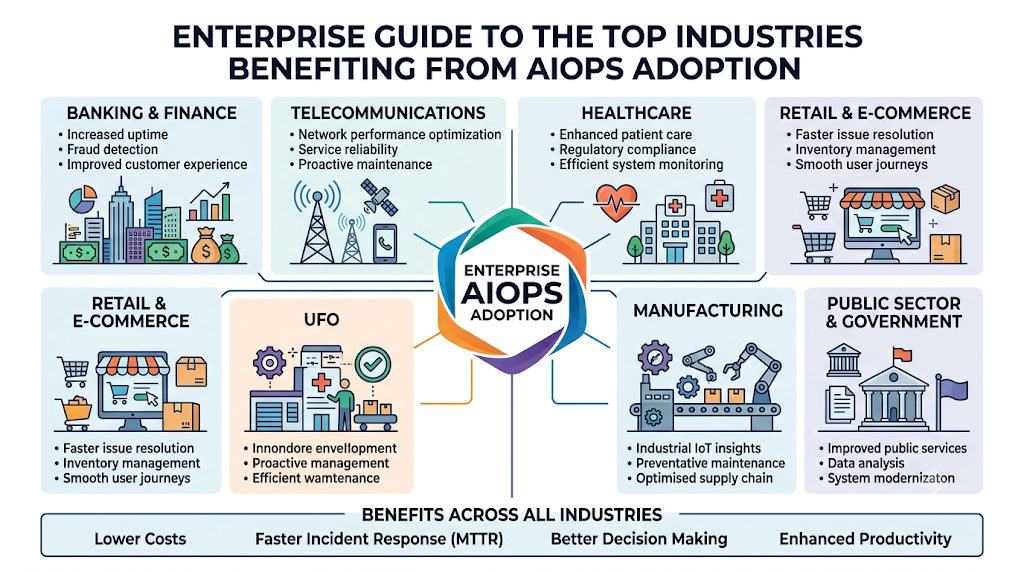
Top Industries Benefiting from AIOps Adoption
Banking and Financial Services
In high-frequency trading and digital banking, even a few seconds of application downtime can result in millions of dollars in lost revenue and severe regulatory penalties. Financial institutions adopt enterprise AIOps to monitor high-volume transaction pathways across legacy mainframes and modern cloud apps.
For example, if an online payment gateway experiences a sudden spike in latency, AIOps correlates network traffic, database queries, and third-party API performance to pinpoint the bottleneck immediately. This ensures that consumer banking applications remain highly available and transaction delays are stopped before they affect users.
Healthcare
Modern hospitals and healthcare providers rely on interconnected Electronic Health Record (EHR) systems, telemetry monitors, and digital imaging networks. A service disruption in these systems can delay critical patient care or block access to lifesaving data.
By implementing predictive IT monitoring, a hospital network can ensure its medical imaging applications and patient databases communicate without friction. If an internal image-sharing server shows early signs of resource exhaustion, the AIOps platform alerts the on-duty systems administrator or dynamically allocates more cloud storage, keeping patient data flowing safely.
Telecommunications
Telecommunications providers manage massive, geographically dispersed networks consisting of thousands of cell towers, fiber routes, and edge data centers. The sheer volume of telemetry data generated by these environments is impossible for human teams to process manually.
Telecom enterprises use intelligent IT operations to monitor network performance in real time. If a specific 5G cellular hub begins dropping packets due to a localized hardware malfunction, the AIOps system instantly spots the anomaly, reroutes digital traffic to neighboring towers, and flags the exact equipment piece needing physical repair.
Retail and E-Commerce
For e-commerce brands, sudden web traffic surges during seasonal promotional events can easily overwhelm web servers, leading to dropped shopping carts and broken checkout pages. Retailers use AIOps to maintain absolute service reliability during high-stakes sales windows.
Consider a global online retailer launching a flash sale. If the web checkout microservice begins slowing down under the heavy user load, an AIOps system identifies the performance dip, correlates it with database connection limits, and triggers an automated script to spin up additional server instances, ensuring a smooth customer experience.
Manufacturing
Industrial manufacturing relies heavily on Smart Factories, where industrial Internet of Things (IoT) sensors, automated assembly lines, and supply-chain logistics platforms run continuously. A failure in the plant’s inventory tracking software can stall an entire production floor.
AIOps platforms ingest data from both cloud infrastructure and on-premises factory floor devices. If an automated assembly line’s control application exhibits abnormal communication delays with the central inventory system, predictive analytics catch the trend, allowing engineers to fix the network glitch during a scheduled maintenance window rather than during active production.
Cloud Service Providers
Cloud service providers and web hosting enterprises manage hyper-scale data centers housing tens of thousands of virtual machines for global business clients. Ensuring strict Service Level Agreements (SLAs) requires an unparalleled level of infrastructure observability.
By deploying enterprise AIOps platforms, cloud providers automate tenant resource distribution. The AI model detects when a particular hardware cluster is nearing capacity limits and autonomously migrates virtual workloads to underutilized servers, preventing performance degradation without requiring manual intervention from cloud infrastructure specialists.
Government and Public Sector
Public sector agencies manage critical digital services ranging from tax processing systems to municipal emergency response infrastructure. These systems must remain highly resilient while frequently operating under constrained public budgets and strict security baselines.
Government IT branches utilize intelligent monitoring to maintain high system availability across distributed agency networks. When a public portal experiences an unusual wave of document submissions, the AIOps engine optimizes backend database queues to prevent page timeouts, helping citizens access vital public resources reliably.
Energy and Utilities
Smart grids, wind farms, and regional power utilities depend on real-time data networks to balance energy production with shifting consumer demand. If an operational dashboard fails, utility managers lose visibility into regional grid health.
Energy enterprises implement AIOps to monitor the health of application gateways that process grid telemetry. If an automated utility data-ingestion pipeline begins lagging, the predictive engine identifies the underlying network configuration bottleneck, allowing IT teams to restore smooth data flows before grid management is impacted.
Transportation and Logistics
Global logistics firms rely on precise tracking applications, automated warehouse systems, and fleet routing algorithms to deliver goods on schedule. A breakdown in the primary shipping database can delay thousands of physical deliveries worldwide.
Through the integration of IT automation and AIOps, logistics organizations maintain stable application performance. If a mobile tracking application starts failing to log delivery confirmations due to a minor API update error, the system detects the anomaly pattern and alerts the DevOps team with a precise root cause analysis, shortening remediation time.
Media and Entertainment
With millions of global users simultaneously streaming high-definition video content, media enterprises cannot afford application stuttering or content delivery network (CDN) disruptions.
Media networks use predictive IT monitoring to optimize content streaming paths. If a regional CDN node shows a slight degradation in data delivery speed, the AIOps controller automatically shifts traffic to a healthier alternate path, providing end users with uninterrupted video playback.
AIOpsSchool.com Guide to AIOps Across Industries
Understanding Enterprise AIOps
Adopting AIOps requires a solid understanding of how artificial intelligence integrates with enterprise IT architecture. Platforms learn to ingest unstructured log files, metrics, and distributed traces from various sources, transforming disparate data streams into a unified operational view.
Learning Intelligent Monitoring
Moving away from static thresholds is a fundamental shift for modern tech teams. Learners must explore how machine learning models analyze historical telemetry data to establish dynamic baselines that automatically adjust for normal business cycles, like weekday traffic spikes.
Improving IT Reliability
The ultimate goal of AIOps across every industry sector is to eliminate unexpected service outages. By understanding event correlation patterns, engineers learn how to filter out noisy, repetitive alerts and focus their energy entirely on resolving true infrastructure incidents.
Building Automated Operations
True efficiency is achieved when platforms move from insight to autonomous action. IT professionals use automated runbooks and webhook integrations to fix recurring issues, allowing software infrastructure to self-heal without needing human eyes on a screen around the clock.
Scaling Modern IT Infrastructure
As enterprise networks grow to encompass multi-cloud architectures, manual oversight becomes impossible. Understanding how to scale automated discovery patterns ensures that no matter how fast an enterprise spins up new cloud resources, they are immediately monitored and protected by the central AIOps platform.
Common Enterprise Use Cases
Infrastructure Monitoring
AIOps platforms continuously scan physical servers, virtual machines, storage arrays, and network devices. By tracking historical resource utilization, the platform identifies long-term performance degradation and helps infrastructure teams catch hardware vulnerabilities before an outage occurs.
Cloud Operations
Managing dynamic multi-cloud environments requires real-time observability. AIOps platforms automatically discover newly deployed cloud assets, track containerized applications, and optimize cloud spend by pointing out over-provisioned or idle virtual machines.
Application Performance Monitoring
By tracking user journeys across complex software architectures, AIOps isolates the exact source of slow page loads or broken API calls. It maps out application dependencies, revealing whether an issue stems from front-end code, a backend service, or a database lock.
Security Event Correlation
Modern security teams are often overwhelmed by thousands of daily firewall and access notifications. AIOps tools cross-reference infrastructure performance alerts with security logs to distinguish standard system misconfigurations from genuine malicious cyber threats or distributed denial-of-service (DDoS) attacks.
Capacity Planning
Instead of guessing future hardware and cloud resource requirements, engineering departments use predictive analytics to analyze consumption trends. This helps management precisely forecast storage, compute, and memory needs months in advance, avoiding emergency infrastructure purchases.
Service Reliability
Site Reliability Engineers (SREs) utilize AIOps to maintain strict error budgets and track Service Level Objectives (SLOs). The system identifies microscopic errors and performance anomalies early on, allowing engineers to push software updates frequently while keeping services highly dependable.
Benefits of AIOps Adoption
- Reduced Downtime: By predicting system failures before they occur and accelerating root cause analysis, organizations drastically minimize the duration and frequency of critical business outages.
- Faster Incident Resolution: Machine learning models condense hours of manual troubleshooting into seconds, providing operations engineers with the precise data needed to resolve complex infrastructure problems.
- Improved Customer Experience: When backend enterprise IT platforms run smoothly, end users enjoy fast application response times, seamless checkouts, and uninterrupted service availability.
- Better Operational Efficiency: Automating repetitive manual tasks like alert sorting, log parsing, and routine server reboots frees up IT personnel to focus on high-value development and engineering projects.
- Lower IT Costs: Minimizing major outages, reducing cloud resource waste, and maximizing engineering efficiency directly translates to significant long-term operational cost savings.
- Enhanced Business Continuity: Proactive anomaly detection and automated disaster recovery workflows ensure that critical enterprise operations remain functional even during major infrastructure updates.
Traditional IT Operations vs AIOps
| Feature | Traditional IT Operations | AIOps |
| Monitoring | Manual threshold configuration | Intelligent, dynamic baseline analytics |
| Incident Detection | Reactive (after a failure occurs) | Predictive (before systems break) |
| Event Correlation | Limited or manual log cross-referencing | AI-driven, automatic alert grouping |
| Root Cause Analysis | Manual troubleshooting war rooms | Automated assistance and direct root cause pinpointing |
| Operational Efficiency | Moderate (stuck in repetitive cycles) | High (driven by automated workflows) |
Common Challenges
Legacy Infrastructure
Older enterprise mainframes and disconnected heritage software platforms often lack the modern APIs required to export comprehensive telemetry data.
Recommendation: Implement lightweight data collectors or intermediate middleware solutions that can extract log files from legacy machines and forward them to a centralized AIOps data platform.
Data Integration
Ingesting and organizing millions of data points across disconnected monitoring tools can create significant configuration hurdles.
Recommendation: Standardize your enterprise monitoring architecture on open data frameworks like OpenTelemetry to ensure unified formatting across metrics, logs, and traces.
Skills Gap
Many IT teams understand traditional infrastructure management but lack deep experience with machine learning operations, predictive workflows, and automated runbook engineering.
Recommendation: Leverage structured educational platforms like AIOpsSchool.com to upskill existing IT personnel and bridge the knowledge gap through practical training.
Tool Compatibility
Organizations often possess dozens of specialized monitoring tools across different departments, leading to disjointed data silos.
Recommendation: Choose an open, vendor-agnostic AIOps platform designed to ingest data seamlessly from multiple third-party tools via pre-built ecosystem connectors.
Organizational Change
Shifting from familiar manual troubleshooting procedures to automated, AI-assisted operations can trigger cultural resistance within engineering teams.
Recommendation: Start by automating small, low-risk operational tasks—such as automated ticket routing—to build internal trust in AI insights before expanding to autonomous remediation.
Best Practices
- Begin with clear business objectives: Do not try to automate your entire infrastructure overnight. Select one specific problem area—such as reducing alert noise on a problematic application cluster—before scaling the deployment.
- Integrate quality monitoring data: Machine learning engines require clean, continuous telemetry. Ensure your infrastructure components are correctly instrumented to emit high-quality metrics, logs, and trace data.
- Automate repetitive operational tasks: Use reliable runbooks to automate well-understood, recurring issues, such as clearing temporary disk caches or scaling cloud containers during predictable peak hours.
- Continuously review AI-generated insights: Have senior engineering teams regularly assess automated root cause suggestions and alert groups to fine-tune the system’s accuracy over time.
- Train teams on AIOps workflows: Educate your site reliability and DevOps engineers on how to interpret machine learning suggestions, turning your IT department into data-driven operations specialists.
Key Performance Metrics
Mean Time to Detect (MTTD)
The average time it takes for an enterprise to notice that an IT issue or system anomaly is occurring. AIOps reduces MTTD from hours to fractions of a second via real-time stream analysis.
Mean Time to Resolve (MTTR)
The average time required for engineering teams to fix an issue once it has been discovered. By delivering instant root cause analysis, AIOps helps developers repair bugs and restore system operations much faster.
Infrastructure Availability
The total percentage of time that core business systems remain online and functional. Higher availability directly protects companies against lost operational revenue and customer attrition.
Alert Accuracy
The ratio of true, actionable incident notifications compared to meaningless background noise. Improving alert accuracy eliminates developer fatigue and ensures critical notifications are never ignored.
Incident Volume
The total number of distinct IT service tickets logged within a given timeframe. Effective event correlation reduces total ticket volume by grouping duplicate system warnings into a single comprehensive file.
Service Reliability
A holistic measurement of how consistently an application meets its performance goals. Tracking reliability ensures that enterprise deployments remain highly stable during heavy usage.
Career Opportunities
- AIOps Engineer: Focuses on configuring and maintaining AI models, integrating data pipelines, and designing automated workflows across enterprise systems.
- Site Reliability Engineer (SRE): Uses automated tools and software engineering principles to ensure that large-scale infrastructure environments remain reliable and scalable.
- DevOps Engineer: Bridges the gap between software development and IT operations, utilizing intelligent monitoring to accelerate application deployment cycles safely.
- Cloud Operations Engineer: Specializes in monitoring cloud infrastructure performance, container orchestration systems, and automated asset scaling.
- IT Operations Manager: Oversees structural operational strategies, shifting departmental workflows from reactive debugging to predictive, data-driven management frameworks.
- Enterprise Architect: Designs the overarching blueprint for an organization’s IT ecosystem, ensuring new AIOps tools integrate cleanly with existing business applications.
Future of AIOps Across Industries
Autonomous IT Operations
The industry is moving toward fully autonomous IT operations, where enterprise monitoring software self-configures, self-corrects, and optimizes its own infrastructure parameters without requiring human approval steps.
AI-Driven Observability
Future analytics platforms will not just track raw metrics; they will understand the context of software updates, automatically tracing how minor changes in application code affect system performance across the enterprise.
Self-Healing Infrastructure
When an unexpected system vulnerability or hardware failure is identified, self-healing setups will dynamically spin up isolated test environments, validate code patches, and deploy fixes across production environments in real time.
Intelligent Enterprise Automation
AIOps frameworks will increasingly break out of pure IT boundaries, integrating with broader business workflows to automatically adjust server resources based on real-time corporate financial metrics and market demands.
Predictive Digital Operations
By blending historic market signals with real-time operational infrastructure telemetry, organizations will be able to run simulations that accurately predict how future business choices will affect global service performance.
Common Misconceptions
AIOps Is Only for Large Enterprises
While large organizations certainly deal with immense data scales, mid-sized companies also face complex cloud architectures. Implementing smart automation saves smaller IT teams from spending valuable time on manual log parsing.
AIOps Replaces IT Professionals
Artificial intelligence does not replace skilled engineers; it eliminates the tedious, repetitive tasks that cause employee burnout, allowing human operators to focus on building new, innovative business solutions.
Automation Eliminates Every Incident
No technology can completely prevent software bugs or hardware wear and tear. AIOps ensures that when an unexpected incident does occur, your teams can isolate and fix the root cause instantly.
AIOps Works Without Quality Data
An AI model is only as good as the information it processes. Without comprehensive log documentation and structured system metrics, automated systems cannot accurately learn baseline operational behavior.
FAQ Section
- What is the primary difference between standard monitoring and AIOps?Standard monitoring tools simply inform you when a specific infrastructure threshold is breached by sending a basic alert. AIOps platform architecture goes much further by collecting data from multiple systems, using machine learning to find the true root cause, and executing automated runbooks to fix the issue.
- How does AIOps help reduce alert fatigue for DevOps engineers?DevOps teams often get overwhelmed by thousands of duplicate notifications when a single core system goes offline. AIOps utilizes advanced event correlation models to group these related alerts into a single actionable incident file, eliminating background noise.
- Can small and mid-sized businesses benefit from implementing AIOps?Yes, companies of all sizes benefit from adopting smart automation tools. Mid-sized businesses often run complex multi-cloud apps with lean IT engineering teams, and AIOps helps those smaller departments manage expansive systems efficiently without requiring additional headcount.
- What type of data does an AIOps platform need to ingest?An AIOps engine relies on three core telemetry components: metrics (numerical performance data), logs (historical records of software events), and traces (the operational paths that data journeys take through your system infrastructure).
- Is AIOps designed to replace human system administrators?No, this technology is built to assist human engineering teams rather than replace them. By handling repetitive manual work like alert sorting and basic reboots, it empowers engineers to focus on architectural design and strategic business updates.
- What does “self-healing infrastructure” mean in practice?Self-healing infrastructure refers to an environment where an AI platform identifies an operational error, identifies the root cause, and immediately executes a pre-approved automated script—like restarting a service—to fix the bug without human intervention.
- How does predictive analytics improve enterprise cloud cost management?Predictive analytics models track historical computing patterns to forecast future capacity needs. This allows organizations to downscale idle servers during low-traffic periods and prepare resources for upcoming demand peaks, avoiding unnecessary cloud spending.
- What is the best way to start an AIOps implementation project?Begin by defining a narrow, measurable business objective, such as reducing incident resolution times on a single application cluster. Ensure that system’s telemetry data is clean and well-structured before connecting it to an AI engine.
- Does AIOps require specialized training for existing IT staff?While the platforms are designed to be user-friendly, teams must understand core machine learning concepts, automated runbook configuration, and data-driven observability workflows to get the most out of their enterprise software.
- How can I learn the practical skills needed to work in an AIOps environment?Aspiring professionals and engineers can utilize dedicated educational resources like AIOpsSchool.com to study practical tutorials, explore real-world deployment use cases, and master the technical competencies required for intelligent enterprise operations.
Final Summary
Adopting AIOps has become a critical operational driver for modern enterprises navigating highly complex digital ecosystems. From financial institutions securing high-frequency transaction pathways to healthcare networks protecting real-time patient data, artificial intelligence for IT operations provides the observability, speed, and automation necessary to prevent system downtime. By shifting from reactive troubleshooting to predictive, intelligent monitoring, businesses can significantly reduce incident resolution times, protect their customer experiences, and scale their infrastructure efficiently.
As organizations continue to embrace autonomous operations, the demand for skilled professionals who understand how to deploy and manage these AI-driven systems is rising rapidly. Learning resources like AIOpsSchool.com play a vital role in this transformation, helping engineers, architects, and technology enthusiasts master the practical configurations and enterprise frameworks required to lead modern digital operations. Embracing these advanced automation methodologies ensures your organization stays resilient, efficient, and prepared for the future of enterprise IT.