Introduction
Multimodal Model Platforms provide access to artificial intelligence systems that can understand, process, and generate information across multiple data formats, including text, images, audio, video, and structured data.
Traditional AI systems were often designed to handle a single type of input, such as text-based language models or image recognition systems. Multimodal AI combines multiple forms of information into a unified model, allowing machines to understand real-world scenarios more naturally.
For example, a multimodal AI system can analyze an image, understand related text, interpret spoken instructions, summarize video content, and generate responses using multiple information sources.
Multimodal Model Platforms help organizations:
- Build advanced AI applications
- Analyze complex data formats
- Create intelligent assistants
- Improve customer experiences
- Automate content understanding
- Develop AI-powered workflows
- Enable human-like interactions
These platforms are used by:
- Software developers
- Enterprises
- Research organizations
- Healthcare companies
- Media companies
- Education providers
- Financial institutions
- Robotics organizations
Modern multimodal platforms support capabilities such as:
- Vision-language models
- Speech understanding
- Image generation
- Video analysis
- Document intelligence
- AI assistants
- Multimodal search
- AI agents
The goal of these platforms is to make AI systems more intelligent, flexible, and capable of understanding information in the same way humans interact with the world.
How Multimodal Model Platforms Work
Multimodal Data Processing
Multimodal AI systems process different types of information:
- Text
- Images
- Audio
- Video
- Documents
- Sensor data
The model learns relationships between different data formats.
Feature Understanding
AI models identify:
- Objects in images
- Meaning in text
- Speech patterns
- Visual relationships
- Context between different inputs
Cross-Modal Reasoning
The system combines information from multiple sources.
Examples:
- Understanding an image using text instructions
- Answering questions about videos
- Extracting information from documents
- Creating content from multiple inputs
AI Generation
Multimodal platforms can generate:
- Text responses
- Images
- Audio outputs
- Summaries
- Recommendations
Application Integration
Developers connect multimodal capabilities through:
- APIs
- SDKs
- Cloud platforms
- Enterprise applications
Common Use Cases
AI Assistants
Multimodal assistants can understand conversations, images, and documents.
Healthcare Applications
Organizations use multimodal AI for:
- Medical image analysis
- Clinical documentation
- Research support
Customer Support
Businesses create assistants that understand:
- Text messages
- Screenshots
- Voice requests
Education Technology
AI platforms support:
- Interactive learning
- Visual explanations
- Personalized tutoring
Content Creation
Multimodal AI helps create:
- Marketing materials
- Videos
- Images
- Written content
Enterprise Search
Organizations use multimodal search across documents, images, and knowledge bases.
Robotics and Automation
Robotics systems use multimodal AI to understand environments and instructions.
Why Multimodal Model Platforms Matter
Better AI Understanding
Multimodal models understand information beyond text.
More Natural Interactions
Users can communicate through:
- Voice
- Images
- Text
- Video
Improved Business Automation
Organizations can automate complex workflows involving multiple data formats.
Faster Innovation
Developers can build advanced applications without creating AI models from scratch.
Real-World Intelligence
Multimodal systems better represent how humans process information.
Evaluation Criteria for Buyers
Model Capability
Platforms should support:
- Text understanding
- Image processing
- Audio analysis
- Video understanding
- Generation capabilities
Performance
Important factors include:
- Response speed
- Accuracy
- Reliability
- Context handling
Developer Experience
Platforms should provide:
- APIs
- SDKs
- Documentation
- Development tools
Customization
Important capabilities include:
- Fine-tuning
- Retrieval integration
- Custom workflows
Security
Organizations should evaluate:
- Data protection
- Privacy controls
- Access management
Scalability
Platforms should support:
- Enterprise workloads
- Large data volumes
- Multiple applications
Key Trends
Vision-Language Models
AI systems are combining visual understanding with language reasoning.
AI Agents
Multimodal models are becoming the foundation for intelligent autonomous systems.
Real-Time AI Interaction
Platforms are improving live voice and video understanding.
Enterprise Multimodal AI
Businesses are integrating multimodal capabilities into daily workflows.
Robotics and Physical AI
Multimodal models are improving machine understanding of real environments.
Personalized AI Experiences
AI systems are becoming more adaptive and context-aware.
Methodology
The following platforms were evaluated based on:
- Multimodal capabilities
- Model quality
- API availability
- Developer experience
- Enterprise readiness
- Security
- Scalability
- Integration ecosystem
- Performance
- Value
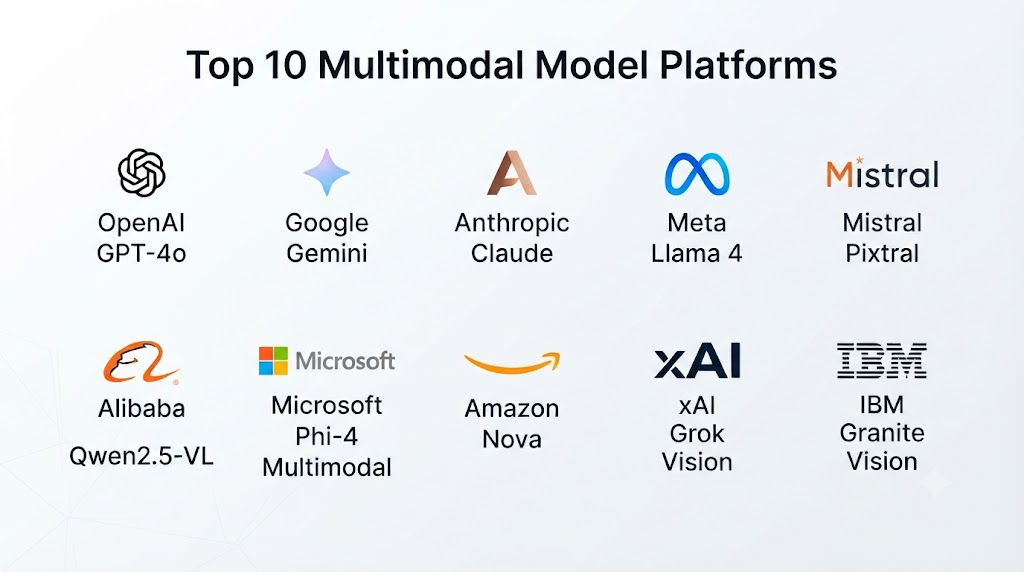
Top 10 Multimodal Model Platforms
1. OpenAI Multimodal Platform
OpenAI provides multimodal AI capabilities that allow applications to work with text, images, audio, and other information formats.
Key Features
- Text understanding
- Image analysis
- Vision capabilities
- Audio processing
- AI assistants
- Content generation
- Reasoning capabilities
- API integration
- Embeddings
- AI application workflows
Pros
- Advanced multimodal capabilities
- Strong reasoning performance
- Broad developer adoption
- Flexible APIs
- Wide application support
Cons
- Usage costs vary
- Requires application design expertise
- Model selection requires testing
Platforms
Cloud API platform.
Deployment or Support
Cloud deployment.
Security & Compliance
Enterprise security controls and privacy options.
Integrations & Ecosystem
Developer tools, AI frameworks, business applications, and software platforms.
Support & Community
Large developer community and professional support.
2. Google Vertex AI Gemini Platform
Google Vertex AI provides access to multimodal AI models designed for enterprise applications.
Key Features
- Text processing
- Image understanding
- Video analysis
- Audio capabilities
- AI development tools
- Model customization
- Data integration
- Enterprise deployment
- AI workflows
- Analytics
Pros
- Strong multimodal capabilities
- Enterprise cloud infrastructure
- Advanced AI ecosystem
- Scalable deployment
- Developer tools
Cons
- Requires cloud expertise
- Complex for beginners
- Enterprise configuration needed
Platforms
Cloud platform.
Deployment or Support
Cloud deployment.
Security & Compliance
Enterprise cloud security controls.
Integrations & Ecosystem
Google Cloud services, databases, AI tools, and enterprise applications.
Support & Community
Google Cloud support ecosystem.
3. Amazon Bedrock Multimodal AI
Amazon Bedrock provides access to multiple foundation models with multimodal capabilities.
Key Features
- Multimodal model access
- Image understanding
- Text generation
- AI agents
- Model customization
- Enterprise security
- Knowledge bases
- API access
- Cloud integration
- Monitoring
Pros
- Multiple model choices
- Strong AWS ecosystem
- Enterprise security
- Scalable infrastructure
- Flexible deployment
Cons
- AWS expertise required
- Configuration complexity
- Cost management needed
Platforms
Cloud platform.
Deployment or Support
Cloud deployment.
Security & Compliance
Enterprise cloud security controls.
Integrations & Ecosystem
AWS services, enterprise applications, databases, and AI tools.
Support & Community
AWS support ecosystem.
4. Anthropic Claude Platform
Anthropic provides advanced AI models with strong reasoning and document understanding capabilities.
Key Features
- Text analysis
- Image understanding
- Long-context processing
- Document analysis
- AI assistants
- Enterprise workflows
- API access
- Reasoning capabilities
- Content generation
- Knowledge processing
Pros
- Strong reasoning
- Long-context support
- Good document understanding
- Safety-focused design
- Enterprise usability
Cons
- Smaller ecosystem
- Requires workload testing
- Features vary by model
Platforms
Cloud API platform.
Deployment or Support
Cloud deployment.
Security & Compliance
Enterprise security controls.
Integrations & Ecosystem
AI applications, developer platforms, and enterprise workflows.
Support & Community
Developer support.
5. Microsoft Azure AI Foundry
Azure AI Foundry provides enterprise tools for developing multimodal AI applications.
Key Features
- Multimodal model access
- AI development tools
- Model management
- Data integration
- AI evaluation
- Security controls
- Deployment management
- Monitoring
- Enterprise workflows
- Governance
Pros
- Enterprise-focused
- Strong Microsoft integration
- Security capabilities
- Scalable infrastructure
- Developer tools
Cons
- Requires Azure knowledge
- Enterprise complexity
- Implementation effort
Platforms
Cloud platform.
Deployment or Support
Cloud deployment.
Security & Compliance
Enterprise cloud security controls.
Integrations & Ecosystem
Microsoft services, enterprise systems, databases, and AI applications.
Support & Community
Microsoft support ecosystem.
6. Hugging Face Multimodal Models
Hugging Face provides access to a large ecosystem of open-source multimodal models.
Key Features
- Open multimodal models
- Model hosting
- Vision-language models
- Audio models
- Community models
- APIs
- Fine-tuning
- Developer tools
- Research workflows
- Model sharing
Pros
- Large open-source ecosystem
- Flexible customization
- Strong community
- Research-friendly
- Many model options
Cons
- Requires technical expertise
- Model quality varies
- Enterprise deployment needs planning
Platforms
Cloud and self-managed platforms.
Deployment or Support
Flexible deployment.
Security & Compliance
Depends on implementation.
Integrations & Ecosystem
AI frameworks, developer tools, open models, and cloud environments.
Support & Community
Large developer community.
7. NVIDIA AI Enterprise
NVIDIA provides optimized infrastructure for running advanced AI models.
Key Features
- Multimodal AI deployment
- GPU acceleration
- Model optimization
- AI containers
- Enterprise deployment
- Inference optimization
- AI workflows
- Monitoring
- Developer tools
- Hardware integration
Pros
- High-performance AI infrastructure
- Strong GPU optimization
- Enterprise capabilities
- Fast inference
- Production-ready tools
Cons
- Requires NVIDIA ecosystem
- Hardware expertise needed
- Enterprise-focused
Platforms
Cloud and enterprise platforms.
Deployment or Support
Hybrid deployment.
Security & Compliance
Enterprise security controls.
Integrations & Ecosystem
NVIDIA hardware, cloud platforms, AI frameworks, and enterprise systems.
Support & Community
Enterprise support.
8. IBM watsonx AI
IBM watsonx provides enterprise AI development and governance capabilities.
Key Features
- Multimodal AI workflows
- Model management
- AI governance
- Enterprise deployment
- Data integration
- Monitoring
- Security controls
- AI applications
- Model evaluation
- Hybrid deployment
Pros
- Strong enterprise governance
- Hybrid capabilities
- Security-focused
- Business integration
- AI management
Cons
- Complex implementation
- Enterprise-focused
- Requires expertise
Platforms
Cloud and hybrid platforms.
Deployment or Support
Hybrid deployment.
Security & Compliance
Enterprise security controls.
Integrations & Ecosystem
Enterprise applications, data platforms, cloud systems, and AI tools.
Support & Community
Enterprise support.
9. Meta Llama Multimodal Ecosystem
Meta provides open model ecosystems supporting multimodal AI development.
Key Features
- Open models
- Vision capabilities
- Model customization
- Research support
- Self-hosting
- Fine-tuning
- Developer ecosystem
- AI experimentation
- Flexible deployment
- Community tools
Pros
- Open ecosystem
- Flexible deployment
- Community support
- Customization options
- Research-friendly
Cons
- Requires technical expertise
- Self-management required
- Enterprise support varies
Platforms
Cloud and self-managed platforms.
Deployment or Support
Flexible deployment.
Security & Compliance
Depends on implementation.
Integrations & Ecosystem
AI frameworks, developer tools, cloud platforms, and applications.
Support & Community
Open developer community.
10. Mistral AI Platform
Mistral AI provides efficient AI models with multimodal capabilities.
Key Features
- Multimodal models
- Language processing
- Image understanding
- API access
- Model customization
- Enterprise applications
- Developer tools
- Efficient inference
- AI workflows
- Deployment flexibility
Pros
- Efficient models
- Flexible deployment
- Developer-friendly
- Open ecosystem support
- Good performance
Cons
- Smaller ecosystem
- Requires technical knowledge
- Enterprise adoption varies
Platforms
Cloud and self-managed platforms.
Deployment or Support
Flexible deployment.
Security & Compliance
Security controls vary.
Integrations & Ecosystem
AI frameworks, developer tools, cloud environments, and applications.
Support & Community
Developer community.
Comparison Table
| Tool Name | Best For | Platform(s) Supported | Deployment | Standout Feature | Public Rating |
|---|---|---|---|---|---|
| OpenAI Multimodal Platform | General AI applications | Cloud API | Cloud | Advanced multimodal AI | N/A |
| Google Vertex AI Gemini | Enterprise AI | Cloud | Cloud | Multimodal intelligence | N/A |
| Amazon Bedrock | Multi-model AI access | Cloud | Cloud | Model flexibility | N/A |
| Anthropic Claude | Reasoning applications | Cloud API | Cloud | Context understanding | N/A |
| Azure AI Foundry | Enterprise solutions | Cloud | Cloud | Enterprise integration | N/A |
| Hugging Face Models | Open AI development | Cloud/Open | Flexible | Open ecosystem | N/A |
| NVIDIA AI Enterprise | AI infrastructure | Cloud/Private | Hybrid | GPU optimization | N/A |
| IBM watsonx AI | AI governance | Hybrid | Hybrid | Enterprise control | N/A |
| Meta Llama Ecosystem | Open models | Cloud/Open | Flexible | Customization | N/A |
| Mistral AI Platform | Efficient AI models | Cloud/Open | Flexible | Efficient deployment | N/A |
Weighted Evaluation
| Tool Name | Core Features 25% | Ease of Use 15% | Integrations & Ecosystem 15% | Security & Compliance 10% | Performance & Reliability 10% | Support & Community 10% | Price/Value 15% | Total |
|---|---|---|---|---|---|---|---|---|
| OpenAI Multimodal Platform | 25 | 14 | 15 | 10 | 10 | 10 | 12 | 96 |
| Google Vertex AI Gemini | 25 | 13 | 15 | 10 | 10 | 10 | 11 | 94 |
| Amazon Bedrock | 24 | 13 | 15 | 10 | 10 | 10 | 12 | 94 |
| Anthropic Claude | 24 | 14 | 14 | 10 | 10 | 10 | 11 | 93 |
| Azure AI Foundry | 24 | 13 | 15 | 10 | 10 | 10 | 12 | 94 |
| Hugging Face Models | 23 | 14 | 14 | 10 | 10 | 10 | 12 | 93 |
| NVIDIA AI Enterprise | 24 | 12 | 14 | 10 | 10 | 10 | 11 | 91 |
| IBM watsonx AI | 23 | 12 | 14 | 10 | 10 | 10 | 10 | 89 |
| Meta Llama Ecosystem | 24 | 12 | 14 | 10 | 10 | 10 | 13 | 93 |
| Mistral AI Platform | 23 | 14 | 13 | 10 | 10 | 10 | 12 | 92 |
Which Multimodal Model Platform Is Right for You?
Choose OpenAI Multimodal Platform when advanced general-purpose multimodal AI is required.
Choose Google Vertex AI Gemini when enterprise AI development is important.
Choose Amazon Bedrock when multiple AI models through cloud infrastructure are needed.
Choose Anthropic Claude Platform when reasoning and document understanding matter.
Choose Microsoft Azure AI Foundry when enterprise integration is preferred.
Choose Hugging Face Multimodal Models when open-source flexibility is needed.
Choose NVIDIA AI Enterprise when high-performance AI deployment is required.
Choose IBM watsonx AI when AI governance and enterprise control matter.
Choose Meta Llama Ecosystem when open model customization is important.
Choose Mistral AI Platform when efficient AI deployment is preferred.
Implementation Playbook
Phase 1: Define AI Goals
- Identify multimodal use cases
- Select required data types
- Define performance goals
- Establish security requirements
Phase 2: Prepare Data
- Organize text data
- Prepare images and documents
- Manage audio and video sources
- Establish data governance
Phase 3: Deploy Multimodal AI
- Integrate APIs
- Test model performance
- Configure workflows
- Add security controls
Phase 4: Measure Results
- Monitor accuracy
- Track user adoption
- Optimize performance
- Improve applications
Phase 5: Maintain Systems
- Update models
- Monitor usage
- Improve workflows
- Review governance
Common Mistakes
- Using poor-quality data
- Ignoring security requirements
- Selecting models without testing
- Poor prompt design
- Lack of monitoring
- Ignoring costs
- Poor integration planning
- Missing governance policies
FAQs
1. What are Multimodal Model Platforms?
Multimodal Model Platforms provide AI systems that can understand and process multiple data types such as text, images, audio, and video.
2. Why are multimodal models important?
They allow AI systems to understand information more naturally across different formats.
3. What can multimodal AI applications do?
They can analyze images, understand documents, process audio, summarize videos, and generate content.
4. Who uses multimodal AI platforms?
Enterprises, developers, researchers, healthcare organizations, and technology companies use them.
5. Can multimodal AI generate images and text?
Many platforms support both understanding and generation capabilities.
6. Are multimodal models suitable for enterprises?
Yes. Many platforms provide enterprise security and deployment options.
7. How do organizations choose a multimodal platform?
They should evaluate model capability, security, scalability, cost, and integrations.
8. Can open-source multimodal models be customized?
Yes. Many open models support fine-tuning and custom deployment.
9. Are multimodal AI platforms secure?
Organizations should evaluate privacy controls and security features.
10. What is the future of multimodal AI?
Multimodal AI is moving toward more intelligent assistants, autonomous systems, and human-like interactions.
Conclusion
Multimodal Model Platforms are transforming artificial intelligence by enabling systems to understand and interact with multiple forms of information. These platforms allow developers and organizations to build more powerful applications that combine text, images, audio, and video intelligence.OpenAI, Google Vertex AI, Amazon Bedrock, Microsoft Azure AI Foundry, Anthropic, NVIDIA, and open-source ecosystems provide strong options for building next-generation AI solutions.The most successful multimodal AI implementations combine capable models with quality data, secure infrastructure, responsible AI practices, and effective application design.