Introduction
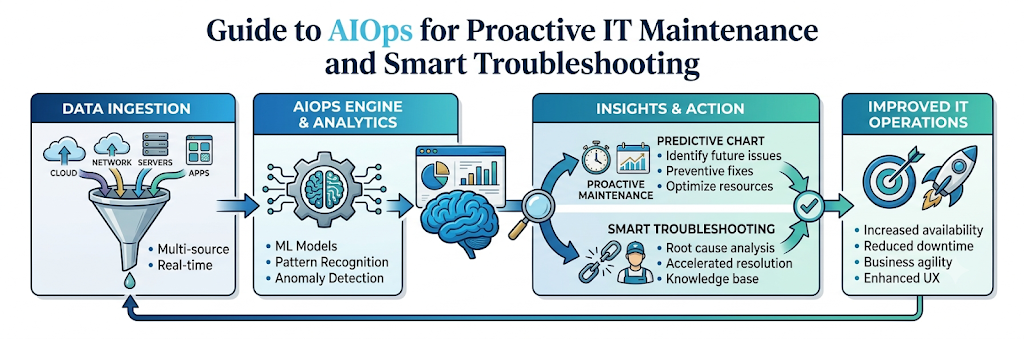
For decades, IT teams have operated in a perpetual state of firefighting. When a server crashed, an application lagged, or a database corrupted, an alarm sounded, and engineers rushed to fix it. This traditional approach—known as reactive maintenance—worked well enough when corporate networks were self-contained and predictable. Today, digital ecosystems are massive, distributed, and incredibly complex. Relying on humans to manually track every alert simply does not scale anymore. Waiting for a system to break before fixing it leads to costly downtime, frustrated customers, and exhausted engineering teams. This is where AIOps (Artificial Intelligence for IT Operations) steps in. By combining big data, machine learning, and automation, AIOps shifts the paradigm entirely. Instead of waiting for a failure to happen, AIOps allows organizations to analyze massive amounts of operational data in real-time. This guide explores how integrating AI into your workflow shifts your business from a defensive posture to a proactive strategy, catching infrastructure issues before they ever impact an end-user. Learn more about modern operations frameworks at AIOpsSchool.com.
What Is AIOps?
AIOps stands for Artificial Intelligence for IT Operations. Coined by Gartner, it refers to the practice of using data science, machine learning, and artificial intelligence to automate and enhance daily IT operational workflows.
At its core, AIOps is about making sense of the overwhelming noise generated by modern software. Think of a standard corporate network: it consists of thousands of microservices, cloud servers, databases, and third-party APIs. Every single one of these components constantly generates data in the form of logs, metrics, and traces.
[Raw IT Data: Logs, Metrics, Events]
                 │
                 ▼
     [AIOps Machine Learning Engine]
                 │
        ┌────────┴────────┐
        ▼                 ▼
[Anomaly Detection]  [Root Cause Analysis]
        │                 │
        └────────┬────────┘
                 ▼
     [Automated Remediation]
Traditional tools require human operators to write static rules to monitor this data (e.g., “Alert me if CPU usage exceeds 85%”). However, Machine Learning for IT works differently. Instead of relying on rigid rules, AIOps algorithms ingest historical and streaming data to learn what “normal” behavior looks like for your specific system.
Once a baseline is established, the AI can automatically identify subtle statistical deviations, correlate isolated events across different platforms, and provide actionable insights without human intervention. In short, it turns raw, chaotic operational data into intelligent clarity.
What Is Proactive IT Maintenance?
To understand proactive maintenance, it helps to contrast it with its legacy counterpart:
- Reactive Maintenance: A “break-fix” model. An incident occurs, a ticket is generated, and the IT team scrambles to diagnose and repair the issue.
- Proactive Maintenance: A predictive model. The IT team continuously monitors system health, identifies early indicators of degradation, and schedules fixes before an actual failure takes place.
Reactive Flow:  [System Fails] ──> [Alert Triggers] ──> [Fix Applied] ──> [Downtime Incurred]

Proactive Flow: [Subtle Anomaly] ──> [AI Predicts Failure] ──> [Auto-Fix] ──> [Zero Downtime]
Consider a hard drive on a critical database server. In a reactive model, the drive fills up completely or crashes, knocking the database offline and disrupting thousands of users. In a proactive model, monitoring tools spot a steady, unusual acceleration in disk consumption or a spike in read/write latency days in advance. The system flags this trend early, allowing an engineer to allocate more storage during a scheduled maintenance window—preventing an outage entirely.
Proactively managing systems ensures corporate digital services remain reliable, predictable, and highly available.
Why AIOps Is Important for Proactive IT Maintenance
Shifting to a proactive model manually is nearly impossible due to the sheer volume of enterprise data. AIOps serves as the technological engine that makes proactive maintenance achievable.
- Early Issue Detection: AIOps highlights microscopic anomalies that human eyes would miss, such as a slight, progressive memory leak in a containerized application.
- Reduced Downtime: By intercepting system degradations before they manifest as outright crashes, businesses maintain continuous availability.
- Faster Incident Response: Instead of spending hours hunting through logs during a crisis, teams receive pre-correlated alerts that pinpoint the exact source of a problem.
- Better Service Availability: Applications run smoother because underlying infrastructure bottlenecks are cleared before they bottleneck user traffic.
- Improved Operational Efficiency: Engineers stop wasting time on repetitive troubleshooting tasks and focus instead on building new features and scaling infrastructure.
- Cost Savings: Outages are expensive. Preventing downtime saves companies thousands of dollars per minute in lost revenue, compliance fines, and service-level agreement (SLA) penalties.
How AIOps Enables Proactive IT Maintenance
AIOps accomplishes proactive maintenance through a structured, data-driven cycle. Here is how the process unfolds step-by-step:
Step 1: Data Collection & Log Aggregation
The platform ingests massive volumes of disparate data from across the entire corporate technology stack. This includes system logs, performance metrics, API traces, network traffic reports, and historical helpdesk tickets.
Step 2: Event Correlation
Instead of treating every alert as an isolated event, the AI analyzes relationships across time and topology. If a database slows down at the exact moment a network switch experiences a minor packet drop, the system links these events together.
Step 3: Anomaly Detection
Using mathematical modeling, the platform compares live performance against historical baselines. It flags unusual deviations—such as a sudden change in traffic patterns—even if those deviations haven’t breached a traditional hard threshold limit.
Step 4: Predictive Analytics & Incident Prediction
By analyzing current data trends alongside historical failure patterns, the platform calculates the mathematical probability of a future breakdown. For instance, it might predict that a specific memory leak will cause an application crash within the next four hours.
Step 5: Root Cause Analysis (RCA)
When a potential issue is flagged, the AI automatically traces the dependency path backward. It separates the symptoms from the core issue, presenting engineers with the exact root cause of the friction.
Step 6: Intelligent Alerting & Automated Remediation
Instead of overwhelming engineers with dozens of individual alarms, the system sends a single, contextualized alert. In advanced setups, the system triggers IT Automation scripts to fix the issue automatically—such as restarting a clogged service or scaling up cloud resources—without human intervention.
Core Components of AIOps
A functional AIOps architecture relies on the integration of several distinct technological layers:
- Artificial Intelligence & Machine Learning: The mathematical engines that discover patterns, predict outcomes, and adapt to changing environments over time.
- Big Data Analytics: Scalable data pipelines capable of ingesting and processing terabytes of real-time streaming data from diverse platforms.
- Monitoring & Observability: Tools that provide deep visibility into the internal states of systems via metrics, logs, and distributed traces.
- Automation Engines: The actionable execution layer, utilizing scripts, playbooks, and orchestration tools to execute self-healing tasks.
- Event Management: Platforms that filter, de-duplicate, prioritize, and route infrastructure alerts to the correct teams.
- Knowledge Management: A repository of historical fixes, documentation, and past incidents that trains the AI to recommend better solutions.
Benefits of AIOps for IT Maintenance
Implementing an AI-driven approach to infrastructure management delivers measurable advantages across technical and business metrics:
- Minimized Operational Friction: IT teams transition out of panic mode, resulting in a calmer workspace and significantly reduced burnout.
- Optimized Resource Utilization: Predictive Analytics reveal exactly which cloud servers are over-provisioned or under-utilized, helping businesses right-size their infrastructure spend.
- Superior Customer Experience: When systems don’t slow down or crash, end-users enjoy a seamless, highly responsive digital experience.
- Accelerated Innovation: Because operations teams spend far less time on manual troubleshooting, they can focus heavily on strategic deployment and architectural improvements.
Common Challenges
While the advantages of AIOps are clear, deployment requires navigating specific organizational and technical hurdles:
- Data Quality Issues: Machine learning algorithms require clean, structured data. If your logs are disorganized, inconsistent, or missing entirely, the AI will generate inaccurate predictions.
- Complex Hybrid Environments: Legacy on-premise hardware combined with multi-cloud architectures can create operational silos that are difficult for a single AI platform to map cleanly.
- Alert Fatigue from Misconfiguration: If the machine learning models are not properly tuned to your specific environmental baseline, they can trigger false alarms, causing teams to ignore legitimate notifications.
- Skills Shortages: Operating, tuning, and maintaining an advanced AIOps platform requires a blended understanding of data science, DevOps methodologies, and system administration.
Best Practices for Implementation
To successfully adopt AIOps for proactive IT maintenance, consider these tactical recommendations:
- Start Small: Do not attempt to automate your entire enterprise infrastructure overnight. Begin by applying AIOps to a single, well-defined service or application delivery pipeline.
- Focus on Clean Data: Prioritize data hygiene. Ensure logs are standardized, time-stamps are synchronized across servers, and monitoring agents are deployed uniformly.
- Keep Humans in the Loop Initially: When deploying IT Automation, start by having the AI suggest fixes to a human engineer first. Once the recommendations prove consistently accurate, grant the system permission to auto-remediate.
- Foster Collaboration: Break down structural walls between your development, operations, security, and data science teams to ensure everyone trusts and acts on the AI’s insights.
Real-World Use Cases
Cloud Infrastructure
- Challenge: A global software provider experienced sporadic application slowdowns across thousands of cloud containers, making manual root cause identification impossible.
- Approach: An AIOps engine was deployed to correlate microservice metrics, traces, and host machine logs simultaneously.
- Outcome: The system pinpointed an isolated database connection pool limit breach before it impacted users, automatically scaling the database cluster up to prevent an outage.
E-Commerce
- Challenge: During a major holiday shopping event, subtle, un-alerted micro-spikes in checkout page latency began degrading conversion rates.
- Approach: Real-time Anomaly Detection analyzed user behavior patterns alongside server CPU usage.
- Outcome: The platform recognized a progressive API timeout error, cleared the stuck cache automatically, and preserved millions in potential holiday sales.
Banking and Financial Services
- Challenge: A retail bank struggled with massive alert storms during routine, high-volume batch processing cycles, masking genuine hardware failures.
- Approach: Deployed Intelligent IT Operations software to de-duplicate alerts and correlate simultaneous events.
- Outcome: The system suppressed 92% of redundant operational noise, isolating an underlying storage array failure hours before morning banking services opened.
Future Trends
The evolution of IT operations points toward deeper automation and smarter analytics. Over the coming years, expect to see significant expansion across these core areas:
- Generative AI for Operations: Engineers will interact with their infrastructure using natural language, asking questions like, “Show me why the payment gateway slowed down at 2:00 PM,” and receiving immediate, plain-text synthesis alongside corrective code.
- Self-Healing Autonomous Environments: Infrastructure will mature past basic automated scaling scripts, dynamically rewriting its own configurations to completely bypass hardware failures without human oversight.
- Predictive Multi-Cloud Management: As software spreads across multiple cloud vendors, advanced cross-platform machine learning engines will dynamically shift workloads between clouds to optimize costs, performance, and compliance profiles ahead of regional demands.
Comparison Tables
Reactive IT Maintenance vs. Proactive IT Maintenance
| Feature | Reactive Maintenance | Proactive Maintenance | Business Impact |
| Operational Trigger | A system crashes or a user files a complaint ticket. | An internal system anomaly or statistical drift is detected. | Proactive avoids costly downtime entirely. |
| Problem Resolution | Manual investigation through logs during an active outage. | Automated Root Cause Analysis before failure occurs. | Proactive drastically slashes mean time to repair (MTTR). |
| Staff Utilization | High-stress, chaotic firefighting mode for engineering teams. | Structured, scheduled optimization and platform tuning. | Proactive prevents staff burnout and boosts morale. |
| Cost Profile | High unpredictable costs due to emergencies and lost business. | Stable, planned operational expenses and optimized resource usage. | Proactive protects the bottom-line margin. |
Core AIOps Capabilities for Proactive IT Maintenance
| Capability | Purpose | Business Benefit | Example Use Case |
| Log Aggregation | Centralizes unstructured log files from all platforms into one place. | Eliminates data silos and provides holistic visibility. | Gathering web server, database, and OS logs into a unified dashboard. |
| Anomaly Detection | Identifies subtle, unusual shifts in system behavior metrics. | Highlights creeping system health degradation early. | Spotting a gradual, non-standard memory leak in a critical background app. |
| Event Correlation | Groups hundreds of separate technical alerts into a single incident. | Cuts out noise so engineers focus on the real issue. | Linking a switch drop to simultaneous database timeouts. |
| Automated Remediation | Triggers automated workflows to resolve known issues instantly. | Eradicates recurring, simple operational problems immediately. | Running a safe script to purge a full disk partition automatically. |
FAQs
What is the difference between DevOps and AIOps?
DevOps is a cultural and operational methodology focused on breaking down silos between software developers and IT operations teams. AIOps is a technology framework that uses artificial intelligence and machine learning tools to automate, enhance, and optimize those very IT operations workflows.
Does implementing AIOps mean replacing our current monitoring software?
No, AIOps does not replace your existing tools. Instead, it sits on top of your current infrastructure monitoring, log aggregation, and APM platforms, ingesting their raw data streams to provide deeper cross-platform correlation and predictive insights.
How does AIOps help reduce alert fatigue for system administrators?
AIOps uses intelligent event correlation to group hundreds of separate, noisy alerts related to the same underlying problem into a single, comprehensive incident ticket, preventing engineers from being flooded with redundant notifications.
Can AIOps tools predict software bugs before code is deployed?
AIOps primarily focuses on production environments by predicting operational failures, resource exhaustion, and performance degradation. While it doesn’t debug code pre-deployment, it quickly identifies post-deployment anomalies triggered by buggy updates.
What types of data does an AIOps platform need to function correctly?
An AIOps engine requires three core pillars of data, often referred to as MELT: Metrics (CPU, memory usage), Events (deployment updates, alerts), Logs (system audit trails), and Traces (the end-to-end path of an application request).
Is AIOps only suitable for large enterprises with massive cloud environments?
While large enterprises experience the loudest operational noise, mid-sized organizations running hybrid clouds or complex e-commerce setups benefit significantly from AIOps by maximizing their existing, smaller IT support teams.
How does predictive analytics work within modern IT operations?
Predictive analytics analyzes live performance metrics alongside historical baseline trends. By recognizing patterns that frequently preceded past infrastructure failures, the machine learning models can flag a future crash before it happens.
What is automated remediation, and is it completely safe to use?
Automated remediation involves using pre-configured scripts to fix known operational issues without human intervention. It is safe when implemented gradually—allowing the AI to suggest the fix to an engineer before granting full automation rights.
How do you measure the return on investment (ROI) of an AIOps platform?
ROI is tracked by measuring the reduction in Mean Time to Resolution (MTTR), a drop in total service downtime hours, fewer escalations, and reduced infrastructure spend through automated cloud resource optimization.
Can AIOps operate effectively within strict regulatory or compliance environments?
Yes. Most modern enterprise AIOps platforms are built to comply with standards like GDPR, HIPAA, and SOC 2 by utilizing strict data masking, filtering out personally identifiable information (PII) before analysis, and maintaining clear audit logs.
Conclusion
Transitioning from a reactive infrastructure model to proactive maintenance is essential for managing today’s complex cloud ecosystems. Relying on manual troubleshooting leaves organizations vulnerable to costly disruptions, operational fatigue, and unhappy users. AIOps offers a scalable path forward. By converting massive streams of raw machine data into clear, predictive insights, it empowers IT teams to resolve underlying system bottlenecks before they turn into severe outages. Adopting these intelligent workflows enables your operations team to reduce system noise, automate repetitive tasks, and maintain a highly resilient digital infrastructure built for the future.