Introduction
AI Internal Talent Marketplace Platforms are helping organizations rethink how employees discover career opportunities, projects, mentors, temporary assignments, learning opportunities, and new roles within their own companies. In many organizations, valuable skills and employee potential remain difficult to discover because workforce information is distributed across HR systems, manager knowledge, performance records, learning platforms, and informal professional networks.Traditional internal mobility processes often depend heavily on managers, recruiters, job postings, and personal connections. Employees may not know which internal opportunities are available, while business leaders may struggle to identify employees with the right combination of skills and experience for emerging projects or roles.Instead of matching employees only through job titles or previous positions, these platforms can use skills data, experience, employee interests, career aspirations, learning history, and organizational requirements to recommend relevant opportunities. An employee may discover that their transferable skills make them a strong candidate for a project, mentorship opportunity, temporary assignment, or future career path that they would not have identified through a traditional job board.
AI can support this process by analyzing relationships between skills, roles, projects, career pathways, learning resources, and employee profiles. Some platforms use skills graphs, machine learning, semantic matching, and recommendation systems to identify potential matches that may not be obvious through traditional keyword-based searches.
What Are AI Internal Talent Marketplace Platforms?
AI Internal Talent Marketplace Platforms are workforce technology systems designed to connect employees with internal opportunities using skills and other relevant workforce information.
These opportunities may include:
- Internal jobs
- Short-term projects
- Gigs
- Temporary assignments
- Mentorship opportunities
- Career paths
- Learning opportunities
- Stretch assignments
- Cross-functional work
- Succession opportunities
The platform creates connections between employee capabilities and organizational needs.
A typical system may analyze:
- Employee skills
- Job history
- Current role
- Career interests
- Employee preferences
- Learning history
- Certifications
- Experience
- Project history
- Skills required for internal opportunities
- Organizational priorities
AI can then recommend potentially relevant opportunities to employees or identify potential talent pools for managers and talent teams.
How AI Internal Talent Marketplaces Work
Employee Profile Creation
The system builds or imports employee profiles containing skills, experience, interests, and career information.
Skills Inference
AI can help identify skills from available information such as job descriptions, profiles, projects, learning records, and other approved workforce data.
Opportunity Analysis
Jobs, projects, gigs, and other internal opportunities are analyzed and connected with relevant skills.
Talent Matching
Recommendation systems identify potential matches between employees and opportunities.
Career Path Recommendations
The platform may suggest potential future roles based on transferable skills and career interests.
Skill Gap Identification
Employees can see capabilities that may be useful for target roles or opportunities.
Learning Recommendations
The marketplace may connect identified skill gaps with relevant development resources.
Continuous Matching
As employees update their profiles or new opportunities appear, recommendations can change.
Why AI Internal Talent Marketplaces Matter
Organizations often spend significant resources recruiting external talent while existing employees may already possess transferable skills or the potential to develop required capabilities.
Internal talent marketplaces can help organizations:
- Improve internal mobility
- Discover hidden skills
- Support career development
- Increase workforce agility
- Improve project staffing
- Encourage cross-functional collaboration
- Connect learning with career opportunities
- Reduce dependence on external hiring
- Improve employee opportunity visibility
- Support skills-based workforce strategies
Key Features
AI-Powered Talent Matching
The platform recommends employees for internal jobs, projects, or other opportunities based on relevant capabilities.
Skills Intelligence
AI helps identify, organize, and connect workforce skills.
Internal Job Marketplace
Employees can discover available internal positions.
Gig and Project Marketplace
Organizations can match employees with short-term or project-based work.
Career Pathing
Employees can explore potential future roles and required capabilities.
Skill Gap Analysis
The platform identifies potential development areas for target opportunities.
Learning Integration
Learning resources can be recommended based on identified skill gaps.
Employee Opportunity Recommendations
Employees can receive personalized recommendations for relevant opportunities.
Talent Discovery
Managers and talent teams can search for employees with relevant skills.
Mentorship Matching
Some platforms support matching employees with mentors, coaches, or subject matter experts.
Succession Support
Talent marketplace data can support broader succession and workforce planning processes.
Workforce Analytics
Organizations can analyze skill supply, internal mobility, opportunity demand, and workforce movement.
HR System Integration
Platforms can integrate with HRIS, HCM, ATS, LMS, and talent management systems.
Employee Preference Controls
Employees may be able to define career interests, mobility preferences, and development goals.
Common Use Cases
Internal Job Mobility
Employees can discover internal roles based on their skills and interests.
Project Staffing
Business leaders can identify employees for short-term projects or specialized assignments.
Skills-Based Talent Discovery
Organizations can find employees based on demonstrated or inferred skills rather than job titles alone.
Career Development
Employees can explore possible career pathways and development requirements.
Workforce Redeployment
Organizations can identify employees whose skills may transfer to emerging business needs.
Cross-Functional Mobility
Employees can discover opportunities outside their current department.
Succession Planning
Talent data can support identification and development of potential future candidates.
Mentorship
Employees can discover relevant mentors and professional development relationships.
Learning-to-Mobility Programs
Employees can connect learning activities with potential internal career opportunities.
Benefits
Better Internal Mobility
Employees gain greater visibility into opportunities across the organization.
Improved Skill Visibility
Organizations can better understand the capabilities already available within the workforce.
Reduced Talent Silos
Skills and talent can become more visible beyond individual departments.
Career Development
Employees can explore potential career opportunities and identify development paths.
Faster Opportunity Matching
AI can help identify potential matches more efficiently than manual searching.
Workforce Agility
Organizations can respond more quickly to changing skill and project requirements.
Improved Employee Engagement
Greater access to development and mobility opportunities can support a stronger employee experience.
More Effective Learning Investment
Learning can be connected directly with skills needed for future opportunities.
Challenges
Incomplete Skills Data
Recommendations may be inaccurate if employee profiles do not accurately represent capabilities.
Algorithmic Bias
Historical workforce patterns can influence AI recommendations.
Manager Resistance
Managers may be reluctant to lose high-performing employees to other teams.
Employee Trust
Employees may have concerns about how career preferences or mobility interests are shared.
Privacy
Talent marketplace platforms process sensitive employee information.
Opportunity Quality
Poorly defined projects or job requirements can reduce matching quality.
Explainability
Employees and managers may want to understand why a recommendation was made.
Change Management
Organizations need policies and cultural support for internal mobility.
Unequal Access
Not all employees may have equal opportunities to participate in marketplace programs.
Over-Reliance on AI
AI recommendations should not become automatic decisions about promotions, transfers, or employee suitability.
Responsible AI Practices
AI Internal Talent Marketplace Platforms should support fair and transparent workforce processes.
Organizations should consider:
- Human review of important decisions
- Transparent recommendation criteria
- Regular bias monitoring
- Employee control over profile information
- Clear privacy policies
- Skill verification processes
- Opportunities to correct inaccurate profiles
- Explainable recommendations
- Governance for AI-generated skill inferences
- Fair access to opportunities
- Regular audits of matching outcomes
AI should broaden opportunity discovery rather than create hidden barriers.
Evaluation Criteria
Organizations can evaluate internal talent marketplace platforms based on:
- Skills intelligence
- Matching quality
- Internal mobility
- Career pathing
- Gig marketplace capabilities
- Project matching
- Learning integration
- Talent discovery
- Analytics
- Explainability
- Privacy
- Security
- Integrations
- Ease of use
- Scalability
Key Trends
Skills-Based Organizations
Companies are increasingly focusing on employee skills rather than relying exclusively on job titles.
Dynamic Talent Matching
AI systems can continuously match employees with newly available opportunities.
Internal Gig Economies
Organizations are creating internal marketplaces for temporary projects and stretch assignments.
Career Marketplace Integration
Learning, career development, mentoring, and mobility are increasingly connected.
Skills Graphs
Platforms are building relationships between skills, jobs, people, projects, and learning content.
Employee-Driven Mobility
Employees increasingly expect greater visibility and control over career opportunities.
Workforce Redeployment
Organizations can use internal talent intelligence to identify transferable skills during workforce changes.
AI Career Assistants
Conversational AI can help employees explore roles, skills, career paths, and development opportunities.
Integrated Workforce Intelligence
Talent marketplaces are increasingly connected with workforce planning, succession, learning, recruiting, and people analytics.
Methodology
The platforms below were selected based on their relevance to internal mobility, skills intelligence, AI-powered talent matching, career development, workforce redeployment, project matching, and enterprise talent management.
The comparison considers:
- AI matching
- Skills intelligence
- Internal mobility
- Career development
- Gig and project opportunities
- Learning integration
- Analytics
- Integrations
- Ease of use
- Scalability
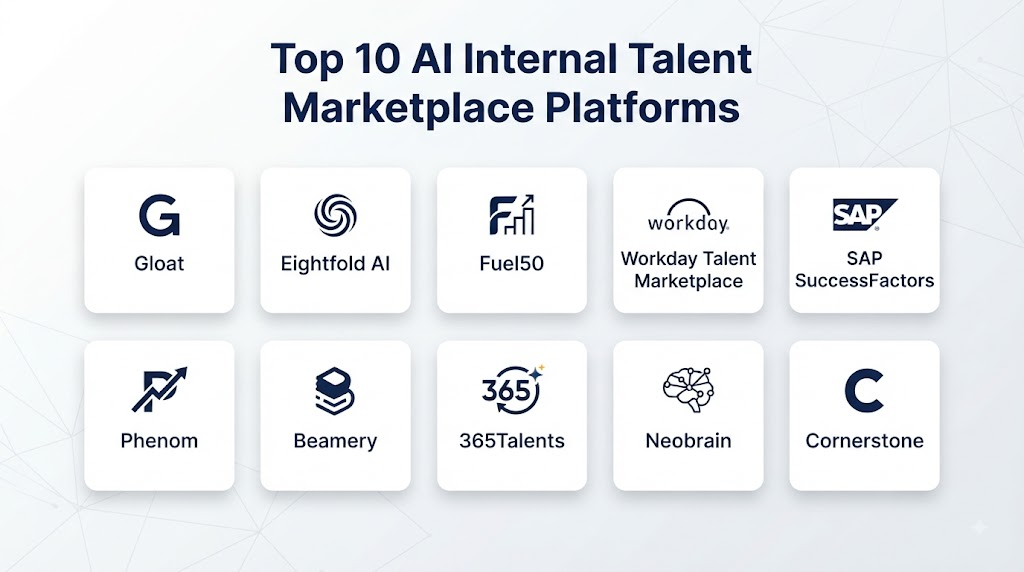
Top 10 AI Internal Talent Marketplace Platforms
1. Gloat
Gloat focuses on internal talent mobility and talent marketplace capabilities, connecting employees with internal opportunities based on skills and career interests.
Key Features
- Internal talent marketplace
- AI-powered talent matching
- Skills intelligence
- Project and gig matching
- Career mobility
- Learning recommendations
- Workforce insights
Pros
- Strong internal marketplace focus
- Skills-based matching
- Supports project opportunities
- Useful workforce agility capabilities
Cons
- Requires reliable employee and skills data
- Organization-wide adoption may require significant change management
2. Eightfold AI
Eightfold AI provides talent intelligence capabilities covering skills, talent acquisition, internal mobility, workforce planning, and career development.
Key Features
- Talent intelligence
- Skills inference
- Internal mobility
- Career recommendations
- Talent matching
- Workforce analytics
Pros
- Strong AI and skills intelligence
- Broad talent management coverage
- Supports internal mobility
- Enterprise-focused platform
Cons
- Broad functionality can require complex implementation
- Organizations need strong governance for AI-generated talent insights
3. Fuel50
Fuel50 provides AI-powered career pathing, internal mobility, skills intelligence, and employee development capabilities.
Key Features
- Career marketplace
- AI career recommendations
- Skills intelligence
- Internal opportunities
- Career pathways
- Learning recommendations
Pros
- Strong career development focus
- Useful internal mobility functionality
- Employee-centered experience
- Skills-based recommendations
Cons
- Organizations need clear career frameworks
- Recommendation quality depends on accurate workforce information
4. Workday
Workday provides HCM, skills, talent, career, workforce, and internal mobility capabilities within a broader enterprise ecosystem.
Key Features
- Employee skills
- Internal opportunities
- Career development
- Talent management
- Workforce analytics
- HCM integration
Pros
- Strong enterprise HR integration
- Broad workforce data availability
- Connects mobility with talent processes
- Suitable for large organizations
Cons
- Enterprise implementation can be complex
- Best value often depends on broader Workday adoption
5. SAP SuccessFactors
SAP SuccessFactors provides talent management and employee development capabilities with support for skills, internal opportunities, career development, and workforce planning.
Key Features
- Talent management
- Career development
- Internal mobility
- Skills management
- Succession planning
- Learning integration
Pros
- Strong enterprise talent ecosystem
- Broad integration capabilities
- Suitable for large organizations
- Supports multiple talent workflows
Cons
- Complex enterprise configuration
- User experience may depend on implementation design
6. Cornerstone
Cornerstone provides learning, skills intelligence, talent mobility, and employee development capabilities.
Key Features
- Skills intelligence
- Career development
- Learning recommendations
- Internal mobility
- Talent marketplace capabilities
- Workforce insights
Pros
- Strong learning and skills ecosystem
- Good development integration
- Enterprise scalability
- Supports skills-based talent strategies
Cons
- Broad platform can require configuration
- Organizations need quality skills frameworks
7. Beamery
Beamery provides talent lifecycle and workforce intelligence capabilities, including skills intelligence and talent matching.
Key Features
- Skills intelligence
- Talent matching
- Workforce planning
- Talent analytics
- Career data
- Talent lifecycle management
Pros
- Strong talent intelligence capabilities
- Useful skills data management
- Supports strategic workforce planning
- Broad talent ecosystem
Cons
- Organizations focused only on internal mobility may need to evaluate feature fit
- Implementation may require data integration work
8. Phenom
Phenom provides talent experience capabilities across recruiting, employee development, talent intelligence, and internal mobility.
Key Features
- Talent marketplace
- Internal mobility
- Skills intelligence
- Employee experience
- Career development
- AI-powered recommendations
Pros
- Broad talent experience platform
- Supports internal and external talent workflows
- Strong personalization capabilities
- Useful employee opportunity discovery
Cons
- Broad platform can increase implementation scope
- Organizations should evaluate specific marketplace functionality
9. 365Talents
365Talents focuses on skills intelligence, talent management, workforce mobility, and employee career development.
Key Features
- Skills mapping
- Internal mobility
- Talent matching
- Career development
- Workforce analytics
- Skills intelligence
Pros
- Strong skills-based approach
- Useful workforce visibility
- Supports internal mobility
- Good focus on talent intelligence
Cons
- Requires reliable skills data
- Integration requirements vary by organization
10. Neobrain
Neobrain provides skills intelligence, workforce planning, internal mobility, and career development capabilities.
Key Features
- Skills intelligence
- Internal mobility
- Career pathways
- Workforce planning
- Skill-gap analysis
- Talent analytics
Pros
- Strong skills-focused platform
- Supports strategic workforce planning
- Useful career mobility capabilities
- Connects skills with organizational needs
Cons
- Enterprise skills transformation may require significant change management
- Results depend on accurate workforce and skills information
Comparison Table
| No. | Platform | Best For | AI Matching | Skills Intelligence | Career Pathing | Gig/Project Matching | Learning Integration |
|---|---|---|---|---|---|---|---|
| 1 | Gloat | Internal talent marketplace | Strong | Strong | Strong | Strong | Strong |
| 2 | Eightfold AI | Enterprise talent intelligence | Strong | Strong | Strong | Strong | Strong |
| 3 | Fuel50 | Career mobility | Strong | Strong | Strong | Moderate | Strong |
| 4 | Workday | HCM-integrated mobility | Strong | Strong | Strong | Moderate | Strong |
| 5 | SAP SuccessFactors | Enterprise talent management | Strong | Strong | Strong | Moderate | Strong |
| 6 | Cornerstone | Skills and development | Strong | Strong | Strong | Moderate | Strong |
| 7 | Beamery | Talent intelligence | Strong | Strong | Strong | Moderate | Moderate |
| 8 | Phenom | Talent experience | Strong | Strong | Strong | Strong | Moderate |
| 9 | 365Talents | Skills-based mobility | Strong | Strong | Strong | Moderate | Moderate |
| 10 | Neobrain | Skills and workforce planning | Strong | Strong | Strong | Moderate | Strong |
Weighted Evaluation Table
| No. | Platform | AI Matching 20% | Skills Intelligence 20% | Internal Mobility 15% | Career Pathing 15% | Learning Integration 10% | Integrations 10% | Ease of Use 10% | Total Score |
|---|---|---|---|---|---|---|---|---|---|
| 1 | Gloat | 20 | 20 | 15 | 15 | 10 | 10 | 9 | 99 |
| 2 | Eightfold AI | 20 | 20 | 15 | 15 | 10 | 10 | 8 | 98 |
| 3 | Fuel50 | 19 | 19 | 15 | 15 | 10 | 9 | 10 | 97 |
| 4 | Workday | 19 | 19 | 14 | 15 | 10 | 10 | 8 | 95 |
| 5 | SAP SuccessFactors | 19 | 19 | 14 | 15 | 10 | 10 | 8 | 95 |
| 6 | Cornerstone | 19 | 20 | 14 | 14 | 10 | 9 | 9 | 95 |
| 7 | Beamery | 19 | 20 | 14 | 14 | 8 | 10 | 8 | 93 |
| 8 | Phenom | 19 | 19 | 15 | 14 | 8 | 9 | 9 | 93 |
| 9 | 365Talents | 18 | 20 | 14 | 14 | 8 | 9 | 9 | 92 |
| 10 | Neobrain | 18 | 20 | 14 | 15 | 9 | 8 | 9 | 93 |
Which AI Internal Talent Marketplace Platform Is Right for You?
Choose Gloat if your primary goal is to build a dedicated internal talent marketplace with strong skills-based opportunity matching.
Choose Eightfold AI if you need broad talent intelligence covering skills, internal mobility, workforce planning, and talent matching.
Choose Fuel50 if employee career development, career pathing, and internal mobility are your main priorities.
Choose Workday if your organization wants internal mobility connected directly with a broader enterprise HCM environment.
Choose SAP SuccessFactors if you need internal mobility as part of a large enterprise talent management ecosystem.
Choose Cornerstone if learning, skills intelligence, employee development, and internal mobility need to work together.
Choose Beamery if skills intelligence and strategic talent data are central to your workforce strategy.
Choose Phenom if you want internal mobility within a broader talent experience platform.
Choose 365Talents if your organization is focused on skills mapping and skills-based workforce mobility.
Choose Neobrain if strategic workforce planning, skills intelligence, and career mobility are closely connected.
Common Mistakes
- Building employee profiles with incomplete skills data
- Treating AI recommendations as automatic hiring decisions
- Failing to explain how opportunities are recommended
- Ignoring employee privacy
- Allowing managers to block internal mobility without clear policies
- Using outdated skills frameworks
- Providing unequal access to internal opportunities
- Ignoring transferable skills
- Failing to verify AI-inferred skills
- Launching a marketplace without change management
- Separating learning from career opportunities
- Measuring platform activity instead of mobility outcomes
- Failing to monitor recommendation bias
FAQs
1. What is an AI Internal Talent Marketplace Platform?
It is a platform that uses skills, employee information, career interests, and AI-powered matching to connect employees with internal jobs, projects, gigs, mentors, and development opportunities.
2. How does AI talent matching work?
AI can compare employee skills, experience, interests, and career information with the requirements of internal opportunities to identify potentially relevant matches.
3. Can these platforms identify hidden employee skills?
Yes. Some platforms can infer or surface skills from employee profiles, work history, learning activities, projects, and other approved workforce data.
4. Can employees find temporary projects through an internal marketplace?
Many talent marketplace platforms support internal gigs, projects, stretch assignments, and temporary opportunities.
5. How do talent marketplaces support career development?
They can recommend potential career paths, target roles, relevant skills, development opportunities, and learning resources.
6. Can AI reduce external hiring?
Internal talent marketplaces can help organizations discover existing capabilities and identify employees who may be suitable for internal opportunities, potentially reducing dependence on external hiring for some roles.
7. What are the main risks of AI talent marketplaces?
Major concerns include incomplete skills data, algorithmic bias, employee privacy, poor transparency, unequal opportunity access, and excessive reliance on automated recommendations.
8. Can AI recommend employees for promotions?
AI can assist with identifying potential opportunities or relevant skills, but promotion and other consequential employment decisions should involve appropriate human judgment and organizational review.
9. What systems can an internal talent marketplace integrate with?
Common integrations include HRIS, HCM, LMS, performance management, recruiting, skills intelligence, workforce planning, and people analytics systems.
10. What is the future of AI internal talent marketplaces?
The category is moving toward skills-based organizations, dynamic project matching, AI career assistants, internal gig economies, workforce redeployment, integrated learning, skills graphs, and increasingly personalized career opportunities.
Conclusion
AI Internal Talent Marketplace Platforms are helping organizations unlock greater value from their existing workforce by making skills, career opportunities, projects, and development paths more visible. Rather than limiting employee mobility to traditional job postings and manager networks, these platforms can create a more dynamic and skills-based approach to connecting people with opportunities.Gloat, Eightfold AI, Fuel50, Workday, SAP SuccessFactors, Cornerstone, Beamery, Phenom, 365Talents, and Neobrain provide different approaches to internal mobility, skills intelligence, talent matching, and workforce development.The best platform depends on organizational size, existing HR infrastructure, skills maturity, internal mobility strategy, learningecosystem, and workforce planning requirements.