Introduction
AI feedback mining and theming tools help businesses turn large volumes of customer comments, surveys, reviews, support tickets, interviews, chats, and product feedback into organized insights. Instead of reading every response manually, teams can use these platforms to identify recurring themes, sentiment, customer needs, complaints, feature requests, friction points, and emerging trends.
Modern feedback analysis goes beyond simple keyword counting. Advanced tools can cluster similar comments, generate themes automatically, connect sentiment with specific topics, summarize thousands of responses, identify root causes, and track how customer concerns change over time. Some platforms also combine feedback with product usage, customer segments, support history, or revenue data so teams can understand which issues matter most.
Common use cases include Voice of Customer analysis, product-feedback research, feature-request analysis, support-ticket mining, review analysis, survey analysis, churn research, customer-experience monitoring, and product-roadmap prioritization.
What’s Changing in AI Feedback Mining & Theming Tools
- Feedback analysis is moving beyond manual tagging toward automatically generated themes.
- AI can increasingly discover topics without predefined categories.
- Themes can be created at different levels, such as broad issues and detailed subtopics.
- Sentiment can increasingly be measured for individual themes rather than the whole comment.
- LLM-based analysis can interpret longer and more nuanced customer responses.
- Feedback from support, surveys, reviews, interviews, and social channels can increasingly be analyzed together.
- AI-generated summaries can reduce the time required to review thousands of responses.
- Product teams increasingly connect feature requests with customer segments and account value.
- Feedback mining is becoming more useful for churn investigation.
- Customer complaints can be connected with product areas or journey stages.
- Duplicate feature requests can increasingly be grouped automatically.
- Emerging issues can be identified before they become dominant themes.
- Multilingual feedback analysis is becoming more practical.
- Teams increasingly want evidence behind AI-generated themes.
- Human validation remains important because automated clusters can merge unrelated issues.
- AI can increasingly separate product complaints from service complaints.
- Feedback themes can be linked with sentiment trends over time.
- Customer feedback is increasingly combined with product usage and behavioral data.
- Privacy matters because feedback can contain personal or confidential customer information.
- The strongest platforms focus on helping teams take action rather than producing more dashboards.
Quick Buyer Checklist
Before selecting an AI feedback mining and theming tool, check whether it can:
- Import survey responses.
- Analyze support tickets.
- Analyze reviews.
- Analyze chat conversations.
- Analyze call transcripts.
- Analyze interview notes.
- Generate themes automatically.
- Create custom themes.
- Support hierarchical themes.
- Detect sentiment.
- Perform aspect-based sentiment analysis.
- Identify feature requests.
- Detect recurring complaints.
- Find emerging topics.
- Merge duplicate feedback.
- Summarize feedback.
- Support multilingual analysis.
- Segment insights by customer type.
- Segment by product or feature.
- Connect feedback with account data.
- Connect feedback with revenue where needed.
- Track theme trends.
- Provide source evidence.
- Allow human correction.
- Export data.
- Integrate with CRM.
- Integrate with support platforms.
- Provide APIs.
- Apply RBAC.
- Protect customer information.
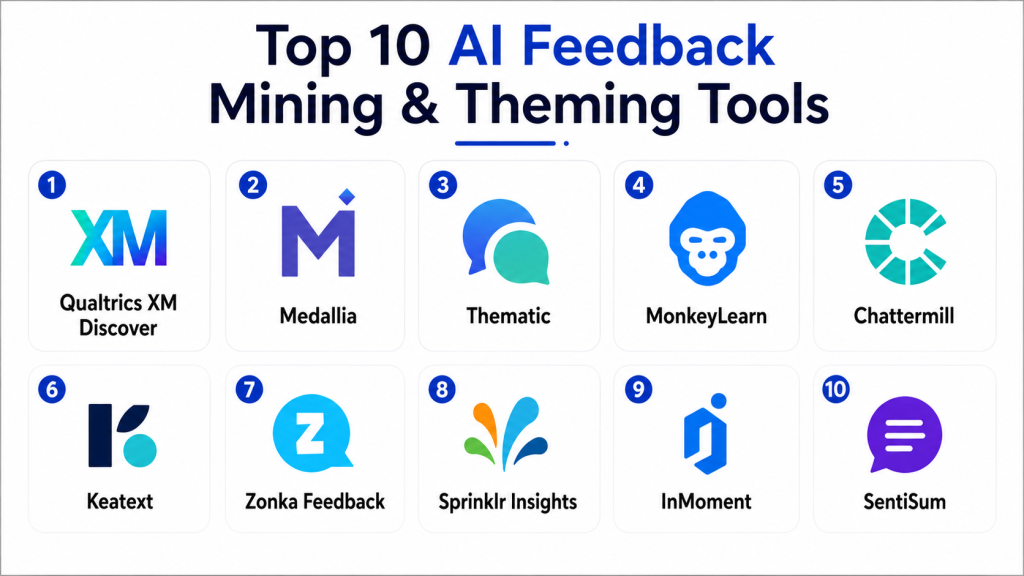
Top 10 AI Feedback Mining & Theming Tools
1 — Chattermill
One-line verdict: Best for product and CX teams wanting unified customer-feedback themes, sentiment, and experience insights across multiple channels.
Chattermill focuses on customer-feedback intelligence. It helps teams combine feedback from surveys, reviews, support, and other channels so recurring customer themes and experience problems can be analyzed in one place.
Standout Capabilities
- Automated feedback categorization.
- Theme detection.
- Sentiment analysis.
- Unified Voice of Customer.
- Customer-experience trends.
- Product-feedback analysis.
- Journey insights.
- Customer segmentation.
AI-Specific Depth
- Model support: Platform-managed AI.
- RAG / knowledge integration: Customer-feedback context.
- Evaluation: Human review and theme validation.
- Guardrails: Workspace permissions and data controls.
- Observability: Theme, sentiment, and customer-experience analytics.
Pros
- Strong multi-source feedback analysis.
- Useful for product and CX teams.
- Helps connect themes with customer outcomes.
Cons
- Requires source integrations for maximum value.
- Theme quality depends on feedback quality.
- Larger implementations require taxonomy governance.
Security & Compliance
Verify SSO, RBAC, auditing, encryption, data retention, residency, and required certifications according to deployment.
Deployment & Platforms
- Cloud: Available.
- Web: Available.
- Data integrations: Available.
Integrations & Ecosystem
- Surveys
- Helpdesk systems
- Reviews
- CRM
- Data warehouses
- Product feedback
- Analytics workflows
Pricing Model
Commercial SaaS.
Best-Fit Scenarios
- Voice of Customer.
- Product-feedback analysis.
- Multi-channel CX research.
2 — Thematic
One-line verdict: Best for teams wanting automated theme discovery from surveys, customer comments, reviews, and support feedback.
Thematic is focused on analyzing text feedback and converting it into structured themes and sentiment insights. It is useful for teams that want to discover what customers are discussing without manually tagging every response.
Standout Capabilities
- Automatic theme discovery.
- Sentiment analysis.
- Feedback categorization.
- Theme hierarchy.
- Trend analysis.
- Customer-comment analysis.
- Survey analysis.
- Reporting.
AI-Specific Depth
- Model support: Platform-managed AI.
- RAG / knowledge integration: Feedback context.
- Evaluation: Human theme review and category validation.
- Guardrails: Workspace and analyst controls.
- Observability: Theme and sentiment analytics.
Pros
- Strong text-feedback specialization.
- Useful automatic theme generation.
- Reduces manual coding work.
Cons
- Best suited to feedback analytics rather than broad CX operations.
- Themes still require human interpretation.
- Custom business context may need setup.
Security & Compliance
Verify SSO, RBAC, auditing, retention, encryption, residency, and relevant certifications.
Deployment & Platforms
- Cloud: Available.
- Web: Available.
- Feedback-data integrations: Available.
Integrations & Ecosystem
- Surveys
- Customer comments
- Support feedback
- Reviews
- Analytics tools
- Data exports
Pricing Model
Commercial SaaS.
Best-Fit Scenarios
- Survey analysis.
- Customer-comment theming.
- Product and experience research.
3 — Enterpret
One-line verdict: Best for product-led companies wanting feedback themes connected with customer, product, and business context.
Enterpret is designed for customer-feedback intelligence and product research. It can help teams organize large volumes of feedback into structured categories and connect themes with customer information.
Standout Capabilities
- Feedback taxonomy.
- Theme discovery.
- Feature-request analysis.
- Sentiment.
- Product-feedback intelligence.
- Customer segmentation.
- Feedback search.
- Trend monitoring.
AI-Specific Depth
- Model support: Platform-managed AI.
- RAG / knowledge integration: Customer and feedback context.
- Evaluation: Human review and taxonomy validation.
- Guardrails: Workspace and data permissions.
- Observability: Feedback and product-insight analytics.
Pros
- Strong product-feedback orientation.
- Useful for feature-request analysis.
- Helps centralize scattered feedback.
Cons
- Primarily product and customer-feedback focused.
- Value depends on integrations.
- Taxonomy management still needs ownership.
Security & Compliance
Verify SSO, RBAC, auditing, encryption, retention, residency, and certifications.
Deployment & Platforms
- Cloud: Available.
- Web: Available.
- Data integrations: Available.
Integrations & Ecosystem
- Support systems
- Surveys
- Product feedback
- CRM
- Customer-success platforms
- Collaboration tools
- Data sources
Pricing Model
Commercial SaaS.
Best-Fit Scenarios
- Product roadmap research.
- Feature-request analysis.
- SaaS customer-feedback intelligence.
4 — SentiSum
One-line verdict: Best for support-focused teams mining customer complaints, topics, sentiment, and contact reasons from service conversations.
SentiSum is strongly focused on customer-support intelligence. It can analyze tickets, reviews, chats, and other feedback to identify why customers contact support and which issues are driving dissatisfaction.
Standout Capabilities
- Topic detection.
- Contact-reason analysis.
- Sentiment analysis.
- Support-ticket mining.
- Root-cause insights.
- Complaint analysis.
- Trend detection.
- Customer-feedback intelligence.
AI-Specific Depth
- Model support: Platform-managed AI.
- RAG / knowledge integration: Support and feedback context.
- Evaluation: Human category review.
- Guardrails: Workspace permissions.
- Observability: Support, topic, and sentiment analytics.
Pros
- Strong support specialization.
- Useful for recurring issue detection.
- Practical for identifying operational problems.
Cons
- Narrower than broad enterprise VoC platforms.
- Less focused on product-roadmap workflows.
- Requires enough support volume to create useful patterns.
Security & Compliance
Verify SSO, RBAC, auditability, encryption, retention, residency, and certifications.
Deployment & Platforms
- Cloud: Available.
- Web: Available.
- Support-data integrations: Available.
Integrations & Ecosystem
- Helpdesks
- Surveys
- Reviews
- CRM
- Support analytics
- Customer-feedback sources
Pricing Model
Commercial SaaS.
Best-Fit Scenarios
- Support-ticket mining.
- Complaint analysis.
- Contact-reason discovery.
5 — Qualtrics Text and Feedback Analytics
One-line verdict: Best for enterprises combining feedback theming with surveys, Voice of Customer, sentiment, and broader experience management.
Qualtrics provides customer-experience and survey analytics that can help organizations analyze large amounts of unstructured feedback alongside structured experience data.
Standout Capabilities
- Text analytics.
- Theme detection.
- Sentiment analysis.
- Survey analytics.
- Voice of Customer.
- Experience drivers.
- Customer segmentation.
- Enterprise reporting.
AI-Specific Depth
- Model support: Platform-managed AI.
- RAG / knowledge integration: Customer-experience context varies.
- Evaluation: Survey comparison and human analysis.
- Guardrails: Enterprise permissions and governance.
- Observability: Feedback, sentiment, and CX analytics.
Pros
- Strong enterprise experience ecosystem.
- Useful for large survey programs.
- Combines text feedback with structured customer metrics.
Cons
- More complex than dedicated feedback tools.
- Enterprise implementation can be substantial.
- May be too broad for small product teams.
Security & Compliance
Verify SSO, RBAC, auditing, encryption, retention, residency, and required certifications.
Deployment & Platforms
- Cloud: Available.
- Web: Available.
- Enterprise experience environments: Available.
Integrations & Ecosystem
- Surveys
- CRM
- Contact centers
- Customer feedback
- Enterprise analytics
- Experience workflows
Pricing Model
Enterprise commercial pricing.
Best-Fit Scenarios
- Enterprise Voice of Customer.
- Survey feedback mining.
- Customer-experience programs.
6 — Medallia Text Analytics
One-line verdict: Best for large enterprises mining customer feedback across surveys, contact centers, digital experiences, and service channels.
Medallia combines customer-experience management with text and feedback analytics. It can help organizations identify themes, sentiment, customer problems, and experience trends across multiple channels.
Standout Capabilities
- Text-feedback analysis.
- Sentiment.
- Theme identification.
- Experience analytics.
- Customer feedback.
- Journey context.
- Contact-center insights.
- Trend detection.
AI-Specific Depth
- Model support: Platform-managed AI.
- RAG / knowledge integration: Customer-experience context varies.
- Evaluation: Human review and experience validation.
- Guardrails: Enterprise controls and permissions.
- Observability: Feedback and experience analytics.
Pros
- Broad enterprise CX coverage.
- Suitable for large datasets.
- Combines feedback and operational experience signals.
Cons
- Enterprise-focused.
- Implementation can be complex.
- Smaller teams may need a simpler platform.
Security & Compliance
Verify SSO, RBAC, audit logs, encryption, retention, residency, and certifications.
Deployment & Platforms
- Cloud: Available.
- Web: Available.
- Enterprise CX environments: Available.
Integrations & Ecosystem
- Surveys
- Contact centers
- CRM
- Digital experiences
- Customer feedback
- Enterprise data
Pricing Model
Enterprise commercial model.
Best-Fit Scenarios
- Large CX programs.
- Omnichannel feedback mining.
- Enterprise sentiment and theme analytics.
7 — Dovetail
One-line verdict: Best for research and product teams organizing qualitative feedback, interview notes, themes, and customer research.
Dovetail is oriented toward customer research, user interviews, qualitative analysis, and research repositories. It is particularly useful when feedback mining needs human research workflows alongside AI-assisted analysis.
Standout Capabilities
- Research repository.
- Interview analysis.
- Feedback tagging.
- Theme organization.
- Research summaries.
- Customer evidence.
- Collaborative analysis.
- Insight sharing.
AI-Specific Depth
- Model support: Platform-managed AI capabilities.
- RAG / knowledge integration: Research repository context.
- Evaluation: Human researcher validation.
- Guardrails: Workspace and project permissions.
- Observability: Research and insight activity.
Pros
- Strong qualitative research workflow.
- Excellent for interviews and customer studies.
- Keeps evidence connected to insights.
Cons
- Less automated than some large-scale feedback-mining tools.
- Not primarily designed for contact-center analytics.
- Very high-volume operational feedback may require other tools.
Security & Compliance
Verify SSO, RBAC, auditability, encryption, retention, residency, and required certifications.
Deployment & Platforms
- Cloud: Available.
- Web: Available.
- Research workspace: Available.
Integrations & Ecosystem
- Research interviews
- Documents
- Customer feedback
- Collaboration
- Product research
- Research repositories
Pricing Model
Tiered commercial SaaS.
Best-Fit Scenarios
- UX research.
- Interview theming.
- Product discovery.
8 — Productboard
One-line verdict: Best for product teams connecting customer feedback themes with feature ideas, prioritization, and product planning.
Productboard focuses on product management and customer insights. It can help product teams centralize feedback, connect insights with features, and identify recurring customer needs.
Standout Capabilities
- Customer-feedback collection.
- Product insights.
- Feature-request organization.
- Feedback linking.
- Product prioritization.
- Customer segmentation.
- Product planning.
- Feedback repositories.
AI-Specific Depth
- Model support: Platform-managed AI capabilities vary.
- RAG / knowledge integration: Product and customer-feedback context.
- Evaluation: Product-team review and feedback evidence.
- Guardrails: Workspace permissions and product workflows.
- Observability: Product-insight and feedback analytics.
Pros
- Strong connection between feedback and roadmap planning.
- Useful for feature-request workflows.
- Helps product managers preserve supporting evidence.
Cons
- Less specialized in advanced sentiment analysis.
- Not designed primarily for support analytics.
- Feedback quality still requires human review.
Security & Compliance
Verify SSO, RBAC, auditing, encryption, retention, residency, and certifications.
Deployment & Platforms
- Cloud: Available.
- Web: Available.
- Product-management environment: Available.
Integrations & Ecosystem
- CRM
- Support tools
- Product feedback
- Collaboration platforms
- Product-management workflows
- Customer data
Pricing Model
Commercial SaaS.
Best-Fit Scenarios
- Feature-request mining.
- Product roadmap planning.
- Customer-driven product discovery.
9 — Sprig
One-line verdict: Best for product and UX teams combining in-product research, surveys, feedback analysis, and behavioral context.
Sprig focuses on product research and user feedback. It can help teams collect feedback in context and analyze responses alongside product experiences.
Standout Capabilities
- In-product surveys.
- Feedback analysis.
- User research.
- Theme discovery.
- Experience research.
- Behavioral context.
- Product insights.
- Research workflows.
AI-Specific Depth
- Model support: Platform-managed AI capabilities.
- RAG / knowledge integration: Product research context.
- Evaluation: Researcher review and behavioral outcomes.
- Guardrails: Workspace permissions.
- Observability: Research and response analytics.
Pros
- Strong in-product research.
- Useful for product teams.
- Connects feedback with user context.
Cons
- Less suited to broad contact-center analysis.
- Focused primarily on product and UX research.
- Enterprise VoC programs may need broader tooling.
Security & Compliance
Verify SSO, RBAC, audit logs, encryption, retention, residency, and certifications.
Deployment & Platforms
- Cloud: Available.
- Web: Available.
- In-product research: Available.
Integrations & Ecosystem
- Product applications
- User research
- Surveys
- Analytics
- Customer-data tools
- Product workflows
Pricing Model
Commercial SaaS.
Best-Fit Scenarios
- Product feedback.
- In-product surveys.
- UX research.
10 — Custom LLM Feedback Mining Platform
One-line verdict: Best for mature organizations needing custom taxonomies, private models, source control, and highly specialized feedback analytics.
Organizations with strong data and AI teams can build custom feedback-mining systems using language models, embeddings, clustering, vector search, customer data, support conversations, surveys, and data warehouses.
Standout Capabilities
- Custom theme discovery.
- Custom taxonomies.
- BYO models.
- Sentiment classification.
- Feature-request extraction.
- Duplicate clustering.
- Private deployment.
- Custom dashboards.
AI-Specific Depth
- Model support: Proprietary / open-source / BYO / multi-model.
- RAG / knowledge integration: Fully customizable.
- Evaluation: Human-coded datasets, regression tests, clustering evaluation, and category accuracy.
- Guardrails: Source controls, permissions, privacy filters, and human review.
- Observability: Theme stability, model drift, accuracy, latency, cost, and corrections.
Pros
- Maximum flexibility.
- Can support specialized domain language.
- Strong privacy and architecture control.
Cons
- High engineering effort.
- Theme quality requires continuous evaluation.
- Dashboards and workflows must be maintained internally.
Security & Compliance
Architecture-dependent. Organizations must implement identity, access controls, encryption, auditing, retention, privacy, residency, and model governance.
Deployment & Platforms
- Cloud: Possible.
- Self-hosted: Possible.
- Hybrid: Possible.
- Private models: Possible.
Integrations & Ecosystem
- CRM
- Helpdesk
- Surveys
- Reviews
- Data warehouses
- BI systems
- Internal applications
Pricing Model
Infrastructure, model, engineering, storage, integration, and maintenance costs.
Best-Fit Scenarios
- Regulated enterprises.
- Highly specialized feedback taxonomies.
- Organizations with strong internal AI teams.
Comparison Table
| Tool Name | Best For | Deployment | Model Flexibility | Strength | Watch-Out | Public Rating |
|---|---|---|---|---|---|---|
| Chattermill | Product and CX teams | Cloud | Hosted | Unified feedback intelligence | Integration effort | N/A |
| Thematic | Survey and text feedback | Cloud | Hosted | Automatic theme discovery | Requires human interpretation | N/A |
| Enterpret | Product-led businesses | Cloud | Hosted | Product-feedback taxonomy | Needs data integrations | N/A |
| SentiSum | Support teams | Cloud | Hosted | Support-topic mining | Narrower scope | N/A |
| Qualtrics | Enterprise CX | Cloud | Hosted | VoC + feedback analytics | Enterprise complexity | N/A |
| Medallia | Large CX programs | Cloud | Hosted | Omnichannel feedback | Implementation overhead | N/A |
| Dovetail | UX and research teams | Cloud | Hosted | Qualitative research | Less operational automation | N/A |
| Productboard | Product management | Cloud | Hosted / Varies | Feedback-to-roadmap workflow | Lighter sentiment depth | N/A |
| Sprig | Product and UX teams | Cloud | Hosted | In-product feedback | Product-focused | N/A |
| Custom Platform | Mature enterprises | Cloud / Self-hosted / Hybrid | BYO / Multi-model | Maximum control | Engineering overhead | N/A |
Scoring & Evaluation
The scores below are comparative editorial assessments rather than official vendor ratings. Feedback-mining platforms should be judged by how accurately they organize customer evidence and whether the resulting themes lead to useful product, support, or CX decisions.
Core features measure theme discovery, sentiment, clustering, segmentation, and summarization. Reliability considers human validation and source evidence. Guardrails cover customer-data access and privacy. Integrations measure support, CRM, surveys, research, and product-data connectivity.
- Core features – 20%
- AI reliability and evaluation – 15%
- Guardrails and safety – 10%
- Integrations and ecosystem – 15%
- Ease of use – 10%
- Performance and cost controls – 15%
- Security and administration – 10%
- Support and community – 5%
| Tool | Core | Reliability/Eval | Guardrails | Integrations | Ease | Perf/Cost | Security/Admin | Support | Weighted Total |
|---|---|---|---|---|---|---|---|---|---|
| Chattermill | 10 | 9 | 9 | 10 | 9 | 8 | 9 | 9 | 9.15 |
| Thematic | 10 | 9 | 9 | 9 | 9 | 9 | 9 | 8 | 9.00 |
| Enterpret | 10 | 9 | 9 | 10 | 9 | 8 | 9 | 9 | 9.15 |
| SentiSum | 9 | 9 | 9 | 9 | 9 | 9 | 9 | 8 | 8.85 |
| Qualtrics | 10 | 9 | 10 | 10 | 8 | 7 | 10 | 10 | 9.10 |
| Medallia | 10 | 9 | 10 | 10 | 8 | 7 | 10 | 10 | 9.10 |
| Dovetail | 9 | 10 | 9 | 9 | 10 | 8 | 9 | 9 | 9.05 |
| Productboard | 9 | 9 | 9 | 10 | 9 | 8 | 9 | 9 | 9.00 |
| Sprig | 9 | 9 | 9 | 9 | 9 | 8 | 9 | 9 | 8.85 |
| Custom Platform | 10 | 10 | 10 | 10 | 5 | 7 | 10 | 6 | 8.85 |
Which AI Feedback Mining & Theming Tool Is Right for You?
Solo / Freelancer
Solo professionals rarely need a dedicated enterprise feedback-intelligence platform.
Simple tagging and summarization may be enough when feedback volume is small.
Start by grouping responses into a few practical themes such as:
- Product problem.
- Pricing concern.
- Feature request.
- Support complaint.
- Positive feedback.
SMB
Small and growing businesses should prioritize easy theme discovery and clear evidence.
The platform should help answer:
- What are customers complaining about most?
- Which feature is requested repeatedly?
- Which issues are increasing?
- What causes negative sentiment?
- Which feedback deserves immediate attention?
Avoid building an overly complicated taxonomy too early.
Mid-Market
Mid-market organizations should combine feedback from:
- Support tickets.
- Surveys.
- Reviews.
- Customer-success conversations.
- Product research.
- Interviews.
The same customer issue may appear differently across each channel, so unified analysis becomes increasingly valuable.
Enterprise
Enterprise buyers should evaluate:
- SSO.
- RBAC.
- Audit logs.
- Data retention.
- Data residency.
- Custom taxonomies.
- Multilingual support.
- Customer segmentation.
- Source evidence.
- CRM integration.
- Support integration.
- Survey integration.
- Data-warehouse export.
- Human validation.
- Model monitoring.
AI-generated themes should always remain traceable to supporting customer evidence.
Regulated Industries
Healthcare, finance, insurance, government, and other regulated sectors should carefully manage feedback containing sensitive information.
Use:
- Least-privilege access.
- Data minimization.
- Appropriate retention.
- Redaction where required.
- Human review for sensitive conclusions.
Do not infer sensitive customer characteristics unnecessarily from free-text feedback.
Budget vs Premium
Lightweight tools can be enough for surveys and product feedback.
Premium platforms become valuable when organizations need:
- Multiple feedback sources.
- Large-scale automation.
- Multilingual analysis.
- Enterprise permissions.
- Customer segmentation.
- Journey context.
- Revenue or account overlays.
- Advanced Voice of Customer analytics.
Measure the quality of decisions improved rather than simply the number of comments analyzed.
Build vs Buy
Building can make sense when the organization needs a highly specific taxonomy or private model infrastructure.
Buying is generally faster when standard theme discovery, sentiment, clustering, and feedback integrations are sufficient.
Implementation Playbook: 30 / 60 / 90 Days
First 30 Days — Build a Feedback Baseline
Collect a representative set of:
- Support tickets.
- Reviews.
- Survey comments.
- Interview notes.
- Feature requests.
Have humans manually code part of the sample.
Create an initial taxonomy.
Measure:
- Theme accuracy.
- Missing themes.
- Duplicate themes.
- Sentiment accuracy.
- Human correction rate.
Days 31–60 — Connect Customer Context
Add useful metadata such as:
- Product.
- Plan.
- Customer segment.
- Region.
- Lifecycle stage.
- Account value.
- Support queue.
This makes feedback more actionable.
For example, a theme reported by five strategic customers may deserve more attention than a larger number of low-impact comments.
Days 61–90 — Operationalize Insights
Connect recurring themes with:
- Product planning.
- Support operations.
- Knowledge updates.
- Customer-success outreach.
- UX research.
- Executive reporting.
Track:
- Theme volume.
- Theme sentiment.
- Trend changes.
- Product issues resolved.
- Feature requests addressed.
- Reduction in recurring support contacts.
Refresh the taxonomy as products and customer behavior change.
Common Mistakes and How to Avoid Them
- Creating too many overlapping themes.
- Treating every keyword as a customer theme.
- Ignoring customer context.
- Ignoring duplicate feedback.
- Using sentiment without topic context.
- Automatically trusting AI-generated themes.
- Losing source evidence behind summaries.
- Ignoring multilingual accuracy.
- Treating all customers as equally important to every decision.
- Mixing feature requests with product bugs.
- Combining support problems with product dissatisfaction.
- Using outdated taxonomies.
- Ignoring new emerging themes.
- Measuring comment volume without business impact.
- Failing to connect themes with customer segments.
- Ignoring privacy requirements.
- Generating themes without human review.
- Overreacting to small samples.
- Creating dashboards without ownership for follow-up.
- Assuming feedback automatically represents the entire customer base.
Frequently Asked Questions
1. What is AI feedback mining?
AI feedback mining uses automated text analysis to extract useful information from customer comments, surveys, reviews, tickets, interviews, and other unstructured feedback.
2. What is automated feedback theming?
Automated theming groups related customer comments into topics such as pricing, usability, billing, bugs, support quality, or feature requests without requiring every response to be manually tagged.
3. Can AI discover themes automatically?
Yes. Modern systems can identify recurring patterns and generate candidate themes from large feedback datasets. Human review is still useful for validating the results.
4. Can feedback mining identify feature requests?
Yes. AI can identify, group, and summarize repeated feature requests from support conversations, surveys, customer interviews, and reviews.
5. Can AI analyze customer sentiment by theme?
Yes. Aspect-based analysis can identify different sentiment toward separate parts of the customer experience, such as positive product sentiment but negative pricing sentiment.
6. Can feedback tools analyze multiple channels together?
Yes. Many platforms can combine surveys, support tickets, reviews, interviews, and other feedback sources into a unified analysis environment.
7. Can AI feedback mining replace customer interviews?
No. Automated analysis helps identify patterns across large datasets, while direct interviews remain valuable for understanding motivations, context, and deeper customer needs.
8. How do I validate AI-generated themes?
Review representative source comments, compare AI categories with human-coded samples, measure disagreement, and periodically audit emerging or changing themes.
9. Can feedback mining help reduce churn?
Yes. Repeated complaints, declining sentiment, support problems, missing capabilities, and customer-effort themes can help teams investigate factors contributing to churn.
10. How do I choose the best AI feedback mining and theming tool?
Compare automatic theme discovery, sentiment analysis, source coverage, customer segmentation, evidence traceability, integrations, multilingual support, customization, privacy, security, human review, trend analysis, and how easily insights can be turned into product or CX actions.
Conclusion
AI feedback mining and theming tools help businesses turn thousands of unstructured customer comments into organized evidence that product, support, research, and customer-experience teams can actually use. Instead of manually reviewing every ticket, survey response, review, or interview note, teams can identify repeated themes, emerging complaints, feature requests, sentiment changes, and important experience patterns much faster.Different platforms fit different requirements. Chattermill and Thematic are strong for automated Voice of Customer analysis. Enterpret is particularly useful for product-feedback intelligence, while SentiSum focuses strongly on support-driven insights. Qualtrics and Medallia fit large enterprise experience programs. Dovetail is well suited to qualitative research, Productboard connects customer evidence with product planning, and Sprig is useful for in-product research. Organizations with highly specialized requirements can also build custom feedback-mining systems.