Introduction
AI SEO content optimization tools help marketers, SEO professionals, writers, agencies, and businesses improve content for search visibility. These platforms analyze keywords, search intent, competing pages, topics, entities, questions, content structure, readability, and topical coverage to provide practical optimization recommendations.
Modern SEO optimization is no longer limited to adding keywords to an article. Strong platforms can help teams create content briefs, discover missing topics, optimize existing pages, build content clusters, improve internal linking, generate SEO-friendly drafts, and monitor content performance. They can also help teams prepare content for evolving search experiences where users increasingly receive direct answers instead of simply browsing a traditional list of results.
Common use cases include blog optimization, landing-page improvement, content refreshing, competitor analysis, topical research, content briefs, keyword clustering, internal linking, and large-scale SEO content planning.
What’s Changing in AI SEO Content Optimization Tools
- SEO optimization is shifting from keyword density toward complete topic coverage.
- Search intent is becoming more important than exact-match keyword repetition.
- AI can identify missing subtopics and questions automatically.
- Content briefs can be created much faster from competitor and search-result analysis.
- Existing-content optimization is becoming as important as creating new articles.
- AI can help identify pages that need refreshing.
- Content tools increasingly combine research, writing, optimization, and monitoring.
- Entity-based optimization is becoming more important.
- Internal-link recommendations are becoming more automated.
- AI can help identify content cannibalization and overlapping topics.
- Content teams increasingly use AI to create outlines before drafting.
- Search visibility increasingly includes traditional results and AI-generated answers.
- Content optimization platforms are beginning to consider answer-engine visibility.
- Brand voice controls are becoming more useful for scaled SEO production.
- Multilingual optimization is becoming more practical.
- AI-generated SEO content still requires human fact-checking.
- Original expertise and first-hand information are increasingly valuable.
- Teams are moving away from blindly following optimization scores.
- Content performance data is increasingly connected with optimization workflows.
- SEO automation is becoming more agentic, but publishing still benefits from human approval.
Quick Buyer Checklist
Before selecting an AI SEO content optimization tool, check whether it can:
- Analyze search intent.
- Analyze competing pages.
- Identify important topics.
- Identify relevant entities.
- Recommend semantic terms.
- Discover content gaps.
- Create content briefs.
- Generate outlines.
- Score content.
- Optimize content while writing.
- Optimize existing articles.
- Suggest important questions.
- Generate titles.
- Assist with meta descriptions.
- Support keyword clustering.
- Create topic clusters.
- Recommend internal links.
- Monitor published pages.
- Support content refreshing.
- Assist with AI-generated drafts.
- Maintain brand voice.
- Support multiple languages.
- Integrate with content workflows.
- Support team collaboration.
- Provide content inventories.
- Reduce keyword stuffing.
- Support human editing.
- Help evaluate AI-search visibility.
- Maintain permissions where required.
- Measure performance beyond a proprietary content score.
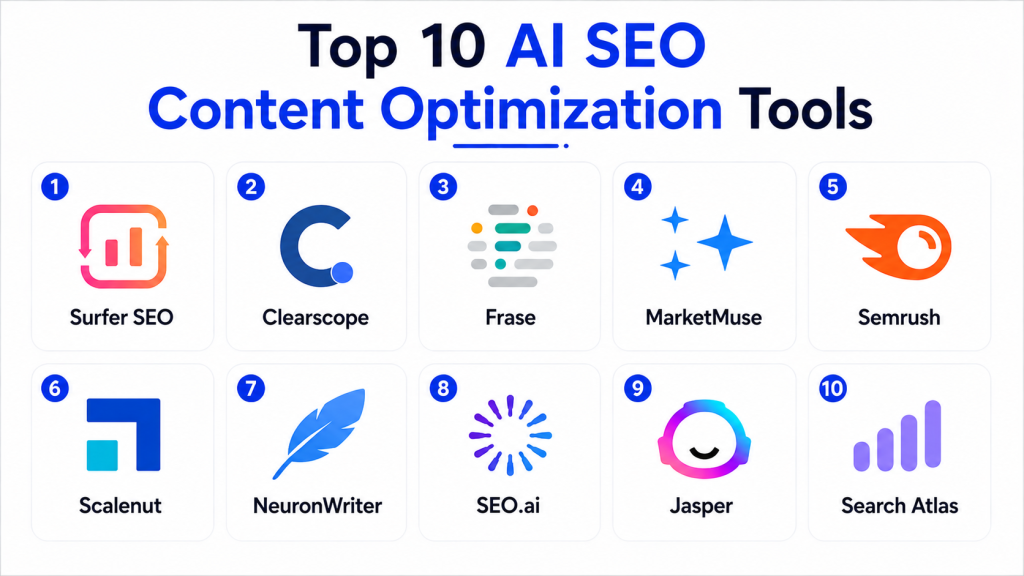
Top 10 AI SEO Content Optimization Tools
1 — Surfer
One-line verdict: Best for SEO teams wanting real-time content optimization, competitive analysis, content scoring, and AI-assisted writing.
Surfer is a popular SEO content optimization platform designed to help writers improve pages based on competitive search data and topical recommendations.
Its content editor provides recommendations while content is being created or updated.
Standout Capabilities
- Content Editor.
- Content scoring.
- SERP-based analysis.
- Topic recommendations.
- Semantic term suggestions.
- Content briefs.
- Existing-page optimization.
- AI-assisted writing.
AI-Specific Depth
- Model support: Platform-managed AI.
- RAG / knowledge integration: Search and content context.
- Evaluation: Content scoring, human review, and search-performance analysis.
- Guardrails: Human editorial approval and workspace controls.
- Observability: Content optimization and performance insights.
Pros
- Easy real-time optimization.
- Strong SEO writing workflow.
- Useful for agencies and content teams.
Cons
- Writers can become overly focused on scores.
- Recommendations still require human judgment.
- Not a complete replacement for technical SEO tools.
Security & Compliance
SSO, RBAC, audit logs, encryption, data retention, residency, and certifications should be verified according to the selected plan.
Deployment & Platforms
- Web: Available.
- Cloud: Available.
- Browser-based workflows: Available.
Integrations & Ecosystem
Surfer can fit into common SEO writing and publishing workflows.
- Content editors
- CMS workflows
- SEO operations
- Writing workflows
- Team collaboration
- Content production
Pricing Model
Tiered commercial SaaS.
Best-Fit Scenarios
- SEO article optimization.
- Existing-content refreshing.
- Agency content production.
2 — Clearscope
One-line verdict: Best for quality-focused editorial teams wanting clear topical recommendations without overly complicated SEO workflows.
Clearscope helps writers and SEO teams improve topical relevance and content completeness. It focuses on providing understandable recommendations that can be incorporated naturally into high-quality content.
Standout Capabilities
- Content optimization.
- Topic recommendations.
- Content grading.
- Competitor analysis.
- Search-intent research.
- Content monitoring.
- Existing-page optimization.
- Editorial workflows.
AI-Specific Depth
- Model support: Platform-managed AI and analysis.
- RAG / knowledge integration: N/A for conventional RAG.
- Evaluation: Content grades, human review, and search results.
- Guardrails: Human editorial control.
- Observability: Content monitoring and optimization metrics.
Pros
- Clean interface.
- Strong topical recommendations.
- Good for professional editorial teams.
Cons
- Can be expensive for smaller teams.
- Less automation than some all-in-one platforms.
- Does not replace technical SEO analysis.
Security & Compliance
Enterprise security capabilities should be verified for the required subscription and deployment.
Deployment & Platforms
- Web: Available.
- Cloud: Available.
- Document-based workflows: Available.
Integrations & Ecosystem
- Content editors
- Editorial workflows
- CMS processes
- SEO teams
- Content monitoring
Pricing Model
Tiered commercial SaaS.
Best-Fit Scenarios
- Editorial SEO.
- Enterprise content optimization.
- High-quality long-form content.
3 — Semrush
One-line verdict: Best for businesses wanting AI content optimization inside a broader keyword, competitor, technical, and SEO platform.
Semrush provides a broad SEO ecosystem that includes keyword research, competitive intelligence, content optimization, rank tracking, technical SEO, and content-writing assistance.
It is useful when content optimization needs to connect with a wider SEO strategy.
Standout Capabilities
- SEO writing assistance.
- Keyword research.
- Competitor research.
- Content optimization.
- Readability recommendations.
- Content ideation.
- Search-performance analysis.
- Broader technical SEO capabilities.
AI-Specific Depth
- Model support: Platform-managed AI.
- RAG / knowledge integration: SEO and content context.
- Evaluation: Search data, content recommendations, and human review.
- Guardrails: Workspace and editorial controls.
- Observability: SEO, keyword, and content-performance analytics.
Pros
- Comprehensive SEO ecosystem.
- Strong keyword research.
- Useful for agencies.
Cons
- Can feel complex for beginners.
- More functionality than content-only teams may need.
- Different capabilities can be distributed across multiple modules.
Security & Compliance
Verify current SSO, RBAC, auditability, encryption, retention, residency, and certifications based on organizational requirements.
Deployment & Platforms
- Web: Available.
- Cloud: Available.
Integrations & Ecosystem
- Keyword research
- Site auditing
- Rank tracking
- Content marketing
- Competitor analysis
- SEO reporting
- Marketing workflows
Pricing Model
Tiered commercial SaaS.
Best-Fit Scenarios
- Full-stack SEO.
- Digital marketing agencies.
- Multi-project SEO operations.
4 — Frase
One-line verdict: Best for content teams wanting research, briefs, AI writing, optimization, and content refreshing in one workflow.
Frase combines content research and optimization with AI-assisted writing. It can help teams move from search-result research to a structured brief and optimized article without using multiple separate tools.
Standout Capabilities
- SERP research.
- Content briefs.
- Content scoring.
- Topic recommendations.
- AI writing.
- Outline generation.
- Question discovery.
- Existing-page optimization.
AI-Specific Depth
- Model support: Platform-managed AI.
- RAG / knowledge integration: Search-result and content context.
- Evaluation: Content scoring and editorial review.
- Guardrails: Human review before publishing.
- Observability: Content optimization metrics.
Pros
- Efficient research-to-writing workflow.
- Strong brief generation.
- Useful for content refreshes.
Cons
- AI drafts require editing.
- Not a complete technical SEO suite.
- Competitive recommendations should not be followed mechanically.
Security & Compliance
Security controls and certifications should be verified according to organizational requirements.
Deployment & Platforms
- Web: Available.
- Cloud: Available.
Integrations & Ecosystem
- Content writing
- SEO research
- Content briefs
- CMS workflows
- Team collaboration
- Content optimization
Pricing Model
Tiered commercial SaaS.
Best-Fit Scenarios
- SEO writers.
- Content agencies.
- Content refresh programs.
5 — MarketMuse
One-line verdict: Best for strategic content teams focused on topical authority, content gaps, planning, and large content inventories.
MarketMuse focuses on content intelligence and strategic SEO planning. It can help teams understand topical coverage across a website and decide what content should be created, expanded, consolidated, or improved.
Standout Capabilities
- Topic modeling.
- Content optimization.
- Content planning.
- Competitive analysis.
- Content inventory.
- Topic-gap identification.
- Authority analysis.
- Content prioritization.
AI-Specific Depth
- Model support: Platform-managed AI.
- RAG / knowledge integration: Website and topical context.
- Evaluation: Content metrics and editorial review.
- Guardrails: Human strategic oversight.
- Observability: Content inventory and topic-level insights.
Pros
- Strong strategic SEO capabilities.
- Useful for topical authority.
- Good for large content libraries.
Cons
- More complex than simple content editors.
- Requires SEO knowledge.
- May be excessive for very small sites.
Security & Compliance
Verify SSO, RBAC, encryption, retention, residency, auditability, and required certifications.
Deployment & Platforms
- Web: Available.
- Cloud: Available.
Integrations & Ecosystem
- Content strategy
- Editorial workflows
- Content inventories
- SEO planning
- Topic research
- Content auditing
Pricing Model
Tiered commercial SaaS.
Best-Fit Scenarios
- Enterprise content strategy.
- Topical-authority development.
- Large website optimization.
6 — Scalenut
One-line verdict: Best for growth teams wanting SEO planning, AI writing, optimization, and content production in one environment.
Scalenut combines keyword and topic research with AI-assisted writing and content optimization. It is designed to support a larger portion of the SEO content lifecycle.
Standout Capabilities
- Content optimization.
- Content scoring.
- SERP analysis.
- AI writing.
- Topic research.
- Content planning.
- Existing-content optimization.
- SEO content workflows.
AI-Specific Depth
- Model support: Platform-managed AI.
- RAG / knowledge integration: Search and content context.
- Evaluation: Content scoring and human review.
- Guardrails: Editorial oversight.
- Observability: SEO and content optimization metrics.
Pros
- Broad SEO content workflow.
- Useful for scaling production.
- Combines creation and optimization.
Cons
- Broad functionality can require onboarding.
- AI-generated content needs verification.
- Optimization scores should not become the only quality target.
Security & Compliance
Verify security, permissions, encryption, retention, residency, and required certifications.
Deployment & Platforms
- Web: Available.
- Cloud: Available.
Integrations & Ecosystem
- SEO planning
- AI writing
- Content optimization
- Content research
- Marketing workflows
- Publishing processes
Pricing Model
Tiered commercial SaaS.
Best-Fit Scenarios
- Growth marketing.
- SEO agencies.
- Scaled content production.
7 — NEURONwriter
One-line verdict: Best for budget-conscious SEO teams needing semantic optimization, competitor analysis, content scoring, and writing assistance.
NEURONwriter focuses on semantic content optimization. It helps writers understand important concepts and terms appearing across competitive search results.
Standout Capabilities
- Semantic SEO analysis.
- Content scoring.
- Competitor analysis.
- Topic recommendations.
- AI-assisted writing.
- Content planning.
- Search-intent support.
- Existing-page optimization.
AI-Specific Depth
- Model support: Platform-managed AI; options vary.
- RAG / knowledge integration: Search and content context.
- Evaluation: Content scores and human review.
- Guardrails: Editorial oversight.
- Observability: Optimization metrics.
Pros
- Good value for smaller teams.
- Strong semantic analysis.
- Useful for freelancers and agencies.
Cons
- Enterprise governance is more limited than some larger platforms.
- Interface can feel technical.
- Requires SEO understanding for best results.
Security & Compliance
Advanced enterprise controls and certifications should be verified when required.
Deployment & Platforms
- Web: Available.
- Cloud: Available.
Integrations & Ecosystem
- SEO writing
- Content planning
- Semantic optimization
- Competitor research
- Team workflows
Pricing Model
Tiered commercial SaaS.
Best-Fit Scenarios
- Freelance SEO.
- Small agencies.
- Budget-conscious content optimization.
8 — Search Atlas
One-line verdict: Best for agencies wanting AI-assisted content optimization combined with broader SEO automation and website operations.
Search Atlas combines content optimization with a wider set of SEO capabilities. It can support agencies and SEO teams that want to connect content work with on-page, technical, and broader optimization processes.
Standout Capabilities
- AI content optimization.
- SERP analysis.
- Content generation.
- Topical planning.
- On-page optimization.
- SEO automation.
- Site analysis.
- Multi-project workflows.
AI-Specific Depth
- Model support: Platform-managed AI.
- RAG / knowledge integration: Website and SEO context.
- Evaluation: Search outcomes and human review.
- Guardrails: Workflow and publishing controls.
- Observability: SEO and content analytics.
Pros
- Broad SEO workflow.
- Useful for agencies.
- Connects content with wider optimization tasks.
Cons
- More complex than content-only editors.
- Smaller teams may not need the entire platform.
- Automated changes require careful review.
Security & Compliance
Verify SSO, RBAC, auditing, encryption, retention, residency, and relevant certifications.
Deployment & Platforms
- Web: Available.
- Cloud: Available.
Integrations & Ecosystem
- SEO operations
- Content creation
- Website optimization
- Agency workflows
- Reporting
- Content planning
Pricing Model
Commercial SaaS.
Best-Fit Scenarios
- SEO agencies.
- Multi-site SEO.
- Automated optimization workflows.
9 — WriterZen
One-line verdict: Best for keyword-driven teams wanting topic discovery, keyword clustering, planning, and SEO writing in one workspace.
WriterZen combines keyword research and content planning with SEO writing workflows. It can be particularly useful when teams want to organize large keyword lists into practical content clusters.
Standout Capabilities
- Keyword research.
- Topic discovery.
- Keyword clustering.
- Content planning.
- SEO writing.
- Competitor analysis.
- Content briefs.
- Team workflows.
AI-Specific Depth
- Model support: Platform-managed AI capabilities vary.
- RAG / knowledge integration: N/A.
- Evaluation: Human editorial and search-performance review.
- Guardrails: Human review.
- Observability: Keyword and content workflow metrics.
Pros
- Useful keyword-clustering workflow.
- Good for content planning.
- Accessible for smaller teams.
Cons
- Less enterprise depth.
- Not a full technical SEO platform.
- Advanced AI-search functionality may be more limited.
Security & Compliance
Advanced security controls and certifications should be verified when required.
Deployment & Platforms
- Web: Available.
- Cloud: Available.
Integrations & Ecosystem
- Keyword research
- Content planning
- SEO writing
- Topic clusters
- Editorial workflows
Pricing Model
Commercial SaaS.
Best-Fit Scenarios
- Keyword clustering.
- Blog planning.
- Small SEO teams.
10 — Outranking
One-line verdict: Best for teams wanting structured SEO content strategy, optimization, briefs, and AI-assisted content workflows.
Outranking focuses on SEO content strategy and optimization. It is designed to help teams research search intent, structure content, create briefs, optimize pages, and use AI during production.
Standout Capabilities
- SERP analysis.
- SEO content briefs.
- Content optimization.
- AI-assisted writing.
- Topic coverage.
- Content strategy.
- Existing-page optimization.
- Search-intent analysis.
AI-Specific Depth
- Model support: Platform-managed AI.
- RAG / knowledge integration: Search and content context.
- Evaluation: Optimization analysis and human review.
- Guardrails: Editorial approval.
- Observability: Content optimization metrics.
Pros
- Strong structured SEO workflow.
- Useful for content strategists.
- Combines planning and optimization.
Cons
- Learning curve for beginners.
- AI output requires editing.
- Smaller teams may prefer simpler tools.
Security & Compliance
Security controls, data retention, encryption, SSO, RBAC, and certifications should be verified based on organizational requirements.
Deployment & Platforms
- Web: Available.
- Cloud: Available.
Integrations & Ecosystem
- SEO research
- Content planning
- Content writing
- Optimization workflows
- Editorial processes
- Publishing workflows
Pricing Model
Commercial SaaS.
Best-Fit Scenarios
- SEO content strategy.
- Long-form optimization.
- Agency content operations.
Comparison Table
| Tool Name | Best For | Deployment | Model Flexibility | Strength | Watch-Out | Public Rating |
|---|---|---|---|---|---|---|
| Surfer | SEO content teams | Cloud | Hosted | Real-time optimization | Score chasing | N/A |
| Clearscope | Editorial teams | Cloud | Hosted | Topical optimization | Premium positioning | N/A |
| Semrush | Full-stack SEO | Cloud | Hosted | Broad SEO ecosystem | Platform complexity | N/A |
| Frase | Writers and agencies | Cloud | Hosted | Research-to-writing workflow | Requires editing | N/A |
| MarketMuse | Content strategists | Cloud | Hosted | Topical authority | Learning curve | N/A |
| Scalenut | Growth teams | Cloud | Hosted | End-to-end content workflow | Broad feature set | N/A |
| NEURONwriter | Smaller SEO teams | Cloud | Hosted / Varies | Semantic optimization | Lighter enterprise controls | N/A |
| Search Atlas | Agencies | Cloud | Hosted | SEO automation | More complex | N/A |
| WriterZen | Keyword-focused teams | Cloud | Hosted / Varies | Keyword clustering | Lighter enterprise depth | N/A |
| Outranking | SEO strategists | Cloud | Hosted | Structured optimization | Learning curve | N/A |
Scoring & Evaluation
These scores are comparative editorial assessments rather than official product ratings. SEO optimization platforms should be evaluated based on how effectively they support research, content quality, workflow efficiency, and measurable search performance.
A high content score does not guarantee a high search ranking. Search visibility also depends on technical SEO, website authority, competition, links, content usefulness, user experience, and search intent.
- Core features – 20%
- AI reliability and evaluation – 15%
- Guardrails and safety – 10%
- Integrations and ecosystem – 15%
- Ease of use – 10%
- Performance and cost controls – 15%
- Security and administration – 10%
- Support and community – 5%
| Tool | Core | Reliability/Eval | Guardrails | Integrations | Ease | Perf/Cost | Security/Admin | Support | Weighted Total |
|---|---|---|---|---|---|---|---|---|---|
| Surfer | 10 | 9 | 8 | 10 | 10 | 8 | 9 | 9 | 9.05 |
| Clearscope | 10 | 10 | 9 | 9 | 10 | 7 | 9 | 9 | 8.95 |
| Semrush | 10 | 9 | 9 | 10 | 8 | 8 | 10 | 10 | 9.10 |
| Frase | 10 | 9 | 8 | 9 | 10 | 9 | 8 | 9 | 8.95 |
| MarketMuse | 10 | 10 | 9 | 9 | 8 | 7 | 9 | 9 | 8.85 |
| Scalenut | 10 | 9 | 8 | 9 | 9 | 9 | 8 | 9 | 8.90 |
| NEURONwriter | 9 | 9 | 8 | 8 | 9 | 10 | 8 | 8 | 8.70 |
| Search Atlas | 10 | 9 | 9 | 10 | 7 | 8 | 9 | 9 | 8.85 |
| WriterZen | 8 | 8 | 8 | 8 | 9 | 9 | 8 | 8 | 8.20 |
| Outranking | 9 | 9 | 8 | 8 | 8 | 8 | 8 | 8 | 8.35 |
Which AI SEO Content Optimization Tool Is Right for You?
Solo / Freelancer
Freelancers usually need a straightforward platform that combines:
- Competitor analysis.
- Content scoring.
- Semantic recommendations.
- Content briefs.
- Existing-page optimization.
NEURONwriter, Frase, and Surfer can be useful depending on workflow and budget.
SMB
Small businesses should prioritize ease of use and practical recommendations.
Important capabilities include:
- Search-intent analysis.
- Content briefs.
- Topic recommendations.
- Existing-content optimization.
- AI writing assistance.
- Simple content scoring.
Avoid paying for enterprise capabilities that the team will rarely use.
Mid-Market
Mid-market organizations should look for:
- Content inventories.
- Keyword research.
- Content monitoring.
- Internal linking.
- Collaboration.
- Content refreshing.
- CMS workflows.
- Search-performance integration.
At this stage, maintaining existing content becomes increasingly important.
Enterprise
Enterprise buyers should evaluate:
- SSO.
- RBAC.
- Audit logs.
- Data retention.
- Data residency.
- Multiple workspaces.
- API access.
- Brand governance.
- Content monitoring.
- Content inventories.
- Team permissions.
- CMS integration.
- Search-performance data.
- AI-search visibility.
- Editorial approval.
Large organizations should avoid forcing every writer to follow the same optimization formula.
Regulated Industries
Healthcare, finance, legal, insurance, and other regulated sectors should maintain additional editorial controls.
AI-assisted SEO content involving medical, legal, financial, safety, or regulatory information should be reviewed by appropriate subject-matter experts.
Budget vs Premium
Lower-cost tools can be sufficient for:
- Freelancers.
- Small agencies.
- Small blogs.
- Basic optimization.
- Keyword clustering.
Premium platforms become more valuable for:
- Enterprise websites.
- Multiple brands.
- Large content inventories.
- Advanced monitoring.
- Team collaboration.
- Content governance.
- Large-scale optimization.
Build vs Buy
Buying is usually more practical for standard SEO content optimization.
A custom solution may make sense when an organization has:
- Proprietary search data.
- Large internal content repositories.
- Private AI requirements.
- Custom scoring models.
- Specialized editorial rules.
- Strong SEO engineering teams.
The custom system should still be evaluated against actual organic-search outcomes.
Implementation Playbook: 30 / 60 / 90 Days
First 30 Days — Pilot
Select representative pages such as:
- High-traffic articles.
- Declining pages.
- Pages close to strong ranking positions.
- New content.
- Commercial pages.
Record baseline metrics:
- Impressions.
- Organic clicks.
- Rankings.
- Engagement.
- Conversions.
Optimize a controlled group instead of changing the entire site.
Days 31–60 — Standardize Optimization
Create a repeatable process:
- Understand search intent.
- Review competing pages.
- Identify important topics.
- Build the content brief.
- Add genuinely useful missing information.
- Improve structure.
- Add relevant internal links.
- Fact-check.
- Review manually.
- Publish.
Do not add keywords simply because a tool recommends them.
Days 61–90 — Scale and Monitor
Build recurring workflows for:
- Declining content.
- Outdated pages.
- Missing topics.
- Internal links.
- Search-intent changes.
- Cannibalization.
- Weak commercial pages.
- Important pages losing visibility.
Track:
- Ranking changes.
- Organic clicks.
- Conversion changes.
- Pages improved.
- Editing time.
- Optimization cost.
- Search visibility.
Scale the processes that produce measurable results.
Common Mistakes and How to Avoid Them
- Chasing a perfect content score.
- Adding every suggested keyword.
- Copying competitor structures too closely.
- Ignoring search intent.
- Publishing generated information without fact-checking.
- Making articles longer without adding value.
- Ignoring original expertise.
- Overusing exact-match keywords.
- Ignoring internal links.
- Optimizing successful pages without a clear reason.
- Ignoring technical SEO.
- Creating multiple pages targeting the same intent.
- Ignoring keyword cannibalization.
- Using identical article structures repeatedly.
- Ignoring conversion goals.
- Treating competitor correlation as ranking causation.
- Focusing only on new content.
- Forgetting old high-value pages.
- Automating publishing without review.
- Assuming an SEO tool can guarantee rankings.
Frequently Asked Questions
1. What is an AI SEO content optimization tool?
An AI SEO content optimization tool analyzes search and content data to recommend topics, keywords, entities, headings, questions, structure, and other improvements that can make a page more useful and relevant.
2. Can AI SEO tools guarantee rankings?
No. No content optimization platform can guarantee rankings. Search performance depends on content quality, competition, website authority, technical SEO, links, user experience, and many other factors.
3. What is an SEO content score?
A content score is a tool-specific measurement of how closely an article follows that platform’s optimization recommendations. It should be treated as guidance rather than a direct search-engine ranking score.
4. Can these tools optimize old content?
Yes. Updating existing pages is one of their most valuable use cases. They can help identify missing topics, outdated sections, weak coverage, and changing search intent.
5. Can AI SEO tools write complete articles?
Many platforms can generate outlines, sections, or complete drafts. Human editing remains important for factual accuracy, expertise, originality, tone, and usefulness.
6. What is semantic SEO?
Semantic SEO focuses on covering related concepts, entities, questions, and relationships around a topic rather than repeatedly inserting one exact keyword.
7. Can AI SEO tools help with internal linking?
Some platforms can identify internal-link opportunities by analyzing relationships between existing pages. These recommendations should still be checked for relevance.
8. Should I use every keyword suggested by an optimization tool?
No. Only use terms that naturally improve the content. Forcing every recommendation into an article can make the writing repetitive and difficult to read.
9. Are AI SEO optimization tools useful for small websites?
Yes, especially for content research and optimization. However, smaller sites should choose tools based on actual content volume rather than paying for unnecessary enterprise functionality.
10. How do I choose the best AI SEO content optimization tool?
Compare search-intent analysis, semantic recommendations, content briefs, scoring, content refreshing, competitor research, internal linking, AI writing, integrations, usability, security, cost, and the platform’s ability to support measurable organic-search improvements.
Conclusion
AI SEO content optimization tools can make content research, planning, writing, and refreshing more efficient. They help teams understand search intent, identify important topics, discover content gaps, improve structure, and make better decisions about existing and future pages.Different platforms serve different needs. Surfer provides a strong real-time optimization workflow, while Clearscope focuses on straightforward topical optimization. Semrush works well for businesses that want content optimization inside a broader SEO platform. Frase combines research, briefs, writing, and optimization, while MarketMuse is useful for strategic topical planning. Scalenut supports broader content production, NEURONwriter provides accessible semantic optimization, Search Atlas supports more automated SEO workflows, WriterZen is useful for keyword clustering, and Outranking focuses on structured SEO content strategy.