Introduction
AI Learning Path Recommendation Engines are transforming how organizations design, personalize, and manage employee learning experiences. Traditional learning programs often rely on predefined course catalogs, mandatory training schedules, and manually created development plans. While these approaches can work for basic compliance or standardized training, they may struggle to accommodate differences in employee skills, career goals, existing knowledge, job responsibilities, learning preferences, and organizational priorities.AI-powered learning path recommendation engines address this challenge by analyzing learner information and recommending relevant learning resources, skills, courses, and development activities. Instead of presenting every learner with the same list of content, these systems can create more personalized learning journeys based on an individual’s current capabilities and desired outcomes.
For example, an employee moving toward a data engineering role may already understand Python and SQL but need additional knowledge of cloud infrastructure, data pipelines, distributed systems, and platform engineering. An AI recommendation engine can use available skills information, career goals, learning history, job requirements, and organizational skill frameworks to identify potential learning gaps and recommend appropriate content.
What Are AI Learning Path Recommendation Engines?
AI Learning Path Recommendation Engines are software systems that use artificial intelligence, machine learning, skills intelligence, behavioral signals, and learning data to recommend personalized learning experiences.
These engines can analyze information such as:
- Employee skills
- Job roles
- Career aspirations
- Learning history
- Course completion
- Assessment results
- Skill gaps
- Competencies
- Employee interests
- Job requirements
- Organizational priorities
- Content metadata
The system can then recommend:
- Courses
- Learning paths
- Certifications
- Assessments
- Videos
- Articles
- Projects
- Practice activities
- Skills
- Career development opportunities
How AI Learning Path Recommendation Works
A typical recommendation workflow involves several stages.
Learner Profile Analysis
The platform evaluates available learner information, including skills, role, learning history, and development objectives.
Skill Gap Identification
AI compares current capabilities with the skills required for a target role or development objective.
Content Matching
The system identifies courses and learning resources that correspond to the learner’s identified needs.
Recommendation Ranking
Relevant learning resources are ranked based on factors such as skill relevance, learner history, difficulty, content quality, and career objectives.
Continuous Personalization
As learners complete courses, update skills, or change career objectives, recommendations can be updated.
Progress Monitoring
Learning teams and employees can monitor progress toward development goals and target skills.
Why AI Learning Path Recommendations Matter
Organizations increasingly need employees to develop new capabilities as technology, job requirements, and business priorities change.
AI learning recommendations can help organizations:
- Personalize employee development
- Identify skill gaps
- Improve learning relevance
- Support internal mobility
- Develop future skills
- Increase learning engagement
- Connect learning with career goals
- Improve learning resource utilization
Key Features
Personalized Learning Paths
AI can create individualized development journeys based on employee profiles and goals.
Skills Gap Analysis
Platforms can compare current skills with target skills and identify development opportunities.
Course Recommendations
The system can recommend relevant courses based on learner needs.
Career-Based Recommendations
Some platforms connect learning recommendations with potential career paths.
Skills Intelligence
AI can map learning content to skills and competencies.
Learning History Analysis
Past learning activity can influence future recommendations.
Content Discovery
AI can help learners find relevant resources across large content libraries.
Adaptive Recommendations
Recommendations can change as learners acquire new skills.
Competency Mapping
Learning content can be connected to organizational competency frameworks.
Role-Based Learning
Platforms can recommend learning based on job responsibilities and target roles.
Certification Recommendations
Some platforms can suggest certifications or credential pathways.
Manager Insights
Managers may receive visibility into employee development progress and skill gaps.
Career Mobility
Learning recommendations can support movement toward internal roles.
Learning Analytics
Organizations can analyze learning adoption, progress, completion, and skill development.
LMS and HR Integration
Platforms can connect with learning management systems, HRIS platforms, talent systems, and content libraries.
Common Use Cases
Employee Upskilling
Organizations can recommend learning paths that help employees develop new capabilities.
Reskilling
Employees can receive learning recommendations for transitioning into new roles.
Career Development
AI can connect career aspirations with potential learning activities.
Internal Mobility
Organizations can identify learning needed for employees to move into target positions.
Leadership Development
Learning paths can be customized around leadership competencies and career levels.
Technical Skill Development
Technology teams can create personalized learning journeys for rapidly changing technical skills.
Compliance Learning
AI can help organize required learning while recommending additional role-relevant development.
New Employee Development
New hires can receive role-specific learning paths based on responsibilities and existing skills.
Benefits
Personalized Learning
Learners receive recommendations that are more relevant to their individual development needs.
Improved Content Discovery
AI can reduce the difficulty of finding appropriate resources in large learning libraries.
Better Skill Development
Learning paths can be aligned with specific skills rather than simply course completion.
Career Alignment
Learning can be connected with potential career paths and organizational opportunities.
Reduced Administrative Work
Learning teams can automate portions of manual learning-path creation.
Continuous Development
Recommendations can evolve as employee capabilities change.
Better Learning Engagement
More relevant recommendations can encourage employees to participate in development activities.
Workforce Agility
Organizations can use personalized learning to respond to changing skill requirements.
Challenges
Data Quality
Incomplete employee profiles can produce weak recommendations.
Skills Taxonomy Problems
Outdated or poorly structured skills frameworks can affect recommendation accuracy.
Recommendation Bias
Algorithms can reinforce historical learning patterns or organizational biases.
Content Quality
AI cannot compensate for poor-quality or outdated learning content.
Privacy
Employee learning and skills information can be sensitive.
Explainability
Learners may want to understand why a particular course or skill was recommended.
Over-Personalization
Too many personalized recommendations can overwhelm learners.
Content Silos
Recommendations may be limited when learning content is distributed across disconnected systems.
Adoption
Employees may ignore recommendations if they do not align with career goals or manager expectations.
Skills Validation
The system needs reliable ways to determine whether a learner actually possesses a skill.
Responsible Use of AI Learning Recommendations
Organizations should ensure that learning recommendations do not become restrictive career decisions.
AI should not automatically determine that an employee is unsuitable for a role simply because their current skill profile is incomplete.
Responsible implementation should include:
- Human oversight
- Transparent recommendations
- Employee control
- Explainable skill-gap analysis
- Regular taxonomy reviews
- Privacy protections
- Bias monitoring
- Accurate employee profiles
- Opportunities for employees to provide feedback
- Clear distinction between recommendations and decisions
Evaluation Criteria
AI Learning Path Recommendation Engines can be evaluated using:
- Recommendation quality
- Personalization
- Skills intelligence
- Skill-gap analysis
- Career-path integration
- Content matching
- Adaptive learning
- Learning analytics
- LMS integration
- HR integration
- Explainability
- Privacy
- Ease of use
- Scalability
Key Trends
Skills-Based Learning
Learning recommendations are increasingly organized around skills rather than only courses.
AI-Powered Career Development
Platforms are connecting learning recommendations with career aspirations and potential internal roles.
Dynamic Learning Paths
Learning paths can adapt as employees complete activities and acquire skills.
Generative AI Learning Assistants
AI assistants can help learners discover content, summarize resources, answer questions, and create personalized development plans.
Internal Talent Mobility
Learning recommendation systems are increasingly connected with internal mobility and career marketplaces.
Skills Graphs
Organizations are using interconnected skills models to map relationships between jobs, skills, courses, and career opportunities.
Personalized Content Discovery
AI can help employees discover relevant resources from large and diverse learning libraries.
Learning and Workforce Planning Integration
Organizations are increasingly connecting learning data with workforce planning and talent strategy.
Continuous Reskilling
AI-driven learning recommendations can support ongoing development as job requirements evolve.
Methodology
The platforms below were selected based on their relevance to AI-powered learning recommendations, personalized learning paths, skills intelligence, employee development, career mobility, learning analytics, and enterprise learning management.
The comparison considers:
- AI recommendations
- Learning personalization
- Skills intelligence
- Skill-gap analysis
- Career alignment
- Content discovery
- Learning analytics
- Integrations
- Ease of use
- Scalability
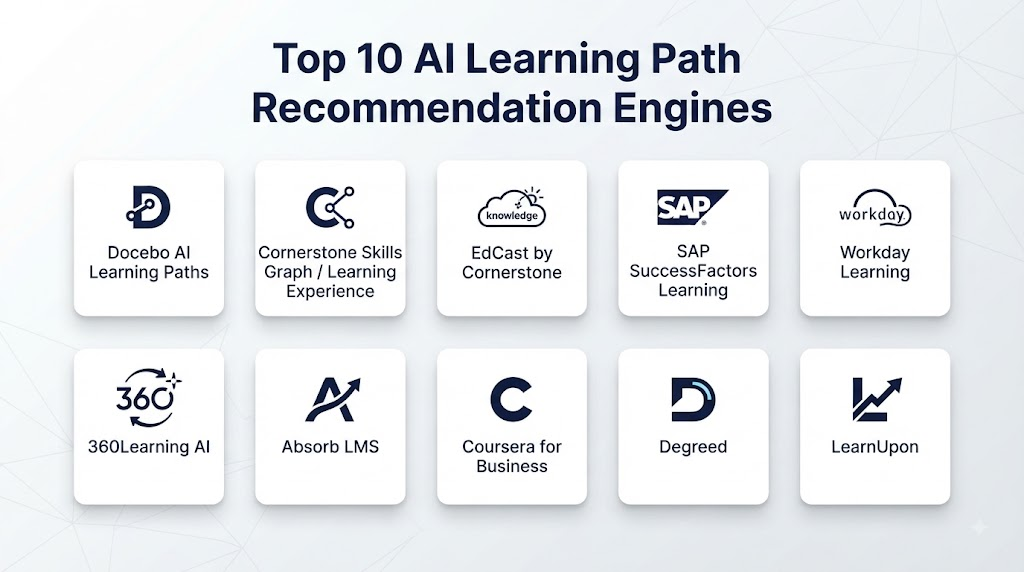
Top 10 AI Learning Path Recommendation Engines
1. Degreed
Degreed provides learning experience and skills intelligence capabilities designed to help organizations connect employee development with skills and career goals.
Key Features
- Personalized learning
- Skills intelligence
- Learning pathways
- Content recommendations
- Career development
- Skill-gap analysis
Pros
- Strong skills-based learning approach
- Broad content discovery
- Personalized learning capabilities
- Useful career development functionality
Cons
- Effective personalization depends on quality skills data
- Enterprise implementation can require configuration
2. Cornerstone Learning
Cornerstone provides enterprise learning and talent management capabilities, including personalized learning recommendations and skills-oriented development.
Key Features
- AI-powered learning recommendations
- Learning paths
- Skills intelligence
- Course management
- Talent development
- Learning analytics
Pros
- Strong enterprise learning capabilities
- Broad content ecosystem
- Good talent-management integration
- Scalable for large organizations
Cons
- Extensive functionality can require implementation effort
- Configuration can be complex for smaller organizations
3. Workday Learning
Workday Learning connects learning with broader HCM, talent, skills, and employee development workflows.
Key Features
- Learning recommendations
- Skills management
- Learning paths
- Talent development
- Employee profiles
- HCM integration
Pros
- Strong HCM integration
- Useful employee development ecosystem
- Suitable for enterprise organizations
- Connects learning with broader talent data
Cons
- Best suited to organizations using broader Workday capabilities
- Implementation can require specialized expertise
4. LinkedIn Learning
LinkedIn Learning provides a large professional learning library with personalized recommendations based on learner interests, skills, and learning activity.
Key Features
- Personalized recommendations
- Professional courses
- Skills-based learning
- Learning paths
- Assessments
- Enterprise learning
Pros
- Large learning content library
- Strong professional skills coverage
- Familiar user experience
- Useful personalized recommendations
Cons
- Recommendation quality depends on available learner context
- Organizations needing highly customized enterprise skills frameworks may require additional systems
5. Docebo
Docebo provides a learning platform with AI-supported learning recommendations, content discovery, and learning management capabilities.
Key Features
- AI learning recommendations
- Personalized learning
- Learning paths
- Content management
- Learning analytics
- Enterprise LMS
Pros
- Strong LMS capabilities
- Useful AI functionality
- Flexible learning management
- Good content discovery
Cons
- Configuration can require planning
- Advanced personalization depends on data and content quality
6. Sana Learn
Sana Learn provides AI-powered learning capabilities designed around personalized knowledge discovery, learning, and employee development.
Key Features
- AI learning assistant
- Personalized learning
- Knowledge discovery
- Learning recommendations
- AI-generated learning experiences
- Enterprise learning
Pros
- Strong AI-first approach
- Modern learning experience
- Useful knowledge discovery
- Personalized learning capabilities
Cons
- Organizations may need to evaluate AI governance carefully
- Integration requirements vary by deployment
7. 360Learning
360Learning provides collaborative learning and LMS capabilities with AI-supported course creation and personalized learning experiences.
Key Features
- Personalized learning
- Learning paths
- AI-assisted learning
- Collaborative learning
- Course creation
- Learning analytics
Pros
- Strong collaborative learning
- User-friendly experience
- Useful AI capabilities
- Good course creation workflows
Cons
- Advanced enterprise skills intelligence may require additional capabilities
- Recommendation quality depends on content structure
8. EdCast by Cornerstone
EdCast provides learning experience and knowledge discovery capabilities focused on personalized learning and skills development.
Key Features
- AI-powered recommendations
- Learning paths
- Skills intelligence
- Content aggregation
- Knowledge discovery
- Career development
Pros
- Strong learning experience capabilities
- Broad content discovery
- Good personalization
- Skills-oriented approach
Cons
- Enterprise deployment can require configuration
- Broader Cornerstone ecosystem may influence implementation decisions
9. LearnUpon
LearnUpon provides learning management capabilities for organizations that need structured learning programs, courses, and employee development.
Key Features
- Learning paths
- Course recommendations
- Learning management
- Reporting
- Employee training
- Content management
Pros
- User-friendly LMS
- Strong learning-path capabilities
- Good reporting
- Suitable for growing organizations
Cons
- Advanced AI personalization may not match specialized AI-first platforms
- Skills intelligence capabilities should be evaluated based on requirements
10. Valamis
Valamis provides learning experience, skills development, analytics, and personalized learning capabilities.
Key Features
- Personalized learning
- Skills analytics
- Learning paths
- Learning recommendations
- Learning analytics
- Employee development
Pros
- Strong skills-based learning
- Good analytics
- Personalized learning capabilities
- Enterprise-oriented platform
Cons
- Implementation may require configuration
- Organizations need reliable skills data for advanced personalization
Comparison Table: AI Learning Path Recommendation Engines
| No. | Platform | Best For | AI Recommendations | Skills Intelligence | Learning Paths | Career Development | Analytics |
|---|---|---|---|---|---|---|---|
| 1 | Degreed | Skills-based learning | Strong | Strong | Strong | Strong | Strong |
| 2 | Cornerstone Learning | Enterprise learning | Strong | Strong | Strong | Strong | Strong |
| 3 | Workday Learning | HCM-integrated learning | Strong | Strong | Strong | Strong | Strong |
| 4 | LinkedIn Learning | Professional learning | Strong | Strong | Strong | Moderate | Strong |
| 5 | Docebo | AI-powered LMS | Strong | Strong | Strong | Strong | Strong |
| 6 | Sana Learn | AI-first learning | Strong | Strong | Strong | Strong | Strong |
| 7 | 360Learning | Collaborative learning | Strong | Moderate | Strong | Moderate | Strong |
| 8 | EdCast | Learning experience | Strong | Strong | Strong | Strong | Strong |
| 9 | LearnUpon | Structured learning | Moderate | Moderate | Strong | Moderate | Strong |
| 10 | Valamis | Skills-based development | Strong | Strong | Strong | Strong | Strong |
Weighted Evaluation Table
| No. | Platform | AI Recommendations 20% | Personalization 20% | Skills Intelligence 15% | Learning Paths 15% | Career Alignment 10% | Integrations 10% | Ease of Use 10% | Total Score |
|---|---|---|---|---|---|---|---|---|---|
| 1 | Degreed | 20 | 20 | 15 | 15 | 10 | 10 | 9 | 99 |
| 2 | Cornerstone Learning | 20 | 19 | 15 | 15 | 10 | 10 | 9 | 98 |
| 3 | Workday Learning | 19 | 19 | 15 | 15 | 10 | 10 | 8 | 96 |
| 4 | LinkedIn Learning | 20 | 19 | 14 | 15 | 9 | 10 | 10 | 97 |
| 5 | Docebo | 20 | 19 | 14 | 15 | 9 | 10 | 9 | 96 |
| 6 | Sana Learn | 20 | 20 | 15 | 14 | 10 | 9 | 9 | 97 |
| 7 | 360Learning | 19 | 18 | 13 | 15 | 9 | 10 | 10 | 94 |
| 8 | EdCast | 19 | 19 | 15 | 15 | 10 | 9 | 9 | 96 |
| 9 | LearnUpon | 17 | 17 | 12 | 15 | 8 | 10 | 10 | 89 |
| 10 | Valamis | 19 | 19 | 15 | 15 | 10 | 9 | 9 | 96 |
Which AI Learning Path Recommendation Engine Is Right for You?
Choose Degreed if skills-based learning, content discovery, and employee career development are your primary priorities.
Choose Cornerstone Learning if you need enterprise-scale learning management combined with AI recommendations and talent development.
Choose Workday Learning if learning needs to operate closely with your existing HCM, employee, skills, and talent data.
Choose LinkedIn Learning if professional content breadth and personalized learning recommendations are particularly important.
Choose Docebo if you want an AI-enabled LMS with strong learning management and content discovery capabilities.
Choose Sana Learn if you are looking for an AI-first learning experience with personalized knowledge discovery.
Choose 360Learning if collaborative learning and employee-generated knowledge are important parts of your learning strategy.
Choose EdCast if you need learning experience, skills intelligence, content aggregation, and personalized recommendations.
Choose LearnUpon if structured learning paths and straightforward LMS management are your main requirements.
Choose Valamis if skills analytics, personalized learning, and enterprise learning intelligence are priorities.
Common Mistakes
- Recommending courses without understanding employee goals
- Using outdated skills taxonomies
- Ignoring existing employee skills
- Overloading learners with recommendations
- Measuring course completion instead of skill development
- Failing to explain why content was recommended
- Relying entirely on historical learning behavior
- Ignoring employee career aspirations
- Using low-quality or outdated content
- Failing to update skills frameworks
- Ignoring privacy considerations
- Treating AI recommendations as mandatory career decisions
- Failing to involve managers and employees in development planning
FAQs
1. What are AI Learning Path Recommendation Engines?
AI Learning Path Recommendation Engines use artificial intelligence and learner data to recommend personalized courses, skills, learning activities, and development paths.
2. How do AI learning recommendations work?
They can analyze learner profiles, skills, job roles, learning history, career goals, and content metadata to identify relevant learning opportunities.
3. Can AI create personalized learning paths?
Yes. AI can assemble recommended courses and learning activities based on a learner’s current skills and desired development outcomes.
4. Can AI identify employee skill gaps?
Yes. When reliable skills and role data are available, AI can compare current capabilities with target skills and identify potential development gaps.
5. Can AI learning recommendations support career development?
Yes. Some platforms connect learning recommendations with career frameworks, target roles, skills, and internal mobility opportunities.
6. Are AI learning recommendations always accurate?
No. Recommendation quality depends on data quality, skills frameworks, content metadata, learner behavior, and the underlying recommendation models.
7. Can employees influence AI learning recommendations?
Well-designed systems should allow employees to update interests, career goals, skills, and learning preferences so recommendations become more relevant.
8. Can AI recommendations work with existing LMS platforms?
Many enterprise learning platforms integrate with LMS, HRIS, talent management, content libraries, and other workforce systems.
9. What data does an AI learning recommendation engine need?
Depending on the system, useful data can include employee skills, job roles, learning history, goals, competencies, career interests, assessments, and learning content metadata.
10. What is the future of AI learning path recommendations?
The category is moving toward dynamic skills-based learning, AI learning assistants, career-path recommendations, skills graphs, adaptive development journeys, internal mobility integration, and continuous reskilling.
Conclusion
AI Learning Path Recommendation Engines are helping organizations move from standardized training programs toward personalized, skills-based employee development. Instead of requiring every employee to follow the same learning journey, these systems can recommend content and development activities based on individual capabilities, career objectives, job requirements, and organizational skill priorities.Degreed, Cornerstone Learning, Workday Learning, LinkedIn Learning, Docebo, Sana Learn, 360Learning, EdCast, LearnUpon, and Valamis offer different approaches to AI-powered learning recommendations and personalized development.The right platform depends on an organization’s learning strategy, existing HR and LMS infrastructure, skills framework, content ecosystem, career-development requirements, and desired level of personalization.