Introduction
AI CPQ Recommendation Engines help sales teams recommend suitable products, configurations, pricing options, bundles, and commercial packages during the Configure, Price, Quote process. By combining artificial intelligence with product catalogs, customer information, pricing rules, historical sales data, and business policies, these engines can help representatives create more relevant quotes and recommendations.Traditional CPQ systems rely heavily on predefined rules and manual product selection. AI-enhanced CPQ platforms can go further by identifying patterns in previous transactions, customer requirements, product relationships, and purchasing behavior.
What Are AI CPQ Recommendation Engines?
AI CPQ Recommendation Engines use machine learning, predictive analytics, recommendation models, and business rules to assist sales teams during product configuration and quoting.
CPQ stands for Configure, Price, Quote.
The configuration process determines which products or services can work together. Pricing determines the appropriate commercial structure. Quoting produces a customer-facing proposal.
An AI recommendation engine can analyze factors such as:
- Customer requirements
- Previous purchases
- Product compatibility
- Industry
- Company size
- Existing products
- Deal characteristics
- Pricing history
- Product relationships
- Sales outcomes
- Contract information
The system can then recommend products, bundles, configurations, or commercial options.
Why AI CPQ Recommendation Engines Matter
Complex product catalogs can make selling difficult. Sales representatives may need to understand hundreds or thousands of products, pricing combinations, dependencies, and configuration rules.
AI can help simplify this process.
For example, when a customer selects a particular product, an AI-enabled CPQ system may identify complementary products or services that are commonly purchased together.
This can help sales teams improve:
- Quote speed
- Product selection
- Customer experience
- Sales consistency
- Cross-selling
- Upselling
- Revenue opportunities
Key Features of AI CPQ Recommendation Engines
Product Recommendations
AI can recommend products based on customer requirements and purchase context.
Bundle Recommendations
The system can identify combinations of products or services that work well together.
Cross-Sell Recommendations
AI can identify complementary products that may be relevant to a customer.
Upsell Recommendations
The platform can suggest higher-value products, packages, or configurations.
Configuration Assistance
AI can help representatives select compatible product combinations.
Pricing Recommendations
Some systems can support pricing decisions using customer, product, and transaction context.
Product Compatibility
Recommendation engines can help identify incompatible or dependent product configurations.
Customer Segmentation
AI can use customer characteristics to personalize recommendations.
Historical Purchase Analysis
Previous transactions can provide signals for future product recommendations.
Guided Selling
Sales representatives can receive recommendations while working through a quote.
Approval Workflows
Complex discounts and pricing decisions can be routed through appropriate approval processes.
CRM Integration
CPQ systems can connect customer, account, opportunity, and product information.
Common Use Cases
B2B Sales
Organizations with complex product catalogs can help representatives select suitable configurations.
SaaS Packaging
Software companies can recommend plans, add-ons, services, and bundles.
Manufacturing
Manufacturers can assist representatives with complex product configurations.
Telecommunications
Sales teams can configure plans, devices, services, and bundles.
Industrial Equipment
AI can help configure equipment and related services based on customer requirements.
Financial Services
Organizations can recommend relevant service packages and commercial offerings.
Technology Solutions
Sales representatives can create combinations of hardware, software, licenses, and services.
Benefits of AI CPQ Recommendation Engines
Faster Quote Creation
AI recommendations can reduce the time required to select products and configure quotes.
Better Product Selection
Sales representatives receive recommendations based on available customer and product information.
Reduced Configuration Errors
Automated compatibility and business rules can reduce invalid configurations.
Increased Cross-Selling
AI can identify products that may complement the customer’s existing purchases.
Better Upselling
Recommendation models can identify higher-value options that may be relevant.
Improved Customer Experience
Relevant recommendations can make buying processes easier.
Consistent Sales Processes
AI can help standardize product recommendations across sales teams.
Better Sales Productivity
Representatives can spend less time searching through catalogs and pricing information.
Challenges
Product Data Quality
Poor product catalogs can result in inaccurate recommendations.
Pricing Complexity
Highly customized pricing can make recommendation systems difficult to implement.
Model Accuracy
AI recommendations depend on the quality and relevance of historical data.
Explainability
Sales representatives may need to understand why a particular product or bundle was recommended.
Business Rule Conflicts
AI recommendations must operate within product, pricing, legal, and commercial constraints.
Integration Complexity
CPQ systems often need to connect with CRM, ERP, billing, product catalog, and pricing systems.
Organizational Adoption
Sales representatives need training and trust to use AI recommendations effectively.
Evaluation Criteria
AI CPQ Recommendation Engines can be evaluated using:
- Product recommendations
- Configuration intelligence
- Pricing intelligence
- Bundle recommendations
- Cross-selling
- Upselling
- AI capabilities
- Product catalog management
- CRM integration
- ERP integration
- Automation
- Explainability
- Scalability
Key Trends
Personalized Product Recommendations
AI is increasingly using customer and account context to recommend products rather than relying solely on static rules.
Intelligent Bundling
Machine learning can identify product combinations based on historical purchasing patterns.
AI-Guided Selling
Sales representatives can receive recommendations throughout the quoting process.
Dynamic Pricing Support
AI can help analyze pricing context and support more informed commercial decisions.
Predictive Cross-Selling
Recommendation models can identify complementary products that customers may be likely to purchase.
Natural Language CPQ
AI assistants are making it possible to describe customer requirements in natural language and receive relevant configuration suggestions.
Autonomous Quote Preparation
AI is increasingly being used to automate portions of quote preparation while retaining human approval for complex commercial decisions.
Methodology
The platforms below were selected based on their relevance to CPQ, AI-assisted product recommendations, guided selling, configuration, pricing, quoting, product catalog management, and sales automation.
The comparison considers:
- AI capabilities
- Product recommendations
- Configuration
- Pricing
- Bundle intelligence
- Cross-selling
- CRM integration
- Automation
- Ease of use
- Scalability
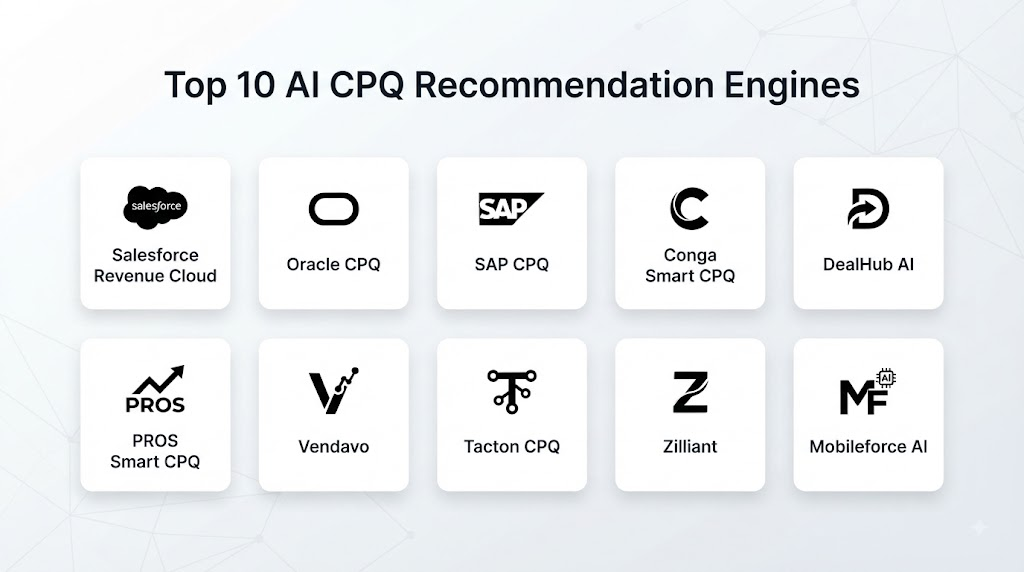
Top 10 AI CPQ Recommendation Engines
1. Salesforce Revenue Cloud
Salesforce Revenue Cloud provides capabilities for product configuration, pricing, quoting, and revenue management within the Salesforce ecosystem.
Key Features
- Product configuration
- Pricing
- Quoting
- Guided selling
- Product recommendations
- Revenue management
- CRM integration
Pros
- Strong CRM ecosystem
- Broad revenue capabilities
- Suitable for complex sales environments
- Strong integration potential
Cons
- Can require significant configuration
- Advanced implementations may be complex
2. Oracle CPQ
Oracle CPQ supports complex product configuration, pricing, quoting, and sales processes for organizations with sophisticated commercial requirements.
Key Features
- Product configuration
- Pricing management
- Quote generation
- Guided selling
- Product rules
- Sales automation
Pros
- Strong enterprise capabilities
- Suitable for complex configurations
- Extensive business rules
- Good scalability
Cons
- Enterprise implementation can be complex
- Requires strong product and pricing data
3. SAP CPQ
SAP CPQ provides configure-price-quote capabilities designed for organizations with complex product catalogs and enterprise sales processes.
Key Features
- Product configuration
- Pricing
- Quote management
- Guided selling
- Product catalog management
- Enterprise integration
Pros
- Strong enterprise ecosystem
- Good configuration capabilities
- Suitable for complex product environments
- Strong integration options
Cons
- Implementation can require specialized expertise
- Better suited to larger organizations
4. Conga CPQ
Conga CPQ supports product configuration, pricing, quoting, contract processes, and sales workflows.
Key Features
- Product configuration
- Pricing
- Quoting
- Guided selling
- Product rules
- Contract integration
Pros
- Strong CPQ capabilities
- Useful for complex sales
- Good CRM connectivity
- Broad commercial workflow support
Cons
- Configuration can be extensive
- Complex deployments require planning
5. DealHub CPQ
DealHub provides CPQ and sales execution capabilities designed to simplify quoting and commercial workflows.
Key Features
- Product configuration
- Pricing
- Quote generation
- Guided selling
- Sales workflows
- Approval management
Pros
- User-friendly interface
- Strong sales workflow integration
- Good quoting experience
- Useful for B2B sales
Cons
- Advanced requirements may require configuration
- Complex product environments can increase implementation effort
6. PROS Smart CPQ
PROS provides CPQ and AI-powered pricing capabilities that can support product recommendations, configuration, and commercial decisions.
Key Features
- AI-assisted recommendations
- Product configuration
- Pricing optimization
- Quote management
- Guided selling
- Commercial analytics
Pros
- Strong AI and pricing capabilities
- Useful for complex pricing
- Good recommendation potential
- Enterprise scalability
Cons
- Primarily enterprise focused
- Implementation can require significant planning
7. Vendavo CPQ
Vendavo provides CPQ and pricing capabilities focused on B2B organizations with complex products and pricing structures.
Key Features
- Product configuration
- Pricing
- Quoting
- Guided selling
- Pricing analytics
- Commercial intelligence
Pros
- Strong B2B pricing capabilities
- Good for complex commercial environments
- Useful pricing analytics
- Enterprise functionality
Cons
- More specialized
- Requires high-quality pricing data
8. Tacton CPQ
Tacton specializes in configuration and CPQ for complex products, particularly in manufacturing and industrial environments.
Key Features
- Product configuration
- Guided selling
- Configuration rules
- Quote generation
- Product modeling
- Sales automation
Pros
- Strong complex configuration
- Excellent for manufacturing
- Useful product modeling
- Good guided selling
Cons
- More specialized toward complex products
- Implementation can require product modeling expertise
9. Zilliant
Zilliant provides pricing and sales optimization capabilities that can support product recommendations, pricing decisions, and commercial strategy.
Key Features
- AI pricing
- Product recommendations
- Sales optimization
- Price optimization
- Customer segmentation
- Commercial analytics
Pros
- Strong pricing intelligence
- AI-focused capabilities
- Useful sales recommendations
- Good commercial analytics
Cons
- More focused on pricing and sales optimization
- Requires good underlying commercial data
10. Experlogix CPQ
Experlogix CPQ provides product configuration, quoting, pricing, and guided selling capabilities for organizations with complex product requirements.
Key Features
- Product configuration
- Pricing
- Quote generation
- Guided selling
- Product rules
- CRM integration
Pros
- Strong configuration capabilities
- Flexible deployment options
- Useful for complex products
- Good integration capabilities
Cons
- Complex configurations require careful setup
- Product data quality is important
Comparison Table: AI CPQ Recommendation Engines
| No. | Platform | Best For | Product Recommendations | Configuration | Pricing | Bundle Intelligence | Guided Selling |
|---|---|---|---|---|---|---|---|
| 1 | Salesforce Revenue Cloud | Revenue management | Strong | Strong | Strong | Strong | Strong |
| 2 | Oracle CPQ | Enterprise CPQ | Strong | Strong | Strong | Strong | Strong |
| 3 | SAP CPQ | Enterprise commerce | Strong | Strong | Strong | Strong | Strong |
| 4 | Conga CPQ | Complex B2B sales | Strong | Strong | Strong | Strong | Strong |
| 5 | DealHub CPQ | Sales execution | Strong | Strong | Strong | Strong | Strong |
| 6 | PROS Smart CPQ | Pricing and recommendations | Strong | Strong | Strong | Strong | Strong |
| 7 | Vendavo CPQ | B2B pricing | Strong | Strong | Strong | Strong | Strong |
| 8 | Tacton CPQ | Complex manufacturing | Strong | Strong | Strong | Strong | Strong |
| 9 | Zilliant | Pricing intelligence | Strong | Moderate | Strong | Strong | Strong |
| 10 | Experlogix CPQ | Product configuration | Strong | Strong | Strong | Strong | Strong |
Weighted Evaluation Table
| No. | Platform | AI Capabilities 20% | Recommendations 20% | Configuration 15% | Pricing 15% | Integrations 10% | Ease of Use 10% | Scalability 10% | Total Score |
|---|---|---|---|---|---|---|---|---|---|
| 1 | Salesforce Revenue Cloud | 19 | 19 | 15 | 14 | 10 | 9 | 10 | 96 |
| 2 | Oracle CPQ | 19 | 19 | 15 | 15 | 10 | 8 | 10 | 96 |
| 3 | SAP CPQ | 19 | 19 | 15 | 15 | 10 | 8 | 10 | 96 |
| 4 | Conga CPQ | 18 | 19 | 15 | 14 | 10 | 9 | 10 | 95 |
| 5 | DealHub CPQ | 18 | 18 | 14 | 14 | 10 | 10 | 9 | 93 |
| 6 | PROS Smart CPQ | 20 | 20 | 14 | 15 | 9 | 8 | 10 | 96 |
| 7 | Vendavo CPQ | 19 | 19 | 14 | 15 | 9 | 8 | 10 | 94 |
| 8 | Tacton CPQ | 18 | 20 | 15 | 13 | 9 | 8 | 10 | 93 |
| 9 | Zilliant | 20 | 19 | 12 | 15 | 9 | 9 | 10 | 94 |
| 10 | Experlogix CPQ | 18 | 18 | 15 | 13 | 9 | 9 | 9 | 91 |
Which AI CPQ Recommendation Engine Is Right for You?
Choose Salesforce Revenue Cloud if your sales organization already relies heavily on the Salesforce ecosystem and wants CPQ connected to broader revenue operations.
Choose Oracle CPQ for complex enterprise product configurations, pricing structures, and commercial workflows.
Choose SAP CPQ if CPQ needs to operate within a broader enterprise commerce and SAP environment.
Choose Conga CPQ for complex B2B quoting, configuration, and contract-related workflows.
Choose DealHub CPQ if ease of use and streamlined sales execution are major priorities.
Choose PROS Smart CPQ if AI-powered pricing and commercial recommendations are central requirements.
Choose Vendavo CPQ for complex B2B pricing and commercial optimization.
Choose Tacton CPQ if your organization sells highly configurable industrial or manufactured products.
Choose Zilliant if pricing intelligence and sales optimization are more important than traditional CPQ functionality alone.
Choose Experlogix CPQ if product configuration and flexible CPQ workflows are your main requirements.
Common Mistakes
- Using inaccurate product information
- Failing to maintain pricing rules
- Giving AI access to outdated catalogs
- Ignoring product compatibility rules
- Over-relying on historical purchasing behavior
- Recommending products without considering customer requirements
- Failing to explain recommendations
- Ignoring margin requirements
- Treating AI recommendations as mandatory
- Poorly integrating CPQ with CRM and ERP systems
- Failing to monitor recommendation quality
- Not involving sales teams in recommendation design
FAQs
1. What are AI CPQ Recommendation Engines?
AI CPQ Recommendation Engines use artificial intelligence and machine learning to recommend products, configurations, bundles, pricing options, and commercial packages during the configure-price-quote process.
2. How does AI improve CPQ?
AI can analyze customer information, product relationships, purchasing history, and sales data to provide more relevant recommendations during configuration and quoting.
3. Can AI recommend product bundles?
Yes. Recommendation engines can identify products or services that are frequently purchased together or are logically complementary.
4. Can AI support cross-selling?
Yes. AI can identify additional products that may be relevant based on customer requirements, existing purchases, and historical sales patterns.
5. Can AI help with upselling?
Yes. AI can suggest higher-value configurations, product upgrades, premium packages, or additional services when they are relevant.
6. Can AI CPQ reduce configuration errors?
AI-supported product rules and compatibility checks can help reduce invalid product combinations and configuration mistakes.
7. Can AI recommend prices?
Some CPQ and commercial optimization platforms can use AI and analytics to support pricing recommendations, although pricing decisions should remain subject to organizational rules and approval processes.
8. What data is required for AI CPQ recommendations?
Common inputs include product catalogs, pricing information, configuration rules, customer data, historical transactions, product relationships, and sales information.
9. Can AI CPQ integrate with CRM and ERP systems?
Yes. Enterprise CPQ platforms commonly integrate with CRM, ERP, billing, product catalog, and other business systems.
10. What is the future of AI CPQ Recommendation Engines?
The category is moving toward natural-language configuration, predictive product recommendations, intelligent bundles, dynamic pricing support, automated quote preparation, and AI-guided selling.
Conclusion
AI CPQ Recommendation Engines can make complex selling processes more efficient by helping representatives select relevant products, configure solutions, identify bundles, and create accurate quotes.Salesforce Revenue Cloud, Oracle CPQ, SAP CPQ, Conga CPQ, DealHub CPQ, PROS Smart CPQ, Vendavo CPQ, Tacton CPQ, Zilliant, and Experlogix CPQ offer different approaches to configuration, pricing, recommendations, and guided selling.The best platform depends on product complexity, pricing requirements, CRM and ERP infrastructure, sales processes, industry, and the level of AI-driven recommendation capability required.Successful implementation also depends heavily on product catalog quality, accurate pricing data, well-defined configuration rules, and sales-team adoption.