Introduction
AI fraud and abuse detection tools for support help customer-service, trust and safety, fraud operations, and risk teams identify suspicious behavior inside tickets, chats, calls, account requests, refunds, returns, promotions, and other service interactions. Instead of relying only on manual review or fixed rules, these systems can analyze customer behavior, account history, device signals, payment activity, conversation patterns, unusual request frequency, and other risk indicators.
Modern fraud detection increasingly combines machine learning, behavioral analytics, identity signals, graph analysis, anomaly detection, and case investigation. In support environments, these capabilities can help identify refund abuse, account takeover, fake identities, promotion abuse, social engineering, repeated chargeback behavior, suspicious account changes, and coordinated attacks.
What’s Changing in AI Fraud/Abuse Detection for Support
- Fraud detection is moving beyond static rules toward behavioral and contextual analysis.
- Support interactions are increasingly treated as an important fraud signal.
- AI can detect patterns across multiple accounts rather than reviewing each case independently.
- Account takeover detection increasingly combines device, identity, login, and support behavior.
- Refund and return abuse can be analyzed using customer history and transaction patterns.
- Promotion abuse can be identified through repeated account creation and linked identities.
- Graph analytics can reveal coordinated fraud rings.
- LLMs can help investigators summarize suspicious cases and customer histories.
- AI can help detect social-engineering attempts aimed at support representatives.
- Conversation analysis can identify repeated scripts or suspicious language patterns.
- Risk engines increasingly combine transaction and non-transaction signals.
- Device intelligence is becoming important for identifying linked accounts.
- Identity verification is increasingly connected with support workflows.
- Behavioral biometrics can add signals beyond passwords and static credentials.
- Real-time risk scoring is becoming more important for account changes and high-value actions.
- Human review remains essential for uncertain or high-impact decisions.
- Fraud models must be monitored for false positives.
- Explainability matters because legitimate customers should not be blocked without clear reasons.
- Privacy and data minimization are increasingly important.
- Fraud systems are increasingly evaluated based on prevented loss and customer friction together.
Quick Buyer Checklist
Before selecting an AI fraud or abuse detection platform, check whether it can:
- Detect suspicious support requests.
- Detect account takeover.
- Analyze refund abuse.
- Analyze return abuse.
- Detect promotion abuse.
- Detect fake accounts.
- Analyze payment risk.
- Identify repeated suspicious behavior.
- Link related accounts.
- Use device intelligence.
- Analyze customer history.
- Detect unusual behavior.
- Provide real-time risk scores.
- Support configurable thresholds.
- Provide investigation workflows.
- Support human review.
- Explain important risk signals.
- Integrate with CRM.
- Integrate with helpdesk systems.
- Integrate with payment systems.
- Integrate with identity systems.
- Support APIs.
- Maintain audit logs.
- Support RBAC.
- Protect personal information.
- Support model monitoring.
- Measure false positives.
- Measure fraud-loss reduction.
- Support case escalation.
- Allow analysts to override automated decisions.
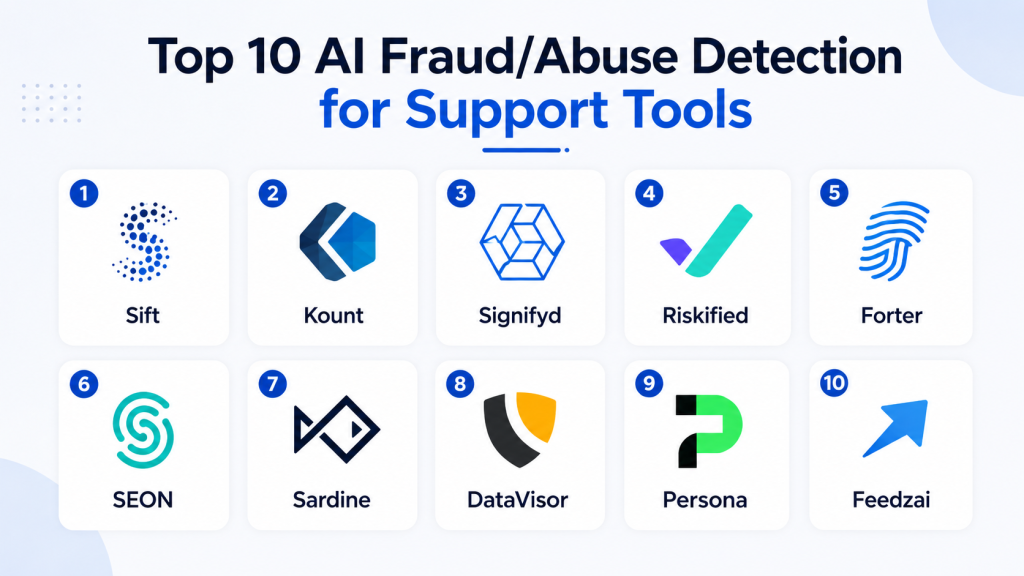
Top 10 AI Fraud/Abuse Detection for Support Tools
1 — Sift
One-line verdict: Best for digital businesses needing broad fraud detection across accounts, payments, abuse, and suspicious customer behavior.
Sift provides fraud and risk intelligence for digital businesses. It can help organizations evaluate customer behavior, transaction activity, account signals, and abuse patterns to identify suspicious activity.
Standout Capabilities
- Account-abuse detection.
- Payment fraud detection.
- Account takeover analysis.
- Behavioral risk scoring.
- Identity signals.
- Abuse pattern detection.
- Real-time decisioning.
- Case investigation support.
AI-Specific Depth
- Model support: Platform-managed machine-learning models.
- RAG / knowledge integration: N/A for traditional fraud scoring.
- Evaluation: Historical fraud labels, analyst review, and production outcomes.
- Guardrails: Rules, thresholds, analyst review, and workflow controls.
- Observability: Fraud rates, risk decisions, and model performance analytics.
Pros
- Broad digital-risk coverage.
- Suitable for real-time decisions.
- Strong behavioral focus.
Cons
- Requires good event integration.
- False positives require tuning.
- Smaller businesses may not need the platform depth.
Security & Compliance
Verify SSO, RBAC, audit logs, encryption, retention, residency, data-processing controls, and required certifications.
Deployment & Platforms
- Cloud: Available.
- API: Available.
- Web administration: Available.
Integrations & Ecosystem
- Ecommerce
- Payments
- Identity
- Customer support
- Account systems
- APIs
- Risk workflows
Pricing Model
Commercial enterprise pricing.
Best-Fit Scenarios
- Ecommerce fraud.
- Account abuse.
- Digital marketplace risk.
2 — Stripe Radar
One-line verdict: Best for Stripe-centered businesses wanting payment fraud detection tightly integrated with transaction workflows.
Stripe Radar uses machine learning and payment-network information to evaluate payment risk. It is particularly useful for businesses already using Stripe for payment processing.
Standout Capabilities
- Payment fraud scoring.
- Transaction risk analysis.
- Custom rules.
- Block and review workflows.
- Payment-network intelligence.
- Dispute-risk support.
- Account-level signals.
- Real-time decisions.
AI-Specific Depth
- Model support: Stripe-managed machine learning.
- RAG / knowledge integration: N/A.
- Evaluation: Chargebacks, fraud outcomes, and rule performance.
- Guardrails: Rules, allow lists, block lists, and review workflows.
- Observability: Transaction and fraud analytics.
Pros
- Native Stripe integration.
- Easy for Stripe merchants to adopt.
- Real-time payment-risk scoring.
Cons
- Primarily payment-focused.
- Less suited to non-payment abuse.
- Best value depends on Stripe adoption.
Security & Compliance
Verify account permissions, logging, encryption, retention, and relevant payment-security requirements.
Deployment & Platforms
- Cloud: Available.
- API: Available.
- Payment workflows: Available.
Integrations & Ecosystem
- Payments
- Checkout
- Billing
- Subscriptions
- Ecommerce
- Customer accounts
- APIs
Pricing Model
Commercial usage-based model tied to payment and fraud services.
Best-Fit Scenarios
- Online payment fraud.
- Subscription billing risk.
- Stripe-based ecommerce.
3 — Riskified
One-line verdict: Best for ecommerce businesses focused on transaction fraud, account abuse, policy abuse, and conversion protection.
Riskified provides ecommerce fraud and risk-management capabilities designed to help merchants distinguish legitimate customers from suspicious activity.
Standout Capabilities
- Transaction fraud detection.
- Account takeover analysis.
- Policy abuse detection.
- Chargeback management.
- Identity signals.
- Behavioral analytics.
- Ecommerce risk decisions.
- Fraud investigation.
AI-Specific Depth
- Model support: Platform-managed machine learning.
- RAG / knowledge integration: N/A.
- Evaluation: Fraud outcomes and chargeback performance.
- Guardrails: Business policies and analyst workflows.
- Observability: Fraud, approval, and chargeback analytics.
Pros
- Strong ecommerce specialization.
- Useful for balancing fraud control and conversion.
- Broad policy-abuse coverage.
Cons
- Mainly ecommerce-focused.
- Requires transaction and customer-data integration.
- Exact fit depends on business volume.
Security & Compliance
Verify SSO, RBAC, auditability, encryption, retention, residency, and required certifications.
Deployment & Platforms
- Cloud: Available.
- API: Available.
- Ecommerce integration: Available.
Integrations & Ecosystem
- Ecommerce platforms
- Payments
- Customer accounts
- Order systems
- Risk operations
- APIs
Pricing Model
Commercial enterprise model.
Best-Fit Scenarios
- Ecommerce fraud.
- Policy abuse.
- High-volume online retail.
4 — Forter
One-line verdict: Best for enterprises needing identity, fraud, abuse, and trust decisions across the complete digital customer journey.
Forter provides digital identity and fraud decisioning across account creation, login, payment, promotions, and other customer interactions.
Standout Capabilities
- Identity protection.
- Account takeover detection.
- Payment fraud.
- Promotion abuse.
- Policy abuse.
- Behavioral intelligence.
- Real-time decisioning.
- Customer-journey risk analysis.
AI-Specific Depth
- Model support: Platform-managed machine learning.
- RAG / knowledge integration: N/A.
- Evaluation: Historical fraud and identity outcomes.
- Guardrails: Policy controls and review workflows.
- Observability: Risk, identity, and fraud analytics.
Pros
- Broad customer-journey coverage.
- Strong identity focus.
- Suitable for large digital businesses.
Cons
- Enterprise-oriented.
- Implementation can be substantial.
- Requires high-quality customer and transaction data.
Security & Compliance
Verify identity controls, RBAC, auditing, encryption, retention, residency, and certifications.
Deployment & Platforms
- Cloud: Available.
- APIs: Available.
- Digital commerce environments: Available.
Integrations & Ecosystem
- Ecommerce
- Payments
- Identity
- Account systems
- Customer-service workflows
- Risk platforms
Pricing Model
Commercial enterprise pricing.
Best-Fit Scenarios
- Enterprise fraud prevention.
- Account protection.
- Promotion and policy abuse.
5 — SEON
One-line verdict: Best for fraud teams wanting flexible digital identity, device intelligence, behavioral signals, and configurable risk scoring.
SEON provides fraud-prevention tooling that combines digital identity, device information, behavioral data, and risk rules.
Standout Capabilities
- Device intelligence.
- Digital identity signals.
- Email risk.
- Phone risk.
- Behavioral analytics.
- Fraud rules.
- Risk scoring.
- Case investigation.
AI-Specific Depth
- Model support: Platform-managed fraud models and rules.
- RAG / knowledge integration: N/A.
- Evaluation: Fraud-label comparison and analyst review.
- Guardrails: Rules, thresholds, and human review.
- Observability: Fraud and risk analytics.
Pros
- Flexible risk signals.
- Useful for digital businesses.
- Good investigation context.
Cons
- Requires fraud expertise for tuning.
- Not a full customer-service platform.
- Broader enterprise workflows may need integrations.
Security & Compliance
Verify SSO, RBAC, logging, encryption, retention, residency, and certifications.
Deployment & Platforms
- Cloud: Available.
- API: Available.
- Web administration: Available.
Integrations & Ecosystem
- Payments
- Identity
- Ecommerce
- Support
- Account systems
- APIs
Pricing Model
Commercial SaaS and usage-oriented pricing.
Best-Fit Scenarios
- Account fraud.
- Digital identity analysis.
- High-risk online services.
6 — Feedzai
One-line verdict: Best for financial institutions needing advanced transaction fraud, behavioral risk, and financial-crime analytics.
Feedzai focuses strongly on financial fraud and risk intelligence. It is designed for banks, payment providers, and other financial organizations dealing with high-volume transactions.
Standout Capabilities
- Transaction fraud detection.
- Behavioral analytics.
- Real-time risk scoring.
- Financial-crime analytics.
- Customer-risk monitoring.
- Case management.
- Model governance.
- Explainable decisioning.
AI-Specific Depth
- Model support: Platform-managed and configurable machine-learning capabilities.
- RAG / knowledge integration: N/A for core fraud models.
- Evaluation: Historical fraud labels, analyst review, and model monitoring.
- Guardrails: Risk policies and case-management workflows.
- Observability: Model, fraud, and transaction analytics.
Pros
- Strong financial-services specialization.
- Large-scale real-time processing.
- Strong governance orientation.
Cons
- Enterprise complexity.
- More than most general support teams need.
- Requires specialized fraud operations.
Security & Compliance
Verify SSO, RBAC, auditing, encryption, retention, residency, regulatory support, and required certifications.
Deployment & Platforms
- Cloud: Available.
- Enterprise deployments: Vary.
- APIs: Available.
Integrations & Ecosystem
- Banking
- Payments
- Financial systems
- Risk operations
- Case management
- Enterprise data
Pricing Model
Enterprise commercial pricing.
Best-Fit Scenarios
- Banking fraud.
- Payment risk.
- Large financial institutions.
7 — Featurespace
One-line verdict: Best for financial-services organizations needing adaptive behavioral fraud detection across payments and account activity.
Featurespace focuses on behavioral analytics and fraud prevention, particularly within banking and payment environments.
Standout Capabilities
- Behavioral profiling.
- Transaction anomaly detection.
- Payment fraud.
- Account-risk analysis.
- Adaptive models.
- Real-time scoring.
- Risk monitoring.
- Fraud investigation.
AI-Specific Depth
- Model support: Platform-managed behavioral machine-learning models.
- RAG / knowledge integration: N/A.
- Evaluation: Fraud outcomes and model monitoring.
- Guardrails: Risk policies and analyst review.
- Observability: Fraud and anomaly analytics.
Pros
- Strong behavioral modeling.
- Suitable for financial transactions.
- Useful for detecting changing fraud patterns.
Cons
- Finance-focused.
- Less relevant for general ecommerce support.
- Enterprise implementation required.
Security & Compliance
Verify access controls, auditability, encryption, retention, residency, and certifications.
Deployment & Platforms
- Enterprise environments: Available.
- Cloud options: Vary.
- API integration: Available.
Integrations & Ecosystem
- Banking systems
- Payments
- Fraud operations
- Transaction platforms
- Enterprise data
Pricing Model
Enterprise commercial model.
Best-Fit Scenarios
- Payment fraud.
- Banking abuse.
- Transaction anomaly detection.
8 — Arkose Labs
One-line verdict: Best for digital platforms needing protection against automated abuse, fake accounts, credential attacks, and malicious account activity.
Arkose Labs focuses heavily on online abuse, bots, account attacks, and fraudulent digital behavior.
Standout Capabilities
- Bot detection.
- Account-abuse prevention.
- Credential attack protection.
- Fake-account mitigation.
- Automated-abuse detection.
- Behavioral analysis.
- Challenge workflows.
- Digital-risk intelligence.
AI-Specific Depth
- Model support: Platform-managed risk models.
- RAG / knowledge integration: N/A.
- Evaluation: Attack outcomes and risk-performance monitoring.
- Guardrails: Risk thresholds and challenge controls.
- Observability: Attack and abuse analytics.
Pros
- Strong automated-abuse focus.
- Useful for account-protection workflows.
- Suitable for large digital platforms.
Cons
- More focused on digital abuse than support-case analytics.
- Requires integration with account flows.
- Can create customer friction if configured poorly.
Security & Compliance
Verify RBAC, logging, encryption, retention, data residency, and certifications.
Deployment & Platforms
- Cloud: Available.
- APIs: Available.
- Web and mobile environments: Available.
Integrations & Ecosystem
- Login
- Registration
- Account recovery
- Digital platforms
- Identity workflows
- Security operations
Pricing Model
Commercial enterprise pricing.
Best-Fit Scenarios
- Bot abuse.
- Fake accounts.
- Credential attacks.
9 — Fingerprint
One-line verdict: Best for digital businesses needing device intelligence and visitor identification to uncover linked accounts and suspicious behavior.
Fingerprint provides device and visitor intelligence that can help businesses recognize returning devices and identify suspicious patterns across accounts.
Standout Capabilities
- Device identification.
- Visitor intelligence.
- Account-linking signals.
- Fraud context.
- Bot and automation signals.
- Suspicious-session detection.
- API access.
- Real-time decision support.
AI-Specific Depth
- Model support: Platform-managed identification and risk models.
- RAG / knowledge integration: N/A.
- Evaluation: Identity and fraud outcome validation.
- Guardrails: Application-level rules and permissions.
- Observability: Device and risk analytics.
Pros
- Strong device intelligence.
- Useful for detecting linked identities.
- Developer-friendly integration.
Cons
- Not a complete fraud platform.
- Requires additional decision logic.
- Should be combined with customer and transaction context.
Security & Compliance
Verify encryption, access controls, retention, privacy requirements, residency, and certifications.
Deployment & Platforms
- Cloud: Available.
- APIs: Available.
- Web and mobile: Available.
Integrations & Ecosystem
- Account systems
- Ecommerce
- Payments
- Authentication
- Fraud engines
- Custom applications
Pricing Model
Usage-oriented commercial pricing.
Best-Fit Scenarios
- Multi-account abuse.
- Account takeover investigation.
- Device-based fraud signals.
10 — Custom AI Fraud and Abuse Detection System
One-line verdict: Best for mature organizations needing custom fraud signals, private models, support-case intelligence, and full decision control.
Organizations with strong engineering and data-science teams can build fraud detection systems using support conversations, transaction data, identity information, device signals, graph models, behavioral analytics, and machine learning.
Standout Capabilities
- Custom fraud labels.
- Support-ticket risk analysis.
- BYO models.
- Graph-based fraud detection.
- Behavioral anomaly detection.
- Custom risk scoring.
- Private deployment.
- Custom investigation workflows.
AI-Specific Depth
- Model support: Traditional ML / graph ML / LLM-assisted / open-source / proprietary.
- RAG / knowledge integration: Customizable for investigation and case summarization.
- Evaluation: Historical fraud cases, precision, recall, false-positive rates, and analyst validation.
- Guardrails: Custom decision thresholds and human-review rules.
- Observability: Model drift, fraud rates, false positives, latency, cost, and overrides.
Pros
- Maximum flexibility.
- Can use proprietary fraud signals.
- Strong privacy options.
Cons
- High engineering cost.
- Requires extensive labeled data.
- Continuous monitoring is mandatory.
Security & Compliance
Entirely architecture-dependent. Organizations must design identity, encryption, access controls, logging, retention, privacy, residency, and model governance.
Deployment & Platforms
- Cloud: Possible.
- Self-hosted: Possible.
- Hybrid: Possible.
- Private infrastructure: Possible.
Integrations & Ecosystem
- CRM
- Helpdesk
- Payments
- Identity
- Device intelligence
- Data warehouse
- Internal APIs
Pricing Model
Infrastructure, models, engineering, storage, investigation tooling, and maintenance costs.
Best-Fit Scenarios
- Highly specialized fraud environments.
- Regulated enterprises.
- Organizations with proprietary abuse patterns.
Comparison Table
| Tool Name | Best For | Deployment | Model Flexibility | Strength | Watch-Out | Public Rating |
|---|---|---|---|---|---|---|
| Sift | Digital businesses | Cloud / API | Hosted | Broad fraud intelligence | Needs tuning | N/A |
| Stripe Radar | Stripe merchants | Cloud | Hosted | Payment fraud | Payment-focused | N/A |
| Riskified | Ecommerce | Cloud | Hosted | Fraud + policy abuse | Commerce-focused | N/A |
| Forter | Large digital enterprises | Cloud / API | Hosted | Identity + fraud decisions | Enterprise complexity | N/A |
| SEON | Flexible fraud teams | Cloud / API | Hosted / Rules | Device + identity intelligence | Requires expertise | N/A |
| Feedzai | Financial services | Cloud / Enterprise | Hosted / Varies | Financial fraud | Enterprise overhead | N/A |
| Featurespace | Banks and payments | Enterprise / Varies | Hosted | Behavioral fraud detection | Finance-focused | N/A |
| Arkose Labs | Digital platforms | Cloud / API | Hosted | Abuse and bot prevention | Customer friction risk | N/A |
| Fingerprint | Developers | Cloud / API | Hosted | Device intelligence | Not full fraud suite | N/A |
| Custom System | Mature enterprises | Cloud / Self-hosted / Hybrid | BYO / Multi-model | Maximum control | Engineering overhead | N/A |
Scoring & Evaluation
The scores below are comparative editorial assessments rather than official vendor benchmarks. Fraud and abuse platforms should be evaluated on prevented loss, detection quality, customer friction, explainability, operational efficiency, and false-positive control.
- Core features – 20%
- AI reliability and evaluation – 15%
- Guardrails and safety – 10%
- Integrations and ecosystem – 15%
- Ease of use – 10%
- Performance and cost controls – 15%
- Security and administration – 10%
- Support and community – 5%
| Tool | Core | Reliability/Eval | Guardrails | Integrations | Ease | Perf/Cost | Security/Admin | Support | Weighted Total |
|---|---|---|---|---|---|---|---|---|---|
| Sift | 10 | 9 | 9 | 10 | 9 | 8 | 9 | 9 | 9.10 |
| Stripe Radar | 9 | 9 | 9 | 10 | 10 | 9 | 10 | 9 | 9.25 |
| Riskified | 10 | 9 | 9 | 9 | 9 | 8 | 9 | 9 | 9.00 |
| Forter | 10 | 10 | 10 | 10 | 8 | 8 | 10 | 9 | 9.35 |
| SEON | 9 | 9 | 9 | 9 | 9 | 9 | 9 | 8 | 8.90 |
| Feedzai | 10 | 10 | 10 | 10 | 7 | 7 | 10 | 10 | 9.15 |
| Featurespace | 10 | 10 | 10 | 9 | 7 | 8 | 10 | 9 | 9.05 |
| Arkose Labs | 9 | 9 | 9 | 9 | 8 | 8 | 9 | 9 | 8.70 |
| Fingerprint | 8 | 9 | 9 | 10 | 10 | 9 | 9 | 8 | 8.90 |
| Custom System | 10 | 10 | 10 | 10 | 5 | 7 | 10 | 6 | 8.85 |
Which AI Fraud/Abuse Detection Tool Is Right for You?
Solo / Small Business
Small businesses should begin with basic safeguards such as:
- Payment fraud controls.
- Account verification.
- Refund limits.
- Suspicious-login monitoring.
- Manual review of unusual requests.
A full enterprise fraud platform may not be necessary until transaction and customer volumes grow.
SMB
Growing businesses should prioritize tools that can combine:
- Payment signals.
- Account behavior.
- Device information.
- Customer history.
- Refund patterns.
- Login anomalies.
The system should make suspicious activity easier to review rather than automatically blocking every unusual customer.
Mid-Market
Mid-market organizations should connect fraud detection with:
- CRM.
- Customer support.
- Payments.
- Identity.
- Order history.
- Authentication.
- Account changes.
This helps investigators understand the complete risk context.
Enterprise
Enterprise buyers should evaluate:
- Real-time scoring.
- Identity intelligence.
- Graph analysis.
- Device intelligence.
- SSO.
- RBAC.
- Audit logs.
- Model monitoring.
- Explainability.
- Case management.
- Data residency.
- Retention.
- APIs.
- False-positive management.
- Analyst overrides.
Fraud controls should protect the business without creating unnecessary friction for legitimate customers.
Regulated Industries
Financial services, insurance, telecom, marketplaces, and other regulated businesses should maintain strong investigation and governance workflows.
AI risk scores should support trained analysts rather than automatically determine every high-impact outcome.
Important cases should include:
- Human review.
- Evidence.
- Audit trails.
- Decision documentation.
- Clear escalation procedures.
Budget vs Premium
Basic payment and account rules may be sufficient for smaller organizations.
Premium platforms become more valuable when fraud involves:
- Multiple accounts.
- Coordinated networks.
- Device manipulation.
- Account takeover.
- Promotion abuse.
- High-value transactions.
- Cross-channel behavior.
Evaluate prevented losses and legitimate-customer friction together.
Build vs Buy
Building can make sense when fraud patterns are highly specific to the business.
A custom platform may combine:
- Transaction models.
- Graph analytics.
- Device intelligence.
- Support conversations.
- Identity signals.
- Behavioral models.
- LLM investigation assistants.
Buying is usually faster when standard fraud and identity patterns explain most risk.
Implementation Playbook: 30 / 60 / 90 Days
First 30 Days — Define Fraud and Build a Baseline
Clearly define the abuse categories you want to detect.
Examples:
- Refund abuse.
- Account takeover.
- Promotion abuse.
- Fake accounts.
- Payment fraud.
- Return fraud.
- Support social engineering.
Collect historical examples.
Measure:
- Confirmed fraud.
- Fraud-loss rate.
- Chargebacks.
- Refund abuse.
- False positives.
- Manual-review volume.
Days 31–60 — Add Signals and Evaluation
Connect:
- Customer history.
- Payments.
- Devices.
- Identity.
- Login behavior.
- Support tickets.
- Order history.
Test how well the model separates legitimate customers from suspicious activity.
Measure precision, recall, false-positive rate, and analyst correction rate.
Days 61–90 — Controlled Automation
Automate low-risk responses first.
Examples:
- Requesting additional verification.
- Sending cases to specialist queues.
- Requiring human review.
- Limiting promotional use.
- Flagging suspicious refunds.
Avoid permanently blocking customers based only on uncertain AI signals.
Monitor model drift and emerging fraud patterns continuously.
Common Mistakes and How to Avoid Them
- Using only payment data.
- Ignoring support interactions.
- Blocking customers based on a single risk signal.
- Using overly aggressive thresholds.
- Ignoring false positives.
- Treating every unusual customer as fraudulent.
- Failing to analyze linked accounts.
- Ignoring device intelligence.
- Ignoring account takeover patterns.
- Failing to monitor refund abuse.
- Using outdated fraud labels.
- Automatically trusting historical analyst decisions.
- Failing to investigate model drift.
- Creating excessive customer friction.
- Ignoring privacy requirements.
- Giving support reps excessive fraud information.
- Using AI risk scores without evidence.
- Failing to maintain appeal workflows.
- Measuring only detected fraud rather than prevented loss.
- Assuming a fraud platform eliminates the need for trained analysts.
Frequently Asked Questions
1. What is AI fraud and abuse detection for support?
It is the use of machine learning and behavioral analysis to identify suspicious customer or account activity that appears through support requests, transactions, refunds, account changes, and related interactions.
2. Can AI detect refund abuse?
Yes. Fraud systems can analyze refund frequency, customer history, transaction patterns, account relationships, and other signals to identify potentially abusive refund behavior.
3. Can AI detect account takeover through support channels?
Yes. Suspicious password resets, account-detail changes, unusual devices, identity mismatches, and social-engineering attempts can all contribute to account-takeover risk.
4. What is promotion abuse?
Promotion abuse occurs when users exploit discounts, trials, referrals, coupons, or promotional programs in ways that violate intended rules, often through multiple or linked accounts.
5. Can fraud tools identify linked accounts?
Many platforms use device, identity, network, behavioral, and transaction signals to identify relationships between accounts that may not be obvious from names or email addresses alone.
6. Can AI fraud detection completely replace manual review?
No. Human investigation remains important for ambiguous, high-value, or high-impact cases and for monitoring false positives.
7. What is a fraud risk score?
A fraud risk score is an estimate of how suspicious an interaction, account, or transaction appears based on multiple risk signals. It should be interpreted as decision support rather than unquestionable proof.
8. How can fraud detection avoid blocking legitimate customers?
Use multiple signals, calibrated thresholds, confidence levels, human review, appeal processes, and continuous false-positive monitoring.
9. Can support conversations be used as fraud signals?
Yes. Repeated refund requests, unusual identity claims, social-engineering language, inconsistent account information, and suspicious behavior across support interactions can contribute useful risk context.
10. How do I choose the best AI fraud/abuse detection platform?
Compare fraud coverage, account protection, device intelligence, behavioral analysis, real-time scoring, explainability, case management, integrations, false-positive controls, privacy, security, model monitoring, and the platform’s ability to reduce fraud without damaging legitimate customer experience.
Conclusion
AI fraud and abuse detection for support helps organizations identify suspicious customer behavior earlier and respond more consistently. By combining account history, transaction data, device intelligence, identity signals, support interactions, and behavioral patterns, these platforms can reveal risks that simple rules or isolated manual reviews may miss.Different tools fit different environments. Sift provides broad digital-risk capabilities, while Stripe Radar is practical for businesses already using Stripe. Riskified and Forter are particularly relevant to ecommerce and digital commerce. SEON and Fingerprint provide useful identity and device signals, while Feedzai and Featurespace are stronger for financial-services risk. Arkose Labs is valuable for automated abuse and account attacks, and custom systems provide greater flexibility for organizations with proprietary risk patterns.