Introduction
AI Merchandising Decision Support tools help retailers make faster and more informed decisions about products, categories, pricing, promotions, inventory, and customer demand. Instead of relying only on spreadsheets, historical reports, and manual analysis, these platforms combine retail data with predictive analytics, optimization, and AI-assisted recommendations.
Modern merchandising teams can use these systems to identify underperforming products, discover assortment gaps, compare category scenarios, understand demand changes, evaluate pricing decisions, and prioritize actions across stores and digital channels.
Best for: Retailers, fashion brands, grocery businesses, department stores, specialty retailers, consumer brands, marketplaces, and e-commerce companies managing complex product portfolios.
Not ideal for: Very small retailers with limited SKUs, simple product catalogs, and predictable demand. In those situations, conventional BI dashboards and spreadsheet-based planning may be sufficient.
What’s Changed in AI Merchandising Decision Support
- AI is moving from reporting to recommendations: Merchandising systems increasingly help users determine what action to take rather than simply showing historical performance.
- Conversational analytics is becoming more practical: Merchants can ask questions about category performance, inventory, products, and trends using natural language.
- AI agents can support repetitive merchandising work: Agents can investigate anomalies, summarize categories, compare scenarios, and prepare recommendations for human review.
- Assortment and inventory decisions are becoming connected: Merchandising decisions increasingly account for availability, supply constraints, and inventory economics.
- Localized decision-making is becoming more important: Products can perform differently across stores, regions, customer segments, and channels.
- Generative AI can explain recommendations: Instead of presenting only a score or forecast, systems can summarize the business factors behind a recommendation.
- Multimodal workflows are emerging: Product descriptions, images, attributes, customer signals, and structured sales data can increasingly be analyzed together.
- Evaluation is becoming essential: AI recommendations should be tested using historical data, controlled pilots, and business KPIs.
- Guardrails are increasingly important: Retailers need rules preventing automated recommendations from violating business, brand, inventory, or pricing policies.
- Data privacy remains a core consideration: Customer and behavioral information needs appropriate access, retention, and governance controls.
- Cost and latency matter at scale: Large retailers may process millions of product, store, customer, and transaction combinations.
- Human-in-the-loop workflows remain important: AI can accelerate analysis, but merchants should retain control over strategic decisions.
- Model transparency is increasingly valuable: Merchants need understandable reasons behind recommended product, pricing, and category actions.
- Continuous monitoring matters: Demand, customer preferences, competitive conditions, and product performance can change rapidly.
Quick Buyer Checklist
When evaluating AI merchandising decision support platforms, check for:
- Product-level analytics.
- Category analytics.
- Assortment planning.
- Demand forecasting.
- Inventory visibility.
- Pricing analytics.
- Markdown optimization.
- Promotion analytics.
- Product lifecycle management.
- Store clustering.
- Customer segmentation.
- New-product analysis.
- Scenario planning.
- What-if analysis.
- Recommendation engines.
- Exception detection.
- Natural-language analytics.
- AI assistant capabilities.
- AI agent workflows.
- Human approval workflows.
- Model evaluation.
- Historical backtesting.
- Recommendation explainability.
- Guardrails.
- Prompt-injection protection where generative AI is used.
- Data privacy controls.
- Data retention controls.
- RBAC.
- SSO.
- Audit logs.
- Data residency options where relevant.
- ERP integrations.
- POS integrations.
- PIM integrations.
- E-commerce integrations.
- WMS integrations.
- Data warehouse connectivity.
- APIs.
- Cost controls.
- Latency monitoring.
- Vendor lock-in risk.
- Data portability.
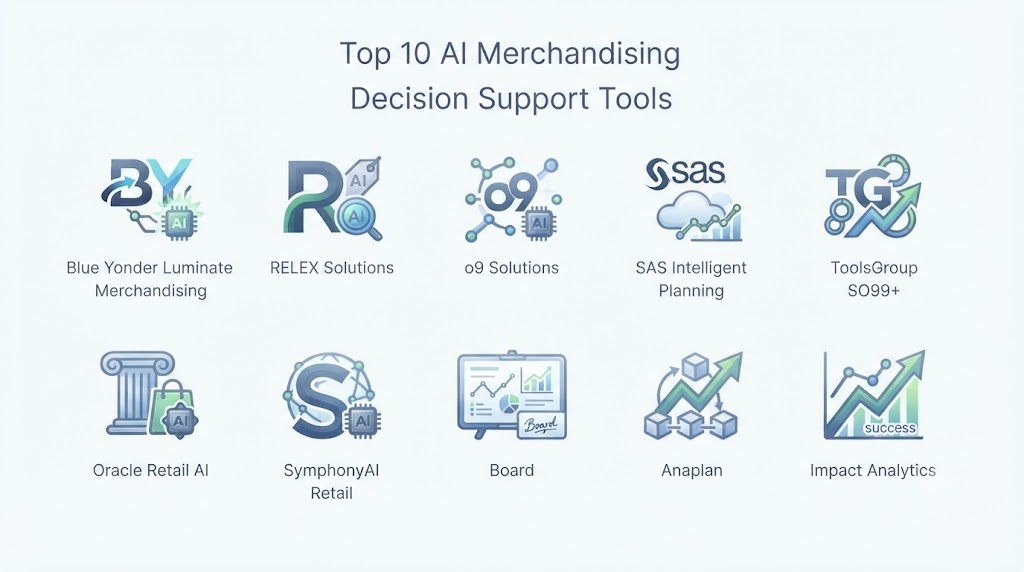
Top 10 AI Merchandising Decision Support Tools
1. Blue Yonder
One-line verdict: Best for enterprise retailers connecting merchandising decisions with assortment, demand, inventory, and supply-chain planning.
Short description:
Blue Yonder provides a broad retail planning environment covering merchandising, demand, inventory, assortment, and supply-chain processes. Its integrated approach makes it useful for organizations that want merchandising decisions connected to operational execution.
Standout Capabilities
- Merchandise planning.
- Assortment planning.
- Demand forecasting.
- Inventory optimization.
- Pricing and promotion planning.
- Product lifecycle management.
- Scenario analysis.
- Retail analytics.
AI-Specific Depth
- Model support: Managed AI and machine-learning capabilities; exact model architecture varies.
- RAG / knowledge integration: Primarily structured enterprise and retail data.
- Evaluation: Forecasting, inventory, assortment, and commercial KPIs.
- Guardrails: Business rules, merchandising constraints, and planning policies.
- Observability: Planning and analytics monitoring; detailed model-level tracing varies.
Pros
- Broad retail planning capabilities.
- Strong connection between merchandising and supply-chain processes.
- Suitable for complex enterprise environments.
Cons
- Large platform footprint.
- Implementation can be complex.
- Pricing is not publicly stated.
Security & Compliance
Enterprise security, identity, governance, and compliance capabilities vary by deployment. Specific certifications should be verified during procurement.
Deployment & Platforms
- Cloud.
- Web.
- Enterprise applications.
- APIs.
Integrations & Ecosystem
Blue Yonder can connect merchandising decisions with broader retail and supply-chain workflows.
- ERP.
- POS.
- Inventory systems.
- WMS.
- E-commerce.
- Merchandising systems.
- APIs.
Pricing Model
Enterprise pricing varies and is not publicly stated.
Best-Fit Scenarios
- Enterprise merchandising.
- Omnichannel retail.
- Integrated merchandising and supply-chain planning.
2. o9 Solutions
One-line verdict: Best for enterprises seeking AI-assisted merchandising decisions connected to demand, inventory, supply, and commercial planning.
Short description:
o9 Solutions provides connected planning capabilities that bring together commercial, demand, supply, and inventory information. Its scenario-based approach can help merchandising teams evaluate decisions across multiple business constraints.
Standout Capabilities
- Merchandise planning.
- Assortment planning.
- Demand planning.
- Inventory planning.
- Scenario modeling.
- Commercial planning.
- Exception management.
- AI-assisted analytics.
AI-Specific Depth
- Model support: Multiple AI and analytical approaches; exact model architecture varies.
- RAG / knowledge integration: Enterprise data integration rather than conventional RAG.
- Evaluation: Planning and commercial performance metrics.
- Guardrails: Business rules and planning constraints.
- Observability: Planning analytics and operational monitoring.
Pros
- Strong scenario-planning capabilities.
- Connects multiple planning functions.
- Useful for large and complex organizations.
Cons
- Requires significant data integration.
- Broad functionality may increase implementation effort.
- Pricing is not publicly stated.
Security & Compliance
Security and compliance capabilities vary by deployment and agreement. Specific certifications should be verified before procurement.
Deployment & Platforms
- Cloud.
- Web.
- Enterprise applications.
- APIs.
Integrations & Ecosystem
- ERP.
- POS.
- Inventory.
- Product information systems.
- Supply-chain systems.
- Data warehouses.
- APIs.
Pricing Model
Enterprise pricing varies.
Best-Fit Scenarios
- Enterprise merchandising.
- Complex scenario planning.
- Cross-functional retail decision support.
3. RELEX Solutions
One-line verdict: Best for retailers connecting merchandising decisions with demand forecasting, inventory, replenishment, and localized retail planning.
Short description:
RELEX Solutions focuses on retail planning and optimization across demand, inventory, replenishment, and merchandising-related workflows. It can be particularly useful when merchandising teams need to understand how commercial decisions affect operational inventory.
Standout Capabilities
- Merchandise planning.
- Assortment planning.
- Demand forecasting.
- Store clustering.
- Inventory optimization.
- Replenishment.
- Promotion planning.
- Retail analytics.
AI-Specific Depth
- Model support: Managed AI and forecasting technologies; exact model architecture is not publicly stated.
- RAG / knowledge integration: Primarily structured retail data.
- Evaluation: Forecast and retail performance KPIs.
- Guardrails: Inventory and merchandising constraints.
- Observability: Forecasting and planning analytics.
Pros
- Strong retail specialization.
- Good connection between merchandising and inventory.
- Useful for localized decisions.
Cons
- Requires reliable retail data.
- Enterprise deployment can require substantial preparation.
- Pricing is not publicly stated.
Security & Compliance
Security and compliance capabilities vary by deployment. Specific certifications should be verified directly.
Deployment & Platforms
- Cloud.
- Web.
- Enterprise applications.
- APIs.
Integrations & Ecosystem
- POS.
- ERP.
- WMS.
- Inventory systems.
- E-commerce.
- Product data.
- Supply-chain applications.
Pricing Model
Enterprise pricing varies.
Best-Fit Scenarios
- Store-level merchandising.
- High-SKU retail.
- Inventory-aware decisions.
4. Oracle Retail
One-line verdict: Best for enterprise retailers needing merchandising intelligence connected to pricing, inventory, planning, and retail operations.
Short description:
Oracle Retail provides a broad portfolio covering merchandising, planning, inventory, pricing, analytics, and other retail processes. Its ecosystem can support decision-making across physical stores and digital channels.
Standout Capabilities
- Merchandise planning.
- Assortment planning.
- Product management.
- Pricing.
- Promotion planning.
- Inventory planning.
- Retail analytics.
- Scenario analysis.
AI-Specific Depth
- Model support: Oracle-managed AI capabilities vary by application.
- RAG / knowledge integration: Enterprise data integration; exact AI functionality depends on the selected products.
- Evaluation: Retail and commercial KPIs.
- Guardrails: Business rules and workflow controls.
- Observability: Enterprise analytics and monitoring vary.
Pros
- Broad retail ecosystem.
- Strong merchandising capabilities.
- Suitable for enterprise retail organizations.
Cons
- Large technology ecosystem.
- Implementation can require specialist expertise.
- AI capabilities vary across products.
Security & Compliance
Enterprise security and governance capabilities are available. Specific certifications should be verified for the selected deployment.
Deployment & Platforms
- Cloud.
- Web.
- Enterprise applications.
- APIs.
Integrations & Ecosystem
- POS.
- ERP.
- Inventory.
- Merchandising.
- E-commerce.
- Analytics.
- APIs.
Pricing Model
Enterprise pricing varies.
Best-Fit Scenarios
- Enterprise merchandising.
- Omnichannel retail.
- Integrated pricing and assortment decisions.
5. SAP
One-line verdict: Best for SAP-centric retailers wanting merchandising decisions integrated with enterprise planning, inventory, and business data.
Short description:
SAP provides enterprise planning, analytics, retail, supply-chain, and AI capabilities that can be combined to support merchandising decisions. It is particularly relevant for organizations already using SAP as part of their enterprise technology environment.
Standout Capabilities
- Demand planning.
- Merchandise planning.
- Inventory planning.
- Retail analytics.
- Enterprise data integration.
- Scenario planning.
- Forecasting.
- Business process integration.
AI-Specific Depth
- Model support: SAP-managed AI capabilities vary by product.
- RAG / knowledge integration: Enterprise data integration and AI capabilities vary by selected SAP products.
- Evaluation: Forecast and business planning KPIs.
- Guardrails: Business rules and workflow constraints.
- Observability: Enterprise monitoring varies by implementation.
Pros
- Strong enterprise integration.
- Useful for organizations already invested in SAP.
- Connects merchandising with broader business processes.
Cons
- Can require substantial configuration.
- Best value may come within an existing SAP environment.
- Exact merchandising capabilities depend on product selection.
Security & Compliance
SAP provides enterprise security and governance capabilities. Specific certifications should be verified for the relevant deployment.
Deployment & Platforms
- Cloud.
- Web.
- Enterprise applications.
- APIs.
Integrations & Ecosystem
- SAP ERP.
- Inventory.
- Supply planning.
- Retail applications.
- Analytics.
- Data platforms.
- APIs.
Pricing Model
Enterprise pricing varies.
Best-Fit Scenarios
- SAP-centric retailers.
- Enterprise planning.
- Connected merchandising decisions.
6. SAS Viya
One-line verdict: Best for advanced analytics teams that want to build customized merchandising intelligence and machine-learning workflows.
Short description:
SAS Viya is an enterprise analytics and AI platform rather than a single-purpose merchandising product. Organizations can use its statistical modeling, machine learning, optimization, and data capabilities to develop customized merchandising decision-support applications.
Standout Capabilities
- Machine learning.
- Statistical analytics.
- Predictive modeling.
- Optimization.
- Customer segmentation.
- Scenario analysis.
- Model management.
- Data preparation.
AI-Specific Depth
- Model support: Multiple statistical and machine-learning approaches.
- RAG / knowledge integration: Data integration capabilities vary; RAG is not its primary focus.
- Evaluation: Strong model validation and evaluation capabilities.
- Guardrails: Governance and model-management controls.
- Observability: Model and analytics monitoring varies by implementation.
Pros
- High customization potential.
- Strong analytics foundation.
- Suitable for data-science-led organizations.
Cons
- Requires specialized expertise.
- May need custom merchandising development.
- Not necessarily the fastest option for a simple packaged deployment.
Security & Compliance
Enterprise security and governance capabilities are available. Specific certifications should be verified for the applicable environment.
Deployment & Platforms
- Cloud.
- Enterprise environments.
- Web.
- APIs.
Integrations & Ecosystem
- Data warehouses.
- Databases.
- ERP.
- POS.
- Cloud platforms.
- BI tools.
- APIs.
Pricing Model
Enterprise pricing varies.
Best-Fit Scenarios
- Custom merchandising analytics.
- Advanced retail data science.
- Large organizations with internal analytics teams.
7. ToolsGroup
One-line verdict: Best for merchandising teams that need decisions closely connected to demand forecasting and inventory economics.
Short description:
ToolsGroup specializes in supply-chain planning, forecasting, and inventory optimization. Its capabilities are useful when merchandising decisions need to account for demand variability, stock availability, service levels, and inventory investment.
Standout Capabilities
- Demand forecasting.
- Inventory optimization.
- Assortment analysis.
- Replenishment.
- Service-level optimization.
- Scenario analysis.
- Exception management.
- Supply planning.
AI-Specific Depth
- Model support: Proprietary and managed forecasting technologies.
- RAG / knowledge integration: Primarily structured supply-chain data.
- Evaluation: Forecast accuracy and inventory KPIs.
- Guardrails: Inventory and service-level constraints.
- Observability: Forecast and inventory analytics.
Pros
- Strong inventory analytics.
- Useful for demand variability.
- Helps connect merchandising and supply decisions.
Cons
- More supply-chain focused than some merchandising-first platforms.
- Requires good operational data.
- Pricing is not publicly stated.
Security & Compliance
Security, identity, compliance, and retention controls vary by deployment.
Deployment & Platforms
- Cloud.
- Web.
- Enterprise applications.
- APIs.
Integrations & Ecosystem
- ERP.
- WMS.
- Inventory systems.
- E-commerce.
- Supply-chain applications.
- Data platforms.
- APIs.
Pricing Model
Enterprise pricing varies.
Best-Fit Scenarios
- Inventory-aware merchandising.
- High-SKU retailers.
- Demand-driven planning.
8. Infor
One-line verdict: Best for organizations seeking enterprise merchandising decision support connected with supply-chain and planning processes.
Short description:
Infor provides enterprise software across retail, supply chain, planning, analytics, and related business processes. Its broader ecosystem can help organizations connect merchandising decisions with operational and financial considerations.
Standout Capabilities
- Retail analytics.
- Demand planning.
- Supply planning.
- Inventory planning.
- Merchandising.
- Scenario planning.
- Exception management.
- Enterprise integration.
AI-Specific Depth
- Model support: Managed AI and analytical capabilities vary by product.
- RAG / knowledge integration: Enterprise data integration.
- Evaluation: Forecast and business KPIs.
- Guardrails: Business rules and workflow constraints.
- Observability: Planning analytics vary by implementation.
Pros
- Broad enterprise ecosystem.
- Strong business-process integration.
- Suitable for complex organizations.
Cons
- Broad platform scope can increase complexity.
- Exact AI capabilities vary by product.
- Pricing is not publicly stated.
Security & Compliance
Security and compliance depend on the selected products and deployment.
Deployment & Platforms
- Cloud.
- Web.
- Enterprise applications.
- APIs.
Integrations & Ecosystem
- ERP.
- POS.
- Inventory.
- Supply chain.
- Data warehouses.
- Analytics.
- APIs.
Pricing Model
Enterprise pricing varies.
Best-Fit Scenarios
- Enterprise retail.
- Connected merchandising.
- Integrated planning.
9. Anaplan
One-line verdict: Best for collaborative merchandising decisions involving scenario planning, workflows, and cross-functional business teams.
Short description:
Anaplan provides connected planning capabilities that organizations can configure for merchandising, demand, inventory, financial, and commercial planning. Its strength is collaborative scenario modeling across different business functions.
Standout Capabilities
- Connected planning.
- Scenario modeling.
- Merchandise planning.
- Demand planning.
- Financial planning.
- Workflow collaboration.
- What-if analysis.
- Planning analytics.
AI-Specific Depth
- Model support: AI and predictive capabilities vary by application and configuration.
- RAG / knowledge integration: Enterprise data integration; conventional RAG is not its primary focus.
- Evaluation: Planning and predictive KPIs.
- Guardrails: Workflow and planning constraints.
- Observability: Planning analytics and platform monitoring vary.
Pros
- Strong collaborative planning.
- Flexible scenario analysis.
- Useful across merchandising and finance.
Cons
- Requires configuration.
- Not exclusively a merchandising AI platform.
- Complex models may require specialist support.
Security & Compliance
Enterprise security and administrative capabilities are available. Specific certifications should be verified for the relevant service.
Deployment & Platforms
- Cloud.
- Web.
- Enterprise applications.
- APIs.
Integrations & Ecosystem
- ERP.
- CRM.
- Data warehouses.
- Financial systems.
- Retail applications.
- BI platforms.
- APIs.
Pricing Model
Enterprise pricing varies.
Best-Fit Scenarios
- Collaborative merchandising.
- Scenario-driven planning.
- Cross-functional decision-making.
10. Manhattan Active
One-line verdict: Best for retailers connecting merchandising decisions with inventory, fulfillment, commerce, and operational retail workflows.
Short description:
Manhattan Active provides cloud-based retail and supply-chain capabilities covering commerce, inventory, order management, and related retail operations. Its operational data can support merchandising decisions where inventory availability and fulfillment are important.
Standout Capabilities
- Inventory visibility.
- Retail operations.
- Order management.
- Commerce.
- Supply-chain analytics.
- Exception management.
- Product and inventory insights.
- Enterprise integration.
AI-Specific Depth
- Model support: AI capabilities vary by product and workflow.
- RAG / knowledge integration: Enterprise data integration; exact capabilities vary.
- Evaluation: Operational and retail KPIs.
- Guardrails: Business rules and operational constraints.
- Observability: Operational analytics and monitoring vary.
Pros
- Strong operational retail ecosystem.
- Useful inventory and fulfillment context.
- Cloud-oriented enterprise architecture.
Cons
- More operationally focused than dedicated merchandising platforms.
- Assortment capabilities may require complementary solutions.
- Pricing is not publicly stated.
Security & Compliance
Security and compliance capabilities vary by deployment and agreement. Specific certifications should be verified during procurement.
Deployment & Platforms
- Cloud.
- Web.
- Enterprise applications.
- APIs.
Integrations & Ecosystem
- E-commerce.
- Order management.
- Inventory.
- WMS.
- ERP.
- Retail applications.
- APIs.
Pricing Model
Enterprise pricing varies.
Best-Fit Scenarios
- Omnichannel retail.
- Inventory-aware merchandising.
- Retail operations connected to commercial decisions.
Comparison Table
| Tool Name | Best For | Deployment | Model Flexibility | Strength | Watch-Out | Public Rating |
|---|---|---|---|---|---|---|
| Blue Yonder | Enterprise merchandising | Cloud | Managed | Broad retail planning | Implementation complexity | N/A |
| o9 Solutions | Connected decision support | Cloud | Multi-model/managed | Scenario intelligence | Broad platform scope | N/A |
| RELEX Solutions | Retail optimization | Cloud | Managed | Merchandising + inventory | Data requirements | N/A |
| Oracle Retail | Enterprise retail | Cloud | Managed | Retail ecosystem | Large platform | N/A |
| SAP | SAP-centric enterprises | Cloud | Managed | Enterprise integration | Configuration complexity | N/A |
| SAS Viya | Custom analytics | Cloud/Enterprise | Multi-model | Analytical flexibility | Requires expertise | N/A |
| ToolsGroup | Inventory-aware decisions | Cloud | Managed | Demand + inventory | Supply-chain focus | N/A |
| Infor | Enterprise planning | Cloud | Managed | Business integration | Broad scope | N/A |
| Anaplan | Collaborative planning | Cloud | Multi-model/managed | Scenario planning | Configuration effort | N/A |
| Manhattan Active | Operational retail | Cloud | Managed | Inventory + commerce | Less merchandising-focused | N/A |
Scoring & Evaluation
These scores are comparative editorial assessments, not official vendor ratings. They reflect how well each platform can support merchandising decision-making across functionality, AI capabilities, integrations, usability, operational performance, security, and support.
| Tool | Core | Reliability/Eval | Guardrails | Integrations | Ease | Perf/Cost | Security/Admin | Support | Weighted Total |
|---|---|---|---|---|---|---|---|---|---|
| Blue Yonder | 10 | 9 | 9 | 10 | 7 | 8 | 10 | 10 | 9.10 |
| o9 Solutions | 10 | 9 | 9 | 10 | 7 | 8 | 9 | 9 | 8.95 |
| RELEX Solutions | 10 | 9 | 9 | 9 | 8 | 9 | 9 | 9 | 9.10 |
| Oracle Retail | 10 | 8 | 9 | 10 | 7 | 8 | 10 | 10 | 9.00 |
| SAP | 9 | 9 | 9 | 10 | 7 | 8 | 10 | 10 | 9.00 |
| SAS Viya | 9 | 10 | 9 | 9 | 7 | 8 | 10 | 10 | 8.95 |
| ToolsGroup | 9 | 9 | 9 | 9 | 8 | 9 | 9 | 9 | 8.95 |
| Infor | 9 | 8 | 9 | 9 | 7 | 8 | 9 | 9 | 8.55 |
| Anaplan | 9 | 8 | 9 | 10 | 8 | 8 | 10 | 9 | 8.95 |
| Manhattan Active | 8 | 8 | 9 | 10 | 8 | 9 | 10 | 9 | 8.75 |
Top 3 for Enterprise
- Blue Yonder — Strong overall combination of merchandising, planning, inventory, and supply-chain capabilities.
- RELEX Solutions — Strong choice for detailed retail optimization and operational merchandising decisions.
- o9 Solutions — Particularly useful for connected planning and complex decision scenarios.
Top 3 for SMB
- Anaplan — Useful when collaborative planning and flexible scenarios are important.
- ToolsGroup — Relevant when inventory and demand are central to merchandising decisions.
- RELEX Solutions — Worth considering for growing retailers with increasing product and store complexity.
Top 3 for Developers
- SAS Viya — Strongest option for custom analytics and machine-learning development.
- o9 Solutions — Relevant for data-rich planning and scenario workflows.
- Anaplan — Useful when configurable models and integrations are priorities.
Which AI Merchandising Decision Support Tool Is Right for You?
Solo / Freelancer
A dedicated merchandising AI platform is usually unnecessary for a small operation.
Start with:
- Sales dashboards.
- Product-level reporting.
- Basic demand analysis.
- Inventory reports.
- Margin analysis.
- Spreadsheet-based planning.
- Simple customer segmentation.
Consider a dedicated platform when product, store, or channel complexity becomes difficult to manage manually.
SMB
SMBs should focus on practical capabilities rather than buying the largest platform available.
Prioritize:
- Easy implementation.
- Product analytics.
- Category insights.
- Inventory visibility.
- Basic forecasting.
- Pricing analytics.
- Simple recommendations.
- Clear dashboards.
- Reasonable integration requirements.
Mid-Market
Mid-market retailers can benefit from AI when merchants manage hundreds or thousands of products across multiple locations or channels.
Prioritize:
- Product-level recommendations.
- Category analytics.
- Assortment optimization.
- Store localization.
- Inventory-aware recommendations.
- Pricing and promotion analysis.
- Scenario modeling.
- Exception detection.
Enterprise
Large organizations should look for a connected merchandising intelligence architecture.
Prioritize:
- Enterprise data integration.
- Product and category analytics.
- Assortment optimization.
- Demand forecasting.
- Pricing.
- Promotions.
- Inventory.
- Customer segmentation.
- Store localization.
- Scenario simulation.
- AI assistants.
- Agentic workflows.
- Explainability.
- Evaluation.
- Governance.
- Auditability.
- APIs.
- Model monitoring.
Platforms such as Blue Yonder, RELEX Solutions, o9 Solutions, Oracle Retail, SAP, and ToolsGroup can be strong candidates depending on the retailer’s existing technology environment.
Regulated Industries
Retailers handling significant customer or behavioral data should pay attention to:
- Data access.
- Data retention.
- Encryption.
- RBAC.
- SSO.
- Audit logs.
- Model governance.
- Explainability.
- Human approval.
- Data residency where applicable.
Budget vs Premium
Budget Approach
A smaller retailer can combine:
- Existing BI software.
- POS analytics.
- Inventory reports.
- Spreadsheet models.
- Basic forecasting.
- Product dashboards.
- Simple machine-learning models.
Premium Approach
Enterprise merchandising decision support can include:
- AI-generated recommendations.
- Automated category analysis.
- Product opportunity detection.
- Assortment optimization.
- Demand forecasting.
- Pricing analysis.
- Promotion optimization.
- Customer segmentation.
- Scenario simulation.
- AI agents.
- Exception management.
- Governance.
Build vs Buy
Build when:
- Merchandising intelligence is a competitive advantage.
- You have experienced data scientists.
- You have proprietary customer and product signals.
- Existing platforms cannot represent your business logic.
- You need highly customized optimization.
Buy when:
- Standard retail workflows are sufficient.
- You need faster implementation.
- Your organization lacks specialized AI expertise.
- Enterprise integrations are important.
- You need vendor support.
Hybrid Approach
A hybrid strategy can combine commercial merchandising software with internal AI.
Use the commercial platform for:
- Planning workflows.
- Data integration.
- Standard analytics.
- Dashboards.
- Merchandising processes.
Keep internal ownership of:
- Proprietary models.
- Custom signals.
- Evaluation datasets.
- Business rules.
- AI governance.
- Strategic decision logic.
Implementation Playbook: 30 / 60 / 90 Days
First 30 Days: Pilot + Success Metrics
Start with a limited merchandising use case.
For example:
- One product category.
- One region.
- A small group of stores.
- One digital category.
- One pricing workflow.
Collect:
- Product data.
- Sales history.
- Inventory.
- Prices.
- Promotions.
- Product attributes.
- Store information.
- Customer segments where appropriate.
- Returns.
- Margins.
Define baseline KPIs:
- Revenue.
- Gross margin.
- Sell-through.
- Inventory turnover.
- Stock-outs.
- Markdown rate.
- Average selling price.
- Product productivity.
- Conversion.
- Recommendation acceptance.
Create a historical evaluation set to determine whether AI recommendations would have produced better decisions.
Days 31–60: Harden Security + Evaluation + Rollout
Create an AI evaluation framework.
Test:
- Recommendation accuracy.
- Category insights.
- Forecast quality.
- Product ranking.
- Scenario results.
- Recommendation consistency.
- New-product behavior.
- Outlier handling.
Introduce guardrails for:
- Pricing limits.
- Brand requirements.
- Margin thresholds.
- Inventory constraints.
- Product exclusions.
- Category rules.
- Human approval.
For generative AI workflows, test:
- Prompt injection.
- Incorrect reasoning.
- Unsupported claims.
- Sensitive-data exposure.
- Inappropriate actions.
- Hallucinated product information.
Version-control:
- Prompts.
- Models.
- Business rules.
- Evaluation datasets.
- Data transformations.
- Recommendation logic.
Days 61–90: Optimize Cost + Latency + Governance
Expand successful use cases.
Track:
- Recommendation acceptance.
- Sales impact.
- Margin impact.
- Inventory performance.
- Category productivity.
- Forecast accuracy.
- Processing time.
- AI usage.
- Infrastructure costs.
- User adoption.
Introduce AI assistants that can:
- Explain category performance.
- Identify product opportunities.
- Summarize merchandising changes.
- Compare scenarios.
- Find anomalies.
- Prepare recommendations.
- Answer merchant questions.
Keep material decisions under human approval until the system demonstrates consistent performance.
Common Mistakes & How to Avoid Them
- Treating AI as a replacement for merchants: Use AI to augment expertise rather than eliminate strategic judgment.
- Optimizing revenue alone: Revenue growth may come at the expense of margin or inventory efficiency.
- Ignoring inventory: A recommendation is less useful when the product cannot be supplied.
- Using poor product data: Incorrect attributes can produce misleading recommendations.
- Ignoring store differences: Product behavior varies across locations.
- No evaluation framework: AI recommendations need measurable benchmarks.
- No historical backtesting: Test whether the recommendation would have improved previous decisions.
- Ignoring promotions: Promotional sales can distort demand signals.
- Ignoring returns: High-return products may appear stronger than they really are.
- No explainability: Merchants need understandable reasons for recommendations.
- Overusing generative AI: Not every merchandising task requires an LLM.
- Exposing sensitive data to AI systems: Apply appropriate privacy and access controls.
- Ignoring prompt injection: AI assistants connected to enterprise data need appropriate security testing.
- No observability: Track recommendation quality, latency, usage, and cost.
- Automating too early: Start with human approval before enabling automated actions.
- Ignoring model drift: Customer preferences and market conditions change.
- Creating vendor lock-in: Maintain portable data and independent evaluation capabilities.
- Underestimating integration work: Connecting POS, ERP, PIM, inventory, e-commerce, and analytics systems can be significant.
FAQs
1. What Is AI Merchandising Decision Support?
AI merchandising decision support uses artificial intelligence, machine learning, forecasting, optimization, and analytics to help merchants make decisions about products, categories, pricing, promotions, inventory, and customers.
2. How Does AI Help Merchandisers?
AI can analyze large volumes of retail information, identify patterns, detect exceptions, forecast outcomes, compare scenarios, and recommend actions.
3. Can AI Replace Merchandisers?
No. AI can automate repetitive analysis, but strategic decisions still benefit from merchant expertise, brand knowledge, market context, and human judgment.
4. What Data Does AI Merchandising Software Need?
Typical inputs include sales, product attributes, inventory, pricing, promotions, store information, margins, customer data, and product lifecycle information.
5. Can AI Recommend Which Products to Promote?
Yes. Depending on the platform, AI can analyze demand, inventory, margins, historical promotions, product performance, and other signals to support promotion decisions.
6. Can AI Support Pricing Decisions?
Yes. AI can analyze demand, historical prices, inventory, competitive signals where available, promotions, and other factors to support pricing decisions.
7. Can AI Help With Assortment Decisions?
Yes. Assortment optimization is a major merchandising use case. AI can help evaluate which products should be carried across stores, regions, categories, and channels.
8. Can AI Personalize Merchandising Decisions?
Yes. Customer segments and behavioral data can be incorporated into merchandising decisions, although the depth of personalization depends on the available data and platform.
9. What Are AI Guardrails in Merchandising?
Guardrails are rules that prevent AI recommendations from violating business requirements, such as minimum margins, pricing limits, inventory constraints, brand rules, or approval policies.
10. What Is Human-in-the-Loop Merchandising?
It means AI produces analysis or recommendations while a merchant reviews and approves important decisions before they are implemented.
11. Can Generative AI Help Merchandising Teams?
Yes. Generative AI can summarize category performance, answer natural-language questions, explain recommendations, compare scenarios, and prepare reports.
12. Can AI Agents Work as Merchandising Assistants?
Yes. Agents can investigate category anomalies, gather information, analyze product performance, prepare recommendations, and support repetitive workflows.
13. What Is the Difference Between AI Analytics and AI Decision Support?
Analytics primarily helps users understand what happened. Decision support goes further by helping identify what should happen next and why.
14. Can AI Merchandising Tools Integrate With ERP Systems?
Many enterprise platforms provide integrations with ERP, POS, inventory, e-commerce, product information, and other enterprise systems. Exact integrations vary by vendor.
15. Can AI Merchandising Platforms Use Existing Company Data?
Yes. Most enterprise implementations depend heavily on the retailer’s existing operational and commercial data.
16. Can Retailers Bring Their Own AI Models?
This depends on the platform. Analytics-oriented environments generally offer more flexibility than packaged retail applications.
17. Can AI Merchandising Software Be Self-Hosted?
Deployment options vary. Some analytical architectures can be deployed within controlled environments, while commercial retail platforms commonly use managed cloud deployments.
18. How Much Does AI Merchandising Software Cost?
Pricing varies considerably according to users, data volume, product count, integrations, functionality, deployment requirements, and enterprise scale. Exact prices are often not publicly stated.
19. Is AI Merchandising Useful for Small Retailers?
It can be, but small retailers may achieve sufficient results with BI dashboards, POS reporting, spreadsheets, and basic forecasting before requiring a dedicated enterprise platform.
20. What Is the Biggest Risk of AI Merchandising?
Poor data quality is one of the biggest risks. Incorrect inventory, product attributes, pricing, or sales data can produce unreliable recommendations.
21. How Should AI Merchandising Recommendations Be Evaluated?
Use measurable KPIs such as revenue, gross margin, sell-through, inventory turnover, stock-outs, markdowns, conversion, recommendation acceptance, and customer outcomes.
22. Should AI Recommendations Be Automatically Implemented?
Not initially. Retailers should generally begin with human approval, validate performance, and gradually automate low-risk decisions.
23. How Can Retailers Protect Data Used by AI Merchandising Tools?
Organizations should evaluate access controls, encryption, retention policies, data residency, audit logging, vendor data usage, and administrative controls.
24. What Is Prompt Injection in AI Merchandising?
Prompt injection is an attack technique in which malicious or untrusted content attempts to manipulate an AI system into ignoring its intended instructions or performing unintended actions.
25. Why Is AI Explainability Important for Merchandising?
Merchants need to understand why a product was recommended, why a category changed, or why a particular action was prioritized before trusting the system.
26. Can AI Merchandising Reduce Costs?
Potentially. Better decisions can reduce manual analysis, excess inventory, markdowns, ineffective promotions, and inefficient product selection, although actual savings depend on implementation.
27. Which AI Merchandising Tool Is Best for Enterprise Retail?
Blue Yonder, RELEX Solutions, o9 Solutions, Oracle Retail, and SAP can all be relevant depending on existing systems, business requirements, and planning complexity.
28. Which Tool Is Best for Custom AI Analytics?
SAS Viya is particularly suitable for organizations that want to build customized machine-learning, optimization, and analytical workflows.
29. Should Retailers Build or Buy AI Merchandising Software?
Buying is generally faster for standard merchandising workflows. Building can make sense when the retailer has unique requirements, proprietary data, or specialized decision logic.
30. What Should a Retailer Do Before Selecting a Platform?
Define the merchandising problems first, identify required data sources and integrations, establish measurable KPIs, determine security requirements, and run a controlled pilot before committing to a large deployment.
Conclusion
AI Merchandising Decision Support is becoming an important layer between retail data and everyday commercial decisions. The technology can help merchants move from manually reviewing reports toward continuous analysis, predictive insights, scenario comparison, and prioritized recommendations.Blue Yonder is a strong enterprise option for connected merchandising and supply-chain planning. RELEX Solutions is particularly relevant when retail optimization and inventory are closely connected. o9 Solutions stands out for connected planning and scenario-based decisions. Oracle Retail and SAP can be attractive for retailers already operating within their respective enterprise ecosystems. ToolsGroup is worth considering when demand and inventory economics are central to merchandising. SAS Viya is a better fit for organizations wanting extensive analytical customization.best choice depends on the retailer’s size, product complexity, number of stores, sales channels, data maturity, existing technology stack, AI requirements, budget, and desired level of automa