Introduction
AI Policy Q&A Assistants for Employees are changing how organizations deliver answers to workplace policy questions. Employees regularly need clarification about leave policies, travel and expenses, remote work, workplace conduct, benefits, information security, procurement procedures, reimbursement rules, onboarding requirements, and other internal policies. Traditionally, employees have relied on HR teams, managers, intranet searches, PDFs, email, or helpdesk tickets to find these answers.This process can be slow when policies are distributed across multiple documents, websites, knowledge bases, and departmental systems. Employees may also struggle to determine which policy applies to a specific situation or whether a document is still current.AI-powered policy assistants provide a conversational interface for accessing approved organizational information. Instead of searching through lengthy documents, an employee can ask a natural-language question and receive an answer based on the organization’s available policy and knowledge sources.
For example, an employee might ask whether a particular business expense qualifies for reimbursement, how far in advance leave should be requested, or what procedure should be followed when working remotely from another location. An AI assistant can retrieve relevant policy information and provide a contextual response.
What Are AI Policy Q&A Assistants for Employees?
AI Policy Q&A Assistants are conversational AI systems designed to help employees find and understand internal organizational policies and procedures.
They can answer questions about:
- HR policies
- Leave and attendance
- Travel policies
- Expense policies
- Benefits
- Remote work
- Workplace conduct
- Information security
- Procurement
- IT policies
- Onboarding
- Compliance procedures
- Internal processes
Depending on the platform, they can connect with HR systems, intranets, document repositories, collaboration platforms, enterprise search systems, and service-management workflows.
Why Employee Policy Assistants Matter
Organizations can have hundreds or thousands of internal policies and procedures. Employees may not know where to find the right document or understand how different policies interact.
AI assistants can help:
- Reduce repetitive policy questions
- Improve employee self-service
- Make internal knowledge easier to access
- Reduce HR support workload
- Provide faster answers
- Improve consistency
- Surface relevant policy documents
- Route complex questions to human teams
- Improve knowledge discovery
Key Features
Natural-Language Questions
Employees can ask questions using everyday language instead of searching for exact policy terminology.
Enterprise Knowledge Retrieval
The assistant searches approved internal sources to identify relevant information.
Policy-Aware Responses
AI can provide responses based on organizational policies rather than generic internet information.
Source Citations
Some platforms can show the policy or knowledge source supporting an answer.
Document Search
The system can search PDFs, documents, knowledge articles, intranet pages, and other repositories.
Policy Version Awareness
Effective policy assistants should distinguish current information from outdated documents.
Role-Based Access
Employees should only receive information they are authorized to access.
Multilingual Support
Organizations with international workforces may need policy assistance in multiple languages.
Human Escalation
Complex or sensitive questions can be routed to HR, legal, compliance, or another appropriate team.
Workflow Integration
The assistant can connect answers to related processes such as leave requests, expense submissions, or service requests.
Conversation Context
The system can maintain relevant context during a policy-related conversation.
Analytics
HR and knowledge teams can analyze frequently asked questions and identify gaps in policy documentation.
Common Use Cases
Leave Policy Questions
Employees can ask about leave eligibility, procedures, approval requirements, and documentation.
Travel and Expense Policies
Assist employees in understanding reimbursement rules and travel procedures.
Remote Work Policies
Answer questions about remote and hybrid work requirements.
Benefits Information
Help employees locate approved benefits information.
Workplace Conduct
Provide access to relevant conduct and workplace policies while escalating sensitive matters when necessary.
Information Security Policies
Help employees understand password, device, access, data handling, and security procedures.
Procurement Policies
Explain purchasing procedures, approval requirements, and spending rules.
Onboarding
Help new employees discover important policies and procedures.
Compliance Questions
Surface relevant internal compliance information while directing complex matters to appropriate specialists.
Benefits of AI Policy Q&A Assistants
Faster Employee Self-Service
Employees can find information without waiting for an HR response.
Reduced Repetitive Work
HR and support teams can spend less time answering frequently repeated questions.
Improved Knowledge Accessibility
Employees can interact with complex internal documentation through conversational queries.
More Consistent Answers
Responses can be grounded in centralized and approved policy sources.
Better Employee Experience
A conversational interface can make internal policies easier to understand.
Knowledge Gap Detection
Frequently asked questions can reveal unclear or missing policy documentation.
Scalable Support
AI assistants can support large employee populations simultaneously.
Challenges and Risks
Outdated Policies
An AI assistant may provide incorrect information if its underlying documents are outdated.
Hallucinations
Generative AI can produce plausible but unsupported answers if retrieval and grounding are weak.
Policy Exceptions
Many policies contain exceptions that require contextual interpretation.
Regional Differences
A policy may vary by country, state, department, employment type, or business unit.
Sensitive Information
HR and employee questions can involve confidential information.
Legal Interpretation
AI should not be treated as a substitute for qualified legal or HR judgment.
Access Control
The assistant must respect employee permissions and information boundaries.
Ambiguous Questions
Employees may ask questions that require clarification before an accurate answer can be given.
Responsible AI Practices
Organizations should establish strong governance before deploying an employee policy assistant.
Recommended practices include:
- Ground answers in approved policy sources
- Show source references where appropriate
- Maintain policy version control
- Clearly identify effective dates
- Apply role-based access
- Protect employee information
- Monitor unsupported answers
- Provide escalation paths
- Regularly review knowledge sources
- Test regional and policy exceptions
- Keep human HR support available
- Maintain audit trails for sensitive workflows
Key Trends
Generative AI Knowledge Assistants
Organizations are increasingly using conversational AI to make internal documentation easier to access.
Retrieval-Augmented Generation
Policy assistants increasingly combine generative AI with controlled organizational knowledge retrieval.
HR Service Automation
Policy Q&A is increasingly being connected with employee service workflows.
Multilingual Employee Support
Global organizations are adopting multilingual conversational support.
Personalized Policy Experiences
Future assistants may use role, location, department, employment type, and other authorized context to surface relevant policies.
Proactive Policy Guidance
AI can potentially alert employees to relevant policies during workflows such as travel booking, procurement, onboarding, or leave requests.
Knowledge Governance
Organizations are placing greater emphasis on maintaining authoritative, current, and well-structured policy sources.
Methodology
The platforms below were selected based on their relevance to employee self-service, enterprise knowledge management, HR service delivery, conversational AI, policy discovery, workflow automation, and internal knowledge assistance.
The evaluation considers:
- Employee Q&A
- Enterprise search
- Knowledge retrieval
- AI response quality
- HR integration
- Workflow automation
- Security and governance
- Multilingual capabilities
- Ease of use
- Enterprise scalability
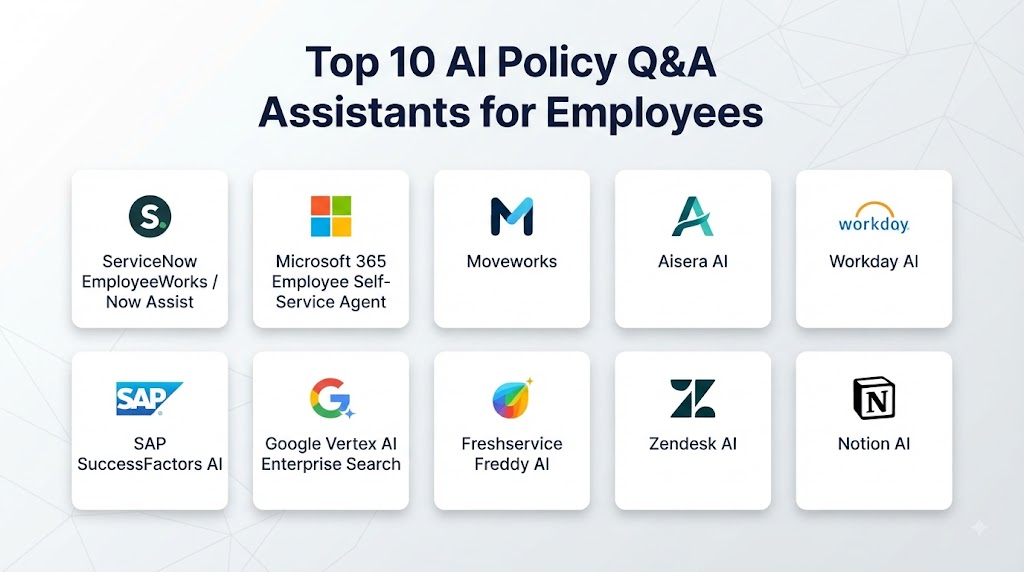
Top 10 AI Policy Q&A Assistants for Employees
1. Microsoft 365 Copilot
Microsoft 365 Copilot can help employees find and interact with information across supported Microsoft environments and organizational content.
Key Features
- Conversational knowledge access
- Enterprise search
- Document assistance
- Microsoft 365 integration
- Natural-language interaction
- Workplace productivity assistance
Pros
- Strong Microsoft ecosystem integration
- Familiar workplace environment
- Broad enterprise knowledge access
- Useful document and information discovery
Cons
- Capabilities depend on Microsoft licensing and configuration
- Organizations need strong permissions and information-governance practices
2. ServiceNow Now Assist
ServiceNow Now Assist provides generative AI capabilities across service-management workflows and can support employee self-service and knowledge discovery.
Key Features
- Employee self-service
- Knowledge retrieval
- AI-generated responses
- Service catalog integration
- Case and request assistance
- Workflow automation
Pros
- Strong enterprise service-management integration
- Useful employee-service capabilities
- Broad workflow automation
- Strong knowledge-management foundation
Cons
- Best suited to organizations already using the ServiceNow ecosystem
- Enterprise implementations can require substantial configuration
3. Moveworks
Moveworks focuses on conversational employee support and enterprise automation, making it well suited to policy and internal knowledge questions.
Key Features
- Employee self-service
- Conversational AI
- Enterprise search
- Knowledge retrieval
- Workflow automation
- Multichannel assistance
Pros
- Strong employee experience focus
- Broad enterprise integrations
- Effective conversational interface
- Strong automation capabilities
Cons
- Enterprise implementation can require integration planning
- Advanced workflows require governance
4. Aisera
Aisera provides conversational AI and service automation capabilities across employee and enterprise support environments.
Key Features
- Employee Q&A
- Knowledge retrieval
- AI service desk
- Workflow automation
- Conversational support
- Enterprise integrations
Pros
- Broad enterprise service capabilities
- Strong conversational AI
- Supports multiple business functions
- Useful automation
Cons
- Configuration requirements vary
- Organizations should validate answers against authoritative policy sources
5. Espressive Barista
Espressive Barista is designed as a virtual employee assistant that can help workers find information and complete service-related tasks.
Key Features
- Employee self-service
- Conversational assistance
- Knowledge retrieval
- HR support
- IT support
- Workflow automation
Pros
- Employee-focused design
- Strong self-service orientation
- Supports multiple enterprise functions
- Useful conversational workflows
Cons
- Advanced integrations may require implementation effort
- Organizations should carefully govern connected workflows
6. Leena AI
Leena AI provides conversational employee support across HR and workplace processes.
Key Features
- HR policy Q&A
- Employee self-service
- HR knowledge management
- Workflow automation
- Employee assistance
- Conversational AI
Pros
- Strong HR orientation
- Useful employee self-service
- Supports policy-related questions
- Suitable for HR service delivery
Cons
- Best suited to organizations seeking HR-focused capabilities
- Enterprise deployments may require integration work
7. Workday Assistant
Workday provides conversational assistance capabilities within its broader human capital management environment.
Key Features
- Employee assistance
- HR information access
- HCM integration
- Workforce information
- Employee self-service
- Conversational interaction
Pros
- Strong HCM ecosystem
- Access to relevant workforce information
- Useful for Workday-based organizations
- Integrated employee experience
Cons
- Best value depends on existing Workday adoption
- Capabilities depend on configuration and available services
8. Paradox
Paradox provides conversational AI focused heavily on recruiting and employee interactions, including automated conversations and workflow support.
Key Features
- Conversational AI
- Employee interactions
- Recruiting workflows
- Automated responses
- Scheduling
- HR process support
Pros
- Strong conversational experience
- Useful HR interaction capabilities
- Workflow automation
- Good fit for high-volume interactions
Cons
- More recruitment-oriented than broad enterprise policy management
- Additional systems may be needed for extensive policy knowledge use cases
9. Unily
Unily provides an employee experience and intranet platform that can help organizations centralize internal information and improve employee access to organizational knowledge.
Key Features
- Employee intranet
- Enterprise search
- Knowledge management
- Employee communications
- Personalization
- AI-powered information discovery
Pros
- Strong employee experience platform
- Useful internal communications
- Centralized organizational knowledge
- Good intranet capabilities
Cons
- AI policy Q&A capabilities depend on implementation
- Organizations may need additional workflow integrations
10. Sana AI
Sana AI provides enterprise knowledge and AI assistant capabilities designed to help employees discover organizational information and interact with internal knowledge.
Key Features
- Enterprise knowledge search
- AI assistant
- Conversational Q&A
- Knowledge management
- Learning content
- Workplace information discovery
Pros
- Strong knowledge discovery
- Conversational employee experience
- Useful enterprise search
- Modern AI interface
Cons
- Policy workflow capabilities depend on integrations
- Organizations need effective knowledge governance
Comparison Table
| No. | Platform | Best For | Policy Q&A | Enterprise Search | HR Integration | Workflow Automation | Employee Self-Service |
|---|---|---|---|---|---|---|---|
| 1 | Microsoft 365 Copilot | Microsoft environments | Strong | Strong | Strong | Strong | Strong |
| 2 | ServiceNow Now Assist | Enterprise service management | Strong | Strong | Strong | Strong | Strong |
| 3 | Moveworks | Employee automation | Strong | Strong | Strong | Strong | Strong |
| 4 | Aisera | Enterprise service AI | Strong | Strong | Strong | Strong | Strong |
| 5 | Espressive Barista | Employee self-service | Strong | Strong | Strong | Strong | Strong |
| 6 | Leena AI | HR policy assistance | Strong | Strong | Strong | Strong | Strong |
| 7 | Workday Assistant | HCM environments | Strong | Strong | Strong | Strong | Strong |
| 8 | Paradox | Conversational HR | Moderate | Moderate | Strong | Strong | Strong |
| 9 | Unily | Employee intranet | Strong | Strong | Moderate | Moderate | Strong |
| 10 | Sana AI | Knowledge discovery | Strong | Strong | Moderate | Moderate | Strong |
Weighted Evaluation Table
| No. | Platform | Policy Q&A 20% | Knowledge Retrieval 15% | AI Accuracy 15% | HR Integration 15% | Automation 10% | Security & Governance 10% | Ease of Use 5% | Scalability 10% | Total Score |
|---|---|---|---|---|---|---|---|---|---|---|
| 1 | Microsoft 365 Copilot | 19 | 15 | 14 | 15 | 9 | 10 | 5 | 10 | 97 |
| 2 | ServiceNow Now Assist | 19 | 15 | 15 | 15 | 10 | 10 | 4 | 10 | 98 |
| 3 | Moveworks | 20 | 15 | 15 | 15 | 10 | 9 | 4 | 10 | 98 |
| 4 | Aisera | 19 | 15 | 15 | 14 | 10 | 9 | 4 | 10 | 96 |
| 5 | Espressive Barista | 19 | 14 | 14 | 14 | 10 | 9 | 5 | 9 | 94 |
| 6 | Leena AI | 20 | 14 | 14 | 15 | 9 | 9 | 5 | 9 | 95 |
| 7 | Workday Assistant | 18 | 14 | 14 | 15 | 9 | 10 | 4 | 10 | 94 |
| 8 | Paradox | 16 | 12 | 14 | 15 | 10 | 9 | 5 | 9 | 90 |
| 9 | Unily | 18 | 15 | 13 | 12 | 8 | 9 | 5 | 9 | 89 |
| 10 | Sana AI | 19 | 15 | 14 | 11 | 8 | 9 | 5 | 9 | 90 |
How to Choose the Right AI Policy Q&A Assistant
Choose Microsoft 365 Copilot if your organization operates heavily within Microsoft 365 and wants conversational access to workplace information.
Choose ServiceNow Now Assist if employee service management, knowledge bases, and automated workflows are central to your environment.
Choose Moveworks if employee self-service and enterprise conversational automation are your primary priorities.
Choose Aisera if you need broad conversational service automation across multiple enterprise functions.
Choose Espressive Barista if you want an employee-focused virtual assistant across IT and HR services.
Choose Leena AI if HR policy assistance and employee service delivery are your main requirements.
Choose Workday Assistant if your workforce information and HR processes already operate primarily within Workday.
Choose Paradox if conversational HR interactions and recruiting-related workflows are important.
Choose Unily if centralized employee communications, intranet content, and organizational knowledge are your priorities.
Choose Sana AI if enterprise knowledge discovery and conversational access to internal information are central requirements.
Common Mistakes
- Using outdated policy documents
- Allowing AI to answer from unapproved sources
- Failing to show policy references
- Ignoring regional policy differences
- Treating AI responses as legal advice
- Giving the assistant excessive access to employee information
- Failing to establish escalation rules
- Ignoring policy version control
- Allowing automated workflows without authorization
- Failing to test policy exceptions
- Not monitoring inaccurate answers
- Assuming one policy applies to every employee
FAQs
1. What is an AI Policy Q&A Assistant?
It is an AI-powered employee assistant that helps users find and understand approved organizational policies and procedures through natural-language conversations.
2. What types of questions can employees ask?
Employees can ask about leave, travel, expenses, benefits, remote work, workplace procedures, security policies, procurement, onboarding, and many other internal policies.
3. Can an AI assistant search company policies?
Yes. AI assistants can connect to approved knowledge bases, documents, intranets, and enterprise search systems.
4. Can these assistants replace HR teams?
No. They can automate repetitive information requests, but sensitive, ambiguous, exceptional, and high-impact situations should remain available for human HR support.
5. How can organizations prevent incorrect policy answers?
Use authoritative sources, retrieval-based responses, policy version control, source references, access controls, testing, monitoring, and human escalation.
6. Can employees receive personalized policy answers?
Potentially. With appropriate permissions, assistants can use authorized context such as location, department, employment type, or role to provide more relevant information.
7. Can AI policy assistants work with HR systems?
Yes. Many platforms can integrate with HR, IT service management, knowledge management, collaboration, and workflow systems.
8. Are AI policy assistants suitable for global companies?
Yes, but global organizations must account for regional policies, languages, employment regulations, and country-specific procedures.
9. Should policy answers include citations?
Where possible, showing the relevant policy source improves transparency and allows employees to verify important information.
10. What is the future of employee policy Q&A assistants?
The category is moving toward more personalized, multilingual, workflow-aware assistants that can provide contextual policy guidance and connect directly to employee service processes.
Conclusion
AI Policy Q&A Assistants can make organizational knowledge significantly easier for employees to access. Instead of navigating lengthy documents or submitting repetitive questions to HR teams, employees can use conversational interfaces to find relevant policy information quickly.Microsoft 365 Copilot, ServiceNow Now Assist, Moveworks, Aisera, Espressive Barista, Leena AI, Workday Assistant, Paradox, Unily, and Sana AI offer different approaches to employee knowledge discovery, conversational support, HR assistance, and workflow automation.The best platform depends on the organization’s existing HR and IT ecosystem, policy-document structure, employee population, geographic footprint, security requirements, and automation strategy.