Introduction
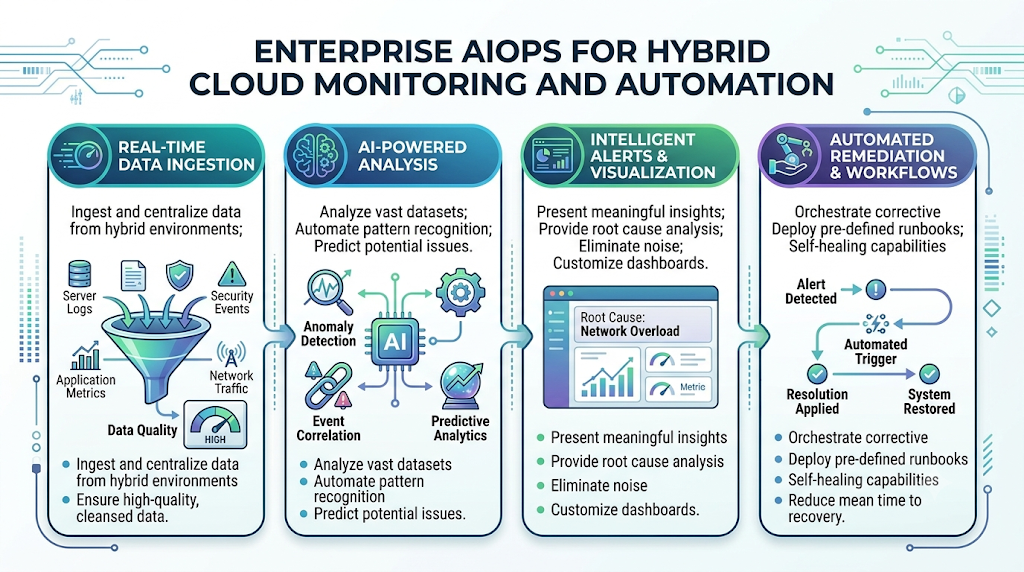
Hybrid cloud environments have become common in modern enterprises. Many organizations now run some workloads in private data centers, some in public cloud platforms, and some across multiple cloud providers. This gives flexibility, scalability, and better control over business-critical applications. However, managing hybrid infrastructure is not simple. IT teams must monitor servers, containers, databases, networks, security tools, cloud services, storage systems, and applications across different environments. Each platform may produce separate logs, alerts, metrics, and incidents. This is where AIOps becomes important. AIOps, or Artificial Intelligence for IT Operations, uses machine learning, big data analytics, automation, and observability to help IT teams manage complex infrastructure more intelligently. It helps teams detect problems faster, reduce alert noise, predict capacity issues, automate routine tasks, and improve cloud operations management. For learners and professionals who want to understand AIOps in a structured way, AIOpsSchool.com is a useful educational learning resource for building knowledge around AIOps, cloud operations, automation, monitoring, and enterprise IT operations.
What Is Hybrid Cloud Management?
Hybrid cloud management means controlling, monitoring, securing, and optimizing IT resources that are spread across on-premises data centers, private clouds, public clouds, and sometimes multiple cloud providers.
In simple terms, it helps IT teams manage different infrastructure environments as one connected system.
Definition
Hybrid cloud management is the process of managing applications, workloads, infrastructure, data, security, and operations across both private and public cloud environments.
It includes monitoring performance, managing resources, handling incidents, controlling costs, enforcing security policies, and ensuring business applications remain available.
Core Architecture
A typical hybrid cloud architecture may include:
- On-premises data centers
- Private cloud platforms
- Public cloud services
- Virtual machines
- Containers and Kubernetes clusters
- Databases
- Storage systems
- APIs and integration layers
- Network connectivity
- Security and compliance tools
- Observability and monitoring platforms
For example, a bank may keep sensitive customer data in its private data center while running customer-facing mobile applications in a public cloud. Both environments must work together smoothly.
Benefits of Hybrid Cloud Management
Hybrid cloud management gives organizations several benefits:
- Better flexibility for workload placement
- Improved scalability during traffic spikes
- More control over sensitive data
- Better disaster recovery options
- Faster application deployment
- Support for legacy and modern systems
- Better balance between performance, security, and cost
Common Management Challenges
Hybrid cloud also creates operational challenges, such as:
- Too many monitoring dashboards
- Alert overload from different tools
- Difficult root cause analysis
- Security visibility gaps
- Manual incident handling
- Data silos between teams
- Inconsistent policies across environments
- Cloud cost and resource waste
AIOps helps solve many of these problems by bringing intelligence and automation into hybrid cloud operations.
Understanding AIOps
Definition
AIOps stands for Artificial Intelligence for IT Operations. It uses artificial intelligence, machine learning, analytics, and automation to improve how IT teams monitor, manage, and troubleshoot infrastructure and applications.
AIOps helps operations teams move from reactive problem-solving to proactive and predictive operations.
Instead of waiting for users to report issues, AIOps platforms can detect abnormal behavior, connect related events, identify likely root causes, and trigger automated actions.
Core Components
AIOps usually includes four major components:
- Machine learning
- Big data analytics
- Intelligent automation
- Observability
Together, these components help IT teams understand what is happening across complex environments.
Machine Learning
Machine learning helps AIOps platforms learn normal behavior from operational data.
For example, an AIOps system can learn that CPU usage on a payment application usually rises during business hours. If CPU usage suddenly increases at midnight without expected traffic, the system can mark it as unusual.
Machine learning helps with:
- Anomaly detection
- Pattern recognition
- Event correlation
- Predictive alerts
- Root cause analysis
Big Data Analytics
Hybrid cloud environments generate large amounts of data from logs, metrics, events, traces, alerts, and user activity.
Big data analytics helps process this data at scale. Instead of manually checking thousands of alerts or log lines, teams can use AIOps to identify meaningful patterns.
For example, if multiple servers, databases, and APIs start showing errors at the same time, AIOps can analyze the relationship between these events and identify the likely source.
Intelligent Automation
Intelligent automation allows AIOps systems to take action based on conditions, patterns, or incidents.
For example:
- Restarting a failed service
- Scaling cloud resources
- Opening an incident ticket
- Notifying the right team
- Running a diagnostic script
- Rolling back a faulty deployment
- Clearing temporary storage before it causes downtime
Automation saves time and reduces repetitive manual work.
Observability
Observability helps teams understand the internal state of systems using logs, metrics, traces, and events.
In hybrid cloud management, observability is very important because applications often run across multiple environments. A single user transaction may pass through a web app in the cloud, an API gateway, a private database, and a legacy backend system.
AIOps improves cloud observability by connecting these signals and presenting a clearer operational picture.
How AIOps Supports Hybrid Cloud Management
AIOps supports hybrid cloud management by giving IT teams better visibility, faster analysis, smarter automation, and predictive insights across on-premises and cloud environments.
Unified Infrastructure Monitoring
In traditional operations, teams often use separate tools for cloud monitoring, server monitoring, application monitoring, network monitoring, and security monitoring.
This creates scattered visibility.
AIOps brings data from multiple environments into a unified view. It can collect logs, metrics, traces, alerts, and events from public cloud platforms, private cloud systems, virtual machines, containers, databases, and network devices.
Enterprise example:
A retail company runs its website in a public cloud, its inventory system in a private data center, and its payment gateway through third-party services. AIOps helps the operations team monitor all these systems together instead of switching between many dashboards.
Intelligent Event Correlation
Hybrid environments can generate thousands of alerts every day. Many alerts are symptoms of the same root problem.
AIOps uses event correlation to group related alerts and reduce noise.
Instead of showing 500 separate alerts, an AIOps system may identify that a network latency issue is causing application errors, database timeout warnings, and API failures.
Enterprise example:
A telecom company receives alerts from routers, application servers, and customer service portals. AIOps correlates these alerts and shows that a regional network issue is affecting multiple services.
Anomaly Detection
Anomaly detection helps identify unusual behavior before it becomes a serious incident.
AIOps learns normal patterns for CPU usage, memory usage, transaction volume, network traffic, response time, error rate, and cloud resource consumption.
When behavior moves outside the normal range, AIOps can alert the team.
Enterprise example:
A healthcare application usually processes patient appointment requests at a steady rate. If requests suddenly drop while servers appear healthy, AIOps may detect an application routing issue that traditional monitoring missed.
Predictive Analytics
Predictive analytics helps teams forecast future issues based on current and historical data.
AIOps can predict:
- Storage capacity problems
- Cloud cost spikes
- Application performance degradation
- Resource exhaustion
- Traffic surges
- Failure trends
Enterprise example:
An e-commerce company expects high traffic during a seasonal sale. AIOps analyzes previous traffic patterns and predicts which services may need more compute capacity.
Automated Incident Response
AIOps can automate parts of incident response by triggering workflows when known issues occur.
This does not mean humans are removed from the process. It means repetitive steps can be handled automatically while engineers focus on complex decisions.
Enterprise example:
If a containerized application crashes repeatedly, AIOps can collect logs, restart the pod, create an incident ticket, notify the platform team, and attach diagnostic information.
Capacity Planning
Capacity planning ensures that infrastructure has enough resources to support business demand.
In hybrid cloud environments, capacity planning is difficult because workloads may shift between on-premises and cloud environments.
AIOps helps teams understand usage trends and predict future capacity needs.
Enterprise example:
A manufacturing company runs analytics workloads on-premises during working hours and shifts some workloads to cloud resources during peak demand. AIOps helps predict when additional cloud resources will be needed.
Resource Optimization
Hybrid cloud environments often suffer from unused resources, over-provisioned servers, idle cloud instances, and poor workload placement.
AIOps helps identify where resources are being wasted and where optimization is possible.
Enterprise example:
A cloud operations team discovers that several test environments are running continuously even when not used. AIOps recommends shutdown schedules and resource resizing to improve cost efficiency.
AIOpsSchool.com Guide to Hybrid Cloud Operations
AIOpsSchool.com helps learners understand how AIOps fits into real enterprise cloud operations. For hybrid cloud teams, the focus should not only be on tools but also on visibility, processes, automation, and continuous improvement.
Building End-to-End Visibility
End-to-end visibility means understanding the full journey of applications, infrastructure, users, services, and dependencies.
Hybrid cloud operations need visibility across:
- Application performance
- Cloud infrastructure
- On-premises systems
- Network paths
- Database performance
- API dependencies
- Security events
- User experience
Without visibility, teams may only see symptoms, not root causes.
Reducing Alert Fatigue
Alert fatigue happens when teams receive too many alerts, many of which are low-priority, duplicate, or not useful.
AIOps helps reduce alert fatigue by:
- Grouping related alerts
- Suppressing duplicate alerts
- Prioritizing business-impacting incidents
- Identifying root causes faster
- Escalating alerts to the right teams
This helps engineers focus on real problems instead of chasing noise.
Automating Routine Tasks
Many cloud operations tasks are repetitive.
Examples include:
- Restarting failed services
- Scaling resources
- Cleaning disk space
- Running health checks
- Creating incident tickets
- Collecting logs
- Notifying support teams
AIOps automation helps reduce manual workload and speeds up incident handling.
Improving Operational Efficiency
Operational efficiency means doing more with less manual effort, fewer delays, and better accuracy.
AIOps improves efficiency by helping teams:
- Detect problems earlier
- Reduce troubleshooting time
- Standardize response workflows
- Improve collaboration between teams
- Optimize infrastructure usage
- Reduce repeated incidents
Preparing for Enterprise-Scale Cloud Operations
Enterprise-scale hybrid cloud operations require strong practices.
Teams should focus on:
- Standard monitoring policies
- Clear ownership of services
- Centralized observability
- Automation governance
- Security integration
- Incident response playbooks
- Continuous learning
AIOps works best when technology, process, and people are aligned.
Benefits of Using AIOps in Hybrid Cloud Environments
Faster Incident Detection
AIOps helps detect incidents earlier by continuously analyzing operational data.
Instead of waiting for manual checks or user complaints, teams can identify abnormal behavior quickly.
Reduced Downtime
Downtime affects revenue, productivity, customer trust, and business operations.
AIOps reduces downtime by improving detection, correlation, diagnosis, and automated response.
Better Resource Utilization
AIOps helps teams understand how resources are used across cloud and on-premises environments.
This helps reduce waste, improve performance, and support better capacity planning.
Improved Security Visibility
Hybrid cloud security is difficult because threats may appear across networks, cloud platforms, identity systems, endpoints, and applications.
AIOps can help connect security-related events with operational data.
For example, repeated failed login attempts, unusual network traffic, and application errors may together indicate a security concern.
Enhanced Scalability
AIOps supports scalability by predicting demand and helping teams scale resources intelligently.
This is useful for applications with changing traffic patterns, such as online banking, retail platforms, and digital services.
Better User Experience
User experience depends on fast, reliable, and available applications.
AIOps helps teams detect performance problems before users are heavily affected. It can identify slow APIs, database bottlenecks, network delays, or overloaded services.
Common Hybrid Cloud Challenges
Multi-Cloud Complexity
Many enterprises use more than one cloud provider along with private infrastructure. Each platform has different tools, billing models, monitoring systems, and security controls.
Solution:
Use AIOps to centralize monitoring, correlate data across platforms, and standardize operational workflows.
Data Silos
Different teams often manage separate data sources. Cloud teams, network teams, security teams, and application teams may all use different dashboards.
Solution:
Use AIOps to bring logs, metrics, traces, and events into a common operational view.
Performance Bottlenecks
Performance issues may come from cloud resources, network latency, database queries, application code, or integration failures.
Solution:
Use AIOps-driven observability to trace performance across the full service path and identify likely root causes.
Security Monitoring
Hybrid environments create wider attack surfaces. Security teams need visibility across cloud and on-premises systems.
Solution:
Integrate security monitoring with AIOps workflows so security events can be correlated with infrastructure and application behavior.
Compliance Requirements
Enterprises must follow internal policies and industry regulations. Hybrid cloud makes compliance harder because data and workloads may be distributed.
Solution:
Use standardized monitoring, audit logs, policy checks, and automated reporting to support compliance visibility.
Real-World Enterprise Use Cases
Banking and Financial Services
Banks operate highly sensitive and transaction-heavy systems. They often use private infrastructure for core banking and public cloud for customer-facing applications.
AIOps helps banks monitor payment systems, detect transaction delays, identify abnormal traffic, and reduce service disruption.
Healthcare
Healthcare organizations manage patient portals, appointment systems, medical records, and connected devices.
AIOps helps detect system slowdowns, monitor application availability, and support reliable access to digital healthcare services.
Retail and E-Commerce
Retail companies face changing traffic patterns, especially during campaigns, holidays, and sales events.
AIOps helps predict traffic surges, scale resources, detect checkout failures, and improve customer experience.
Manufacturing
Manufacturing companies use hybrid systems for plant operations, supply chain platforms, analytics, and enterprise applications.
AIOps helps monitor production systems, detect infrastructure issues, and support reliable operations across factory and cloud environments.
Telecommunications
Telecom companies manage large networks, customer platforms, billing systems, and service portals.
AIOps helps correlate network events, reduce alert noise, and improve incident response across distributed infrastructure.
Traditional Cloud Management vs AIOps-Driven Management
| Capability | Traditional Cloud Management | AIOps-Driven Cloud Management |
|---|---|---|
| Monitoring | Manual dashboards | Intelligent observability |
| Alert Handling | Rule-based | AI-powered correlation |
| Incident Response | Mostly manual | Automated workflows |
| Capacity Planning | Reactive | Predictive |
| Resource Optimization | Periodic | Continuous |
| Root Cause Analysis | Time-consuming manual investigation | Data-driven probable cause analysis |
| Scalability | Planned after demand increases | Forecast-based scaling recommendations |
| Operational Data | Scattered across tools | Centralized and analyzed together |
| Team Productivity | Engineers handle repetitive alerts | Engineers focus on high-value decisions |
| User Experience | Issues found after impact | Issues detected earlier through patterns |
Traditional cloud management can work for small environments. But as hybrid cloud grows, manual dashboards and rule-based alerts become harder to manage.
AIOps-driven management gives teams a smarter way to understand complex systems.
Best Practices for Successful Hybrid Cloud Management
Centralize Observability
Collect logs, metrics, traces, alerts, and events from all environments into a central observability approach.
This helps teams see the full picture instead of isolated fragments.
Automate Repetitive Operations
Start with simple automation tasks such as service restarts, log collection, ticket creation, disk cleanup, and scaling actions.
Automation should be tested, documented, and monitored.
Standardize Monitoring Policies
Create consistent monitoring standards across cloud and on-premises systems.
For example, define common rules for availability, latency, error rates, resource utilization, and security events.
Continuously Analyze Operational Data
AIOps becomes more useful when it has quality data.
Teams should continuously analyze incident patterns, recurring alerts, resource usage, and performance trends.
Integrate Security into Cloud Operations
Security should not be separate from operations.
Hybrid cloud management should include identity monitoring, access reviews, threat signals, vulnerability visibility, and compliance checks.
Key Metrics to Monitor
Infrastructure Availability
Availability shows whether systems, services, and infrastructure are running as expected.
This includes servers, containers, databases, cloud services, storage, and network components.
Application Performance
Application performance includes response time, transaction speed, API latency, page load time, and error rates.
Poor performance can hurt user experience even when infrastructure appears healthy.
Resource Utilization
Resource utilization includes CPU, memory, storage, network bandwidth, database capacity, and cloud service usage.
AIOps helps identify underused, overused, or misconfigured resources.
Mean Time to Detect
Mean Time to Detect, or MTTD, measures how quickly teams identify an issue.
Lower MTTD means teams can respond faster before problems grow.
Mean Time to Resolve
Mean Time to Resolve, or MTTR, measures how long it takes to fix an issue.
AIOps can reduce MTTR by improving root cause analysis and automating response steps.
Cloud Cost Efficiency
Cloud cost efficiency measures whether cloud resources are being used wisely.
AIOps can help detect idle resources, over-provisioned instances, and unexpected cost increases.
Career Opportunities
AIOps and hybrid cloud management are creating strong career opportunities for IT professionals.
Important roles include:
- AIOps Engineer
- Cloud Operations Engineer
- Site Reliability Engineer
- Cloud Architect
- DevOps Engineer
- Platform Engineer
- Observability Engineer
- Infrastructure Automation Engineer
- Cloud Reliability Specialist
- IT Operations Analyst
Professionals who understand AIOps, cloud observability, automation, incident management, and hybrid infrastructure management can support modern enterprise operations more effectively.
Future of AIOps and Hybrid Cloud Management
Autonomous Cloud Operations
The future of cloud operations will include more autonomous systems that can detect, analyze, and resolve common issues with limited manual effort.
Human teams will still provide governance, strategy, and decision-making.
AI-Driven Observability
Observability will become more intelligent.
Instead of simply showing dashboards, platforms will explain patterns, predict risks, and recommend actions.
Predictive Infrastructure Management
Predictive infrastructure management will help teams plan capacity, prevent outages, and optimize resources before problems occur.
This will be especially useful in large hybrid and multi-cloud environments.
Self-Healing Systems
Self-healing systems can automatically recover from known failures.
For example, if an application instance fails, the system may restart it, route traffic away, or scale another instance automatically.
Intelligent Multi-Cloud Platforms
As enterprises use more cloud services, intelligent multi-cloud platforms will help simplify operations.
AIOps will support better visibility, governance, cost control, and reliability across different cloud providers.
Common Misconceptions About AIOps
AIOps Replaces IT Teams
AIOps does not replace IT teams. It supports them.
It reduces repetitive manual work and helps engineers make faster, better decisions.
AIOps Works Only in Large Enterprises
Large enterprises may benefit strongly from AIOps, but smaller teams can also use AIOps concepts.
Any team dealing with alert noise, performance issues, or cloud complexity can benefit from intelligent operations.
Automation Eliminates Human Oversight
Automation still needs governance.
Teams must define policies, review workflows, test automation, and monitor outcomes. Human oversight remains important.
Hybrid Cloud Is Only About Cost Savings
Cost savings are one benefit, but hybrid cloud is also about flexibility, security, scalability, performance, and business continuity.
AIOps helps manage all these areas more effectively.
FAQ Section
- What is AIOps in hybrid cloud management?
AIOps in hybrid cloud management means using AI, machine learning, analytics, and automation to monitor and manage workloads across private data centers and cloud platforms. - How does AIOps improve hybrid cloud monitoring?
AIOps improves monitoring by collecting data from different environments, correlating alerts, detecting anomalies, and giving teams a clearer view of infrastructure health. - Can AIOps reduce alert fatigue?
Yes. AIOps can group related alerts, remove duplicates, prioritize important incidents, and help teams focus on real operational problems. - Is AIOps useful for DevOps and SRE teams?
Yes. DevOps and SRE teams can use AIOps for observability, incident response, automation, capacity planning, and reliability improvement. - Does AIOps work with on-premises infrastructure?
Yes. AIOps can support on-premises systems, private cloud platforms, public cloud services, containers, applications, databases, and network devices. - How does AIOps help with root cause analysis?
AIOps analyzes logs, metrics, traces, and events together. It identifies patterns and suggests the most likely source of an issue. - Can AIOps improve cloud cost efficiency?
Yes. AIOps can identify idle resources, over-provisioned systems, unusual usage patterns, and opportunities for better resource optimization. - Is AIOps difficult for beginners to learn?
Beginners can learn AIOps step by step by first understanding monitoring, observability, cloud operations, automation, and incident management. - What skills are needed for AIOps hybrid cloud roles?
Useful skills include cloud fundamentals, Linux, monitoring tools, logs and metrics, automation, DevOps practices, incident management, and basic machine learning concepts. - Why is AIOps important for enterprise hybrid cloud operations?
AIOps is important because enterprise hybrid cloud environments are complex. It helps teams improve visibility, reduce downtime, automate tasks, and manage operations more intelligently.
Final Summary
Hybrid cloud gives enterprises flexibility, scalability, and control. But it also creates operational complexity because workloads, applications, data, and infrastructure are spread across multiple environments. AIOps supports hybrid cloud management by bringing intelligence, automation, and observability into daily operations. It helps teams monitor infrastructure, correlate alerts, detect anomalies, predict capacity needs, automate incident response, and optimize resources. For IT operations engineers, cloud engineers, DevOps teams, SREs, infrastructure architects, and students, understanding AIOps is becoming increasingly important. Modern cloud operations need more than manual dashboards and reactive troubleshooting.
A key challenge in hybrid cloud AIOps is maintaining consistent observability across on-premise and cloud-native environments. Different monitoring stacks, data formats, and access policies often create visibility gaps that make unified automation difficult. Achieving reliable cross-environment correlation is essential for building truly enterprise-scale intelligent operations.