Introduction
Artificial intelligence is changing how IT operations teams monitor systems, detect problems, automate incidents, and improve service reliability. As businesses depend more on cloud platforms, applications, data pipelines, and digital services, traditional manual operations are no longer enough. This is where AIOps becomes important. AIOps combines artificial intelligence, machine learning, automation, monitoring, and IT operations to help teams manage complex technology environments more intelligently. For students, DevOps engineers, SRE professionals, system administrators, cloud engineers, and career changers, Career Opportunities in AIOps are growing because organizations need skilled professionals who can connect IT operations with intelligent automation. AIOpsSchool.com is an educational learning resource for professionals who want to build practical knowledge in AIOps, MLOps, observability, automation, and AI-driven IT operations. You can explore the platform here: AIOpsSchool.com In this guide, you will learn what AIOps is, why it is becoming a high-demand career, which job roles are available, what skills you need, how to follow an AIOps career roadmap, and how certifications and hands-on projects can support long-term career growth.
What Is AIOps?
AIOps, or Artificial Intelligence for IT Operations, is the use of artificial intelligence, machine learning, data analytics, and automation to improve IT operations, monitoring, incident response, and system reliability.
In simple words, AIOps helps IT teams understand large volumes of operational data faster. Instead of manually checking logs, alerts, metrics, and incidents, AIOps platforms can detect patterns, identify anomalies, reduce alert noise, and suggest or trigger automated actions.
Core Concepts of AIOps
AIOps is built around a few important concepts:
- Data collection: Gathering logs, metrics, traces, events, and alerts from IT systems.
- Correlation: Connecting related events to understand the bigger problem.
- Anomaly detection: Finding unusual behavior before it becomes a major issue.
- Root cause analysis: Identifying the likely reason behind an incident.
- Automation: Reducing manual work through scripts, workflows, and self-healing actions.
- Predictive insights: Using data patterns to predict potential failures.
Relationship with AI, ML, DevOps, and SRE
AIOps does not work in isolation. It connects multiple technology areas.
Artificial intelligence helps systems make intelligent decisions. Machine learning helps tools learn from past patterns. DevOps supports automation, CI/CD, and collaboration. SRE focuses on reliability, incident response, SLIs, SLOs, and reducing operational toil.
AIOps brings these practices together so IT teams can move from reactive operations to proactive and predictive operations.
Why AIOps Is Becoming a High-Demand Career
AIOps is becoming a high-demand career because modern IT environments are complex, fast-moving, and difficult to manage manually. Businesses need professionals who understand automation, observability, cloud systems, incident management, and AI-powered operations.
Growth of Cloud Computing
Organizations are moving applications, databases, infrastructure, and services to cloud platforms. Cloud environments are dynamic, scalable, and distributed.
This creates more operational data and more monitoring challenges. AIOps professionals help cloud teams manage performance, detect issues, automate responses, and maintain reliability.
Rise of Intelligent Automation
Manual troubleshooting takes time. Repeated incidents, noisy alerts, and slow response processes can affect business performance.
AIOps uses intelligent automation to reduce repetitive work. This creates demand for professionals who can build scripts, workflows, automation pipelines, and event-driven remediation systems.
Expansion of Digital Infrastructure
Modern businesses depend on websites, mobile apps, APIs, microservices, containers, and global cloud infrastructure. Even a small technical issue can affect users quickly.
AIOps careers are growing because organizations need skilled people who can manage digital infrastructure with speed and accuracy.
Need for Faster Incident Resolution
IT incidents can affect customer experience, revenue, and internal productivity. Traditional monitoring often shows symptoms but not root causes.
AIOps helps teams connect logs, metrics, traces, and alerts to find problems faster. Professionals with AIOps skills can support faster incident response and better service reliability.
Enterprise Demand for Operational Intelligence
Enterprises want more than monitoring dashboards. They want intelligent insights, predictive alerts, automated remediation, and business-level visibility.
This demand creates career opportunities for AIOps engineers, observability engineers, SRE professionals, cloud operations teams, and automation specialists.
Popular Career Opportunities in AIOps
AIOps career paths are suitable for both beginners and experienced IT professionals. Some roles are deeply technical, while others combine operations, automation, analysis, and communication.
5.1 AIOps Engineer
An AIOps engineer designs, builds, configures, and maintains AI-driven IT operations systems.
Primary responsibilities:
- Implement AIOps platforms and workflows
- Collect and analyze logs, metrics, traces, and alerts
- Configure anomaly detection and event correlation
- Build automation for incident response
- Support root cause analysis and reporting
Required skills:
- Linux, networking, and cloud basics
- Monitoring and observability tools
- Python or scripting knowledge
- Machine learning fundamentals
- Incident management understanding
Typical work environment:
AIOps engineers usually work with IT operations, DevOps, SRE, cloud, security, and application teams.
Career progression:
AIOps Engineer → Senior AIOps Engineer → AIOps Architect → AIOps Consultant or AIOps Platform Lead
5.2 Site Reliability Engineer
A Site Reliability Engineer focuses on system reliability, availability, performance, and automation.
Primary responsibilities:
- Define service reliability goals
- Monitor SLIs, SLOs, and error budgets
- Automate repetitive operational tasks
- Improve incident response processes
- Reduce system downtime and operational toil
Required skills:
- Linux and networking
- Cloud infrastructure
- Kubernetes and containers
- Monitoring and observability
- Automation and scripting
Typical work environment:
SREs work closely with development, operations, platform, and business teams.
Career progression:
Junior SRE → SRE → Senior SRE → Staff SRE → Reliability Architect or Engineering Manager
5.3 DevOps Engineer
A DevOps engineer builds automation across software development, testing, deployment, and infrastructure operations.
Primary responsibilities:
- Manage CI/CD pipelines
- Automate infrastructure provisioning
- Support deployment reliability
- Integrate monitoring and alerting
- Improve collaboration between developers and operations
Required skills:
- Git, CI/CD, Linux, and scripting
- Infrastructure as Code
- Cloud and containers
- Monitoring and incident response
- Automation mindset
Typical work environment:
DevOps engineers usually work in software, cloud, product, and platform engineering teams.
Career progression:
DevOps Engineer → Senior DevOps Engineer → DevOps Architect → Platform Engineer or DevOps Manager
5.4 Cloud Operations Engineer
A Cloud Operations Engineer manages cloud-based infrastructure, services, monitoring, and operational reliability.
Primary responsibilities:
- Monitor cloud resources
- Manage cloud incidents
- Optimize availability and performance
- Support security and compliance controls
- Automate operational tasks
Required skills:
- Cloud platform knowledge
- Linux and networking
- Cost and performance monitoring
- Automation tools
- Incident management
Typical work environment:
Cloud operations engineers work with cloud infrastructure teams, DevOps teams, security teams, and business application teams.
Career progression:
Cloud Support Engineer → Cloud Operations Engineer → Cloud Reliability Engineer → Cloud Architect
5.5 Platform Engineer
A Platform Engineer builds internal platforms that help development teams deploy and manage applications more easily.
Primary responsibilities:
- Build reusable infrastructure platforms
- Manage developer self-service tools
- Standardize deployment workflows
- Improve observability and automation
- Support Kubernetes and cloud-native platforms
Required skills:
- Kubernetes and containers
- Infrastructure as Code
- CI/CD systems
- Monitoring and logging
- Automation and platform design
Typical work environment:
Platform engineers work in modern engineering teams that support multiple developers and product groups.
Career progression:
Platform Engineer → Senior Platform Engineer → Platform Architect → Head of Platform Engineering
5.6 IT Operations Analyst
An IT Operations Analyst monitors IT systems, analyzes incidents, and supports operational stability.
Primary responsibilities:
- Review alerts, logs, and system dashboards
- Identify recurring issues
- Escalate incidents to technical teams
- Prepare reports and operational insights
- Support process improvement
Required skills:
- Basic IT infrastructure knowledge
- Monitoring tools
- Incident management
- Analytical thinking
- Communication skills
Typical work environment:
IT operations analysts often work in network operations centers, service operations teams, or enterprise IT departments.
Career progression:
IT Operations Analyst → Senior Operations Analyst → AIOps Analyst → Operations Lead or AIOps Engineer
5.7 Observability Engineer
An Observability Engineer helps teams understand system behavior through metrics, logs, traces, dashboards, and alerts.
Primary responsibilities:
- Design monitoring and observability systems
- Configure dashboards and alert rules
- Support distributed tracing
- Improve visibility across applications and infrastructure
- Help teams detect and resolve incidents faster
Required skills:
- Metrics, logs, and traces
- Monitoring platforms
- OpenTelemetry concepts
- Cloud-native systems
- Incident response
Typical work environment:
Observability engineers work with SRE, DevOps, application, and platform teams.
Career progression:
Monitoring Engineer → Observability Engineer → Senior Observability Engineer → Observability Architect
5.8 Automation Engineer
An Automation Engineer builds scripts, workflows, and tools to reduce manual IT work.
Primary responsibilities:
- Automate repetitive operational tasks
- Build remediation scripts
- Integrate tools and APIs
- Improve deployment and maintenance workflows
- Support self-healing infrastructure
Required skills:
- Python, Bash, or PowerShell
- APIs and integrations
- Linux and cloud knowledge
- CI/CD concepts
- Troubleshooting ability
Typical work environment:
Automation engineers work across IT operations, DevOps, cloud, security, and infrastructure teams.
Career progression:
Automation Engineer → Senior Automation Engineer → AIOps Automation Specialist → Automation Architect
Essential Skills for an AIOps Career
A successful AIOps career requires a mix of infrastructure knowledge, automation skills, monitoring experience, and basic AI understanding.
Linux Administration
Linux is widely used in servers, cloud systems, containers, and DevOps environments. Beginners should learn file systems, permissions, services, processes, shell commands, logs, and basic troubleshooting.
Networking Fundamentals
AIOps professionals should understand IP addresses, DNS, HTTP, firewalls, load balancers, latency, ports, and routing basics. Many incidents are related to network performance or connectivity.
Cloud Computing
Cloud platforms are central to modern IT operations. Learn compute, storage, networking, IAM, monitoring, autoscaling, and managed services.
Python and Scripting
Python, Bash, and PowerShell help professionals automate tasks, analyze logs, call APIs, and build operational workflows.
Machine Learning Basics
You do not need to become a data scientist immediately, but you should understand concepts such as anomaly detection, pattern recognition, classification, prediction, and model evaluation.
Monitoring and Observability
Learn how metrics, logs, traces, alerts, dashboards, and service maps help teams understand system behavior.
Containers and Kubernetes
Containers and Kubernetes are widely used in cloud-native environments. Learn pods, deployments, services, ingress, config maps, secrets, scaling, and troubleshooting.
CI/CD Concepts
AIOps professionals should understand how software moves from code to production. CI/CD knowledge helps connect deployment changes with operational incidents.
Incident Management
Learn incident severity, escalation, root cause analysis, post-incident review, alert prioritization, and service restoration.
Problem-Solving and Communication
AIOps is not only about tools. Professionals must explain issues clearly, work with different teams, and make decisions under pressure.
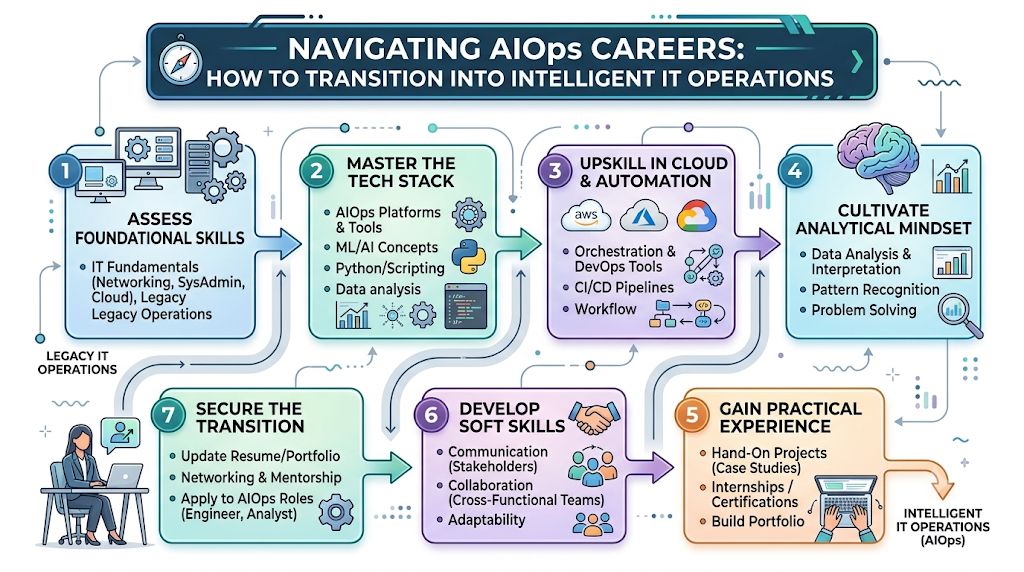
Step-by-Step AIOps Career Roadmap
A strong AIOps career roadmap helps beginners avoid confusion and learn in the right order.
Step 1: Learn IT Fundamentals
Start with basic IT concepts such as servers, operating systems, databases, applications, networks, and infrastructure.
Step 2: Master Linux and Networking
Build confidence with Linux commands, log files, system services, shell scripting, networking basics, and troubleshooting.
Step 3: Learn Cloud Platforms
Understand cloud compute, storage, networking, monitoring, identity management, security basics, and high availability concepts.
Step 4: Understand DevOps Practices
Learn Git, CI/CD, infrastructure automation, configuration management, containers, and deployment pipelines.
Step 5: Study Monitoring and Observability
Practice with metrics, logs, traces, dashboards, alert rules, uptime monitoring, and root cause analysis.
Step 6: Explore AI and Machine Learning
Learn basic AI and ML concepts related to IT operations, including anomaly detection, event correlation, prediction, and intelligent automation.
Step 7: Build Real-World Projects
Create small projects such as:
- Server monitoring dashboard
- Log analysis script
- Automated alert notification workflow
- Kubernetes health monitoring setup
- Incident response automation script
Step 8: Earn Relevant Certifications
Certifications can help validate your knowledge, especially when combined with hands-on projects and practical experience.
Tools Commonly Used in AIOps Careers
AIOps professionals work with different tool categories. The goal is not to learn every tool at once, but to understand what each category does.
| Tool Category | Primary Purpose | Typical Users | Business Value |
|---|---|---|---|
| Monitoring Platforms | Track system health, uptime, and performance | SRE, DevOps, IT Operations | Faster issue detection |
| Log Analytics Solutions | Collect and analyze application and system logs | AIOps Engineer, Observability Engineer | Better troubleshooting |
| Automation Tools | Automate repetitive tasks and workflows | DevOps, Automation Engineer | Reduced manual effort |
| Cloud Platforms | Run scalable infrastructure and services | Cloud Engineer, Platform Engineer | Flexible and reliable operations |
| Container Technologies | Package and run applications consistently | DevOps, Platform Engineer | Easier deployment and scaling |
| Collaboration Platforms | Support incident communication and teamwork | IT Operations, SRE, Support Teams | Faster coordination during incidents |
Certifications That Strengthen an AIOps Career
Certifications are useful when they support real skills. They should not replace hands-on practice, but they can improve confidence and credibility.
Cloud Certifications
Cloud certifications help prove your understanding of cloud infrastructure, services, security, monitoring, and architecture.
Kubernetes Certifications
Kubernetes certifications are valuable for professionals working with containers, microservices, platform engineering, and cloud-native operations.
Linux Certifications
Linux certifications support system administration skills, which are important for troubleshooting servers, services, and application environments.
DevOps Certifications
DevOps certifications help professionals understand CI/CD, automation, collaboration, infrastructure as code, and release management.
AI and Machine Learning Certifications
AI and ML certifications can help AIOps professionals understand anomaly detection, prediction, data analysis, and intelligent decision-making.
AIOpsSchool.com also provides learning resources related to AIOps training, AIOps certification, MLOps, observability, and AI-driven IT operations for learners who want a structured path.
Real-World Applications of AIOps Professionals
AIOps professionals are needed across many industries because every modern organization depends on reliable digital systems.
Financial Services
Banks, payment platforms, and fintech companies use AIOps to monitor transactions, detect service issues, reduce downtime, and improve customer experience.
Healthcare
Healthcare systems depend on applications, patient portals, medical records, and connected infrastructure. AIOps helps improve system reliability and incident response.
Telecommunications
Telecom companies manage large networks, customer systems, and service platforms. AIOps helps detect outages, analyze network patterns, and automate operational workflows.
E-Commerce
E-commerce platforms need high availability, fast response times, and reliable checkout systems. AIOps supports performance monitoring, incident detection, and traffic surge management.
Manufacturing
Manufacturing companies use connected systems, automation platforms, IoT devices, and production applications. AIOps helps improve operational visibility and reduce disruption.
Government and Public Services
Government platforms need secure, reliable, and scalable digital services. AIOps can support monitoring, incident response, and service continuity.
11. Factors That Influence Career Growth
AIOps career growth depends on more than job titles. Professionals grow faster when they combine technical knowledge with practical experience and communication skills.
Technical Skills
Strong Linux, cloud, automation, monitoring, and scripting skills create a solid career base.
Hands-On Experience
Practical projects, lab work, real incidents, and production exposure are highly valuable.
Continuous Learning
AIOps changes as AI, cloud, DevOps, and automation practices evolve. Continuous learning is important for long-term success.
Communication Skills
AIOps professionals often work with developers, operations teams, managers, vendors, and business stakeholders. Clear communication helps during incidents and planning.
Industry Certifications
Certifications can support career growth when they match your role and learning goals.
Common Challenges Beginners Face
Beginners often feel confused because AIOps combines many areas. The solution is to learn step by step instead of trying everything at once.
| Challenge | Why It Happens | Practical Solution |
| Learning Too Many Tools at Once | Beginners try to master every monitoring, cloud, and automation tool together | Start with one monitoring tool, one scripting language, and one cloud platform |
| Weak Linux Fundamentals | Many learners jump directly into advanced tools | Practice Linux commands, logs, permissions, and services first |
| Lack of Practical Projects | Theory alone does not build confidence | Create small projects such as dashboards, alerts, and automation scripts |
| Limited Understanding of AI | Beginners think AIOps requires advanced data science | Start with anomaly detection, patterns, and basic ML concepts |
| Ignoring Soft Skills | Technical learners focus only on tools | Practice incident communication, documentation, and teamwork |
Best Practices for Building a Successful AIOps Career
To build a successful AIOps career, focus on long-term skill development instead of shortcuts.
- Build a strong technical foundation in Linux, networking, cloud, and system administration.
- Practice automation regularly using Python, Bash, APIs, and workflow tools.
- Create personal projects that show real-world problem-solving.
- Stay updated with industry trends in AI for IT operations, observability, DevOps, and cloud.
- Join technical communities to learn from real discussions and practical use cases.
- Develop troubleshooting skills by studying logs, alerts, incidents, and root cause patterns.
- Learn how to explain technical issues in simple language for both technical and non-technical teams.
AIOps careers reward professionals who can combine technical depth, automation thinking, and operational maturity.
Career Opportunities in AIOps vs Traditional IT Operations
AIOps careers are different from traditional IT operations because they focus more on automation, intelligence, prediction, and cross-functional collaboration.
| Aspect | Traditional IT Operations | AIOps Careers |
| Main Approach | Reactive problem-solving | Proactive and predictive operations |
| Alert Handling | Manual alert review | Intelligent alert correlation |
| Incident Response | Human-led investigation | AI-assisted root cause analysis |
| Automation Level | Limited automation | Strong automation and remediation |
| Skills Required | Infrastructure and support skills | Infrastructure, cloud, AI, automation, and observability |
| Data Usage | Basic logs and dashboards | Metrics, logs, traces, events, and patterns |
| Career Direction | Operations support and administration | AIOps engineering, SRE, observability, and automation |
| Business Impact | Keeps systems running | Improves reliability, speed, and operational intelligence |
Future of AIOps Careers
The future of AIOps careers looks strong because IT systems are becoming more complex, distributed, and data-driven.
AI-Driven Operations
More organizations will use AI to analyze alerts, logs, user behavior, infrastructure health, and application performance.
Predictive IT Management
Instead of waiting for failures, teams will use predictive insights to prevent incidents before they affect users.
Self-Healing Infrastructure
Self-healing systems can automatically restart services, scale resources, roll back changes, or trigger remediation workflows.
Intelligent Automation
Automation will move beyond simple scripts. It will become more context-aware and connected with monitoring, incident response, and business priorities.
Enterprise Digital Transformation
As enterprises modernize applications and infrastructure, AIOps professionals will play an important role in reliability, automation, and operational intelligence.
16. Salary Factors in AIOps Careers
Salary in AIOps careers can vary widely. It is better to understand the factors that influence compensation instead of focusing only on fixed numbers.
Important salary factors include:
- Experience: Professionals with production experience and incident handling skills usually have stronger earning potential.
- Skills: Cloud, Kubernetes, automation, observability, scripting, and AI knowledge can improve career value.
- Certifications: Relevant certifications may support credibility, especially for beginners and career changers.
- Industry: Finance, technology, healthcare, telecom, and large digital businesses may value AIOps skills differently.
- Geographic location: Compensation depends on country, city, local demand, and remote work opportunities.
- Organization size: Large enterprises may have more complex systems and specialized AIOps roles.
The best way to grow compensation is to build real skills, gain hands-on experience, document projects, and keep improving technical depth.
Common Misconceptions About AIOps Careers
Many beginners misunderstand what AIOps careers require. These myths can create confusion.
| Myth | Reality |
| AIOps is only for data scientists | AIOps also needs IT operations, DevOps, SRE, cloud, and automation professionals |
| You must master AI before learning AIOps | Beginners can start with IT fundamentals, monitoring, and automation first |
| AIOps will replace IT teams completely | AIOps supports IT teams by reducing manual work and improving decision-making |
| Certifications alone are enough | Certifications help, but practical projects and troubleshooting skills matter more |
| AIOps is only for large enterprises | Many cloud-native and digital businesses can benefit from AIOps practices |
| Traditional IT skills are no longer useful | Linux, networking, cloud, and operations skills remain very important |
| AIOps is only about tools | AIOps also includes processes, data, automation, collaboration, and business understanding |
FAQ Section
- What are Career Opportunities in AIOps?
Career Opportunities in AIOps include roles such as AIOps engineer, SRE, DevOps engineer, cloud operations engineer, observability engineer, automation engineer, platform engineer, and IT operations analyst. - Is AIOps a good career for beginners?
Yes, beginners can start an AIOps career if they learn step by step. A strong foundation in Linux, networking, cloud, monitoring, and scripting is more important than learning everything at once. - Do I need coding skills for AIOps careers?
Basic coding or scripting skills are very useful. Python, Bash, or PowerShell can help you automate tasks, analyze logs, work with APIs, and build operational workflows. - Is machine learning required for AIOps jobs?
You do not need advanced machine learning knowledge at the beginning. Start with basic concepts such as anomaly detection, pattern recognition, prediction, and data analysis. - Which role is best for starting an AIOps career?
Good starting roles include IT operations analyst, monitoring engineer, junior DevOps engineer, cloud support engineer, or automation engineer. These roles help you build practical operational experience. - How can DevOps engineers move into AIOps?
DevOps engineers can move into AIOps by learning observability, incident management, AI-driven monitoring, event correlation, anomaly detection, and automated remediation workflows. - Are AIOps certifications useful for career growth?
Yes, AIOps certification can support career growth when combined with hands-on projects, tool practice, troubleshooting skills, and real-world implementation knowledge. - What projects should I build for an AIOps portfolio?
You can build projects such as log analysis scripts, monitoring dashboards, automated alert workflows, Kubernetes health checks, incident response automation, and anomaly detection demos. - Is AIOps only useful for large companies?
No. AIOps is useful for any organization that manages complex applications, cloud systems, digital services, or high-volume operational data. - How long does it take to build an AIOps career path?
The learning time depends on your current background. Students may need more time to build fundamentals, while DevOps, SRE, and cloud professionals can transition faster with focused learning and projects.
Final Summary
AIOps is becoming an important career field because modern IT operations need speed, intelligence, automation, and reliability. As cloud platforms, microservices, containers, observability tools, and digital infrastructure continue to grow, organizations need professionals who can manage complexity with AI-driven operations. Career Opportunities in AIOps are suitable for students, IT professionals, system administrators, DevOps engineers, SRE professionals, cloud engineers, and career changers. The most important step is to build a strong foundation in Linux, networking, cloud computing, scripting, monitoring, incident management, and automation.
An important consideration for aspiring AIOps professionals is developing strong domain knowledge before focusing on AI tools. Many operational issues stem from understanding infrastructure behavior, service dependencies, and incident patterns rather than from machine learning itself. The most effective AIOps practitioners are often those who can bridge operational experience with automation and analytics.