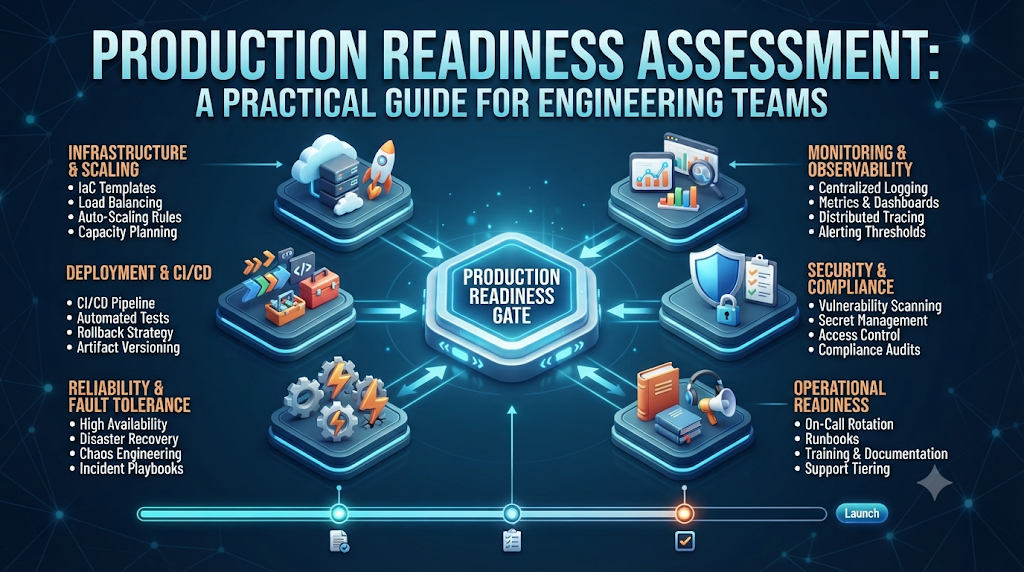
Shipping code quickly is only half the battle in modern software engineering. Once a service reaches production, real users, unpredictable traffic spikes, network hiccups, and cloud bills test every assumption made during development. A structured production readiness assessment helps teams verify whether a system is truly ready to operate safely—before a preventable outage wakes someone up at 3:00 AM.
At OpsRoadmaps, we focus on how engineering teams assess operational health, spot gaps early, and build practical improvement roadmaps across their systems. Rather than treating readiness as a rubber stamp right before launch, this guide explains how production readiness works, how it connects to broader engineering maturity, and how teams put it into practice without slowing delivery to a crawl.
Understanding Production Readiness and Core Concepts
A production readiness assessment is a structured review of a software service, infrastructure stack, or operational workflow to check whether it meets defined reliability, security, observability, and support standards before—or while—running live user traffic.
In simple terms, it asks: If something breaks, degrades, or spikes in traffic tomorrow, does our team have the visibility, automation, runbooks, and ownership needed to handle it safely?
Why Readiness Matters Beyond Launch Day
Many teams treat readiness as a one-time checklist right before a v1.0 release. In reality, systems drift. New dependencies get added, traffic patterns shift, on-call rotations change, and cloud costs creep upward. Regular readiness checks help teams:
- Prevent avoidable outages: Catch missing health probes, single points of failure, or unmonitored queues early.
- Shorten incident recovery: Ensure runbooks, alerts, and rollback paths exist before an incident starts.
- Clarify ownership: Make sure every production component has clear technical and on-call accountability.
- Balance speed and safety: Give product teams confidence to ship frequently without gambling on stability.
How Readiness Fits Into Broader Engineering Maturity
Readiness evaluates whether a specific service or environment is prepared to run safely, while a DevOps maturity assessment looks more broadly at how an organization builds, tests, deploys, and operates software across teams. Both connect closely to specialized frameworks such as a platform engineering adoption roadmap, an SRE adoption roadmap, an incident management maturity model, a DevSecOps implementation roadmap, an observability maturity model, and a cloud cost optimization roadmap.
One critical distinction: a high maturity score or completed readiness review is not a guarantee against outages or a formal compliance audit. It reflects capability and risk reduction—not perfection.
Key Dimensions of Production Readiness
Effective readiness reviews evaluate both technical mechanics and human operations. Most engineering organizations group their criteria into practical focus areas:
- Architecture and Resilience: Redundancy, graceful degradation, rate limiting, timeouts, retries with backoff, and database failover behavior.
- Deployment and Rollback: Automated CI/CD pipelines, progressive rollouts (such as canary or blue-green deployments), configuration management, and tested rollback steps.
- Observability and Alerting: Structured logs, metrics, distributed traces, meaningful Service Level Indicators (SLIs), Service Level Objectives (SLOs), and actionable alerts tied to real user impact.
- Incident Response and Support: Clear on-call schedules, escalation paths, up-to-date runbooks, and post-incident review habits.
- Security and Access Control: Least-privilege IAM roles, secrets management, dependency and container scanning, encryption in transit and at rest, and audit logging.
- Cost and Capacity: Resource requests and limits, autoscaling boundaries, data retention policies, and spend visibility.
Step-by-Step Implementation Guide
Adopting a production readiness assessment works best when it is lightweight, transparent, and tied to real engineering risks rather than heavy bureaucracy.
1. Define Clear Baseline Criteria
Start with a concise baseline tailored to your stack—for example, a Kubernetes production readiness checklist for containerized microservices. Keep requirements specific and verifiable rather than vague (“must be scalable” is hard to verify; “pod has CPU/memory requests and limits, a readiness probe, and at least two replicas across availability zones” is concrete).
2. Assess Current State and Identify Gaps
Review the service against each criterion using real evidence: dashboards, Terraform or Helm manifests, alert rules, and runbooks. Group gaps by risk severity—such as Blocker (high outage or security risk), High, and Medium.
3. Prioritize Based on Risk, Effort, and Dependencies
Not every gap needs to be fixed before launch. Low-risk polish items can often wait until after initial rollout if a clear owner and timeline are tracked, whereas missing rollbacks or unconfigured alerts usually warrant immediate attention.
4. Automate Checks Where Possible
Manual reviews get skipped when teams are under pressure. Automate objective checks in CI/CD pipelines or cluster policy admission controllers—for instance, verifying that deployments define resource requests, liveness/readiness probes, and non-root container settings.
5. Re-Assess Continuously
Re-run readiness checks after major architecture changes, traffic milestones, or significant incidents so your baseline stays aligned with how the system actually runs.
Practical Technical Example: Kubernetes Readiness and Probes
In Kubernetes environments, misconfigured probes and missing resource boundaries are frequent sources of instability. Here is a minimal Deployment example showing readiness and liveness probes alongside explicit resource requests and limits:
YAML
apiVersion: apps/v1
kind: Deployment
metadata:
  name: orders-api
  namespace: production
spec:
  replicas: 3
  selector:
    matchLabels:
      app: orders-api
  template:
    metadata:
      labels:
        app: orders-api
    spec:
      containers:
        - name: api
          image: registry.example.com/orders-api:1.4.2
          ports:
            - containerPort: 8080
          resources:
            requests:
              cpu: "250m"
              memory: "256Mi"
            limits:
              cpu: "500m"
              memory: "512Mi"
          readinessProbe:
            httpGet:
              path: /healthz/ready
              port: 8080
            initialDelaySeconds: 5
            periodSeconds: 10
          livenessProbe:
            httpGet:
              path: /healthz/live
              port: 8080
            initialDelaySeconds: 15
            periodSeconds: 20
A readinessProbe tells Kubernetes whether the pod is ready to receive traffic (preventing requests from hitting a service that is still warming up its cache). A livenessProbe restarts a wedged container—though overly aggressive liveness probes can trigger restart loops if a slow dependency temporarily delays responses.
Real-World Scenarios and Troubleshooting
Scenario 1: Preparing a Checkout Service Before Peak Traffic
A retail engineering team prepares a payment and checkout service ahead of a seasonal promotion. During a production readiness assessment, they discover that database connection pools are not capped per pod, and there is no alert for elevated 5xx error rates. By setting connection limits, adding a readiness check that verifies downstream health, and defining an error-rate alert with a clear rollback runbook, the team avoids cascading timeouts during peak load.
Scenario 2: Kubernetes CrashLoopBackOff Troubleshooting
After deploying a new container image, a pod enters CrashLoopBackOff. When doing Kubernetes CrashLoopBackOff troubleshooting, engineers typically follow a calm diagnostic sequence rather than blindly scaling replicas:
- Inspect pod status and recent events:Bash
kubectl get pods -n production kubectl describe pod orders-api-xyz -n production - Check container logs from the current and previous run:Bash
kubectl logs orders-api-xyz -n production kubectl logs orders-api-xyz -n production --previous - Identify the root cause: Common culprits include missing environment variables or secrets, uncaught application startup exceptions, failing liveness probes, or
OOMKilledevents when memory limits are set too low. - Apply a targeted fix and verify: Update the broken configuration or memory limit, roll out the change, and confirm the pod stays
RunningwithRESTARTSremaining steady. (Avoid deleting stateful workloads or production namespaces hastily without checking impact.)
Benefits, Challenges, and Trade-Offs
| Aspect | Potential Benefits | Common Challenges & Trade-Offs |
| Delivery Speed | Fewer emergency rollbacks and firefights over time | Overly rigid gates can slow releases if checklists are bloated |
| Reliability | Earlier detection of bottlenecks, timeouts, and single points of failure | Requires dedicated engineering time to build tests, probes, and runbooks |
| Team Ownership | Clearer accountability between product, platform, and on-call engineers | Can create friction if security or ops teams hand down rules without context |
| Cost Efficiency | Better visibility into over-provisioned compute and noisy telemetry | High-cardinality metrics or excessive log retention can raise observability bills |
Different organizations need different targets. A small early-stage team shipping a non-critical internal tool should not copy the heavy operational gates of a regulated financial platform operating multi-region clusters.
Metrics That Show Real Progress
Readiness checklists are only useful if they translate into healthier day-to-day operations. Teams often track a mix of delivery, reliability, and cost indicators:
- Deployment Frequency and Lead Time for Changes: Inspired by DORA metrics, these help show whether teams can ship small, safe changes regularly.
- Change Failure Rate and Mean Time to Restore (MTTR): Indicate how often releases cause issues and how quickly engineers recover when something breaks.
- SLIs, SLOs, and Error Budgets: Define measurable reliability targets (such as request success rate or latency) and how much unreliability is acceptable before prioritizing stability work.
- Cost per Workload or Request: Helps ensure reliability improvements do not quietly inflate cloud spend without business value.
Common Mistakes to Avoid
- Treating checklists as box-ticking: Checking boxes without verifying whether alerts fire or runbooks actually work creates false confidence.
- Ignoring developer experience: If platform or readiness rules require hours of manual ticket-filing for every small service, engineers will look for workarounds.
- Alerting on noisy symptoms without context: Hundreds of low-signal alerts cause alert fatigue, leading responders to ignore real problems.
- Confusing maturity scores with business outcomes: A maturity rating is a diagnostic aid, not proof of uptime or regulatory compliance.
How OpsRoadmaps Supports Engineering Teams
OpsRoadmaps is built to help engineering teams and leaders evaluate operational capabilities, spot gaps, and plan practical improvements across engineering operations. Rather than focusing solely on individual coding skills, the platform emphasizes organizational workflows, readiness practices, and structured roadmaps.
Depending on where your team is focusing next, you can explore structured assessments, checklists, runbooks, and roadmaps on OpsRoadmaps covering production readiness, DevOps maturity, Kubernetes operations, platform engineering, SRE, incident management, DevSecOps, observability, and cloud cost optimization—using findings as a starting point for prioritized, evidence-backed improvements.
Frequently Asked Questions (FAQs)
1. What is a production readiness assessment?
It is a structured evaluation of whether a software service, infrastructure setup, and support process are prepared to run reliably, securely, and observably in production.
2. When should an engineering team run a production readiness assessment?
Before major launches, high-traffic events, or significant architectural changes—and periodically afterward as systems and teams evolve.
3. How is a DevOps maturity assessment different from a readiness review?
A DevOps maturity assessment evaluates broader organizational delivery, automation, collaboration, and operational practices across teams, whereas a readiness review focuses on whether a specific system or release is ready to operate safely.
4. What should a Kubernetes production readiness checklist cover?
Key items typically include resource requests and limits, readiness and liveness probes, multi-replica high availability, RBAC and network policies, secrets management, logging/metrics collection, and rollback procedures.
5. How does a platform engineering adoption roadmap help teams?
A platform engineering adoption roadmap guides teams in building self-service internal developer platforms based on real developer needs, reducing duplicated infrastructure toil while maintaining standards.
6. How does an SRE adoption roadmap fit into reliability work?
An SRE adoption roadmap helps organizations introduce SLOs, error budgets, toil reduction, blameless postmortems, and automation to balance feature velocity with system reliability.
7. What does an incident management maturity model evaluate?
An incident management maturity model looks at how well a team detects, triages, communicates during, resolves, and learns from incidents—moving from ad-hoc heroics to clear roles, runbooks, and follow-up actions.
8. What should a DevSecOps implementation roadmap include?
A DevSecOps implementation roadmap integrates security early in the software lifecycle through threat modeling, dependency and container scanning, Infrastructure-as-Code checks, secrets hygiene, and clear remediation workflows.
9. How do teams evaluate an observability maturity model?
Teams assess whether they can diagnose unknown production issues using correlated logs, metrics, and traces—and whether alerts map to user-impacting SLOs rather than raw host noise.
10. What is the goal of a cloud cost optimization roadmap?
A cloud cost optimization roadmap aligns cloud spending with business value by right-sizing compute and storage, eliminating idle resources, using appropriate commitment or spot strategies where safe, and tracking unit costs.
11. What is the first step in Kubernetes CrashLoopBackOff troubleshooting?
Check kubectl describe pod and container logs (including --previous) to see whether the application is crashing on startup, failing a health probe, or hitting a memory limit (OOMKilled).
12. Does passing a readiness check guarantee zero downtime?
No. Readiness reviews reduce preventable risks and improve recovery speed, but hardware faults, upstream outages, and unexpected traffic patterns can still cause issues.
Conclusion
A thoughtful production readiness assessment turns operational reliability from a last-minute scramble into a repeatable engineering habit. By pairing clear readiness criteria with practical troubleshooting skills, measurable reliability goals, and realistic trade-offs, teams can ship faster while protecting users and on-call engineers alike.
As a practical next step, pick one active production service this week, review its probes, alerts, and rollback steps against a simple checklist, and use OpsRoadmaps resources to map out your next highest-impact operational improvements.