Introduction
Landing in a foreign country brings instant excitement. But airport arrival stress can ruin that joy fast. Long queues for physical SIM cards drain your patience. Home carrier roaming fees threaten your bank account with massive bills. Modern travelers need a smarter way to stay online. Digital data profiles solve this problem completely.
Platforms like eSIMRoamly give independent travelers a clear way to compare mobile options. You can explore transparent pricing without aggressive sales pressure. Smart digital prep keeps your phone connected from the moment you touch down. Let us explore how modern mobile data works for global journeys.
What Is a Travel eSIM and How Does It Work?
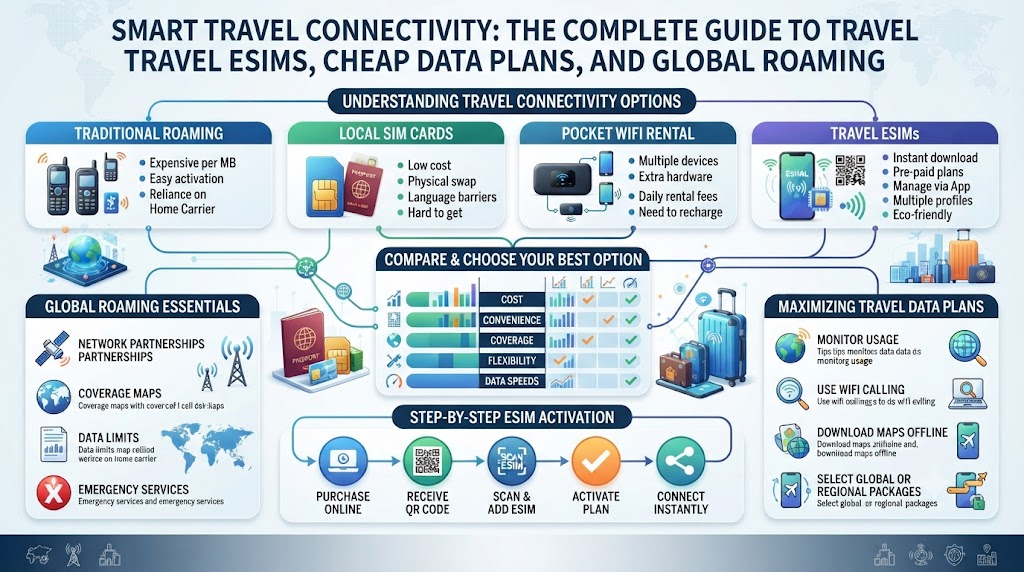
An eSIM is a tiny digital chip built right into modern smartphones. You do not need a physical plastic card to get mobile service. Instead, you download a digital profile over Wi-Fi in seconds. This digital technology changes how people travel across the world.
Travelers keep their home phone number active on their main line. You still receive important bank text messages and family calls from home. Meanwhile, your second data line handles cheap map directions and web browsing. Finding the Best Travel eSIM saves you both time and money.
You scan a simple QR code to install your new data profile. The phone connects to local cell towers the moment you land. You skip airport kiosks and avoid expensive daily roaming fees completely.
Comparing Travel Connectivity: eSIM vs Physical SIM vs Carrier Roaming
Choosing the right travel data option depends on cost, convenience, and setup speed. Let us compare the main choices available to modern tourists.
| Connection Method | Setup Convenience | Average Cost | Physical SIM Swapping Needed | Risk of Bill Shock |
| Digital Travel eSIM | Instant setup via QR code at home | Low to medium prepaid pricing | No physical card swapping | Zero surprise charges |
| Local Airport Physical SIM | Long waiting queues after landing | Moderate local retail cost | Requires opening tiny phone tray | Zero surprise charges |
| Home Carrier Daily Roaming | Automatic connection upon landing | Very expensive daily flat fees | Keeps original card in phone | High risk of hidden bills |
| Public Pocket Wi-Fi Rental | Must pick up and return hardware | High daily device rental fees | Connects via separate router | Low risk of extra bills |
Digital profiles save valuable luggage space during your trips. They also prevent you from losing your tiny home SIM chip. You manage everything directly from your phone settings menu.
Travel eSIM Comparison: What Smart Travelers Look For
Smart tourists look beyond simple price tags when shopping for mobile data. A thorough Travel eSIM Comparison involves checking several critical factors. You must review network generation speeds like fast 4G and 5G connections. Slower 3G networks will frustrate you when loading live maps or uploading photos.
Validity days matter just as much as total gigabyte allowances. Check how many days your data pack stays active after first activation. Hotspot sharing permissions also affect your choice if you travel with a laptop. Some cheap plans block personal tethering entirely.
Underlying carrier agreements determine your actual signal strength abroad. Reliable providers partner with top-tier local operators to prevent dropped connections. Conducting a careful Compare eSIM Plans routine ensures you never experience dead zones in foreign cities. Look for transparent provider data to make confident purchasing decisions before your flight.
How to Find Cheap eSIM Plans Without Falling for Traps
Finding Cheap eSIM Plans takes a little bit of careful math. You should calculate the true cost per gigabyte across your entire trip duration. A low upfront price might offer very little data, costing you more in top-ups.
Watch out for hidden pitfalls like short twenty-four-hour expiration windows. Some budget offers force you to use all your data in a single day. Activation fees can also sneak up on unsuspecting shoppers at checkout. Always check for unexpected credit card foreign transaction costs before paying.
Reading the fine print protects your travel budget from surprise expenses. Independent comparison platforms help you spot these tricks instantly. You secure genuine value without sacrificing network speed or reliability.
International eSIM Plans for Multi-Country Adventures
Multi-country adventures require flexible mobile solutions that cross borders smoothly. Single-destination plans work well if you stay in one specific country. But regional bundles make more sense when visiting multiple nations on one trip.
Europe-wide packs cover dozens of countries under a single data pool. Southeast Asia bundles keep you connected as you cross land and sea borders. Global plans cover over one hundred nations for round-the-world travelers.
Cross-border tourists stay fully connected on high-speed trains and international flights. You never need to swap physical cards every time you cross a border. Your phone updates its connection automatically as you enter a new country.
Unlimited Data eSIM Comparison: The Truth About Fair Use
Unlimited data sounds like the ultimate travel dream for heavy internet users. However, an Unlimited Data eSIM Comparison reveals important hidden details. Most carriers enforce a strict Fair Use Policy, known as FUP.
A Fair Use Policy limits your daily high-speed data allowance. Once you pass one or two gigabytes in a single day, speeds slow down to a crawl. This throttled speed makes loading web pages or streaming videos nearly impossible.
True unlimited full-speed lines are rare and cost significantly more money. Read the fine print carefully before buying any unlimited package. Decide if a fixed gigabyte pack fits your daily usage habits better. Knowing how FUP rules work saves you from frustrating speed drops abroad.
Evaluating the Best eSIM Providers in the Market
The digital travel market features many different mobile brands and marketplaces. Evaluating the Best eSIM Providers requires checking their reputation and service quality. Established global travel brands offer reliable connections across multiple continents.
Customer support availability separates great providers from mediocre ones. Look for companies offering responsive live chat support around the clock. Clear refund terms protect your money if your travel plans change suddenly.
Transparent network partner listings show you exactly which local towers you will use. Checking user reviews helps you spot consistent network performance. Reliable providers make your digital travel experience smooth and worry-free.
Destination Focus: Best eSIM for Japan
Traveling through Tokyo, Kyoto, Osaka, and mountain trails requires strong mobile coverage. Finding the Best eSIM for Japan ensures you never get lost in busy train stations. Reliable navigation apps depend entirely on stable cellular signals.
Japan features advanced telecommunications infrastructure managed by elite national carriers. You want a travel eSIM that connects directly to top-tier networks like NTT Docomo or SoftBank. These major operators provide excellent coverage across crowded city streets and deep rural valleys.
Subway tunnels and bullet trains demand robust network partners to maintain signals. Cheap unknown carriers often buy low-priority wholesale data that drops during peak hours. Choosing a verified Japanese network profile guarantees fast speeds everywhere you explore. Enjoy your ramen and temple visits with total digital peace of mind.
Destination Focus: Best eSIM for USA
Exploring the United States involves massive distances and diverse geographic landscapes. Road trips across national parks require dependable coverage far away from major cities. Finding the Best eSIM for USA keeps your emergency maps working on remote highways.
Urban centers like New York and Los Angeles demand high-capacity data networks. American mobile infrastructure relies heavily on elite operators like T-Mobile and AT&T. You must check that your phone supports local American radio frequency bands before traveling.
Different providers partner with different US carriers for their data routing. Compare network coverage maps to see who performs best in your destination state. Solid coverage ensures you share your cross-country adventure photos without delay.
Pre-Purchase Travel eSIM Evaluation Checklist
Evaluating a travel data plan before buying prevents costly mistakes abroad. Inspect these crucial areas to ensure your digital profile meets your needs.
| Evaluation Area | What to Inspect | Why It Matters |
| Device Compatibility | Check if phone is carrier-unlocked and eSIM-ready | Locked phones cannot install third-party profiles |
| High-Speed Cap | Look for daily full-speed data limit (FUP) | Prevents unexpected speed slowdowns in the middle of a trip |
| Hotspot & Tethering | Verify personal hotspot sharing permissions | Crucial if sharing data with a laptop or traveling partner |
| Network Partner Quality | Confirm which local cellular operator provides signal | Determines download speeds and rural coverage |
| Activation Timing | Check if validity starts on install or when landing | Avoids wasting prepaid days while still at home |
| Voice & SMS Inclusions | Check if plan is data-only or includes a phone number | Important if you need to receive local phone calls |
Verifying your home phone carrier unlock status is your very first step. Do this days before your flight to avoid airport stress.
Finding Verified eSIM Deals and Discounts
Smart shoppers love finding eSIM Deals and Discounts for their upcoming vacations. Seasonal promotions and holiday sales lower connectivity costs for budget travelers. Signing up for newsletter alerts often unlocks welcome discounts on your first data pack.
However, you must stay cautious when searching for online coupon codes. Unverified coupon scraper websites often publish fake codes that waste your time. Stick to trusted comparison platforms to find authentic, working promotional offers.
Saving money on mobile data leaves more cash for local food and souvenirs. Verified discount codes give you premium network access at budget-friendly prices.
How eSIMRoamly Helps Travelers Make Informed Choices
Navigating dozens of digital data options can feel overwhelming for tourists. eSIMRoamly acts as an independent discovery and comparison platform. We bring transparent data research directly to your fingertips without sales bias.
You can compare real landed costs across multiple global providers instantly. Checking verified carrier data helps you select plans tailored to your exact trip length. eSIMRoamly empowers you to travel smarter with reliable mobile connectivity everywhere you go.
Real-Life Travel Scenarios
- A solo backpacker hopping across five European countries using a single regional Europe eSIM to share navigation maps and social updates.
- A remote professional working from a cafe in Tokyo using a high-allowance Japan data plan to join video meetings without relying on spotty cafe Wi-Fi.
- A family driving across California using a shared hotspot on a prepaid USA eSIM to keep everyone connected on highway navigation apps.
- A business executive landing in Singapore for a two-day conference activating a short-term 3 GB plan in seconds directly from the airplane seat.
Common Mistakes to Avoid When Buying Travel eSIMs
- Buying an eSIM before checking if your smartphone is carrier-unlocked. Locked devices reject foreign digital profiles completely. Always verify unlock status with your home provider early.
- Installing an eSIM that starts its expiration clock immediately upon QR scan while still at home. Check activation rules so you do not waste prepaid days before your flight.
- Purchasing an unlimited plan without reading the fine print regarding daily speed throttling. High-speed caps can ruin video streaming if you exceed daily limits.
- Deleting an active eSIM profile from phone settings when troubleshooting rather than toggling flight mode. Deleting the profile destroys your data pack and requires a fresh purchase.
- Turning on data roaming on your primary home SIM line by mistake, triggering expensive domestic carrier roaming fees. Keep your primary line data roaming locked off entirely.
- Forgetting to turn off background app updates, causing heavy cloud syncs to burn through prepaid travel data in hours. Switch off automatic photo backups over cellular data.
- Waiting until arriving at a foreign airport without working Wi-Fi to purchase and download the digital profile. Always buy and install your profile while still at home.
- Assuming all data-only plans include a local telephone number for making restaurant reservation calls. Most travel eSIMs provide data only, so use internet apps for calls.
Simple eSIM Setup and Activation Checklist
- Verify that your smartphone supports eSIM technology in device settings.
- Confirm your phone is fully unlocked from your home telecommunications carrier.
- Purchase your chosen plan and save the installation QR code on a second screen or printed page.
- Scan and install the digital profile over your home or hotel Wi-Fi network before departure.
- Turn on your eSIM line and enable Data Roaming for that specific profile upon touching down at your destination.
Frequently Asked Questions
1. What is the difference between an eSIM and a physical travel SIM card?
An eSIM is a tiny digital chip built directly inside modern smartphone hardware. You download a mobile data profile remotely via Wi-Fi without inserting plastic cards. A physical SIM card requires opening your phone tray and swapping small plastic chips manually every time you change networks.
2. How can I tell if my smartphone is unlocked and compatible with travel eSIMs?
You can check device compatibility inside your phone operating system settings menu. Look under cellular or mobile network menus to confirm digital profile options exist. To check network locks, insert a different carrier SIM card or call your home service provider directly to confirm full unlock status.
3. When should I install my travel eSIM profile—before leaving home or after landing?
You should always purchase and install your travel eSIM profile while still at home. Using your stable home Wi-Fi ensures smooth download speeds before your journey begins. Many profiles activate only upon connecting to foreign towers, but checking activation rules prevents accidental countdowns.
4. Can I use my WhatsApp and home phone number while using a travel eSIM?
Yes, you can keep your home phone number fully active for messaging apps like WhatsApp. Modern smartphones allow dual-SIM operation with one physical line and one digital line active together. Your home line receives standard text messages while your travel eSIM delivers affordable local data.
5. What does Fair Use Policy (FUP) mean on unlimited data eSIM plans?
A Fair Use Policy limits your daily high-speed data volume on advertised unlimited plans. Once you cross a specific threshold, network speeds slow down drastically for the rest of the day. Reading the fine print helps you avoid unexpected slowdowns during critical online tasks.
6. Can I share my mobile data using personal hotspot with a travel eSIM?
Most travel eSIM plans allow personal hotspot sharing without extra fees. You can connect your laptop or your travel companion’s phone to your mobile data connection. Always check plan details beforehand, as rare budget providers restrict tethering on specific promotional packages.
7. Which local network provides the best cellular coverage for tourists in Japan?
NTT Docomo and SoftBank offer the most reliable nationwide coverage across Japan. These elite operators maintain robust cell towers in busy cities and remote mountain regions. Choosing an eSIM connected to these networks guarantees fast speeds during your entire vacation.
8. How does coverage differ between major mobile networks when visiting the USA?
T-Mobile and AT&T provide extensive high-speed coverage across American metropolitan areas and highways. Rural western national parks may favor one carrier over another depending on regional tower placement. Reviewing coverage maps helps you select the best network partner for your specific travel route.
9. What happens if I use up all my high-speed data before my trip ends?
Running out of high-speed data usually cuts off internet access or drops your speed to a crawl. Many providers let you purchase instant data top-ups through their mobile apps or websites. Buying an extra data pack restores full-speed browsing in just a few minutes.
10. Do travel eSIM plans include a local phone number for voice calls and text messages?
Most standard travel eSIM plans provide mobile data only without traditional phone numbers. You can make voice calls and send messages using internet apps like WhatsApp or FaceTime. If you need traditional local calling, look for specialized plans that include voice minutes.
11. Why should travelers compare eSIM plans on an independent platform instead of buying the first ad they see?
Independent platforms show transparent pricing and unbiased network comparisons across multiple providers. Ads often highlight low starting prices that hide restrictive data caps or short validity periods. Comparing options lets you find true value tailored to your specific trip duration.
12. How does eSIMRoamly help international travelers find verified mobile data plans?
eSIMRoamly provides a comprehensive, independent directory of global travel data options. Travelers can compare real landed costs, check network partners, and find reliable plans instantly. This transparent resource removes guesswork and ensures stress-free mobile connectivity worldwide.
Conclusion
Choosing the right travel data plan transforms your international journey into a stress-free adventure. Balancing data allowances, trip lengths, and reliable network speeds protects your budget from surprise roaming bills. Independent comparison tools make finding the perfect digital profile simple and fast. Smart digital preparation ensures your phone connects seamlessly the moment you land abroad. Embrace modern travel technology to keep your overseas voyages wonderfully connected, safe, and fully informed every step of the way.