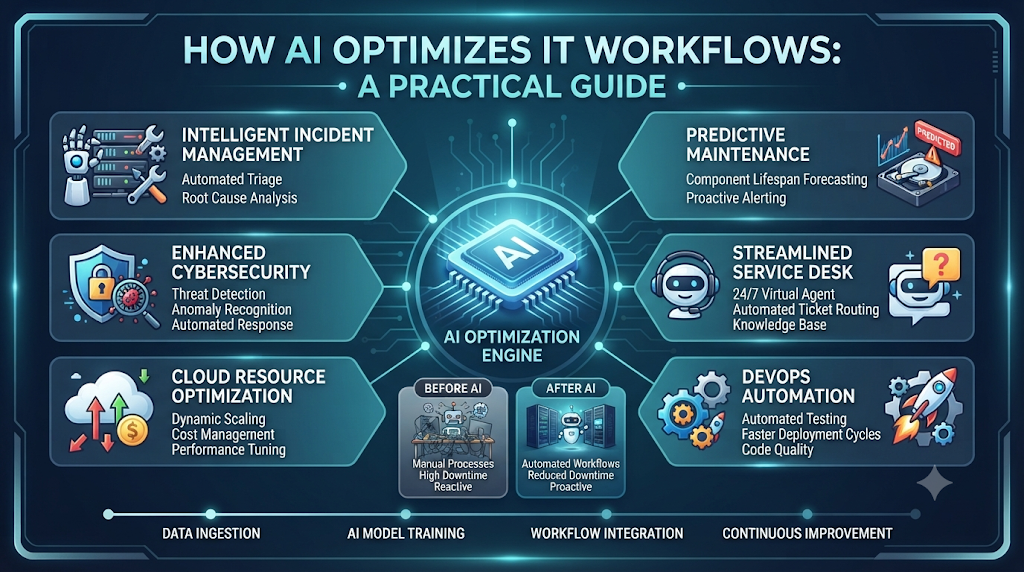
The daily reality of modern IT operations is defined by friction: a constant influx of alerts, repetitive configuration requests, cross-system troubleshooting bottlenecks, and the heavy manual overhead of routine infrastructure maintenance. As systems scale in complexity—spanning multi-cloud environments, distributed microservices, and containerized deployments—traditional manual monitoring and ticket-routing models struggle to keep up.
AIOps (Artificial Intelligence for IT Operations) addresses this operational friction by applying machine learning, data science, and automation to historical and real-time operations data. Far from being a silver bullet that replaces engineering judgment, AI acts as an intelligent force multiplier. It cuts through noise, automates deterministic tasks, and surfaces actionable insights from complex telemetry streams, allowing IT teams to shift from reactive firefighting to proactive engineering.
The Operational Challenge in Modern IT Environments
IT departments face a data deluge. Modern infrastructure—comprising application performance monitors (APM), network flow logs, container orchestrators, infrastructure metrics, and security event logs—generates an unprecedented volume of telemetry data.
The Cost of Alert Fatigue and Siloed Tools
When every tool operates in a vacuum, the operational costs compound rapidly:
- High Noise-to-Signal Ratios: Monitoring tools often generate thousands of alerts for a single underlying issue, overwhelming engineers and increasing the likelihood of missed critical failures.
- Siloed Diagnostics: Troubleshooting an intermittent latency spike requires an engineer to manually correlate logs across Kubernetes clusters, database connection pools, and cloud load balancers.
- Delayed Mean Time to Resolution (MTTR): The manual collection of context during an incident consumes valuable minutes or hours before troubleshooting even truly begins.
AIOps directly targets these bottlenecks by ingesting disparate data sources into a unified analytical engine, transforming raw telemetry into contextual intelligence.
Core Pillars of AI-Driven IT Optimization
To understand how AI optimizes IT workflows, it helps to examine the core operational domains where machine learning models deliver measurable value.
1. Noise Reduction and Alert Correlation
Traditional alerting systems rely on static thresholds (e.g., CPU utilization greater than 90 percent for 5 minutes). These thresholds frequently trigger false positives during routine traffic spikes or fail to catch complex, multi-variable failures.
- Dynamic Thresholding: Machine learning models establish behavioral baselines based on historical seasonality, time of day, and workload patterns. An alert is only triggered when behavior deviates significantly from expected norms.
- Event Deduplication and Clustering: When a core database cluster fails, it might trigger cascading alerts across dozens of dependent microservices. AI clustering algorithms group these related alerts into a single, cohesive incident ticket, preventing alert fatigue and giving on-call engineers an immediate view of the root cause.
2. Predictive Maintenance and Anomaly Detection
Waiting for a disk to fill up, a memory leak to crash a service, or a certificate to expire leads to unplanned outages. Predictive analytics shifts operations left.
- Resource Utilization Forecasting: Regression models and time-series forecasting analyze historical growth in storage, memory, and compute consumption to predict precisely when infrastructure components will exhaust capacity.
- Subtle Anomaly Detection: Advanced models monitor multi-dimensional metrics simultaneously. Even if individual metrics remain within safe static thresholds, an unusual correlation between network I/O and thread-pool exhaustion can be flagged as an early indicator of degradation.
3. Automated Root Cause Analysis (RCA)
During a high-severity incident, finding the root cause is a race against time. AI accelerates RCA by executing automated correlation routines across past incident resolutions and current system state.
- Topological Mapping: By understanding the dependency graph of services, AI systems can trace the propagation path of an error back to its source node.
- Log Pattern Analysis: Natural language processing (NLP) models scan thousands of lines of unstructured log data during an incident window, instantly highlighting novel error stack traces or configuration changes that immediately preceded the failure.
Practical Implementation: Integrating AI into Incident Management Workflows
Integrating AI into an existing IT workflow requires a structured approach. Below is a practical blueprint for embedding AI-driven anomaly detection and ticket enrichment into an incident response pipeline.
[Telemetry Sources (APM, Logs, Metrics)]
                   │
                   ▼
       [AIOps Ingestion & Normalization Engine]
                   │
         (Anomaly Detected / Clustered)
                   │
                   ▼
     [ITSM / PagerDuty Automation Hook]
                   │
         (Enriched Context Attached)
                   │
                   ▼
     [On-Call Engineer / Remediation Bot]
Step-by-Step Integration Workflow
- Data Pipeline Unification: Centralize log aggregation, metrics collection, and APM traces into a common data lake or observability platform (e.g., OpenTelemetry, Prometheus, Elasticsearch).
- Baseline Training: Allow the machine learning models to ingest at least 14 to 30 days of historical telemetry to learn normal workload cycles, deployments, and batch processing windows.
- Automated Incident Enrichment: Configure webhooks between your observability platform and your Incident Management system (e.g., ServiceNow, Jira Service Management, PagerDuty). When an anomaly triggers an alert, the AI engine appends a summary of top log anomalies, recent code deployments, and suggested runbooks directly to the ticket.
- Remediation Script Triggering: For known, highly deterministic failure modes (e.g., disk space exhaustion in a non-production log directory, or a hung service process), tie AI confidence thresholds to automated remediation scripts or Ansible playbooks.
Decision Guidance: Benefits, Limitations, and Alternatives
Implementing AI-driven IT workflows involves architectural trade-offs. Organizations must evaluate whether their maturity level justifies the investment.
Advantages
- Accelerated MTTR: Reduces time spent gathering logs and correlating disparate dashboard metrics.
- Proactive Outage Prevention: Catches resource exhaustion and behavioral anomalies before they impact end users.
- Reduced Burnout: Filters out low-value alert noise, letting engineers focus on high-impact architecture and complex troubleshooting.
Limitations and Constraints
- High Initial Setup Cost: AIOps tools require clean, structured, and unified data. If your logging practices are inconsistent, the AI models will generate poor insights (“garbage in, garbage out”).
- Black-Box Reasoning: Some complex machine learning models struggle to explain why they flagged an anomaly, making it difficult for senior engineers to trust automated decisions.
- False Confidence: Over-reliance on automation without proper guardrails can lead to automated remediation scripts executing destructive actions during edge-case failures.
When NOT to Use AI-Driven Automation
- Immature Observability Foundations: If your team does not yet have centralized metrics, structured logging, or basic APM coverage, introducing machine learning models will fail due to lack of quality data. Start with basic monitoring and alerting first.
- High-Risk, Unverified Remediation: Never grant AI models autonomous permission to execute destructive actions (e.g., database drops, traffic blackholing, or infrastructure termination) in production without human-in-the-loop confirmation.
Risks and Failure Modes
Failing to account for the unique failure modes of machine learning in operations can degrade system stability rather than improve it.
- Model Drift: As software applications are updated, system behavior changes. If AIOps models are not continuously retrained on fresh data, they will flag normal new deployments as anomalies.
- Alert Storm Amplification: Misconfigured clustering rules can sometimes suppress critical individual alerts or incorrectly group unrelated incidents into a single confusing notification.
- Over-Automation: Allowing automated scripts to execute fixes based on probabilistic outputs rather than deterministic states can lead to cascading failures during unexpected edge cases.
Verification and Success Metrics
To verify that your AI-driven IT workflow optimization is delivering value, track quantitative operational metrics over a 90-day window:
- Mean Time to Detect (MTTD): Measure the reduction in time from when a system anomaly occurs to when it is flagged by monitoring.
- Mean Time to Resolution (MTTR): Measure the reduction in total incident duration driven by automated log enrichment and root-cause suggestions.
- Alert Noise Reduction Percentage: Track the ratio of raw alerts generated versus actionable incidents routed to on-call engineers.
- False Positive Rate: Monitor the frequency with which AI-flagged anomalies require no intervention, adjusting sensitivity thresholds accordingly.
Frequently Asked Questions
Q1. Does AIOps replace traditional monitoring tools like Prometheus or Datadog? No. AIOps platforms act as an analytical and orchestration layer that sits on top of traditional monitoring, log aggregation, and APM tools. They consume data from these sources to find patterns, correlate events, and reduce noise.
Q2. How much historical data is needed before an AIOps model becomes effective? Most machine learning models require a minimum of two to four weeks of clean, consistent telemetry data to establish accurate behavioral baselines and account for weekly business cycles.
Q3. Can AI safely handle automated remediation without human oversight? AI can safely handle automated remediation only for highly deterministic, low-risk, and well-tested tasks (e.g., restarting a known stuck service container or clearing temporary cache files). High-risk infrastructure changes should always require human approval.
Q4. What is the difference between deterministic automation and AI-driven operations? Deterministic automation follows strict, hard-coded “if-this-then-that” rules defined by engineers. AI-driven operations use probabilistic machine learning models to adapt to dynamic environments, predict unknown failure modes, and detect subtle anomalies.
Q5. How do we prevent AI models from generating false positives during scheduled maintenance? Modern AIOps platforms allow engineers to tag maintenance windows or integrate with CI/CD deployment pipelines, automatically suppressing anomaly detection during planned infrastructure changes.
Q6. What skill sets does an IT team need to successfully implement AIOps? While data scientists are not required for day-to-day use, IT teams need engineers comfortable with data pipelines, structured logging standards (like JSON and OpenTelemetry), and basic threshold tuning for machine learning models.
Q7. How does AIOps impact on-call burnout? By filtering out repetitive alert noise, grouping cascading alert storms into single incidents, and attaching pre-computed diagnostic context, AIOps significantly reduces cognitive load and fatigue for on-call engineers.
Q8. What are the primary security risks of deploying AIOps tools? AIOps tools ingest vast amounts of operational telemetry, which can occasionally contain sensitive data, API keys, or personally identifiable information (PII) buried in log files. Proper data masking and secure pipeline encryption are essential.
Q9. Is AIOps suitable for small IT teams and startups? For small teams, full-scale AIOps platforms may introduce unnecessary complexity and cost. Simpler teams benefit more from robust, well-structured alerting, basic runbook automation, and unified observability dashboards before introducing machine learning.
Q10. How do you measure the ROI of an AIOps implementation? Return on investment is measured by tracking reductions in MTTR, decreases in unplanned downtime hours, lower escalation costs, and measurable drops in engineer time spent managing false-positive alerts.
Conclusion
AI-driven optimization transforms IT workflows from reactive firefighting into proactive engineering. By automating alert correlation, surfacing predictive insights, and accelerating root cause analysis, organizations can tame operational complexity. Success relies on clean foundational observability, careful human oversight of automated actions, and continuous model validation.