Introduction
Tool-Calling Middleware for Agents are software layers that enable AI agents to securely connect with external tools, APIs, databases, applications, and enterprise systems to perform real-world actions.
Modern AI agents are moving beyond simple text generation. Instead of only answering questions, advanced AI agents can now execute tasks such as retrieving information, updating records, running calculations, calling APIs, managing workflows, and interacting with business applications.
However, connecting AI agents directly with external tools creates challenges around:
- Security
- Authentication
- Data access
- Error handling
- Tool selection
- Workflow management
- Monitoring
- Reliability
Tool-Calling Middleware provides a controlled communication layer between AI agents and external systems.
These platforms help organizations:
- Connect agents with business tools
- Manage API interactions
- Control tool permissions
- Improve agent reliability
- Secure external actions
- Monitor tool usage
- Create scalable AI applications
Tool-Calling Middleware is used by:
- AI engineers
- Software developers
- Enterprise automation teams
- Machine learning engineers
- SaaS companies
- Cloud architects
- Business process teams
Modern tool-calling middleware platforms support:
- API orchestration
- Function calling
- Agent tool discovery
- Authentication management
- Workflow execution
- Data retrieval
- Enterprise integrations
- Security controls
- Monitoring
The goal of Tool-Calling Middleware for Agents is to provide a reliable bridge between AI reasoning systems and external capabilities.
What Is Tool-Calling Middleware?
Tool-Calling Middleware is an intermediate software layer that manages communication between AI agents and external tools.
Instead of allowing an AI agent to directly access systems, middleware controls:
- Which tools agents can use
- How tools are called
- What data can be accessed
- How responses are returned
- How failures are handled
Examples of tools connected through middleware:
- Databases
- Search engines
- CRM systems
- Payment systems
- Cloud services
- Internal applications
- File systems
- APIs
Why AI Agents Need Tool-Calling Middleware
AI models are powerful but have limitations.
A language model alone cannot:
- Access real-time data
- Update databases
- Send emails
- Execute business actions
- Retrieve private information
Tool-calling middleware solves this by giving agents controlled access to external capabilities.
Benefits include:
- Better accuracy
- Real-time information access
- Secure automation
- Improved productivity
- Enterprise integration
How Tool-Calling Middleware Works
Agent Request
An AI agent identifies that an external action is required.
Example:
“Find customer order details.”
Tool Selection
The middleware identifies the appropriate tool.
Example:
Customer database API.
Authentication Check
The system verifies:
- User permissions
- Agent permissions
- Access policies
Tool Execution
The middleware sends the request to the external system.
Response Processing
The returned information is:
- Validated
- Structured
- Sent back to the AI agent
Final Action
The AI agent uses the information to complete the task.
Key Capabilities of Tool-Calling Middleware
Tool Discovery
Allows agents to understand available tools.
Benefits:
- Dynamic tool selection
- Better automation
- Easier integration
API Management
Handles:
- API requests
- Responses
- Authentication
- Rate limits
Security Controls
Provides:
- Permission management
- Access restrictions
- Audit logs
Workflow Execution
Manages:
- Multi-step actions
- Task dependencies
- Error handling
Data Transformation
Converts information between:
- AI formats
- API formats
- Business systems
Monitoring
Tracks:
- Tool usage
- Errors
- Performance
- Agent actions
Common Use Cases
Enterprise AI Assistants
Agents connect with:
- Documents
- Databases
- Business applications
Customer Support Automation
AI agents access:
- CRM systems
- Order databases
- Knowledge bases
Software Development Agents
Agents use:
- Code repositories
- Testing tools
- Deployment systems
Business Process Automation
Agents interact with:
- ERP systems
- Workflow tools
- Internal applications
Data Analysis Agents
Agents access:
- Databases
- Analytics platforms
- Data pipelines
Research Agents
Agents use:
- Search tools
- Scientific databases
- Information systems
Why Tool-Calling Middleware Matters
Secure AI Integration
Middleware prevents uncontrolled access to business systems.
Better Agent Reliability
It manages failures and unexpected responses.
Enterprise Scalability
Organizations can connect many tools through a standard layer.
Improved Governance
Teams can monitor and control AI actions.
Faster AI Development
Developers avoid building every integration manually.
Evaluation Criteria for Buyers
Tool Integration Support
Platforms should support:
- APIs
- Databases
- Enterprise applications
- Cloud services
Security Features
Important capabilities include:
- Authentication
- Authorization
- Encryption
- Audit logging
Developer Experience
Look for:
- SDKs
- Documentation
- APIs
- Examples
Workflow Capabilities
Important features include:
- Multi-step execution
- Error handling
- Conditional workflows
Agent Compatibility
Platforms should support:
- LLM agents
- Multi-agent systems
- Function calling
Scalability
Evaluate:
- Request handling
- Enterprise workloads
- Performance
Key Trends
Model Context Protocol (MCP) Adoption
Standardized tool communication methods are becoming increasingly important.
Growth of Agentic AI
More applications are using AI agents that perform real actions.
Enterprise AI Integration
Businesses need secure connections between AI and existing systems.
AI Governance
Organizations require better monitoring and control.
Automated Business Processes
Tool-enabled agents are replacing manual workflows.
Secure AI Operations
Security is becoming a priority for AI automation.
Methodology
The following Tool-Calling Middleware Platforms were evaluated based on:
- Tool integration capabilities
- Security features
- Agent support
- Developer experience
- Scalability
- Workflow management
- Enterprise readiness
- Monitoring
- Flexibility
- Value
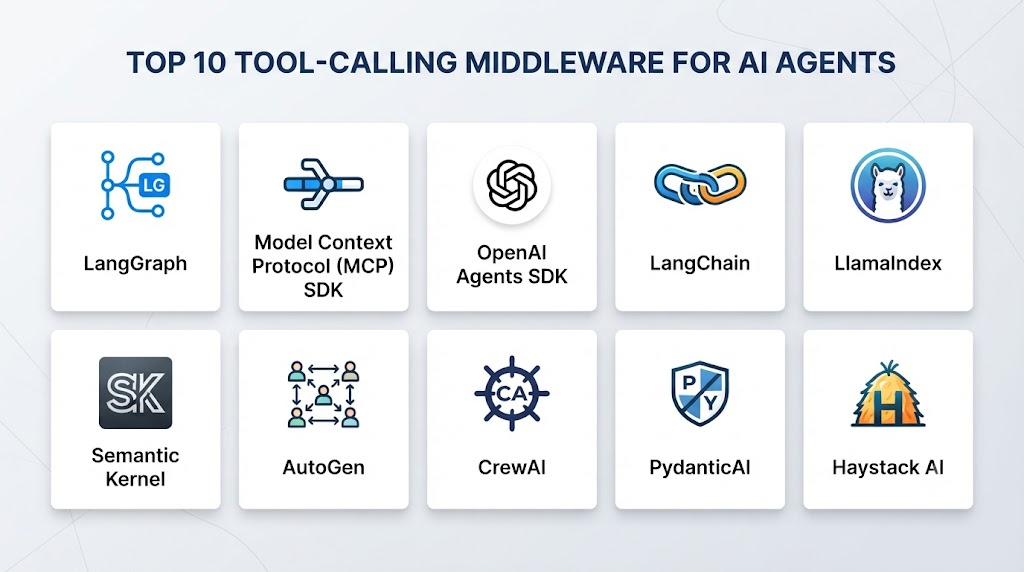
Top 10 Tool-Calling Middleware for Agents
1. Model Context Protocol (MCP)
Model Context Protocol provides a standardized way for AI applications to connect with external tools and data sources.
Key Features
- Standard tool communication
- Agent-tool connectivity
- Resource access
- Secure integrations
- Tool discovery
- AI application support
- Extensible architecture
- Developer ecosystem
- Context management
- Enterprise integration
Pros
- Open standard approach
- Simplifies tool integration
- Flexible architecture
- Growing ecosystem
- Good for agent development
Cons
- New ecosystem
- Requires implementation knowledge
- Tool availability varies
Platforms
Cloud and local environments.
Deployment or Support
Flexible deployment.
Security & Compliance
Supports controlled access patterns.
Integrations & Ecosystem
AI applications, tools, APIs, and data sources.
Support & Community
Growing developer community.
2. LangChain Tools
LangChain provides tools and abstractions for connecting AI agents with external capabilities.
Key Features
- Tool calling
- Agent workflows
- API integration
- Data connectors
- Function execution
- Memory support
- Workflow automation
- LLM integration
- Custom tools
- Developer framework
Pros
- Large ecosystem
- Many integrations
- Developer-friendly
- Strong community
- Flexible
Cons
- Requires development knowledge
- Complex workflows need expertise
- Rapidly evolving
Platforms
Cloud and local environments.
Deployment or Support
Production AI applications.
Security & Compliance
Depends on implementation.
Integrations & Ecosystem
APIs, databases, LLMs, and enterprise systems.
Support & Community
Large developer community.
3. Semantic Kernel Plugins
Semantic Kernel provides plugin-based tool integration for AI applications.
Key Features
- Plugin architecture
- Function calling
- AI orchestration
- Memory management
- Enterprise integrations
- Workflow support
- Multiple language support
- API connectivity
- Agent capabilities
- Developer SDKs
Pros
- Enterprise-ready
- Strong Microsoft ecosystem
- Flexible plugins
- Good governance
- Production focused
Cons
- Requires coding skills
- Microsoft ecosystem focus
- Learning curve
Platforms
Cloud and enterprise environments.
Deployment or Support
Enterprise deployment.
Security & Compliance
Supports enterprise controls.
Integrations & Ecosystem
Microsoft tools, APIs, and business applications.
Support & Community
Enterprise support.
4. OpenAI Function Calling
OpenAI Function Calling enables AI models to interact with external functions and APIs.
Key Features
- Structured tool calls
- API integration
- Function execution
- JSON-based outputs
- Agent workflows
- Developer APIs
- Tool selection
- Reliable responses
- Application integration
- AI automation
Pros
- Simple implementation
- Strong model support
- Developer-friendly
- Reliable structured outputs
- Easy integration
Cons
- Provider-specific
- Requires external tool development
- Limited middleware features
Platforms
Cloud environments.
Deployment or Support
AI application development.
Security & Compliance
Depends on application implementation.
Integrations & Ecosystem
OpenAI APIs and external tools.
Support & Community
Developer community.
5. LlamaIndex Tools
LlamaIndex provides tools for connecting AI agents with data sources and external systems.
Key Features
- Data tools
- Retrieval tools
- API integration
- Agent workflows
- RAG support
- Document access
- Custom tools
- Knowledge systems
- LLM integration
- Enterprise applications
Pros
- Strong data integration
- Excellent RAG support
- Flexible
- AI-focused
- Developer-friendly
Cons
- Requires AI knowledge
- Data preparation needed
- Complex workflows require expertise
Platforms
Cloud and local environments.
Deployment or Support
Enterprise AI applications.
Security & Compliance
Depends on implementation.
Integrations & Ecosystem
Databases, documents, APIs, and AI models.
Support & Community
Developer community.
6. CrewAI Tools
CrewAI Tools allow AI agents to use external capabilities inside multi-agent workflows.
Key Features
- Agent tools
- Role-based workflows
- API integration
- Task execution
- Agent collaboration
- Custom tools
- Workflow automation
- LLM support
- Memory integration
- Developer APIs
Pros
- Easy agent tool creation
- Good for multi-agent systems
- Simple workflow design
- Developer-friendly
- Growing ecosystem
Cons
- New platform
- Limited enterprise features
- Requires customization
Platforms
Cloud and local environments.
Deployment or Support
Flexible deployment.
Security & Compliance
Depends on implementation.
Integrations & Ecosystem
APIs, LLMs, and automation tools.
Support & Community
Developer community.
7. Haystack Tools
Haystack provides tool integration capabilities for AI search and retrieval systems.
Key Features
- Tool pipelines
- Search integration
- Retrieval systems
- Agent support
- Document processing
- API connections
- RAG workflows
- Custom components
- Enterprise search
- AI applications
Pros
- Strong retrieval capabilities
- Open-source
- Flexible
- Enterprise-friendly
- Good documentation
Cons
- Retrieval focused
- Requires technical knowledge
- Complex workflows need expertise
Platforms
Cloud and local environments.
Deployment or Support
Enterprise deployment.
Security & Compliance
Depends on implementation.
Integrations & Ecosystem
Search systems, databases, and AI models.
Support & Community
Open-source community.
8. Apache Camel
Apache Camel provides integration middleware capabilities for connecting applications and services.
Key Features
- Enterprise integrations
- Routing
- Data transformation
- API connectivity
- Workflow management
- Message handling
- Application integration
- Enterprise patterns
- Custom connectors
- Automation workflows
Pros
- Mature integration platform
- Enterprise adoption
- Powerful routing
- Large ecosystem
- Reliable
Cons
- Not AI-specific
- Requires expertise
- Complex configuration
Platforms
Cloud and enterprise environments.
Deployment or Support
Enterprise integration.
Security & Compliance
Enterprise security options.
Integrations & Ecosystem
Enterprise systems, APIs, and applications.
Support & Community
Large open-source community.
9. Zapier AI Actions
Zapier AI Actions connects AI applications with thousands of business tools.
Key Features
- Business app integration
- Workflow automation
- API actions
- Tool execution
- No-code workflows
- SaaS connectivity
- Task automation
- AI assistants
- Business processes
- Integration library
Pros
- Easy setup
- Many integrations
- No-code approach
- Business-friendly
- Fast automation
Cons
- Limited customization
- SaaS dependency
- Advanced workflows need planning
Platforms
Cloud environment.
Deployment or Support
Cloud deployment.
Security & Compliance
Business security controls.
Integrations & Ecosystem
SaaS applications and APIs.
Support & Community
Large user community.
10. n8n AI Tool Integration
n8n provides workflow automation with AI tool connections.
Key Features
- Visual workflow builder
- API integrations
- AI agent tools
- Automation workflows
- Custom nodes
- Business integrations
- Data processing
- Self-hosting
- Workflow monitoring
- Developer tools
Pros
- Flexible automation
- Self-hosting option
- Many integrations
- Visual builder
- Developer-friendly
Cons
- Complex workflows require expertise
- Scaling needs planning
- Not fully agent-focused
Platforms
Cloud and self-hosted environments.
Deployment or Support
Flexible deployment.
Security & Compliance
Depends on deployment.
Integrations & Ecosystem
APIs, SaaS tools, databases.
Support & Community
Developer community.
Comparison Table
| Tool Name | Best For | Platform(s) Supported | Deployment | Standout Feature | Public Rating |
|---|---|---|---|---|---|
| MCP | Standard tool communication | Cloud/Local | Flexible | Open tool protocol | |
| LangChain Tools | AI applications | Cloud/Local | Production | Large ecosystem | |
| Semantic Kernel Plugins | Enterprise AI | Cloud | Enterprise | Plugin system | |
| OpenAI Function Calling | API actions | Cloud | Flexible | Structured calls | |
| LlamaIndex Tools | Data agents | Cloud/Local | Enterprise | Data integration | |
| CrewAI Tools | Agent teams | Cloud/Local | Flexible | Agent tools | |
| Haystack Tools | RAG systems | Cloud/Local | Enterprise | Retrieval tools | |
| Apache Camel | Enterprise integration | Cloud/Local | Enterprise | Integration middleware | |
| Zapier AI Actions | Business automation | Cloud | Cloud | SaaS integrations | |
| n8n AI Tools | Workflow automation | Cloud/Self-hosted | Flexible | Visual workflows |
Weighted Evaluation
| Tool Name | Core Features 25% | Ease of Use 15% | Integrations & Ecosystem 15% | Security & Compliance 10% | Performance & Reliability 10% | Support & Community 10% | Price/Value 15% | Total |
|---|---|---|---|---|---|---|---|---|
| MCP | 24 | 13 | 14 | 10 | 10 | 10 | 15 | 96 |
| LangChain Tools | 25 | 14 | 15 | 10 | 10 | 10 | 14 | 98 |
| Semantic Kernel Plugins | 24 | 12 | 15 | 10 | 10 | 10 | 13 | 94 |
| OpenAI Function Calling | 23 | 15 | 14 | 10 | 10 | 10 | 14 | 96 |
| LlamaIndex Tools | 24 | 14 | 15 | 10 | 10 | 10 | 14 | 97 |
| CrewAI Tools | 23 | 15 | 14 | 10 | 10 | 10 | 15 | 97 |
| Haystack Tools | 23 | 13 | 14 | 10 | 10 | 10 | 14 | 94 |
| Apache Camel | 24 | 11 | 15 | 10 | 10 | 10 | 13 | 93 |
| Zapier AI Actions | 22 | 15 | 15 | 10 | 10 | 10 | 14 | 96 |
| n8n AI Tools | 23 | 15 | 15 | 10 | 10 | 10 | 15 | 98 |
Which Tool-Calling Middleware Is Right for You?
Choose Model Context Protocol for standardized AI tool communication.
Choose LangChain Tools for flexible AI agent development.
Choose Semantic Kernel Plugins for enterprise applications.
Choose OpenAI Function Calling for simple API-based actions.
Choose LlamaIndex Tools for data-connected AI agents.
Choose CrewAI Tools for multi-agent systems.
Choose Haystack Tools for retrieval applications.
Choose Apache Camel for enterprise integrations.
Choose Zapier AI Actions for business automation.
Choose n8n AI Tools for visual workflow automation.
Implementation Playbook
Phase 1: Identify Required Tools
- List business systems
- Identify APIs
- Define agent capabilities
- Set access requirements
Phase 2: Build Tool Connections
- Configure APIs
- Setup authentication
- Create tool definitions
- Test integrations
Phase 3: Add Agent Workflows
- Connect AI models
- Configure tool selection
- Add monitoring
- Test execution
Phase 4: Secure Operations
- Apply permissions
- Monitor activity
- Audit tool usage
- Protect data
Phase 5: Optimize
- Improve workflows
- Add new tools
- Reduce failures
- Monitor performance
Common Mistakes
- Giving agents unlimited tool access
- Poor permission management
- Lack of monitoring
- Ignoring API security
- Poor error handling
- Not testing workflows
- Selecting unsuitable tools
- Missing governance policies
FAQs
1. What is Tool-Calling Middleware for Agents?
It is a software layer that connects AI agents with external tools and systems securely.
2. Why do AI agents need tools?
Tools allow agents to access real-time data and perform actions.
3. What types of tools can agents use?
Agents can use APIs, databases, search systems, and business applications.
4. Is tool-calling secure?
Middleware improves security through permissions, authentication, and monitoring.
5. Who uses tool-calling middleware?
Developers, enterprises, SaaS companies, and AI teams use it.
6. What is MCP in AI?
MCP is a protocol that standardizes communication between AI applications and tools.
7. Can multiple agents share tools?
Yes. Middleware can manage shared tools across multiple agents.
8. How does middleware improve AI reliability?
It handles validation, errors, permissions, and structured communication.
9. Can businesses create custom tools?
Yes. Most platforms support custom integrations.
10. What is the future of tool-calling middleware?
Tool middleware will become a core layer for enterprise AI agents and autonomous systems.
Conclusion
Tool-Calling Middleware for Agents is becoming a critical component of modern AI infrastructure. It enables AI agents to move beyond conversations and perform meaningful actions by securely connecting them with external systems.Platforms such as LangChain Tools, Model Context Protocol, Semantic Kernel Plugins, LlamaIndex Tools, CrewAI Tools, Zapier AI Actions, and n8n provide powerful solutions for building connected AI applications.As agent-based AI continues growing, tool-calling middleware will play an essential role in creating secure, scalable, and intelligent automation systems.