Introduction
Have you ever tried to fix a computer or phone when it suddenly stops working? For a regular person, it is incredibly frustrating. But for a large business, a computer system crash is a total disaster. Every minute a company’s website or app is down, they lose a huge amount of money. Customers get angry, sales stop completely, and the people running the business start to panic. The hardest part is not just turning the system back on, but finding out exactly why it broke in the first place so it does not happen again. In the technology world, finding the exact reason for a crash is called Root Cause Analysis. Think of it like trying to find a single needle in a massive haystack, but the haystack is made of millions of lines of confusing computer text. Human workers have to dig through all this digital noise to find the one small error that brought everything down. It takes a lot of time, and it is a very stressful job. Thankfully, Artificial Intelligence is stepping in to save the day. AI can act like a super-smart detective that reads through all that computer text in a matter of seconds. If you want to learn even more about how to master these smart IT tools, you can check out Aiopsschool.com for some great resources. AI is totally changing how businesses find and fix their biggest computer problems, making the whole process fast, calm, and incredibly easy.
The Nightmare of Manual Root Cause Analysis
Imagine it is 3 AM, and a major banking app suddenly goes completely offline. The alarm bells ring, and a team of sleepy IT workers is forced to wake up and jump on an emergency video call. This is the classic IT fire drill, and it is a complete nightmare for everyone involved. Everyone is stressed, bosses are asking for updates every five minutes, and the team has no idea where to even begin looking for the problem.
To find the problem the old-fashioned human way, the team has to manually read through things called “log files.” These are just endless lists of text that record every single thing the computer system does. A big system can create millions of these text lines every single minute. Asking a human to read through millions of lines of confusing code to find one single error is almost impossible. It is a slow, painful guessing game that hurts the eyes and the brain.
While the team is guessing and reading, the clock is ticking. Time is money in the business world, and a website being down for just a few hours can cost a large company millions of dollars in lost sales. It also ruins the trust of their loyal customers. The pressure on the human workers to find the real problem is absolutely massive, and this constant stress often leads to burnout and exhausted employees.
The simple truth is that human brains were not built to process this much data at such a high speed. We get tired, our eyes blur, and we easily miss tiny details. When a modern computer system breaks, it is just too big and complex for a manual search. The old way of finding problems is simply broken, and IT teams have been begging for a better, smarter way to do their jobs.
How AI Completely Changes the Game
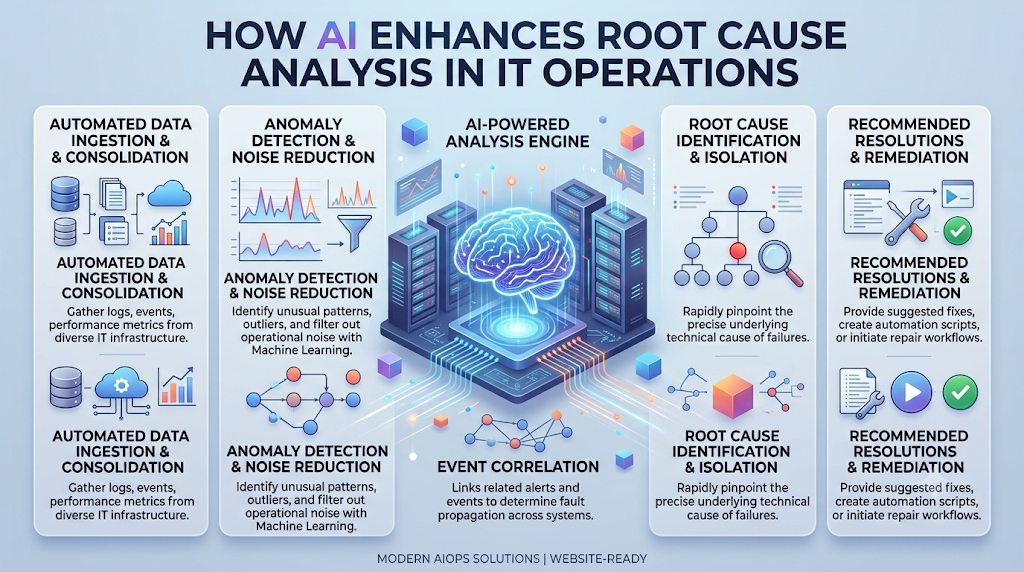
Artificial Intelligence steps into this highly stressful situation and brings instant calm. Instead of relying on tired humans to read endless lines of text in the dark, AI takes over all the heavy lifting. It acts like an incredibly fast, smart digital detective that never needs to sleep or take a coffee break. AI is built from the ground up to handle massive amounts of data, and it does so with absolute ease.
Instant Data Sorting
When a crash happens, the AI can read through millions of log files in a single second. It instantly sorts through all the noise, tossing aside the normal data and keeping only the important clues. A job that would take a human team five or six hours takes the AI less than a second. It does not get tired, it does not get distracted by other things, and it never misses a single detail.
Spotting Hidden Patterns
AI uses something called machine learning, which is a simple way of saying it learns by watching. The AI watches the computer system every single day and learns exactly what “normal” healthy behavior looks like. When something weird happens—even a tiny change that a human would never notice—the AI spots it immediately. It can see hidden patterns in the data and flag the exact moment things started to go wrong.
Connecting the Dots
A large computer system is like a massive puzzle where everything is connected by invisible strings. If a small database fails, it might cause the main website to crash ten minutes later. For a human, linking those two separate events is very hard. The AI, however, can instantly connect the dots. It sees the whole big picture and draws a straight line from the broken database right to the crashed website, pointing exactly to the root cause.
Comparing Manual RCA vs. AI-Driven RCA
| Feature | Manual RCA (The Human Way) | AI-Driven RCA (The Smart Way) |
| Time Taken to Find the Issue | Hours or even days of slow, painful searching. | Seconds or minutes of instant data sorting. |
| Accuracy | Very low. Humans often guess and fix the wrong thing. | Extremely high. AI points directly to the exact broken part. |
| Team Stress Levels | Very high. Panicked phone calls and angry bosses. | Very low. The team stays calm while the AI does the hard work. |
Looking at the table above, it is very easy to see why businesses around the world are rushing to use AI. The old human method is simply too slow and relies too much on pure luck and guessing. When a company is losing thousands of dollars every minute their app is down, they absolutely cannot afford to wait hours for a human to find the broken piece of the puzzle.
The AI-driven method brings incredible speed and peace of mind to the workplace. The amazing accuracy of AI means that teams are no longer fixing the wrong thing by mistake. In the past, a team might spend three hours fixing a computer server, only to realize later that the actual problem was a bad piece of code. AI stops this wasted effort entirely by pointing them to the exact right spot on the very first try.
Most importantly, the stress levels for the human workers drop dramatically. Instead of a panicked fire drill in the middle of the night, the IT team gets a clear, calm alert on their phones from the AI. The alert tells them exactly what broke, why it broke, and exactly where to go to fix it. This turns a major corporate disaster into a simple, quick repair job.
A Real-World Scenario: Fixing a Crash in Minutes
Let us imagine a giant online clothing store having its biggest sale of the year on a holiday weekend. Millions of eager shoppers are on the website trying to buy shoes, hats, and shirts. Suddenly, right in the middle of the busy morning, the main checkout page stops working entirely. Customers cannot pay for their items, and the company starts losing tons of money by the second.
In the old days, this event would cause total panic across the company. The IT bosses would call an emergency meeting. Dozens of engineers would start frantically reading through logs, trying to figure out if it was a server issue, a code error, or a problem with the credit card system. They would be guessing in the dark while the company watched millions of dollars slip away.
But this time, the company has an AI assistant watching their systems. The exact moment the checkout page breaks, the AI notices something is wrong. In a fraction of a second, the AI reads through the millions of events happening on the website. It looks at the normal patterns, spots the weird behavior, and connects the dots instantly without any human help.
Within two minutes, the AI sends a simple text message to the lead engineer. The message says, “The checkout page is broken because the new shipping software update is blocking the payment system.” The engineer reads the message, goes straight to the shipping software, turns off the bad update, and the checkout page immediately starts working again. A problem that used to take six hours of panic was fixed in five minutes, saving the huge holiday sale.
The Future of IT Problem Solving
The way we find and fix computer problems is only going to get better in the coming years. Right now, AI is amazing at finding the root cause of a crash right after it happens. But the real future lies in stopping the crash before it ever occurs. AI is getting so smart that it can predict the future of a computer system based on tiny warning signs that humans cannot see.
Soon, AI will notice that a server is slowly getting too warm or that a piece of code is starting to run a little bit slowly. It will send a friendly alert saying, “This system is going to crash in two hours if you do not fix it.” The IT team can then step in calmly, make a small adjustment, and prevent the disaster completely. The customers never even notice a problem because the website never actually goes down.
Some people worry that this super-smart AI will take jobs away from human IT workers. But the truth is much more positive and exciting. IT workers do not want to spend their lives reading boring text files in the middle of the night. By letting AI do the annoying, heavy lifting, human workers are freed up to do much more creative and interesting things.
In the future, IT teams will spend their time building new, exciting apps and features, rather than just fixing broken things all day. The workplace will be calmer, happier, and much more productive for everyone involved. AI is not here to replace human workers; it is here to give them a much better, stress-free way to work.
FAQs
Q1: What exactly is Root Cause Analysis?
A1: Root Cause Analysis is the process of finding the exact original reason why a computer system or website broke, instead of just treating the symptoms.
Q2: Why is finding a computer problem so hard for humans?
A2: It is hard because humans have to manually read through millions of lines of computer text to find one tiny error, which is exactly like finding a needle in a massive haystack.
Q3: How does AI help in fixing computer systems?
A3: AI helps by reading all the computer data instantly, spotting weird behavior, and pointing exactly to the broken part so human workers can fix it fast.
Q4: Will AI take away IT jobs?
A4: No, AI will actually help IT workers by taking over the boring, stressful tasks, allowing humans to focus their time on building new and creative technology.
Q5: Can AI fix the problem on its own?
A5: While some advanced AI can make small fixes automatically, most systems use AI to find the problem and tell a human exactly how to fix it.
Q6: What is a log file?
A6: A log file is simply a long list of text that a computer writes to record everything it does, acting like a digital diary of all its actions.
Q7: How fast can AI find a problem?
A7: AI can read millions of pieces of data in a fraction of a second, often finding the real root cause of a problem in just a few minutes.
Q8: Does AI get tired of reading data?
A8: No, unlike humans, AI never gets tired, never needs to sleep, and can look at massive amounts of data 24 hours a day without making any careless mistakes.
Q9: What does predicting a crash mean?
A9: Predicting a crash means the AI looks at tiny warning signs and tells the team that the system is going to break soon, so they can stop it before it actually happens.
Q10: Why do businesses care so much about fixing crashes quickly?
A10: Businesses care because every single minute their website or app is broken, they lose money and upset their customers, so fixing it fast saves their business.
Conclusion
Finding the real reason why a computer system broke used to be the absolute worst part of working in technology. It was a slow, stressful process of digging through endless amounts of data to find one tiny mistake. But with Artificial Intelligence stepping up to help, that painful guessing game is finally a thing of the past.
AI has proven to be the ultimate digital detective. By reading data instantly, spotting hidden patterns, and connecting the dots, it turns hours of wild panic into a few minutes of calm problem-solving. Businesses save their hard-earned money, websites stay online for customers, and IT workers finally get to have a good night’s sleep. As AI continues to grow and learn, the future of technology looks brighter and more reliable than ever before.