Introduction
Agent Memory Stores are specialized data storage systems designed to help AI agents remember information, maintain context, learn from interactions, and improve decision-making over time.
Unlike traditional AI applications that process each request independently, AI agents require memory to maintain continuity across conversations, workflows, and tasks. Memory allows agents to remember previous interactions, user preferences, business information, task history, and learned knowledge.
As organizations build advanced agentic AI systems, managing memory has become a critical requirement. AI agents need reliable memory systems to:
- Store previous conversations
- Retrieve relevant information
- Maintain long-term context
- Improve personalization
- Support complex workflows
- Enable continuous learning
Agent Memory Stores help organizations:
- Build smarter AI assistants
- Maintain user context
- Improve agent accuracy
- Store enterprise knowledge
- Support multi-step reasoning
- Enable personalized experiences
- Manage AI agent data efficiently
These platforms are used by:
- AI engineers
- Machine learning teams
- Software developers
- Enterprise automation teams
- Data scientists
- AI application developers
- Research organizations
Modern Agent Memory Stores provide capabilities such as:
- Short-term memory management
- Long-term memory storage
- Vector search
- Semantic retrieval
- Knowledge storage
- Conversation history management
- Context management
- Memory optimization
- AI workflow integration
The goal of Agent Memory Stores is to provide AI agents with reliable, scalable, and intelligent memory capabilities required for advanced autonomous systems.
What Is Agent Memory?
Agent memory is the ability of an AI agent to store, retrieve, and use information from previous interactions or experiences.
Memory allows AI agents to remember:
- User preferences
- Previous conversations
- Task history
- Business information
- Learned patterns
- Important context
Without memory, AI agents behave like they have no previous knowledge.
Types of Agent Memory
Short-Term Memory
Short-term memory stores information during an active interaction.
Examples:
- Current conversation
- Current task details
- Recent instructions
Benefits:
- Better conversation flow
- Improved immediate responses
Long-Term Memory
Long-term memory stores information across multiple sessions.
Examples:
- User preferences
- Historical interactions
- Important facts
Benefits:
- Personalization
- Continuous improvement
Semantic Memory
Stores knowledge and meaningful information.
Examples:
- Documents
- Facts
- Business knowledge
Episodic Memory
Stores past experiences and events.
Examples:
- Previous tasks
- Completed workflows
- Agent actions
Working Memory
Stores information needed during active reasoning.
Examples:
- Current goals
- Intermediate results
- Temporary data
How Agent Memory Stores Work
Data Collection
The AI agent receives information from:
- Conversations
- Documents
- Applications
- User interactions
Memory Processing
The system organizes information into:
- Structured data
- Embeddings
- Knowledge records
Memory Storage
Information is stored in:
- Databases
- Vector stores
- Knowledge graphs
Retrieval
When needed, the AI agent searches memory for relevant information.
Decision Making
The retrieved information helps the agent generate better responses and actions.
Key Capabilities of Agent Memory Stores
Vector Search
Allows agents to find information based on meaning rather than exact keywords.
Benefits:
- Semantic search
- Better retrieval accuracy
- Context awareness
Context Management
Maintains information needed for agent reasoning.
Benefits:
- Better conversations
- Improved task completion
Knowledge Storage
Stores:
- Documents
- Facts
- User data
- Business information
Memory Retrieval
Provides relevant information when agents need it.
Benefits:
- Faster responses
- Better decisions
Integration Support
Connects with:
- AI frameworks
- Databases
- Enterprise applications
Memory Management
Handles:
- Updating information
- Removing outdated data
- Organizing knowledge
Common Use Cases
AI Personal Assistants
Memory stores help assistants remember:
- User preferences
- Previous requests
- Personal workflows
Customer Support Agents
AI agents use memory for:
- Customer history
- Previous conversations
- Account information
Enterprise Knowledge Assistants
Organizations store:
- Internal documents
- Policies
- Business knowledge
Coding Agents
Memory helps agents remember:
- Project details
- Coding patterns
- Development history
Research Agents
Memory stores:
- Research findings
- Previous analysis
- Knowledge sources
Business Automation Agents
Agents remember:
- Workflow history
- Business rules
- Task outcomes
Why Agent Memory Stores Matter
Better AI Personalization
Agents can provide more relevant experiences.
Improved Decision Making
Memory provides additional context.
More Reliable Workflows
Agents maintain continuity across tasks.
Reduced Repetition
Users do not need to repeat information.
Enterprise AI Scalability
Organizations can manage large amounts of AI knowledge.
Evaluation Criteria for Buyers
Storage Capability
Platforms should support:
- Large-scale data storage
- Structured information
- Unstructured information
Retrieval Performance
Important factors include:
- Search speed
- Accuracy
- Semantic understanding
AI Framework Compatibility
Support should include:
- Agent frameworks
- LLM applications
- APIs
Security Features
Organizations should evaluate:
- Encryption
- Access controls
- Data privacy
Scalability
Important considerations:
- Large workloads
- Multiple agents
- Enterprise usage
Developer Experience
Look for:
- SDKs
- Documentation
- APIs
- Community support
Key Trends
Growth of Agentic AI
AI agents increasingly require memory capabilities.
Vector Database Adoption
Semantic memory storage is becoming common.
Personalized AI Experiences
Organizations are building AI systems that remember users.
Enterprise Knowledge Management
Businesses are connecting AI agents with internal knowledge.
Memory Governance
Companies are focusing on:
- Privacy
- Data control
- Memory management
Hybrid Memory Systems
Future AI agents will combine:
- Short-term memory
- Long-term memory
- Knowledge graphs
- Vector search
Methodology
The following Agent Memory Stores were evaluated based on:
- Memory capabilities
- Retrieval performance
- AI integration
- Scalability
- Security
- Developer experience
- Enterprise readiness
- Community adoption
- Flexibility
- Value
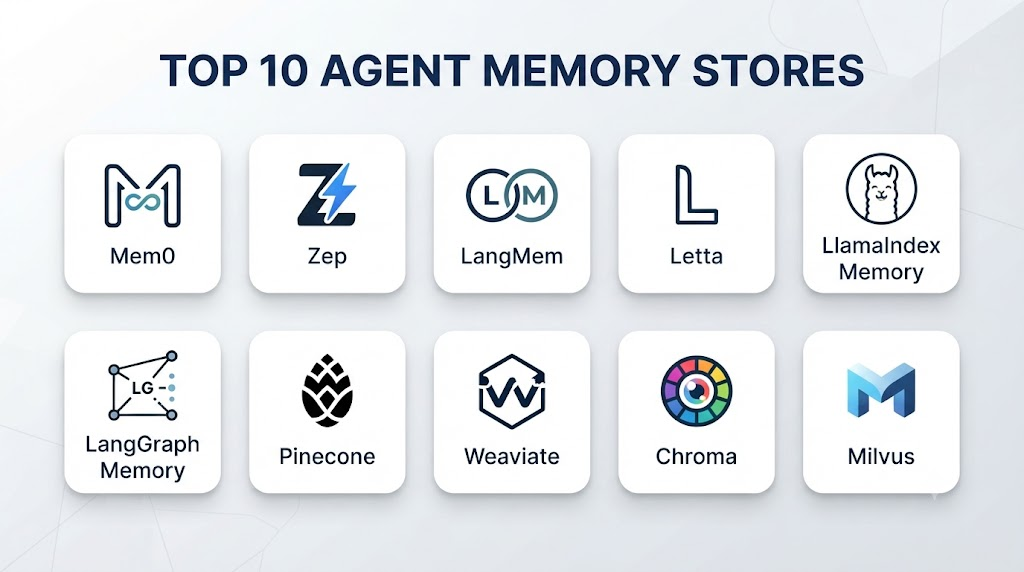
Top 10 Agent Memory Stores
1. Zep AI Memory Platform
Zep is an AI memory platform designed specifically for building applications with persistent agent memory.
Key Features
- Long-term memory
- Conversation history
- Context management
- User memory
- Semantic search
- Knowledge extraction
- Agent integration
- Memory optimization
- Developer APIs
- AI application support
Pros
- Built specifically for AI memory
- Strong conversation memory
- Easy integration
- Good retrieval capabilities
- Developer-friendly
Cons
- Newer ecosystem
- Requires AI architecture knowledge
- Enterprise features may require planning
Platforms
Cloud and self-hosted environments.
Deployment or Support
AI application deployment.
Security & Compliance
Provides controlled memory management.
Integrations & Ecosystem
LLMs, AI frameworks, and applications.
Support & Community
Developer community.
2. Mem0
Mem0 provides memory infrastructure for AI applications and agents.
Key Features
- Persistent memory
- User memory
- Context retrieval
- Memory management
- AI integration
- Developer APIs
- Personalization
- Knowledge storage
- Agent support
- Memory optimization
Pros
- AI-focused memory solution
- Easy integration
- Good personalization
- Developer-friendly
- Flexible
Cons
- Growing ecosystem
- Requires configuration
- Advanced use cases need customization
Platforms
Cloud and local environments.
Deployment or Support
AI application deployment.
Security & Compliance
Depends on implementation.
Integrations & Ecosystem
AI frameworks and applications.
Support & Community
Developer community.
3. Redis Vector Database
Redis provides high-performance data storage with vector search capabilities for AI applications.
Key Features
- Vector search
- Fast retrieval
- Real-time data access
- Memory storage
- Caching
- Database capabilities
- AI integrations
- Developer APIs
- High performance
- Scalable infrastructure
Pros
- Extremely fast
- Mature technology
- Real-time capabilities
- Flexible
- Large ecosystem
Cons
- Requires database expertise
- Not AI-memory specific
- Infrastructure management needed
Platforms
Cloud and self-hosted environments.
Deployment or Support
Enterprise deployment.
Security & Compliance
Enterprise security features.
Integrations & Ecosystem
Applications, APIs, AI frameworks.
Support & Community
Large developer community.
4. Pinecone
Pinecone is a managed vector database designed for AI search and retrieval applications.
Key Features
- Vector storage
- Semantic search
- Similarity matching
- AI retrieval
- Scalable infrastructure
- Metadata filtering
- API access
- Cloud deployment
- Enterprise security
- Developer tools
Pros
- Easy vector database management
- Strong performance
- Scalable
- AI-focused
- Managed service
Cons
- Cloud dependency
- Cost considerations
- Specialized use case
Platforms
Cloud environments.
Deployment or Support
Managed cloud deployment.
Security & Compliance
Enterprise security options.
Integrations & Ecosystem
LLMs, AI frameworks, and applications.
Support & Community
Developer community.
5. Weaviate
Weaviate is an open-source vector database for AI applications.
Key Features
- Vector search
- Semantic retrieval
- Knowledge storage
- Hybrid search
- AI integrations
- Graph capabilities
- API access
- Cloud deployment
- Data management
- Developer tools
Pros
- Open-source
- Flexible
- Strong search capabilities
- AI-focused
- Hybrid search support
Cons
- Requires setup knowledge
- Database management needed
- Learning curve
Platforms
Cloud and self-hosted environments.
Deployment or Support
Flexible deployment.
Security & Compliance
Depends on deployment.
Integrations & Ecosystem
AI frameworks, databases, and applications.
Support & Community
Open-source community.
6. Chroma
Chroma is an open-source embedding database designed for AI applications.
Key Features
- Vector storage
- Embedding management
- Semantic search
- Developer APIs
- Local deployment
- AI application support
- Document retrieval
- Metadata filtering
- LLM integration
- Simple setup
Pros
- Easy to use
- Open-source
- Developer-friendly
- Good for prototypes
- Lightweight
Cons
- Enterprise features limited
- Scaling requires planning
- Smaller ecosystem
Platforms
Local and cloud environments.
Deployment or Support
Development and production use.
Security & Compliance
Depends on deployment.
Integrations & Ecosystem
AI frameworks and LLM applications.
Support & Community
Developer community.
7. Milvus
Milvus is an open-source vector database designed for large-scale AI applications.
Key Features
- Large-scale vector search
- Distributed architecture
- High performance
- AI retrieval
- Data management
- Cloud deployment
- Scalability
- Multiple index types
- API support
- Enterprise applications
Pros
- Highly scalable
- Open-source
- Strong performance
- Large data support
- Enterprise-ready
Cons
- Complex setup
- Requires infrastructure knowledge
- Management overhead
Platforms
Cloud and self-hosted environments.
Deployment or Support
Enterprise deployment.
Security & Compliance
Depends on deployment.
Integrations & Ecosystem
AI frameworks and data platforms.
Support & Community
Open-source community.
8. Qdrant
Qdrant is an open-source vector database focused on fast similarity search.
Key Features
- Vector search
- Metadata filtering
- API access
- AI retrieval
- Scalable storage
- Cloud deployment
- Developer tools
- Data management
- High performance
- Open-source
Pros
- Fast retrieval
- Developer-friendly
- Flexible deployment
- Good performance
- Open-source
Cons
- Requires technical knowledge
- Smaller ecosystem
- Infrastructure management
Platforms
Cloud and self-hosted environments.
Deployment or Support
Flexible deployment.
Security & Compliance
Depends on deployment.
Integrations & Ecosystem
AI frameworks and applications.
Support & Community
Developer community.
9. LangChain Memory
LangChain provides memory components for building AI applications.
Key Features
- Conversation memory
- Agent memory
- Context management
- Retrieval support
- LLM integration
- Memory modules
- Workflow support
- Developer APIs
- Agent integration
- Application development
Pros
- Large ecosystem
- Easy integration
- Strong developer support
- Many AI integrations
- Flexible
Cons
- Requires framework knowledge
- Memory features vary
- Rapidly changing ecosystem
Platforms
Cloud and local environments.
Deployment or Support
AI application development.
Security & Compliance
Depends on implementation.
Integrations & Ecosystem
LLMs, APIs, databases.
Support & Community
Large developer community.
10. LlamaIndex Memory
LlamaIndex provides memory capabilities for AI agents connected with knowledge sources.
Key Features
- Context storage
- Retrieval systems
- Knowledge integration
- Agent memory
- Document access
- RAG workflows
- Data connectors
- LLM support
- Enterprise search
- AI applications
Pros
- Strong data integration
- Excellent RAG support
- Flexible
- AI-focused
- Enterprise-friendly
Cons
- Requires AI expertise
- Data preparation needed
- Complex systems require planning
Platforms
Cloud and local environments.
Deployment or Support
Enterprise AI applications.
Security & Compliance
Depends on implementation.
Integrations & Ecosystem
Databases, documents, APIs, and LLMs.
Support & Community
Developer community.
Comparison Table
| Tool Name | Best For | Platform(s) Supported | Deployment | Standout Feature | Public Rating |
|---|---|---|---|---|---|
| Zep | AI memory | Cloud/Self-hosted | Flexible | Persistent memory | |
| Mem0 | Personal AI memory | Cloud/Local | Flexible | User personalization | |
| Redis | Real-time memory | Cloud/Self-hosted | Enterprise | Fast retrieval | |
| Pinecone | Vector memory | Cloud | Managed | Scalable search | |
| Weaviate | Knowledge memory | Cloud/Self-hosted | Flexible | Hybrid search | |
| Chroma | AI prototypes | Local/Cloud | Flexible | Simple setup | |
| Milvus | Large-scale AI memory | Cloud/Self-hosted | Enterprise | Distributed vectors | |
| Qdrant | Semantic search | Cloud/Self-hosted | Flexible | Fast retrieval | |
| LangChain Memory | Agent apps | Cloud/Local | Development | AI framework integration | |
| LlamaIndex Memory | Data agents | Cloud/Local | Enterprise | Knowledge retrieval |
Weighted Evaluation
| Tool Name | Core Features 25% | Ease of Use 15% | Integrations & Ecosystem 15% | Security & Compliance 10% | Performance & Reliability 10% | Support & Community 10% | Price/Value 15% | Total |
|---|---|---|---|---|---|---|---|---|
| Zep | 25 | 14 | 14 | 10 | 10 | 10 | 14 | 97 |
| Mem0 | 24 | 15 | 14 | 10 | 10 | 10 | 15 | 98 |
| Redis | 24 | 13 | 15 | 10 | 10 | 10 | 14 | 96 |
| Pinecone | 24 | 14 | 15 | 10 | 10 | 10 | 13 | 96 |
| Weaviate | 24 | 13 | 15 | 10 | 10 | 10 | 14 | 96 |
| Chroma | 22 | 15 | 14 | 10 | 10 | 10 | 15 | 96 |
| Milvus | 25 | 12 | 14 | 10 | 10 | 10 | 14 | 95 |
| Qdrant | 23 | 14 | 14 | 10 | 10 | 10 | 15 | 96 |
| LangChain Memory | 23 | 14 | 15 | 10 | 10 | 10 | 14 | 96 |
| LlamaIndex Memory | 24 | 14 | 15 | 10 | 10 | 10 | 14 | 97 |
Which Agent Memory Store Is Right for You?
Choose Zep for dedicated AI memory management.
Choose Mem0 for personalized AI applications.
Choose Redis for fast real-time memory systems.
Choose Pinecone for managed vector memory.
Choose Weaviate for flexible AI knowledge systems.
Choose Chroma for lightweight AI applications.
Choose Milvus for large-scale vector workloads.
Choose Qdrant for fast semantic retrieval.
Choose LangChain Memory for AI agent development.
Choose LlamaIndex Memory for data-connected AI agents.
Implementation Playbook
Phase 1: Define Memory Requirements
- Identify information to store
- Determine memory type
- Define retention policies
- Plan security requirements
Phase 2: Select Storage Architecture
- Choose vector database
- Configure retrieval methods
- Define data structure
- Setup integrations
Phase 3: Connect AI Agents
- Add memory tools
- Configure retrieval
- Test context handling
- Validate responses
Phase 4: Secure Memory Data
- Apply access controls
- Encrypt sensitive information
- Monitor usage
- Manage permissions
Phase 5: Optimize Memory
- Remove outdated data
- Improve retrieval
- Monitor performance
- Update memory strategies
Common Mistakes
- Storing unnecessary information
- Poor memory organization
- Ignoring privacy requirements
- No data retention policy
- Weak security controls
- Poor retrieval design
- Not monitoring memory usage
- Overloading agents with context
FAQs
1. What are Agent Memory Stores?
Agent Memory Stores are systems that allow AI agents to store and retrieve information over time.
2. Why do AI agents need memory?
Memory helps agents maintain context, personalize responses, and improve decision-making.
3. What is long-term AI memory?
Long-term memory stores information across multiple interactions and sessions.
4. What is vector memory?
Vector memory stores information as embeddings for semantic search.
5. Who uses Agent Memory Stores?
AI developers, enterprises, and automation teams use them.
6. Are Agent Memory Stores secure?
Security depends on implementation, access controls, and data policies.
7. Can memory stores work with multiple AI agents?
Yes. Many support shared memory for multi-agent systems.
8. What data can AI agents remember?
Agents can store conversations, documents, preferences, and workflow history.
9. How do agents retrieve memories?
They use search, embeddings, and retrieval systems.
10. What is the future of AI memory?
AI memory will become a core component of autonomous agents and personalized AI systems.
Conclusion
Agent Memory Stores are becoming an essential foundation for modern AI agents. They allow intelligent systems to remember information, maintain context, personalize experiences, and perform complex tasks more effectively.Platforms such as Zep, Mem0, Redis, Pinecone, Weaviate, Milvus, LangChain Memory, and LlamaIndex Memory provide powerful solutions for building memory-enabled AI applications.As agentic AI continues expanding, memory infrastructure will play a critical role in creating smarter, more reliable, and more personalized AI systems.