Introduction
AI Warehouse Slotting Optimization platforms use artificial intelligence, machine learning, optimization algorithms, warehouse data, and operational rules to determine where products should be stored inside a warehouse. The objective is to place inventory in locations that reduce travel time, improve picking efficiency, balance workload, increase storage utilization, and support faster fulfillment.
Traditional slotting often relies on static rules such as product size, sales volume, or warehouse zones. AI-driven approaches can consider much more data, including order patterns, SKU velocity, seasonality, product dimensions, handling requirements, replenishment frequency, pick paths, congestion, and changing demand.
Best for: E-commerce businesses, retailers, manufacturers, distributors, third-party logistics providers, grocery operators, and enterprises managing medium-to-large warehouses with significant SKU volumes.
Not ideal for: Small warehouses with limited SKUs, predictable order patterns, or low picking activity. In these environments, spreadsheet-based analysis or simple rule-based slotting may provide sufficient value.
What’s Changed in AI Warehouse Slotting Optimization
- Dynamic slotting is becoming more important: Warehouses increasingly need layouts that respond to changing demand instead of relying on annual or quarterly slotting exercises.
- AI can combine more operational variables: Modern optimization workflows can consider velocity, cube, weight, order frequency, replenishment, travel distance, and operational constraints simultaneously.
- Demand forecasting is becoming part of slotting: Expected future demand can influence where products should be positioned.
- Seasonality is receiving greater attention: Seasonal products can be moved closer to optimal pick locations before demand peaks.
- Real-time warehouse data is increasingly valuable: WMS, WES, WCS, robotics, scanners, and order systems can provide data for continuous optimization.
- Robotics changes slotting decisions: Automated storage systems and mobile robots introduce new constraints and optimization opportunities.
- AI agents can support warehouse analysis: Emerging agentic workflows can summarize slotting problems, identify unusual SKU behavior, and recommend operational actions.
- Digital twins can improve scenario testing: Businesses can evaluate alternative layouts before physically changing the warehouse.
- Multimodal data is expanding: Product dimensions, images, order history, location information, and operational telemetry can potentially be analyzed together.
- Human approval remains important: Warehouse managers should be able to review recommendations before large-scale physical changes.
- Explainability matters: Teams need to understand why a SKU was recommended for a different location.
- Optimization is increasingly continuous: Instead of treating slotting as a one-time project, organizations can continuously monitor and adjust product placement.
Quick Buyer Checklist
When evaluating AI Warehouse Slotting Optimization platforms, look for:
- SKU velocity analysis.
- ABC classification.
- Cube and weight optimization.
- Pick-frequency analysis.
- Order affinity analysis.
- Product-family analysis.
- Travel-distance optimization.
- Pick-path optimization.
- Replenishment optimization.
- Warehouse-zone optimization.
- Storage-capacity constraints.
- Shelf and bin constraints.
- Pallet-location optimization.
- Case-pick optimization.
- Piece-pick optimization.
- Seasonal slotting.
- Demand forecasting.
- Dynamic re-slotting.
- Congestion analysis.
- Labor-efficiency analysis.
- WMS integration.
- WES integration.
- WCS integration.
- ERP integration.
- Robotics integration.
- API access.
- Scenario simulation.
- Digital-twin capabilities.
- Explainable recommendations.
- Human approval workflows.
- Audit trails.
- Role-based access.
- Data-retention controls.
- Security controls.
- Cost monitoring.
- Vendor lock-in assessment.
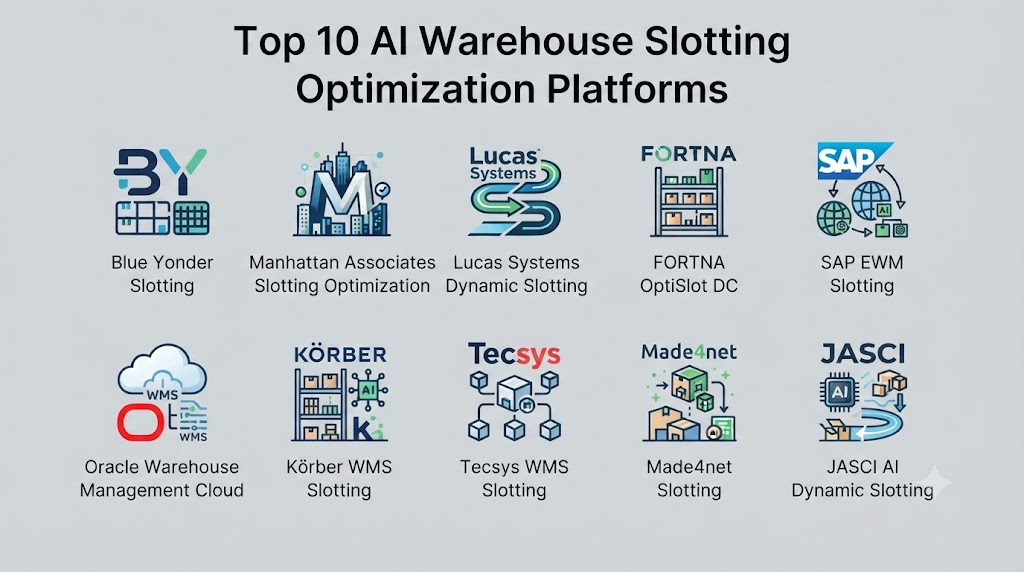
Top 10 AI Warehouse Slotting Optimization Platforms
1. Manhattan Active Warehouse Management
One-line verdict: Best for enterprises seeking warehouse management with sophisticated fulfillment, inventory, and optimization capabilities.
Short description:
Manhattan Active Warehouse Management is an enterprise warehouse management platform designed to coordinate inventory, labor, fulfillment, and warehouse operations. Its broader optimization environment makes it relevant for organizations looking to connect slotting with warehouse execution.
Standout Capabilities
- Warehouse management.
- Inventory management.
- Fulfillment optimization.
- Labor management.
- Warehouse execution.
- Order orchestration.
- Automation integration.
- Enterprise analytics.
AI-Specific Depth
- Model support: Proprietary optimization and AI capabilities; exact underlying models are not publicly stated.
- RAG / knowledge integration: N/A for core warehouse slotting.
- Evaluation: Operational KPIs and warehouse performance data can be used for evaluation.
- Guardrails: Warehouse business rules and operational permissions.
- Observability: Warehouse and fulfillment analytics vary by implementation.
Pros
- Broad enterprise warehouse capabilities.
- Strong integration potential.
- Suitable for complex fulfillment environments.
Cons
- Enterprise implementation can be complex.
- May be excessive for small warehouses.
- Slotting capabilities depend on configuration.
Security & Compliance
Enterprise security and administrative capabilities vary by deployment and contract. Specific certifications should be independently verified when required.
Deployment & Platforms
- Cloud.
- Enterprise web applications.
- Warehouse devices and integrations.
- APIs.
Integrations & Ecosystem
Manhattan can operate as part of a broader warehouse technology environment.
- ERP.
- WMS.
- WES.
- Robotics.
- Automation systems.
- Transportation systems.
- APIs.
Pricing Model
Enterprise/custom pricing; exact pricing is Not publicly stated.
Best-Fit Scenarios
- Large distribution centers.
- High-volume e-commerce.
- Complex enterprise fulfillment.
2. Blue Yonder Warehouse Management
One-line verdict: Best for large organizations connecting warehouse slotting with supply-chain planning and fulfillment optimization.
Short description:
Blue Yonder provides warehouse management and supply-chain technologies designed for large-scale logistics operations. Its broader planning ecosystem can connect warehouse decisions with demand, inventory, labor, and fulfillment requirements.
Standout Capabilities
- Warehouse management.
- Inventory optimization.
- Supply-chain planning.
- Labor optimization.
- Fulfillment management.
- Warehouse execution.
- Automation support.
- Analytics.
AI-Specific Depth
- Model support: Proprietary AI and optimization technologies; exact model architecture varies.
- RAG / knowledge integration: N/A for traditional slotting.
- Evaluation: Warehouse KPIs and operational data can be used for evaluation.
- Guardrails: Business rules and operational constraints.
- Observability: Analytics and warehouse monitoring vary by implementation.
Pros
- Broad supply-chain ecosystem.
- Strong enterprise orientation.
- Useful for connecting demand and warehouse decisions.
Cons
- Implementation can be substantial.
- Smaller organizations may not need the full platform.
- Specific slotting functionality varies by configuration.
Security & Compliance
Security and compliance capabilities depend on the product and deployment. Specific certifications should be verified directly.
Deployment & Platforms
- Cloud.
- Enterprise.
- Web.
- Warehouse systems.
- APIs.
Integrations & Ecosystem
- ERP.
- WMS.
- TMS.
- WES.
- Robotics.
- Supply-chain planning.
- APIs.
Pricing Model
Enterprise/custom pricing; exact pricing is Not publicly stated.
Best-Fit Scenarios
- Enterprise distribution networks.
- Large retailers.
- Complex supply chains.
3. SAP Extended Warehouse Management
One-line verdict: Best for SAP-centric enterprises requiring warehouse execution integrated with enterprise inventory and supply-chain processes.
Short description:
SAP Extended Warehouse Management provides warehouse management capabilities within the SAP ecosystem. Organizations can use warehouse data, inventory information, product characteristics, and operational processes as inputs to slotting and warehouse optimization workflows.
Standout Capabilities
- Warehouse management.
- Inventory management.
- Warehouse processes.
- Storage-bin management.
- Warehouse task management.
- Material-flow integration.
- Enterprise integration.
- Analytics.
AI-Specific Depth
- Model support: SAP AI and optimization capabilities vary by solution and architecture.
- RAG / knowledge integration: N/A for traditional slotting.
- Evaluation: Warehouse KPIs and operational data.
- Guardrails: SAP roles, business rules, and workflow controls.
- Observability: Enterprise monitoring and analytics vary by implementation.
Pros
- Strong SAP ecosystem integration.
- Useful for enterprise warehouse operations.
- Connects warehouse data with broader business processes.
Cons
- Best suited to organizations already invested in SAP.
- Implementation can require specialist expertise.
- Advanced AI slotting may require additional technologies.
Security & Compliance
SAP provides enterprise security and administrative capabilities, but exact controls and certifications depend on the deployment and service.
Deployment & Platforms
- Cloud.
- Enterprise.
- Web.
- Warehouse devices.
- Integrated SAP environments.
Integrations & Ecosystem
- SAP ERP.
- SAP supply-chain applications.
- Automation.
- Transportation.
- Manufacturing.
- APIs.
- Warehouse devices.
Pricing Model
Enterprise licensing and subscription structures vary.
Best-Fit Scenarios
- SAP-centric warehouses.
- Global manufacturing.
- Enterprise distribution.
4. Oracle Warehouse Management
One-line verdict: Best for enterprises that want warehouse management and optimization integrated with Oracle supply-chain applications.
Short description:
Oracle Warehouse Management supports warehouse execution, inventory, fulfillment, and operational processes. It can serve as a foundation for data-driven warehouse slotting and optimization within Oracle-centric environments.
Standout Capabilities
- Warehouse management.
- Inventory control.
- Fulfillment.
- Task management.
- Warehouse execution.
- Mobile warehouse workflows.
- Supply-chain integration.
- Analytics.
AI-Specific Depth
- Model support: Oracle AI and optimization technologies vary across products.
- RAG / knowledge integration: N/A for core slotting.
- Evaluation: Operational warehouse metrics.
- Guardrails: Roles, permissions, and warehouse business rules.
- Observability: Operational analytics vary by deployment.
Pros
- Strong Oracle integration.
- Broad enterprise functionality.
- Useful for complex warehouse environments.
Cons
- Enterprise complexity.
- Best suited to organizations within the Oracle ecosystem.
- Advanced slotting may require configuration or complementary technologies.
Security & Compliance
Security capabilities depend on Oracle product configuration and deployment. Required certifications should be verified for the specific service.
Deployment & Platforms
- Cloud.
- Enterprise.
- Web.
- Mobile warehouse applications.
- APIs.
Integrations & Ecosystem
- Oracle ERP.
- Supply-chain applications.
- Transportation.
- Automation.
- Robotics.
- APIs.
Pricing Model
Enterprise/custom pricing varies.
Best-Fit Scenarios
- Oracle-centric enterprises.
- Large warehouses.
- Integrated supply-chain operations.
5. Körber Warehouse Management
One-line verdict: Best for organizations needing flexible warehouse management and automation capabilities across complex distribution environments.
Short description:
Körber provides warehouse management and supply-chain technology supporting distribution, fulfillment, automation, and warehouse execution. Its capabilities can support data-driven slotting strategies.
Standout Capabilities
- Warehouse management.
- Inventory control.
- Order fulfillment.
- Automation integration.
- Labor workflows.
- Warehouse execution.
- Analytics.
- Distribution management.
AI-Specific Depth
- Model support: AI and optimization capabilities vary by product.
- RAG / knowledge integration: N/A.
- Evaluation: Operational warehouse metrics can support evaluation.
- Guardrails: Warehouse rules and access controls.
- Observability: Warehouse monitoring varies.
Pros
- Flexible warehouse technology portfolio.
- Automation integration.
- Suitable for complex distribution environments.
Cons
- Implementation requirements vary.
- Exact slotting capabilities depend on configuration.
- Enterprise deployments can require specialist expertise.
Security & Compliance
Security capabilities vary by product and deployment. Specific certifications should be independently verified.
Deployment & Platforms
- Cloud.
- Enterprise.
- Web.
- Warehouse devices.
- APIs.
Integrations & Ecosystem
- ERP.
- WMS.
- WES.
- Robotics.
- Automation.
- Transportation.
- APIs.
Pricing Model
Enterprise/custom pricing.
Best-Fit Scenarios
- Distribution centers.
- Automated warehouses.
- Complex fulfillment operations.
6. Tecsys Warehouse Management
One-line verdict: Best for organizations seeking warehouse management with inventory, fulfillment, and operational optimization capabilities.
Short description:
Tecsys provides warehouse and supply-chain software supporting inventory management, fulfillment, distribution, and warehouse operations. It can be relevant for organizations incorporating analytics and optimization into warehouse slotting.
Standout Capabilities
- Warehouse management.
- Inventory control.
- Distribution.
- Fulfillment.
- Labor workflows.
- Warehouse analytics.
- Supply-chain integration.
- Operational visibility.
AI-Specific Depth
- Model support: Proprietary analytics and optimization capabilities vary.
- RAG / knowledge integration: N/A.
- Evaluation: Warehouse performance metrics.
- Guardrails: Business rules and administrative permissions.
- Observability: Operational analytics vary.
Pros
- Broad warehouse functionality.
- Suitable for distribution-heavy organizations.
- Strong operational focus.
Cons
- Advanced AI slotting functionality varies.
- Implementation complexity depends on scope.
- Smaller warehouses may require fewer capabilities.
Security & Compliance
Security capabilities depend on the implementation and service. Certifications should be verified directly where required.
Deployment & Platforms
- Cloud.
- Web.
- Enterprise.
- Warehouse devices.
Integrations & Ecosystem
- ERP.
- WMS.
- Distribution systems.
- Automation.
- E-commerce.
- APIs.
Pricing Model
Enterprise/custom pricing varies.
Best-Fit Scenarios
- Distribution businesses.
- Complex inventory operations.
- Enterprise warehouses.
7. Locus
One-line verdict: Best for organizations combining supply-chain intelligence, fulfillment planning, and logistics optimization.
Short description:
Locus provides logistics technology focused on planning and optimization across delivery and supply-chain operations. Its relevance to warehouse slotting is strongest when warehouse decisions need to connect with downstream transportation and fulfillment requirements.
Standout Capabilities
- Logistics optimization.
- Supply-chain planning.
- Fulfillment workflows.
- Route optimization.
- Operational analytics.
- Decision support.
- Automation.
- Enterprise integrations.
AI-Specific Depth
- Model support: Proprietary AI and optimization technologies; exact model architecture is not publicly stated.
- RAG / knowledge integration: N/A for core warehouse slotting.
- Evaluation: Operational KPIs and optimization outcomes.
- Guardrails: Business rules and workflow controls.
- Observability: Operational analytics vary by implementation.
Pros
- Strong logistics optimization focus.
- Can connect fulfillment and transportation decisions.
- Useful for data-driven supply-chain operations.
Cons
- Not primarily a dedicated slotting application.
- Exact warehouse functionality varies.
- Enterprise integration may be required.
Security & Compliance
Security capabilities vary by product and deployment. Specific certifications should be verified when required.
Deployment & Platforms
- Cloud.
- Web.
- APIs.
- Enterprise integrations.
Integrations & Ecosystem
- WMS.
- TMS.
- ERP.
- Order management.
- Transportation.
- Analytics.
- APIs.
Pricing Model
Enterprise/custom pricing; exact pricing is Not publicly stated.
Best-Fit Scenarios
- Integrated logistics networks.
- Large fulfillment operations.
- Supply-chain optimization.
8. Manhattan Slotting Optimization
One-line verdict: Best for organizations requiring specialized warehouse slotting connected to broader Manhattan warehouse operations.
Short description:
Manhattan’s warehouse ecosystem includes functionality designed to support storage and fulfillment optimization. Slotting decisions can be connected to inventory characteristics, warehouse processes, and picking requirements.
Standout Capabilities
- SKU slotting.
- Storage optimization.
- Pick-path considerations.
- Warehouse inventory analysis.
- Fulfillment optimization.
- Warehouse execution.
- Operational analytics.
- Enterprise integration.
AI-Specific Depth
- Model support: Proprietary optimization and analytics; exact model architecture is not publicly stated.
- RAG / knowledge integration: N/A.
- Evaluation: Slotting recommendations can be measured against travel, productivity, and fulfillment KPIs.
- Guardrails: Warehouse constraints and business rules.
- Observability: Warehouse analytics vary by configuration.
Pros
- Strong warehouse specialization.
- Can connect slotting to warehouse execution.
- Appropriate for large operations.
Cons
- Enterprise implementation requirements.
- May be excessive for small warehouses.
- Exact functionality depends on deployment.
Security & Compliance
Security controls depend on the applicable Manhattan product and deployment. Specific certifications should be verified directly.
Deployment & Platforms
- Cloud.
- Enterprise.
- Web.
- Warehouse devices.
- APIs.
Integrations & Ecosystem
- ERP.
- WMS.
- WES.
- Automation.
- Robotics.
- Transportation.
- APIs.
Pricing Model
Enterprise/custom pricing.
Best-Fit Scenarios
- High-volume distribution centers.
- E-commerce fulfillment.
- Complex warehouse operations.
9. Blue Yonder Slotting Optimization
One-line verdict: Best for large warehouses connecting SKU placement decisions with demand, inventory, and fulfillment planning.
Short description:
Blue Yonder’s broader warehouse and supply-chain ecosystem provides capabilities for warehouse optimization. Slotting can be approached using inventory characteristics, demand patterns, fulfillment requirements, and warehouse constraints.
Standout Capabilities
- SKU analysis.
- Warehouse optimization.
- Demand-aware planning.
- Inventory analysis.
- Fulfillment optimization.
- Labor considerations.
- Warehouse execution.
- Supply-chain integration.
AI-Specific Depth
- Model support: Proprietary AI and optimization; exact models are not publicly stated.
- RAG / knowledge integration: N/A.
- Evaluation: Operational warehouse metrics and historical performance.
- Guardrails: Warehouse rules and enterprise permissions.
- Observability: Operational analytics vary.
Pros
- Strong supply-chain integration.
- Useful for complex inventory environments.
- Suitable for large warehouse networks.
Cons
- Enterprise implementation can be complex.
- Smaller operations may not require the full ecosystem.
- Exact slotting features vary by configuration.
Security & Compliance
Security and compliance capabilities vary by product and deployment.
Deployment & Platforms
- Cloud.
- Enterprise.
- Web.
- Warehouse systems.
Integrations & Ecosystem
- ERP.
- WMS.
- TMS.
- WES.
- Demand planning.
- Automation.
- APIs.
Pricing Model
Enterprise/custom pricing.
Best-Fit Scenarios
- Large retail warehouses.
- Enterprise distribution.
- Integrated supply-chain operations.
10. OptimoRoute
One-line verdict: Best for smaller operations wanting optimization capabilities that can complement warehouse and fulfillment planning.
Short description:
OptimoRoute is primarily known for delivery route optimization rather than dedicated warehouse slotting. It can nevertheless become relevant when organizations want to connect fulfillment planning with downstream delivery optimization.
Standout Capabilities
- Route optimization.
- Delivery scheduling.
- Driver planning.
- Delivery windows.
- Operational analytics.
- Multi-stop optimization.
- Delivery tracking.
- Fulfillment coordination.
AI-Specific Depth
- Model support: Proprietary optimization technology; exact models are not publicly stated.
- RAG / knowledge integration: N/A.
- Evaluation: Operational route and delivery KPIs.
- Guardrails: Business constraints and route rules.
- Observability: Delivery and route monitoring.
Pros
- Practical optimization platform.
- Useful downstream from warehouse planning.
- Easier to deploy than a large warehouse suite in many scenarios.
Cons
- Not a dedicated warehouse slotting platform.
- Limited direct warehouse functionality compared with WMS-centric solutions.
- Additional warehouse software may be required.
Security & Compliance
Security capabilities vary by deployment. Specific certifications should be verified where required.
Deployment & Platforms
- Cloud.
- Web.
- Mobile workflows.
- APIs.
Integrations & Ecosystem
- WMS.
- E-commerce.
- ERP.
- Delivery platforms.
- Fleet systems.
- APIs.
Pricing Model
Subscription pricing varies by plan and usage.
Best-Fit Scenarios
- Small fulfillment operations.
- Delivery-focused businesses.
- Businesses connecting warehouse and transportation optimization.
Comparison Table
| Tool Name | Best For | Deployment | Model Flexibility | Strength | Watch-Out | Public Rating |
|---|---|---|---|---|---|---|
| Manhattan Active Warehouse Management | Enterprise warehouses | Cloud | Hosted / Varies | Warehouse execution | Implementation complexity | N/A |
| Blue Yonder Warehouse Management | Supply-chain enterprises | Cloud | Hosted / Varies | Supply-chain integration | Enterprise complexity | N/A |
| SAP Extended Warehouse Management | SAP-centric organizations | Cloud / Enterprise | Hosted / Varies | SAP integration | Specialist expertise | N/A |
| Oracle Warehouse Management | Oracle-centric enterprises | Cloud / Enterprise | Hosted / Varies | Enterprise integration | Configuration complexity | N/A |
| Körber Warehouse Management | Complex distribution | Cloud / Enterprise | Hosted / Varies | Automation integration | Implementation effort | N/A |
| Tecsys Warehouse Management | Distribution operations | Cloud / Enterprise | Hosted / Varies | Warehouse functionality | AI depth varies | N/A |
| Locus | Integrated logistics | Cloud | Hosted / Varies | Logistics optimization | Not dedicated slotting | N/A |
| Manhattan Slotting Optimization | Dedicated enterprise slotting | Cloud | Hosted / Varies | Warehouse slotting | Enterprise-oriented | N/A |
| Blue Yonder Slotting Optimization | Large warehouse networks | Cloud | Hosted / Varies | Demand-aware optimization | Complex deployment | N/A |
| OptimoRoute | Smaller fulfillment operations | Cloud | Hosted / Varies | Practical optimization | Not dedicated slotting | N/A |
Scoring & Evaluation
The following scores are a comparative editorial framework rather than official vendor ratings. Actual performance should be tested against warehouse-specific data.
The weighting emphasizes core slotting capabilities, optimization quality, integration, ease of deployment, operational cost, and enterprise controls.
- Core features – 20%
- AI reliability & evaluation – 15%
- Guardrails & safety – 10%
- Integrations & ecosystem – 15%
- Ease of use – 10%
- Performance & cost controls – 15%
- Security & admin – 10%
- Support & community – 5%
| Tool | Core | Reliability/Eval | Guardrails | Integrations | Ease | Perf/Cost | Security/Admin | Support | Weighted Total |
|---|---|---|---|---|---|---|---|---|---|
| Manhattan Active Warehouse Management | 10 | 9 | 9 | 10 | 7 | 8 | 9 | 9 | 8.95 |
| Blue Yonder Warehouse Management | 10 | 9 | 9 | 10 | 7 | 8 | 9 | 9 | 8.95 |
| SAP Extended Warehouse Management | 10 | 9 | 9 | 10 | 6 | 8 | 10 | 10 | 9.00 |
| Oracle Warehouse Management | 9 | 9 | 9 | 10 | 7 | 8 | 10 | 9 | 8.90 |
| Körber Warehouse Management | 9 | 8 | 9 | 9 | 7 | 8 | 9 | 9 | 8.55 |
| Tecsys Warehouse Management | 8 | 8 | 8 | 9 | 8 | 8 | 8 | 8 | 8.15 |
| Locus | 8 | 9 | 8 | 9 | 8 | 9 | 8 | 8 | 8.45 |
| Manhattan Slotting Optimization | 10 | 9 | 9 | 10 | 7 | 8 | 9 | 9 | 8.95 |
| Blue Yonder Slotting Optimization | 10 | 9 | 9 | 10 | 7 | 8 | 9 | 9 | 8.95 |
| OptimoRoute | 5 | 8 | 8 | 8 | 9 | 9 | 8 | 8 | 7.55 |
Top 3 for Enterprise
- SAP Extended Warehouse Management — Strong choice for organizations already operating within the SAP ecosystem.
- Manhattan Active Warehouse Management — Strong for high-volume warehouse execution.
- Blue Yonder Warehouse Management — Strong for integrated supply-chain and warehouse planning.
Top 3 for SMB
- Tecsys Warehouse Management — Worth considering for growing distribution operations.
- OptimoRoute — Useful when the requirement extends from fulfillment into delivery optimization.
- Locus — Relevant for organizations seeking broader logistics optimization.
Top 3 for Developers
- Locus — Useful for organizations building integrated logistics workflows.
- Oracle Warehouse Management — Suitable for enterprise integration architectures.
- SAP Extended Warehouse Management — Strong for SAP-based technology environments.
Which AI Warehouse Slotting Optimization Platform Is Right for You?
Solo / Freelancer
Most small warehouses do not need a sophisticated AI slotting platform.
Start with:
- SKU velocity analysis.
- ABC classification.
- Spreadsheet-based slotting.
- Simple warehouse heatmaps.
- Manual review of high-volume SKUs.
A dedicated platform becomes more useful when the number of SKUs, warehouse locations, and daily orders becomes difficult to manage manually.
SMB
SMBs should prioritize usability and measurable ROI.
Look for:
- Simple data import.
- WMS integration.
- SKU velocity analysis.
- Pick-path optimization.
- Replenishment analysis.
- Warehouse visualization.
- Easy-to-understand recommendations.
- Human approval.
Avoid purchasing an enterprise warehouse suite solely because it contains AI features you may never use.
Mid-Market
Mid-market warehouses should evaluate optimization across multiple dimensions.
Important factors include:
- SKU count.
- Order-line volume.
- Number of storage locations.
- Pick density.
- Replenishment frequency.
- Labor availability.
- Seasonal demand.
- Warehouse layout.
- Automation.
- Product dimensions.
A pilot should determine whether dynamic slotting produces measurable improvements over current practices.
Enterprise
Enterprise warehouses should evaluate:
- Multi-site slotting.
- Automated re-slotting.
- Demand forecasting.
- WMS integration.
- WES integration.
- Robotics.
- Automation.
- Digital twins.
- Scenario modeling.
- Labor optimization.
- Congestion management.
- Explainability.
- Governance.
- Security.
- Data residency.
- API scalability.
The platform should also support controlled human approval for major layout changes.
Regulated Industries
Industries handling pharmaceuticals, healthcare products, food, chemicals, or other controlled inventory should consider additional constraints.
Evaluate:
- Storage requirements.
- Product segregation.
- Expiration dates.
- Batch and lot handling.
- Temperature requirements.
- Access control.
- Auditability.
- Data retention.
- Security.
- Regulatory workflows.
AI recommendations should never override mandatory storage or safety requirements.
Budget vs Premium
Budget solutions are appropriate when:
- SKU count is relatively small.
- Order volumes are predictable.
- Warehouse layouts rarely change.
- Manual slotting remains manageable.
Premium systems become more attractive when:
- Warehouses contain thousands of SKUs.
- Pick volumes are high.
- Labor is expensive.
- Demand changes rapidly.
- Product assortment changes frequently.
- Multiple warehouses must be optimized.
- Robotics are involved.
Build vs Buy
Build when:
- Your warehouse operations are highly specialized.
- You have strong engineering and data-science resources.
- Slotting is a competitive differentiator.
- You need custom optimization objectives.
- You require deep control over algorithms and data.
Buy when:
- You need faster implementation.
- Your WMS already supports integrations.
- You want vendor-managed optimization.
- Your warehouse requirements are relatively standard.
- You want support and maintenance handled externally.
A hybrid architecture can be effective: use a commercial WMS as the operational system while deploying a specialized optimization engine for advanced slotting analytics.
Implementation Playbook: 30 / 60 / 90 Days
First 30 Days: Pilot + Success Metrics
Start with one warehouse zone rather than changing the entire facility.
Collect:
- SKU master data.
- Product dimensions.
- Product weight.
- Historical orders.
- Pick frequency.
- Pick locations.
- Replenishment events.
- Storage capacity.
- Warehouse layout.
- Travel distances.
- Worker movement.
- Seasonal patterns.
Establish baseline KPIs:
- Average picker travel.
- Picks per labor hour.
- Replenishment frequency.
- Lines picked per hour.
- Order cycle time.
- Picking errors.
- Storage utilization.
- Congestion.
- Labor cost per order.
Create a controlled test set of high-volume SKUs.
Days 31–60: Security + Evaluation + Rollout
Build a slotting evaluation harness.
Test whether recommendations:
- Reduce travel.
- Improve pick productivity.
- Respect storage constraints.
- Respect product compatibility.
- Reduce replenishment.
- Improve location utilization.
- Reduce congestion.
Run simulations before physically relocating inventory.
Test special cases:
- Seasonal products.
- New SKUs.
- Slow-moving inventory.
- Large products.
- Heavy products.
- Hazardous products.
- Temperature-sensitive products.
- Expiration-sensitive inventory.
For AI-enabled systems, evaluate:
- Incorrect recommendations.
- Unsupported explanations.
- Data-quality failures.
- Unexpected optimization behavior.
- Unauthorized access.
- Prompt injection where generative AI is used.
- Incorrect automated actions.
Maintain version control for:
- Slotting rules.
- Optimization models.
- AI prompts.
- Product constraints.
- Warehouse policies.
Days 61–90: Cost, Latency + Governance
Connect the system with operational platforms:
- WMS.
- WES.
- ERP.
- Order-management system.
- Inventory system.
- Robotics.
- Warehouse control systems.
- Demand planning.
Optimize:
- Re-slotting frequency.
- Data-processing costs.
- Optimization runtime.
- API usage.
- Recommendation thresholds.
- Simulation frequency.
Establish governance for:
- Automatic recommendations.
- Human approval.
- Physical inventory movement.
- Product restrictions.
- Model changes.
- AI-generated explanations.
- Exception handling.
- Audit records.
Common Mistakes & How to Avoid Them
- Optimizing only for SKU velocity: Fast-moving products are important, but product size, weight, order relationships, and replenishment also matter.
- Ignoring product dimensions: A location that looks available may not physically accommodate the SKU.
- Ignoring replenishment: Moving a product closer to pickers can increase replenishment requirements if not modeled correctly.
- Ignoring order affinity: Frequently co-ordered products may benefit from strategic placement.
- Ignoring warehouse congestion: Putting every fast-moving SKU in the same area can create bottlenecks.
- Using outdated demand data: Slotting decisions should reflect current and expected demand.
- Ignoring seasonality: Seasonal products can require temporary placement strategies.
- Treating AI recommendations as automatically correct: Warehouse managers should validate major changes.
- Skipping simulation: Test layout changes digitally before physically moving inventory.
- Ignoring worker ergonomics: Optimization should account for safe and practical picking.
- Ignoring special storage requirements: AI should not override safety or regulatory rules.
- No baseline measurement: Without before-and-after measurements, ROI is difficult to establish.
- Ignoring WMS data quality: Bad master data can produce bad slotting recommendations.
- Optimizing one KPI: Maximum storage density may conflict with picking productivity.
- Creating vendor lock-in: Keep ownership of critical warehouse data, rules, and business logic.
FAQs
1. What is AI Warehouse Slotting Optimization?
AI Warehouse Slotting Optimization uses data, machine learning, optimization algorithms, and business rules to determine where products should be stored for better warehouse performance.
2. Why is warehouse slotting important?
Product location directly affects picker travel, replenishment frequency, congestion, productivity, and order fulfillment speed.
3. Can AI automatically decide where every SKU should go?
Some systems can generate recommendations automatically, but organizations should generally retain human approval for significant physical changes.
4. What data is required for AI slotting?
Common inputs include SKU velocity, product dimensions, weight, order history, storage capacity, location information, replenishment activity, and warehouse layout.
5. Can AI consider seasonal demand?
Yes. Historical and forecast demand can be incorporated into slotting strategies when the required data is available.
6. Can AI optimize warehouse picking paths?
Yes. Slotting and pick-path optimization can work together to reduce unnecessary picker movement.
7. Can AI reduce warehouse labor costs?
Potentially. Better product placement can reduce travel and improve picks per labor hour, but actual savings depend on warehouse conditions.
8. Can warehouse slotting AI integrate with a WMS?
Yes. WMS integration is important because the WMS typically contains inventory, location, order, and warehouse-task information.
9. Can AI work with warehouse robots?
It can, depending on the platform. Robotics can introduce additional constraints and opportunities for storage and movement optimization.
10. Does AI slotting require a digital twin?
No. Digital twins can improve simulation and scenario analysis, but they are not mandatory for every implementation.
11. Can AI optimize multiple warehouses?
Some enterprise systems can support multi-site warehouse operations, although capabilities vary significantly.
12. Can AI optimize storage density and picking efficiency simultaneously?
Yes. Multi-objective optimization can balance storage utilization, picker travel, replenishment, throughput, and other operational objectives.
13. Is warehouse slotting AI expensive?
Costs vary significantly. Enterprise platforms typically require software, integration, implementation, and potentially consulting resources.
14. Can small warehouses benefit from AI slotting?
Yes, but the business case may be weaker. Smaller warehouses should first determine whether simple analytics and rule-based slotting can solve the problem.
15. Can companies build their own slotting system?
Yes. Organizations with strong software, optimization, and data-science teams can build custom slotting engines.
16. How often should a warehouse re-slot inventory?
There is no universal schedule. The appropriate frequency depends on demand volatility, SKU turnover, warehouse capacity, labor, and operational disruption.
17. How do you measure AI slotting ROI?
Track metrics such as picker travel, picks per labor hour, replenishment frequency, order cycle time, storage utilization, congestion, errors, and labor cost.
18. Can AI explain why a product should be moved?
Modern optimization systems can provide the underlying factors and constraints behind recommendations, although the depth of explainability varies.
19. Is AI slotting suitable for regulated inventory?
It can be, but mandatory product, safety, storage, and regulatory constraints must take precedence over optimization objectives.
20. What is the difference between slotting optimization and warehouse management?
Slotting optimization focuses on product placement and storage strategy. A WMS manages a much broader range of warehouse processes, including inventory, receiving, picking, packing, and shipping.
Conclusion
AI Warehouse Slotting Optimization is becoming increasingly valuable as warehouses handle more SKUs, faster fulfillment expectations, tighter labor conditions, and increasingly automated operations.The strongest implementations do more than simply move fast-selling products closer to picking areas. They consider SKU velocity, demand forecasts, product dimensions, order relationships, replenishment, storage capacity, warehouse congestion, labor, automation, and fulfillment objectives together.For enterprise environments, platforms such as Manhattan Active Warehouse Management, Blue Yonder, SAP Extended Warehouse Management, Oracle Warehouse Management, and Körber are important options to evaluate. Tecsys can be relevant for distribution-focused organizations, while Locus can connect warehouse decisions with broader logistics optimization. OptimoRoute is more delivery-focused and is best considered when warehouse and downstream delivery planning need to work together.The best solution depends on warehouse size, SKU complexity, order volume, automation level, existing WMS, integration requirements, budget, and operational g